
Contemporary South Asia | CBSE Class 12 Political Science Notes
On this page
Try an idea before you read. Test your understanding of South Asia's geopolitics and political systems. Explore →
This note covers South Asia’s regional identity, democratic experiences, military rule in Pakistan and Bangladesh, Nepal’s transition from monarchy, ethnic conflict in Sri Lanka, India’s relations with its neighbours, regional cooperation through SAARC and SAFTA, and the influence of China and the United States.
What makes South Asia a distinct but diverse region?
Regional identity and boundaries
South Asia usually includes Bangladesh, Bhutan, India, the Maldives, Nepal, Pakistan and Sri Lanka. These countries differ in language, society, culture and political experience, yet together form a connected geopolitical space.
The Himalayas to the north and the Indian Ocean to the south give the region a degree of natural separation. The Arabian Sea lies to the west and the Bay of Bengal to the east. These geographical features have contributed to the subcontinent’s distinctive character.
The region’s eastern and western boundaries are less clearly defined than its northern and southern boundaries. Afghanistan and Myanmar are often included in wider discussions of South Asia. China influences regional politics but is not considered part of South Asia.
Note: A regional definition and an organisation’s membership need not be identical. The usual seven-country definition of South Asia can be distinguished from SAARC membership, which expanded when Afghanistan joined in 2007.
Why do rivalry and goodwill coexist?
South Asian relations combine conflict and cooperation. An India-Pakistan cricket match may generate intense rivalry, while visiting supporters also experience hospitality. The same region contains suspicion between governments and goodwill among ordinary people.
Border disputes, water sharing, insurgency, ethnic tensions and competition over resources produce conflict. At the same time, people recognise that cooperation can support development and prosperity. Domestic politics helps explain why governments pursue particular regional policies.
Studying South Asia therefore requires attention to both relations between states and struggles within states. A military takeover, a democracy movement or an ethnic conflict can affect neighbouring countries as well as the country where it begins.
How do democratic experiences differ across South Asia?
A shared aspiration with different political histories
India and Sri Lanka have sustained democratic systems since independence despite serious difficulties. Pakistan and Bangladesh have experienced both civilian and military rule. Nepal’s political struggle involved monarchy, democratic parties and Maoists. These differences prevent a single description from capturing the whole region.
Bhutan became a constitutional monarchy in 2008 and developed multi-party democracy under the king’s leadership. The Maldives changed from a Sultanate to a republic with a presidential system in 1968. Its parliament voted unanimously for a multi-party system in June 2005.
| Country | Important democratic development |
|---|---|
| Pakistan | Elected civilian leadership returned in 2008 after another period of military dominance. |
| Bangladesh | Mass protests ended Ershad’s rule in 1990; multi-party elections followed in 1991. |
| Nepal | The monarchy was abolished and a democratic republic established in 2008. |
| Bhutan | Constitutional monarchy and multi-party democracy developed in 2008. |
| Maldives | The Maldivian Democratic Party won the 2018 elections. |
What did public attitudes reveal?
A survey published in 2007 drew on interviews with more than 19,000 citizens in five South Asian countries. It found widespread support for democratic institutions among people with different incomes and religious backgrounds. This challenged the assumption that democracy attracts support only in prosperous societies.
Diagram
Preference for democracy
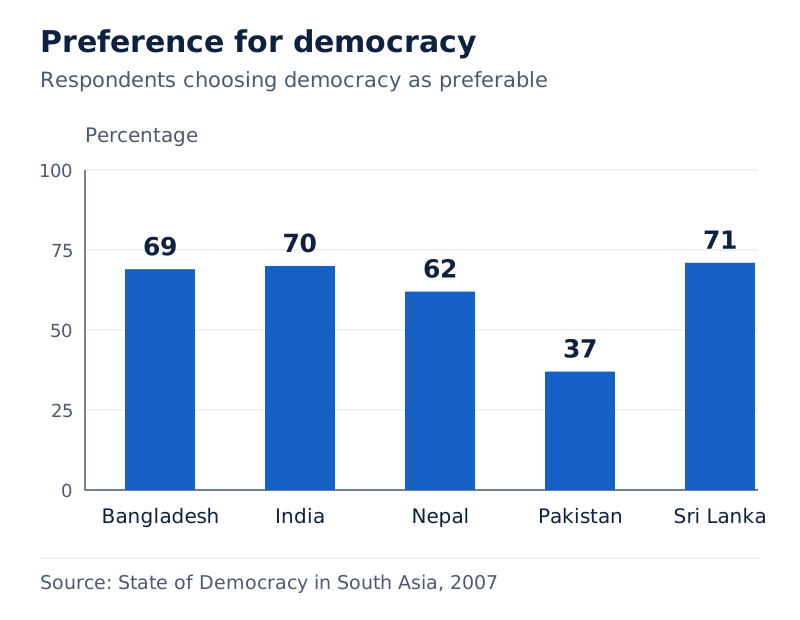
Draw five bars showing the percentage choosing democracy as preferable: Bangladesh 69, India 70, Nepal 62, Pakistan 37 and Sri Lanka 71. Label the vertical axis “Percentage” and identify the figures as survey results published in 2007.
Drawn by One Young India.
Preference and suitability are different questions. In Pakistan, 37 per cent chose democracy as preferable, while 49 per cent said the choice of political system did not matter to them. The separate suitability graph nevertheless showed broad acceptance of democracy’s suitability.
The evidence supports a careful conclusion: popular democratic aspirations can exist even where democratic government has been unstable. It does not establish that every country has had the same political system or an equally secure democratic experience.
Why has Pakistan struggled to establish stable democracy?
Repeated changes between civilian and military rule
After Pakistan framed its first constitution, General Ayub Khan took control of the administration and subsequently had himself elected. Popular dissatisfaction forced him from office. Another military ruler, General Yahya Khan, then took over.
During Yahya Khan’s rule, the Bangladesh crisis and the 1971 war with India led to East Pakistan becoming independent. Zulfikar Ali Bhutto headed an elected government from 1971 to 1977, until General Zia-ul-Haq removed it.
A pro-democracy movement challenged Zia from 1982. Elected government returned in 1988 under Benazir Bhutto. Competition subsequently centred on her Pakistan People’s Party and the Muslim League. This period ended when General Pervez Musharraf removed Nawaz Sharif in 1999.
Musharraf became President in 2001. Elections under military dominance gave the regime a democratic appearance without ending the army’s central role. Elected civilian leaders returned to government in 2008.
Social power, security arguments and external support
The military, clergy and landowning aristocracy exercised considerable social power. Their dominance weakened elected governments. Conflict with India strengthened groups arguing that military rule was necessary for national security and that political parties would endanger the country.
Such arguments treated democracy as disorderly and civilian politicians as self-interested. This helped justify the army’s continued authority. However, military dominance did not mean that Pakistani society lacked support for democracy.
A relatively free and courageous press, a strong human rights movement and repeated popular demands for representative government provided important democratic pressures. The distinction between powerful institutions and public aspirations is essential to understanding Pakistan’s experience.
International support also mattered. Western governments supported military rulers for strategic reasons. Concerns about terrorism and Pakistan’s nuclear arsenal encouraged the view that its military could protect Western interests, weakening external pressure for democratic rule.
How did Bangladesh emerge and struggle for democracy?
From East Pakistan to independence
Bangladesh formed part of Pakistan between 1947 and 1971. It included partitioned areas of Bengal and Assam. People opposed domination by western Pakistan, the imposition of Urdu and unequal treatment of Bengali language and culture.
Demands for cultural recognition were connected to demands for fair representation in administration and political power. Sheikh Mujib-ur Rahman led the struggle for autonomy. His Awami League won all East Pakistan’s seats in the 1970 elections and a majority in the proposed national constituent assembly.
The West Pakistani leadership refused to convene the assembly, and Mujib was arrested. Under Yahya Khan, military repression killed thousands and caused large-scale migration into India. India supported the independence movement financially and militarily.
The December 1971 war ended with Pakistani forces surrendering in East Pakistan and Bangladesh becoming independent. The conflict thus connected a struggle over representation within Pakistan with a refugee crisis and an international war.
Constitutional change and democratic mobilisation
- Bangladesh’s constitution initially affirmed secularism, democracy and socialism.
- In 1975, Mujib changed the parliamentary system into a presidential system and abolished all parties except the Awami League. He was assassinated in August that year.
- Military ruler Ziaur Rahman formed his own party and won elections in 1979. His assassination was followed by another military takeover under H. M. Ershad.
- Students and other citizens mobilised for democracy. Mass protests forced Ershad to step down in 1990, and elections in 1991 restored representative government based on multi-party competition.
The transition to independence did not automatically secure democratic government. Bangladesh subsequently experienced restrictions on party competition, military intervention and popular resistance. Students played a prominent part in the movement demanding democratic political activity.
Pakistan and Bangladesh therefore share experiences of military rule and democratic mobilisation. Their historical paths differ, but neither can be understood by looking only at rulers and ignoring movements within society.
How did Nepal move from monarchy to a democratic republic?
Monarchy, democrats and Maoists
Nepal was a Hindu kingdom and later a constitutional monarchy. Political parties and ordinary people demanded a more responsive government. The king retained control with military support, limiting the expansion of democracy.
A strong movement led the king to accept a new democratic constitution in 1990. Democratic governments nevertheless faced instability. During the 1990s, Maoists gained influence and pursued armed insurrection against the monarchy and ruling elite.
This produced a triangular conflict involving monarchist forces, democratic parties and Maoists. The king abolished parliament and dismissed the government in 2002, ending the limited democratic arrangement. The struggle concerned both who should govern and how political authority should be organised.
The movement of 2006 and constitutional change
In April 2006, large-scale pro-democracy protests forced the restoration of the House of Representatives. The largely non-violent movement brought together the Seven Party Alliance, Maoists and social activists. Cooperation among these forces was important despite their different political objectives.
Diagram
Nepal’s democratic transition
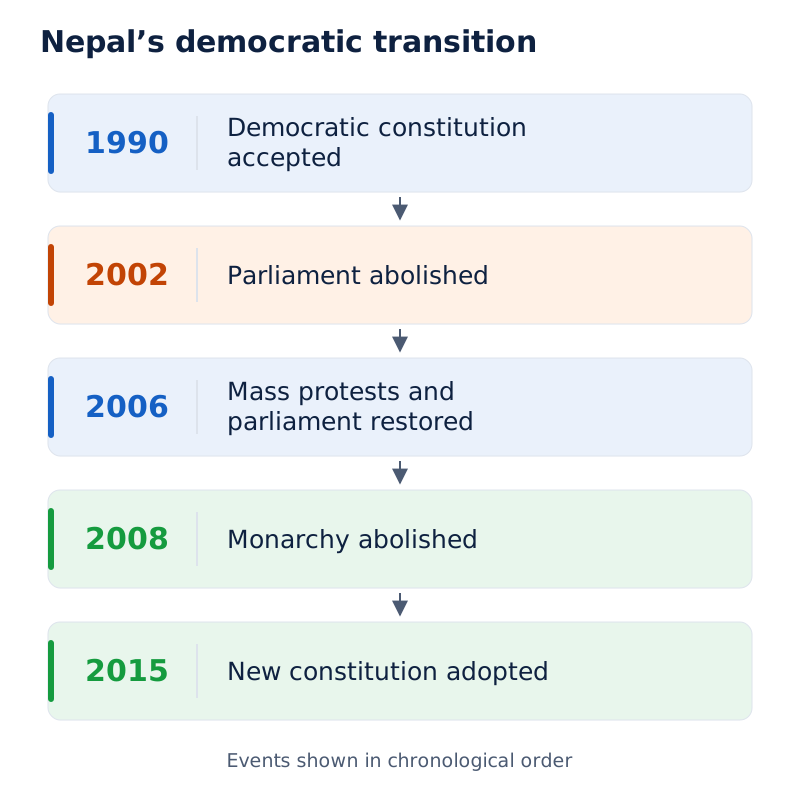
Connect five labelled boxes with arrows: democratic constitution accepted in 1990; parliament abolished in 2002; mass protests and parliament restored in 2006; monarchy abolished in 2008; new constitution adopted in 2015.
Drawn by One Young India.
A constituent assembly was formed to draft a constitution. Maoist groups agreed to suspend armed struggle but sought radical social and economic restructuring. All parties in the Seven Party Alliance did not agree with this programme.
Some groups favoured retaining a nominal monarchy as a link with the past. The Maoists and some other political groups were also deeply suspicious of the Indian government and its future role in Nepal. These disagreements show that opposition to royal rule did not remove every political difference.
Nepal abolished the monarchy and became a democratic republic in 2008. It adopted a new constitution in 2015. The transition combined mass mobilisation, negotiation among competing forces and changes in constitutional institutions.
How did ethnic conflict challenge democracy in Sri Lanka?
Majority domination and Tamil militancy
Sri Lanka became independent in 1948 and retained democratic government. Its major challenge came from ethnic conflict, rather than military rule or monarchy. Political democracy therefore coexisted with a serious struggle over inclusion and national identity.
Post-independence politics was dominated by forces representing the majority Sinhala community. Sinhala nationalists opposed concessions to Tamils and viewed the island as belonging to the Sinhala people. Neglect of Tamil concerns encouraged militant Tamil nationalism.
From 1983, the Liberation Tigers of Tamil Eelam, or LTTE, fought the Sri Lankan army for a separate Tamil country. At one stage, the LTTE controlled the northeastern part of the island. The conflict developed into prolonged armed confrontation.
India’s intervention and the outcome
Pressure from Tamils in India encouraged the Indian government to protect Tamil interests in Sri Lanka. India attempted negotiations and, in 1987, signed an accord with Sri Lanka and sent troops to stabilise relations between the government and Tamils.
The Indian Peace Keeping Force eventually fought the LTTE. Many Sri Lankans viewed India’s military presence as interference in their internal affairs. The force withdrew without achieving its objective, and the conflict continued.
International actors, including Norway and Iceland, tried to bring the warring sides into negotiations. The armed conflict ended when the LTTE was defeated in 2009. An account of the conflict must therefore include both attempted settlements and the military outcome.
Despite the war, Sri Lanka achieved considerable economic growth and high human development. It was the region’s first country to liberalise its economy and among the early developing countries to control population growth successfully.
Sri Lanka’s experience illustrates that maintaining democratic institutions does not automatically prevent ethnic conflict. Its economic and social achievements also show why the effects of war should not be used as the sole description of a country’s development.
What have been the main sources of India-Pakistan conflict?
Territory, strategic competition and mutual suspicion
Kashmir became a major dispute soon after Partition. Wars in 1947 to 1948 and 1965 failed to settle it. India’s victory in the 1971 war, which accompanied Bangladesh’s independence, also did not resolve the Kashmir issue.
Strategic rivalry extended to control of the Siachen glacier and the acquisition of arms. Nuclear weapons and missiles changed the character of the competition. In 1998, India tested nuclear weapons at Pokhran, and Pakistan conducted tests in the Chagai Hills soon afterwards.
Both governments also levelled accusations of interference. India blamed Pakistan for supporting armed militancy and terrorist attacks. Pakistan accused India and its security agencies of encouraging unrest in Sindh and Balochistan. These are competing governmental allegations and must be identified as such.
| Issue | Nature of disagreement |
|---|---|
| Kashmir | A territorial dispute that successive wars did not settle. |
| Siachen and armaments | Strategic control and competition in military capabilities. |
| Indus basin waters | Disagreements over sharing water and interpreting treaty arrangements. |
| Sir Creek | Disagreement over demarcation, linked to control of adjoining sea resources. |
Negotiation alongside conflict
India and Pakistan signed the Indus Waters Treaty in 1960 with World Bank assistance. The agreement provided an important example of cooperation despite military conflict. Some minor differences nevertheless remained over interpretation of the Indus Waters Treaty and use of river waters.
The Sir Creek dispute concerns a demarcation line in the Rann of Kutch. Although the disputed line may appear a limited issue, its settlement can affect control over marine resources. Territorial disagreements can therefore have an economic dimension.
Note: Nuclear weapons, negotiated agreements and peace initiatives do not by themselves prove that all disputes have ended. Cooperation on one issue can exist alongside unresolved conflict on another.
How do India’s relations with Bangladesh and Nepal combine cooperation and disagreement?
Bangladesh: water, borders and development
India and Bangladesh have disagreed over sharing the Ganga and Brahmaputra waters, migration, security, trade and access through territory. Indian governments raised concerns about illegal immigration, anti-Indian groups and restrictions on transit to northeastern India.
Bangladeshi governments expressed fears about Indian dominance, unfair trade and Indian interest in natural gas. They also criticised India’s approach to river waters and its alleged role in the Chittagong Hill Tracts. These concerns reflect each government’s perspective.
Cooperation developed alongside these disagreements. The two countries signed the Farakka Treaty in 1996 for sharing Ganga waters. They have cooperated in disaster management and environmental matters and exchanged certain enclaves in 2015.
Bangladesh is also important to India’s Look East policy, called Act East since 2014, which seeks connections with Southeast Asia through Myanmar. Economic links and attention to common threats offer opportunities to improve relations.
Nepal: close ties with continuing sensitivities
A treaty arrangement allows Indian and Nepalese citizens to travel to and work in the other country without visas and passports. This gives India-Nepal relations a distinctive character, although close contact has not eliminated disagreements.
India has expressed concern about Nepal’s ties with China and anti-Indian activities. Many Nepalese leaders and citizens believe the Indian government interferes in their country’s internal affairs, seeks control over water and hydroelectric resources, and restricts convenient access to the sea.
| Relationship | Cooperation | Areas of disagreement |
|---|---|---|
| India and Bangladesh | Disaster management, environmental cooperation and enclave exchange. | River waters, migration, security concerns and trade. |
| India and Nepal | Trade, scientific cooperation, electricity and shared water resources. | Trade disputes, security concerns and perceptions of interference. |
Trade, scientific cooperation, electricity generation and connected water-management arrangements have helped sustain India-Nepal ties. In both relationships, interdependence provides reasons to cooperate, while inequalities of size and power can generate suspicion.
How do India’s other neighbours reveal the region’s wider pattern?
Sri Lanka, Bhutan and the Maldives
India’s relations with Sri Lanka have been strongly affected by the island’s ethnic conflict. After the military intervention, India moved towards disengagement from Sri Lanka’s internal troubles. Economic and humanitarian cooperation nevertheless strengthened ties.
The two countries signed a free trade agreement in 1998. Indian assistance in reconstruction after the tsunami also brought them closer. Relations therefore involved both controversy over intervention and practical cooperation.
India and Bhutan have enjoyed close relations without a major bilateral conflict. Bhutan’s action against guerrillas and militants from northeastern India helped Indian security. India has also supported large hydroelectric projects and provided development aid.
In November 1988, mercenaries from Sri Lanka attacked the Maldives. At the Maldivian government’s request, the Indian air force and navy helped stop the invasion. India also contributed to the island country’s economic development, tourism and fisheries.
Why does unequal size matter?
Given India’s size and power, its smaller neighbours are bound to be suspicious of its intentions and fear regional dominance. The Indian government, in turn, often feels exploited by its neighbours and worries that their political instability may enable outside powers to gain influence in the region.
These competing perceptions help explain recurring tensions. A balanced account distinguishes a neighbour’s fear of domination from evidence that every Indian action is an attempt to dominate. The record includes disputes, negotiated arrangements, aid and development cooperation.
Not every regional conflict involves India. Nepal and Bhutan have disagreed over migration of ethnic Nepalese into Bhutan. Bangladesh and Myanmar have faced tensions concerning Rohingya migration. Bangladesh and Nepal have also differed over the future of Himalayan river waters.
South Asian conflict therefore cannot be reduced to a single rivalry. India’s central position makes it important to many relationships, but smaller states also have their own interests and disagreements with one another.
How can SAARC, SAFTA and peace initiatives strengthen cooperation?
Regional institutions and their limitations
The South Asian Association for Regional Cooperation, or SAARC, began in 1985. It provides a multilateral framework through which South Asian states can cooperate. Persistent political differences, however, have limited its success.
The South Asian Free Trade Agreement, or SAFTA, was signed in 2004 and came into effect on 1 January 2006. It aimed to lower trade tariffs and promote a free trade zone across South Asia.
| Arrangement | Role | Important date |
|---|---|---|
| SAARC | Regional organisation for cooperation through multilateral means. | Established in 1985. |
| SAFTA | Agreement intended to reduce trade barriers and encourage regional trade. | Signed in 2004; effective from 1 January 2006. |
India argues that SAFTA offers real economic benefits for all and that a region trading more freely will be able to cooperate better on political issues. Some neighbours fear that Indian commercial influence could extend into their societies and politics. Some Indian critics question SAFTA because India already has bilateral agreements with Bhutan, Nepal and Sri Lanka.
Confidence building and the role of outside powers
Confidence-building measures seek to reduce the risk of war. India-Pakistan peace efforts have included meetings between leaders, collaboration among social activists and prominent personalities, bus links and periods of increased trade and easier visas. Such openings have also faced reversals.
China and the United States influence the regional setting. China’s strategic partnership with Pakistan complicates India-China relations, even as development and globalisation have encouraged economic interaction between India and China.
American involvement expanded after the Cold War. Relations with India and Pakistan gave the United States a moderating role, while economic reforms, large markets and South Asian diasporas strengthened its interest in regional peace and security.
Outside powers can affect opportunities and tensions, but the region’s future depends primarily on its own people and governments. Cooperation requires political willingness to accommodate interests as well as institutions and agreements that enable states to work together.
Glossary
- South Asia — A geopolitical region usually comprising Bangladesh, Bhutan, India, the Maldives, Nepal, Pakistan and Sri Lanka.
- Representative democracy — A democratic arrangement in which elected representatives participate in governing, supported by institutions of political representation.
- Military rule — Government dominated by military leaders, often established through the removal of an elected civilian government.
- Constitutional monarchy — A political arrangement retaining a monarch within a constitutional system, as in Bhutan’s transition to multi-party democracy.
- Democratic republic — A democratic political order without a monarch, established in Nepal after the monarchy’s abolition in 2008.
- Constituent assembly — A body formed to draft a constitution, as during Nepal’s transition towards a democratic republic.
- Awami League — The party led by Sheikh Mujib-ur Rahman that secured an electoral majority in Pakistan’s proposed constituent assembly in 1970.
- Seven Party Alliance — The alliance of political parties that joined Maoists and social activists in Nepal’s 2006 pro-democracy movement.
- LTTE — The Liberation Tigers of Tamil Eelam, a militant organisation that fought for a separate Tamil country in Sri Lanka.
- IPKF — The Indian Peace Keeping Force sent to Sri Lanka following India’s 1987 accord with the Sri Lankan government.
- SAARC — The South Asian Association for Regional Cooperation, established in 1985 to promote cooperation through multilateral means.
- SAFTA — The South Asian Free Trade Agreement, intended to lower tariffs and encourage a free trade zone across South Asia.
- Confidence-building measures — Agreed initiatives intended to reduce the risk of war and improve trust between countries with tense relations.
Common errors and misconceptions
- Misconception: South Asian countries have identical political histories. Correct: Their experiences include sustained democratic government, military rule, monarchy and movements for democratic change.
- Misconception: Military dominance proves that people reject democracy. Correct: Pakistan and Bangladesh experienced military rule alongside strong pro-democracy movements and demands for representative institutions.
- Misconception: Nepal became a democratic republic in 1990. Correct: The king accepted a democratic constitution in 1990; the monarchy was abolished in 2008.
- Misconception: Sri Lanka’s main political struggle was against military government. Correct: It retained democratic institutions while experiencing ethnic conflict between Sinhala-dominated forces and Tamil militants.
- Misconception: SAARC and SAFTA are two names for one organisation. Correct: SAARC is a regional organisation; SAFTA is a free trade agreement signed in 2004.
- Misconception: Every South Asian dispute involves India. Correct: Other disputes include Nepal-Bhutan tensions over migration and Bangladesh-Nepal differences over Himalayan river waters.
- Misconception: Signing an agreement guarantees lasting peace. Correct: Agreements and cooperation can coexist with political suspicion, unresolved disputes and reversals in relations.
Exam-style questions with model answers
Q1. SAARC began in 1985 as a regional organisation for multilateral cooperation. SAFTA was signed in 2004 to lower trade tariffs and came into effect on 1 January 2006. Using this information, distinguish SAARC from SAFTA. [2 marks]
- SAARC is a regional organisation established in 1985 to promote cooperation among South Asian states.
- SAFTA is a trade agreement signed in 2004, effective from 1 January 2006, that aims to lower tariffs.
Q2. A survey published in 2007 found support for democracy across different incomes and religions in five South Asian countries. Pakistan and Bangladesh had experienced military rule alongside pro-democracy movements. What do these facts show about democracy in the region? [2 marks]
- Support for democracy extends across different social groups and is not confined to prosperous citizens.
- Unstable democratic government does not imply an absence of democratic aspirations: popular movements can challenge military rule.
Q3. In Pakistan, the military, clergy and landowning aristocracy held social power. Conflict with India strengthened groups claiming military rule protected national security. Western governments supported military regimes for strategic reasons. Explain three obstacles to stable democracy using these facts. [3 marks]
- The social dominance of the military, clergy and landowning aristocracy weakened civilian institutions and made elected governments vulnerable to overthrow.
- Conflict with India enabled pro-military groups to portray civilian politics as a security risk and present army rule as necessary.
- Western support for military regimes reduced external pressure for democratic government, allowing strategic considerations to take precedence over support for elected rule.
Q4. In 1970, Mujib’s Awami League won all East Pakistan’s seats and a majority in Pakistan’s proposed constituent assembly. West Pakistani leaders refused to convene it. Mujib was arrested; military repression caused large-scale migration to India. India supported independence financially and militarily. The December 1971 war ended with Pakistani forces surrendering in East Pakistan and Bangladesh becoming independent. Explain the sequence leading to Bangladesh’s independence. [4 marks]
- The Awami League’s electoral majority gave the demand for political representation a clear democratic basis, but the refusal to convene the assembly blocked its expression.
- Mujib’s arrest and military repression intensified the conflict and pushed large numbers of people into India.
- The resulting refugee crisis connected developments in East Pakistan with India, which supported the independence movement financially and militarily.
- The December 1971 war ended with Pakistani forces surrendering in East Pakistan and Bangladesh emerging as an independent country.
Q5. Nepal’s king accepted a democratic constitution in 1990, but governments remained unstable. Maoists pursued armed struggle while the king retained military support. In 2002 he abolished parliament. In April 2006, the Seven Party Alliance, Maoists and social activists led mass protests that restored parliament. Maoists suspended armed struggle, though parties differed over radical restructuring. The monarchy ended and Nepal became a democratic republic in 2008; a new constitution followed in 2015. Explain Nepal’s democratic transition and its difficulties. [6 marks]
- The 1990 constitutional change opened democratic possibilities, but unstable governments and continued royal power prevented a secure democratic settlement.
- Armed Maoist opposition and the king’s military backing produced conflict involving monarchists, democrats and Maoists, rather than a simple contest between two unified sides.
- Abolishing parliament in 2002 removed the limited democratic arrangement and intensified the struggle over political authority.
- The broad movement of April 2006 forced parliament’s restoration. Cooperation among the Seven Party Alliance, Maoists and social activists was central to this achievement.
- Suspension of armed struggle assisted the transition, but disagreements about radical restructuring showed that the opposition did not share every objective.
- Abolition of monarchy in 2008 and the new constitution in 2015 marked major institutional stages in establishing a democratic republic.
Q6. Sri Lanka retained democratic government after independence in 1948. Sinhala-dominated politics neglected Tamil concerns; the LTTE pursued a separate Tamil country through armed struggle from 1983. India signed an accord and sent troops in 1987, but its force fought the LTTE and withdrew without achieving its objective. Norway and Iceland encouraged negotiations. The LTTE was defeated in 2009. Explain the conflict, outside involvement and outcome using this account. [6 marks]
- Sri Lanka’s challenge arose within an existing democratic system. Continued democratic institutions did not prevent exclusion or conflict over ethnic identity.
- The neglect of Tamil concerns under Sinhala-dominated politics contributed to militant Tamil nationalism and demands for a separate country.
- From 1983, the LTTE’s armed struggle turned the political dispute into sustained military confrontation over the proposed Tamil country.
- India’s 1987 accord and troop deployment aimed to stabilise relations between the Sri Lankan government and Tamils. The Indian force subsequently fought the LTTE and withdrew without achieving its objective.
- Norway and Iceland pursued a different form of outside involvement by encouraging negotiations between the opposing sides.
- The armed conflict ended with the LTTE’s defeat in 2009, rather than through the successful completion of India’s earlier military mission.
Q7. India and Bangladesh have disagreed over Ganga and Brahmaputra water sharing, migration and trade. They have also cooperated in disaster management and environmental matters and exchanged certain enclaves in 2015. Explain why their relationship cannot be described as entirely hostile, identifying two disagreements and two areas of cooperation. [4 marks]
- Sharing the waters of the Ganga and Brahmaputra has been a source of disagreement between the two governments.
- Migration has also caused tensions, showing that relations involve concerns beyond river resources.
- Cooperation in disaster management demonstrates that the countries can work together on shared practical needs.
- Environmental cooperation provides another common interest. Together, these examples show that disagreements and cooperation coexist; an entirely hostile description would overlook important parts of the relationship.
Q8. SAARC offers multilateral cooperation, but political differences restrict its success. SAFTA aims to lower tariffs; India expects economic benefits for all and better political cooperation. Some neighbours fear Indian commercial dominance. China’s partnership with Pakistan complicates India-China ties. US involvement reflects relations with India and Pakistan, regional markets and South Asian diasporas. Assess the opportunities and limits of regional cooperation from these facts. [6 marks]
- SAARC provides a shared institutional framework, allowing states to pursue cooperation through multilateral discussion rather than relying entirely on separate bilateral contacts.
- SAFTA offers an economic opportunity by seeking lower tariffs. India expects freer trade to benefit all regional economies and enable better political cooperation.
- Persistent political differences limit what regional institutions can achieve. Creating an organisation does not automatically remove disputes between its members.
- Fears of Indian commercial dominance show that smaller neighbours may assess regional trade through concerns about unequal power and influence.
- China’s partnership with Pakistan affects India-China relations, demonstrating that outside strategic relationships can complicate cooperation within the region.
- US ties, market interests and diaspora connections give it a stake in regional relations, but these external interests cannot by themselves settle the political differences constraining cooperation.
Key takeaways
- South Asia combines substantial linguistic, social and political diversity with geographical connections and a shared regional setting.
- Democratic aspirations have survived military rule, constitutional instability and monarchy, although national democratic experiences differ considerably.
- Pakistan’s repeated military interventions reflected domestic concentrations of power, security arguments and international strategic support.
- Bangladesh’s independence followed conflict over language, representation and autonomy, while its later politics included struggles against military rule.
- Nepal’s mass movements and constitutional changes culminated in the abolition of monarchy in 2008 and a new constitution in 2015.
- Sri Lanka retained democracy during ethnic conflict, showing that democratic institutions alone do not guarantee political inclusion.
- India’s neighbourhood relationships combine disagreements over security and resources with trade, development assistance and negotiated cooperation.
- SAARC and SAFTA offer opportunities for regional cooperation, but political distrust and fears of unequal influence constrain progress.
Test yourself
Which seven countries are usually included in South Asia?
They are Bangladesh, Bhutan, India, the Maldives, Nepal, Pakistan and Sri Lanka.
Why should popular attitudes be distinguished from the political system in power?
A country may experience military rule while citizens, political groups and social movements continue to support democracy.
What made the refusal to convene Pakistan’s proposed constituent assembly significant after the 1970 elections?
The Awami League had secured a majority, so refusal to convene the assembly blocked its electoral claim to political representation.
Which forces led Nepal’s largely non-violent movement in April 2006?
The Seven Party Alliance, Maoists and social activists led the movement that forced restoration of the House of Representatives.
What did the LTTE seek, and when did the armed conflict end?
The LTTE sought a separate Tamil country in Sri Lanka. The armed conflict ended with its defeat in 2009.
Why is the Sir Creek dispute connected with economic interests?
The demarcation line can affect control over sea resources in the area adjoining Sir Creek.
How do the dates of SAARC’s establishment and SAFTA’s operation differ?
SAARC began in 1985. SAFTA was signed in 2004 and came into effect on 1 January 2006.
Why can an account of South Asian politics not ignore outside powers?
China’s strategic links and American political and economic involvement influence regional relationships, although regional people and governments remain central.
Try it
Contemporary South Asia | Class 12 Political Science
Test your understanding of South Asia's geopolitics and political systems.
1Which country is described in the text as an "important player" in the region but NOT considered part of South Asia?
Afghanistan is frequently included when South Asia is discussed as a whole, according to the text.
The text explicitly states: "China is also an important player in the region, but it is not considered a part of South Asia."
The text mentions Myanmar is "frequently included" when the region is discussed as a whole.
2According to the text, what factor has "repeatedly led to the overthrow of elected governments" in Pakistan?
While Sri Lanka faced bankruptcy, the text links Pakistan's coups to social power structures, not economic factors.
The text states: "The social dominance of the military, the clergy and the landowning aristocracy has repeatedly led to the overthrow of elected governments and the setting up of military governments."
The text mentions conflict with India (not Bangladesh) as a factor that strengthened pro-military groups in Pakistan.