
International Organisations | CBSE Class 12 Political Science Notes
On this page
Watch & explore
Start with a few high-quality watches, then dive into the notes below.
Try an idea before you read. Test your understanding of the UN system through these practical scenarios. Explore →
This note covers international cooperation, the origins and principal organs of the United Nations, Security Council membership and the veto, proposals for UN reform, India’s position, the UN in a unipolar world, international economic institutions, nuclear cooperation and human rights organisations.
Why do countries need international organisations?
Cooperation without a world government
An international organisation comes into existence when states agree to create it. It responds to states and helps them address shared problems. It is not a super-state exercising authority over all its members. Its usefulness depends on cooperation among the countries that created it.
Countries have disagreements, but disagreement need not lead to war. International organisations provide opportunities to discuss contentious issues and seek peaceful solutions. The United Nations, or UN, helps countries deal with war and peace while also working towards better living conditions.
Definition: International organisations are institutions created by agreement among states to help them cooperate and resolve common problems, including disputes that might otherwise become conflicts.
Why is recognising a problem insufficient?
Some problems require countries to act together. The eradication of certain diseases needs cooperation in vaccinating populations. Global warming also demands joint action, particularly by major industrial powers. Addressing its causes can be more effective than each country separately responding to its effects.
Recognition of a common need does not automatically produce cooperation. Governments may disagree about methods, the division of costs and the distribution of benefits. They may also fear that another state will accept an agreement and then fail to honour it.
| Obstacle to cooperation | How an international organisation helps |
|---|---|
| Disagreement over the best approach | Provides a forum for discussion and ideas about joint action. |
| Disagreement over costs and benefits | Provides rules and mechanisms that support fair sharing. |
| Fear that others will break an agreement | Provides an administrative framework that builds confidence in commitments. |
International organisations therefore matter even when they cannot solve every problem. Discussion, agreed rules and administrative support can reduce the obstacles to collective action. Their value lies partly in making peaceful cooperation possible where separate national responses would be inadequate.
How did the United Nations develop after the world wars?
From the League of Nations to the UN
The First World War encouraged efforts to create an organisation that could prevent further conflict. The resulting League of Nations achieved some initial success but could not prevent the Second World War of 1939 to 1945. The UN emerged as its successor.
The UN was established in 1945, immediately after the Second World War. Its purpose was to prevent international conflict and encourage cooperation. It aimed to stop disagreements escalating into war and, where war occurred, to limit the extent of hostilities.
Its objectives also included social and economic development. Since conflicts often arose from a lack of social and economic development, countries needed to cooperate in improving living conditions. Peace and development were therefore connected parts of the organisation’s purpose.
Which events led to its foundation?
| Date | Development |
|---|---|
| August 1941 | Franklin D. Roosevelt and Winston S. Churchill signed the Atlantic Charter. |
| January 1942 | Twenty-six Allied nations supported the Atlantic Charter and signed the Declaration by United Nations. |
| February 1945 | The Yalta Conference decided to organise a conference on the proposed world organisation. |
| 26 June 1945 | Fifty nations signed the UN Charter; Poland signed later, bringing the founding membership to 51. |
| 24 October 1945 | The UN was founded; this date is celebrated as UN Day. |
| 30 October 1945 | India joined the UN. |
The UN Charter provided the basis for the organisation. Distinguish the signing of the Charter from the date of the UN’s foundation: they were separate events. By 2011, membership had reached 193 states, including almost all independent countries.
What the figure shows
UN emblem
The emblem shows a world map surrounded by olive branches. The branches signify world peace.
Reference: NCERT Class 12, page 45
What are the principal organs and functions of the UN?
Different institutions perform different tasks
The UN system includes principal organs, programmes, funds and specialised agencies. The General Assembly and Security Council both discuss questions of war, peace and differences among states. Other institutions deal with administration, international disputes, and social and economic concerns.
| Principal organ | Composition or role |
|---|---|
| General Assembly | Includes representatives of all member states, each with one vote; debates and discusses global issues. |
| Security Council | Has five permanent and ten non-permanent members; works for international peace and security. |
| Economic and Social Council | Deals with economic and social welfare; its 54 seats are filled through General Assembly elections for overlapping three-year terms. |
| International Court of Justice | Resolves disputes between member countries; based in The Hague, with 15 judges elected for nine-year terms. |
| Secretariat | Provides administration and coordination through international staff; headed by the Secretary-General. |
| Trusteeship Council | Suspended operations on 1 November 1994 following the independence of Palau, the last UN trust territory. |
How do their powers differ?
The General Assembly provides broad representation. Its major decisions require a two-thirds majority, while other decisions require a simple majority. Its decisions are not binding on UN members. The Security Council’s decisions, by contrast, are binding on members.
The International Court of Justice’s judges are elected through absolute majorities in both the General Assembly and Security Council. Judicial settlement is a different function from the Security Council’s responsibility for peace and security or the Secretariat’s administrative work.
The Secretary-General is the UN’s representative head and most visible public figure. The General Assembly appoints the Secretary-General on the Security Council’s recommendation for a renewable five-year term. António Guterres took office as the ninth Secretary-General on 1 January 2017.
What the figure shows
Principal organs of the UN system
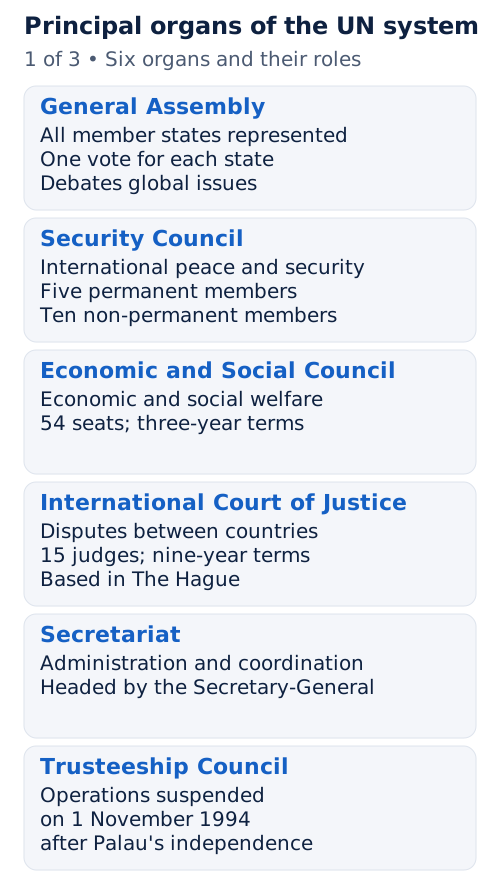
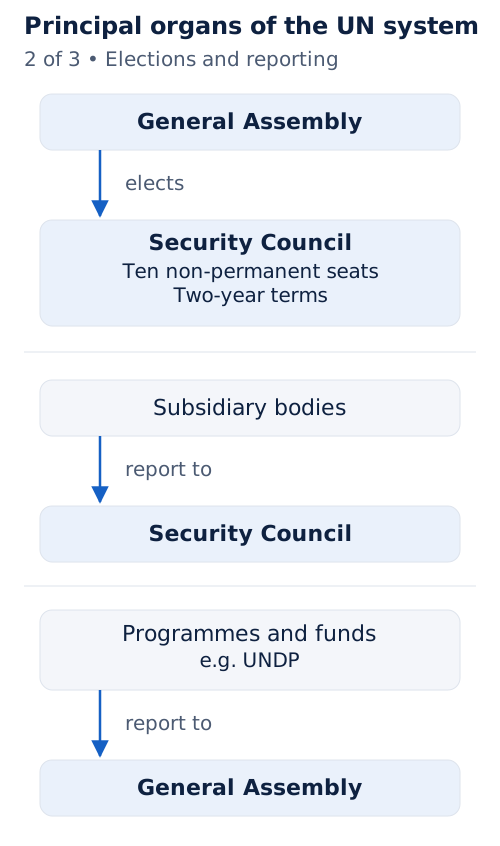
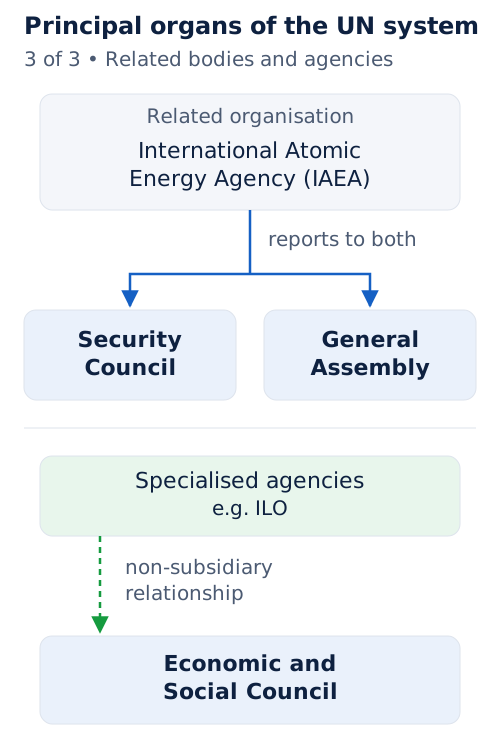
The chart places the six principal organs in separate boxes. Arrows connect them with one another and with boxes for subsidiary bodies, programmes, funds, related organisations and specialised agencies.
Drawn by One Young India. Reference: NCERT Class 12, page 49
Knowing the separate roles prevents a common confusion: membership of the UN does not give a state identical authority in every organ. Broad participation in the General Assembly coexists with the special powers of permanent Security Council members.
How do Security Council membership and the veto work?
Permanent and non-permanent membership
The Security Council has 15 members. Five are permanent: the United States, Russia, the United Kingdom, France and China. Their position reflects the power of the victorious states immediately after the Second World War. Ten other members hold non-permanent seats.
The permanent members possess two major privileges: permanency and veto power. Non-permanent members serve for two years and cannot be re-elected immediately after completing that term. Their election provides representation for the world’s continents.
How does non-permanent membership rotate?
- The General Assembly elects countries to the Council’s non-permanent seats.
- The elected countries serve two-year terms, taking part in the Council’s work without possessing a veto.
- When their terms end, they give way to newly elected members.
- A country completing its term cannot be re-elected immediately, so it cannot simply continue through immediate re-election.
Why is a veto different from an ordinary vote?
All Council members have one vote, but their voting powers are unequal. A veto is a permanent member’s negative vote that can block a decision, even when the other members support it. It is a power to prevent a decision, not a power to secure approval alone.
| Feature | Permanent members | Non-permanent members |
|---|---|---|
| Number | Five | Ten |
| Membership | Permanent position | Two-year elected term |
| Veto | Possess veto power | Do not possess veto power |
Critics see the veto as inconsistent with sovereign equality and democracy. Yet removing it is difficult because permanent members are unlikely to agree. There is also concern that powerful countries might lose interest in the UN and act outside it, weakening the organisation.
Note: One vote for each member does not mean equal effective power. The veto gives the permanent members a special ability to block decisions that non-permanent members do not share.
Why did demands for UN reform grow after the Cold War?
A changed international setting
The UN’s original structure reflected the world of 1945. The end of the Cold War changed that setting. The Soviet Union collapsed, the United States emerged as the strongest power, and new states entered the UN after independence from former communist political structures.
The post-Cold War setting also involved China’s emergence as a major power, India’s growth and the rapid expansion of Asian economies. These developments strengthened demands for institutions that represented a wider range of countries and interests.
New challenges included genocide, civil war, ethnic conflict, terrorism, nuclear proliferation, climate change, environmental degradation and epidemics. Reform concerned both the UN’s ability to respond and the fairness of the way its decisions were made.
What are the two broad areas of reform?
| Area | Central question | Examples of proposals |
|---|---|---|
| Structures and processes | How should the organisation be composed and operate? | Expand Security Council membership; improve budgetary procedures and administration. |
| Jurisdiction | Which issues should receive its attention? | Strengthen peace and security missions or confine the UN’s role to development and humanitarian work. |
Agreement that reform is necessary does not establish agreement over its content. States differ over what should change, how change should occur and when it should happen. Representation, effectiveness and the interests of existing members can pull reform proposals in different directions.
In 1992, a General Assembly resolution reflected complaints that the Security Council failed to represent contemporary realities, that its decisions reflected only Western values and interests and were dominated by a few powers, and that it lacked equitable representation. On 1 January 1997, Secretary-General Kofi Annan initiated an inquiry into UN reform.
Security Council reform became the most prominent structural issue, but it did not exhaust the reform agenda. Better administration and decisions about the organisation’s responsibilities remained separate questions that changing the membership alone could not settle.
Why is choosing new Security Council members difficult?
Proposed criteria for membership
Proposals for new permanent and non-permanent members use several different standards. Some stress the ability to contribute resources; others emphasise democratic credentials or fair representation. None automatically produces a list acceptable to all governments.
| Proposed criterion | Difficulty in applying it |
|---|---|
| Major economic power | There is disagreement about how large an economy must be to qualify. |
| Major military power | The required level of military strength is disputed. |
| Substantial UN budget contribution | Financial influence raises the question of whether membership can be bought. |
| Large population | States disagree about whether population size makes a country more effective internationally. |
| Respect for democracy and human rights | A good record does not necessarily settle whether a state would be effective on the Council. |
| Representation of global diversity | Geography, economic systems and culture provide different ways to judge diversity. |
What does equitable representation mean?
Equitable representation is not a single, self-explanatory formula. A geographical approach raises questions about seats for continents, regions or sub-regions. Proposals for greater representation from Asia, Africa and South America attempt to address imbalances, but do not resolve every disagreement.
An economic approach might favour more seats for developing countries. Yet these countries differ greatly in their levels of development. It remains difficult to decide which states could represent such a varied group or how its seats should be distributed.
A cultural approach creates another problem. Countries often contain several cultural streams within their borders. Dividing the world into distinct cultures or civilisations is therefore complicated, and governments may disagree about which categories deserve separate representation.
States assess each criterion partly through their own interests and ambitions. Even countries that do not seek seats can object to the principles used to allocate them. Consequently, broad support for a more representative Council can coexist with resistance to particular candidates.
Note: These are proposed criteria for reform. They are not an agreed checklist that automatically entitles a country to permanent membership.
How does reform of UN jurisdiction extend beyond membership?
The reform agenda discussed in 2005
Jurisdiction concerns the issues and responsibilities within the UN’s scope. It asks what the organisation should do, rather than simply which countries should hold its seats. Humanitarian protection, peacebuilding, development and democracy all raise questions about the extent of international action.
In September 2005, leaders met for the UN’s sixtieth anniversary and reviewed its role. They agreed on a range of steps intended to make the organisation more relevant to a changing world.
- Create a Peacebuilding Commission.
- Accept international responsibility when national governments fail to protect citizens from atrocities.
- Establish a Human Rights Council, which became operational on 19 June 2006.
- Work towards the Millennium Development Goals.
- Condemn terrorism in all its forms and manifestations.
- Create a Democracy Fund.
- Agree to wind up the Trusteeship Council.
Why do these proposals remain contentious?
A Peacebuilding Commission raises questions about which conflicts require attention and whether intervention in every conflict is possible or desirable. Accepting responsibility to protect people from atrocities also leaves difficult choices about who should determine when international action is needed.
Human rights protection requires decisions about the seriousness of violations and the appropriate response. Development goals raise questions about what is achievable where many countries still face development challenges. Agreement on condemning terrorism does not necessarily produce agreement on its definition.
Promoting democracy through an international fund also raises questions about how the money should be used. These disputes show why jurisdictional reform involves political judgement and disagreement, even where governments share broad objectives.
The proposal to wind up the Trusteeship Council must be distinguished from its earlier suspension of operations. A proposed institutional change and an already completed operational change are different facts. Similarly, changing Security Council seats would not by itself answer the questions about humanitarian action.
Why does India support UN reform and seek a permanent seat?
India’s argument for a more representative UN
India supports a strengthened and revitalised UN. It regards development as essential to international peace and security and favours a stronger UN role in promoting cooperation among states. Its reform position therefore extends beyond its own claim to membership.
India argues that the General Assembly has expanded substantially while Security Council membership has remained largely static. The Council grew from 11 to 15 members in 1965, but the number of permanent members did not change.
The overwhelming majority of General Assembly members are developing countries. India argues that they should help shape Security Council decisions affecting them. Greater representation can increase political support for the Council’s work, while a broader base can strengthen its representative character.
India therefore supports an increase in both permanent and non-permanent membership. The aim is not merely to enlarge the Council numerically, but to make its composition better reflect the wider international community, particularly developing countries.
What supports India’s candidature?
- Population and democracy: India’s very large population and position as the world’s largest democracy support its representative claim.
- UN participation: India has participated in virtually all UN initiatives and has a long, substantial record in peacekeeping.
- Economic emergence: Its economic emergence perhaps justifies its claim to a permanent seat in the Security Council.
- Financial contributions: India has regularly contributed financially to the UN and maintained its payments.
Permanent membership also has symbolic importance. Recognition as a major power can strengthen a country’s influence and assist the conduct of its foreign policy. India’s bid combines this status consideration with arguments about representation and contributions.
Why does the claim face opposition?
Pakistan is reluctant to support India’s permanent membership. Some countries are concerned about India’s nuclear weapons capabilities; others think its difficulties with Pakistan would make it ineffective as a permanent member. Still others oppose accommodating additional emerging powers such as Brazil, Germany, Japan and perhaps even South Africa if India is admitted.
There are also demands for permanent representation from Africa and South America. These competing expectations mean that a strong individual claim does not automatically produce an agreed reform package. India’s candidature is part of a wider dispute over representation, power and the distribution of privileges.
What can the UN achieve in a unipolar world?
Limits imposed by unequal power
A unipolar world is one dominated by a single superpower. After the Soviet Union’s collapse, the United States occupied this position. The debate about UN reform included the question of whether the organisation could restrain US dominance or sustain meaningful dialogue with it.
In that setting, US military and economic power made it difficult to check American actions. A powerful state could ignore the UN, while also exercising considerable influence within the organisation. International institutions did not erase the inequalities among their members.
The United States’ financial contribution, the location of the UN within US territory, and the presence of US nationals in its bureaucracy supplied sources of influence. Its veto could block decisions opposed to its interests or those of its allies.
The veto and broader American power also gave Washington considerable influence over the choice of Secretary-General. Other countries were rarely united in opposition, further limiting the possibility that the UN could act as an effective balance to US power.
Why does dialogue still matter?
The UN nevertheless provided an arena where the United States and other countries could discuss disputes, development and international cooperation. Criticism of US policies could be heard there, and discussion could help shape compromises and concessions.
There is a difference between balancing a superpower and influencing its behaviour through discussion. The UN’s inability to impose an effective counterweight did not mean that its forums had no political value. Even powerful countries could find cooperation through the organisation useful.
Growing interdependence strengthens the need for international organisations. Societies and issues are increasingly connected, and technology can deepen these connections. An imperfect UN can still help countries manage their common problems and pursue both national and international interests.
The central judgement is therefore balanced: the UN has important limitations, yet abandoning it would remove a valuable space for peaceful negotiation and collective action. Its continuing relevance rests on these practical functions rather than an ability to control every state.
How do the IMF, World Bank and WTO differ?
Finance, development and trade
International cooperation extends beyond peace and security. Financial regulation, development and trade involve institutions with different responsibilities. Distinguishing the IMF, World Bank and WTO prevents the mistaken assumption that they perform the same economic function.
| Institution | Main work | Issue of power or criticism |
|---|---|---|
| International Monetary Fund | Oversees financial institutions and regulations operating internationally. | Member countries do not enjoy equal voting influence. |
| World Bank | Supports development through loans and grants to member countries. | Criticised for stringent conditions and influence over poorer countries’ economic agendas. |
| World Trade Organisation | Sets rules for global trade. | Developing countries complain about non-transparent procedures and pressure from major economic powers. |
What do their activities reveal?
The International Monetary Fund deals with the international financial system. Its members have unequal voting shares. This contrasts with the General Assembly’s rule of one vote per member and illustrates how different institutions distribute decision-making authority differently.
The World Bank was created in 1944, during the Second World War. Its work focuses on developing countries and includes education, health, agriculture, rural services, environmental protection, infrastructure and governance.
Loans and grants give the World Bank substantial influence over economic policy. The World Bank is often criticised for setting poorer nations’ economic agendas, attaching stringent conditions to loans and forcing free-market reforms. Assistance and influence therefore need to be considered together when assessing its role.
The World Trade Organisation was established in 1995 as the successor to GATT. Its decisions are taken unanimously, but major economic powers such as the United States, the European Union and Japan have used it to advance their interests.
Formal agreement does not necessarily remove inequalities in bargaining power. Developing countries’ complaints concern how trade rules are framed and how negotiations operate. The broader issue is whether international economic institutions provide cooperation on terms that members regard as fair.
These institutions illustrate different dimensions of the same problem: countries need shared arrangements, but the rules governing those arrangements can reflect unequal resources and influence. Evaluating an organisation requires attention to both its purpose and its decision-making practices.
How do UN agencies and the IAEA address specialised concerns?
Health, development and humanitarian work
The UN’s work involves many specialised agencies, programmes and offices. Social and economic problems require institutions with different responsibilities. The range of bodies within the UN system demonstrates why international cooperation cannot be reduced to Security Council debates.
| Body | Area identified by its role or name |
|---|---|
| World Health Organisation, WHO | Good health for all. |
| United Nations Development Programme, UNDP | Development. |
| United Nations Children’s Fund, UNICEF | Children. |
| United Nations Educational, Scientific and Cultural Organisation, UNESCO | Education, science and culture. |
| UN High Commissioner for Refugees, UNHCR | Refugees, including shelter and medical help during emergencies. |
| International Labour Organisation, ILO | A specialised agency of the UN system. |
What is the IAEA’s role?
The International Atomic Energy Agency, or IAEA, was established in 1957 to implement US President Dwight Eisenhower’s Atoms for Peace proposal. Its purpose connects the peaceful use of nuclear energy with efforts to prevent its military use.
IAEA teams inspect nuclear facilities to check that civilian reactors are not used for military purposes. This inspection role distinguishes the agency from bodies concerned with trade, development finance or general humanitarian assistance.
The IAEA’s work illustrates a particular difficulty in international cooperation: a technology can have civilian uses while also raising military concerns. Agreed oversight helps address the relationship between peaceful applications and the risks associated with military use.
The different bodies should be identified accurately. A specialised agency, a programme and a principal UN organ are not interchangeable categories. For example, the Security Council is a principal organ, while the ILO is a specialised agency and UNDP is a programme.
How do international human rights NGOs influence world politics?
Amnesty International
Amnesty International is a non-governmental organisation, or NGO, campaigning for human rights worldwide. It promotes respect for the rights contained in the Universal Declaration of Human Rights and treats these rights as interdependent and indivisible.
It prepares and publishes reports on human rights. A major focus is misconduct by government authorities, so governments may object to its findings. Nevertheless, such reports contribute to research and advocacy by drawing attention to abuses and supporting demands for protection.
Human Rights Watch
Human Rights Watch is another international NGO engaged in human rights research and advocacy. It draws the attention of global media to abuses, helping bring matters that governments may prefer to avoid into wider public discussion.
It has helped build international coalitions campaigning to ban landmines, stop the use of child soldiers and establish the International Criminal Court. These examples show how organised campaigning can connect research on abuses with demands for international action.
| Organisation | Distinctive work |
|---|---|
| Amnesty International | Campaigns for rights in the Universal Declaration of Human Rights and publishes reports on violations. |
| Human Rights Watch | Uses research, advocacy, media attention and international coalitions to address abuses. |
Both organisations must be distinguished from intergovernmental institutions and UN organs. Their influence comes through research, publicity, advocacy and campaigning. They show that international politics includes organised non-governmental activity as well as negotiations among states.
Human rights reporting can make governments uncomfortable precisely because it examines their conduct. Criticism from a government therefore does not, by itself, explain away the importance of such work. The reports and campaigns provide material for public scrutiny and international debate.
Glossary
- International organisation — An institution created by agreement among states to support cooperation and help resolve shared problems.
- UN Charter — The founding agreement through which states established the United Nations and its institutional framework.
- General Assembly — The UN organ representing all member states, with one vote for each member.
- Security Council — The UN organ concerned with international peace and security, comprising permanent and non-permanent members.
- Veto — A permanent Security Council member’s negative vote that can block a decision supported by other members.
- Secretary-General — The UN’s representative head, who leads the Secretariat and is its most visible public figure.
- Jurisdiction — The range of issues and responsibilities that fall within an organisation’s scope of action.
- Equitable representation — Fair representation of the world’s diversity, debated through geographical, economic and cultural criteria.
- Unipolar world — An international setting in which one superpower occupies a dominant position without a comparable rival.
- Interdependence — Growing connections between societies and issues that increase the importance of cooperation across national boundaries.
- Peacebuilding Commission — A body included in the UN reform agenda to address problems of peacebuilding in conflict situations.
- Human rights advocacy — Work that promotes protection of human rights through activities such as research, reporting and campaigning.
Common errors and misconceptions
- Misconception: The UN is a world government controlling its members. Correct: It was created by states and responds to them; it is not a super-state.
- Misconception: Every Security Council member has a veto because each has one vote. Correct: Only the five permanent members possess veto power.
- Misconception: Reform means only enlarging the Security Council. Correct: Reform also includes procedures, administration and the scope of the UN’s responsibilities.
- Misconception: The proposed membership criteria are already agreed admission rules. Correct: They are contested proposals, and meeting a proposed criterion does not automatically secure membership.
- Misconception: India wants an increase only in permanent seats. Correct: India supports expansion of both categories and greater developing-country representation.
- Misconception: The IMF, World Bank and WTO perform the same work. Correct: Their main concerns are international finance, development assistance and trade rules respectively.
- Misconception: Amnesty International and Human Rights Watch are UN organs. Correct: Both are NGOs engaged in human rights research, advocacy or campaigning.
- Misconception: Suspension of the Trusteeship Council and a proposal to wind it up are identical events. Correct: Operations were suspended in 1994; winding it up appeared in the 2005 reform agenda.
Exam-style questions with model answers
Q1. States recognise that some diseases require coordinated vaccination, but disagree over sharing costs and fear that others will break their commitments. Explain two ways an international organisation can help. [2 marks]
- It can provide a forum where governments discuss how to cooperate and how the costs should be shared.
- Its rules, mechanisms and administrative support can increase confidence that members will honour their commitments.
Q2. The Security Council has five permanent members with veto power and ten non-permanent members without it. All members have one vote, but a permanent member’s negative vote can block a decision. Explain why equal vote numbers do not mean equal power. [2 marks]
- Every Council member has one vote, so permanent membership does not give a country extra ordinary votes.
- A permanent member’s negative vote can nevertheless block a decision even if all other members support it; a non-permanent member’s negative vote has no such power.
Q3. Reform proposals include expanding Security Council seats, improving budgetary procedures and administration, strengthening peace missions, and confining the UN’s role to development and humanitarian work. Classify these into the two broad areas of UN reform and explain the distinction. [4 marks]
- Expansion of Security Council seats belongs to reform of structures and processes because it changes the organisation’s composition.
- Better budgetary procedures and administration also concern structures and processes because they alter how the institution operates.
- A stronger peace and security role and a role confined to development and humanitarian work are competing proposals about jurisdiction: they concern what work the UN should undertake.
- The distinction is between changing how the organisation is arranged and run, and deciding what work it should undertake.
Q4. Proposed criteria for new Council members include economic strength, military strength, financial contributions, population, democracy and human rights, and representation of geographical, economic and cultural diversity. Explain three reasons why agreement on these criteria is difficult. [3 marks]
- There is no agreed threshold for economic strength, military strength or financial contributions, so countries can disagree about who qualifies.
- Democratic credentials and a large population do not automatically settle whether a country would be effective on the Council.
- Diversity can be defined through geography, development or culture. These approaches can favour different countries, and states assess them through their own interests.
Q5. India supports expanding both categories of Security Council membership, argues that developing countries need a stronger voice, and links development with peace. Its claim cites its population, democracy, peacekeeping, economic emergence and regular UN payments. Opposition concerns Pakistan relations, nuclear capabilities and competing claims from other countries and continents. Assess India’s position using these facts. [6 marks]
- India’s position includes a general reform argument: a Council with greater developing-country representation would better reflect the wider membership and could gain greater political support.
- Support for expanding both permanent and non-permanent seats shows that the proposal extends beyond securing one additional privileged position for India.
- The connection between development and peace supports India’s demand for a UN that promotes cooperation and addresses development concerns.
- India’s population, democracy, peacekeeping and regular financial contributions support its candidature; its economic emergence perhaps also justifies a permanent seat.
- However, concerns about relations with Pakistan and nuclear capabilities create opposition, while other countries’ and continents’ claims complicate any expansion package.
- A substantial claim therefore does not guarantee admission. Agreement requires reconciling India’s aspirations with broader disputes over representation and privilege.
Q6. In the post-Cold War unipolar setting, US military and economic strength, financial influence, the UN’s location in US territory and the American veto limited the UN’s ability to check Washington. Yet the UN enabled discussion, criticism, concessions and compromises. Evaluate its usefulness using this evidence. [5 marks]
- The evidence shows that the UN could not easily balance US power. American military and economic resources created influence beyond the organisation.
- Financial influence and the location of the UN supplied additional advantages within the institution, while the veto could block decisions opposed by Washington.
- These limitations did not remove the value of a common forum. Other states could discuss disagreements with the United States and present criticism of its policies.
- Discussion could help produce concessions and compromises even where the UN could not compel a superpower to change its behaviour.
- The UN should therefore be assessed as a useful but limited institution: its ability to support negotiation remained important despite unequal power among its members.
Q7. The IMF oversees international financial institutions and regulations; the World Bank gives development loans and grants; the WTO sets global trade rules. IMF voting power is unequal, World Bank lending conditions attract criticism, and developing countries complain of pressure within the WTO. Compare their functions and the common concern raised. [4 marks]
- The IMF oversees the international financial system and its regulatory arrangements.
- The World Bank supports development through loans and grants to member countries.
- The WTO sets the rules governing global trade.
- Despite their different functions, all raise concerns about unequal influence: voting shares in the IMF, lending conditions in the World Bank and pressure from major economic powers in the WTO.
Q8. Amnesty International publishes human rights reports, often examining government misconduct. Human Rights Watch draws media attention to abuses and has helped campaigns against landmines and child soldiers. Both are NGOs. Explain three ways such organisations can influence international politics. [3 marks]
- Research and reports make human rights abuses available for public scrutiny, including abuses involving government authorities.
- Media attention can bring violations into wider international discussion and support advocacy for protecting rights.
- Campaigns and coalitions can organise demands for action, as the landmine and child-soldier examples show. Their influence operates through reporting and advocacy rather than authority as UN organs.
Key takeaways
- International organisations help states cooperate, settle disagreements peacefully and address shared problems without becoming a government above their members.
- The UN emerged in 1945 as the League of Nations’ successor, linking international peace with social and economic development.
- The Security Council combines five permanent members with ten elected members, while veto power remains a privilege of the permanent five.
- UN reform concerns structures, procedures and jurisdiction; changing Council membership alone cannot resolve every dispute about international action.
- India supports wider representation, development cooperation and expansion of both membership categories, alongside its own claim to a permanent seat.
- The UN’s limited ability to restrain a superpower does not eliminate its usefulness for dialogue, compromise and international cooperation.
- The IMF, World Bank, WTO and IAEA address different concerns, from finance and development to trade and peaceful nuclear energy.
- Amnesty International and Human Rights Watch influence human rights debates through research, reporting, advocacy, publicity and international campaigns.
Test yourself
What separates an international organisation from a super-state?
An international organisation is created by states and responds to them, rather than exercising authority over them as a super-state.
Which five countries hold permanent Security Council seats?
The five are the United States, Russia, the United Kingdom, France and China.
How long does a non-permanent member serve, and can it immediately return?
A non-permanent member serves a two-year term and cannot be re-elected immediately after completing it.
What are the two broad categories of UN reform?
They are reform of structures and processes, and review of the issues within the organisation’s jurisdiction.
Why does India connect representation with the Council’s effectiveness?
India argues that broader representation can increase international political support, which is important for successful Security Council action.
What did the 1965 expansion change?
Security Council membership increased from eleven to fifteen, while the number of permanent members remained unchanged.
What links the IAEA to peaceful nuclear energy?
The IAEA promotes peaceful nuclear uses and inspects facilities to check that civilian reactors are not used for military purposes.
Why should Amnesty International be distinguished from a UN organ?
It is a non-governmental human rights organisation whose work includes campaigning, research and publishing reports on violations.
Try it
The UN in Action: Scenario-Based Quiz
Test your understanding of the UN system through these practical scenarios.
1Two countries are in a heated border dispute that threatens to become armed conflict. The UN needs to intervene to maintain international peace and security. Which UN body has primary responsibility for this, and why is it uniquely equipped?
The General Assembly includes all 193 member states and each country has one vote, but its resolutions are mostly recommendations rather than binding law. It cannot enforce actions to stop conflicts.
The Security Council has primary responsibility for international peace and security. It is the only UN body whose decisions are binding on all members, and it can impose sanctions, authorise peacekeeping missions, or approve the use of force.
The ICJ settles legal disputes between states and gives advisory opinions, but it deals with legal matters, not immediate threats to peace. It cannot enforce military action or sanctions.
2India is campaigning for a permanent seat on a reformed Security Council. What specific power would India gain if granted permanent membership?
The veto is the key power of permanent members. Each of the P5 (China, France, Russia, UK, US) can single-handedly block any substantive decision—one veto stops the Council even if every other member agrees.
While the Security Council authorises peacekeeping missions, permanent membership does not grant automatic control over them. Decisions still require at least 9 affirmative votes including the P5 consensus on substantive matters.
Every member state in the General Assembly has exactly one vote, regardless of Security Council status. Permanent membership in the Security Council does not change General Assembly voting rights.
Great work! Understanding how the UN's organs differ in power and function is key to mastering this chapter.