
Heat and Energy | ICSE Class 9 Physics Notes
On this page
This note covers heat and temperature, heat units, anomalous expansion of water, volume and density graphs, Hope’s experiment, freezing of lakes, the greenhouse effect, global warming, and energy degradation.
What are heat and temperature, and how do they differ?
Definition: Heat is energy transferred between bodies, or between a body and its surroundings, because of a temperature difference. Temperature is a relative measure of the hotness or coldness of a body.
A system is the body or portion of matter being studied. Its surroundings are everything outside it that can interact with it. For a cup of hot tea standing on a table, the tea can be the system and the surrounding air part of its surroundings.
What determines the direction of heat transfer?
When bodies at different temperatures are in thermal contact, meaning they can exchange heat, heat flows from the hotter body to the colder body. The flow stops when their temperatures become equal. This condition is called thermal equilibrium.
A glass of ice-cold water left on a table on a hot summer day gains heat from its surroundings. Hot tea on the same table loses heat to its surroundings. The temperature difference determines the direction of transfer in both cases.
Touch gives a sense of temperature, but this sense is somewhat unreliable and has too limited a range for scientific measurements. A thermometer is an instrument used to measure temperature and assign it a numerical value on a temperature scale.
How can the two quantities be compared?
SI means International System of Units. Heat and temperature use different SI units because they describe different physical quantities.
| Feature | Heat | Temperature |
|---|---|---|
| Meaning | Energy transferred because of a temperature difference | Relative measure of hotness or coldness |
| Role | Describes energy passing between bodies | Determines the direction of heat flow in thermal contact |
| SI unit | Joule, symbol J | Kelvin, symbol K |
The SI unit of heat is the joule. The SI unit of temperature is the kelvin. Degree Celsius, written °C, is also a commonly used temperature unit. Heat and temperature describe different physical quantities, so their units cannot be interchanged.
How is heat expressed in joules and calories?
The calorie, symbol cal, is another unit of heat energy. Its relationship with the joule is exactly. This conversion relates two ways of expressing the same energy transfer; it does not convert heat into temperature.
How should a conversion be set out?
To express an energy value in calories as joules, multiply its numerical value by 4.186. To express a value in joules as calories, divide its numerical value by 4.186. In either direction, retain the unit so that the physical meaning of the answer remains clear.
Worked example 1. Express a heat transfer of 1 cal in joules. Use 1 cal = 4.186 J exactly.
Answer: The given conversion states directly that the heat transferred is 4.186 J. The numerical value changes with the chosen unit, but the energy transferred remains the same.
The reverse conversion is equally direct: a transfer of 4.186 J is a transfer of 1 cal. Neither statement specifies a temperature rise. A heat unit tells us how much energy has been transferred, while a temperature unit describes a body's hotness or coldness.
Does receiving heat necessarily mean becoming hotter?
When a body is heated, its temperature may rise, it may expand, or it may change state. A change of state is a change between solid, liquid and gaseous forms. Pressure is the perpendicular force acting on a surface per unit area. Water can boil or freeze at fixed pressure while its temperature remains unchanged during the change.
The energy associated with matter itself is called internal energy. It includes energy of molecular motion and interactions. Molecules are the particles making up the substance. Heat describes energy passing because of a temperature difference, rather than an amount of heat permanently contained in a body.
Note: “Heat supplied to water” describes an energy transfer. “Temperature of water” describes its thermal condition. A value in joules cannot be substituted for a temperature in degrees Celsius.
What is the anomalous expansion of water?
Thermal expansion is an increase in the dimensions of a body when its temperature increases. Most substances expand on heating and contract on cooling. Contraction means a decrease in dimensions. For water near its freezing temperature, the direction of volume change needs particular care.
Volume is the space occupied by a substance. Water contracts when heated from 0 °C to 4 °C and expands when cooled from 4 °C to 0 °C. This unusual behaviour is called the anomalous expansion of water, where anomalous means different from the usual pattern.
Why does density change in the opposite direction?
Density is mass per unit volume. Write , where ρ, the Greek letter rho, represents density; m represents mass, the quantity of matter in the sample; and V represents its volume. The comparison must concern a fixed mass of water.
The SI unit of mass is the kilogram, symbol kg. The SI unit of volume is the cubic metre, written m³. The SI unit of density is the kilogram per cubic metre, written kg/m³. These units express how much mass occupies a given volume.
For the same mass, a decrease in volume means an increase in density. An increase in volume means a decrease in density. Water therefore has its minimum volume and maximum density at 4 °C, compared with neighbouring temperatures in this range.
| Temperature change | Volume of the same water sample | Density |
|---|---|---|
| Heating from 0 °C to 4 °C | Decreases | Increases |
| Heating from 4 °C to 10 °C | Increases | Decreases |
| Cooling from 10 °C to 4 °C | Decreases | Increases |
| Cooling from 4 °C to 0 °C | Increases | Decreases |
These comparisons concern liquid water. Cooling liquid water towards its freezing point and changing liquid water into ice are separate descriptions. The anomalous behaviour can be identified before freezing takes place: liquid water already expands as it cools below 4 °C.
How do volume and density graphs show water’s unusual behaviour?
A graph shows how one quantity changes with another. For the water graphs, put temperature in degrees Celsius on the horizontal axis, the line running across the page. Put either volume or density on the vertical axis, the line running upwards.
What does the volume graph show?
For a fixed mass of water, the volume curve falls as temperature rises from 0 °C to 4 °C. It reaches a minimum at 4 °C and then rises towards 10 °C. The lowest point therefore represents the smallest volume, not the lowest temperature.
Read the graph from left to right for heating. For cooling from 10 °C, read it from right to left. The same curve then shows contraction down to 4 °C followed by expansion below 4 °C. Changing the direction of reading changes the process being described.
What does the density graph show?
The density curve rises between 0 °C and 4 °C, reaches a maximum at 4 °C, and then falls towards 10 °C. Its highest point corresponds to the lowest point of the volume curve. Both identify the same temperature and describe the same physical behaviour.
What the figure shows
Volume and density of water
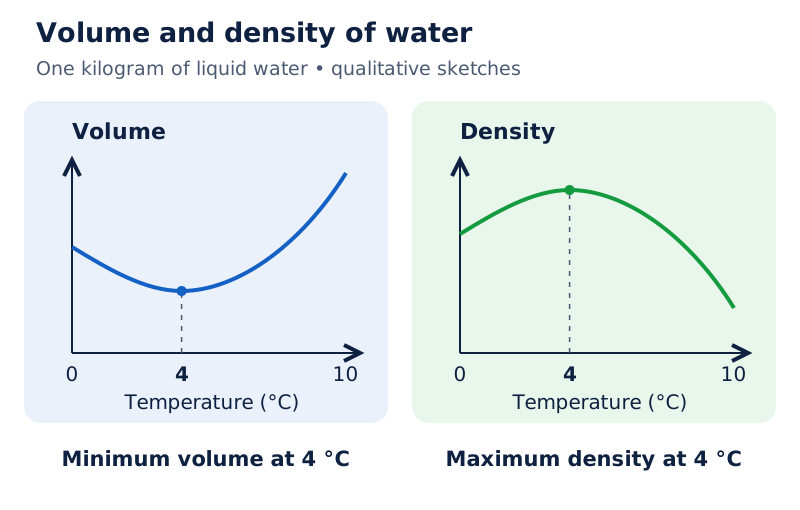
The left panel plots the volume of one kilogram of water against temperature and shows a dip near 4 °C before rising. The right panel plots density against temperature from 0 °C to 10 °C, with a peak near 4 °C and a dashed vertical guide through the peak.
Drawn by One Young India.
For a qualitative sketch, meaning a sketch showing the trend rather than exact measured values, use the 0 °C to 10 °C interval. Mark 4 °C clearly. Label which vertical axis represents volume and which represents density, because exchanging these labels reverses the meaning.
The essential relationship is for a fixed mass. The curves do not show water gaining mass when its density rises. Instead, the same mass occupies less space. Equally, a falling density below 4 °C reflects expansion of that sample, rather than disappearance of water.
How does Hope’s experiment demonstrate maximum density at 4 °C?
Hope’s experiment demonstrates the unusual behaviour of water by cooling it around the middle of a tall vessel and observing temperatures above and below the cooled region. The movement of water connects the thermometer readings with changes in density.
How is the apparatus arranged?
A tall cylindrical vessel contains water initially above 4 °C. An annular trough, meaning a ring-shaped container, surrounds its middle. The trough holds a freezing mixture of ice and salt that cools the water beside it. Two thermometers measure temperatures in the upper and lower regions.
Diagram
Hope’s experiment
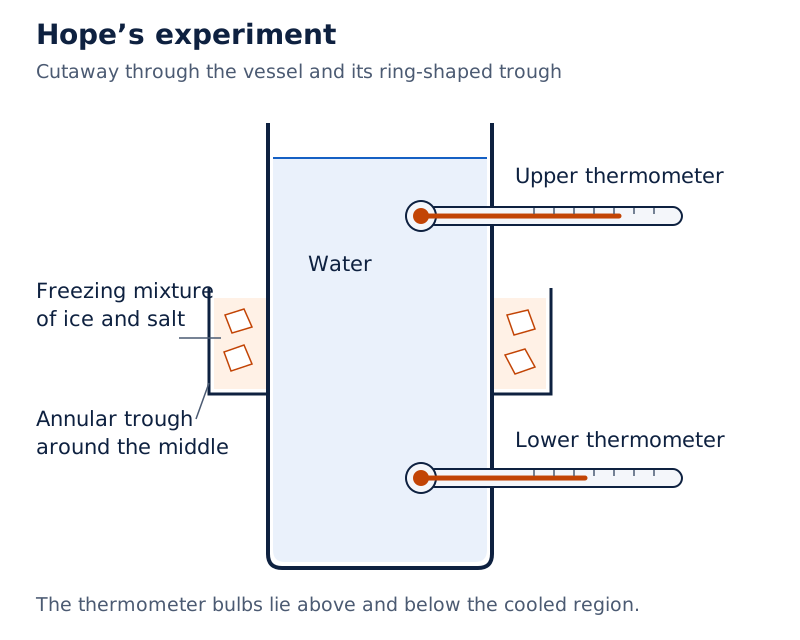
Draw a tall water-filled vessel with a ring-shaped trough around its middle. Label the ice-and-salt freezing mixture, the water, and separate upper and lower thermometers, with their bulbs above and below the cooled region.
Drawn by One Young India.
What happens as the water cools?
- Water beside the freezing mixture cools from a temperature above 4 °C. Its volume decreases and its density increases.
- The denser cooled water sinks. The lower thermometer falls towards 4 °C as this water collects in the lower part of the vessel.
- Water cooled below 4 °C expands and becomes less dense. It rises instead of sinking into the denser lower water.
- The upper thermometer subsequently falls towards 0 °C while the lower thermometer stays near 4 °C during the demonstration.
The conclusion is that water at 4 °C is denser than water at temperatures just above or below it. Cooling first favours sinking, but further cooling below 4 °C favours rising. The change in movement explains why the two thermometers do not follow the same temperature history.
Keep the observation separate from its explanation. A thermometer measures the temperature at its bulb; it does not measure density directly. The readings, the position of each thermometer, and the movement of cooled water together support the conclusion about maximum density.
Why do lakes and ponds freeze at the surface first?
Water’s anomalous expansion has an important environmental consequence. In cold conditions, lakes and ponds freeze at the top first. The explanation depends on the changing density of surface water, rather than the assumption that colder water must always sink.
What happens while the surface cools towards 4 °C?
The surface water loses energy to the colder atmosphere, the air surrounding the Earth. While its temperature remains above 4 °C, cooling makes it denser. It sinks and warmer, less dense water from below rises to replace it.
This circulation transfers water between upper and lower regions. Convection is transfer of heat by the actual movement of matter. Here the density differences caused by cooling help to explain the circulation and the gradual cooling of the lake.
Why does the behaviour change below 4 °C?
- Surface water reaches 4 °C, the temperature at which water has its maximum density.
- Further cooling below 4 °C increases its volume and decreases its density.
- This colder, less dense water remains at the surface instead of sinking through the denser water below.
- The surface water reaches its freezing temperature and changes into ice at the top of the lake.
The distinction between water above 4 °C and water below 4 °C is essential. In the first interval, cooling increases density. In the second, cooling decreases density. The same instruction, “cool the water”, has different consequences in these two intervals.
This behaviour helps protect aquatic life, meaning plants and animals living in water. If water did not have this property, lakes and ponds would freeze from the bottom upwards, destroying much of their animal and plant life. Surface freezing therefore has a major biological consequence.
Hope’s experiment and the cooling lake illustrate the same density principle in different settings. In both, water approaching 4 °C from above becomes denser, while water cooled below 4 °C becomes less dense. Identifying the temperature interval makes the direction of movement understandable.
What is the greenhouse effect, and why is it important?
Radiation is energy carried by electromagnetic waves, which can travel through a vacuum, a region without matter. Solar radiation is radiation from the Sun. The Earth receives this energy, and its surface absorbs part of it and becomes warmer.
The warmed surface emits energy in the infrared region, meaning radiation with wavelengths longer than those of visible light. A wavelength is the distance between successive corresponding points of a wave. This outgoing radiation is important in the Earth’s exchange of energy with its surroundings.
What do greenhouse gases do?
Greenhouse gases absorb outgoing infrared radiation. Examples include carbon dioxide, written CO₂; methane, written CH₄; and water vapour, water in its gaseous form. A portion of the outgoing energy is retained through this interaction, helping keep the Earth warm enough to support life.
The warming associated with this process is called the greenhouse effect. It is a natural part of the Earth’s energy balance. Without the atmosphere, the Earth would be too cold for life to survive. The presence of greenhouse gases is therefore important for habitability.
- Radiation from the Sun reaches the Earth and its atmosphere.
- The Earth’s surface absorbs part of the incoming energy and warms.
- The warmed surface emits infrared radiation towards the atmosphere and space.
- Greenhouse gases absorb part of this outgoing radiation, contributing to warming.
Diagram
Greenhouse effect
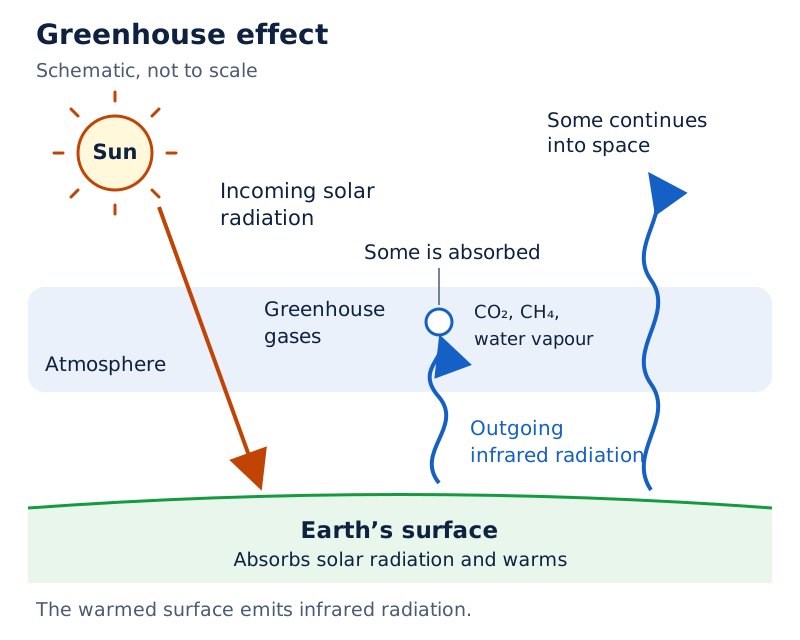
Draw the Sun, the Earth’s surface, and an atmospheric layer. Use labelled arrows for incoming solar radiation and outgoing infrared radiation. Show some outgoing radiation being absorbed by greenhouse gases and some continuing towards space.
Drawn by One Young India.
Absorption means taking in radiation energy. It should not be confused with simple reflection, in which radiation is sent back from a surface. The greenhouse explanation depends on the interaction between outgoing infrared radiation and gases in the atmosphere.
The description also does not mean that all outgoing energy is blocked. A portion is retained through greenhouse-gas absorption. Distinguishing natural atmospheric warming from additional warming caused by increased greenhouse-gas concentrations is necessary when discussing global warming.
What causes global warming?
Global warming is the rise in the Earth’s average temperature. The natural greenhouse effect keeps the planet warm enough for life, but increased concentrations of greenhouse gases enhance that effect. A concentration describes how much of a substance is present in a given mixture.
How do fossil fuels and deforestation contribute?
Fossil fuels include coal, oil and natural gas, formed from buried remains of organisms over very long periods. Burning these fuels releases carbon dioxide. They are used to supply energy for heating, cooking, transport and industry, linking energy use with atmospheric carbon dioxide.
Deforestation means removal of forests. Plants take in carbon dioxide during photosynthesis, the process in which they use sunlight to make food. Forest removal reduces this uptake. Burning fossil fuels and deforestation have increased the amount of carbon dioxide in the atmosphere.
A carbon sink takes up carbon from the atmosphere. Forests and oceans act as sinks for carbon dioxide. Explaining warming therefore involves both the processes adding carbon dioxide to the air and the processes taking it out.
| Process | Connection with atmospheric carbon dioxide |
|---|---|
| Burning coal, oil or gas | Releases carbon dioxide while supplying energy |
| Growth of forest plants | Takes up carbon dioxide through photosynthesis |
| Deforestation | Reduces uptake by forests and contributes to increased concentration |
How is the enhanced effect different from the natural effect?
Enhanced greenhouse effect means additional warming associated with increased greenhouse-gas concentrations. The same absorption process is involved, but the atmospheric balance has changed. Some carbon dioxide is necessary for a habitable planet; excessive amounts intensify the greenhouse effect.
In describing the cause, connect the steps: human activities increase greenhouse-gas concentrations; these gases interact with outgoing infrared radiation; the enhanced greenhouse effect causes warming. Fossil-fuel use is relevant because it changes atmospheric composition, not simply because a flame is hot.
How can global warming affect life on Earth?
Climate describes the longer-term pattern of weather conditions. Global warming affects this pattern and the movement of water through the environment. Its effects may not be uniform everywhere, so different regions need not experience identical changes in temperature or rainfall.
What happens to ice, sea level and coasts?
Warming contributes to the melting of glaciers and ice caps. A glacier is a large mass of land ice. Melting land ice adds water to the sea. The sea also expands as it warms, so thermal expansion contributes to rising sea level.
Rising seas may inundate, or flood, large parts of coastal areas and islands. Coastal flooding can disturb places where people live and affect habitats, the places where organisms live. These changes connect a physical change in temperature with social and biological consequences.
Why can rainfall and agriculture be affected?
A warmer atmosphere holds more moisture, meaning water vapour in the air. Climate change is associated with heavier rains in some areas and droughts elsewhere. A drought is a prolonged shortage of rainfall. The rainfall response therefore cannot be described as the same everywhere.
Intense rainfall can increase run-off, water flowing over the ground. This erodes soil, meaning that it carries soil away. Reduced infiltration, the entry of water into the ground, reduces replenishment of groundwater stored beneath the surface. Agriculture becomes harder to sustain, especially during dry months.
In India, warming may lead to more intense monsoons and threats to agriculture from changing rainfall patterns. Monsoons are seasonal wind systems associated with seasonal rainfall. The word “may” matters: a possible regional consequence should not be turned into a claim of an identical outcome everywhere.
The effects form connected chains. Temperature affects ice and atmospheric moisture; these changes affect sea level and rainfall; altered water conditions affect soils, crops and habitats. Keeping these connections clear explains why warming is an issue for living organisms as well as the physical environment.
What is energy degradation, and how does it occur?
Energy degradation is the conversion of energy into forms less available for doing useful work, commonly as energy dispersed through the surroundings by heating. Here, work means energy transfer by the component of a force along or opposite to a body’s displacement, its change of position. Degradation describes reduced usefulness, rather than destruction of energy.
How can motion produce dispersed thermal energy?
A moving body can come to rest because of friction, a force opposing relative motion between surfaces. Its kinetic energy, the energy of motion, decreases while the body and floor gain internal energy. The energy has changed form and spread between the interacting bodies.
A rotating blade in a liquid can also slow down. Viscosity is the resistance within a fluid to relative motion of its layers. The blade loses mechanical energy, meaning energy associated with its motion or position, while the liquid gains internal energy.
| Example | Initial energy | What happens |
|---|---|---|
| Moving body stopped by friction | Kinetic energy of the moving body | Internal energy of the body and floor increases |
| Rotating blade slowed in liquid | Mechanical energy of the blade | Internal energy of the liquid increases |
Why does conservation not remove the problem?
The law of conservation of energy requires an account of all energy transfers and transformations. When the system and its surroundings are considered together, energy is conserved. Counting only the moving body would miss the energy transferred to other parts of the surroundings.
Friction, viscosity and similar effects are called dissipative effects because they disperse mechanical energy. Most processes encountered in nature are irreversible: they cannot be reversed so that both the system and its surroundings return to their original conditions without other changes.
For example, internal energy gained by a floor does not spontaneously gather back into a body and restore its original motion. Dissipative effects can be minimised but not fully eliminated. Energy remains accounted for, while the capacity to obtain useful work from it is reduced.
Glossary
- Heat — Energy transferred between bodies or between a system and its surroundings because of a temperature difference.
- Temperature — A relative measure of hotness or coldness that determines the direction of heat flow between bodies in thermal contact.
- Thermal equilibrium — The condition in which bodies in thermal contact have equal temperatures and heat flow between them stops.
- Internal energy — Energy associated with the motion and interactions of particles within a substance, distinct from heat in transit.
- Thermal expansion — An increase in the dimensions of a body associated with an increase in its temperature.
- Anomalous expansion of water — Water’s unusual expansion on cooling from 4 °C to 0 °C, with contraction during heating through the same interval.
- Density — Mass per unit volume, increasing when a fixed mass occupies a smaller volume.
- Convection — Transfer of heat by actual movement of matter, as in circulation within a liquid.
- Greenhouse gas — An atmospheric gas that absorbs outgoing infrared radiation and contributes to the greenhouse effect.
- Greenhouse effect — Warming associated with atmospheric gases absorbing outgoing infrared radiation from the Earth’s surface.
- Global warming — A rise in the Earth’s average temperature associated with an enhanced greenhouse effect.
- Carbon sink — A store that takes up carbon from the atmosphere, with forests and oceans acting as examples.
- Energy degradation — Conversion of energy into forms less available for useful work, commonly through dispersal as thermal energy.
- Dissipative effect — An effect such as friction or viscosity that disperses mechanical energy and contributes to irreversibility.
Common errors and misconceptions
- Misconception: Heat and temperature are two names for the same quantity. Correct: Heat is energy transferred because of a temperature difference; temperature measures hotness or coldness. Their SI units are different.
- Misconception: Receiving heat must raise temperature. Correct: Heating may raise temperature, cause expansion or produce a change of state. During a change such as boiling at fixed pressure, temperature can remain unchanged.
- Misconception: Water contracts throughout cooling from 10 °C to 0 °C. Correct: It contracts down to 4 °C, then expands as it cools further towards 0 °C.
- Misconception: Water has its maximum volume at 4 °C. Correct: A fixed mass has minimum volume and maximum density at 4 °C compared with nearby temperatures.
- Misconception: Colder water always sinks, so a lake freezes at the bottom first. Correct: Below 4 °C, cooling decreases water’s density. The colder surface water remains above the denser water and freezes first.
- Misconception: Every greenhouse effect is harmful. Correct: Natural greenhouse warming helps make the Earth habitable. Increased greenhouse-gas concentrations enhance this effect and cause additional warming.
- Misconception: Energy degradation means that energy is destroyed. Correct: Energy is conserved when transfers to the surroundings are included. Degradation refers to its reduced availability for useful work.
Exam-style questions with model answers
Q1. Define heat and state its SI unit. [2 marks]
- Heat is energy transferred between bodies, or between a system and its surroundings, because of a temperature difference.
- Its SI unit is the joule, represented by the symbol J.
Q2. A heat transfer is 1 cal. Given that 1 cal = 4.186 J exactly, express it in joules and state whether changing the unit changes the energy transferred. [2 marks]
- The heat transfer is 4.186 J, using the given exact conversion between the calorie and the joule.
- Changing the unit changes the numerical expression, but it does not change the amount of energy transferred.
Q3. A fixed mass of liquid water is heated from 0 °C to 10 °C. Describe its volume change, its density change, and the significance of 4 °C. [3 marks]
- From 0 °C to 4 °C, the water contracts: its volume decreases and its density increases because the same mass occupies less space.
- From 4 °C to 10 °C, the water expands: its volume increases and its density decreases.
- At 4 °C, the sample has its minimum volume and maximum density compared with the neighbouring temperatures in this range.
Q4. Describe the apparatus, observations and conclusion of Hope’s experiment, starting with water above 4 °C. [5 marks]
- A tall vessel contains water, with a ring-shaped trough of ice and salt around its middle. Thermometers have their bulbs in the water above and below the cooled region.
- Water cooled towards 4 °C becomes denser and sinks. The lower thermometer falls towards 4 °C as this water collects below.
- When water beside the freezing mixture cools below 4 °C, it expands, becomes less dense, and rises.
- The upper thermometer subsequently falls towards 0 °C, while the lower thermometer remains near 4 °C during the demonstration.
- The observations show that water at 4 °C has greater density than water at temperatures just above or below it.
Q5. A lake initially contains water above 4 °C and loses heat to colder air until surface water freezes. Explain the sequence and its importance for aquatic life. [5 marks]
- Surface water loses energy to the colder atmosphere. While cooling towards 4 °C, it contracts, becomes denser, and sinks into the lake.
- Warmer, less dense water rises from below to replace it. This circulation allows further cooling as water reaches the surface.
- Once surface water cools below 4 °C, it expands and becomes less dense instead of continuing to become denser.
- The colder, less dense water remains at the surface, where it freezes when it reaches its freezing temperature.
- Surface freezing helps protect aquatic life. Without this density behaviour, freezing from the bottom upwards would destroy much of the lake’s animal and plant life.
Q6. Explain the greenhouse effect in four stages, including examples of gases involved. [4 marks]
- Solar radiation reaches the Earth, and the surface absorbs part of the incoming energy, causing land and water to warm.
- The warmed surface emits energy as infrared radiation towards the atmosphere and space.
- Greenhouse gases, including carbon dioxide, methane and water vapour, absorb part of this outgoing radiation.
- This interaction contributes to atmospheric warming and helps keep the Earth warm enough for life. Increased greenhouse-gas concentrations enhance the effect.
Q7. Explain three ways in which global warming can affect water conditions and life on Earth. [3 marks]
- Melting glaciers and ice caps, together with thermal expansion of seawater, raise sea level. This may flood coastal areas and islands.
- A warmer atmosphere holds more moisture, contributing to heavier rain in some areas and droughts elsewhere, so regional effects differ.
- Intense rainfall can increase run-off and soil erosion, while reduced infiltration lowers groundwater replenishment. These changes make agriculture harder to sustain, especially during dry months.
Q8. A moving body comes to rest through friction against a floor, and the body and floor gain internal energy. Use this situation to explain energy degradation and its relationship with energy conservation. [5 marks]
- The moving body initially has kinetic energy, the energy associated with its motion. Its kinetic energy decreases as friction brings it to rest.
- The body and the floor gain internal energy, as stated in the situation. Energy is therefore transferred and transformed rather than disappearing.
- Considering the body and its surroundings together preserves the full energy account. Looking only at the body’s motion would leave out the energy gained elsewhere.
- The dispersed energy is less available for doing useful work. This reduction in usefulness is called energy degradation.
- The energy does not spontaneously gather back from the floor to restore the original motion. This illustrates irreversibility without contradicting conservation of energy.
Key takeaways
- Heat is energy transferred because of a temperature difference; temperature describes how hot or cold a body is.
- The joule is the SI heat unit, and one calorie equals exactly 4.186 joules.
- Water contracts on heating from 0 °C to 4 °C and expands on cooling through that interval.
- A fixed mass of water has minimum volume and maximum density at 4 °C.
- Hope’s experiment links different upper and lower thermometer readings with water’s changing density during cooling.
- Below 4 °C, colder water is less dense, explaining why lakes and ponds freeze at the surface first.
- Natural greenhouse warming supports life, while increased greenhouse-gas concentrations enhance the effect and cause global warming.
- Energy degradation reduces availability for useful work while total energy remains conserved when the surroundings are included.
Test yourself
What determines the direction of heat flow between bodies in thermal contact?
Their temperature difference determines the direction: heat flows from the hotter body to the colder body until their temperatures equalise.
Does a thermometer measure heat transferred or temperature?
A thermometer measures temperature. Heat transferred is an energy quantity expressed in units such as joules.
Why does water’s density increase as it warms from 0 °C to 4 °C?
Its volume decreases while its mass stays the same. More mass therefore occupies each unit of volume.
Where are the turning points on water’s volume and density graphs?
Both occur at 4 °C: the volume curve has a minimum and the density curve has a maximum.
Why does water cooled below 4 °C rise in Hope’s experiment?
It expands and becomes less dense than the water at 4 °C beneath it, so it rises.
Name three greenhouse gases discussed here.
Carbon dioxide, methane and water vapour are greenhouse gases that absorb outgoing infrared radiation.
How can deforestation contribute to global warming?
Removing forests reduces carbon dioxide uptake through photosynthesis, contributing to increased atmospheric carbon dioxide and an enhanced greenhouse effect.
Why is energy degradation consistent with conservation of energy?
Energy changes form and becomes less available for useful work; it is not destroyed when transferred to the surroundings.
Write about it
Turn a question from this chapter into a paper.
The Writing Studio has a structure guide, a rubric and citation tools for 15 formats, from essays to research papers. Drafting is free with an account. Learnacy Essential adds feedback from an AI writing coach and submission to The OYI Review.
Learnacy Essential is ₹1,499 for the year. Publication depends on review and is not guaranteed.