
Inverse Trigonometric Functions | CBSE Class 12 Maths Notes
On this page
This note covers inverse trigonometric functions, restrictions on trigonometric domains, principal value branches, domains and ranges, graphs, principal values, inverse compositions, and simplification through trigonometric substitutions.
Why do trigonometric functions need restricted domains before inversion?
What does an inverse function do?
A function assigns one output to each allowed input. Its domain is the set of allowed inputs, its codomain is the specified set of possible outputs, and its range consists of the outputs actually obtained.
A function is one-one when different inputs give different outputs. It is onto when its range equals its codomain. A function satisfying both conditions is bijective, and has an inverse that reverses each input-output assignment.
Definition: An inverse function reverses a bijective function. If f is the original function and f(x) = y, its inverse f⁻¹ satisfies f⁻¹(y) = x. Here x denotes an input and y its corresponding output.
The notation f⁻¹ names the inverse of f. It does not mean division by f. When the assignments are reversed, the original range becomes the inverse domain, and the original domain becomes the inverse range.
Why does the choice of interval matter?
The familiar trigonometric functions repeat values on their full domains. An unrestricted output therefore does not identify a unique original angle. Restricting the angle to an appropriate interval makes the function one-one and onto its stated range, so an inverse can be defined.
Here sin, cos, tan, cot, sec and cosec denote sine, cosine, tangent, cotangent, secant and cosecant. Their inverses use the corresponding superscript ⁻¹. All angles in this note are in radians, the angle measure in which a straight angle equals π.
The symbol π denotes the circle constant. The symbol R denotes the set of real numbers. Square brackets include an interval's endpoints; round brackets exclude them. Thus [−1, 1] includes both −1 and 1, while (0, π) excludes both 0 and π.
A branch is an inverse obtained from a particular permissible restriction. Several branches can arise from different restrictions. The standard choice used when no branch is specified is called the principal value branch. Its outputs are the principal values.
How is the inverse sine function defined and graphed?
Which sine branch is the principal branch?
The sine function has domain R and range [−1, 1]. Restricting its domain to [−π/2, π/2] makes it bijective onto [−1, 1]. Reversing this restricted function defines inverse sine, also called arc sine.
Consequently, y = sin⁻¹x means that sin y = x and −π/2 ≤ y ≤ π/2. The symbol ≤ means “less than or equal to”. Both parts of this statement matter: the trigonometric equation identifies possible angles, and the interval selects the required one.
Definition: The principal inverse sine function has domain [−1, 1] and range [−π/2, π/2]. Thus sin⁻¹x returns the angle in this range whose sine is x.
Sine can also be restricted to intervals such as [−3π/2, −π/2] or [π/2, 3π/2]. These give other inverse branches with the same input domain but different output ranges. They do not replace the principal branch when a question simply writes sin⁻¹x.
How does reflection produce the inverse graph?
For an invertible function, swapping the input and output interchanges a point's coordinates. If (a, b) is a point on the original graph, where a is the horizontal coordinate and b the vertical coordinate, then (b, a) lies on its inverse graph.
This interchange is a reflection, or mirror image, in the line y = x. On that line, horizontal and vertical coordinates are equal. The sine curve must be read with its chosen restriction when using this construction to identify the principal inverse.
What the figure shows
Sine and inverse sine
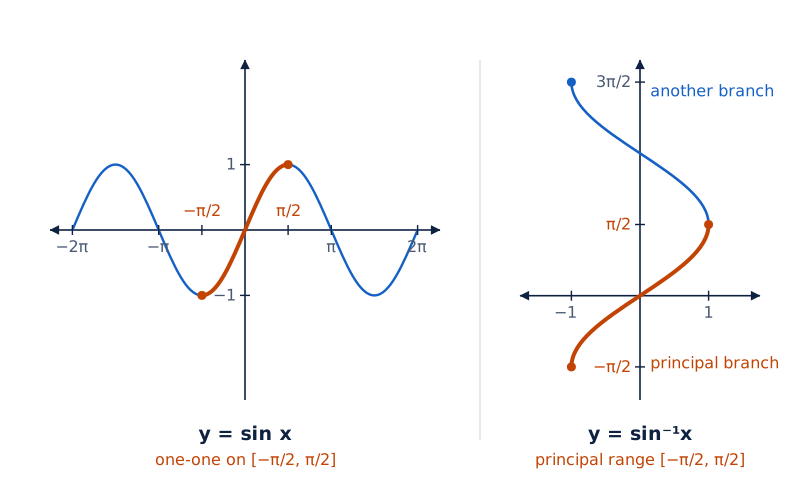
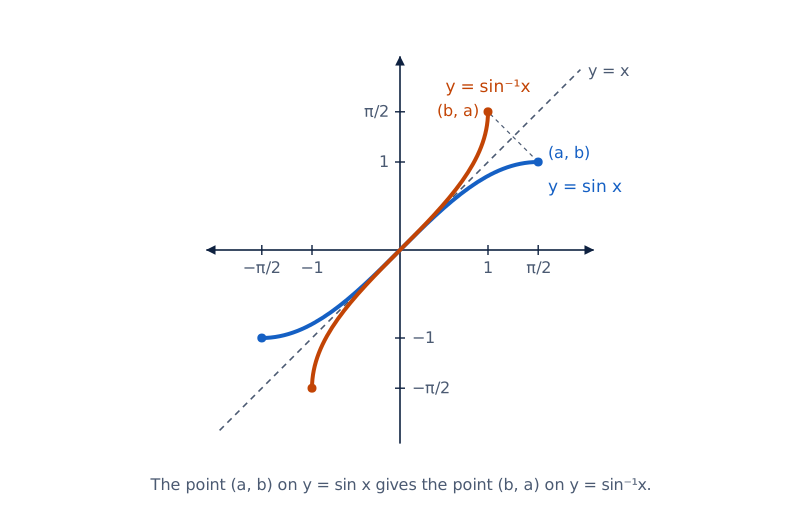
The first graph shows the repeating sine curve. The second shows its inverse branches. The third places the curves together with the diagonal line y = x, illustrating reflection. The darker inverse portion identifies the principal branch.
Drawn by One Young India. See Fig. 2.1 in your NCERT textbook
The endpoint brackets are significant. The inverse sine range includes −π/2 and π/2, just as its domain includes −1 and 1. A graph and a range statement should represent the same selected branch.
How does inverse cosine differ from inverse sine?
Why is the cosine restriction different?
Cosine has domain R and range [−1, 1]. Its restriction to [0, π] is one-one and onto [−1, 1]. The inverse of this restricted function is inverse cosine, also called arc cosine, written cos⁻¹.
The statement y = cos⁻¹x means cos y = x with 0 ≤ y ≤ π. Although inverse sine and inverse cosine accept the same inputs, they return angles from different ranges. An angle acceptable for one inverse function may be unacceptable for the other.
Cosine restricted to [−π, 0] or [π, 2π] also gives inverse branches. The range [0, π] specifies the principal value branch. An unspecified cos⁻¹ expression uses that branch, so its answer must be non-negative and no greater than π.
What does the graph show?
What the figure shows
Cosine and inverse cosine
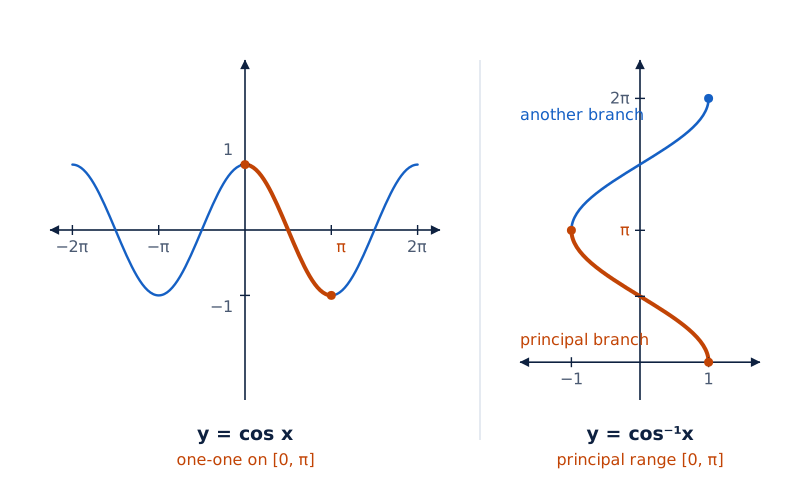
One graph shows the repeating cosine curve along the horizontal axis. The other shows inverse branches with horizontal coordinates between −1 and 1. The principal inverse branch runs downwards between its endpoint heights π and 0.
Drawn by One Young India. See Fig. 2.2 in your NCERT textbook
The same coordinate interchange used for inverse sine gives the inverse cosine graph. The relevant original curve is the cosine portion over [0, π]. Choosing this interval determines which inverse branch represents the function under the principal-value convention.
Worked example 1. Find the principal value of cos⁻¹(√3/2). The symbol √ denotes the non-negative square root.
Answer: Let y = cos⁻¹(√3/2). Then cos y = √3/2 and y lies in [0, π]. Since cos(π/6) = √3/2 and π/6 belongs to this range, the principal value is π/6.
The range check completes the answer. Recognising a cosine value gives a candidate angle; checking that the candidate belongs to [0, π] justifies selecting it as the principal value. This method also applies when the cosine input is negative.
What restrictions define inverse cosecant and inverse secant?
Why do their input domains have a gap?
The reciprocal of a non-zero number is one divided by that number. Cosecant and secant are reciprocal trigonometric functions: cosec x = 1/sin x and sec x = 1/cos x, wherever their denominators are non-zero.
Their ranges contain real numbers at least 1 or at most −1. These ranges become the domains of inverse cosecant and inverse secant. The notation R − (−1, 1) means the real numbers with the open interval between −1 and 1 removed.
The minus sign in this set notation means removal, rather than ordinary subtraction of two numbers. The values −1 and 1 remain included. Inputs strictly between them are excluded for both inverse functions.
Which angles must be excluded?
For inverse cosecant, the principal range is [−π/2, π/2] − {0}. Braces here enclose a set; {0} is the set containing zero. The excluded angle is necessary because cosecant is undefined at zero.
For inverse secant, the principal range is [0, π] − {π/2}. Secant is undefined at π/2, so this angle is removed from the restricted original domain and therefore from the inverse range. The remaining endpoints stay included.
What the figure shows
Cosecant and inverse cosecant
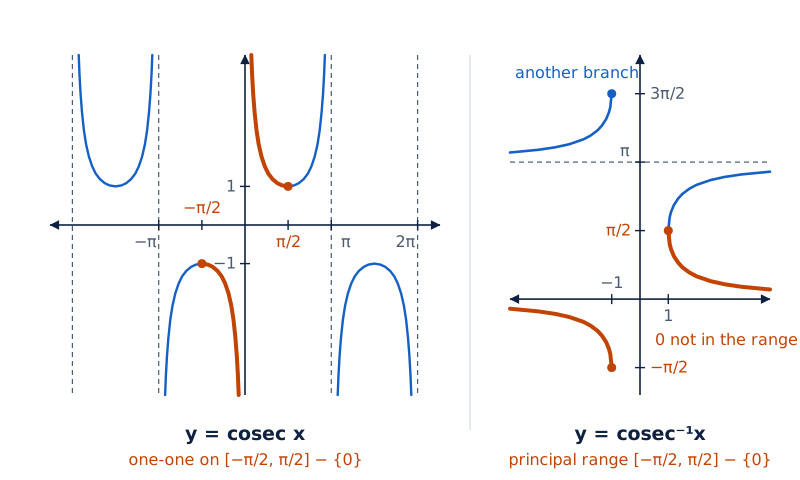
The cosecant graph has separate curved portions above and below the horizontal axis, with dashed vertical guides. The inverse graph has separated portions on either side of the vertical axis and dashed horizontal guides.
Drawn by One Young India. See Fig. 2.3 in your NCERT textbook
What the figure shows
Secant and inverse secant
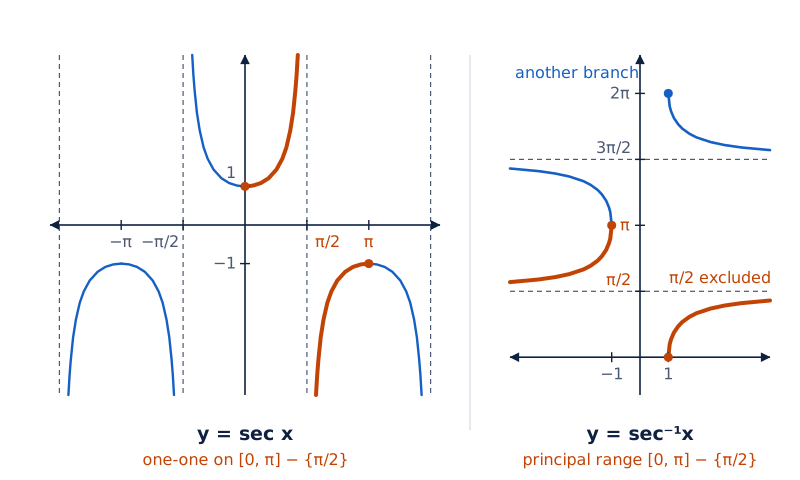
The secant graph shows separate upward and downward curved portions. Its inverse graph shows branches on the two sides of the excluded input interval between −1 and 1, with dashed horizontal guides.
Drawn by One Young India. See Fig. 2.4 in your NCERT textbook
Worked example 2. Find the principal value of cosec⁻¹(2).
Answer: Let y = cosec⁻¹(2), so cosec y = 2. Equivalently, sin y = 1/2. The angle π/6 has this sine and belongs to [−π/2, π/2] − {0}. Hence cosec⁻¹(2) = π/6.
Keep the input gap separate from the excluded output angle. The two inverse functions have identical domains, but their principal ranges remove different angles from different intervals.
How are inverse tangent and inverse cotangent defined?
Why do both accept every real input?
Tangent restricted to (−π/2, π/2) is one-one and onto R. Its inverse, inverse tangent, therefore has domain R and range (−π/2, π/2). The endpoints are excluded because tangent is undefined at those angles.
Cotangent restricted to (0, π) is one-one and onto R. Its inverse, inverse cotangent, has domain R and range (0, π). Here the excluded endpoints are 0 and π, where cotangent is undefined.
Thus y = tan⁻¹x means tan y = x with −π/2 < y < π/2. Similarly, y = cot⁻¹x means cot y = x with 0 < y < π. The symbol < expresses a strict inequality that excludes equality.
What the figure shows
Tangent and inverse tangent
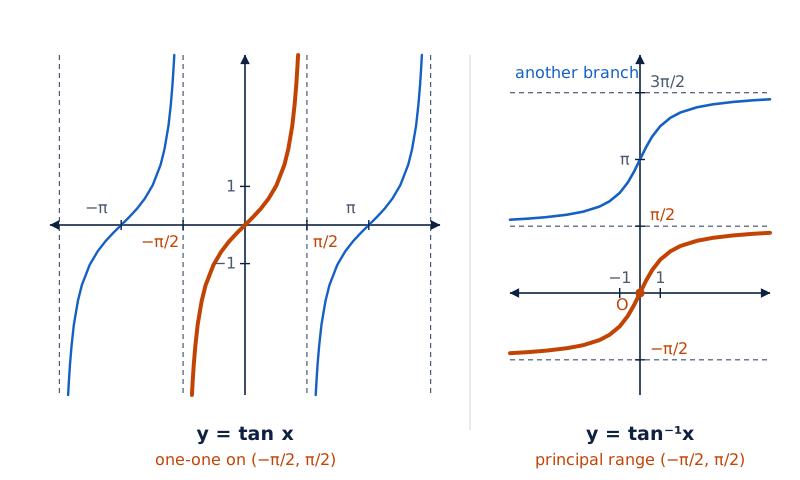
The tangent graph contains repeating rising portions separated by dashed vertical lines. The inverse graph shows rising branches with dashed horizontal lines. Its principal branch passes through the origin, the point with both coordinates zero.
Drawn by One Young India. See Fig. 2.5 in your NCERT textbook
What the figure shows
Cotangent and inverse cotangent
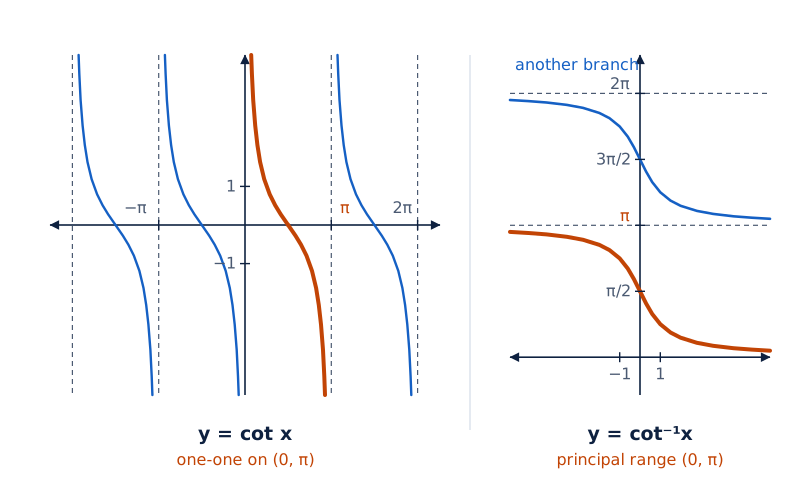
The cotangent graph contains repeating falling portions separated by dashed vertical lines. The inverse graph shows falling branches with dashed horizontal lines. The principal branch lies between the heights 0 and π.
Drawn by One Young India. See Fig. 2.6 in your NCERT textbook
How is a negative cotangent input handled?
Worked example 3. Find the principal value of cot⁻¹(−1/√3).
Answer: Let y = cot⁻¹(−1/√3). Then cot y = −1/√3. Although −π/3 gives this cotangent, it is outside (0, π). Since cot(2π/3) = −1/√3 and 2π/3 lies in (0, π), the answer is 2π/3.
A negative input therefore does not require a negative inverse answer. The chosen branch controls the answer's location. In particular, the inverse cotangent range consists of positive angles, even though its domain contains negative as well as positive numbers.
The graph reinforces the same distinction: read allowed inputs along the horizontal axis, then identify the output on the principal branch. Do not copy the inverse tangent interval when working with inverse cotangent.
How can the six domains and principal ranges be compared?
What is the complete reference table?
The following table pairs each inverse function with its domain and principal range. In every row, x is the input and y is the output angle. Each range is the restriction imposed on the corresponding original trigonometric function before inversion.
| Function | Domain | Range: principal value branch |
|---|---|---|
| y = sin⁻¹x | [−1, 1] | [−π/2, π/2] |
| y = cos⁻¹x | [−1, 1] | [0, π] |
| y = cosec⁻¹x | R − (−1, 1) | [−π/2, π/2] − {0} |
| y = sec⁻¹x | R − (−1, 1) | [0, π] − {π/2} |
| y = tan⁻¹x | R | (−π/2, π/2) |
| y = cot⁻¹x | R | (0, π) |
Which distinctions prevent confusion?
There are three pairs of identical domains. Inverse sine and cosine use [−1, 1]. Inverse cosecant and secant use R − (−1, 1). Inverse tangent and cotangent use R. Within each pair, the ranges differ.
Compare inverse sine with inverse tangent: both ranges are bounded by −π/2 and π/2, but the sine endpoints are included and the tangent endpoints are excluded. Similarly, inverse cosine includes 0 and π, whereas inverse cotangent excludes them.
Compare inverse cosecant with inverse sine: their outer endpoints agree, but inverse cosecant cannot return zero. Compare inverse secant with inverse cosine: their outer endpoints agree, but inverse secant cannot return π/2.
Note: sin⁻¹x denotes an inverse function. In contrast, (sin x)⁻¹ = 1/sin x denotes a reciprocal wherever sin x is non-zero. The same distinction applies to the other trigonometric functions.
Read a row in two directions. First ask whether the supplied number belongs to the domain. Then ask whether the proposed angle belongs to the range. A correct trigonometric value without the second check does not establish the principal inverse value.
The principal-value convention removes the need to repeat a branch in every expression. Unless another branch is explicitly specified, use the ranges in this table throughout a calculation, including intermediate inverse expressions.
How do you find and combine principal values?
What sequence of checks gives a complete solution?
Evaluating an inverse expression means finding an angle, rather than applying the original trigonometric function to the displayed number. A reliable procedure begins with the relevant domain and ends with an explicit check of the principal range.
- Check that the supplied input belongs to the inverse function's domain.
- Name the required angle y and rewrite the inverse equation as a trigonometric equation.
- Identify an angle with the required trigonometric value.
- Select the angle in the principal range and state the resulting inverse value.
Worked example 4. Find the principal value of sin⁻¹(1/√2).
Answer: Put y = sin⁻¹(1/√2). Then sin y = 1/√2. Since sin(π/4) = 1/√2 and π/4 lies in [−π/2, π/2], the required principal value is π/4.
Worked example 5. Find the principal value of sin⁻¹(−1/2).
Answer: The required angle y satisfies sin y = −1/2 and lies in [−π/2, π/2]. Since sin(−π/6) = −1/2 and −π/6 belongs to that interval, sin⁻¹(−1/2) = −π/6.
Worked example 6. Find the principal value of tan⁻¹(−1).
Answer: The principal tangent interval is (−π/2, π/2). Since tan(−π/4) = −1 and −π/4 lies inside that interval, tan⁻¹(−1) = −π/4. The interval identifies the required value among angles having the same tangent.
How should a sum of inverse values be evaluated?
Worked example 7. Evaluate cos⁻¹(1/2) + 2sin⁻¹(1/2).
Answer: The principal values are cos⁻¹(1/2) = π/3 and sin⁻¹(1/2) = π/6. Therefore the expression equals π/3 + 2(π/6) = 2π/3. Evaluate each inverse within its own range before combining the angles.
The coefficient 2 in this example multiplies the angle returned by inverse sine. It does not multiply the input before the inverse is evaluated. Parentheses and the position of the coefficient distinguish these operations.
These examples use the same evaluation method despite different signs and functions. The key change is the permitted output interval. Keep that interval beside the trigonometric equation until the final angle has been selected.
When can a trigonometric function and its inverse cancel?
Property: Sine after inverse sine
For x in [−1, 1], sin(sin⁻¹x) = x. The inner inverse sine produces the angle in its principal range whose sine is x. Applying sine to that angle therefore recovers the original input.
This statement requires x to belong to the inverse sine domain. The two operations are being performed in a particular order: the inverse function acts first, then the original function acts on the returned angle.
Property: Inverse sine after sine
For x in [−π/2, π/2], sin⁻¹(sin x) = x. Here sine acts first. The interval condition ensures that the starting angle is already the angle selected by the principal inverse branch.
For an angle outside that interval, sine can still be calculated, but applying the principal inverse need not recover the original angle. The inverse returns an angle in its own range, so cancellation without a range check can give an incorrect result.
Worked example 8. Find sin⁻¹(sin(3π/5)).
Answer: The angle 3π/5 lies outside [−π/2, π/2]. Using sin(3π/5) = sin(π − 3π/5) = sin(2π/5), and observing that 2π/5 lies in the principal range, gives sin⁻¹(sin(3π/5)) = 2π/5.
How does this principle extend to the other functions?
For the other trigonometric functions, corresponding inverse relations hold for suitable domains. To recover an original angle by applying an inverse after its trigonometric function, use the restricted original domain associated with that inverse's principal branch.
Note: Inverse-trigonometric results apply within the corresponding principal value branches and wherever the expressions are defined. Some results may not be valid for all values in the domains of the inverse functions.
The order of composition, meaning the order in which functions are applied, determines which restriction matters. The outer inverse's range is especially important when the expression contains a trigonometric function of an angle already given.
How do substitutions prove the double-angle results?
Property: Double-angle inverse sine
A substitution replaces an expression by an equal one chosen to simplify the calculation. Let θ, read “theta”, denote a new angle. Writing x = sin θ is useful when an expression contains √(1 − x²); the notation x² means x multiplied by itself.
Worked example 9. Show that sin⁻¹(2x√(1 − x²)) = 2sin⁻¹x for −1/√2 ≤ x ≤ 1/√2.
Answer: Choose θ = sin⁻¹x, so x = sin θ and −π/4 ≤ θ ≤ π/4. On this interval cos θ is non-negative. Hence √(1 − x²) = cos θ and 2x√(1 − x²) = 2sin θ cos θ = sin(2θ).
Since −π/2 ≤ 2θ ≤ π/2, the angle 2θ belongs to the principal sine range. Therefore sin⁻¹(sin(2θ)) = 2θ = 2sin⁻¹x, proving the result under the given restriction.
The identity used here is sin(2θ) = 2sin θ cos θ, a double-angle identity, meaning a trigonometric equality involving twice an angle. The square-root step also uses sin²θ + cos²θ = 1, where sin²θ means (sin θ)² and cos²θ means (cos θ)².
Property: Double-angle inverse cosine form
Worked example 10. Show that sin⁻¹(2x√(1 − x²)) = 2cos⁻¹x for 1/√2 ≤ x ≤ 1.
Answer: Choose θ = cos⁻¹x, so x = cos θ and 0 ≤ θ ≤ π/4. Then sin θ is non-negative and √(1 − x²) = sin θ. Thus 2x√(1 − x²) = 2cos θ sin θ = sin(2θ).
Now 0 ≤ 2θ ≤ π/2, which lies inside the principal inverse sine range. Hence sin⁻¹(sin(2θ)) = 2θ = 2cos⁻¹x, as required.
The two results have the same expression on the left but different conditions on x. Those conditions justify both the sign chosen for the square root and the inverse cancellation. They are part of each result, not optional qualifications.
When reproducing either proof, state the angle interval immediately after the substitution. This makes the final cancellation transparent and prevents extending a valid restricted result to inputs for which its conclusion need not hold.
How can inverse expressions be simplified without losing their restrictions?
Which substitution matches a secant expression?
An expression involving √(x² − 1) suggests a secant substitution. The identity sec²θ − 1 = tan²θ converts that square root into a tangent expression. Here sec²θ means (sec θ)² and tan²θ means (tan θ)².
The square root represents the non-negative value. It can be replaced directly by tan θ when the selected angle interval makes tan θ positive or zero. Establishing that interval is therefore part of the algebraic simplification.
Worked example 11. Simplify cot⁻¹(1/√(x² − 1)) for x > 1. The symbol > means “greater than”.
Answer: Set θ = sec⁻¹x, so x = sec θ. Because x > 1, the principal angle satisfies 0 < θ < π/2. Therefore √(x² − 1) = √(sec²θ − 1) = tan θ, with tan θ positive.
The given expression becomes cot⁻¹(1/tan θ) = cot⁻¹(cot θ). As θ lies in (0, π), the principal cotangent range, this equals θ. Thus the simplest form is sec⁻¹x.
What must be checked before stating the simplest form?
In the example, x > 1 ensures that x² − 1 is positive, so the denominator √(x² − 1) is non-zero. It also places the substituted angle in the part of the principal secant range needed for the positive tangent choice.
The final inverse operation uses the cotangent principal range, although the substitution began with inverse secant. A solution may therefore require more than one range check. Each check belongs to the particular inverse expression at that stage.
- Retain the original restriction while choosing the substitution.
- Translate that restriction into an interval for the new angle.
- Use a trigonometric identity and check the sign of any square root.
- Check the outer inverse's range before replacing a composition by the angle.
This connects simplification with the basic definition of an inverse. Algebra identifies an equivalent trigonometric expression; the branch restriction establishes which angle its inverse returns. Both are necessary to justify the final form.
Glossary
- Domain — The set of permitted inputs for which a function is defined.
- Codomain — The specified output set into which a function maps its inputs.
- Range — The set of output values actually attained by a function.
- One-one function — A function in which different inputs produce different output values.
- Onto function — A function whose range equals the whole of its stated codomain.
- Bijective function — A function that is both one-one and onto, allowing an inverse.
- Inverse function — A function that reverses the input-output assignments of a bijective function.
- Branch — An inverse function obtained by choosing a particular suitable restriction of the original domain.
- Principal value branch — The standard inverse branch understood whenever another branch is not specified.
- Principal value — An inverse function's output lying within the range of its principal branch.
- Reciprocal — One divided by a non-zero quantity, distinct from a function's inverse.
- Reflection — A mirror-image transformation relating inverse graphs across the line y = x.
Common errors and misconceptions
- Misconception: sin⁻¹x means 1/sin x. Correct: The first notation denotes inverse sine; the reciprocal is written (sin x)⁻¹ and requires sin x to be non-zero.
- Misconception: Any angle with the required trigonometric value is an acceptable principal value. Correct: The selected angle must also lie in the inverse function's principal range.
- Misconception: The ranges of inverse sine and inverse tangent have the same endpoints included. Correct: Inverse sine includes −π/2 and π/2, whereas inverse tangent excludes both endpoints.
- Misconception: A negative cotangent input must give a negative inverse cotangent. Correct: The principal inverse cotangent range is (0, π); cot⁻¹(−1/√3) equals 2π/3.
- Misconception: Inverse cosecant and inverse secant accept inputs between −1 and 1. Correct: Their domain is R − (−1, 1), retaining −1 and 1 but excluding the intervening values.
- Misconception: sin⁻¹(sin x) equals x without an angle restriction. Correct: This cancellation requires x in [−π/2, π/2]; for instance, sin⁻¹(sin(3π/5)) equals 2π/5.
- Misconception: The conditions attached to a double-angle inverse identity can be discarded. Correct: They justify the square-root sign and ensure the resulting doubled angle belongs to the required principal range.
Exam-style questions with model answers
Q1. State the domain and principal range of inverse sine, and distinguish sin⁻¹x from (sin x)⁻¹. [2 marks]
- Inverse sine has domain [−1, 1] and principal range [−π/2, π/2], with both endpoints included in each interval.
- sin⁻¹x is the angle whose sine is x in that range; (sin x)⁻¹ is the reciprocal 1/sin x, defined when sin x is non-zero.
Q2. Find the principal value of cot⁻¹(−1/√3), explaining your choice of angle. [3 marks]
- Let y be the required principal value. Then cot y = −1/√3, with y restricted to the inverse cotangent range (0, π).
- The angle 2π/3 has cotangent −1/√3, since cot(2π/3) = cot(π − π/3) = −cot(π/3) = −1/√3.
- As 2π/3 lies in (0, π), it is the required principal value. The negative angle −π/3 does not belong to that principal range.
Q3. Evaluate sin⁻¹(sin(3π/5)) and explain why direct cancellation is invalid. [3 marks]
- The principal inverse sine range is [−π/2, π/2]. The angle 3π/5 is outside this interval, so cancellation cannot return that original angle.
- Rewrite the sine as sin(3π/5) = sin(π − 3π/5) = sin(2π/5), preserving the value inside the inverse function.
- The angle 2π/5 belongs to the principal range. Therefore sin⁻¹(sin(3π/5)) = sin⁻¹(sin(2π/5)) = 2π/5, which is the required output.
Q4. Compare the domains and principal ranges of inverse cosecant and inverse secant, explaining each excluded angle. [4 marks]
- Both inverse functions have domain R − (−1, 1). They accept real inputs at least 1 or at most −1, including both boundary values.
- The principal range of inverse cosecant is [−π/2, π/2] − {0}; the outer endpoints are included.
- The principal range of inverse secant is [0, π] − {π/2}; its outer endpoints are also included.
- Zero is excluded from the first range because cosecant is undefined there. The angle π/2 is excluded from the second because secant is undefined there.
Q5. Prove sin⁻¹(2x√(1 − x²)) = 2sin⁻¹x for −1/√2 ≤ x ≤ 1/√2, including the branch checks. [5 marks]
- Define θ = sin⁻¹x. Then x = sin θ, and the supplied restriction gives −π/4 ≤ θ ≤ π/4 within the principal inverse sine range.
- On this interval cos θ is non-negative. Using sin²θ + cos²θ = 1, the non-negative square root becomes √(1 − x²) = cos θ.
- Substitute into the inner expression: 2x√(1 − x²) = 2sin θ cos θ = sin(2θ), using the sine double-angle identity.
- Doubling the angle bounds gives −π/2 ≤ 2θ ≤ π/2. Therefore 2θ lies in the principal range and sin⁻¹(sin(2θ)) = 2θ.
- Since θ = sin⁻¹x, the original expression equals 2θ = 2sin⁻¹x. This establishes the identity throughout the supplied interval, including its endpoints.
Q6. Simplify cot⁻¹(1/√(x² − 1)) for x > 1, giving the substitution, sign check and branch check. [5 marks]
- Define θ = sec⁻¹x, so x = sec θ. Because x > 1 and this is the principal inverse secant, 0 < θ < π/2.
- Apply sec²θ − 1 = tan²θ. Tangent is positive on this interval, so the non-negative square root is √(x² − 1) = tan θ.
- The reciprocal inside the inverse cotangent is therefore 1/√(x² − 1) = 1/tan θ = cot θ. The denominator is non-zero under the given restriction.
- The angle θ also lies in (0, π), the principal inverse cotangent range. Consequently cot⁻¹(cot θ) = θ is valid in this calculation.
- Substituting back θ = sec⁻¹x gives the simplest form sec⁻¹x. The condition x > 1 has justified the substitution, positive square-root choice and inverse cancellation.
Key takeaways
- Restrict a trigonometric function to a suitable domain so that it becomes one-one and onto before defining its inverse.
- The original restricted domain becomes the inverse range, while the original range becomes the inverse domain.
- Use the principal value branch whenever another branch is not specified in an inverse trigonometric expression.
- Inverse sine and inverse cosine share domain [−1, 1], but use different principal ranges for their output angles.
- Inverse cosecant and inverse secant exclude inputs strictly between −1 and 1, while keeping both boundary inputs.
- Inverse tangent and inverse cotangent accept every real input, but their principal output intervals exclude different endpoints.
- An inverse after a trigonometric function recovers the original angle when that angle belongs to the selected principal range.
- In substitution proofs, track the angle interval, square-root sign and final inverse range before claiming a simplified result.
Test yourself
What two conditions allow a function to have an inverse?
It must be one-one and onto its specified codomain; together these conditions make it bijective.
Which branch is understood when an inverse expression gives no branch?
The principal value branch is understood, so use its stated range to select the output angle.
How do the endpoint conventions differ for inverse sine and inverse tangent?
Inverse sine includes −π/2 and π/2 in its range. Inverse tangent excludes both of those endpoints.
What is the principal range of inverse cotangent?
Its principal range is (0, π), so neither endpoint is included and every output is positive.
Why is zero missing from the inverse cosecant range?
Cosecant is undefined at zero, so zero is removed from its restricted original domain and inverse range.
What is sin⁻¹(1/√2), and which range confirms it?
It equals π/4 because sin(π/4) = 1/√2 and π/4 lies in the principal range [−π/2, π/2].
Why is sin⁻¹(sin(3π/5)) not 3π/5?
The angle 3π/5 is outside the principal sine range. The equal sine value at 2π/5 gives the principal answer.
Across which line are an invertible function and its inverse reflected?
They are reflected across the line y = x, with each point's horizontal and vertical coordinates interchanged.
Write about it
Turn a question from this chapter into a paper.
The Writing Studio has a structure guide, a rubric and citation tools for 15 formats, from essays to research papers. Drafting is free with an account. Learnacy Essential adds feedback from an AI writing coach and submission to The OYI Review.
Learnacy Essential is ₹1,499 for the year. Publication depends on review and is not guaranteed.