
Mole Concept and Stoichiometry | ICSE Class 10 Chemistry Notes
On this page
Watch & explore
Start with a few high-quality watches, then dive into the notes below.
Try an idea before you read. Test your understanding of the mole concept and stoichiometry with these lab scenarios. Explore →
Learnacy Labs Try it hands-on: open the Stoichiometry lab
This note covers the mole, Avogadro’s number, atomic and molecular masses, molar mass, gas-volume laws, atomicity, molar volume, vapour density, percentage composition, empirical and molecular formulae, and calculations using balanced chemical equations.
What does a mole count in chemistry?
Atoms and molecules are extremely small, so even a small sample contains a very large number of particles. An atom is a basic particle of an element. A molecule contains atoms chemically combined together. An ion is an electrically charged particle.
Chemists use a counting unit called the mole. A dozen means 12 items and a gross means 144 items. In the same way, a mole specifies a particular number of entities, meaning the particles or groups being counted.
Definition: The mole, symbol mol, is the unit of amount of substance. One mole contains exactly 6.02214076 × 10²³ specified elementary entities.
The Avogadro constant, written Nₐ, is the number of entities per mole. Its exact value is 6.02214076 × 10²³ mol⁻¹. The numerical value is called Avogadro’s number. For the calculations below, use the rounded value 6.022 × 10²³ mol⁻¹.
The symbol n represents amount of substance, measured in mol. The symbol N represents the number of specified entities. The superscript ⁻¹ in mol⁻¹ means “per mole”. Always identify the entity before counting it: atoms, molecules, ions or formula units.
Why must the particles be named?
| Amount specified | Particles counted, using the rounded constant |
|---|---|
| 1 mol of hydrogen atoms | 6.022 × 10²³ hydrogen atoms |
| 1 mol of water molecules | 6.022 × 10²³ water molecules |
| 1 mol of sodium chloride | 6.022 × 10²³ formula units of sodium chloride |
A formula unit expresses the simplest ratio of ions in an ionic compound, a compound made of electrically charged particles. Sodium chloride is made of sodium and chloride ions arranged in a solid structure, rather than separate sodium chloride molecules. Its formula unit represents one sodium ion for each chloride ion.
The mole fixes a particle count, not a common mass for every substance. Different kinds of particles have different masses. Equal amounts in moles therefore need not have equal masses, even though their numbers of specified entities are equal.
How do atomic mass, molecular mass and molar mass differ?
Atomic mass describes the mass of an atom using the unified atomic mass unit, written u. One u is one-twelfth of the mass of a carbon-12 atom. Carbon-12 is the carbon isotope used as the reference standard; isotopes are forms of the same element with different atomic masses.
The carbon-12 standard was agreed upon in 1961. Relative atomic mass compares an atom’s mass with this reference unit. Relative molecular mass, written Mᵣ, makes the corresponding comparison for a molecule. Relative masses are ratios and have no unit.
Molecular mass is the sum of the atomic masses of all atoms in a molecule. A chemical formula identifies the elements and their numbers: in methane, CH₄, C denotes carbon, H denotes hydrogen, and the subscript 4 shows four hydrogen atoms.
How is molecular mass calculated?
Using atomic masses C = 12.011 u and H = 1.008 u, methane has molecular mass 12.011 + 4 × 1.008 = 16.043 u. For water, H₂O, O denotes oxygen. With O = 16.00 u, its molecular mass is approximately 18.02 u.
Molar mass, written M, is mass per mole, normally expressed here in g mol⁻¹, where g means gram. Its numerical value matches the atomic or molecular mass expressed in u. It connects the microscopic mass scale to a quantity that can be weighed.
Worked example 1. Find the molecular mass and molar mass of glucose, C₆H₁₂O₆, using C = 12.011 u, H = 1.008 u and O = 16.00 u.
Formula: molecular mass = sum of the masses of all atoms in one molecule. Substitute: 6 × 12.011 + 12 × 1.008 + 6 × 16.00 = 180.162.
Answer: molecular mass = 180.162 u; the corresponding molar mass is 180.162 g mol⁻¹.
Gram atomic mass is the mass of one mole of atoms expressed in grams; a gram atom means one mole of atoms. Gram molecular mass is the mass of one mole of molecules expressed in grams; a gram molecule means one mole of molecules.
For sodium chloride, NaCl, Na denotes sodium and Cl denotes chlorine. Its formula mass, the sum of atomic masses represented by its formula unit, is 23.0 + 35.5 = 58.5 u, and its molar mass is 58.5 g mol⁻¹. Formula mass is the appropriate term for its ionic structure.
What the figure shows
Packing of sodium and chloride ions
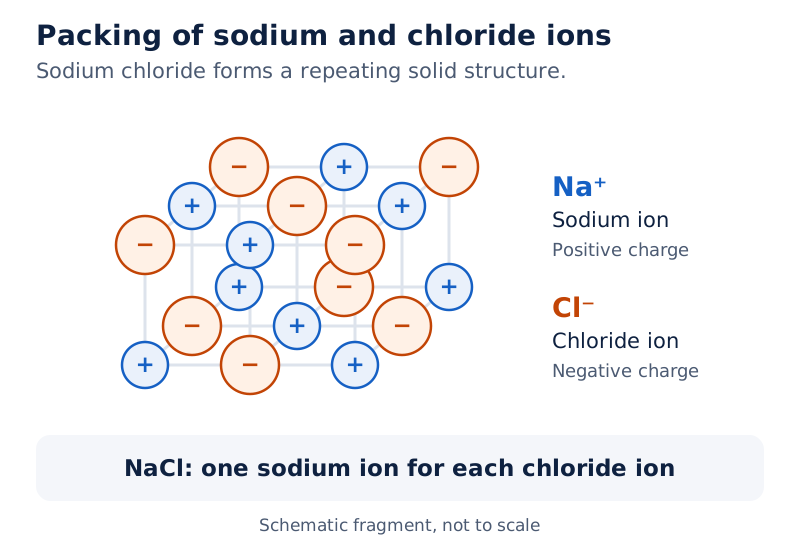
The drawing shows a three-dimensional cluster of alternating blue and orange spheres. Its caption identifies the particles as Na⁺ and Cl⁻ ions, meaning positively charged sodium ions and negatively charged chloride ions.
Drawn by One Young India.
How are mass, moles and particle number connected?
Let m represent sample mass in grams. M is the molar mass in grams per mole, n is the amount in moles, N is the number of entities, and Nₐ is the Avogadro constant in entities per mole. Keep these quantities distinct.
Derivation: obtaining amount from mass
- One mole has a mass numerically equal to the molar mass when that mass is expressed in grams.
- For n moles, multiply the mass per mole by the number of moles, giving m = n × M.
- Divide both sides by M to obtain the amount of substance from the measured sample mass.
n = m / M
The units confirm the result: grams divided by grams per mole gives moles. Reversing the calculation gives m = n × M. This conversion applies to atoms, molecules or formula units when the corresponding molar mass is used.
Derivation: obtaining particle number from amount
- Every mole contains Nₐ entities per mole, with the entities specified in the question.
- Multiplying n by Nₐ gives the number of entities in the sample.
- Substituting n = m / M connects the measured mass directly to the particle count.
N = n × Nₐ
The reverse relation is n = N / Nₐ, while the combined relation is N = (m / M) × Nₐ. Count the molecules first if a molecular substance is given; then use its formula to count atoms of a particular element.
For example, one mole of water molecules contains two moles of hydrogen atoms and one mole of oxygen atoms. The subscript in H₂O changes the number of hydrogen atoms counted. It does not change the number of water molecules in one mole of water.
Note: A molecular subscript counts atoms within a molecule. An amount in moles counts specified entities in the sample. One mole of hydrogen atoms and one mole of hydrogen molecules refer to different entities.
Which units should accompany the calculation?
SI means International System of Units. The SI unit of amount of substance is mole. The SI unit of mass is kilogram, written kg; 1 kg = 1000 g. Grams are convenient for the smaller samples commonly used in chemistry.
The SI unit of volume is cubic metre, written m³. Volume means the space occupied by a substance. A litre, written L, equals 1000 millilitres, written mL. The SI unit of temperature is kelvin, written K. Matching units prevents a correct ratio from producing an incorrect number.
What does Avogadro’s law say about gases?
Definition: Avogadro’s law states that equal volumes of gases contain equal numbers of molecules when measured at the same temperature and pressure.
Amedeo Avogadro proposed this relationship in 1811. The conditions belong to the statement itself. Equal gas volumes cannot be compared by this rule without checking that their temperatures and pressures are the same.
Because one mole contains a fixed number of molecules, equal gas volumes under these conditions also contain equal amounts in moles. Conversely, equal amounts of gases occupy equal volumes when temperature and pressure remain the same.
Does equal volume imply equal mass?
No. Equal numbers of molecules can have different masses because the molecules themselves differ in mass. The law compares numbers of molecules. It does not claim that different gases have equal molecular masses or equal densities.
Density is mass per unit volume. It is calculated as mass divided by volume. At the same temperature and pressure, differences in the masses of equal gas volumes therefore reflect differences in the masses of their molecules.
Avogadro distinguished atoms from molecules. This distinction helps explain why two volumes of hydrogen can combine with one volume of oxygen to form two volumes of water vapour. Hydrogen and oxygen occur here as molecules containing two atoms each.
The proposal initially received little support. At the first international chemistry conference in Karlsruhe, Germany, in 1860, Stanislao Cannizaro emphasised the importance of Avogadro’s work. The distinction between atoms and molecules made gas-volume relationships easier to understand.
What the figure shows
Combining volumes of hydrogen and oxygen
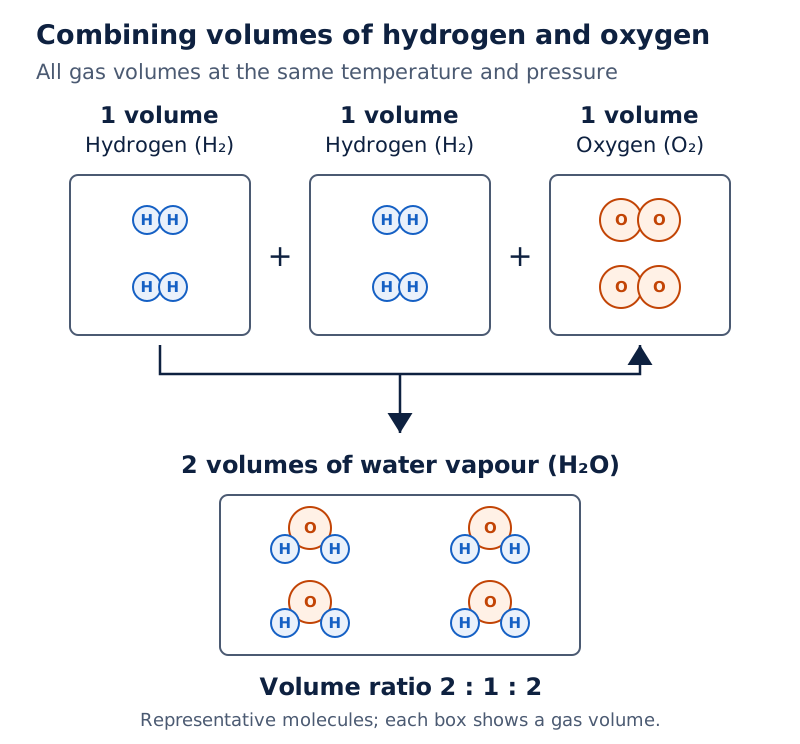
Two separate boxes are each labelled “1 volume of hydrogen”. Another box is labelled “1 volume of oxygen”. An arrow leads to a larger box labelled “2 volumes of water vapour”, containing joined hydrogen and oxygen particles.
Drawn by One Young India.
The drawing connects a visible volume ratio with a molecular interpretation. A box represents a volume of gas, not one molecule. To use the volume ratio quantitatively, all compared gas volumes must satisfy the same temperature and pressure conditions.
How do Gay Lussac’s law and atomicity explain reacting volumes?
Gay Lussac’s law of combining volumes, given in 1808, states that reacting gases and gaseous products have simple whole-number volume ratios, provided their volumes are measured at the same temperature and pressure.
For example, 100 mL of hydrogen combines with 50 mL of oxygen to produce 100 mL of water vapour under comparable conditions. The volume ratio is 2 : 1 : 2. Water must be treated as vapour when included in this gas-volume comparison.
What is atomicity?
Atomicity is the number of atoms in one molecule. Hydrogen, oxygen, nitrogen and chlorine are diatomic: their molecules contain two atoms. Their formulae are H₂, O₂, N₂ and Cl₂, respectively; N denotes nitrogen.
| Element | Molecular formula | Atomicity |
|---|---|---|
| Hydrogen | H₂ | 2 |
| Oxygen | O₂ | 2 |
| Nitrogen | N₂ | 2 |
| Chlorine | Cl₂ | 2 |
A balanced chemical equation has the same number of atoms of each element on both sides. A coefficient is the number written before a formula. An omitted coefficient means one. The arrow indicates formation of products from reactants, the starting substances.
The formation equation H₂ + Cl₂ → 2HCl represents hydrogen combining with chlorine to form hydrogen chloride. The molecules are in a 1 : 1 : 2 ratio. Their gas volumes have this ratio at the same temperature and pressure.
For ammonia, NH₃, the formation ratio is represented by N₂ + 3H₂ → 2NH₃. For nitric oxide, NO, it is N₂ + O₂ → 2NO. These equations illustrate particle and combining-volume ratios, rather than specifying a laboratory preparation procedure or complete conversion under all conditions.
Worked example 2. Hydrogen and oxygen combine in the volume ratio 2 : 1, forming water vapour in the ratio 2 : 1 : 2. Find the vapour volume from 100 mL hydrogen and 50 mL oxygen, all measured at the same temperature and pressure.
Formula: product volume = hydrogen volume × 2 / 2. Substitute: 100 mL × 2 / 2 = 100 mL.
Answer: 100 mL, or 0.100 L, of water vapour. Both reactant volumes are in the required combining ratio.
How is molar volume used in gas calculations?
Molar volume means volume per mole. For calculations at standard temperature and pressure, abbreviated STP, use 22.4 L mol⁻¹. This is the convention in which one mole of a gas occupies 22.4 L at 0 °C and one atmosphere pressure.
The symbol °C means degree Celsius, and atmosphere is a unit of pressure. State the gas conditions alongside the volume. The value 22.4 L mol⁻¹ must not be applied indiscriminately to gases at other conditions or to liquid and solid volumes.
Let V be gas volume in litres and Vₘ be molar volume in litres per mole. The amount-volume relation is V = n × Vₘ. At the stated STP convention, Vₘ = 22.4 L mol⁻¹.
Rearranging gives n = V / Vₘ. Combining the volume relation with the mass relation gives m = (V / Vₘ) × M. Here M is the molar mass of the particular gas, so the gas identity still matters when calculating mass.
What does one molar volume tell us?
The mass of 22.4 L of a gas at STP equals the mass of one mole of that gas. Different gases have different molar masses. A common molar volume therefore does not mean a common mass.
Using rounded molar masses, one mole of methane has a mass of 16 g, whereas one mole of carbon dioxide has a mass of 44 g. Both contain the same number of molecules and occupy the same molar volume under the stated gas conditions.
Figure: One mole of various substances. This photograph shows samples on shallow dishes and in glass vessels. Several samples appear white, with orange and blue samples also visible. The caption identifies them as one-mole samples; the photograph does not label their individual chemical identities.
The photograph illustrates that equal amounts in moles need not look alike. It does not establish a universal volume for solids and liquids. Gas-volume calculations rely on the specified gas conditions and the appropriate molar volume, not on the apparent size of a sample.
How does vapour density give relative molecular mass?
Vapour density in the hydrogen-relative convention is the ratio of the mass of a given volume of gas or vapour to the mass of an equal volume of hydrogen, measured at the same temperature and pressure.
A vapour is a substance in its gaseous form. The comparison uses equal volumes so that Avogadro’s law gives equal numbers of molecules in the two samples. Their mass ratio can then be connected to the masses of individual molecules.
Write vapour density as D. With hydrogen’s relative molecular mass taken as 2, the relation is Mᵣ = 2 × D. Mᵣ is the relative molecular mass of the gas or vapour; both Mᵣ and D are ratios without units.
How should the relation be interpreted?
The factor 2 comes from the hydrogen molecule, H₂, rather than a single hydrogen atom. Hydrogen is diatomic. Replacing 2 with 1 would therefore use the wrong reference particle for the comparison.
The inverse relation is D = Mᵣ / 2. Once relative molecular mass is known, the corresponding numerical value can be used for molar mass in g mol⁻¹. That molar mass can then connect a measured mass to an amount in moles.
Density and vapour density must be distinguished. The SI unit of density is kilogram per cubic metre, written kg m⁻³. Density has units because it divides mass by volume. Vapour density divides one mass by another mass under matched conditions, so the units cancel.
Note: The relation Mᵣ = 2 × D requires vapour density relative to hydrogen. A density stated in grams per litre is not itself a vapour-density ratio and cannot simply be doubled to obtain relative molecular mass.
When molecular formula is required, vapour density can provide the relative molecular mass. Composition data provide the simplest atomic ratio. These are different pieces of information, and both are needed if the molecular formula is a multiple of the simplest formula.
How is percentage composition calculated from a formula?
Percentage composition by mass gives the mass of each element in 100 mass units of a compound. It describes a mass ratio, not the percentage of atoms. The symbol % means per hundred.
To calculate it, add the masses contributed by all atoms of each element in the formula. Divide an element’s contribution by the total formula or molecular mass, then multiply by 100. Use a consistent set of atomic masses throughout the calculation.
Mass percentage = (element’s mass contribution / total mass) × 100
Why do subscripts matter?
A formula subscript tells how many atomic masses to include. Water, H₂O, requires two hydrogen contributions and one oxygen contribution. Ethanol, C₂H₅OH, contains two carbon atoms, six hydrogen atoms and one oxygen atom; the hydrogen in OH must also be counted.
Worked example 3. Find the percentage composition of water using H = 1.008 u, O = 16.00 u and rounded molar mass 18.02 g mol⁻¹.
Formula: mass percentage = element’s mass in one mole / mass of one mole × 100. Substitute: hydrogen = 2.016 / 18.02 × 100; oxygen = 16.00 / 18.02 × 100.
Answer: in 18.02 g of water, hydrogen contributes 11.19% and oxygen contributes 88.79%. The small difference from a total of 100% results from the rounded values used.
Worked example 4. Find the percentage composition of ethanol, C₂H₅OH, using C = 12.01 u, H = 1.008 u and O = 16.00 u.
Formula: molar mass = sum of atomic contributions; mass percentage = element’s contribution / total × 100. Substitute: molar mass = 24.02 + 6.048 + 16.00 = 46.068 g mol⁻¹.
Answer: carbon = 24.02 / 46.068 × 100 = 52.14%; hydrogen = 6.048 / 46.068 × 100 = 13.13%; oxygen = 16.00 / 46.068 × 100 = 34.73%.
The hydrogen atom count in ethanol is greater than the carbon atom count, yet hydrogen contributes less mass. Atomic masses, as well as atom numbers, determine percentage composition. Comparing subscripts alone cannot give the mass percentages.
Composition information can help check whether a sample has the elemental percentages expected for a pure compound. It also supplies the starting data for finding an empirical formula, where masses must first be converted into amounts in moles.
How are empirical and molecular formulae determined?
An empirical formula gives the simplest whole-number ratio of atoms of the elements in a compound. A molecular formula gives the actual number of atoms of each element in one molecule. The same empirical ratio can therefore represent more than one molecular formula.
How are masses converted into an atomic ratio?
- If percentages are given, consider 100 g of compound so each percentage becomes a mass in grams.
- Divide each element’s mass by its atomic molar mass to obtain moles of its atoms.
- Divide every mole value by the smallest mole value to obtain the simplest ratio.
- If necessary, multiply all ratio values by the same suitable factor to obtain whole numbers, then write the formula.
If actual masses of combining elements are supplied, begin directly with those masses. A 100 g sample is convenient for percentages; it is not a required sample size for every calculation. Mass ratios themselves are not atom ratios.
Let k be the whole-number multiplier relating the molecular formula to the empirical formula. Let E be the numerical empirical formula mass. Using the numerical relative molecular mass Mᵣ, the relation is k = Mᵣ / E.
Worked example 5. A compound contains 4.07% hydrogen, 24.27% carbon and 71.65% chlorine by mass. Its molar mass is 98.96 g mol⁻¹. Use atomic molar masses H = 1.008, C = 12.01 and Cl = 35.453 g mol⁻¹ to find both formulae.
Formula: n = m / M; k = Mᵣ / E. First convert the elemental masses to moles; then use the molecular-to-empirical mass ratio to find the formula multiplier.
Substitute: in 100 g, hydrogen gives 4.07 / 1.008 ≈ 4.04 mol; carbon gives 24.27 / 12.01 ≈ 2.021 mol; chlorine gives 71.65 / 35.453 ≈ 2.021 mol. Divide by 2.021 to obtain H : C : Cl = 2 : 1 : 1.
Answer: the empirical formula is CH₂Cl. Its empirical formula mass is 12.01 + 2 × 1.008 + 35.453 ≈ 49.48 u. The molar mass, 98.96 g mol⁻¹, is twice the corresponding 49.48 g mol⁻¹, so the molecular formula is C₂H₄Cl₂.
How is the molecular multiplier found?
Multiply every subscript in the empirical formula by k. A subscript of one, though not normally written, must also be multiplied. For CH₂Cl with k = 2, carbon and chlorine each acquire subscript 2, while hydrogen acquires subscript 4.
Note: Composition establishes an empirical ratio. Molecular mass, molar mass or hydrogen-relative vapour density supplies the additional size information needed to select the molecular formula.
The example’s percentages total 99.99% because they are rounded. Preserve the supplied precision during the calculation. Its nearly equal carbon and chlorine mole amounts support a 1 : 1 ratio; the hydrogen amount is approximately twice either of them.
How are balanced equations used for stoichiometric calculations?
Stoichiometry calculates the quantities of reactants and products in a chemical reaction. Its name comes from the Greek words stoicheion, meaning element, and metron, meaning measure. A balanced equation supplies the particle and mole ratios needed for these calculations.
The law of conservation of mass, put forward by Antoine Lavoisier in 1789, states that mass is neither created nor destroyed in a chemical reaction. It underlies balancing. Chemical reactions reorganise atoms. Balance an equation by changing its coefficients, not by altering subscripts in chemical formulae.
How is an equation balanced before calculation?
For combustion, meaning reaction with oxygen in burning, propane has formula C₃H₈. Carbon dioxide is CO₂. The state labels (g), (l) and (s) mean gas, liquid and solid respectively.
- Start with C₃H₈(g) + O₂(g) → CO₂(g) + H₂O(l).
- Balance carbon by placing 3 before CO₂.
- Balance hydrogen by placing 4 before H₂O.
- There are now ten oxygen atoms in the products, so place 5 before O₂.
- Check the result: C₃H₈(g) + 5O₂(g) → 3CO₂(g) + 4H₂O(l), with equal atom counts for each element on both sides.
The methane equation is CH₄(g) + 2O₂(g) → CO₂(g) + 2H₂O(g). Its coefficients are 1 : 2 : 1 : 2. These are mole ratios; multiplying each amount by its molar mass gives the corresponding mass relationships.
| Substance | Amount in the equation | Corresponding mass using rounded molar masses |
|---|---|---|
| Methane | 1 mol | 16 g |
| Oxygen | 2 mol | 64 g |
| Carbon dioxide | 1 mol | 44 g |
| Water | 2 mol | 36 g |
How are masses calculated from mole ratios?
Worked example 6. Calculate the mass of water produced by complete combustion of 16 g methane with sufficient oxygen. Use CH₄ + 2O₂ → CO₂ + 2H₂O and molar masses methane = 16 g mol⁻¹, water = 18 g mol⁻¹.
Formula: n = m / M; m = n × M. Substitute: methane amount = 16 / 16 = 1 mol; water amount = 1 × 2 = 2 mol; water mass = 2 × 18.
Answer: 36 g of water. The factor 2 comes from the balanced equation, not from a comparison of the two molar masses.
Worked example 7. How many moles of methane are required to produce 22 g carbon dioxide by complete combustion? Use CH₄ + 2O₂ → CO₂ + 2H₂O and carbon dioxide molar mass 44 g mol⁻¹.
Formula: n = m / M. Substitute: carbon dioxide amount = 22 / 44 = 0.5 mol. The methane-to-carbon-dioxide mole ratio is 1 : 1.
Answer: 0.5 mol methane is required, with sufficient oxygen for the stated reaction.
Worked example 8. For complete combustion of 16 g methane with sufficient oxygen, calculate the volume of carbon dioxide at STP. Use CH₄ + 2O₂ → CO₂ + 2H₂O, methane molar mass 16 g mol⁻¹ and molar volume 22.4 L mol⁻¹.
Formula: n = m / M; V = n × Vₘ. Substitute: methane amount = 16 / 16 = 1 mol. The equation gives 1 mol carbon dioxide from 1 mol methane, so carbon dioxide volume = 1 × 22.4.
Answer: 22.4 L of carbon dioxide at STP. Apply the volume conversion to the carbon dioxide amount obtained from the equation, and retain the stated conditions with the answer.
For a mass-volume calculation, convert the known mass to moles, apply the equation’s mole ratio, and convert the required gaseous amount to volume at the stated conditions. For a volume-volume calculation, coefficients give the ratio directly when gas temperatures and pressures match.
These relationships describe the quantities consumed or formed in the stated reaction. If two reactant amounts are supplied, check whether their ratio matches the equation. Do not assume that all of both reactants reacts when their quantities are out of proportion.
Glossary
- Mole — Unit of amount of substance containing exactly 6.02214076 × 10²³ specified elementary entities.
- Avogadro constant — Number of specified entities per mole, commonly rounded to 6.022 × 10²³ mol⁻¹ in calculations.
- Atomic mass unit — Mass unit equal to one-twelfth of the mass of a carbon-12 atom.
- Molecular mass — Sum of the atomic masses of all atoms present in a single molecule.
- Molar mass — Mass per mole of a specified substance, commonly expressed in grams per mole.
- Gram atom — One mole of atoms of an element, with its mass expressed in grams.
- Gram molecule — One mole of molecules, whose mass in grams equals the numerical molecular mass.
- Atomicity — Number of atoms in one molecule, such as two in a hydrogen molecule.
- Molar volume — Volume per mole of a substance, requiring stated temperature and pressure for gas calculations.
- Vapour density — Ratio of masses of equal volumes of a gas and hydrogen at identical temperature and pressure.
- Percentage composition — Mass of each constituent element expressed as a percentage of the total compound mass.
- Empirical formula — Formula representing the simplest whole-number ratio of the atoms of different elements in a compound.
- Molecular formula — Formula showing the actual number of atoms of each element present in one molecule.
- Stoichiometry — Calculation of quantities of reactants and products using the relationships in a balanced chemical equation.
- Stoichiometric coefficient — Number before a chemical formula in a balanced equation, indicating its relative number of molecules or moles.
Common errors and misconceptions
- Misconception: One mole of every substance has the same mass. Correct: One mole has a fixed entity count; its mass depends on the substance’s molar mass.
- Misconception: One mole of hydrogen molecules contains one mole of hydrogen atoms. Correct: H₂ contains two atoms per molecule, so one mole of molecules contains two moles of atoms.
- Misconception: Equal gas volumes contain equal numbers of molecules under any conditions. Correct: Avogadro’s law requires the same temperature and pressure.
- Misconception: Every mole of matter occupies 22.4 L. Correct: This molar-volume value is used for gases at the stated STP convention, not for liquids or solids.
- Misconception: Chemical-equation coefficients give a mass ratio. Correct: They give a mole ratio; multiply each amount by its own molar mass to obtain masses.
- Misconception: Elemental mass percentages can be written directly as formula subscripts. Correct: Convert masses to mole amounts and then find their simplest whole-number ratio.
- Misconception: Empirical formula and molecular formula mean the same thing. Correct: The empirical formula gives a simplest ratio; the molecular formula gives actual atom numbers.
- Misconception: Vapour density carries units of grams per litre. Correct: Hydrogen-relative vapour density is a ratio without units; ordinary density is mass per volume.
Exam-style questions with model answers
Q1. State Avogadro’s law and explain why equal gas volumes need not have equal masses. [2 marks]
- Equal gas volumes contain equal numbers of molecules when their temperature and pressure are the same.
- The molecules of different gases can have different masses, so equal molecule counts do not imply equal sample masses.
Q2. Calculate the molecular mass and corresponding molar mass of glucose, C₆H₁₂O₆. Use atomic masses C = 12.011 u, H = 1.008 u and O = 16.00 u. [3 marks]
- The formula contains six carbon atoms, twelve hydrogen atoms and six oxygen atoms. Their separate mass contributions are 6 × 12.011 = 72.066 u, 12 × 1.008 = 12.096 u, and 6 × 16.00 = 96.00 u.
- Add these contributions: molecular mass = 72.066 + 12.096 + 96.00 = 180.162 u for one glucose molecule.
- The molar mass has the corresponding numerical value in grams per mole, so it is 180.162 g mol⁻¹.
Q3. Hydrogen and oxygen form water vapour by 2H₂(g) + O₂(g) → 2H₂O(g). Calculate the vapour volume from 100 mL hydrogen and 50 mL oxygen reacting completely. All volumes are measured at the same temperature and pressure. Explain the ratio used. [3 marks]
- The balanced equation gives hydrogen : oxygen : water vapour in the molecule and mole ratio 2 : 1 : 2. Because all the substances are gases at the same temperature and pressure, this is also their volume ratio.
- The supplied volumes are 100 : 50, or 2 : 1, so the hydrogen and oxygen are present in exactly the required combining ratio.
- Water vapour volume = 100 mL × 2 / 2 = 100 mL. The answer refers to gaseous water under the stated conditions.
Q4. A compound contains 4.07% H, 24.27% C and 71.65% Cl by mass and has molar mass 98.96 g mol⁻¹. Using atomic molar masses H = 1.008, C = 12.01 and Cl = 35.453 g mol⁻¹, calculate its empirical and molecular formulae. [5 marks]
- Consider 100 g of the compound. The masses are then 4.07 g hydrogen, 24.27 g carbon and 71.65 g chlorine; choosing 100 g turns the percentages directly into gram values.
- Divide each mass by its atomic molar mass: hydrogen gives approximately 4.04 mol, carbon 2.021 mol and chlorine 2.021 mol. These quantities count moles of the respective atoms.
- Divide by the smallest value, 2.021. The atomic ratio H : C : Cl becomes 2 : 1 : 1, giving empirical formula CH₂Cl.
- The empirical formula mass is 12.01 + 2 × 1.008 + 35.453 ≈ 49.48 u. The molecular multiplier is 98.96 / 49.48 = 2.
- Multiply every empirical subscript by two, including the unwritten ones for carbon and chlorine. The molecular formula is therefore C₂H₄Cl₂.
Q5. Complete combustion follows CH₄(g) + 2O₂(g) → CO₂(g) + 2H₂O(g). Calculate the mass of water formed from 16 g methane with sufficient oxygen. Use molar masses methane = 16 g mol⁻¹ and water = 18 g mol⁻¹, and explain your conversion steps. [4 marks]
- First convert the measured methane mass into amount: moles of methane = mass / molar mass = 16 / 16 = 1 mol.
- The balanced equation states that each mole of methane produces two moles of water. Its coefficients supply the required mole ratio.
- The amount of water produced is therefore 1 × 2 = 2 mol, assuming the stated complete combustion with sufficient oxygen.
- Convert the water amount into mass using its own molar mass: 2 × 18 = 36 g of water.
Q6. Complete combustion follows CH₄ + 2O₂ → CO₂ + 2H₂O. How many moles of methane are required to produce 22 g carbon dioxide? Use carbon dioxide molar mass 44 g mol⁻¹ and assume sufficient oxygen. [3 marks]
- Convert the specified carbon dioxide mass into amount of substance by dividing by its molar mass: 22 g / 44 g mol⁻¹ = 0.5 mol carbon dioxide.
- The equation shows a methane-to-carbon-dioxide mole ratio of 1 : 1. Each mole of methane undergoing the stated complete combustion produces one mole of carbon dioxide.
- The required methane amount is therefore 0.5 mol. The one-to-one coefficient ratio applies to moles, rather than equal masses of the two substances.
Q7. Methane has relative molecular mass 16. Define vapour density relative to hydrogen and calculate it using Mᵣ = 2D, where Mᵣ is relative molecular mass and D is vapour density. [2 marks]
- Vapour density is the mass ratio of equal volumes of the gas and hydrogen at the same temperature and pressure.
- D = Mᵣ / 2 = 16 / 2 = 8. This ratio has no unit.
Q8. A 16 g methane sample has molar mass 16 g mol⁻¹. Calculate its amount, molecule count and volume at STP. Use Nₐ = 6.022 × 10²³ mol⁻¹ and molar volume 22.4 L mol⁻¹. [3 marks]
- The amount of methane is obtained from its mass and molar mass: n = 16 g / 16 g mol⁻¹ = 1 mol.
- The number of methane molecules is n × Nₐ = 1 × 6.022 × 10²³ = 6.022 × 10²³ molecules. This counts molecules, not the individual atoms within them.
- At the specified STP convention, the gas volume is n × molar volume = 1 × 22.4 = 22.4 L.
Key takeaways
- A mole counts specified particles; equal mole amounts contain equal numbers of those particles, even when their masses differ.
- Molar mass connects measured mass with amount of substance: divide mass by molar mass to obtain moles.
- Avogadro’s law compares gas volumes at the same temperature and pressure; Gay Lussac’s law gives simple combining-volume ratios.
- Hydrogen, oxygen, nitrogen and chlorine are diatomic, so their molecular formulae each contain a subscript two.
- Use 22.4 litres per mole for gases at the stated STP convention, keeping volume units consistent.
- Hydrogen-relative vapour density is half the relative molecular mass, and neither quantity has a unit.
- Convert elemental masses into mole amounts before finding an empirical ratio; molecular mass then determines the molecular multiplier.
- Balanced equations give mole ratios; converting these to masses requires the separate molar mass of each substance.
Test yourself
What must be specified when stating an amount in moles?
Specify the entities being counted, such as atoms, molecules, ions or formula units.
Why does one mole of water contain two moles of hydrogen atoms?
Each water molecule contains two hydrogen atoms, so the hydrogen atom count is twice the water molecule count.
What two conditions must match when applying Avogadro’s law?
The gas samples must be at the same temperature and the same pressure.
Why can a liquid-water volume not replace a water-vapour volume in Gay Lussac’s law?
The law relates gas volumes; liquid water does not occupy the same volume as the corresponding water vapour.
How does vapour density differ from ordinary density?
Vapour density is a ratio relative to hydrogen under matched conditions; ordinary density is mass per unit volume.
Why must percentage masses be divided by atomic molar masses when finding an empirical formula?
The empirical formula represents atom ratios, so masses must first be converted into comparable mole amounts of atoms.
Which numbers may be changed when balancing a chemical equation?
Change coefficients before formulae while preserving the subscripts that identify the chemical substances.
What information is needed after an empirical formula to obtain a molecular formula?
The molecular mass or equivalent molar mass information is needed to calculate the whole-number formula multiplier.
Try it
Mole Concept and Stoichiometry: ICSE Class 10 Chemistry
Test your understanding of the mole concept and stoichiometry with these lab scenarios.
1Your lab partner weighs out 12 g of carbon (1 mole) and 16 g of oxygen (1 mole). They argue that the oxygen sample must contain more atoms because it is heavier. How should you correct them based on the mole concept?
Correct! The text explains that one mole of carbon (12 g) and one mole of oxygen (16 g) contain the same number of atoms. The mass differs because each atom has a different mass, not because the count differs.
Incorrect. The text states that one mole always contains 6.023 × 10^23 particles. The mass differs because individual oxygen atoms are heavier, not because there are more of them.
Incorrect. A mole is a fixed count (6.023 × 10^23 particles) regardless of the element's mass. Both 12 g of carbon and 16 g of oxygen contain the exact same number of atoms.
2You are preparing to synthesize water using the equation 2H2 + O2 → 2H2O. A classmate suggests mixing 2 grams of hydrogen with 1 gram of oxygen, assuming the 2:1 ratio in the equation applies to their masses. Why will this approach fail?
Correct! The text explicitly states that a balanced chemical equation tells you the mole ratio of reactants and products, not the mass ratio. You must convert given quantities to moles first to find the correct reacting amounts.
Incorrect. While you can use volume for gases at STP, the fundamental error here is assuming the 2:1 ratio applies to mass. The text notes that the coefficients mean 2 moles of hydrogen react with 1 mole of oxygen.
Incorrect. The text defines the limiting reagent as the reactant that produces the least product, not simply the heavier element. The real issue is that the 2:1 ratio is a mole ratio, not a mass ratio.
Great job! You've demonstrated that the mole is a counting unit (always 6.023 × 10^23 particles) and that chemical equations provide mole ratios, not mass ratios, which are the foundational rules of stoichiometry.