
Motion in a Plane | CBSE Class 11 Physics Notes
On this page
Watch & explore
Start with a few high-quality watches, then dive into the notes below.
This note covers scalars and vectors, vector addition and resolution, position and displacement, velocity and acceleration in a plane, motion with constant acceleration, projectile trajectories, time of flight, maximum height, horizontal range, and uniform circular motion.
How do scalars and vectors describe motion in a plane?
Magnitude, direction and physical meaning
A scalar is specified by a magnitude with an appropriate unit. Distance, mass, temperature and time are examples. Scalars follow ordinary algebra, but addition and subtraction require compatible physical quantities expressed in the same units.
A vector has magnitude and direction and obeys the triangle or parallelogram law of addition. Displacement, velocity, acceleration and force are examples. Direction alone does not make a quantity a vector; its rule of addition also matters.
Let denote a vector and its magnitude. Then . An arrow represents its direction, while the arrow's length, drawn to a chosen scale, represents its magnitude. Equal vectors have both equal magnitudes and the same direction.
The free vectors used here can be shifted parallel to themselves without changing them. Two equally long arrows pointing in different directions represent unequal vectors. Changing the position of an arrow is different from rotating it.
Unit symbols used below are for metre, for second, for kilometre, for hour, and for centimetre. Superscript negative powers express rates, such as metres per second.
Position is different from displacement
Choose an origin . The position vector points from the origin to the particle. If is its later position vector, the displacement , meaning change in position, is .
Displacement joins the initial position to the final position. It depends on these endpoints, whereas path length depends on the actual route. The SI unit of displacement is the metre, written . Its magnitude cannot exceed the distance travelled.
| Quantity | Information required | Dependence on route |
|---|---|---|
| Path length | Scalar distance travelled | Depends on the actual path |
| Displacement | Magnitude and direction between endpoints | Depends on initial and final positions |
| Position vector | Vector from a chosen origin | Identifies a location relative to that origin |
If a particle moves away and returns to its starting point, its displacement is a null vector, although its path length need not be zero. A null vector has zero magnitude and no specified direction.
How are vectors multiplied, added and subtracted?
Multiplication by a real number
Let be a real multiplier. Multiplication gives . A positive multiplier preserves direction; a negative multiplier reverses it. The vector has the same magnitude as , but points oppositely.
A multiplier may itself have physical units. Multiplying a constant velocity vector by a time interval produces a displacement vector. In this example, the resulting unit is a unit of displacement rather than velocity.
Graphical rules
For the triangle law, place the tail of a second vector at the head of . The resultant joins the tail of the first vector to the head of the second: .
For the parallelogram law, place both tails at a common point and complete the parallelogram. The diagonal directed from that point represents the resultant. Both methods give the same sum, provided the vectors retain their magnitudes and directions.
What the figure shows
Head-to-tail addition
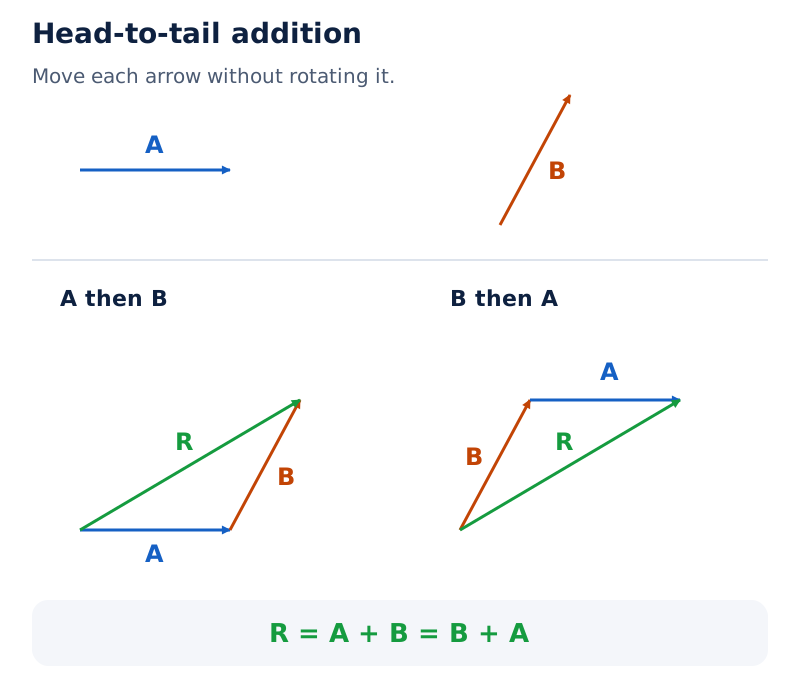
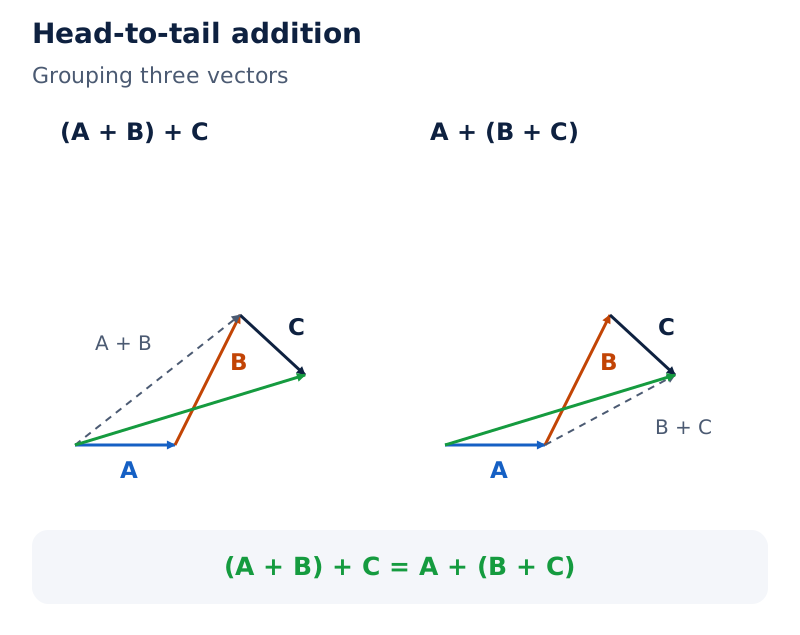
Separate arrows labelled and are followed by two triangular constructions with their order reversed. The resultant arrows join the initial tail to the final head. A further construction introduces a third vector to illustrate grouping.
Drawn by One Young India. See Fig. 3.4 in your NCERT textbook
Vector addition is commutative: . It is also associative: , where is a third vector of the same physical kind.
Subtraction means adding the opposite vector: . Thus , where is the null vector. Reversing the subtracted vector is essential; merely shortening the first arrow does not generally represent subtraction.
Note: Adding magnitudes is not a general rule for adding vectors. Direction must be included. Likewise, a scalar component cannot be added directly to a vector as though both were the same type of quantity.
How is a vector resolved into rectangular components?
Unit vectors and components
A unit vector has magnitude one and specifies a direction. It has no physical unit or dimension. The symbols , and denote unit vectors along the positive coordinate axes , and , respectively.
Let and be the signed scalar components of along two perpendicular axes. Its rectangular representation is . Each component carries the physical unit of the original vector, while the unit vectors supply direction.
If is the angle measured from the positive horizontal axis to the vector, the projections are and . Components can be positive, negative or zero. A negative component indicates a direction opposite to its positive axis.
What the figure shows
Rectangular resolution
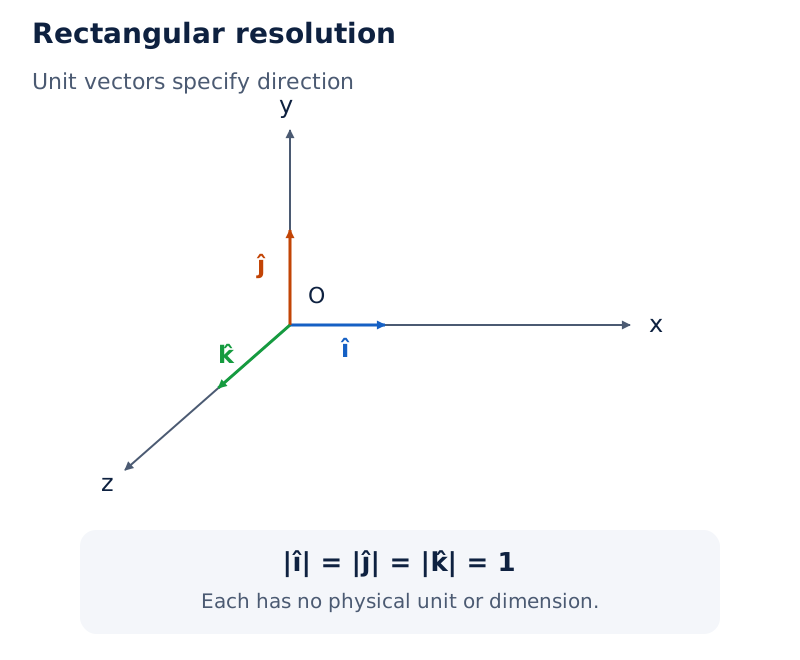
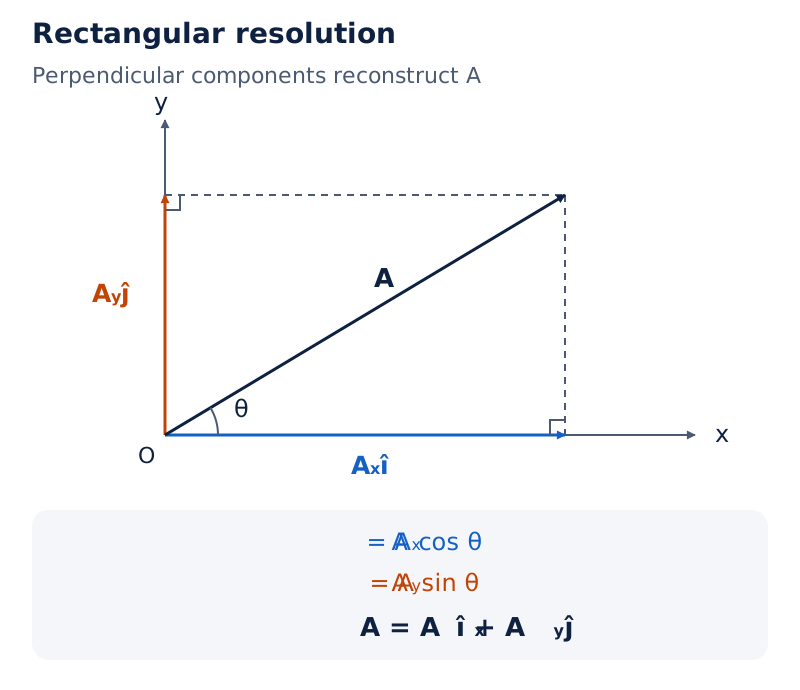
The first panel shows three coordinate axes and their unit vectors. The next two show a slanting vector , dashed perpendicular projections, and horizontal and vertical components. The angle lies between the slanting arrow and the positive horizontal axis.
Drawn by One Young India. See Fig. 3.9 in your NCERT textbook
Recovering magnitude and direction
The magnitude follows from perpendicular components: . For a non-zero horizontal component, the direction satisfies . The component signs identify the correct quadrant; an inverse tangent value alone can be ambiguous.
The distinction between a scalar component and a component vector is important. The expression is a signed number with units, whereas is a vector. Their physical dimensions agree, but their mathematical roles differ.
The method extends to space: , where is the third scalar component. Its magnitude is . Motion confined to a plane requires only two independent coordinate directions.
Resolution is also possible along two non-collinear directions in the same plane. Rectangular axes are especially convenient because each projection and the reconstruction of magnitude follow directly from right-angled triangle geometry.
How do components give the resultant of two vectors?
Analytical addition and the resultant formula
Let and denote the components of , and and those of the resultant. Add corresponding components: , . Then , where is the resultant magnitude.
The analytical method avoids the limited accuracy of measuring a scale drawing. Subtraction uses the same method with component differences. Resolve all vectors along the same chosen axes before combining them.
Derivation: Magnitude and direction of a resultant
Let be the magnitude of , the angle between the two vectors, and the angle of their non-zero resultant from . Choose the horizontal direction along .
- Resolve both vectors:
- Square and add the perpendicular components:
- Use the trigonometric identity to simplify:
- Recover magnitude and direction: The tangent expression requires a non-zero denominator; use the component signs to select the direction.
Result: The angle between the original vectors determines the resultant magnitude. For perpendicular vectors, the cosine term vanishes. The direction formula describes the resultant relative to the first vector, not necessarily relative to a compass direction.
Worked example 1. Rain falls vertically at . Wind adds a westward velocity of . Find the rain's resultant speed and the direction in which a stationary boy should tilt his umbrella.
Formula: Let be the downward speed, the westward speed, and the angle from the vertical. Then and .
Substitute: The two components are perpendicular, so calculate their resultant without adding their magnitudes directly.
- Calculate speed:
- Calculate the tilt angle:
Answer: The speed is . The umbrella should tilt about towards the east from the vertical, facing the arriving rain.
Worked example 2. A motorboat travels north at relative to the water. The current is , directed east of south. Find the resultant velocity.
Formula: Choose east and north as the positive axes. The current contributes a positive eastward component and a negative northward component. Use and , with measured east of north.
Substitute: Retain the signs of the current components.
- Eastward component:
- Northward component:
- Magnitude and direction:
Answer: The resultant velocity is approximately , directed east of north.
Adding velocities versus relative velocity
Distinguish resultant velocity from relative velocity. If and are two contributions to one object's velocity, their resultant is their vector sum. If they describe two objects in a common frame, the first object's velocity relative to the second is .
In the latter expression, denotes relative velocity. The physical interpretation determines whether to add or subtract. Components make either operation systematic, but cannot replace identifying what the given velocities refer to.
How are velocity and acceleration defined in a plane?
Average and instantaneous quantities
Let and be the particle's coordinates at time . Its position is . Over a positive time interval , its average velocity is .
Average velocity points along displacement. Average speed instead uses total path length divided by elapsed time. Consequently, average speed is at least as large as the magnitude of average velocity. Equality requires the path length to equal the displacement magnitude.
The instantaneous velocity is the limiting average velocity: . It points along the tangent to the path in the direction of motion.
The components are and . Speed, denoted by , is . The SI unit of velocity is the metre per second, written .
Let be the change in velocity. Average acceleration is . Instantaneous acceleration is , with components and .
The SI unit of acceleration is the metre per second squared, written . In a plane, acceleration need not be parallel to velocity. A change in direction alone can produce acceleration even when speed remains unchanged.
Worked example 3. A particle has position . Find its velocity and acceleration, then its speed and direction at .
Formula: Use and . The constant third coordinate contributes no velocity.
Substitute: Differentiate each coordinate separately.
- Velocity:
- Acceleration:
- At the specified time:
- Let be the velocity angle from the positive horizontal axis:
Answer: The speed is , directed about above the positive horizontal axis. Acceleration is constant along the positive vertical coordinate direction.
How is motion with constant acceleration solved?
Derivation: Vector equations of motion
Let and be initial position and initial velocity at . Let remain constant in both magnitude and direction throughout the interval.
- Constant acceleration equals average acceleration:
- Rearrange to obtain the velocity:
- Use the average velocity for constant acceleration:
- Substitute the velocity expression:
Result: The position is . The constant-acceleration condition concerns the whole vector, not just its magnitude.
Independent components, common time
Write for initial coordinates and for initial velocity components. Then and . The corresponding velocities are and .
The two directions can be treated as independent one-dimensional motions occurring simultaneously. They share the same time. Solve one coordinate equation for the relevant time, then substitute that time into the other coordinate and velocity equations.
Worked example 4. A particle starts at the origin with velocity and constant acceleration . Find its vertical coordinate and speed when its horizontal coordinate is .
Formula: Here and , because the initial coordinates and initial vertical velocity are zero.
Substitute: First find the positive elapsed time.
- The horizontal equation is Its positive solution is , verified by
- The vertical coordinate is
- The velocity components are
- The speed is
Answer: The vertical coordinate is and the speed is approximately .
What assumptions and equations describe projectile motion?
Horizontal and vertical motion
A projectile is an object in flight after being thrown or projected. In the ideal model, air resistance is negligible and gravity supplies a constant downward acceleration. A football or cricket ball in flight can be treated this way when those assumptions are suitable.
Let denote the positive magnitude of gravitational acceleration, the launch speed, and the launch angle above the horizontal. Put the origin at launch, with horizontal positive in the direction of projection and vertical positive upwards.
Then , , , and . The positions are and . The velocities are and .
The horizontal velocity remains constant while the vertical velocity changes continuously. At the highest point, the vertical component is zero. The horizontal component remains, so the projectile is generally still moving. Its acceleration remains downward there.
What the figure shows
Components along a projectile trajectory
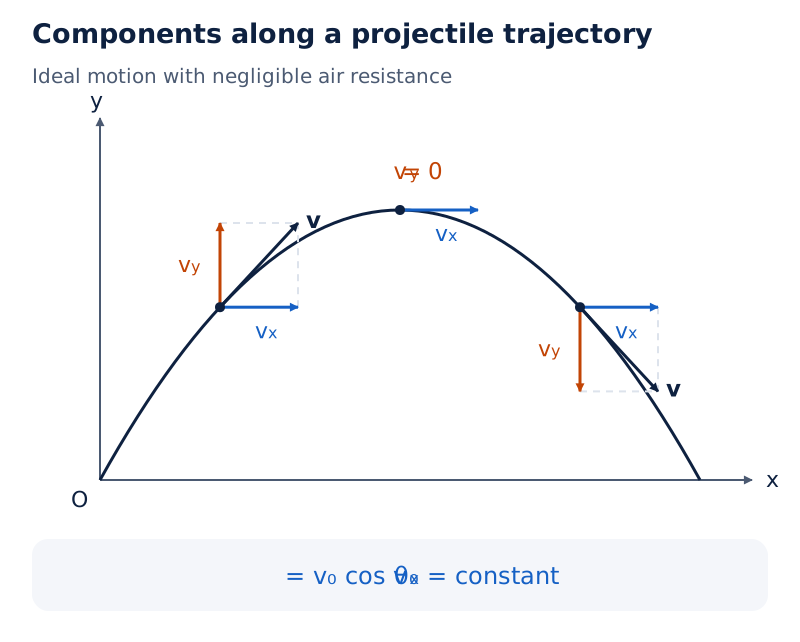
A parabolic arc starts at the origin and returns to the horizontal axis. Velocity arrows are drawn tangent to the rising and falling branches. The highest point has a horizontal velocity arrow and a label showing zero vertical velocity. Component arrows distinguish horizontal and vertical motion.
Drawn by One Young India. See Fig. 3.17 in your NCERT textbook
Landing below the launch point
Worked example 5. A stone is thrown horizontally at from a cliff above the ground. Neglect air resistance and take . Find the flight time and impact speed.
Formula: With the origin at the cliff edge, , , and . The ground has a negative vertical coordinate.
Substitute: Use the vertical drop to find time, then combine the impact velocity components.
- Flight time:
- Impact components:
- Impact speed:
Answer: The flight lasts , and the impact speed is approximately .
This case illustrates why the landing height matters. A horizontal launch does not imply zero flight time. The vertical displacement determines when the projectile reaches the ground, even though its initial vertical velocity is zero.
Why is the ideal projectile trajectory a parabola?
Derivation: Eliminating time
Assume constant downward gravity, negligible air resistance, launch from the origin, and non-zero horizontal launch velocity. Use the same coordinates, launch speed and projection angle as above.
- Start with horizontal motion:
- Substitute this time into the vertical equation:
- Simplify the two terms:
Result: The vertical coordinate is a quadratic function of the horizontal coordinate. Since the launch speed, angle and gravitational acceleration are fixed, the path is a parabola.
What the trajectory equation does and does not describe
The equation relates position coordinates; it is not a velocity-time relation. It allows the height at a horizontal position to be calculated without separately displaying the elapsed time. Its form follows from uniform horizontal motion combined with uniformly accelerated vertical motion.
A strictly vertical projection has zero horizontal velocity, so dividing by that component is invalid. Its trajectory is a straight vertical line. Thus initial conditions matter: gravitational acceleration alone does not determine whether the path is a line or a parabola.
For a horizontal launch, the initial vertical component is zero, but the quadratic downward term remains. Gravity still changes the vertical position while horizontal motion continues. With the origin at launch, positions below launch have negative vertical coordinates.
Note: Keep the coordinate convention consistent. Taking upward as positive makes vertical acceleration negative. The symbol denotes its positive magnitude; it does not become a negative number simply because the motion is downward.
How are maximum height, flight time and horizontal range obtained?
Derivation: Height and time of flight
For an upward launch, let be the time to maximum height, the maximum height above launch, and the flight time back to the launch level. Gravity remains constant and air resistance is negligible.
- At the highest point, vertical velocity vanishes:
- Substitute this time into vertical displacement:
- For return to launch height, put vertical displacement equal to zero:
- Select the non-zero return time:
Result: The ascent and descent times are equal for return to the same level under these assumptions. The SI unit of time of flight is the second, written .
Derivation: Horizontal range
Let now denote horizontal range, the distance from launch to return at the same height. Let denote its maximum value for a fixed launch speed.
- Multiply constant horizontal velocity by flight time:
- Insert the return time and use the double-angle identity:
- Maximise the sine factor:
Result: The greatest range occurs at for equal launch and landing heights. This conclusion presumes negligible air resistance and a fixed launch speed.
Complementary launch angles give equal ranges under these same conditions. If denotes an equal angular departure on either side of , then . The angles share a range, although their heights and flight times differ.
Worked example 6. A cricket ball is thrown at , at above the horizontal, and returns to the same level. Neglect air resistance and use . Find maximum height, flight time and range.
Formula: Use , , and .
Substitute: The initial vertical component is .
- Maximum height:
- Flight time:
- Range:
Answer: The maximum height is , the flight time is approximately , and the range is approximately .
Why is an object in uniform circular motion accelerating?
Constant speed does not mean constant velocity
In uniform circular motion, an object follows a circle at constant speed. Its velocity is tangent to the circle and changes direction continuously. Because acceleration measures change in the velocity vector, a constant speed does not imply zero acceleration.
Let now represent the circle's radius, and the constant speed. The instantaneous acceleration points towards the centre and is called centripetal acceleration. Its magnitude is denoted by .
What the figure shows
Circular motion and velocity change
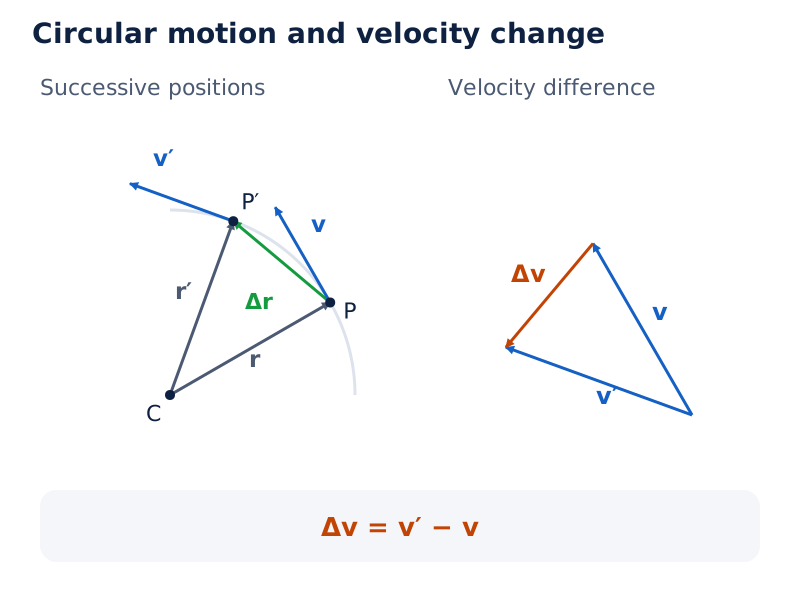
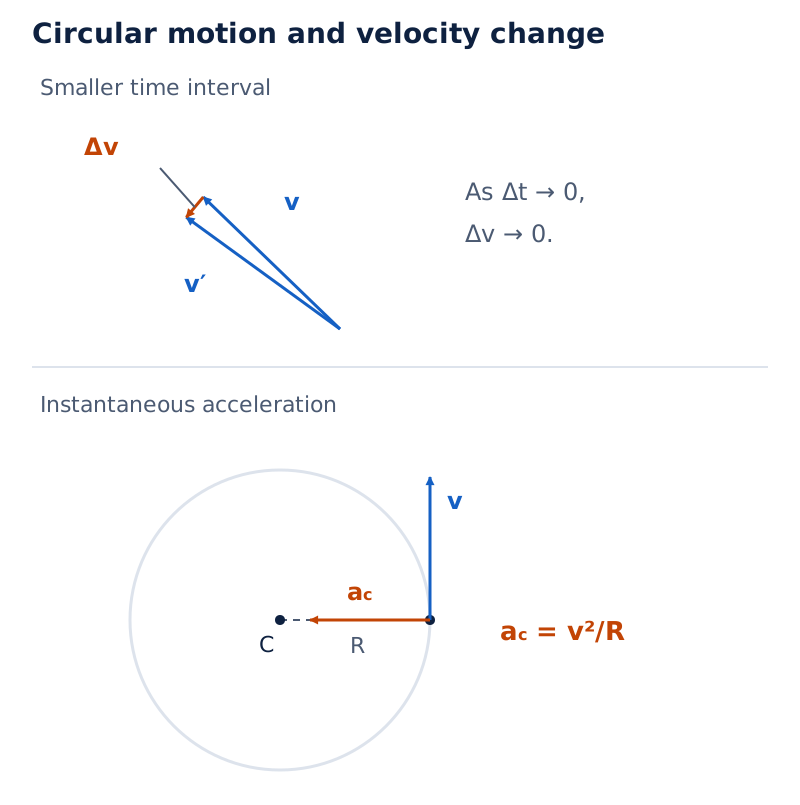
Successive panels show positions on a circular arc, radius vectors from the centre , and tangential velocity arrows. Separate triangles construct the velocity difference. In the limiting panel, the acceleration arrow points inward while the velocity arrow is tangent.
Drawn by One Young India. See Fig. 3.18 in your NCERT textbook
Derivation: Centripetal acceleration
During a time interval , let be the displacement between nearby circle positions and the velocity change. The radius and velocity triangles have the same included angle.
- Use similarity of the triangles:
- Divide the velocity-change magnitude by elapsed time:
- Take the limit as the interval tends to zero:
- In this limit the displacement-to-time ratio becomes speed:
Result: The magnitude is constant when speed and radius are constant, but the acceleration vector changes direction as the particle moves.
The constant-acceleration equations cannot be used across a finite interval of uniform circular motion. They require a fixed acceleration vector. Constant centripetal acceleration magnitude does not meet that condition because its inward direction varies around the circle.
For circular motion with changing speed, the total acceleration is not generally directed solely towards the centre. The purely inward result applies to uniform circular motion. This condition is part of the result, rather than an optional detail.
How are angular speed, period and frequency related?
Describing revolutions
Let denote the angular distance turned in time . In uniform circular motion, angular speed is . The SI unit of angular speed is the radian per second, written .
Let be arc length. With the angle in radians, . Dividing by time gives . Therefore . Angular speed describes how rapidly the radius turns, while linear speed describes distance covered along the circle.
The period is the time for one revolution. The frequency is the number of revolutions per second, so . One revolution covers the circumference, giving , where is the circle constant.
A complete revolution subtends radians. The relations become , , and . The SI unit of frequency is the hertz, written , equivalent to .
Worked example 7. An insect moves steadily around a circular groove of radius , completing seven revolutions in . Find angular speed, linear speed and centripetal acceleration. Is the acceleration vector constant?
Formula: Use , , and .
Substitute: Keep the radius in centimetres to obtain linear quantities in centimetre units.
- Frequency and angular speed:
- Linear speed, treating radians as dimensionless:
- Acceleration magnitude:
Answer: Angular speed is approximately , linear speed is , and acceleration magnitude is . The inward direction changes, so acceleration is not a constant vector.
Glossary
- Scalar — A physical quantity specified by magnitude and an appropriate unit, without an associated spatial direction.
- Vector — A quantity with magnitude and direction that obeys the triangle or parallelogram law of addition.
- Position vector — A vector drawn from a chosen origin to the position occupied by a particle.
- Displacement — The vector joining an initial position to a final position, independent of the intervening route.
- Null vector — A vector whose magnitude is zero and whose direction need not be specified.
- Unit vector — A vector of magnitude one that specifies a direction and has no physical unit.
- Scalar component — The signed magnitude associated with a vector's projection along a chosen coordinate direction.
- Average velocity — The displacement of an object divided by the corresponding elapsed time, directed along that displacement.
- Instantaneous velocity — The limiting average velocity as the time interval approaches zero, tangent to the path.
- Projectile — An object in flight after projection, treated here with negligible air resistance and constant gravitational acceleration.
- Horizontal range — The horizontal distance from a projectile's launch position to its descending return at the launch height.
- Centripetal acceleration — The inward acceleration of uniform circular motion, directed towards the centre of the circle.
- Angular speed — The rate at which angular distance changes as an object moves around a circle.
- Time period — The time taken by an object in circular motion to complete one full revolution.
- Frequency — The number of complete revolutions made per second, equal to the reciprocal of the period.
Common errors and misconceptions
- Misconception: Equal vector magnitudes imply equal vectors. Correct: Their directions must also agree. Parallel shifting preserves a free vector, whereas rotating it generally changes it.
- Misconception: A scalar component is itself a vector. Correct: is a signed scalar component; multiplying it by the unit vector gives the component vector .
- Misconception: Displacement magnitude equals distance travelled on every path. Correct: Displacement depends on endpoints, whereas distance depends on the route; a round trip can have zero displacement.
- Misconception: A projectile has zero velocity and acceleration at maximum height. Correct: Its vertical velocity is zero there. Its horizontal velocity remains and gravitational acceleration still points downwards.
- Misconception: gives the flight time for any landing height. Correct: It describes return to launch height. For another landing height, solve the vertical displacement equation.
- Misconception: Constant speed implies zero acceleration. Correct: In uniform circular motion, changing velocity direction produces inward acceleration even though the speed stays constant.
- Misconception: Constant centripetal acceleration magnitude permits the constant-acceleration vector equations. Correct: The acceleration direction changes around the circle, so the vector is not constant.
- Misconception: Resultant velocity and relative velocity use the same operation. Correct: Velocity contributions add, while one object's velocity relative to another is their difference in a common frame.
Exam-style questions with model answers
Q1. Distinguish a scalar from a vector and give one example of each. [2 marks]
- A scalar is specified by magnitude and unit, as with distance.
- A vector has magnitude and direction and obeys vector addition, as with displacement.
Q2. An obliquely projected ball moves under constant gravity with negligible air resistance. What are its velocity and acceleration directions at its highest point? [2 marks]
- Its velocity is horizontal because the vertical component has become zero while the horizontal component remains.
- Its acceleration is vertically downward due to gravity. Reaching maximum height does not switch off gravitational acceleration.
Q3. Rain has a downward velocity of and a westward velocity of . Find the resultant speed and the tilt of an umbrella held by a stationary person. [3 marks]
- The velocity components are perpendicular, so use their squared magnitudes rather than their arithmetic sum. The resultant speed is
- The angle from vertical satisfies
- The rain moves downwards and westwards. The umbrella must therefore face the incoming rain by tilting about towards the east from vertical.
Q4. A stone is projected horizontally at from a height of . Neglect air resistance and take . Calculate the flight time and impact speed. [4 marks]
- Put the origin at launch and take upward as positive. The initial vertical velocity is zero and the ground is below the origin. From vertical motion,
- Horizontal velocity remains constant, while vertical velocity becomes
- Combine the perpendicular components to obtain the positive speed: The negative vertical component specifies direction; the speed itself is non-negative.
Q5. A projectile is launched from the origin at speed , at an upward angle to the horizontal, with non-zero horizontal velocity. It returns to launch height. Assume negligible air resistance and constant downward gravitational acceleration of magnitude . Derive its trajectory, flight time and range, and state the angle of maximum range. [5 marks]
- Choose horizontal and upward coordinate directions. The horizontal component stays constant because horizontal acceleration is zero. The vertical component changes under gravity. Thus
- Eliminate elapsed time using the horizontal equation. Substitution into the vertical equation gives the trajectory Its quadratic dependence on horizontal position describes a parabola.
- At return to launch height, set vertical displacement to zero and take the non-zero root:
- Multiply flight time by constant horizontal velocity: At fixed launch speed, this is greatest when , giving . Equal launch and landing heights are essential to this range result.
Q6. A particle moves at constant speed around a circle of radius . Derive the magnitude of its acceleration, state its direction, and explain why the constant-acceleration vector equations cannot describe an entire finite interval of this motion. [5 marks]
- At nearby positions, velocity vectors are tangent to the circle and perpendicular to their corresponding radius vectors. Their magnitudes are equal, and their included angle matches the angle between the radii. The velocity and radius triangles are therefore similar.
- Let denote velocity change and displacement during time . Similarity gives
- Divide by elapsed time and take the limit: The limiting displacement-to-time ratio equals the speed.
- The acceleration points towards the centre. Although its magnitude remains constant, its direction changes as the particle moves. The acceleration vector is therefore not constant, which violates the condition required by the constant-acceleration vector equations.
Q7. An insect completes seven revolutions in at constant speed in a circular groove of radius . Find its angular speed, linear speed and acceleration magnitude. [3 marks]
- The revolution rate is . Hence angular speed is .
- Linear speed depends on both angular speed and radius: , with radians treated as dimensionless.
- The centripetal acceleration magnitude is . It points inwards. Its magnitude stays constant because the speed and radius stay constant, but its direction follows the changing inward radius.
Key takeaways
- Vectors require magnitude, direction and the correct addition rule; equal magnitudes alone do not establish equality.
- Displacement depends on endpoints, while distance follows the actual route; average velocity and average speed consequently differ.
- Resolve vectors along common perpendicular axes, combine corresponding signed components, then reconstruct magnitude and direction.
- Instantaneous velocity is tangent to the path, whereas acceleration describes changes in either velocity magnitude or direction.
- Constant-acceleration equations require the acceleration vector to remain fixed; its magnitude alone is insufficient.
- Ideal projectile motion combines constant horizontal velocity with constant downward acceleration, using one shared elapsed time.
- Standard flight-time and range formulae presume return to launch height, negligible air resistance and constant gravity.
- Uniform circular motion has changing velocity and inward acceleration, even though its speed and acceleration magnitude remain constant.
Test yourself
Can an object travel a non-zero distance but have zero displacement?
Yes. If it returns to its initial position, its displacement is zero despite the path travelled.
What does multiplication of a vector by a negative real number do?
It reverses direction and multiplies the magnitude by the absolute value of that number.
How does a scalar component differ from a component vector?
A scalar component is signed but has no vector direction; multiplying by its unit vector produces a component vector.
What is the direction of instantaneous velocity along a curved path?
It is tangent to the path at the particle's position, pointing in the direction of motion.
Why is an oblique projectile still moving at its highest point?
Only its vertical velocity component becomes zero; its horizontal velocity component remains unchanged in the ideal model.
Under what conditions does a projection angle of maximise range?
For fixed launch speed, equal launch and landing heights, negligible air resistance, and constant downward gravitational acceleration.
Is centripetal acceleration a constant vector in uniform circular motion?
No. Its magnitude is constant, but its direction changes continually to point towards the circle's centre.
How are frequency and period related in circular motion?
Frequency is the reciprocal of period: , where counts revolutions per second and is time per revolution.