
Motion in a Straight Line | CBSE Class 11 Physics Notes
On this page
Watch & explore
Start with a few high-quality watches, then dive into the notes below.
This note covers rectilinear motion, position and displacement, average and instantaneous velocity, speed, acceleration, motion graphs, equations for constant acceleration, free fall, vertical projection, stopping distance, reaction time and relative velocity.
How are position and motion described along a straight line?
Motion means a change in an object's position with time. Kinematics describes motion without examining its causes. In rectilinear motion, the object moves along a straight line, so one position coordinate is sufficient once an origin and a positive direction have been chosen.
Choosing an origin and a direction
The origin is the reference point from which position is measured. Let denote position along the chosen axis and denote time. A position to the right may be called positive and one to the left negative. The choice must remain consistent throughout a calculation.
A negative position does not itself mean that the object is moving towards the origin. Position identifies where the object is; the change of position identifies how it moves. Similarly, an object can have positive position while moving in the negative direction.
Let and be the initial and final positions during an interval. The symbol means a change, so the displacement is . Its sign records the direction from the initial position to the final position.
The SI unit of position is the metre, written . The SI unit of displacement is the metre. The SI unit of time is the second, written . Position and displacement use the same unit but answer different questions.
When can a body be treated as a point?
Definition: A point-object approximation neglects the object's size when that size is much smaller than the distance it moves during the interval being considered.
The approximation concerns the motion being studied, rather than whether the body is physically tiny. A railway carriage travelling between stations can be treated approximately as a point when its size is unimportant to that description.
By contrast, a tumbling beaker or a spinning cricket ball whose turning matters cannot be adequately described just by following a single position coordinate. The relevant question is whether the body's size and rotation affect the description required.
How do distance, displacement, average speed and average velocity differ?
Distance travelled is the total path length covered. Displacement depends on the initial and final positions. If an object reverses direction, the return part adds to distance but can cancel part of the displacement. For a complete return to the start, displacement is zero.
Let and denote the initial and final times, with . Let denote total path length, average velocity and average speed. Their definitions are:
The SI unit of velocity is the metre per second, . Speed has the same unit. Average velocity includes a direction through its sign, whereas average speed uses the non-negative total distance.
| Comparison | Distance and speed | Displacement and velocity |
|---|---|---|
| Position information | Distance counts the entire path travelled. | Displacement compares the final and initial positions. |
| Effect of reversal | Both parts add to total distance. | Oppositely directed parts partly or fully cancel. |
| Average rate | Average speed divides distance by elapsed time. | Average velocity divides displacement by elapsed time. |
| Complete return | Average speed remains positive for a non-zero journey. | Average velocity is zero over the complete return. |
| Signs | Distance and speed are non-negative. | Displacement and velocity can be positive, negative or zero. |
Since , it follows that . The vertical bars mean magnitude. Equality holds for one-dimensional motion without reversal during the interval. Stops do not themselves create a difference between distance and displacement magnitude.
Worked example 1. A man walks from home to a market away at , immediately returns at , and reaches home. Find his average speed and average velocity for the complete journey.
Answer: Let and denote the outward and return travel times. The symbol denotes an hour. Choose the outward direction as positive.
- Outward time:
- Return time:
- Total time and distance:
- Average rates:
The average speed is , while the average velocity is zero. Averaging the two given speeds arithmetically would give the wrong result because the two travel times differ.
What do instantaneous velocity and instantaneous speed measure?
Average velocity describes an interval. Instantaneous velocity, denoted by , describes motion at a particular instant. To obtain it, calculate average velocity over progressively shorter intervals around that instant and take the limiting value.
The derivative means the rate at which position changes with time at that instant. The limit is not found by substituting zero into the denominator. It describes the value approached as the interval becomes smaller.
Instantaneous speed is the magnitude . Velocities of and therefore correspond to the same speed, , but opposite directions of motion.
From a secant to a tangent
What the figure shows
Instantaneous velocity from a position-time graph
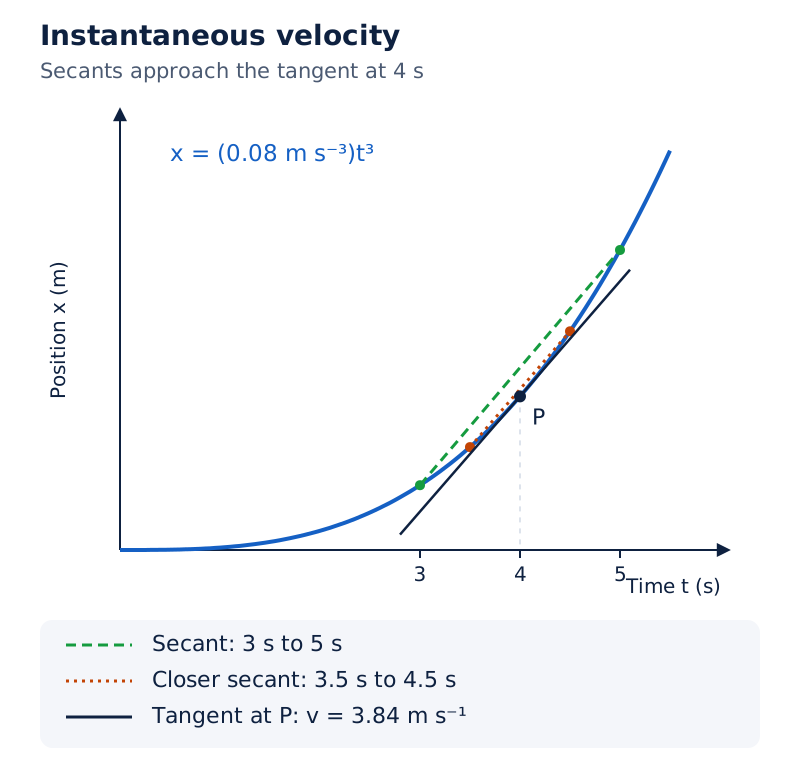
The horizontal axis shows time and the vertical axis position. A rising curved line carries points on either side of the point at . Lines joining successively closer pairs approach the tangent at that point.
Drawn by One Young India. See Fig. 2.1 in your NCERT textbook
The slope of a line joining two points on a position-time graph gives average velocity between them. As the points approach the instant being studied, the line approaches a tangent. Its slope gives instantaneous velocity.
Worked example 2. An object's position is . Find its velocities at and , and its average velocity between and .
Answer: Formula: and . Substitute: differentiate first, retaining the units of the coefficient.
- The velocity function is
- At the two instants,
- The positions are
- Hence
The average velocity is . It describes the whole interval and need not equal the velocity at either endpoint.
Worked example 3. For the position law , calculate the instantaneous velocity at .
Answer: Differentiate the position with respect to time:
The result is , the limiting slope at that instant. The increasing derivative also shows that this motion does not have constant velocity.
How does acceleration describe changes in velocity?
Acceleration measures the rate of change of velocity with time. Let and denote the velocities at times and , and let denote average acceleration. Then:
The SI unit of acceleration is the metre per second squared, . It expresses how much velocity changes per second. Average acceleration is the slope of the line joining the relevant endpoints on a velocity-time graph.
The instantaneous acceleration, denoted by , is obtained by making the time interval approach zero:
It is the slope of the tangent to a velocity-time curve. For constant acceleration, the instantaneous and average accelerations have the same value throughout the interval. Equal time intervals then produce equal changes in velocity.
Does negative acceleration mean slowing down?
The sign of acceleration depends on the chosen positive direction. To decide whether speed increases or decreases, compare the directions of velocity and acceleration. The sign of acceleration alone is insufficient.
| Velocity | Acceleration | Change in speed |
|---|---|---|
| Positive | Positive | Speed increases. |
| Positive | Negative | Speed decreases until a possible reversal. |
| Negative | Negative | Speed increases. |
| Negative | Positive | Speed decreases until a possible reversal. |
These comparisons apply while velocity has the indicated non-zero sign. At a turning point, velocity is momentarily zero, so examine the motion immediately before and after it. Acceleration need not vanish at the turning point.
Note: A ball thrown upwards has zero velocity at its highest point, but its gravitational acceleration remains downward. Being momentarily at rest is different from remaining at rest throughout a time interval.
How should position-time and velocity-time graphs be read?
A motion graph represents the relationship between its labelled variables. A curved position-time graph does not mean that the object follows a curved spatial path. The object may still move entirely along one straight line while its speed changes.
Reading slopes and curvature
On a position-time graph, a positive slope indicates positive velocity and a negative slope indicates negative velocity. A horizontal segment represents constant position. A straight inclined line represents constant velocity because its slope remains unchanged.
Upward curvature indicates positive acceleration because the slope becomes more positive with time. Downward curvature indicates negative acceleration because the slope decreases. Curvature describes a change of slope, not simply whether position is positive or negative.
What the figure shows
Velocity-time graphs with constant acceleration
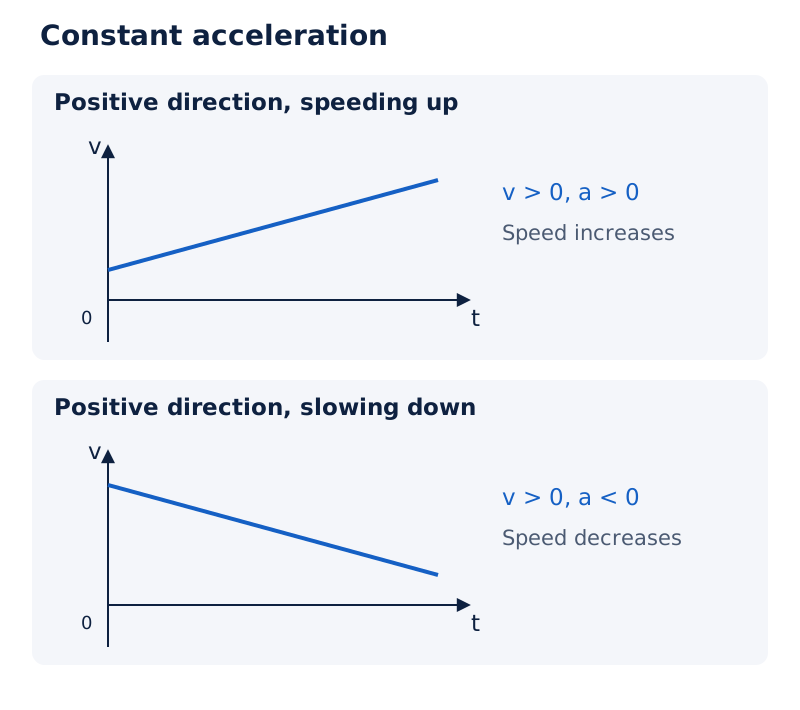
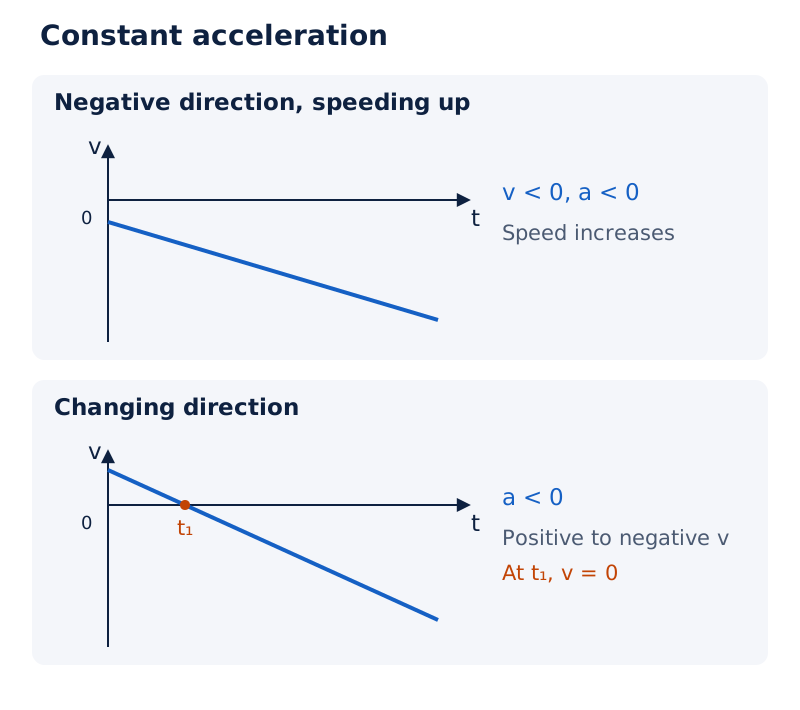
Four panels show straight lines with positive or negative slopes. The final panel has a downward-sloping line crossing the time axis at the labelled turning time, changing from positive to negative velocity.
Drawn by One Young India. See Fig. 2.3 in your NCERT textbook
On a velocity-time graph, the ordinate gives velocity and the slope gives acceleration. A line above the time axis does not necessarily mean speeding up: if it slopes downwards, positive velocity is decreasing.
Reading the area
The signed area between a velocity-time curve and the time axis gives displacement. Areas below the time axis contribute negatively. If direction reverses, total distance instead adds the magnitudes of the separate displacement contributions.
Let be a constant velocity and the duration of motion. The rectangular area has height and width , so . The units confirm the interpretation:
What the figure shows
Displacement as a rectangular area
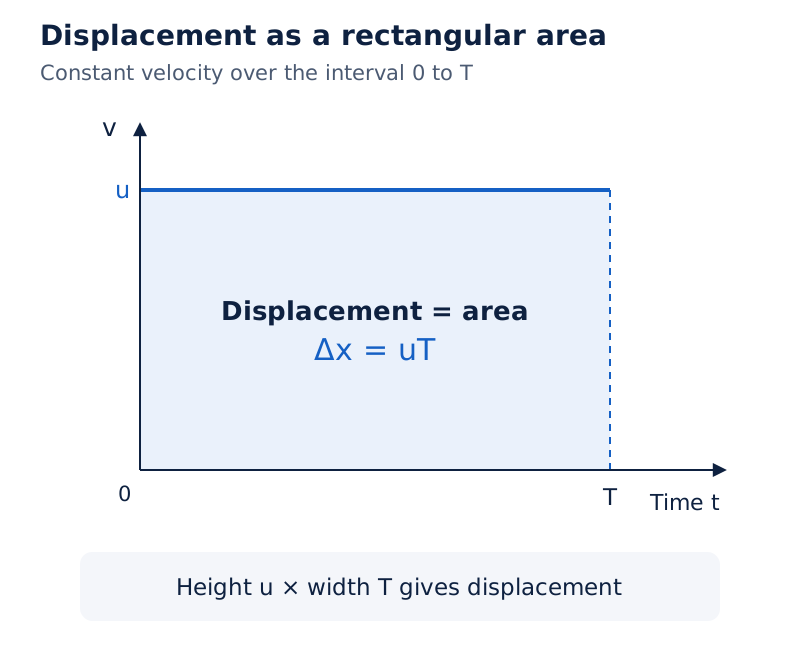
A horizontal velocity line lies above the time axis. The shaded rectangle extends from zero to the final time; its height is the constant velocity and its width is the elapsed time.
Drawn by One Young India. See Fig. 2.4 in your NCERT textbook
Idealised graph segments sometimes meet at sharp corners. Such corners simplify a description; they should not be interpreted as a finite change of velocity occurring in exactly zero time in a realistic motion.
How are the equations for constant acceleration derived graphically?
Let denote initial velocity, final velocity, constant acceleration and elapsed time measured from the initial instant. Let denote initial position and define the displacement .
The following equations require constant acceleration throughout the interval. All displacements, velocities and accelerations are signed quantities referred to the same axis. A reversal of direction does not invalidate the equations if acceleration stays constant.
Derivation: Velocity as a function of time
- Write the definition of constant acceleration:
- Multiply by elapsed time:
- Rearrange for final velocity:
Result: Velocity varies linearly with time when acceleration is constant. Thus, its velocity-time graph is a straight line with initial ordinate equal to the initial velocity.
What the figure shows
Displacement from a triangle and rectangle
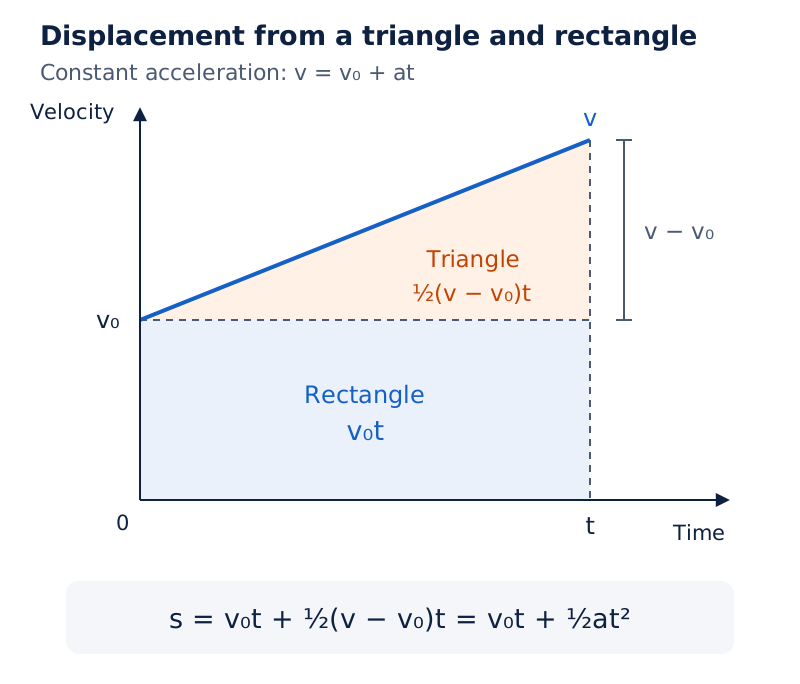
A rising velocity line runs from the initial-velocity point to the final-velocity point. The shaded region below it is divided into a rectangle and a triangle, both sharing the same time interval.
Drawn by One Young India. See Fig. 2.5 in your NCERT textbook
Derivation: Displacement as a function of time
- Add the rectangular and triangular areas:
- Replace the velocity change using constant acceleration:
- Substitute and simplify:
- Restore the initial position:
Result: Initial position must be included when the chosen origin differs from the starting point. Position and displacement coincide only when the initial position is zero.
The same area can be written as . Therefore, for constant acceleration. This arithmetic mean of endpoint velocities is not a general replacement for the definition of average velocity.
Derivation: Eliminating time
- For non-zero constant acceleration, rearrange the velocity equation:
- Substitute into the average-velocity expression for displacement:
- Use the difference of squares:
- Hence obtain
Result: The final equation connects displacement and velocities without time. Although this derivation divides by acceleration, the final equation remains consistent when acceleration is zero and velocity remains unchanged.
How does calculus derive and clarify the equations of motion?
The definitions of instantaneous velocity and acceleration are exact. The familiar polynomial equations require an additional assumption: acceleration must remain constant. Calculus makes this distinction explicit because a constant acceleration can be taken outside an integral.
Derivation: Integrating acceleration and velocity
Use as an integration variable representing time, as one representing velocity and as one representing position. These temporary symbols distinguish integration variables from final values.
- Integrate constant acceleration from the initial to the final instant:
- Evaluate and rearrange:
- Integrate velocity to obtain the position change:
- Evaluate the integral:
Result: Integration recovers both equations and retains the initial position automatically through its lower limit. The initial velocity remains part of the result because acceleration describes changes of velocity, not its starting value.
Derivation: Connecting acceleration with position
- Use the chain rule:
- Rearrange and integrate at constant acceleration:
- Evaluate both sides:
- Rearrange:
Result: The calculus method also provides a route to problems with varying acceleration, but the acceleration must then stay inside the relevant integral unless it is constant.
Before selecting an equation, identify which quantity is absent. The velocity-time equation omits displacement; the displacement-time equation omits final velocity; the squared-velocity equation omits time. This prevents unnecessary algebra without changing any physical assumptions.
How are free fall and vertical projection analysed?
Free fall describes motion under gravity when air resistance is neglected. Near Earth's surface, over heights small compared with Earth's radius, the gravitational acceleration can be treated as constant. Let denote its positive magnitude, approximately .
Let denote vertical position and its initial value. With upward chosen positive, . This acceleration is downward during both ascent and descent. It does not reverse when the object changes its direction of motion.
Release from rest
If the object starts from rest at the origin, the equations reduce to , and . Negative position means below the release point; the positive distance fallen is .
What the figure shows
Free-fall graphs
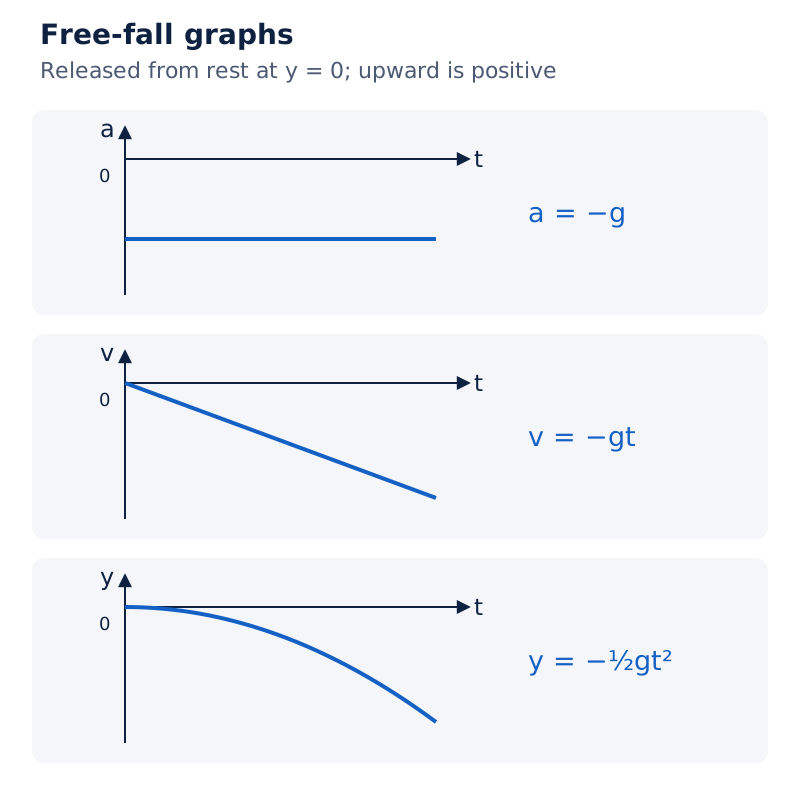
The acceleration graph is horizontal below zero. The velocity graph slopes downwards from the origin. The position graph curves downwards into negative vertical positions as time increases.
Drawn by One Young India. See Fig. 2.7 in your NCERT textbook
For a ball projected upwards, the initial velocity is positive. Its velocity decreases to zero at maximum height, then becomes negative during descent. The same constant-acceleration equations can describe the complete motion without splitting it at the highest point.
Worked example 4. A ball is thrown vertically upwards at from a point above the ground. Neglect air resistance and take . Find its rise above the launch point and its time to reach the ground.
Answer: Choose upward positive and ground level as zero. Formula: and . Substitute: , and .
- Let denote the rise above launch. At the highest point,
- The maximum height above ground is
- At ground level,
- Divide by , rearrange and factor:
- The roots are and . The future impact therefore occurs at .
The rise is , and the flight time is . The negative root belongs to an extrapolation before launch, outside the physical interval being studied.
The distinction between rise above launch and height above ground is essential. Both refer to the same highest point, but they use different reference levels and therefore have different values.
Why do successive free-fall distances follow odd-number ratios?
Galileo's law of odd numbers concerns a body falling from rest at constant acceleration. Distances covered in successive equal time intervals follow the ratio . These are successive interval distances, not total distances measured from release.
Use downward distance as positive in this derivation. Let be the total distance fallen after time , let denote the common interval duration, and let be a positive integer numbering the interval.
Derivation: Distance in the nth equal interval
- For release from rest, write
- Find total distance at the end of interval :
- Subtract the total at the preceding endpoint. If denotes distance in interval , then
- Simplify:
- Since the common factor is unchanged,
Result: The body gains speed as it falls, so each equal interval covers more distance than the preceding interval. The increasing distances are fully consistent with a constant acceleration.
| Elapsed time | Total distance fallen | Distance in the latest interval |
|---|---|---|
The total distances are proportional to the squares of elapsed times. The odd-number sequence appears only after subtracting neighbouring totals. The assumptions of release from rest, equal intervals and constant acceleration are all needed for this particular ratio.
How is the stopping distance of a vehicle calculated?
Stopping distance here means the distance travelled after brakes are applied until the vehicle stops. Take the original direction of motion as positive. The initial velocity is positive and the braking acceleration is negative.
Derivation: Stopping distance under uniform braking
Let denote stopping distance and let be the signed, constant braking acceleration.
- Apply the displacement-velocity equation:
- At stopping, final velocity is zero:
- Rearrange:
- Since is negative, write the explicitly positive form:
Result: Stopping distance is proportional to the square of initial speed, provided the braking acceleration remains the same. Doubling the initial speed therefore multiplies the stopping distance by four.
Worked example 5. A car travelling at stops over . Assuming uniform braking, find its acceleration and stopping time.
Answer: Formula: and . Substitute: convert the initial speed to SI units before using the given distance.
The retardation magnitude is and the stopping time is about . The negative acceleration indicates opposition to the original motion.
A negative result for the stopping distance would signal inconsistent signs. Distance travelled while braking is positive here because the vehicle continues in its original direction until it reaches rest.
How can a falling ruler measure reaction time?
Reaction time is the interval taken to observe a situation, think and act. It depends on the individual and on the complexity of the situation. A falling-ruler experiment estimates this interval from the distance travelled before the ruler is caught.
A friend holds the ruler vertically with its lower part between the observer's thumb and forefinger. The friend releases it, and the observer catches it. Measure the distance it fell between release and catching.
What the figure shows
Measuring reaction time
The photograph shows a vertical ruler held by a friend's hand above another hand positioned near its lower part. Labels identify the ruler, the friend's hand and the catching hand.
See Fig. 2.8 in your NCERT textbook
Let denote the positive downward distance fallen and the reaction time. The ruler starts from rest. Neglect air resistance and treat gravitational acceleration as constant during the fall.
Derivation: Reaction time from falling distance
- Apply the displacement equation for release from rest:
- Isolate the squared time:
- Choose the positive root because elapsed time is positive:
Result: A measured falling distance gives an estimate of the time between release and catching.
Worked example 6. A ruler falls before being caught. Estimate the reaction time, taking and assuming release from rest.
Answer: Convert the distance to metres before substituting.
The reaction time is approximately . The more detailed value shows the calculation; the rounded estimate describes the experiment without implying excessive precision.
The ruler measures a time interval indirectly through motion. The square-root relation matters: the distance is proportional to the square of the reaction time, rather than directly proportional to it. This follows from acceleration during the fall.
How is relative velocity found for motion along one line?
Relative velocity describes how one object's position changes as seen from another moving object. Velocities must first be expressed relative to the same reference frame and positive direction. Subtracting unsigned speeds without checking directions can produce an incorrect result.
Derivation: Velocity relative to another object
Let and denote the positions of objects A and B in a common frame. Let denote B's position relative to A, and , and their corresponding velocities.
- Define relative position:
- Differentiate with respect to the same time:
- Therefore,
Result: For motion in the same direction, the relative speed is the magnitude of the difference of speeds. For opposite directions, signed subtraction gives the sum of the speed magnitudes.
Worked example 7. A police van moves at , while a thief's car moves ahead in the same direction at . A bullet is fired forwards with muzzle speed relative to the van. Find its speed relative to the car.
Answer: Let , and denote the van, car and bullet velocities relative to the road. Choose their forward direction as positive.
- Convert the vehicle velocities:
- Add the muzzle velocity to the van's road velocity:
- Subtract the car's velocity:
The relative speed is . The given muzzle speed belongs to the van's frame, so it cannot be directly compared with the car's road speed.
Glossary
- Kinematics — The description of motion through position, velocity and acceleration without examining the causes of that motion.
- Rectilinear motion — Motion along a straight line, describable using one position coordinate after choosing an origin and direction.
- Point object — An approximation that neglects an object's size when it is small compared with the distance involved.
- Displacement — The signed change of position from an initial point to a final point during an interval.
- Distance travelled — The total length of the path covered, counting both outward and return portions positively.
- Average velocity — Displacement divided by elapsed time, including the direction of the net position change.
- Average speed — Total path length divided by elapsed time, without cancellation between oppositely directed parts of the journey.
- Instantaneous velocity — The limiting value of average velocity as the time interval approaches zero around a particular instant.
- Instantaneous speed — The magnitude of instantaneous velocity, describing how fast an object moves at that instant.
- Acceleration — The rate of change of velocity with time, which may have a positive or negative sign.
- Free fall — Motion under gravity with air resistance neglected, approximated near Earth's surface using constant gravitational acceleration.
- Stopping distance — The distance a moving vehicle travels after its brakes are applied until it reaches rest.
- Reaction time — The time a person takes to observe a situation, think about it and act.
- Relative velocity — The velocity of one object as measured with respect to another object or moving reference frame.
Common errors and misconceptions
- Misconception: Distance and displacement are interchangeable. Correct: Distance counts the complete path, while displacement compares endpoints. Reversal can reduce displacement without reducing distance travelled.
- Misconception: Average speed is the arithmetic mean of the speeds on two parts of a journey. Correct: Divide total distance by total time; unequal travel times generally prevent this shortcut.
- Misconception: Negative acceleration always means slowing down. Correct: Speed increases when velocity and acceleration have the same direction, including when both are negative.
- Misconception: Zero velocity at the highest point means zero acceleration. Correct: Gravitational acceleration remains downward even when a projected ball is momentarily at rest.
- Misconception: A curved position-time graph shows a curved spatial path. Correct: Its curvature describes changing velocity; the actual motion can remain along a straight line.
- Misconception: The area below a velocity-time graph always gives total distance. Correct: Signed area gives displacement. To find distance after reversal, add the magnitudes of the separate contributions.
- Misconception: Constant-acceleration equations apply to every motion. Correct: They require acceleration to remain constant throughout the interval; the derivative definitions have wider validity.
- Misconception: The same gravitational sign applies to every chosen axis. Correct: Gravity is downward, so its signed acceleration depends on whether upward or downward is chosen positive.
Exam-style questions with model answers
Q1. Distinguish between average speed and average velocity for a journey that ends at its starting point. [2 marks]
- Average speed is total path length divided by total time; average velocity is displacement divided by total time.
- For a non-zero journey returning to its start, average speed is positive while average velocity is zero because displacement is zero.
Q2. Can an object have zero velocity but non-zero acceleration? Explain using vertical projection with air resistance neglected. [2 marks]
- Yes. A vertically projected ball has zero instantaneous velocity at its highest point.
- Its acceleration remains downward due to gravity at that instant, so the ball subsequently begins moving downwards.
Q3. Explain how a position-time graph gives average velocity and instantaneous velocity. What does a curved graph imply about the spatial path? [3 marks]
- Average velocity is the slope of the line joining the graph's endpoints for the chosen interval, because this slope is position change divided by time change.
- Instantaneous velocity is the slope of the tangent at the chosen instant, obtained as the time interval approaches zero.
- A curved graph indicates changing slope and hence changing velocity. It does not imply a curved spatial path; the motion can still be one-dimensional along a straight line.
Q4. An object has position , where is time. Find its velocity at and average velocity from to . [3 marks]
- Instantaneous velocity is the time derivative of position: . Thus .
- The endpoint positions are and .
- Therefore, . This is an interval average, whereas the first result describes one instant. The constant starting position cancels when calculating displacement. Subtract the endpoint positions before dividing by elapsed time; dividing final position by final time would use the wrong reference.
Q5. Derive the three equations of uniformly accelerated rectilinear motion. Use initial velocity , final velocity , constant acceleration , elapsed time and displacement . [5 marks]
- Constant acceleration is the velocity change divided by elapsed time: . Multiplying by time and rearranging gives .
- The velocity-time graph is a straight line. Its signed area gives displacement: , using the rectangular contribution and the triangular change from the initial velocity.
- Substitute to obtain . Equivalently, the area gives .
- For non-zero acceleration, substitute into that last relation: . Hence .
- All quantities must use one consistent sign convention, and acceleration must remain constant throughout the interval. If initial position is , displacement is , where is final position.
Q6. A ball is projected upwards at from above ground. Neglect air resistance and use . Find its maximum height above ground and the time it reaches the ground. Explain the acceleration at maximum height. [5 marks]
- Choose upward positive and ground level as zero. The initial vertical position is , initial velocity is , and acceleration is .
- At maximum height, velocity is zero. The rise above launch is . The height above ground is .
- At impact, vertical position is zero: . This gives , where is elapsed time.
- The positive root gives the physical impact time, . The negative root describes extrapolated motion before launch and is excluded from the requested interval.
- At maximum height, acceleration is still . Momentary zero velocity does not remove gravity or imply zero acceleration.
Q7. A ruler released from rest falls before being caught. With air resistance neglected and , estimate the reaction time and state the relation used. [3 marks]
- Let denote downward distance and reaction time. A fall from rest at constant gravitational acceleration obeys , giving .
- Convert the distance: . Hence .
- The estimated reaction time is about . It represents the interval between release and catching, assuming that the ruler begins falling from rest and follows free-fall motion during that interval.
Q8. Derive the odd-number ratio for distances fallen in successive equal time intervals by a body released from rest under constant gravitational acceleration. [4 marks]
- Let be gravitational acceleration magnitude, the interval duration and a positive integer identifying the interval. Total distance after time is .
- The preceding total is . Their difference gives the distance in the latest interval.
- Thus .
- The common factor cancels in the ratio, giving . These are interval distances, not cumulative distances from the release point.
Key takeaways
- Choose an origin and positive direction before assigning signs to position, displacement, velocity and acceleration.
- Average speed uses total distance, whereas average velocity uses displacement; a return journey can have zero average velocity.
- Instantaneous velocity is the slope of a position-time tangent, and instantaneous speed is its magnitude.
- Acceleration describes velocity change with time; compare its direction with velocity to decide whether speed increases.
- Signed area under a velocity-time graph gives displacement, while its slope gives acceleration at that instant.
- The standard kinematic equations require constant acceleration and consistent signs, including when the object reverses direction.
- During vertical projection, gravitational acceleration remains downward even at the highest point where velocity vanishes.
- Stopping distance grows with the square of initial speed when the braking acceleration remains unchanged.
- Relative velocity is found by subtracting velocities expressed in the same reference frame and along the same axis.
Test yourself
When is the point-object approximation appropriate?
When the object's size is much smaller than the distance relevant to the motion being described.
Can average speed be smaller than the magnitude of average velocity?
No. Total distance is at least as large as displacement magnitude, and both averages use the same elapsed time.
What does a horizontal position-time graph mean?
Position remains constant during that interval, so the object is at rest and its velocity is zero.
What does a straight inclined velocity-time graph indicate?
Its constant non-zero slope represents constant acceleration; the sign of the slope gives the acceleration's sign.
Why does negative acceleration sometimes increase speed?
When velocity is also negative, acceleration acts in the direction of motion and increases the magnitude of velocity.
Why must the initial position be retained in some motion equations?
The starting point may differ from the chosen origin, so final position differs from displacement by the initial position.
What assumptions produce the odd-number ratio of successive falling distances?
The body starts from rest, acceleration remains constant, and distances are compared over successive equal time intervals.
How does doubling initial speed affect braking distance at unchanged deceleration?
The braking distance becomes four times as large because it is proportional to the square of initial speed.