
Work, Energy and Power | CBSE Class 11 Physics Notes
On this page
Watch & explore
Start with a few high-quality watches, then dive into the notes below.
This note covers scalar products, work by constant and variable forces, kinetic energy, the work-energy theorem, gravitational and elastic potential energy, conservation of mechanical energy, power, and elastic and inelastic collisions in one and two dimensions.
How does the scalar product connect force and displacement?
A scalar product combines two vectors to produce a scalar. Let and be vectors, and their magnitudes, and the angle between them. Their dot product is .
The product can be read geometrically as one vector's magnitude multiplied by the component of the other along it. Thus is the projection of the second vector along the first. The resulting scalar has no direction, although it can have a sign.
Which properties simplify a dot product?
The commutative property gives . For a third vector , the distributive property gives . For a real number , .
Let and denote the Cartesian components along mutually perpendicular coordinate axes. Then . Multiplying corresponding components and adding gives the scalar product without first calculating the angle.
The unit vectors point along the three axes. Each has scalar product one with itself and zero with either of the others. Consequently, .
Why does the angle matter in mechanics?
For non-zero perpendicular vectors, the scalar product vanishes because . Parallel vectors in the same direction give a positive product; opposite vectors give a negative product. This angular dependence is essential when finding work: only the force component along the displacement contributes.
A force can therefore act on a moving object without doing work on it. The distinction is between the existence of a force and its component along the motion. Dot products provide the mathematical language needed to express that distinction precisely.
When is work positive, negative or zero?
Definition: Work done by a constant force on a body is the scalar product of that force and the body's displacement. Specify the force, the body and the displacement whenever describing work.
Let denote work, a constant force, the displacement, and and their magnitudes. With now the angle between force and displacement, .
The SI unit of work is the joule, symbol , with , where denotes newton and metre. Its dimensions are , where represent mass, length and time respectively.
| Situation | Work and explanation |
|---|---|
| Force component along displacement | Positive work transfers energy to motion through that force's contribution. |
| Force component opposite displacement | Negative work occurs, as for the stopping force on a skidding cycle. |
| Force perpendicular to displacement | Zero work, even when the body moves through a substantial distance. |
| No displacement | Zero work on the stationary body, even with a large applied force. |
| No force | Zero work by that force, although displacement may occur. |
Why does effort not necessarily mean mechanical work?
Pushing a rigid wall can cause tiredness while doing no work on the wall. Muscles use internal energy, but the wall does not move. Similarly, a weightlifter holding a load steadily does no mechanical work on that load during the stationary interval.
Gravity does no work on a block moving horizontally on a smooth table because the displacement is perpendicular to the weight. In an ideal circular lunar orbit, Earth's force is radial and the Moon's instantaneous displacement tangential, so the gravitational work is zero.
Worked example 1. A cyclist skids to rest over . The road exerts a constant opposing force of . Find the work by the road on the cycle and by the cycle on the stationary road.
Answer: Formula: . Substitute:
- The angle is , so .
- The road's displacement is zero: , where means work on the road.
The cycle receives of work; the road receives zero. Equal and opposite forces need not do equal and opposite work because their points of application need not undergo the same displacement.
How does kinetic energy lead to the work-energy theorem?
Kinetic energy is energy associated with motion. For a body of mass and speed , its kinetic energy is . It is a scalar and cannot be negative. A stationary body has zero kinetic energy in the chosen frame.
The SI unit of kinetic energy is the joule. Mass is measured in kilograms, , and speed in metres per second, , where denotes second. Kinetic energy depends on speed squared, so its percentage change differs from the percentage change in speed.
Derivation: work-energy theorem for a constant force
Consider straight-line motion with constant acceleration , initial speed , final speed , and displacement along the line. Let be the signed net force, and let denote initial and final kinetic energies.
- Use the constant-acceleration relation:
- Multiply by half the mass:
- Apply Newton's second law:
- Identify net work and the kinetic energies:
Result: The change in kinetic energy equals the work done by the net force. When several forces act, add their works with their signs. Positive net work increases kinetic energy; negative net work reduces it.
Worked example 2. A bullet of mass , where here denotes gram, enters of soft plywood at . It emerges with of its initial kinetic energy. Find its emergent speed, denoted by .
Answer: Formula: , , . Substitute:
- Convert mass and calculate initial energy: , so .
- Calculate final energy: .
- Calculate speed: .
The final energy is . The speed falls by about , not by . The stated thickness is not needed once the fraction of energy remaining is given.
How can work be calculated for a variable force?
A force may change as the body moves. For one-dimensional motion, let denote position and the signed force component along that axis. Over a sufficiently small displacement , the small amount of work is approximately .
Let and denote the initial and final positions. Adding the small contributions gives a sum of rectangular areas. As their widths tend to zero, the exact work becomes the definite integral .
How should the area under a force graph be interpreted?
The force-displacement graph provides a geometrical calculation of work. For motion towards increasing position, area above the position axis is positive and area below it is negative. Keeping the sign is essential: frictional work must not become positive merely because a rectangle has a positive geometrical area.
What the figure shows
Applied and frictional forces
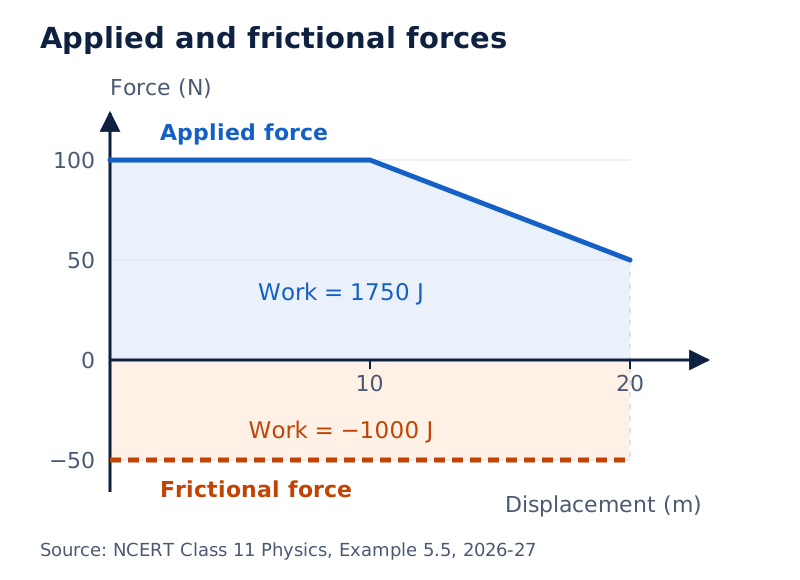
The applied-force line is horizontal at from the origin to , then slopes down to at . The friction line lies horizontally at .
Drawn by One Young India. See Fig. 5.4 in your NCERT textbook
Worked example 3. A woman pushes a trunk with for the first . During the next , her force decreases linearly to . A constant frictional force of opposes motion throughout. Find the work by each force.
Answer: Denote the woman's work by and frictional work by . Formula: add the rectangular and trapezoidal areas for the applied force; use the negative rectangular area for friction. Substitute:
- The first contribution is .
- The second contribution is .
- The woman's work is .
- Friction does .
The separate results are and . Each belongs to a specified force. The applied force remains non-zero at the final position, which is why the second area is a trapezium.
A constant-force rectangle is therefore a special case of the area method. The method also works when a force changes continuously and cannot be replaced by one constant value over the entire displacement.
Why does the work-energy theorem also hold for variable forces?
The constant-acceleration argument is only a starting point. The work-energy theorem also follows from Newton's second law when the force changes with position. The derivation below assumes constant mass and one-dimensional motion, with the force understood as the net force.
Derivation: work-energy theorem for a variable force
Let denote time, the signed velocity along the position axis, and the net force at that instant. The differential symbol indicates an infinitesimal change.
- Differentiate kinetic energy:
- Insert Newton's second law:
- Replace velocity by the rate of change of position:
- Integrate between the endpoints:
Result: The theorem remains valid for a variable force. It can determine the work of an unknown resistive force from the energy change and the work done by the known forces.
Worked example 4. A raindrop of mass starts from rest and falls , reaching . Take gravitational acceleration as constant. Find gravitational work and resistive work ; let denote the distance fallen.
Answer: Formula: , . Substitute:
- Convert the data: and .
- Gravity does .
- The energy gain is .
- Therefore .
The resistance does of work. Its detailed variation is unnecessary for this calculation because the initial and final kinetic energies are known.
Worked example 5. A block enters a rough patch at . The patch extends from to ; its retarding force is , where . Find the exit energy and speed.
Answer: Formula: , with denoting the natural logarithm. Substitute:
- The initial energy is .
- The exit energy is .
- The exit speed is .
The block retains approximately . The logarithm acts on a dimensionless ratio of positions, and the positive exit energy shows that the block crosses the whole patch.
The theorem is a scalar relation, so it does not retain all directional or time information in Newton's second law. Knowing an energy change generally does not tell us how long the motion took or determine the full trajectory.
What makes potential energy and conservative forces useful?
Potential energy is stored energy associated with position or configuration. A stretched bow-string stores energy that can appear as the arrow's kinetic energy when released. The useful connection is that work against certain forces can be stored and recovered through motion.
Let be gravitational potential energy at height above a chosen ground level. Near Earth's surface, where gravitational acceleration can be treated as constant, . The SI unit of potential energy is the joule.
This expression assumes heights small compared with Earth's radius. The symbol here measures height above the reference level, rather than the distance fallen in the raindrop example. Raising a body stores potential energy; falling can convert that energy to kinetic energy.
How are force and potential energy related?
For a conservative force in one dimension, denotes potential energy as a function of position. The force satisfies . With upward position positive, gravity gives ; the minus sign specifies its downward direction.
If and denote initial and final potential energies, conservative-force work satisfies , where is the final value minus the initial value. Positive conservative work therefore corresponds to decreasing potential energy.
| Property | Conservative force | Non-conservative force |
|---|---|---|
| Dependence of work | Only the initial and final positions matter. | The particular path can matter. |
| Closed path | Work is zero when the body returns to its starting position. | Work need not be zero on a closed path. |
| Examples | Gravity and an ideal spring force. | Friction and resistive forces in the examples considered. |
The zero of potential energy is arbitrary. Ground level is convenient for near-surface gravity, while an unstretched spring provides a convenient spring reference. Once selected, the reference must remain consistent throughout the calculation. Changes in potential energy are the physically relevant quantities in work calculations.
When is mechanical energy conserved?
The total mechanical energy is the sum of kinetic and potential energies: . Either part can change during motion. Their sum remains constant provided the forces doing work are conservative, so no non-conservative work changes the mechanical energy.
Derivation: conservation of mechanical energy
Consider motion in which the net work is done by a conservative force. Use the same initial and final labels for kinetic and potential energies throughout.
- Apply the work-energy theorem:
- Express conservative work using potential energy:
- Combine and rearrange:
- Collect the final and initial energies:
Result: Mechanical energy is exchanged between kinetic and potential forms while their sum stays constant. Conservation does not require the speed or the potential energy to remain individually unchanged.
How does a falling ball illustrate this exchange?
Let denote a ball's release height above the ground. Released from rest with negligible air resistance, it begins with . At an intermediate height , let denote its speed; its energy is .
Energy conservation gives . Just before reaching ground level, the speed is . With potential energy chosen as zero at the ground, the initial gravitational energy has then become kinetic energy.
A ball sliding down a smooth inclined plane from the same height also reaches the speed , irrespective of the inclination. Gravity's work depends on the endpoints. This result concerns the speed at the bottom, not the time taken to arrive there.
What changes when friction does work?
Let denote total non-conservative work, and initial and final mechanical energies. The general balance is . Negative frictional work reduces mechanical energy; energy is transferred into other forms rather than disappearing.
Note: Do not impose constant mechanical energy on a rough-surface problem. Use the work-energy theorem with friction included, or use the change in mechanical energy together with non-conservative work.
How does an ideal spring store and exchange energy?
For an ideal spring, the restoring force is proportional to displacement from equilibrium and points towards equilibrium. Let denote the spring force, the signed displacement, and the spring constant. Hooke's law is .
The SI unit of the spring constant is newton per metre, written . A larger spring constant means a stiffer spring. Positive extension produces a negative force; negative compression produces a positive force. The force opposes displacement from equilibrium, not necessarily the direction of motion.
What the figure shows
Block attached to a spring
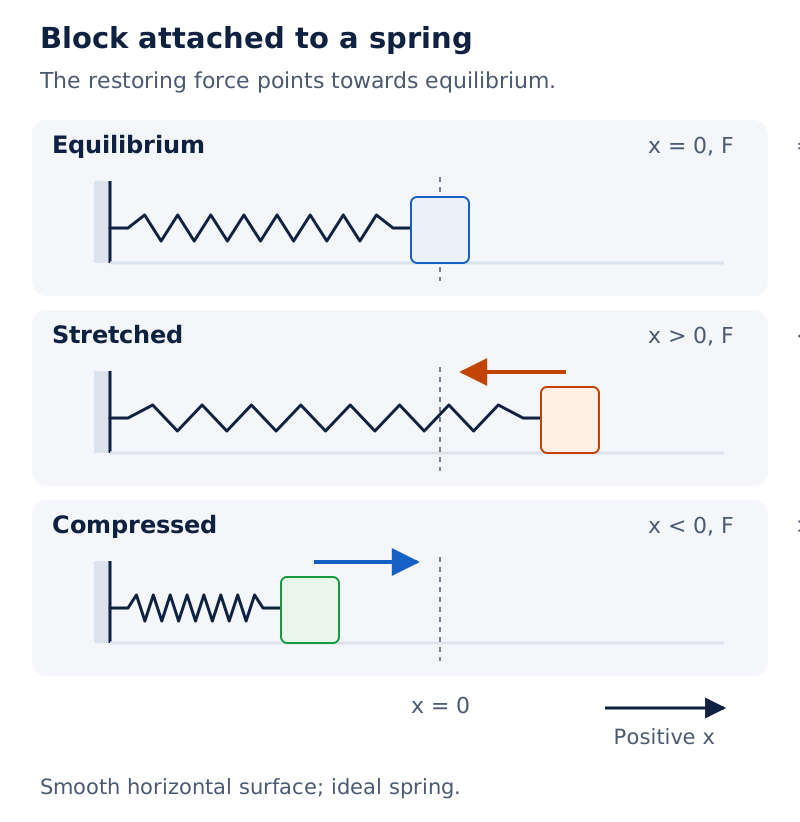
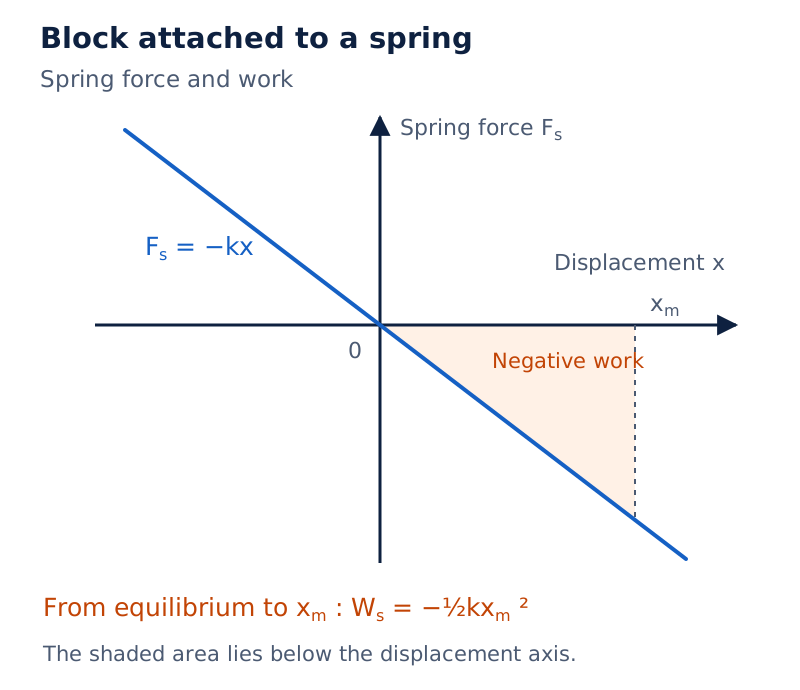
Three drawings show a spring fixed to a wall, with its block at equilibrium, stretched to the right and compressed to the left. Arrows show restoring forces towards equilibrium. A descending straight force-displacement line encloses a shaded triangular area below the positive displacement axis.
Drawn by One Young India. See Fig. 5.7 in your NCERT textbook
Derivation: elastic potential energy
Choose zero potential energy at equilibrium. Let denote work done by the spring while it is displaced from equilibrium to , and let be the integration variable representing intermediate displacement.
- Write the spring's work integral:
- Evaluate the integral:
- Use the negative of conservative work:
- Insert the chosen zero:
Result: Both compression and extension store positive elastic potential energy relative to equilibrium. Between arbitrary positions, spring work is , depending only on the endpoints.
How are the turning points related to maximum speed?
Consider a light spring and block on a smooth horizontal surface. Let be the maximum extension from which the block is released at rest, and its maximum speed. At any allowed displacement, .
At equilibrium, the potential energy is zero and kinetic energy is greatest: . At either turning point, speed is zero and the energy is wholly elastic potential energy. These statements assume negligible friction and a spring obeying Hooke's law.
What the figure shows
Energy exchange in a spring
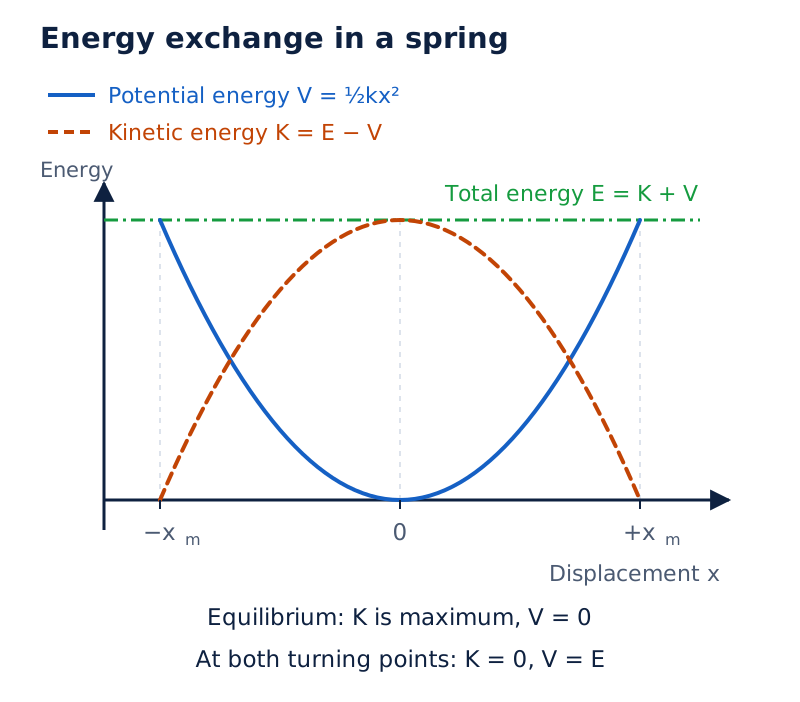
An upward-opening potential-energy parabola and downward-opening kinetic-energy parabola are plotted against displacement. A horizontal line marks total energy. Kinetic energy vanishes at the two marked extreme displacements and reaches its maximum at the central equilibrium position.
Drawn by One Young India. See Fig. 5.8 in your NCERT textbook
How is power different from work and energy?
Power describes how quickly work is done or energy is transferred. Average power over a time interval is . Instantaneous power is the rate at a particular instant: .
The SI unit of power is the watt, symbol , with . Power has dimensions . Horsepower, abbreviated , is another power unit: .
How do force and velocity determine instantaneous power?
Let denote an infinitesimal displacement and instantaneous velocity. The following numbered steps connect the work definition to power.
- Write infinitesimal work:
- Divide by the time interval:
- Identify velocity and power:
The dot product means that the force component along the velocity determines power. For parallel force and velocity in the same direction, . A motor lifting a load at constant speed must balance both its weight and any opposing frictional force.
Worked example 6. An elevator and its passengers have total mass . It rises at constant speed , against friction of . Take and . Find the minimum delivered motor power.
Answer: Let denote the friction magnitude and the upward motor force. Formula: , . Substitute:
- The required force is .
- The power is .
- Convert power: .
The motor must deliver , approximately . Constant speed means zero acceleration, so the upward motor force balances the total downward force.
Why is a kilowatt-hour an energy unit?
The kilowatt-hour, abbreviated , multiplies power by time. Its conversion is . It measures transferred or consumed energy, whereas the kilowatt measures its rate of transfer.
What is conserved in elastic and inelastic collisions?
During a collision, interacting bodies exert strong mutual forces over a short time. Their total linear momentum is conserved when the net external impulse is zero or negligible. Internal forces are equal and opposite, so their impulses cancel in the momentum balance of the pair.
The kinetic energy need not be conserved. Deformation, heat and sound can account for a reduction in the kinetic energy of the bodies. The energy comparison refers to the states before and after the collision, while the momentum balance applies throughout the interaction under the stated isolation condition.
| Collision type | Momentum of the isolated pair | Kinetic energy before and after | Final motion |
|---|---|---|---|
| Elastic | Conserved. | Conserved. | The bodies separate after the interaction. |
| Inelastic | Conserved. | Some initial kinetic energy becomes other forms. | The bodies need not move together. |
| Completely inelastic | Conserved. | Not conserved for the moving-body, stationary-target case. | The bodies move together with a common velocity. |
How is a completely inelastic collision calculated?
Let denote the colliding masses, the first body's initial velocity, and their common final velocity. The second body is initially at rest. All motion is along one line, and external impulse is negligible.
- Conserve momentum:
- Find the common velocity:
- Define the positive kinetic-energy loss :
- Substitute the common velocity and simplify:
The positive loss above is initial energy minus final energy. It is not the same signed quantity as the change in kinetic energy, which means final minus initial. Clear sign conventions prevent a negative change from being incorrectly reported as a negative amount lost.
Even in an elastic collision, kinetic energy need not remain constant at every intermediate instant. Energy may temporarily be stored in deformation, like compression of a spring, and restored as the bodies separate.
How are one-dimensional and two-dimensional elastic collisions solved?
In a one-dimensional collision, initial and final velocities lie along one straight line. Retain their signs to represent direction. Let and denote the final velocities of the first and second bodies; the second body is initially at rest.
Derivation: final velocities in a head-on elastic collision
Assume the pair has negligible external impulse and the collision is elastic. Both momentum and kinetic energy can then be conserved between the initial and final states.
- Conserve momentum:
- Conserve kinetic energy and cancel the common half:
- Factor the energy difference and divide by the non-zero transferred momentum:
- Substitute into momentum conservation:
Result: Equal masses exchange velocities in this head-on, stationary-target case: the first stops and the second moves with its incoming velocity. If the stationary target is much heavier, the lighter incident body approximately reverses its velocity while the heavy target moves very little.
Why does a two-dimensional collision need extra information?
Choose the initial direction as the horizontal axis. Let and be the final deflection angles on opposite sides of that axis. Here the final velocity magnitudes are treated as speeds. Momentum conservation gives two component equations:
There are four unknowns: two final speeds and two angles. Elasticity supplies one energy equation, leaving one further quantity to be specified. For example, giving one scattering angle provides enough information to solve for the remaining quantities in the situation described.
What happens to equal masses in a glancing elastic collision?
For equal masses with one initially at rest, the outgoing velocities in a non-trivial glancing elastic collision are perpendicular. The result follows by comparing the squared vector momentum equation with the kinetic-energy equation. Both outgoing speeds must be non-zero for their directions to define this angle.
For the billiard-ball case with the target deflected through , the cue ball therefore leaves at on the other side. This conclusion assumes negligible friction and rotation. It differs from the head-on equal-mass case, where the cue ball stops.
Glossary
- Scalar product — Product of one vector's magnitude and the other vector's component along it, giving a scalar quantity.
- Work — Energy transfer calculated from a force and the displacement over which it acts on a body.
- Kinetic energy — Energy associated with motion, determined by the body's mass and the square of its speed.
- Work-energy theorem — Relation equating a body's change in kinetic energy to the net work done on it.
- Potential energy — Stored energy associated with position or configuration in a system with a conservative force.
- Conservative force — Force whose work depends only on endpoints and vanishes over a closed path.
- Non-conservative force — Force whose work can depend on the path, changing the system's mechanical energy.
- Mechanical energy — Sum of kinetic and potential energies, conserved when the forces doing work are conservative.
- Spring constant — Quantity expressing an ideal spring's stiffness through the proportionality between restoring force and displacement.
- Power — Rate at which work is done or energy is transferred in a physical process.
- Elastic collision — Collision with the same total kinetic energy before and after, under the idealised conditions considered.
- Completely inelastic collision — Collision after which the interacting bodies move together with a common final velocity.
Common errors and misconceptions
- Misconception: Applying a large force necessarily does substantial work. Correct: Work also requires displacement with a component along the force; a stationary wall receives no mechanical work.
- Misconception: Work by any one force equals the change in kinetic energy. Correct: The work-energy theorem uses the net work, including the signed contributions of all forces.
- Misconception: Newton's third law makes the works of mutual forces cancel. Correct: The two bodies can have different displacements, so equal and opposite forces need not do cancelling work.
- Misconception: A negative spring displacement gives negative elastic potential energy. Correct: With the equilibrium reference, is positive for both compression and extension.
- Misconception: Mechanical energy is conserved in every motion. Correct: Non-conservative work changes mechanical energy; friction must be included in the energy balance.
- Misconception: A kilowatt-hour measures power. Correct: It measures energy because it is power multiplied by time; the watt and kilowatt measure power.
- Misconception: Kinetic energy is conserved throughout every collision. Correct: Inelastic collisions convert some kinetic energy to other forms, and even elastic collisions can temporarily store energy in deformation.
Exam-style questions with model answers
Q1. State two conditions under which a force does zero work on a body. [2 marks]
- Work is zero when the body's displacement is zero, even if the force is large.
- Work is also zero when the force is perpendicular to the displacement because its component along that displacement vanishes.
Q2. A cycle skids through under a constant opposing road force of . The road remains stationary. Calculate the work on the cycle and on the road, and explain why they need not cancel. [3 marks]
- The angle between the stopping force and cycle displacement is . The work on the cycle is , which reduces its kinetic energy.
- The force on the road has the same magnitude, but the road's displacement is zero. Its work is .
- Newton's third law relates forces, not displacements. Therefore, equal and opposite interaction forces do not necessarily do equal and opposite work on their respective bodies.
Q3. Derive the work-energy theorem for a constant-mass particle moving in one dimension under a variable net force. Define the symbols and explain one limitation of the theorem. [5 marks]
- Let be the constant mass, velocity, position, time and net force. Start from kinetic energy . This connects the energy of motion to the particle's changing speed.
- Differentiate with respect to time: . Newton's second law gives , so .
- Since , it follows that . This expression describes the work during an infinitesimal displacement.
- Integrate between initial and final positions: . Subscripts indicate initial and final states; net work equals the change in kinetic energy.
- The result is a scalar relation. It does not generally provide the full directional or time information contained in Newton's second law, although it can determine final energy without solving the detailed motion.
Q4. A raindrop falls from rest through and reaches . Using constant , find the work by gravity and by air resistance. [4 marks]
- Convert the supplied data to and . Gravity acts along the downward displacement, so its work is positive.
- Its work is .
- The kinetic-energy gain is .
- Net work includes both forces. Therefore, resistive work is . Its negative sign shows that resistance removes part of the energy supplied by gravity.
Q5. Derive the potential energy of an ideal spring, choosing zero energy at equilibrium. Explain why both stretching and compression store energy. [3 marks]
- Let denote spring constant and signed displacement from equilibrium. Hooke's law is , so the restoring force opposes the displacement.
- Using intermediate displacement , spring work is .
- Potential-energy change is the negative of spring work. With , this gives . The squared displacement is positive for either sign of non-zero displacement, so both compression and extension store energy relative to equilibrium.
Q6. An elevator of total mass rises at a constant against friction. Take and . Find the minimum motor power in watts and horsepower. [3 marks]
- At constant speed the acceleration is zero. The upward motor force must balance the downward weight and friction, giving .
- Force and velocity are parallel, so . This is the mechanical power delivered to the elevator.
- Using the supplied conversion, . Both forms express the same rate of work against gravity and friction.
Q7. Two equal-mass billiard balls undergo a glancing elastic collision, with the target initially at rest. Neglect friction and rotation, and assume both outgoing speeds are non-zero. The target leaves at to the incident direction. Derive the cue ball's deflection angle. [5 marks]
- Let be the initial cue velocity and the final velocities. Equal masses cancel from momentum conservation, giving . Let be their magnitudes.
- Take the scalar product of this equation with itself: . The final dot product retains the information about the angle between the outgoing directions.
- Because the collision is elastic and the target starts at rest, kinetic-energy conservation gives . Comparing these equations yields .
- Both final speeds are non-zero, so the final velocities are perpendicular. If is the cue deflection on the opposite side from the target, then .
- Hence . The conclusion relies on equal masses, the stationary target and conservation of kinetic energy.
Key takeaways
- Work depends on the force component along displacement and can be positive, negative or zero.
- The work-energy theorem equates the change in kinetic energy to the signed sum of all force contributions.
- For a varying force, integrate its component along displacement or calculate the signed area beneath its graph.
- Conservative-force work depends only on endpoints and equals the decrease in the associated potential energy.
- Mechanical energy stays constant when the forces doing work are conservative; non-conservative work changes that sum.
- An ideal spring stores elastic energy during compression and extension, with maximum kinetic energy at equilibrium.
- Power measures the rate of energy transfer, while a kilowatt-hour measures an amount of energy.
- Momentum conservation applies to isolated collisions, but equal initial and final kinetic energies require an elastic collision.
Test yourself
Why can a force change motion without doing work?
A force perpendicular to the instantaneous displacement does zero work. It can change the direction of velocity while leaving the speed unchanged.
Which force belongs in the work-energy theorem?
The net force belongs in the theorem. Equivalently, add the signed works of all forces acting on the body.
What does a negative region of a force-displacement graph represent for motion towards increasing position?
It represents negative work. Include that area with its sign when adding the force's contributions over the displacement.
Can the zero of potential energy be chosen freely?
Yes. The reference may be selected for convenience, but the same reference must be used consistently throughout the calculation.
Where is kinetic energy greatest for the ideal spring-block system on a smooth horizontal surface?
It is greatest at equilibrium, where the spring potential energy is smallest and the block's speed is maximum.
Why does constant elevator speed not imply zero motor power?
The motor still exerts an upward force through an upward displacement, doing work against gravity and friction despite zero net force.
What happens in a head-on elastic collision between equal masses when the second is initially stationary?
The first body stops, and the second takes its initial velocity. This result uses both momentum and kinetic-energy conservation.
Must the kinetic energy stay constant during every instant of an elastic collision?
No. Some energy may temporarily be stored in deformation, even though total kinetic energy is restored after the bodies separate.