
Nobel Prize in Chemistry 2003: Water and Ion Channels in Cell Membranes
On this page
This note covers the Nobel Prize in Chemistry 2003: who won it, how Peter Agre discovered the water channel protein aquaporin, how Roderick MacKinnon worked out the atomic structure of potassium ion channels, how these discoveries unfolded, why they matter for medicine and biology, and quick facts for exams.
What was the Nobel Prize in Chemistry 2003 awarded for?
The official citation reads: "for discoveries concerning channels in cell membranes". The correct official name of this award is simply the Nobel Prize in Chemistry, given by the Royal Swedish Academy of Sciences.
In plain words, every cell in the body is wrapped in a thin fatty skin called the cell membrane.
This skin keeps most things out, but the cell still needs to let certain things in and out quickly: water, to keep its pressure balanced, and charged particles called ions (like sodium and potassium), to send electrical signals.
The prize rewards the discovery of the tiny tunnel-like proteins, called channels, that do this job with great selectivity, letting one substance through while blocking almost everything else.
The prize was split equally between two scientists who solved two different pieces of this puzzle: one found the channel for water, the other worked out exactly how a channel for ions is built and how it chooses which ion to let through.
Who are the laureates?
Peter Agre
Peter Agre was born on 30 January 1949 in Northfield, Minnesota, USA. At the time of the award he worked at Johns Hopkins University School of Medicine, Baltimore, Maryland, USA, where he had been Professor of Biological Chemistry and Professor of Medicine since 1993.
He received one half of the prize "for the discovery of water channels". Agre earned his medical degree from Johns Hopkins in 1974 and had earlier studied chemistry at Augsburg College, Minneapolis.
His key contribution was isolating, in the late 1980s, a membrane protein that he eventually proved was the long-sought channel allowing water, and only water, to cross the cell membrane rapidly. He named this protein aquaporin.
Roderick MacKinnon
Roderick MacKinnon was born on 19 February 1956 in Burlington, Massachusetts, USA. At the time of the award he was affiliated with Rockefeller University, New York, and the Howard Hughes Medical Institute, USA.
He received one half of the prize "for structural and mechanistic studies of ion channels". He trained in biochemistry at Brandeis University and earned a medical degree from Tufts Medical School in 1982, before turning to research around age 30.
His key contribution was determining, in 1998, the first high-resolution three-dimensional structure of an ion channel, a potassium channel called KcsA from the bacterium Streptomyces lividans, revealing at the atomic level exactly how it lets potassium ions through while rejecting smaller sodium ions.
What problem were these discoveries answering?
The human body, and indeed every living cell, is made mostly of salt water. For life to work, water and dissolved salts (ions) must move into and out of cells in a controlled way.
Scientists had suspected since the mid-nineteenth century that the cell membrane must contain some kind of specific openings for water, because the membrane's fatty material alone is normally impermeable to water and ions.
The cell membrane is built as a double layer of fatty molecules, called a lipid bilayer, which also wraps internal cell structures such as the nucleus and mitochondria. This fatty wall is largely unable to let water, ions and other polar molecules cross on their own, yet the cell constantly needs to shuttle such substances across it, often very quickly and in response to a signal from outside or inside.
Two different kinds of protein machinery handle this. A membrane pump can push a substance across even against its natural direction of flow, using energy, as with the sodium-potassium pump discovered by Jens Skou, who won the Chemistry prize in 1997. A channel, by contrast, simply opens a passage so the substance can flow along its natural concentration gradient, without using extra energy.
By the late 1950s researchers had shown that water crosses red blood cell membranes far too quickly to be explained by simple diffusion through the fatty membrane; there had to be dedicated water-only pores.
Yet for over thirty years nobody could identify which protein actually formed this pore; as late as 1987 the very idea of a water-specific channel was still considered unproven.
A similar puzzle surrounded ion channels. As early as 1890, the chemist Wilhelm Ostwald (who himself won the Chemistry prize in 1909) proposed that electrical signals in living tissue might be caused by ions crossing membranes.
In the 1920s scientists proposed narrow ion channels must exist, and in the early 1950s Alan Hodgkin and Andrew Huxley (Nobel Prize in Physiology or Medicine, 1963) showed in detail how sodium and potassium ion movements generate the electrical signal, the action potential, that nerve cells use to communicate.
But exactly how a channel protein could tell one small ion from another, and open and close on command, remained a mystery because nobody could see its atomic structure. A single ion channel can let roughly a hundred million ions pass every second, so whatever selected the right ion had to work almost instantly, without slowing this enormous traffic.
How did Agre discover the water channel?
In the mid-1980s, Agre was actually studying a different problem, the Rh blood group proteins of red blood cells. While doing this work he came across an unknown membrane protein.
The discovery of the water channel was essentially a serendipity discovery, meaning Agre found something valuable while looking for something else, while his fellow laureate's path was deliberate from the start.
His process of proving this protein was the water channel followed clear steps:
- In 1988, Agre isolated a new membrane protein of about 28 kilodaltons from red blood cells and kidney tubules, initially called CHIP28.
- He determined the protein's peptide sequence, and then its full DNA sequence, which led him to suspect it was the long-sought water channel.
- He tested this by inserting the protein's genetic material into frog egg cells (Xenopus oocytes) and placing them in a weak, water-rich solution: cells containing the protein swelled rapidly by taking in water, while cells without it did not swell.
- He repeated the test using artificial membrane bubbles called liposomes containing the purified protein, which also became water-permeable.
- He confirmed the finding by showing that mercury ions, already known to block water movement across red cell membranes, blocked transport through his new protein in the same way.
Agre named the protein aquaporin, meaning "water pore". In 2000, together with other research teams, he reported the first high-resolution three-dimensional structure of aquaporin, allowing scientists to see exactly how the channel lets water through while excluding other small molecules and ions, including protons.
Later study showed why the channel is so selective. Water molecules pass through the narrow pore in single file, one behind another, and must orient themselves within a local electrical field created by the channel's own atoms. This field also switches direction partway along the channel, so a passing water molecule must flip its own orientation, a trick that blocks positively charged protons from hopping through along a chain of water molecules, while leaving plain water free to cross.
Once aquaporin was identified, related proteins turned out to be common throughout nature: at least eleven different aquaporin-like proteins have been found in the human body alone, several linked to particular diseases, and many more versions exist in plants.
Diagram
the aquaporin swelling test
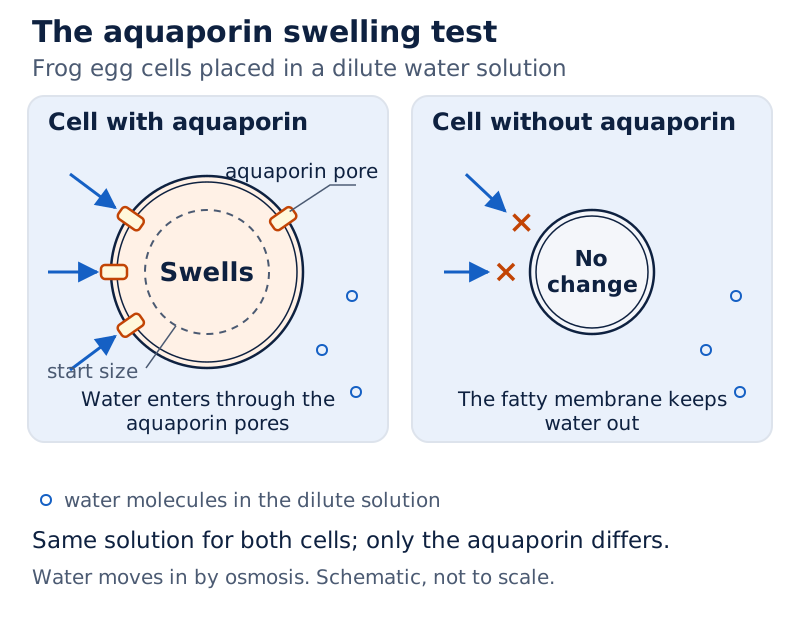
Draw two frog egg cells placed in a dilute water solution.
One cell has aquaporin protein in its membrane and swells up as water rushes in; the other cell, without the protein, stays the same size, showing the protein is responsible for water entry.
Drawn by One Young India.
Definition: osmosis. The movement of water through a semi-permeable membrane, from the side with less dissolved substance to the side with more, as the water tries to even out the concentration.
How did MacKinnon work out the structure of ion channels?
Unlike Agre's discovery, MacKinnon's breakthrough came from a deliberate, high-risk strategy. He decided that understanding ion channels required seeing their atomic structure directly, using a technique called X-ray crystallography, which maps the arrangement of atoms in a molecule from the pattern X-rays make when they pass through a crystal of that molecule.
Because membrane proteins from plants and animals proved very hard to crystallise, MacKinnon worked instead with a bacterial potassium channel protein, called KcsA, from the bacterium Streptomyces lividans, which closely resembles human potassium channels but is easier to handle in the laboratory.
In April 1998, MacKinnon determined the first high-resolution structure of this ion channel. The structure revealed a narrow passage lined with oxygen atoms, called the selectivity filter.
This filter lets potassium ions through because the potassium ion sits the same distance from the surrounding oxygen atoms in the filter as it does from the oxygen atoms of nearby water molecules that normally surround it outside the channel.
The smaller sodium ion does not fit this spacing and so cannot pass, even though it is physically smaller than potassium. This arrangement lets the channel strip away the water surrounding a potassium ion and let it slide through at no cost in energy, a kind of selective, catalysed transport.
MacKinnon also showed how the channel opens and closes: the channel's opening and closing is governed by a bottom-end gate linked to a distinct molecular "sensor" that reacts to signals such as a rise in calcium ion levels, a change in electrical voltage across the membrane, or binding of a signal molecule.
MacKinnon went on to solve further channel structures beyond the first KcsA work, including a calcium-activated potassium channel caught in its open state, which let researchers compare an open channel with a closed one and work out, in general terms, how the gate-pulling mechanism operates. He also studied channels that let ions flow in only one preferred direction, sometimes called molecular diodes, and began mapping the voltage-sensing parts that let a channel respond to changes in the electrical field across the membrane.
| Feature | Water channel (aquaporin) | Ion channel (potassium channel, KcsA) |
|---|---|---|
| Substance carried | Water molecules only | Potassium ions, blocking sodium ions |
| Discoverer | Peter Agre | Roderick MacKinnon |
| Year of key discovery | 1988 to 1992 | 1998 |
| Method used | Protein isolation, sequencing, swelling tests | X-ray crystallography |
| Main biological role | Water balance, kidney water recovery | Nerve and muscle electrical signals |
How did the discovery unfold?
| Year | Event |
|---|---|
| 1890 | Wilhelm Ostwald proposed that electrical currents in living tissue could be caused by ions moving across membranes. |
| Early 1950s | Hodgkin and Huxley showed in detail how ion movements across nerve cell membranes generate the signal known as the action potential. |
| Late 1950s | Researchers found that water crosses red blood cell membranes far too fast to be explained without dedicated water channels. |
| Mid-1980s | Peter Agre, while studying a different blood protein, came across an unidentified membrane protein in red blood cells. |
| 1988 | Agre isolated the new 28 kilodalton membrane protein, then called CHIP28, from red cells and kidney tubules. |
| 1992 | Agre proved this protein was the water channel using swelling tests on frog egg cells and on artificial liposomes. |
| 1998 | Roderick MacKinnon determined the first high-resolution structure of the potassium ion channel KcsA using X-ray crystallography. |
| 2000 | Agre, with other research teams, reported the first high-resolution three-dimensional structure of the aquaporin water channel. |
| 8 October 2003 | The Royal Swedish Academy of Sciences announced the Nobel Prize in Chemistry 2003 for these discoveries. |
Why does it matter?
These discoveries gave scientists, for the first time, an atomic-level picture of how cells manage the movement of water and salts, something essential to nearly every bodily process.
The Royal Swedish Academy of Sciences said the findings gave "a fundamental molecular understanding" of processes such as how kidneys recover water from urine and how electrical signals in nerve cells are generated.
Aquaporins have since been found throughout nature, with at least eleven different versions identified in humans alone, many linked to specific diseases.
In the kidney, aquaporin channels AQP1 and AQP2 are responsible for reabsorbing the vast majority of the roughly 170 litres of fluid filtered each day, leaving only about one litre to be excreted as urine; a shortage of the hormone that controls this process can cause the disease diabetes insipidus, with urine output of 10 to 15 litres a day.
Faulty water-channel function is linked to sensitivity to heat and dehydration: recent European heat waves caused deaths sometimes connected to problems with maintaining the body's fluid balance, a process in which aquaporins play a crucial part.
MacKinnon's structural work opened the door to detailed study of how ion channels contribute to diseases of the nervous system, heart and muscles, and gave drug designers a clear atomic target for new medicines.
Beyond medicine, understanding water channels has mattered for agriculture too, since plants rely on their own aquaporins for taking up water through the roots and for keeping their internal water balance steady, with far more variants found in a model plant than in humans.
Both lines of work let researchers understand membrane channels as finely tuned "molecular machines" rather than mysterious black boxes, and the presentation speech described this work as showing an "economy of design" in how these atomic structures are built.
How does this connect to what you study?
If you study biology topics on the cell membrane, the excretory system or the human nervous system, this prize explains the actual molecular machinery behind several ideas you may already meet in class.
When a textbook describes osmosis, the movement of water across a membrane towards the side with more dissolved substance, it is really describing what happens inside an aquaporin channel: water molecules line up in single file and pass through because the channel's electrical field lets them through while keeping out charged particles.
When you study how the kidney reabsorbs water from filtered fluid to make concentrated urine, the proteins doing that job are the aquaporins AQP1 and AQP2 described in this prize; a shortage of the hormone controlling AQP2 produces the disease diabetes insipidus, with urine output far above normal.
When you study the nerve impulse or action potential, the sodium and potassium channels that generate it are built on the same selectivity-filter principle MacKinnon worked out for the potassium channel KcsA.
So where a textbook simply says water or ions "pass through the membrane", this prize shows exactly which proteins do that job, how they are built, and how each one chooses what it lets through and what it blocks.
Quick facts for exams
The Nobel Prize in Chemistry 2003 was announced on 8 October 2003 by the Royal Swedish Academy of Sciences, for discoveries concerning channels in cell membranes.
It was shared equally between Peter Agre, of Johns Hopkins University School of Medicine, Baltimore, USA, honoured for discovering the water channel protein aquaporin, and Roderick MacKinnon, of Rockefeller University and the Howard Hughes Medical Institute, USA, honoured for working out the atomic structure of potassium ion channels using X-ray crystallography in 1998.
Both laureates were born in the United States and worked at American institutions. The total prize money was 10 million Swedish kronor, divided equally between them.
| Fact | Detail |
|---|---|
| Prize | Nobel Prize in Chemistry 2003 |
| Date announced | 8 October 2003 |
| Awarding body | The Royal Swedish Academy of Sciences |
| Citation | "for discoveries concerning channels in cell membranes" |
| Laureate 1 | Peter Agre, born Northfield, Minnesota, USA; Johns Hopkins University School of Medicine, Baltimore, USA; half share; "for the discovery of water channels" |
| Laureate 2 | Roderick MacKinnon, born Burlington, Massachusetts, USA; Rockefeller University and Howard Hughes Medical Institute, USA; half share; "for structural and mechanistic studies of ion channels" |
| Countries of birth and affiliation | Both laureates: USA |
| Prize amount | 10,000,000 Swedish kronor, shared equally |
Note: Source. The prize facts in this note are from the Nobel Prize's official site, nobelprize.org.
Glossary
- Cell membrane — the thin fatty layer surrounding a cell that normally blocks water and ions from passing freely.
- Channel protein — a protein embedded in the cell membrane that forms a narrow passage allowing a specific substance to cross quickly.
- Aquaporin — the water channel protein discovered by Peter Agre, meaning "water pore".
- Ion — an electrically charged particle, such as sodium (Na⁺) or potassium (K⁺), formed when an atom gains or loses electrons.
- Ion channel — a membrane protein that allows specific ions to cross the membrane, often opening and closing in response to signals.
- Selectivity filter — the narrow part of an ion channel lined with atoms positioned to let only one type of ion through.
- Osmosis — the movement of water across a semi-permeable membrane from a weaker to a stronger solution.
- X-ray crystallography — a technique that reveals the atomic structure of a molecule from the pattern X-rays make passing through its crystal form.
- Action potential — the brief electrical signal that travels along a nerve cell, generated by ion channels opening and closing.
- Liposome — an artificial bubble made of membrane material, used to test how proteins behave when placed in a membrane.
- Gating — the process by which a channel opens or closes in response to a specific signal.
- Kidney tubule — part of the kidney where water and useful substances are reabsorbed from filtered fluid back into the blood.
Common errors and misconceptions
- Misconception: Water simply leaks through the cell membrane everywhere. Correct: The fatty membrane itself is largely impermeable to water; rapid water movement happens through specific aquaporin channel proteins.
- Misconception: Potassium ions pass through the channel because they are smaller than sodium ions. Correct: Potassium is actually larger than sodium; it passes because the channel's oxygen atoms match the spacing potassium normally has with surrounding water, while sodium does not fit this spacing.
- Misconception: Agre set out specifically to find the water channel. Correct: He was studying a different protein (Rh blood group antigens) and found the water channel protein by chance, a discovery the Academy itself called serendipitous.
- Misconception: MacKinnon's discovery and Agre's discovery happened at the same time. Correct: Agre's key proof came in 1992, while MacKinnon's structure was solved in 1998, six years later.
- Misconception: This prize is about transporting large molecules like sugars or proteins across membranes. Correct: It specifically concerns small entities, namely water molecules and ions such as sodium and potassium.
- Misconception: Ion channels are always open. Correct: Many ion channels are gated, meaning they open and close in response to specific chemical, electrical or mechanical signals.
Exam-style questions with model answers
Q1. What was the official citation for the Nobel Prize in Chemistry 2003? [1 mark]
- The citation was "for discoveries concerning channels in cell membranes".
Q2. Name the protein Peter Agre discovered and what it transports. [2 marks]
- Agre discovered the protein aquaporin, a water channel that allows water molecules, but not ions or other small molecules, to cross the cell membrane rapidly.
Q3. Describe the steps Peter Agre took to prove his protein was the water channel. [4 marks]
- In 1988, Agre isolated an unknown 28 kilodalton membrane protein, CHIP28, from red blood cells and kidney tubules.
- He determined the protein's peptide sequence and then its DNA sequence, suspecting it was the water channel.
- He inserted the protein into frog egg cells and showed they swelled rapidly in a dilute solution, unlike untreated cells.
- He repeated the test with artificial liposomes and confirmed the result by showing mercury ions blocked water transport, as they did in red blood cells.
Q4. Explain how the potassium channel KcsA selects potassium ions over sodium ions. [4 marks]
- The channel has a narrow selectivity filter lined with oxygen atoms from the protein backbone.
- These oxygen atoms are positioned at the same distance from a potassium ion as the water molecules that normally surround it outside the channel.
- This allows the potassium ion to shed its surrounding water and pass through the filter without any energy cost.
- The smaller sodium ion does not fit properly between these oxygen atoms, so it cannot pass and remains in the surrounding water solution.
Q5. Discuss the medical and physiological importance of the discoveries honoured by the 2003 Chemistry Nobel Prize. [5 marks]
- Aquaporin water channels explain how the kidney reabsorbs most of the roughly 170 litres of fluid filtered daily, leaving only about one litre excreted as urine, with AQP1 and AQP2 playing the major roles in this process.
- A deficiency in the hormone controlling AQP2 can cause diabetes insipidus, where a person produces 10 to 15 litres of urine a day.
- At least eleven aquaporin variants exist in humans, several linked to specific diseases, giving doctors new molecular targets for understanding fluid-balance disorders.
- MacKinnon's structural work on potassium ion channels revealed the atomic basis of nerve and muscle signalling, helping explain diseases of the nervous system, heart and muscles caused by faulty ion channels.
- Together, the two discoveries gave biochemistry an atomic-level understanding of membrane transport, opening new possibilities for designing drugs that target specific channels.
Q6. Where were Peter Agre and Roderick MacKinnon affiliated at the time of the award? [2 marks]
- Peter Agre was at Johns Hopkins University School of Medicine in Baltimore, while Roderick MacKinnon was at Rockefeller University and the Howard Hughes Medical Institute, both in the USA.
Q7. What technique did Roderick MacKinnon use to determine the structure of the potassium channel, and why was a bacterial protein chosen? [3 marks]
- MacKinnon used X-ray crystallography, which maps the atomic arrangement of a molecule from the diffraction pattern X-rays make passing through its crystal.
- He studied the bacterial channel KcsA from Streptomyces lividans because membrane proteins from plants and animals proved very difficult to crystallise.
- This bacterial channel closely resembled human potassium channels, making its structure relevant to understanding human ion channels.
Key takeaways
- The Nobel Prize in Chemistry 2003 honoured discoveries about how water and ions cross cell membranes through specific channel proteins.
- Peter Agre discovered the water channel protein aquaporin, proving its function in 1992 through swelling experiments.
- Roderick MacKinnon determined the first high-resolution atomic structure of a potassium ion channel in 1998 using X-ray crystallography.
- Aquaporins explain how the kidney recovers most of the water filtered from the blood each day.
- Ion channels explain how nerve and muscle cells generate and transmit electrical signals.
- Agre's discovery was serendipitous, while MacKinnon's was the result of a deliberate, long-term strategy.
- Both laureates shared the prize money equally and were affiliated with institutions in the USA.
Test yourself
What does aquaporin allow to pass through the cell membrane?
Aquaporin allows water molecules to pass through the cell membrane rapidly, while blocking ions and other small molecules.
In which year did MacKinnon determine the structure of the KcsA potassium channel?
Roderick MacKinnon determined the first high-resolution structure of the KcsA potassium channel in 1998.
Why can sodium ions not pass through the potassium channel's selectivity filter?
Sodium ions are too small to fit properly between the oxygen atoms lining the filter, so they remain surrounded by water instead of entering.
Where was Peter Agre working when he received the Nobel Prize?
Peter Agre worked at Johns Hopkins University School of Medicine in Baltimore, Maryland, USA, at the time of the award.
What role do aquaporins AQP1 and AQP2 play in the kidney?
AQP1 and AQP2 reabsorb most of the water filtered from the blood into primary urine, so that only about one litre of urine is excreted daily.
How did Agre discover the water channel protein?
Agre found it by chance while studying a different red blood cell protein, then proved it was the water channel using swelling tests.
What technique is used to see the atomic structure of a protein like an ion channel?
X-ray crystallography reveals atomic structure from the diffraction pattern X-rays produce when passing through a crystal of the protein.