
Nobel Prize in Chemistry 2004: Ubiquitin-Mediated Protein Degradation
On this page
What was the Nobel Prize in Chemistry 2004 awarded for?
The Royal Swedish Academy of Sciences awarded the prize jointly "for the discovery of ubiquitin-mediated protein degradation". This official name is the Nobel Prize in Chemistry.
In plain words, the three laureates found out how a living cell marks its own unwanted proteins for destruction and then chops them up in a tiny cellular machine.
Cells constantly build proteins, but they must also get rid of proteins that are faulty, no longer needed or dangerous.
The laureates showed that a small molecule called ubiquitin acts like a tag or a "kiss of death": once ubiquitin molecules are chained onto a protein, that protein is sent to a barrel-shaped structure called the proteasome, which breaks it into small pieces.
This discovery explained, at the level of individual molecules, how cells control many basic processes by deciding which proteins to keep and which to destroy.
Who are the laureates?
Aaron Ciechanover
Aaron Ciechanover was born on 1 October 1947 in Haifa, in the British Protectorate of Palestine (now Israel). At the time of the award he was affiliated with the Technion - Israel Institute of Technology, Haifa, Israel.
He received one third of the prize. Ciechanover took a doctor's degree in medicine in 1975 at the Hebrew University of Jerusalem, and a second doctorate in biology in 1982 at the Technion. Working with Avram Hershko, and later during sabbatical work in Irwin Rose's laboratory, Ciechanover helped show that an unknown heat-stable protein, later identified as ubiquitin, becomes chemically attached to target proteins before they are broken down, and he took part in isolating the enzymes that carry out this attachment.
Avram Hershko
Avram Hershko was born on 31 December 1937 in Karcag, Hungary. At the time of the award he too was affiliated with the Technion - Israel Institute of Technology, Haifa, Israel. He received one third of the prize.
Hershko took a doctor's degree in medicine in 1969 at the Hadassah and Hebrew University Medical School in Jerusalem. As a postdoctoral researcher he had already studied energy-dependent breakdown of a liver enzyme, and this long-standing puzzle over why protein breakdown inside cells needed energy led him, from 1977, to switch to studying a reticulocyte extract. He led much of the biochemical work that traced this energy requirement to the ubiquitin-tagging system, including developing an immunochemical method to detect ubiquitin-protein links inside living cells.
Irwin Rose
Irwin Rose was born on 16 July 1926 in Brooklyn, NY, USA, and died on 3 June 2015 in Deerfield, MA, USA. At the time of the award he was affiliated with the University of California, Irvine, CA, USA.
He received one third of the prize. Rose took his doctorate in 1952 at the University of Chicago. Much of the key experimental work was carried out during sabbatical visits by Hershko and Ciechanover to Rose's laboratory at the Fox Chase Cancer Center in Philadelphia, where the three scientists worked out the step-by-step chemistry of the tagging process using a cell-free extract from immature red blood cells.
What problem were they trying to solve?
By the late 1970s, biochemists understood reasonably well how cells build proteins from instructions in their genes, a field that had already earned several Nobel Prizes. Far less was known about the opposite process: how cells break proteins down.
Some protein-degrading enzymes, such as trypsin in the small intestine, were already known, and these do not need extra energy to work.
Cell structures called lysosomes, which digest proteins taken in from outside the cell, had also been studied for years, and this attention to lysosomes had slowed progress on understanding energy-dependent breakdown elsewhere in the cell.
The puzzle was that experiments from the 1950s onward showed that breaking down a cell's own, internal proteins does require energy in the form of ATP (adenosine triphosphate, the cell's energy currency).
This did not fit with the usual picture, because chopping a protein chain should not itself need extra energy. Why would the cell spend energy just to destroy something?
A useful early tool came in 1977, when researchers produced a cell-free extract from immature red blood cells (reticulocytes) that could break down abnormal proteins in an ATP-dependent way, with a pH optimum around 7.8 that ruled out any major role for the acid-loving lysosomes.
Ciechanover, Hershko and Rose used this reticulocyte extract as their experimental system. Their task was to find out what, chemically, made protein breakdown depend on energy, and how the cell managed to destroy some proteins while sparing others with such precision.
This question of specificity and control, not just the chemistry of chopping up a chain, is the background puzzle their discovery answered.
How does ubiquitin-mediated protein degradation work?
The laureates found that before a protein is destroyed, it is first labelled with a small polypeptide called ubiquitin, a chain of only 76 amino acids found in almost all tissues and organisms (hence the name, from the Latin for "everywhere").
While separating the reticulocyte extract into fractions, Ciechanover and Hershko discovered a heat-stable protein they named APF-1 (active principle of fraction 1); this protein was later identified as ubiquitin itself.
In 1980 the team showed two striking things: first, that this labelling protein becomes covalently bound to other proteins in the extract, and second, that many copies of it can be attached to a single target protein, a process they called polyubiquitination.
This chain of ubiquitin molecules is the actual "kiss of death" signal that marks a protein for destruction.
Between 1981 and 1983, the group worked out the full tagging mechanism, identifying three types of enzymes called E1, E2 and E3. The process runs as follows:
- The E1 enzyme activates a ubiquitin molecule, a step that consumes energy from ATP.
- The activated ubiquitin is passed from E1 to an E2 enzyme.
- An E3 enzyme recognises the specific protein that is due for destruction and brings it close to the E2-ubiquitin complex, so the ubiquitin label is transferred onto the target protein.
- This transfer step is repeated several times, building up a short chain of ubiquitin molecules attached to the target protein.
- The ubiquitin-tagged protein is recognised by the proteasome, where the ubiquitin label is removed for re-use and the protein is pulled inside and cut into small pieces.
A human cell has only one or a few E1 enzymes, some tens of different E2 enzymes, and several hundred different E3 enzymes.
Because the E3 enzyme is the one that recognises the actual target protein, it is mainly the E3 enzymes that decide which proteins in the cell get marked for destruction.
Diagram
The ubiquitin tagging cycle
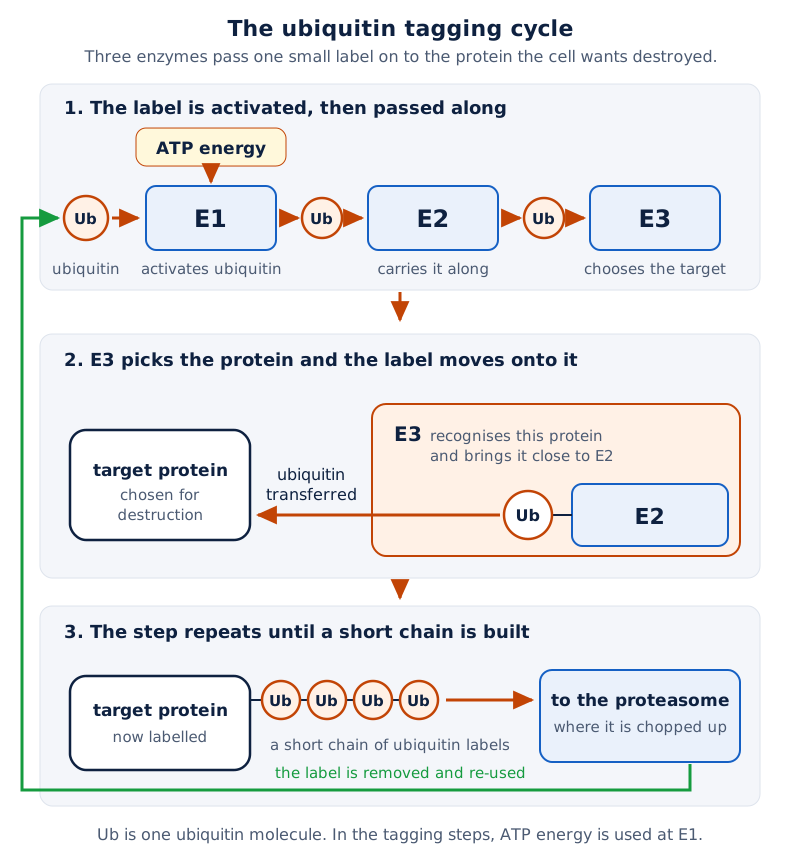
Draw a target protein on the left, with an arrow to a small circle labelled "ubiquitin" being passed in sequence through boxes labelled E1, E2 and E3, with ATP energy entering at the E1 step, and finally a short chain of three or four ubiquitin circles attached to the target protein.
Drawn by One Young India.
What is the proteasome and why does degradation matter for the cell?
The proteasome is the cell's waste-disposal machine, a barrel-shaped structure. A human cell contains roughly 30,000 proteasomes.
The protein-cutting surfaces sit inside the barrel, shielded from the rest of the cell; the only way in is through a "lock" at the opening that recognises polyubiquitinated proteins.
Once a labelled protein is let in, with the help of ATP energy, it is unfolded and pulled through, and its ubiquitin label is removed and recycled before the protein itself is chopped into peptide fragments of about 7 to 9 amino acids.
The proteasome itself does not choose which proteins to destroy; that selectivity comes almost entirely from the E3 enzymes further up the chain.
Diagram
The proteasome as a waste disposer
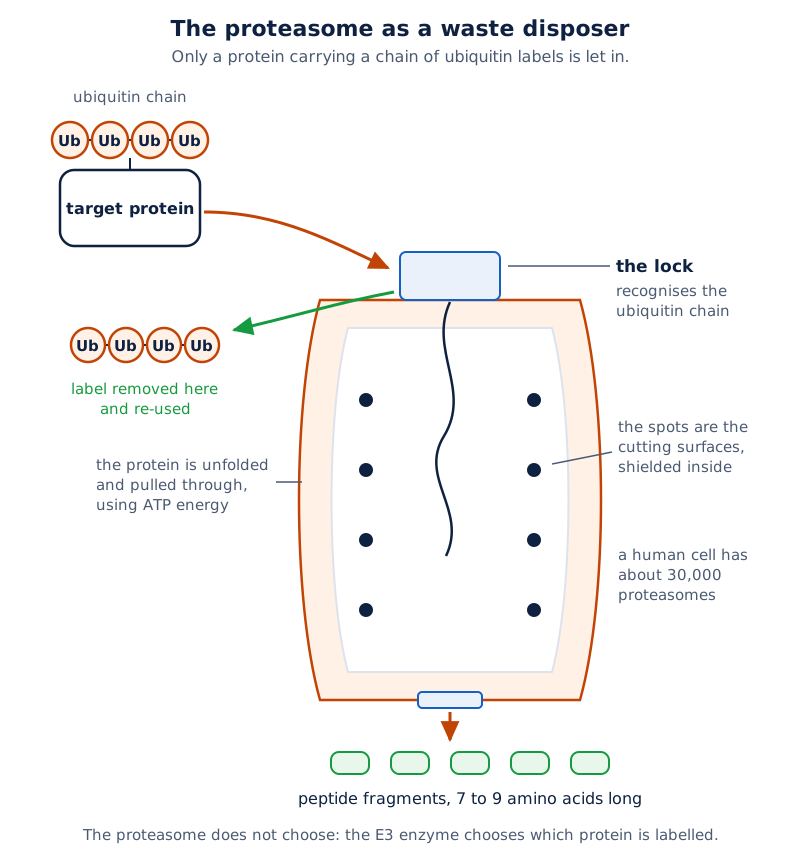
Draw a barrel-shaped structure with a narrow gated opening at the top that only admits proteins carrying a chain of ubiquitin tags, an internal chamber with active cutting surfaces shown as spots, and small peptide fragments coming out at the bottom once the protein has been processed.
Drawn by One Young India.
Because the cell can choose, through its many different E3 enzymes, exactly which proteins to tag and when, ubiquitin-mediated degradation became understood as a general control system, not just a clean-up service.
Processes shown to depend on it include cell division, DNA repair, quality control of newly made proteins, and parts of the immune defence. The table below summarises the main enzymes involved.
| Component | Role in the process |
|---|---|
| Ubiquitin | Small 76-amino-acid label attached to proteins marked for destruction |
| E1 enzyme | Activates ubiquitin using energy from ATP |
| E2 enzyme | Carries the activated ubiquitin from E1 towards the target protein |
| E3 enzyme | Recognises the specific target protein and transfers ubiquitin onto it, giving specificity |
| Proteasome | Barrel-shaped structure that recognises the ubiquitin chain, removes it, and chops the protein into small peptides |
How did the discovery unfold?
| Year | Event |
|---|---|
| 1975 | Ubiquitin is isolated and its 76-amino-acid structure identified, though its role in protein breakdown is not yet known |
| 1977 | A cell-free reticulocyte extract capable of ATP-dependent breakdown of abnormal proteins is developed, giving the laureates their experimental system |
| 1978 | Ciechanover and Hershko identify a heat-stable protein, APF-1 (later shown to be ubiquitin), while separating the extract into two fractions |
| 1979 | The reticulocyte extract is resolved into further fractions, one likely containing an early form of the proteasome |
| 1980 | Two papers by Ciechanover, Hershko and Rose show that APF-1 (ubiquitin) binds covalently to target proteins and that multiple copies can attach to one protein, establishing polyubiquitination |
| 1981 to 1983 | The group identifies and characterises the three enzyme activities E1, E2 and E3, working out the full multistep ubiquitin-tagging pathway |
| 2004 | Aaron Ciechanover, Avram Hershko and Irwin Rose are jointly awarded the Nobel Prize in Chemistry for the discovery, announced on 6 October 2004 |
Why does ubiquitin-mediated degradation matter?
The discovery changed how scientists think about the regulation of proteins inside cells. Rather than being a dull clean-up job, controlled protein breakdown turned out to be a precise switch that cells use to manage important biological events.
Examples named by the Royal Swedish Academy of Sciences include the cell cycle (when a cell divides), DNA repair, the quality control of newly produced proteins, and the immune defence.
Up to 30% of newly made proteins in a cell may be broken down this way because they fail quality checks.
When this labelling and disposal system goes wrong, disease can follow. The Academy pointed to cervical cancer, where a viral protein tricks an E3 enzyme into destroying the tumour-suppressor protein p53, and cystic fibrosis, where a misfolded chloride-channel protein is wrongly degraded instead of being allowed to function.
In the p53 case, the protein is normally kept at low levels through constant breakdown. After DNA damage, this breakdown is switched off so that p53 can rise and pause the cell cycle to allow time for DNA repair, or, if the damage is too severe, trigger programmed cell death. A viral protein found in human papilloma virus infection tricks the relevant E3 enzyme into destroying p53 anyway, removing this safeguard and allowing mutations to build up towards cancer.
In the immune system, a similar switch controls a transcription factor that regulates genes needed for defence against infection: an inhibitor protein is marked with ubiquitin and destroyed, freeing the transcription factor to switch on the relevant genes. The ubiquitin-proteasome system also generates short peptide fragments from virus proteins that are displayed on an infected cell's surface, allowing immune cells to recognise and attack it.
Understanding ubiquitin-mediated degradation opened a path to new drugs; one proteasome inhibitor named in the sources, Velcade, was already in clinical use against multiple myeloma, a cancer of antigen-producing cells, at the time of the award.
How does this connect to what you study?
This discovery links directly to the cell biology taught in school biology courses: proteins, enzymes and how cells regulate their own activities. Students learn that proteins are built from amino acids and folded into working shapes, and this prize adds the other half of that story: how a cell removes a protein once it is no longer wanted or has folded incorrectly.
The idea of a molecular label controlling a biological process is similar to how hormones or enzymes switch reactions on and off in the body. A hormone binds to a receptor and starts a process; ubiquitin binds to a protein and ends one, by sending it for destruction in the proteasome.
The ubiquitin-proteasome system is now described in biology and biochemistry courses as a key example of how cells manage protein quality control and the timing of events such as cell division. It also connects to topics on the cell cycle, DNA repair, the immune system and genetic disease, since the sources link faulty ubiquitin labelling to conditions such as cervical cancer and cystic fibrosis. Seeing how a single chemical tag can decide the fate of thousands of different proteins helps explain why this work earned a Nobel Prize in Chemistry rather than being treated only as a topic in medicine.
How was the physiological importance of ubiquitin confirmed?
By around 1983, the E1, E2 and E3 enzyme pathway had been worked out in cell-free extracts, but its full importance for a living cell was not yet clear. A mutant cell was needed in which the ubiquitin system itself was broken, so researchers could see what went wrong.
In 1980, a research group in Tokyo had isolated such a mutant mouse cell line, later called ts85, while studying how chromosomes condense during cell division. At normal temperatures the cells grew as usual, but at a higher temperature their cells stopped growing, showed defective DNA synthesis and failed to condense their chromosomes properly.
Researchers found that a ubiquitin-tagged form of a chromosome protein rapidly disappeared from ts85 cells at the higher temperature and reappeared once the cells cooled again. This pointed to a fault somewhere in the ubiquitin pathway itself.
The thermo-sensitive component was then identified as the E1 enzyme, the very enzyme that activates ubiquitin using ATP. This showed that ubiquitin activation is necessary simply for a cell to function and reproduce, and that controlled protein breakdown is involved not only in removing faulty proteins but also in cell cycle control, DNA replication and chromosome structure.
Later work traced a more detailed role in cell division: a protein complex called the anaphase-promoting complex acts as an E3 enzyme that labels an inhibitor protein for destruction at a key point in mitosis. Once that inhibitor is destroyed, a protein-cutting enzyme is released and separates the paired chromosomes, allowing the cell to divide correctly.
Because mis-handling of chromosomes during division is the commonest cause of spontaneous miscarriage, and an extra copy of chromosome 21 causes Down's syndrome, this ubiquitin-controlled step in cell division carries clear importance for human health.
The ubiquitin system was also later shown to help plants avoid self-pollination: most plants are bisexual, and rejecting their own pollen through ubiquitin-mediated degradation protects genetic diversity, although the exact mechanism was not fully worked out.
Quick facts for exams
The Nobel Prize in Chemistry 2004 was awarded jointly to Aaron Ciechanover, Avram Hershko and Irwin Rose for discovering ubiquitin-mediated protein degradation, the process by which a small protein called ubiquitin tags unwanted cellular proteins so that a structure called the proteasome can break them down.
The prize was announced on 6 October 2004 by the Royal Swedish Academy of Sciences, which awards the Chemistry prize, and was worth 10,000,000 Swedish kronor, shared equally among the three laureates.
Ciechanover and Hershko were both affiliated with the Technion - Israel Institute of Technology in Haifa, Israel, while Rose was at the University of California, Irvine, in the USA.
| Fact | Detail |
|---|---|
| Prize | Nobel Prize in Chemistry 2004 |
| Laureates | Aaron Ciechanover, Avram Hershko, Irwin Rose |
| Country of birth | Ciechanover: British Protectorate of Palestine (now Israel); Hershko: Hungary; Rose: USA |
| Affiliation at award | Ciechanover and Hershko: Technion - Israel Institute of Technology, Israel; Rose: University of California, Irvine, USA |
| Share | One third each |
| Citation | "for the discovery of ubiquitin-mediated protein degradation" |
| Date announced | 6 October 2004 |
| Prize amount | 10,000,000 Swedish kronor |
Note: Source. The prize facts in this note are from the Nobel Prize's official site, nobelprize.org.
Glossary
- Ubiquitin — a small, 76-amino-acid protein found in almost all tissues and organisms that is attached to other proteins to mark them for breakdown
- Proteasome — a barrel-shaped cell structure that recognises ubiquitin-tagged proteins and chops them into small peptide fragments
- ATP (adenosine triphosphate) — the cell's main energy-carrying molecule, used to power many biochemical reactions, including ubiquitin activation
- E1 enzyme — the enzyme that activates ubiquitin using energy from ATP, the first step in the tagging pathway
- E2 enzyme — the enzyme that carries activated ubiquitin from E1 towards the target protein
- E3 enzyme — the enzyme that recognises a specific target protein and attaches ubiquitin to it, giving the system its specificity
- Polyubiquitination — the attachment of several ubiquitin molecules, forming a chain, onto a single target protein
- Reticulocyte extract — a cell-free preparation from immature red blood cells used by the laureates to study protein breakdown in the laboratory
- p53 — a tumour-suppressor protein, called the "guardian of the genome", whose levels are controlled by ubiquitin-mediated degradation
- Cystic fibrosis — a hereditary disease caused by a faulty chloride-channel protein that is wrongly destroyed by the ubiquitin system instead of reaching the cell membrane
- Cell cycle — the sequence of stages a cell goes through to divide, several of which are controlled by ubiquitin-mediated protein breakdown
- Lysosome — a cell organelle that breaks down proteins taken in from outside the cell, without needing energy, unlike the ubiquitin system
Common errors and misconceptions
- Misconception: Protein breakdown inside cells is a random, unregulated process. Correct: The sources show it is tightly controlled, with specific E3 enzymes choosing exactly which proteins are tagged for destruction.
- Misconception: Breaking a protein chain should never need energy. Correct: The laureates' work explained that ubiquitin-mediated breakdown requires ATP because the activation and tagging steps, not the cutting itself, consume energy, which allows precise control.
- Misconception: The proteasome decides which proteins to destroy. Correct: The E3 enzyme does the selecting by attaching ubiquitin to the right target; the proteasome simply processes whatever carries the ubiquitin chain.
- Misconception: Ubiquitin is a rare, specialised molecule found only in certain organs. Correct: Ubiquitin is found almost everywhere, in many different tissues and organisms, which is how it got its name.
- Misconception: This prize is only about basic cell biology with no medical relevance. Correct: The sources link the pathway to diseases such as cervical cancer and cystic fibrosis, and to a proteasome-inhibitor drug used against multiple myeloma.
- Misconception: Ubiquitin permanently stays attached to the destroyed protein fragments. Correct: The ubiquitin label is removed shortly before the protein enters the proteasome, so it can be reused to tag other proteins.
Exam-style questions with model answers
Q1. For which discovery was the Nobel Prize in Chemistry 2004 awarded? [2 marks]
- It was awarded for the discovery of ubiquitin-mediated protein degradation, the process by which cells tag unwanted proteins with ubiquitin so they can be broken down by the proteasome.
Q2. Name the three laureates of the Nobel Prize in Chemistry 2004 and their affiliations at the time of the award. [2 marks]
- Aaron Ciechanover and Avram Hershko were both at the Technion - Israel Institute of Technology, Haifa, Israel, while Irwin Rose was at the University of California, Irvine, USA.
Q3. Explain, in order, the steps by which ubiquitin marks a protein for destruction. [4 marks]
- First, the E1 enzyme activates a ubiquitin molecule using energy from ATP. Second, this activated ubiquitin is passed to an E2 enzyme. Third, an E3 enzyme recognises the specific protein that needs to be destroyed and brings it close to the E2-ubiquitin complex so the ubiquitin label is transferred onto it. Fourth, this transfer is repeated so a short chain of ubiquitin molecules builds up on the target protein, which is then recognised and processed by the proteasome.
Q4. Why was it puzzling that the breakdown of a cell's own proteins requires energy? [3 marks]
- Simple protein-degrading enzymes known earlier, such as trypsin in the intestine, break down proteins without needing extra energy. Experiments from the 1950s onward, however, showed that breakdown of proteins inside cells does need ATP. This seemed odd because cutting a protein chain should not itself require energy, and it is this paradox that the laureates' discovery of the ubiquitin-tagging system explained.
Q5. Describe the role of the proteasome and explain why ubiquitin-mediated protein degradation matters for human health, giving examples from the sources. [6 marks]
- The proteasome is a barrel-shaped structure, with roughly 30,000 copies in a human cell, whose protein-cutting surfaces are shielded inside the barrel. Only proteins carrying a chain of ubiquitin tags are admitted through the opening; once inside, the ubiquitin is removed and recycled, and the protein is chopped into small peptide fragments. The proteasome itself does not choose which proteins to destroy; that specificity comes from the E3 enzymes further up the pathway.
- This controlled destruction turned out to regulate major cell processes including the cell cycle, DNA repair, quality control of newly made proteins and the immune defence. When the system malfunctions, disease can result: in cervical cancer, a viral protein tricks an E3 enzyme into destroying the tumour-suppressor protein p53, removing a key safeguard against cancer, while in cystic fibrosis a misfolded chloride-channel protein is wrongly degraded by the ubiquitin system instead of reaching the cell membrane. Understanding this pathway opened the door to new treatments, including a proteasome-inhibitor drug used against multiple myeloma.
Q6. What is polyubiquitination and why was its discovery significant? [3 marks]
- Polyubiquitination is the attachment of several ubiquitin molecules, forming a chain, onto a single target protein. Its discovery was significant because this chain, rather than a single ubiquitin tag, is the actual signal recognised by the proteasome that triggers a protein's destruction.
Key takeaways
- The Nobel Prize in Chemistry 2004 went to Aaron Ciechanover, Avram Hershko and Irwin Rose for discovering ubiquitin-mediated protein degradation.
- Ubiquitin is a small 76-amino-acid protein that tags unwanted proteins for destruction, acting as a molecular "kiss of death".
- Three enzymes, E1, E2 and E3, work in sequence to attach ubiquitin chains to the correct target protein, with E3 giving the specificity.
- The proteasome is the barrel-shaped structure that recognises ubiquitin-tagged proteins and chops them into small peptide fragments.
- Protein breakdown inside cells needs ATP energy because the tagging steps, not the cutting, consume energy, which allows tight control.
- Ubiquitin-mediated degradation controls the cell cycle, DNA repair, protein quality control and immune defence.
- Faults in this system are linked to diseases such as cervical cancer and cystic fibrosis.
- Much of the pioneering work was done in a cell-free reticulocyte extract during sabbatical visits by Hershko and Ciechanover to Rose's laboratory.
Test yourself
What molecule tags proteins for destruction inside a cell?
Ubiquitin, a small 76-amino-acid protein, tags unwanted proteins so they can be recognised and broken down by the proteasome.
Where was Avram Hershko affiliated at the time of the award?
Avram Hershko worked at the Technion - Israel Institute of Technology in Haifa, Israel, at the time of the 2004 Nobel Prize.
Which enzyme gives the ubiquitin system its specificity for particular proteins?
The E3 enzyme recognises the specific target protein and attaches ubiquitin to it, deciding which proteins get destroyed.
What structure finally breaks down ubiquitin-tagged proteins?
The proteasome, a barrel-shaped structure, admits ubiquitin-tagged proteins and chops them into small peptide fragments.
Name one disease the sources link to faults in ubiquitin-mediated degradation.
Cystic fibrosis is linked to this system, because a misfolded chloride-channel protein is wrongly degraded instead of reaching the cell membrane.
How much was the Nobel Prize in Chemistry 2004 worth, and how was it shared?
The prize was worth 10,000,000 Swedish kronor, shared equally, one third each, among Ciechanover, Hershko and Rose.