
Nobel Prize in Economics 2002: Behavioural and Experimental Economics
On this page
This note covers the Nobel Prize in Economics 2002: who won it, why psychology and laboratory experiments entered economics, how Vernon L. Smith built experimental economics and how Daniel Kahneman built behavioural economics, how their work developed over the decades, why it matters today, and quick facts for exams.
What was the Nobel Prize in Economics 2002 awarded for?
The 2002 prize was divided equally between two laureates, each honoured for a different achievement. Daniel Kahneman received his half "for having integrated insights from psychological research into economic science, especially concerning human judgment and decision-making under uncertainty". Vernon L.
Smith received his half "for having established laboratory experiments as a tool in empirical economic analysis, especially in the study of alternative market mechanisms".
In plain words, the Royal Swedish Academy of Sciences recognised two scholars who challenged the same old assumption from two different directions. Economics had long pictured people as a "homo oeconomicus", a purely self-interested, perfectly rational calculator.
Kahneman showed, using psychology, that real human judgement often departs from this picture in predictable ways.
Smith showed that economic theories could be tested directly in a controlled laboratory, the way a chemist tests a reaction, rather than only by watching the real economy from a distance.
The award's official name is the Sveriges Riksbank Prize in Economic Sciences in Memory of Alfred Nobel, commonly called the Nobel Prize in Economics. It was announced on 9 October 2002 and carried a prize amount of 10,000,000 Swedish kronor, shared equally between the two laureates.
Who are the laureates?
Daniel Kahneman
Daniel Kahneman was born on 5 March 1934 in Tel Aviv, in the British Mandate of Palestine, now Israel.
At the time of the award he was affiliated with Princeton University in Princeton, New Jersey, USA, where he held a professorship from 1993. He received one half of the 2002 prize. Kahneman died on 27 March 2024.
Kahneman began his prize-winning research in the late 1960s, drawing on cognitive psychology to study how people form judgements and make choices under uncertainty.
Working for many years with his collaborator Amos Tversky, who died in 1996, he showed that human decisions often follow mental shortcuts rather than strict logic, and the pair eventually built an alternative model called prospect theory, which became a foundation of behavioural economics.
Vernon L. Smith
Vernon L. Smith was born on 1 January 1927 in Wichita, Kansas, USA. At the time of the award he was affiliated with George Mason University in Fairfax, Virginia, USA, a post he had held since 2001.
He received the other one half of the prize. Much of the research that earned him the prize was carried out earlier, at the University of Arizona, where he worked from 1976 to 2001.
Smith is credited with turning economics into an experimental science. Starting with his first published market experiment in 1962, he designed laboratory setups where volunteers acted as buyers and sellers, and he used these setups to test whether real market prices behave the way economic theory predicts.
He went on to test different auction designs and to build methodological tools, such as the induced-value method, that other economists still use to run reliable experiments.
What problem were Kahneman and Smith responding to?
Until the late twentieth century, most economists treated their subject as a non-experimental science. Like astronomers or meteorologists, they felt they could only observe the real economy and could not run controlled trials the way chemists or biologists do.
Economic theory also leaned heavily on the idea of the homo oeconomicus, a decision-maker who is motivated purely by self-interest and processes information in a fully rational, logical way.
By the mid-twentieth century, cracks were already appearing in both assumptions. The 1988 economics laureate Maurice Allais had outlined a paradox showing that real people sometimes violate the basic axioms of rational choice under uncertainty.
Herbert Simon had proposed the idea of bounded rationality, where people's reasoning power is limited rather than unlimited. Early game theorists such as John Nash and Reinhard Selten, both later Nobel laureates, had also run small experimental studies.
What had been missing was a sustained, systematic programme that took these doubts seriously on a large scale.
Two separate research traditions grew to fill that gap: cognitive psychologists who studied how people actually judge probabilities and make choices, and experimental economists who tested market theories directly in the laboratory.
The 2002 prize recognised the two researchers the Academy identified as the pioneers of each of these converging traditions.
How did Vernon Smith turn economics into an experimental science?
Smith's starting point was a classroom exercise by his own teacher, Edward Chamberlin, who had students bargain in pairs as buyers and sellers of a fictitious good and found that resulting prices did not match the standard theory of perfect competition.
Smith suspected the setup itself was the problem, so he redesigned it using a market mechanism called a double oral auction, in which buyers and sellers call out prices continuously until trades happen.
His basic experimental procedure worked roughly as follows:
- Divide volunteers randomly into groups of potential buyers and potential sellers.
- Give each seller a private "reservation price", the lowest price at which they are allowed to sell, and each buyer a private reservation price, the highest price at which they are allowed to buy.
- Let the experimenter calculate, from the hidden distribution of these reservation prices, the theoretical equilibrium price where supply and demand would meet.
- Let the subjects trade freely without knowing this theoretical price, recording actual trading prices over several rounds.
- Compare the observed trading prices with the calculated equilibrium price to see whether, and how fast, the market converges on it.
In his first published results, from 1962, Smith found that actual prices came surprisingly close to the theoretical equilibrium even though no trader had the information needed to compute it directly.
He and later collaborators, notably Charles Plott, repeated this kind of test under different trading rules and confirmed that the result was robust, while also showing that the precise market institution used, for example whether prices could be changed continuously or only posted once per round, changed how quickly prices converged.
Smith then extended the method to study auctions, the mechanism used to sell everything from artwork to government bonds to broadcasting licences. Standard theory makes specific predictions about which auction formats should raise the same revenue for a seller.
| Auction type | How it works |
|---|---|
| English auction | Buyers call out rising bids until no higher bid is offered; the last bidder wins and pays that bid. |
| Dutch auction | The seller starts at a high price that falls steadily until a buyer accepts it at that price. |
| First-price sealed-bid auction | Everyone submits a hidden bid at once; the highest bidder wins and pays their own bid. |
| Second-price sealed-bid auction | Everyone submits a hidden bid at once; the highest bidder wins but pays only the second-highest bid. |
Running these four formats in the laboratory, Smith confirmed the theoretical prediction that English and second-price auctions tend to raise similar revenue, but found, against theory, that Dutch and first-price auctions did not behave equivalently.
He also pioneered using the lab as a "wind-tunnel test", adapted from the press release's phrase "wind-tunnel tests", trying out new market designs, such as rules for deregulating electricity markets or allocating airport time slots, before they were used for real.
How did Daniel Kahneman change ideas about human judgment?
Kahneman, working mostly with Amos Tversky, asked a different question: when people judge how likely something is, do they follow the mathematical laws of probability? Their experiments repeatedly found that people instead rely on mental shortcuts, or heuristics, which are useful most of the time but create systematic biases.
One such shortcut is the "law of small numbers", where people wrongly assume that a small sample should show the same pattern as a large one.
A well-known experiment found that subjects rated a greater-than-60-per-cent-boys day as equally likely in a small hospital with few daily births and in a large hospital with many, even though the smaller hospital's daily count should swing to such extremes far more often by chance alone.
A second shortcut is representativeness. In one experiment, subjects were told about a person who was described as "interested in politics, likes to participate in debates, and is eager to appear in the media" and asked whether this person was more likely a salesman or a member of parliament.
Most subjects guessed member of parliament, ignoring the fact that salespeople vastly outnumber members of parliament in the population, so a randomly drawn person described this way is still statistically more likely to be a salesman.
A third shortcut, availability, means people judge how common something is by how easily examples come to mind.
Someone who personally knows a crime victim will tend to overestimate how much violent crime occurs in their city, even when official statistics say otherwise.
Through dozens of such experiments, Kahneman and Tversky built a detailed picture of how human probability judgement departs from the textbook rational model in predictable, repeatable ways, rather than through random error.
What is prospect theory and how does it differ from standard theory?
Having shown that judgement is biased, Kahneman and Tversky turned to decision-making itself, and in particular to choices involving risk.
Standard economics uses expected-utility theory, which assumes a decision-maker weighs every possible final level of wealth by its probability and picks the option with the highest expected value of a smooth, well-behaved utility function.
Kahneman and Tversky's 1979 paper, titled "Prospect Theory: An Analysis of Decisions under Risk", proposed an alternative built directly from experimental evidence rather than from abstract axioms. It differs from expected-utility theory in four main ways; framing effects follow from the reference-point difference.
- People evaluate outcomes as gains and losses relative to a reference point, often their current wealth, rather than as final wealth levels in themselves.
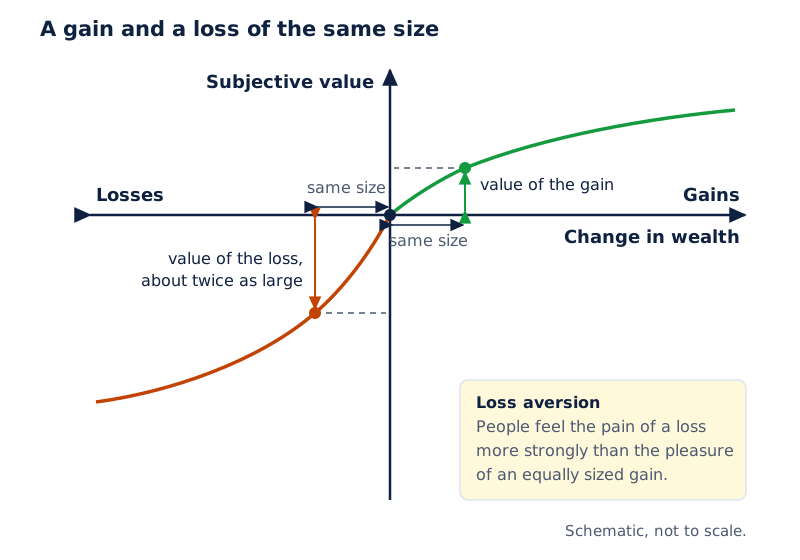
- The value people attach to outcomes follows an S-shaped curve: it bends inward (shows diminishing sensitivity) for both gains and losses, and it is noticeably steeper for losses than for an equal-sized gain near the reference point, a pattern called loss aversion.
- People do not use the true mathematical probabilities directly; instead they apply a decision-weight function that overweights small probabilities and underweights large ones.
- Choices depend on how a decision problem is "framed" or presented, because framing affects which reference point people adopt before they evaluate gains and losses.
Diagram
the prospect-theory value function
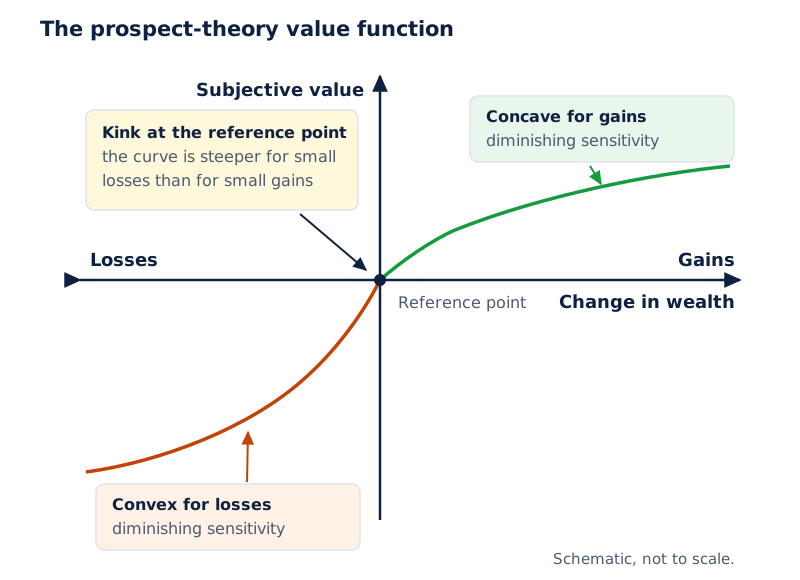
Draw a horizontal axis for change in wealth, running through zero in the middle, with losses to the left and gains to the right, and a vertical axis for subjective value.
Sketch a curve that passes through the origin, rises gently and flattens out on the gains side, and falls steeply and then flattens on the losses side, so the curve has a sharp kink at zero and is clearly steeper just to the left of zero than just to the right of it.
Drawn by One Young India.
This model explains puzzles that plain expected-utility theory struggles with, such as people buying small, overpriced insurance policies for appliances, or refusing to drive across town to save a fixed sum on an expensive purchase while happily driving the same distance to save the same sum on a cheap one.
Prospect theory remains, according to the prize committee's own scientific background document, the basis for much of today's applied work in behavioural economics and finance.
How did the discovery unfold?
| Year | Event |
|---|---|
| 1944 | Daniel Kahneman's father died; the family moved from France to Palestine. |
| 1949 | Vernon Smith earned his bachelor's degree in electrical engineering at Caltech. |
| 1953 | Maurice Allais outlined an early paradox in choice under uncertainty that influenced later behavioural theory. |
| 1955 | Vernon Smith completed his Ph.D. in economics at Harvard University. |
| 1961 | Daniel Kahneman completed his Ph.D. at the University of California, Berkeley. |
| 1962 | Vernon Smith published his first laboratory market experiment, showing prices converging on the theoretical equilibrium. |
| 1973 to 1974 | Kahneman and Tversky published key papers on heuristics such as representativeness and availability. |
| 1976 | Smith published his influential paper setting out the induced-value method for designing reliable experiments. |
| 1979 | Kahneman and Tversky published "Prospect Theory: An Analysis of Decisions under Risk" in Econometrica. |
| 1992 | Tversky and Kahneman extended the model as cumulative prospect theory. |
| 1993 | Daniel Kahneman became Eugene Higgins Professor of Psychology and Professor of Public Affairs at Princeton University. |
| 1996 | Amos Tversky, Kahneman's long-time collaborator, died. |
| 2001 | Vernon Smith became Professor of Economics and Law at George Mason University. |
| 2002 | Kahneman and Smith were jointly awarded the Sveriges Riksbank Prize in Economic Sciences. |
Why does it matter?
Smith's work turned the laboratory into a standard tool of economics. The press release noted that his experimental methods helped set the standards for "what constitutes a reliable laboratory experiment in economics".
Today, economists routinely test new market designs in the lab before using them in the real world, for example when designing electricity markets or allocating scarce licences, rather than relying only on theory or guesswork.
Kahneman's work opened the field now generally called behavioural economics, which borrows findings from psychology to improve economic models of real human choice.
It also fed directly into behavioural finance, a field that tries to explain puzzling swings in financial markets, such as unexplained volatility in stock prices, as the result of investors making the same kind of systematic judgement errors documented in Kahneman and Tversky's experiments.
Open questions remain about how far these findings generalise. The scientific background document notes that how far laboratory results can be generalised to real, large-scale markets is "still under debate", much as physicists debate how far small-scale laboratory results generalise to the universe as a whole.
Economists also still argue over when the richer, more complex behavioural models are needed and when the simpler, traditional rational model works well enough.
Quick facts for exams
The Sveriges Riksbank Prize in Economic Sciences in Memory of Alfred Nobel 2002, commonly called the Nobel Prize in Economics, was announced on 9 October 2002 and shared equally between Daniel Kahneman, born in Tel Aviv and affiliated with Princeton University, and Vernon L.
Smith, born in Wichita, Kansas and affiliated with George Mason University. Kahneman was cited for bringing psychology into economics, especially on judgement and decision-making under uncertainty, producing prospect theory.
Smith was cited for establishing laboratory experiments as a tool in economics, especially for studying alternative market mechanisms such as auctions. The total prize amount was 10,000,000 Swedish kronor, split equally.
| Fact | Detail |
|---|---|
| Prize | Sveriges Riksbank Prize in Economic Sciences in Memory of Alfred Nobel 2002 |
| Date announced | 9 October 2002 |
| Laureates | Daniel Kahneman and Vernon L. Smith |
| Country of birth (Kahneman) | British Mandate of Palestine, now Israel |
| Country of birth (Smith) | United States of America |
| Affiliation at award (Kahneman) | Princeton University, Princeton, NJ, USA |
| Affiliation at award (Smith) | George Mason University, Fairfax, VA, USA |
| Prize shares | One half each |
| Prize amount | 10,000,000 Swedish kronor |
| Citation (Kahneman) | "for having integrated insights from psychological research into economic science, especially concerning human judgment and decision-making under uncertainty" |
| Citation (Smith) | "for having established laboratory experiments as a tool in empirical economic analysis, especially in the study of alternative market mechanisms" |
Note: Source. The prize facts in this note are from the Nobel Prize's official site, nobelprize.org.
Glossary
- Homo oeconomicus — a theoretical model of a human decision-maker who is purely self-interested and perfectly rational.
- Expected-utility theory — the standard economic model in which a decision-maker picks the option with the highest probability-weighted average utility.
- Prospect theory — Kahneman and Tversky's alternative model, in which people value gains and losses relative to a reference point rather than final wealth.
- Heuristic — a mental shortcut used to make a judgement quickly, which can be accurate most of the time but systematically biased in some cases.
- Representativeness — the heuristic of judging how likely something is by how closely it resembles a typical example, ignoring background statistics.
- Availability — the heuristic of judging probability by how easily examples come to mind, giving too much weight to memorable events.
- Law of small numbers — the mistaken belief that small samples should show the same statistical pattern as large samples.
- Loss aversion — the tendency to feel a loss more strongly than an equally sized gain.
- Reference point — the baseline, often current wealth, against which a person judges an outcome as a gain or a loss.
- Double oral auction — a trading mechanism where buyers and sellers continuously call out prices until a deal is struck.
- Induced-value method — Smith's technique of rewarding experimental subjects with money so that their behaviour reflects a demand or supply curve chosen by the researcher.
- Wind-tunnel test — Smith's term, borrowed from aircraft testing, for trying out a new market design in the laboratory before using it in the real economy.
- Behavioural economics — the field that combines psychological findings with economic theory to explain real decision-making.
- Experimental economics — the field that tests economic theories using controlled laboratory trials rather than only real-world data.
Common errors and misconceptions
- Misconception: Kahneman and Smith worked together on one combined theory. Correct: they worked independently on two separate research traditions, psychology-based judgement research and laboratory market experiments, and shared the prize for different contributions.
- Misconception: prospect theory says people are simply irrational. Correct: it says people's choices follow systematic, predictable patterns that differ from the standard rational model, not random error.
- Misconception: Amos Tversky also received the 2002 prize. Correct: Tversky, Kahneman's main collaborator, had died in 1996 and the Nobel Prize is not awarded posthumously, so only Kahneman received it for their joint work.
- Misconception: Smith's experiments proved markets never work as theory predicts. Correct: his 1962 experiment actually found that real trading prices came close to the theoretical equilibrium price, broadly supporting standard market theory.
- Misconception: the "wind-tunnel test" refers to physical engineering testing. Correct: it is Smith's term, borrowed from aircraft testing, for trying a new market or auction design in the economics laboratory first.
- Misconception: loss aversion means people always avoid risk. Correct: the evidence shows people can become risk-loving when facing possible losses, while staying risk-averse over possible gains.
- Misconception: this prize is officially called the "Nobel Prize in Economics". Correct: its official name is the Sveriges Riksbank Prize in Economic Sciences in Memory of Alfred Nobel, though it is widely called the Nobel Prize in Economics.
Exam-style questions with model answers
Q1. In which year was the 2002 Sveriges Riksbank Prize in Economic Sciences announced? [1 mark]
- It was announced on 9 October 2002.
Q2. State the prize share received by each of the two laureates. [2 marks]
- Daniel Kahneman and Vernon L. Smith each received one half of the prize, sharing the 10,000,000 Swedish kronor award equally between them.
Q3. Explain what the "law of small numbers" means, with the example given in the source. [4 marks]
- The law of small numbers is the mistaken belief that a small sample of observations should show the same statistical pattern as a very large sample, even though small samples naturally vary much more by chance.
- Kahneman and Tversky illustrated this with an experiment in which subjects rated a greater-than-60-per-cent-boys day as equally likely in a small hospital with few daily births and in a large hospital with many.
- In reality, the smaller hospital should show more extreme swings purely because of its smaller sample size, so the subjects' equal judgement contradicted the mathematical law of large numbers.
Q4. Describe the main steps of Vernon Smith's early market experiments. [4 marks]
- Smith divided volunteers randomly into buyers and sellers and gave each a private reservation price, the limit below or above which they were not allowed to trade.
- From the hidden distribution of these reservation prices, he calculated a theoretical equilibrium price where supply and demand would meet.
- Subjects then traded freely in a double oral auction without knowing this theoretical price, and their actual trading prices were recorded over several rounds.
- Comparing the recorded prices with the theoretical equilibrium showed that real prices converged surprisingly close to the prediction, even though no trader had the information to compute it directly.
Q5. Discuss how prospect theory differs from expected-utility theory, and why these differences matter for understanding real economic decisions. [6 marks]
- Expected-utility theory assumes people evaluate choices by weighing every possible final level of wealth by its probability, using one smooth utility function, and simply picking the option with the highest expected value.
- Prospect theory instead assumes people evaluate changes in wealth relative to a reference point, often their current wealth, rather than final wealth levels, so the same outcome can feel different depending on the starting point.
- The value function in prospect theory is S-shaped: it shows diminishing sensitivity to further gains and losses and is steeper for losses than for equally sized gains, a pattern called loss aversion.
- Prospect theory also replaces true probabilities with a decision-weight function that overweights small probabilities and underweights large ones, helping to explain puzzles such as the Allais paradox.
- These differences matter because they let economists explain real behaviour, such as paying for small-scale insurance or reacting more strongly to losing money than to gaining the same amount, that traditional expected-utility theory struggles to account for.
Q6. Name the universities with which Kahneman and Smith were affiliated at the time of the 2002 award. [2 marks]
- Daniel Kahneman was affiliated with Princeton University, and Vernon L. Smith was affiliated with George Mason University.
Q7. What did the committee mean by calling the laboratory a "wind-tunnel test"? [3 marks]
- The committee used this phrase to describe how Smith tried out new, complex market or auction designs, such as rules for deregulated electricity markets, inside a controlled laboratory experiment first.
- This mirrors how engineers test an aircraft prototype in a physical wind tunnel before building the real aircraft.
- It is useful because economic theory often cannot predict precisely how a complicated new mechanism will perform, so testing it experimentally first reduces the risk of costly mistakes in the real economy.
Key takeaways
- The 2002 prize was shared equally between Daniel Kahneman and Vernon L. Smith for two separate contributions.
- Kahneman brought psychology into economics, showing systematic biases in human judgement and building prospect theory.
- Smith established the laboratory experiment as a reliable tool for testing economic theories, especially about markets and auctions.
- Both laureates challenged the traditional assumption of a perfectly rational, self-interested "homo oeconomicus".
- Smith's 1962 experiment found real trading prices converged close to the theoretical equilibrium price.
- Kahneman and Tversky's heuristics, including representativeness and availability, cause predictable departures from strict probability logic.
- Prospect theory explains loss aversion and risk-seeking behaviour over losses, which expected-utility theory cannot easily explain.
- Their work founded or strengthened the fields of behavioural economics, behavioural finance and experimental economics.
Test yourself
Who shared the 2002 Sveriges Riksbank Prize in Economic Sciences?
Daniel Kahneman and Vernon L. Smith shared the prize, each receiving one half of the award.
Where was Vernon L. Smith affiliated at the time of the award?
Vernon L. Smith was affiliated with George Mason University in Fairfax, Virginia, at the time of the award.
What is the "law of small numbers"?
It is the mistaken belief that outcomes in a small sample should show the same statistical pattern as a very large sample.
What did Smith's 1962 experiment find about market prices?
Smith found that real trading prices in his laboratory market came surprisingly close to the theoretical equilibrium price.
What does loss aversion mean in prospect theory?
Loss aversion means people feel the pain of a loss more strongly than the pleasure of an equally sized gain.
Who was Kahneman's key long-term collaborator, and what happened to him?
Amos Tversky was Kahneman's key collaborator; he died in 1996, before the prize was awarded in 2002.
What phrase describes Smith's use of the laboratory to test new market designs before real use?
The committee called this a "wind-tunnel test", testing new market designs in the lab before real-world use.