
Nobel Prize in Economics 2004: Time Consistency and Business Cycle Theory
On this page
This note covers the Nobel Prize in Economics 2004: who won it, what "time consistency" of economic policy means, how Finn Kydland and Edward Prescott changed the theory of business cycles, how their ideas developed, why they still matter, and quick facts for exams.
What was the Nobel Prize in Economics 2004 awarded for?
The Royal Swedish Academy of Sciences gave the award "for their contributions to dynamic macroeconomics: the time consistency of economic policy and the driving forces behind business cycles". This sentence covers two separate but related pieces of work.
In plain words, the first half is about why governments find it hard to stick to good long-term plans once people's expectations have already adjusted to those plans.
The second half is about why economies go through ups and downs (business cycles), and whether these swings come mainly from changes in demand (how much people want to buy) or from changes on the supply side, such as how fast technology improves.
The official name of this award is the Sveriges Riksbank Prize in Economic Sciences in Memory of Alfred Nobel, widely called the Nobel Prize in Economics.
It is not one of the original five prizes that Alfred Nobel created in his will; Sweden's central bank, Sveriges Riksbank, established it in 1968 and it has been given alongside the other Nobel Prizes since 1969.
Who are the laureates?
Finn E. Kydland
Finn E. Kydland was born on 1 December 1943 in Gjesdal, Norway. At the time of the award he was affiliated with Carnegie Mellon University, Pittsburgh, PA, USA, and the University of California, Santa Barbara, CA, USA. He received one half of the prize.
According to his biographical page, Kydland grew up outside Stavanger, Norway, studied at the Norwegian School of Economics in Bergen, and became a research assistant to his professor Sten Thore.
He followed Thore to Carnegie Mellon University in 1969 for his Ph.D., writing a dissertation on decentralised economic planning under his future co-laureate, Edward Prescott.
He was a professor at Carnegie Mellon from 1977 to 2004, after which he joined the University of California, Santa Barbara.
Edward C. Prescott
Edward C. Prescott was born on 26 December 1940 in Glens Falls, NY, USA, and died on 6 November 2022 in Paradise Valley, AZ, USA.
At the time of the award he was affiliated with Arizona State University, Tempe, AZ, USA, and the Federal Reserve Bank of Minneapolis, Minneapolis, MN, USA. He received one half of the prize.
Prescott originally studied mathematics before switching to economics, earning his Ph.D. from Carnegie Mellon University in 1967. He taught economics at the University of Pennsylvania from 1966 to 1971, where he advised Kydland's doctoral work.
The two laureates, separately and together, are often credited with shaping how governments conduct monetary and fiscal policy and with helping bring about greater independence for many central banks.
What problem were they trying to solve?
Until the 1970s, macroeconomics was dominated by ideas from John Maynard Keynes and the experience of the Great Depression.
Economists believed that business cycles (the recurring swings between good times and recessions) came mainly from changes in demand, such as how much firms wanted to invest and households wanted to spend.
Governments were expected to use monetary and fiscal policy with full freedom (discretion) to smooth these swings, for example accepting a bit more inflation to get lower unemployment.
This picture seemed to work during the stable growth of the 1950s and 1960s. But the 1970s broke it. Oil-price shocks and a slowdown in productivity growth produced stagflation: high inflation and high unemployment at the same time.
The old Phillips-curve relationship between inflation and unemployment, which had looked stable, stopped holding up.
Economic policy based on the old theory seemed to make things worse rather than better, even though governments kept declaring that low inflation was their goal.
Researcher Robert Lucas (a later laureate himself) argued that the problem was methodological: models built on loose statistical relationships between big aggregate variables could not be trusted, because those relationships themselves changed when policy changed.
He called for macroeconomic theory to be rebuilt from the ground up, starting with the actual decisions of individual households and firms.
It was within this gap, between Lucas's call and a workable alternative, that Kydland and Prescott did their award-winning work.
What is the time consistency problem?
Kydland and Prescott's 1977 paper, titled "Rules Rather than Discretion: The Inconsistency of Optimal Plans", looked at how a government should choose policy over time when people's expectations matter.
The central idea is the time consistency problem: a policy that looks best when announced in advance may stop looking best once people have already reacted to the announcement.
The Nobel committee's press release explained the logic this way: "If economic policymakers lack the ability to commit in advance to a specific decision rule, they will often not implement the most desirable policy later on." The committee added that this gave "a common explanation for events that, until then, had been interpreted as separate policy failures", such as economies becoming trapped in high inflation even though price stability was the stated aim of policy.
A simple example from the inflation case works like this. Suppose a central bank announces it will keep inflation at zero. If workers and firms believe this, they set low wage increases.
But once those wage contracts are fixed, the government may find it tempting to allow a bit of inflation, because that would (in the short run) reduce unemployment at no immediate cost.
The snag is that rational people anticipate this temptation in advance. So the announcement of zero inflation is not believed, wages are set expecting some inflation, and the result is an economy with higher inflation and no lasting gain in employment.
The commitment outcome (low inflation) could not be achieved under discretion, even though everyone, including the government, would have preferred it ex ante.
The same logic applies elsewhere. The source material gives two further cases: governments that promise to help flood or earthquake victims cannot credibly promise not to help afterward, which can encourage risky settlement in advance; and governments that promise to protect new inventions with patents may be tempted to weaken that protection once the invention already exists, which can discourage innovation if firms expect this.
This can be shown with a short step-by-step picture of how the problem arises:
- In an earlier period, the government would like to announce a long-term policy, and private citizens form expectations and make decisions (such as saving or wage-setting) based on that announcement.
- If the government can genuinely commit to the announced policy, it chooses the policy that is best overall, taking its effect on private decisions into account.
- If the government cannot commit, then once the later period arrives and private decisions are already locked in, the government finds it attractive to change its policy, because the earlier effects on private behaviour can no longer be influenced.
- Rational citizens anticipate this temptation in advance, so they never fully believe the original announcement.
- The resulting outcome under "discretionary" policymaking therefore has lower welfare than if the government could have bound itself in advance.
Diagram
Commitment versus discretion outcomes
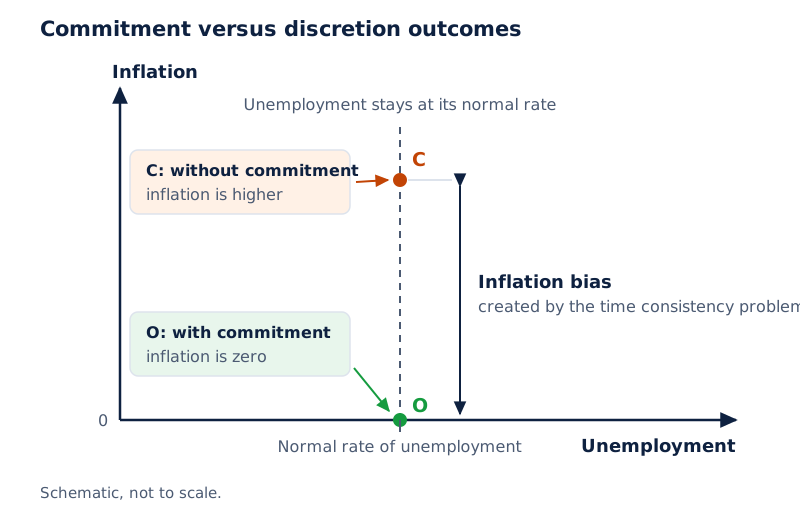
Draw two axes, unemployment on one side and inflation on the other.
Mark a point O where inflation is zero and unemployment sits at its normal rate, representing the outcome if the government could commit in advance.
Then mark a point C, at a higher inflation rate but the same unemployment rate, representing the outcome if the government instead acts without commitment.
Label the gap between O and C as the "inflation bias" created by the time consistency problem.
Drawn by One Young India.
The committee noted that this insight shifted the practical discussion of policy away from single decisions and towards the design of institutions, such as independent central banks, that make low-inflation promises more believable.
How did the laureates explain business cycles?
The second strand of the award comes from Kydland and Prescott's 1982 paper, "Time to Build and Aggregate Fluctuations". Until then, economists had mostly studied long-run economic growth and short-run business-cycle swings as two separate subjects, using separate methods.
Growth was seen as driven by improving technology; cycles were seen as driven mainly by swings in demand.
Kydland and Prescott joined these two subjects together. They built a model in which the economy is made up of utility-maximising households and profit-maximising firms, all making forward-looking decisions about consumption, saving, investment and how much to work.
Into this model they fed realistic short-run variations in the rate of technological progress, that is, random speeding-up and slowing-down of productivity growth (a supply-side shock rather than a demand-side one).
Their result was striking: a model driven only by these supply-side technology shocks could reproduce the pattern seen in real data, in which GDP, consumption, investment and hours worked all tend to move together (co-vary) in a similar way to the actual, observed fluctuations.
This showed that business cycles did not need to come from failures of markets to match demand and supply; they could instead be the natural, efficient response of forward-looking households and firms to changes in the pace of technology.
To test this, the laureates did not use the usual statistical estimation methods of the time.
Instead they used a technique called calibration: setting the model's underlying parameters to match known long-run facts and separate microeconomic studies, then simulating the model on a computer and comparing the simulated, "synthetic" data with actual macroeconomic data.
The Royal Swedish Academy described the model as becoming "a laboratory for large-scale economic experiments" in the ceremony speech.
| Older view (pre-1980s) | Kydland and Prescott's approach |
|---|---|
| Growth and business cycles studied as separate topics | Growth and cycles studied together in one dynamic model |
| Cycles blamed mainly on demand shocks | Cycles can arise from supply-side technology shocks |
| Models based on broad historical statistical relationships | Models built from individual households' and firms' decisions |
| Models tested against past data patterns alone | Models tested by simulation and calibration against real data |
How did the discovery unfold?
| Year | Event |
|---|---|
| 1967 | Edward Prescott receives his Ph.D. from Carnegie Mellon University. |
| 1969 | Finn Kydland joins Carnegie Mellon University for his Ph.D., supervised by Prescott. |
| 1973 | Kydland completes his Ph.D. at Carnegie Mellon University. |
| 1977 | Kydland and Prescott publish "Rules Rather than Discretion: The Inconsistency of Optimal Plans", introducing the time consistency problem. |
| 1982 | Kydland and Prescott publish "Time to Build and Aggregate Fluctuations", linking growth and business cycles through technology shocks. |
| Early 1990s | Many countries begin reforming their central banks towards greater independence, drawing on this research. |
| 11 October 2004 | The Royal Swedish Academy of Sciences announces the award to Kydland and Prescott. |
| 10 December 2004 | The prize is presented at the award ceremony in Stockholm. |
The press materials note that Kydland and Prescott's partnership began when Kydland, having recently finished his Ph.D. and taken a post at the Norwegian School of Economics, worked with Prescott (his former Carnegie Mellon advisor) during a visit by Prescott to Bergen, Norway.
A later return visit to Bergen led to their second major paper on business cycles.
Why does this matter?
The committee said that the laureates' work on time consistency "established the foundations for an extensive research program on the credibility and political feasibility of economic policy." In practice, this research is linked to real reforms: many central banks, including in New Zealand, Sweden, Great Britain and the Euro area, were given greater independence from day-to-day political control from the early 1990s onward, with clearer price-stability goals, partly to make low-inflation promises more credible.
On business cycles, their modelling approach became the basis of a large and ongoing research programme.
Later researchers built more realistic versions of the model, including "new-Keynesian" models that combine Kydland and Prescott's supply-side, forward-looking approach with sticky prices and wages, and such models are widely used to study monetary policy today.
Central banks and international organisations use variants of these models for business-cycle forecasting.
The sources also leave open questions. The Popular information page notes that the original 1982 model was "highly stylized" and that subsequent researchers have had to add features such as market imperfections to make it more realistic, and that current state-of-the-art models give weight to both supply and demand shocks rather than treating technology shocks as the whole story.
Quick facts for exams
The Sveriges Riksbank Prize in Economic Sciences in Memory of Alfred Nobel for 2004, widely known as the Nobel Prize in Economics 2004, was announced on 11 October 2004 by the Royal Swedish Academy of Sciences.
It was awarded jointly to Finn E. Kydland of Norway and Edward C. Prescott of the United States, each receiving one half of the prize, "for their contributions to dynamic macroeconomics: the time consistency of economic policy and the driving forces behind business cycles." Kydland was affiliated with Carnegie Mellon University and the University of California, Santa Barbara;
Prescott was affiliated with Arizona State University and the Federal Reserve Bank of Minneapolis. Their key papers were published in 1977 and 1982.
| Fact | Detail |
|---|---|
| Prize | Sveriges Riksbank Prize in Economic Sciences in Memory of Alfred Nobel (Nobel Prize in Economics) 2004 |
| Date announced | 11 October 2004 |
| Laureates | Finn E. Kydland; Edward C. Prescott |
| Country of birth | Kydland: Norway (Gjesdal); Prescott: USA (Glens Falls, NY) |
| Affiliation at award | Kydland: Carnegie Mellon University and University of California, Santa Barbara; Prescott: Arizona State University and Federal Reserve Bank of Minneapolis |
| Share of prize | One half each |
| Citation | "for their contributions to dynamic macroeconomics: the time consistency of economic policy and the driving forces behind business cycles" |
| Prize amount | 10,000,000 Swedish kronor |
Note: Source. The prize facts in this note are from the Nobel Prize's official site, nobelprize.org.
Glossary
- Macroeconomics — the branch of economics that studies whole economies, such as inflation, unemployment and total output, rather than individual markets.
- Business cycle — the recurring pattern of expansion and contraction in a country's overall economic activity.
- Time consistency problem — the difficulty a policymaker faces in sticking to an announced plan once private expectations have already adjusted to it.
- Discretionary policy — economic policy chosen freely period by period, without being bound by any advance rule.
- Commitment — a government's binding, credible promise to follow a stated policy in the future.
- Stagflation — a situation with high inflation and high unemployment occurring at the same time.
- Phillips curve — a relationship suggesting a trade-off between inflation and unemployment.
- Supply shock — an unexpected change on the production side of the economy, such as a jump in oil prices or a change in productivity growth.
- Demand shock — an unexpected change in spending by households, firms or government.
- Microeconomic foundations — building a model of the whole economy starting from the decisions of individual households and firms.
- Calibration — setting a model's parameters using known facts and separate studies, then testing the model by simulation rather than standard statistical estimation.
- Central bank independence — giving a central bank freedom from direct political control over day-to-day monetary policy decisions.
- Rational expectations — the assumption that people make the best possible forecasts using all available information, including how policy actually works.
Common errors and misconceptions
- Misconception: The prize is one of the original Nobel Prizes set up by Alfred Nobel. Correct: It is a separate award, the Sveriges Riksbank Prize in Economic Sciences in Memory of Alfred Nobel, created by Sweden's central bank and first given in 1969.
- Misconception: Kydland and Prescott argued that business cycles come only from demand changes. Correct: They showed that supply-side technology shocks can also generate realistic business cycles, challenging the demand-only view.
- Misconception: The time consistency problem means governments are dishonest or badly intentioned. Correct: The Scientific Background stresses the problem arises even when policymakers share citizens' goals; it comes from the logic of sequential decision-making, not bad intentions.
- Misconception: Calibration is the same as standard statistical estimation. Correct: Calibration sets parameters from known facts and micro studies and tests the model by simulation, which the Scientific Background describes as a simpler form of estimation, distinct from likelihood-based econometrics.
- Misconception: The 1977 and 1982 papers are about unrelated topics. Correct: Both papers share a common theme of modelling the economy as forward-looking decision-makers interacting over time, applied first to policy credibility and then to business cycles.
- Misconception: Kydland and Prescott worked entirely independently of each other. Correct: Prescott advised Kydland's doctoral work, and they co-authored both award-winning papers together.
Exam-style questions with model answers
Q1. In which year was the Nobel Prize in Economics 2004 announced? [1 mark]
- It was announced on 11 October 2004 by the Royal Swedish Academy of Sciences.
Q2. State the official citation for the 2004 Nobel Prize in Economics. [2 marks]
- The citation reads "for their contributions to dynamic macroeconomics: the time consistency of economic policy and the driving forces behind business cycles."
Q3. Explain, in your own words, the time consistency problem described by Kydland and Prescott. [4 marks]
- The time consistency problem arises when a policy that is best to announce in advance is no longer the best choice once people have already reacted to that announcement.
- For example, a government may promise zero inflation, causing workers to agree to low wage increases.
- Once wages are fixed, the government may be tempted to allow some inflation to reduce unemployment in the short run.
- Because rational people anticipate this temptation, they do not fully believe the original promise, so the economy ends up with higher inflation without any lasting fall in unemployment, a worse outcome than if the government could have committed in advance.
Q4. Who were the two laureates of the 2004 Nobel Prize in Economics, and what were their affiliations at the time of the award? [3 marks]
- Finn E. Kydland was affiliated with Carnegie Mellon University and the University of California, Santa Barbara.
- Edward C. Prescott was affiliated with Arizona State University and the Federal Reserve Bank of Minneapolis.
- The two laureates shared the prize equally, each receiving one half, for their joint work on dynamic macroeconomics.
Q5. Discuss how Kydland and Prescott's 1982 work changed the theory of business cycles, and why it matters for policy today. [6 marks]
- Before 1982, economists treated long-run growth and short-run business cycles as separate subjects, with growth driven by technology and cycles driven mainly by demand changes.
- Kydland and Prescott built a single model with forward-looking households and firms and fed in realistic short-run swings in technology growth, a supply-side shock.
- Their model reproduced the way GDP, consumption, investment and hours worked move together in actual data, showing technology shocks alone could generate realistic cycles.
- They tested the model using calibration and simulation rather than traditional statistical estimation, turning the model into what the Academy called a "laboratory for large-scale economic experiments."
- This approach became the foundation for later new-Keynesian models that combine supply shocks with sticky prices, still used by central banks for forecasting and policy analysis today.
- It matters because it shifted economists away from thinking cycles were always a sign of market failure, towards understanding how efficient, forward-looking decisions can themselves generate fluctuations.
Q6. What practical reforms, mentioned by the Nobel committee, grew out of the time consistency research? [3 marks]
- The committee linked the research to reforms making central banks more independent, with clearer price-stability goals, in countries such as New Zealand, Sweden, Great Britain and the Euro area.
- These reforms, begun from the early 1990s onward, aimed to make low-inflation promises more credible by moving monetary decisions away from direct political control.
Q7. Name the two key papers by Kydland and Prescott that underlie this prize, with their years. [2 marks]
- "Rules Rather than Discretion: The Inconsistency of Optimal Plans" (1977) and "Time to Build and Aggregate Fluctuations" (1982).
Q8. What is meant by "calibration" as a research method, and how does it differ from standard estimation? [4 marks]
- Calibration means setting a model's parameters using known long-run macroeconomic facts and separate microeconomic studies, rather than estimating them directly from the main data being explained.
- The model is then simulated on a computer to produce synthetic data.
- This synthetic data is compared with actual macroeconomic data to see whether the model reproduces real patterns, such as how GDP, consumption, investment and hours worked move together.
- The Scientific Background describes calibration as a simple form of estimation, distinct from traditional likelihood-based econometric estimation of a model's parameters.
Q9. Give one example, other than inflation policy, where Kydland and Prescott showed a time consistency problem could arise. [3 marks]
- One example is disaster protection: a government may find it too costly to protect an area from floods before anyone settles there, but once people have settled, it becomes attractive to help them afterward.
- Because citizens anticipate this later help, they may settle in a risky area that would not have been settled if the government could credibly commit to withholding assistance in advance.
Key takeaways
- Kydland and Prescott shared the 2004 Nobel Prize in Economics equally for work on time consistency of policy and the causes of business cycles.
- The time consistency problem shows that governments without the power to commit in advance often cannot deliver the policy outcome they and citizens would prefer.
- This insight helped explain the inflation of the 1970s as a credibility problem rather than simple policy error.
- It shifted policy debates from single decisions towards designing credible institutions, such as independent central banks.
- Their 1982 paper showed that technology shocks on the supply side can generate realistic business cycles, not only demand shocks.
- They pioneered calibration and computer simulation as tools for testing dynamic macroeconomic models against real data.
- Their methods laid the groundwork for later new-Keynesian business-cycle models still used in macroeconomic forecasting.
Test yourself
What is the official name of the award commonly called the Nobel Prize in Economics?
It is officially the Sveriges Riksbank Prize in Economic Sciences in Memory of Alfred Nobel, created by Sweden's central bank.
Where was Finn E. Kydland born?
Finn E. Kydland was born on 1 December 1943 in Gjesdal, Norway.
At which institutions was Edward C. Prescott affiliated at the time of the award?
Edward C. Prescott was affiliated with Arizona State University and the Federal Reserve Bank of Minneapolis in the United States.
What does "discretionary policy" mean?
Discretionary policy means a government chooses its economic policy freely each period, without being bound by an advance commitment or rule.
What type of shock did Kydland and Prescott's 1982 model emphasise as a cause of business cycles?
They emphasised supply-side shocks, particularly short-run swings in the rate of technological progress.
What research method did Kydland and Prescott use to test their business-cycle model?
They used calibration, setting parameters from known facts, and then compared computer-simulated data with real macroeconomic data.
How did the time consistency research influence central banks after the 1980s?
It encouraged many countries to make their central banks more independent, with clearer price-stability goals, to make low-inflation promises more credible.