
Nobel Prize in Economics 2009: Economic Governance, Commons and Firms
On this page

What was the Nobel Prize in Economics 2009 awarded for?
The official citation reads: "for her analysis of economic governance, especially the commons" for Elinor Ostrom and "for his analysis of economic governance, especially the boundaries of the firm" for Oliver E. Williamson.
In plain words, both laureates studied how people organise cooperation and resolve conflicts when a simple market exchange is not enough.
Economic governance means the set of rules, habits and organisations that decide who gets to use a resource, who makes decisions, and how disagreements get settled.
Ostrom looked at shared natural resources like forests, pastures and fish stocks, which many people use at once.
Williamson looked at why some business activity happens inside one company (a firm) rather than through buying and selling between separate firms in the open market.
The full name of the award is the Sveriges Riksbank Prize in Economic Sciences in Memory of Alfred Nobel, widely called the Nobel Prize in Economics, and it was announced by the Royal Swedish Academy of Sciences.
Who are the laureates?
Elinor Ostrom
Elinor Ostrom was born on 7 August 1933 in Los Angeles, California, USA, and died on 12 June 2012 in Bloomington, Indiana, USA.
At the time of the award she was affiliated with Indiana University, Bloomington, and with Arizona State University, Tempe. She received one half of the prize.
She earned a PhD in political science from the University of California, Los Angeles in 1965, and later became the Arthur F.
Bentley Professor of Political Science at Indiana University as well as founding director of the Center for the Study of Institutional Diversity at Arizona State University.
Her contribution was to show, through many detailed case studies, that groups of ordinary users can govern shared resources such as fisheries, pastures and groundwater basins successfully, often better than outside regulation predicts.
Oliver E. Williamson
Oliver E. Williamson was born on 27 September 1932 in Superior, Wisconsin, USA. At the time of the award he was affiliated with the University of California, Berkeley, where he held the position of Edgar F.
Kaiser Professor Emeritus of Business, Economics and Law. He received one half of the prize. He earned his PhD in economics from Carnegie Mellon University in 1963.
His contribution was to build the first testable theory explaining why some economic transactions happen inside a firm's own management structure, while others happen through buying and selling in the open market.
What problem were they trying to solve?
Standard economic theory had mostly been built around how markets set prices for goods bought and sold between strangers.
But, as the Royal Swedish Academy of Sciences explained, a great deal of economic activity happens outside ordinary markets altogether: inside households, business firms, user associations and government agencies.
Economic theory had said comparatively little about how these non-market arrangements work, or about when they work well.
Two linked puzzles needed answers. First, why does a shared natural resource, like a lake used by many fishing families or a pasture grazed by many herders, sometimes get looked after well by its users and sometimes get ruined through overuse? The common assumption, famously called "the tragedy of the commons" by biologist Garrett Hardin, was that shared resources are almost always overused unless either privatised or regulated by government.
Second, why do some economic activities take place inside a single company's management hierarchy, while very similar activities elsewhere are carried out through separate firms trading in a market? Ronald Coase, who won the prize in 1991, had asked this question decades earlier but had not built a theory precise enough to test against real data.
Ostrom and Williamson each tackled one side of this wider puzzle about how people organise cooperation when contracts cannot cover every situation and disputes are bound to arise.
How did Ostrom show that communities can govern the commons?
Ostrom's central finding was that common property is, in the Academy's own assessment, often surprisingly well managed by the people who use it, challenging the standard view that it must be privatised or state-regulated to avoid ruin.
She built her case mainly by gathering and comparing thousands of existing case studies of resource management from around the world, rather than relying only on abstract theory.
Her research pointed to several design features that distinguish user groups who manage resources successfully from those who fail. According to the Academy's scientific background document, these design principles include:
- Clearly defining who holds what entitlement to the resource, so disputes over rights are minimised.
- Having an adequate mechanism in place for resolving conflicts between users.
- Keeping each user's duty to maintain the resource in reasonable proportion to the benefits that user receives.
- Letting monitoring and sanctioning be carried out by the users themselves, or by people accountable to the users, rather than by distant outside officials.
- Making sanctions graduated, so a first small rule-breaking draws a mild penalty while repeated violations draw stricter ones.
- Allowing a majority of users to take part in modifying the rules, so governance is reasonably democratic.
- Having outside authorities recognise the users' right to organise their own system in the first place.
She illustrated the failures of outside intervention with real examples described in the Academy's material.
In Inner Mongolia and other parts of China, and in Russia, central governments imposed state-run agricultural collectives, and China later privatised much of the grassland of Inner Mongolia into private land plots, on grasslands once managed seasonally by nomadic herders, and both approaches were linked to heavier land degradation than the traditional group-based governance seen in Mongolia.
In Nepal, modern concrete and steel irrigation dams, built to replace older locally built dams of stone, mud and trees, often performed worse because the new, more durable dams removed the practical need for users to cooperate in maintenance, letting "head-end" users upstream take a disproportionate share of water from "tail-end" users downstream, so crop yields were often higher around the older, primitive dams.
Ostrom also tested her ideas in laboratory experiments on groups of volunteers playing games about shared resources.
A key finding reported by the Academy was that many participants were willing to pay a personal cost just to punish others who free-rode on the group, showing that people are not purely selfish calculators when it comes to enforcing fairness in a shared resource.
Diagram
Local commons governance cycle
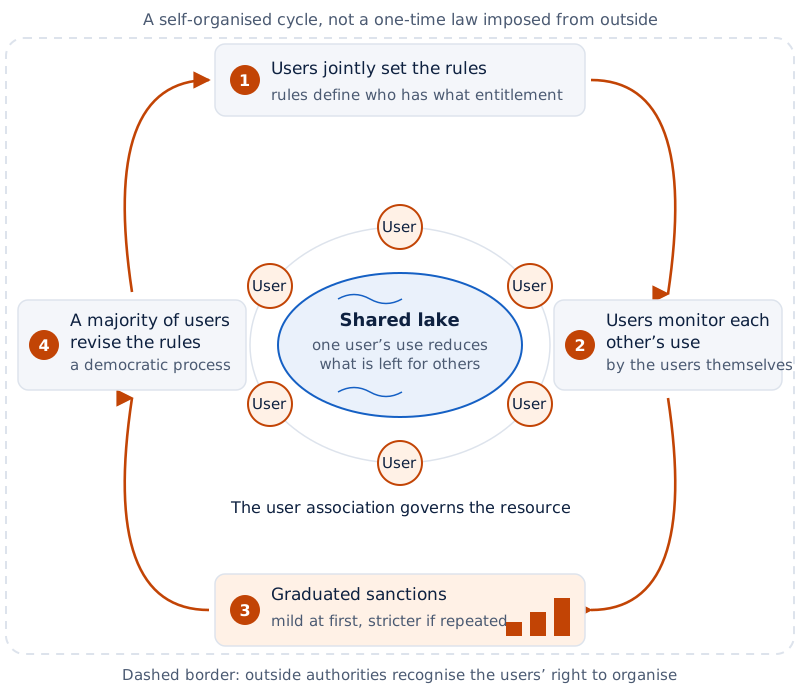
Draw a circle of resource users around a shared resource such as a lake.
Add arrows showing the users jointly setting rules, monitoring each other's use, applying graduated sanctions for rule-breaking, and revising the rules over time, to show governance as an ongoing self-organised process rather than a one-time law imposed from outside.
Drawn by One Young India.
How did Williamson explain the boundaries of the firm?
Williamson's theory treated markets and firms as two alternative ways of resolving the same underlying problem: conflicts of interest between trading parties.
According to the Academy, the drawback of markets is that negotiating a deal can involve costly haggling and disagreement, while the drawback of firms is that the authority of managers, although it resolves disputes quickly, can be abused.
His argument, as set out in the Academy's scientific background, can be understood as a sequence of linked steps:
- In an ordinary market, where buyers and sellers can easily switch to other trading partners, competition keeps both sides honest, so contracts can usually be written and enforced without much difficulty.
- Once one party invests in assets that are valuable mainly within one specific trading relationship, described as "relationship-specific" investments, the relationship shifts from a competitive "thick" market to a "thin" one where the two sides become mutually dependent.
- Because no contract can cover every future situation, this mutual dependence creates a surplus to bargain over later, and the bargaining itself can be costly and inefficient, since each side has an incentive to haggle for a bigger share.
- Bringing the transaction inside a single firm, so that a manager can simply decide how to proceed using authority rather than negotiation, reduces these bargaining losses, which is why firms tend to form around transactions involving highly specific assets.
A frequently cited test of the theory, described in the Academy's scientific background, looked at coal mines and the power plants that burn their coal.
Williamson's theory predicted that a mine and a nearby plant are more likely to be owned by the same firm the further away alternative mines or plants are, since greater distance means greater mutual dependence and higher cost if the relationship breaks down.
The evidence supported this: contracts between mines and plants were short and simple when other trading partners were nearby, and became longer, more detailed, or led to the mine and plant being jointly owned, as the distance to alternatives increased.
| Idea | What it explains |
|---|---|
| Markets | Work well when either party can easily switch trading partners, limiting costly haggling. |
| Firms (hierarchy) | Form when transactions are complex and involve relationship-specific assets, because a manager's authority resolves conflicts more cheaply than repeated bargaining. |
| Risk inside firms | Managerial authority that resolves conflict can also be abused by extracting value from employees or partners unfairly. |
| Testable prediction | The closer a mine and a power plant are to alternative trading partners, the less likely they are to be jointly owned. |
How did the work develop?
| Year | Event |
|---|---|
| 1965 | Elinor Ostrom completed her doctoral dissertation at the University of California, Los Angeles, studying efforts to halt saltwater intrusion into a groundwater basin near Los Angeles. |
| 1971 | Oliver Williamson published a seminal paper beginning his detailed theory of the firm in the spirit of Ronald Coase's earlier questions. |
| 1975 | Williamson published the book Markets and Hierarchies, developing his theory of when transactions are organised inside firms rather than through markets. |
| 1985 | Williamson published The Economic Institutions of Capitalism, which added the argument that managerial authority inside firms can be abused, completing the trade-off in his theory. |
| 1990 | Elinor Ostrom published Governing the Commons: The Evolution of Institutions for Collective Action, presenting her case-study evidence that common property is often well managed by its users. |
| 1992 | Ostrom, Walker and Gardner published laboratory experiment results showing that participants engage in costly punishment of free-riders, especially when allowed to communicate. |
| 2009 | The Royal Swedish Academy of Sciences announced the Sveriges Riksbank Prize in Economic Sciences in Memory of Alfred Nobel for 2009 to Ostrom and Williamson, on 12 October 2009. |
Why does this prize matter?
The Academy's press release said that over the previous three decades these contributions had advanced economic governance research "from the fringe to the forefront of scientific attention", because they showed economic analysis can illuminate most forms of social organisation, not just markets.
Ostrom's findings matter for environmental policy. They suggest that imposing rules from outside, whether through strict government regulation or full privatisation, can sometimes perform worse than letting local user groups develop and enforce their own rules, provided the right design principles are in place.
Her work has been applied to debates about managing fisheries, forests, irrigation water and, as the Academy noted, even larger-scale and global commons such as climate and atmospheric resources.
Williamson's theory matters for business strategy and competition policy. The Academy noted that his work has often been required reading in business school courses on corporate strategy, helping managers decide which activities to keep in-house and which to outsource.
It also influenced antitrust thinking: his analysis gave a coherent efficiency-based reason for vertical mergers (where a firm buys a supplier or customer), which the Academy said contributed to reduced hostility toward such mergers in United States merger guidelines by 1984.
The sources note that open questions remain, including how far Ostrom's lessons from small local commons can scale up to large or global resource problems, and how fully Williamson's largely informal theory of bargaining and contractual incompleteness can be captured in precise mathematical models.
How does this connect to what you study?
If you study economics or business studies, Ostrom's and Williamson's ideas connect directly to lessons on market failure and business organisation.
The idea of a common-pool resource, one that many people can access but where one person's use reduces what is left for others, extends the standard discussion of public goods and externalities that appears in many economics courses.
When a textbook explains why a fishery or a forest can be overused unless someone intervenes, it is describing exactly the puzzle Ostrom spent her career studying, and her design principles for successful user governance give that discussion a concrete, evidence-based answer rather than a purely theoretical one.
Williamson's reasoning about why some transactions sit inside a firm and others sit in a market connects to lessons on the theory of the firm and to practical make-or-buy and outsourcing decisions that businesses face when deciding whether to produce a part themselves or buy it from a supplier.
His concept of a relationship-specific asset also helps explain, in business studies terms, why some companies choose to own their suppliers through vertical integration while others prefer short-term contracts with independent firms.
Students preparing for general studies or quiz examinations can use both laureates' work as real-world illustrations of how economic theory applies beyond simple buying and selling, covering environmental policy, cooperative institutions and corporate strategy in a single prize.
Quick facts for exams
The Sveriges Riksbank Prize in Economic Sciences in Memory of Alfred Nobel for 2009, commonly called the Nobel Prize in Economics, was announced on 12 October 2009 by the Royal Swedish Academy of Sciences.
It was shared equally between Elinor Ostrom, the first woman to win this prize, cited for her analysis of economic governance especially the commons, and Oliver E.
Williamson, cited for his analysis of economic governance especially the boundaries of the firm. Ostrom was affiliated with Indiana University, Bloomington and Arizona State University, Tempe; Williamson was affiliated with the University of California, Berkeley.
Both laureates were born in the United States. The prize amount was 10,000,000 Swedish kronor, shared equally.
| Fact | Detail |
|---|---|
| Prize | Sveriges Riksbank Prize in Economic Sciences in Memory of Alfred Nobel |
| Year | 2009 |
| Laureates | Elinor Ostrom; Oliver E. Williamson |
| Country of birth | Both born in the United States of America |
| Country of affiliation | United States of America (Indiana University and Arizona State University; University of California, Berkeley) |
| Shares | One half each |
| Citation | "for her analysis of economic governance, especially the commons" / "for his analysis of economic governance, especially the boundaries of the firm" |
| Date announced | 12 October 2009 |
| Prize amount | SEK 10,000,000 |
Note: Source. The prize facts in this note are from the Nobel Prize's official site, nobelprize.org.
Glossary
- Economic governance — the rules, organisations and enforcement mechanisms that decide how people cooperate and resolve conflicts in economic activity.
- Common-pool resource — a resource, such as a fishery or pasture, that many people can access but where each person's use reduces what remains for others.
- Tragedy of the commons — the idea, associated with biologist Garrett Hardin, that shared resources tend to be overused unless privatised or regulated.
- User association — a group of people who jointly use and manage a shared resource, often setting their own rules.
- Transaction costs — the costs of carrying out an exchange, such as negotiating, monitoring and enforcing an agreement.
- Vertical integration — when a single firm owns and controls multiple linked stages of production, such as a coal mine and the power plant that burns its coal.
- Relationship-specific asset — an investment that is valuable mainly within one particular trading relationship and loses much of its value outside it.
- Hierarchy (in Williamson's theory) — an organisation, such as a firm, where a manager's authority rather than negotiation settles disputes.
- Graduated sanctions — a system of penalties that starts mild for a first rule violation and becomes stricter for repeated violations.
- Boundary of the firm — the dividing line between activities a company carries out in-house and activities it leaves to outside suppliers or the market.
- Repeated game — a game-theory setting in which the same players interact over many rounds, allowing cooperation to be sustained through future consequences.
- Free-rider — someone who benefits from a shared resource or collective effort without contributing a fair share to maintaining it.
Common errors and misconceptions
- Misconception: Ostrom's work proves that shared resources are always best left to local user groups. Correct: the Academy's material notes user management is often successful but not universally superior; in the 1930s, for example, a failure to privatise oil pools in Texas and Oklahoma caused massive waste, showing privatisation can sometimes work better than user management.
- Misconception: Williamson argued firms should simply grow as large as possible to avoid market haggling costs. Correct: he argued firms grow only where relationship-specific assets and complexity make this worthwhile, because managerial authority inside a firm can itself be abused.
- Misconception: this prize is officially called "the Nobel Prize in Economics". Correct: its official name is the Sveriges Riksbank Prize in Economic Sciences in Memory of Alfred Nobel, though it is widely referred to by the shorter name.
- Misconception: Ostrom's conclusions came mainly from laboratory experiments. Correct: her main method was gathering and comparing thousands of real-world case studies, with laboratory experiments used later to test specific propositions.
- Misconception: Coase, Ostrom and Williamson all received the prize in the same year. Correct: Ronald Coase won the Prize in Economic Sciences in 1991, nearly two decades before Ostrom and Williamson won it in 2009.
- Misconception: Williamson's theory says bigger firms are always more efficient than smaller, market-trading firms. Correct: his theory instead predicts that firm size depends on the balance between contracting difficulties and the risk of authority being misused.
Exam-style questions with model answers
Q1. In which year was Elinor Ostrom born, and in which year did she receive the Nobel Prize in Economics? [2 marks]
- Elinor Ostrom, the first woman to win this prize, was born in 1933 in Los Angeles and received the award jointly with Oliver E. Williamson in 2009.
Q2. State the official citation for Oliver E. Williamson's share of the 2009 prize. [2 marks]
- His citation reads "for his analysis of economic governance, especially the boundaries of the firm", recognising his work on why some transactions sit inside companies.
Q3. Explain what Ostrom meant by challenging the "tragedy of the commons" idea. [4 marks]
- The conventional view held that shared resources, used by many people, would almost always be overused unless privatised or regulated by government.
- Ostrom challenged this by studying many real cases of fisheries, pastures, forests and water basins managed jointly by their users.
- She found that outcomes were, more often than not, better than standard theory predicted, because users themselves developed rules and enforcement mechanisms to handle conflicts.
- This showed that self-governance by resource users is a third workable option alongside privatisation and state regulation.
Q4. Describe Williamson's four-step argument for why firms sometimes replace market transactions. [4 marks]
- Markets work well when trading partners can easily be switched, since competition prevents unfair bargaining.
- Once a party invests in assets valuable mainly to one relationship, the market becomes "thin" and the parties grow mutually dependent.
- This dependence creates a surplus that must be bargained over, and such bargaining can be costly due to haggling.
- Bringing the transaction inside one firm, where a manager's authority replaces negotiation, reduces these bargaining losses, explaining why firms form around complex, relationship-specific transactions.
Q5. Discuss, with examples from the sources, how Ostrom's design principles explain both successful and failed resource management. [6 marks]
- Ostrom identified several design principles behind successful common-pool resource management, including clearly defined entitlements, workable conflict resolution mechanisms, proportionate duties to benefits, user-based monitoring and sanctioning, graduated sanctions, democratic decision processes, and outside recognition of users' right to organise.
- Where these principles were present, as in many of the traditional user-managed fisheries, pastures and irrigation systems she studied, local groups sustained resources successfully, sometimes for centuries.
- Where governments instead imposed outside solutions without involving users, outcomes were often worse. In Inner Mongolia, both state collectivisation and later privatisation of grassland disrupted the traditional seasonal movement of herds, each leading to greater land degradation than the user-governed system still largely intact in Mongolia.
- In Nepal, modern concrete irrigation dams built with foreign assistance often performed worse than older, locally maintained dams, because the durability of the new dams removed the need for upstream and downstream users to cooperate, letting upstream users take a disproportionate share of water.
- These cases show that the process by which rules are created and enforced, with active user participation, can matter as much as the content of the rules themselves.
Q6. Why, according to the Academy's scientific background, is Williamson's and Ostrom's work considered complementary? [5 marks]
- Williamson focused on the problem of resolving conflicts in transactions that are not fully covered by detailed contracts or legal rules, mainly within firms and markets.
- Ostrom focused on the related but separate problem of how rules get enforced among users sharing a common-pool resource.
- Both address the challenge Ronald Coase raised about why institutions other than pure markets exist, going beyond theories that assume contracts are complete and automatically enforced.
- Together, their work broadened economic governance research to cover firms, user associations and other non-market institutions, advancing the field "from the fringe to the forefront of scientific attention", as the Academy's press release put it.
Key takeaways
- The 2009 prize honoured two separate but related analyses of economic governance beyond ordinary markets.
- Elinor Ostrom showed that user communities can manage shared natural resources successfully through self-made rules.
- Oliver E. Williamson explained why some transactions happen inside firms and others through market trading, based on asset specificity and contracting difficulty.
- Ostrom was one of the few women to win this prize, for her work on the commons.
- Outside intervention, whether collectivisation or privatisation, sometimes performs worse than user self-governance, as seen in Inner Mongolian grasslands and Nepalese irrigation.
- Williamson's theory was tested using coal mine and power plant ownership patterns and matched real-world evidence closely.
- Design principles such as graduated sanctions and user-based monitoring help explain why some common-pool resource governance succeeds.
- Both laureates' work extended beyond their original fields into business strategy, antitrust policy and environmental governance.
Test yourself
Who shared the 2009 Nobel Prize in Economics?
Elinor Ostrom and Oliver E. Williamson shared the prize equally, each receiving one half of it.
What was Elinor Ostrom's main research method?
She mainly gathered and compared existing case studies of how local communities manage shared resources like fisheries and pastures.
What is a common-pool resource?
It is a resource, such as a lake or forest, that many people can access, where one person's use reduces what remains for others.
What did Williamson's theory predict about coal mines and power plants?
It predicted that a mine and nearby power plant are more likely to be jointly owned the further away alternative trading partners are located.
Name one design principle Ostrom identified for successful commons governance.
Sanctions for breaking rules should be graduated, starting mild for a first violation and becoming stricter for repeated violations.
What was the drawback of firms, according to Williamson?
The managerial authority that resolves conflicts quickly inside a firm can also be abused by those in charge.
Where was Oliver E. Williamson affiliated at the time of the award?
Oliver E. Williamson was affiliated with the University of California, Berkeley, in the United States at the time of the award.