
Nobel Prize in Physiology or Medicine 2002: C. Elegans, Death Genes and Organ Development
On this page

What was the Nobel Prize in Physiology or Medicine 2002 awarded for?
The 2002 prize was given "for their discoveries concerning genetic regulation of organ development and programmed cell death". This is the exact wording used by the prize-giving body.
In plain words, the laureates showed that genes control two linked things inside a growing body: how cells divide and specialise to build organs, and how certain cells are made to die on purpose at the right moment.
This controlled dying is called programmed cell death. Before their work, scientists knew that cells died during development, but nobody had identified the actual genes that switch this death process on and off.
The laureates proved these ideas using a very small worm rather than a mammal, because the worm's cells could be watched one by one under a microscope. Their findings later turned out to apply to humans too, since similar genes were found in the human genome.
The official name of the award is the Nobel Prize in Physiology or Medicine, and it was announced on 7 October 2002.
Who are the laureates?
All three laureates shared the prize equally, each receiving one third, and all three had worked with the same small worm at different stages of the research.
Sydney Brenner
Sydney Brenner was born on 13 January 1927 in Germiston, South Africa, and died on 5 April 2019 in Singapore. At the time of the award his affiliation was The Molecular Sciences Institute, Berkeley, CA, USA.
He realised in the early 1960s that the nematode Caenorhabditis elegans could serve as a simple, transparent model organism for studying development.
In 1974 he showed that specific gene mutations could be produced in the worm's genome using the chemical EMS (ethyl methane sulphonate), and that these mutations could be linked to changes in organ formation.
H. Robert Horvitz
H. Robert Horvitz was born on 8 May 1947 in Chicago, IL, USA. At the time of the award he was at the Massachusetts Institute of Technology (MIT), Cambridge, MA, USA.
Joining the worm research in 1974, he identified the actual genes that carry out and control cell death, including ced-3, ced-4 and ced-9, and showed that comparable genes exist in the human genome.
John E. Sulston
John E. Sulston was born on 27 March 1942 in Fulmer, United Kingdom, and died on 6 March 2018 in Stapleford, Cambridgeshire, United Kingdom.
At the time of the award he worked at The Wellcome Trust Sanger Institute, Cambridge, United Kingdom.
He traced every cell division of C. elegans from the fertilised egg to the adult worm and, in 1976, described the complete cell lineage of a part of its developing nervous system, and identified the nuc-1 gene, the first gene shown to take part in programmed cell death.
What problem were the laureates trying to solve?
Every human body starts as a single fertilised egg cell, about a tenth of a millimetre in size. That one cell divides again and again, and the resulting cells gradually specialise into the hundreds of cell types that make up muscle, blood, nerves and other tissues. This process is called differentiation.
Just making new cells is not enough to build a working body. At precise moments, specific cells must also die so that organs end up the correct shape and size, for example when the webbing between a developing foetus's fingers and toes is removed by this controlled death.
A similar excess removal happens in the developing brain, where a large surplus of nerve cells formed early on is later eliminated by the same mechanism, leaving behind only the cells the nervous system actually needs.
Scientists in the mid-twentieth century could see cells dying during development but did not know which genes controlled this timing, or how a cell's own death could be switched on as if following a programme.
The difficulty was finding the right organism in which to study this. Single-celled organisms such as bacteria and yeast are too simple, since they have no organs and no cooperation between differentiated cells to study.
Mammals, including humans, are far too complicated, being built from an enormous number of cells of many types, which makes it very hard to follow what happens to any single cell as the whole organism grows.
A workable solution needed an organism that was multicellular, so that organ-like cooperation between cells could appear, yet simple and transparent enough that every cell division could be watched directly under a microscope. This gap is exactly what Sydney Brenner's choice of worm was meant to fill, and it set up the entire line of discovery that followed, carried forward by John Sulston and Robert Horvitz.
Why did Sydney Brenner choose a worm called C. elegans?
Brenner selected the nematode Caenorhabditis elegans, a spool-shaped worm about a millimetre long that feeds on bacteria and, in its adult form, is built from 959 cells.
It had several useful features: it was genetically amenable, meaning its genes could be changed experimentally, it had a short generation time suited to repeated experiments, and its body was transparent, so that every cell inside it could be observed under a microscope as it divided and specialised.
Brenner's 1974 publication demonstrated a working method for generating and studying mutations in this worm, showing that different mutations could be linked to specific genes and to specific, visible effects on how organs formed.
- Treat worms with the chemical EMS (ethyl methane sulphonate) to induce random mutations across their genome.
- Breed the treated worms and look for offspring with unusual features in body shape or behaviour.
- Trace each unusual feature back to a change in a specific gene.
- Observe, under the microscope, how that gene change affected cell division, differentiation or organ formation.
This combination of inducing gene mutations and watching cell behaviour directly under the microscope was the research tool that allowed Sulston and Horvitz to make their own discoveries in the years that followed; Sulston carried this out in the same Cambridge, UK laboratory where Brenner worked, while Horvitz later continued this line of research in his own laboratory at MIT.
Diagram
The C. elegans cell lineage tree
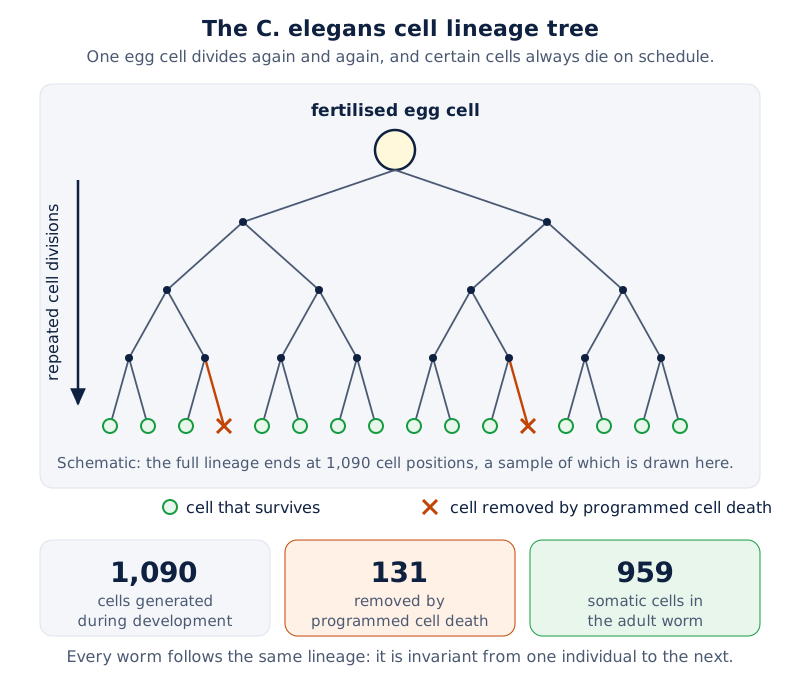
Draw a branching tree starting from a single fertilised egg cell at the top, with lines splitting repeatedly downward to represent repeated cell divisions, ending at 1,090 cell positions; mark 131 of these end-points with a cross to show cells removed by programmed cell death, leaving 959 surviving cells in the adult worm.
Drawn by One Young India.
How did John Sulston map the cell lineage?
Sulston joined Brenner's laboratory in 1969 and used the worm's transparency to follow every single cell division under the microscope, from the fertilised egg all the way to the 959 cells of the adult worm.
In a 1976 publication he described the complete cell lineage, essentially a family tree of cells showing which cells were siblings and which were cousins, for part of the developing nervous system.
His central finding was that this lineage was invariant: every single worm of the species went through exactly the same pattern of cell division and differentiation, with no meaningful variation between individuals.
This precision meant cell division was not left to chance either. Sulston showed that specific cells, at specific stages, always died on schedule as a normal, repeated part of development, rather than dying by accident or at random.
Building on this, Sulston identified the first gene shown to take part in programmed cell death, called nuc-1, by tracking which mutant worms failed to clear away dead-cell material properly.
He showed that the protein made by the nuc-1 gene was needed to break down the DNA of a cell once it had died, essentially clearing away the genetic material left behind inside the dead cell's remains.
| Measurement in C. elegans | Value |
|---|---|
| Total cells generated during development | 1,090 |
| Cells eliminated by programmed cell death | 131 |
| Somatic cells in the adult hermaphrodite | 959 |
| Approximate adult body length | about 1 millimetre |
What death genes did Robert Horvitz discover?
Horvitz joined the worm research group in 1974 and, starting with a series of experiments in the 1970s, set out to find whether a genetic programme, rather than chance, controlled when cells died.
In a 1986 publication, he identified the first two confirmed "death genes", named ced-3 and ced-4, and showed that both genes had to be working correctly for a cell's programmed death to actually happen.
Later work from Horvitz identified a third gene, ced-9, which instead protects cells against death by interacting with ced-3 and ced-4. He also found further genes that direct how a dead cell's remains are cleared away once it has died.
Crucially, Horvitz showed that the human genome contains a gene similar to ced-3. This meant the cell-death machinery first worked out in a worm had been conserved across a huge span of evolution, right up to humans, and most of the genes controlling cell death in the worm turned out to have human counterparts.
These discoveries changed how scientists viewed cell death generally: instead of a vague or accidental process, it became clear that programmed cell death follows a strict genetic programme, with specific genes switching the process on, carrying it out and clearing up afterwards.
| Gene | Role in programmed cell death |
|---|---|
| ced-3 | Required for the cell death process to be carried out |
| ced-4 | Required alongside ced-3 for cell death to proceed |
| ced-9 | Protects cells from death by interacting with ced-3 and ced-4 |
| nuc-1 | Needed to break down the DNA of a cell after it has died |
Diagram
The ced gene interactions
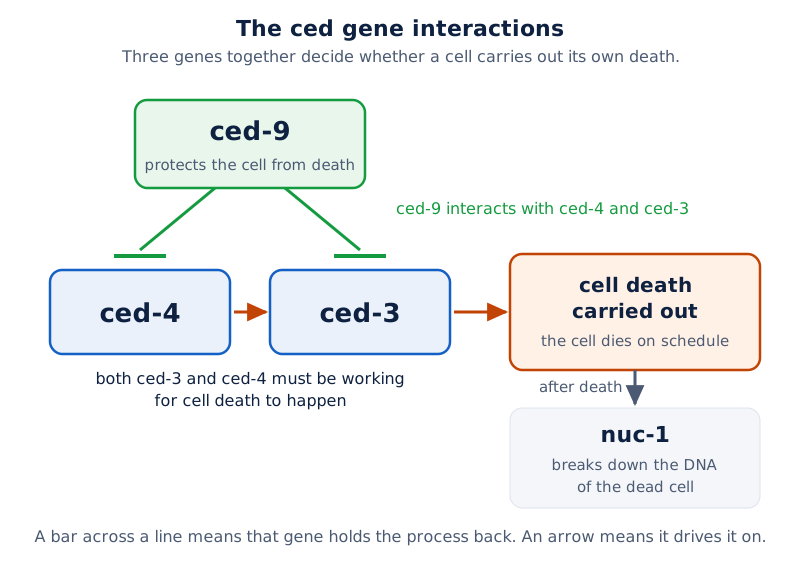
Draw ced-9, ced-4 and ced-3 as three linked boxes with a line from ced-9 to ced-4 and a line from ced-4 to ced-3 leading to a labelled box marked "cell death carried out", to show how these three genes interact to control whether a cell dies.
Drawn by One Young India.
How did the discovery unfold?
The work behind this prize was not a single moment but a sequence of findings built up by the three laureates over roughly four decades, each building on the one before.
| Year | Event |
|---|---|
| Early 1960s | Sydney Brenner realises that the nematode C. elegans could serve as a useful model organism for studying development |
| 1969 | John Sulston joins Brenner's laboratory in Cambridge, UK |
| 1974 | Brenner publishes his method for inducing gene mutations in C. elegans using the chemical EMS |
| 1974 | Robert Horvitz joins Brenner's and Sulston's research group |
| 1976 | Sulston publishes the cell lineage of part of the developing nervous system, showing it is invariant, and identifies the nuc-1 gene |
| 1986 | Horvitz identifies the first two confirmed death genes, ced-3 and ced-4 |
| 2002 | The Nobel Prize in Physiology or Medicine is awarded jointly to Brenner, Horvitz and Sulston on 7 October, with the ceremony held in Stockholm on 10 December |
Why does programmed cell death matter?
Normal life depends on a careful balance between making new cells and removing old ones. Every day, an adult human body makes roughly a thousand billion new cells, and about the same number die through this controlled process.
This kind of death happens naturally during development: it removes the webbing originally present between a foetus's fingers and toes, and it clears away a large excess of nerve cells produced early in brain development.
When programmed cell death goes wrong, disease can follow. Excessive cell death contributes to conditions such as AIDS, neurodegenerative diseases, stroke and myocardial infarction (heart attack), where cells are lost that the body needs.
By contrast, reduced cell death is linked to autoimmune conditions and cancer, where cells that should have died instead survive and multiply, escaping their normal "suicide programme".
Understanding this genetic machinery has also helped explain how some viruses and bacteria invade cells, and research on programmed cell death remains intense, including efforts in cancer treatment that try to deliberately stimulate a cell's own death programme to remove diseased cells more precisely.
How does this connect to what you study?
This prize links directly to basic ideas in school biology about cell division and differentiation, the process by which one fertilised egg cell becomes the many specialised cell types of a full organism.
It also extends the idea that cells have a finite, regulated life, not just an ability to multiply.
Students studying genetics encounter the idea that a gene is a unit of hereditary information that can control a specific cellular behaviour, and the ced genes are a clear, concrete example of this in action.
Finally, the discovery that worm genes have close counterparts in the human genome illustrates how biologists use simple model organisms to understand processes that would be very hard to study directly in humans, a method still widely used in disease research today.
Why was this worm important for other areas of biology too?
Beyond answering the specific question of how cells die, establishing C. elegans as a usable experimental model turned out to be valuable far more widely across biology and medicine.
Because its cell lineage had been fully mapped and shown to be invariant, researchers could link genetic changes directly to effects on development, which proved useful for studying developmental biology in general, not only cell death.
It also became a useful system for studying the functions of various signalling pathways, the chains of molecules inside a cell that pass on instructions, in a multicellular organism where cells must cooperate with one another.
Once the ced-3, ced-4 and ced-9 genes had been characterised in the worm, scientists were able to search for and quickly identify related genes with similar functions in humans. It became clear that one major signalling pathway leading to cell death in humans is evolutionarily well conserved, meaning it has been kept largely unchanged across a very long span of evolutionary time, with ced-3-like, ced-4-like and ced-9-like molecules taking part in it.
Understanding disturbances in this and other cell-death signalling pathways is considered of prime importance for medicine, because so many diseases involve cells either dying when they should not, or failing to die when they should.
Quick facts for exams
The Nobel Prize in Physiology or Medicine 2002 was awarded jointly to Sydney Brenner, H. Robert Horvitz and John E. Sulston, each receiving one third of the prize, "for their discoveries concerning genetic regulation of organ development and programmed cell death". The prize was announced on 7 October 2002 by the Nobel Assembly at Karolinska Institutet.
The laureates used the nematode worm Caenorhabditis elegans to identify genes, including ced-3, ced-4, ced-9 and nuc-1, that control how organs develop and how cells are made to die on purpose, and showed that similar genes exist in humans.
| Fact | Detail |
|---|---|
| Prize | The Nobel Prize in Physiology or Medicine 2002 |
| Laureates | Sydney Brenner, H. Robert Horvitz, John E. Sulston |
| Share | One third each |
| Citation | "for their discoveries concerning genetic regulation of organ development and programmed cell death" |
| Date announced | 7 October 2002 |
| Prize amount | 10,000,000 Swedish kronor |
| Brenner born / affiliation | Germiston, South Africa / The Molecular Sciences Institute, Berkeley, CA, USA |
| Horvitz born / affiliation | Chicago, IL, USA / Massachusetts Institute of Technology (MIT), Cambridge, MA, USA |
| Sulston born / affiliation | Fulmer, United Kingdom / The Wellcome Trust Sanger Institute, Cambridge, UK |
Note: Source. The prize facts in this note are from the Nobel Prize's official site, nobelprize.org.
Glossary
- Programmed cell death — a controlled, gene-directed process by which specific cells die at a set time as a normal part of development.
- Nematode — a type of thin, worm-like multicellular organism, such as Caenorhabditis elegans.
- Cell lineage — a traced record of which cell divided from which, like a family tree of a cell's descendants.
- Differentiation — the process by which a general cell becomes specialised into a particular cell type.
- Genome — the complete set of genetic material carried inside an organism's cells.
- Mutation — a change in a gene's sequence that can alter how it works.
- EMS (ethyl methane sulphonate) — a chemical compound used by Brenner to induce gene mutations in C. elegans.
- ced-3, ced-4 — genes shown by Horvitz to be required for programmed cell death to occur.
- ced-9 — a gene that protects cells from programmed death by interacting with ced-3 and ced-4.
- nuc-1 — the first gene identified by Sulston as taking part in programmed cell death; its protein degrades DNA in dead cells.
- Invariant lineage — a pattern of cell division that is identical across every individual of a species.
- Model organism — a simple species studied in the laboratory because findings in it can apply more widely, including to humans.
- Homologue — a gene in one species that closely resembles, in structure and function, a gene found in another species.
Common errors and misconceptions
- Misconception: C. elegans is a bacterium or single-celled organism. Correct: it is a small, multicellular nematode worm about a millimetre long.
- Misconception: cell death is always a sign of disease or damage. Correct: programmed cell death is a normal, necessary part of healthy development.
- Misconception: the three laureates worked entirely separately on unrelated problems. Correct: Sulston and Horvitz both joined and built on work begun in Brenner's laboratory.
- Misconception: the ced genes are found only in worms. Correct: Horvitz showed that the human genome contains a closely related gene to ced-3.
- Misconception: every cell produced during C. elegans development survives into the adult worm. Correct: of 1,090 cells generated, 131 are removed by programmed cell death.
- Misconception: the cell lineage in C. elegans differs between individual worms. Correct: Sulston showed the lineage is invariant, identical from one individual to another.
- Misconception: this prize was given for discovering a cure for cancer. Correct: it was given for discovering the genetic mechanism of organ development and programmed cell death, which later informed cancer research.
Exam-style questions with model answers
Q1. Name the three laureates of the Nobel Prize in Physiology or Medicine 2002. [2 marks]
- The prize was shared equally by Sydney Brenner, H. Robert Horvitz and John E. Sulston for discoveries on genetic regulation of organ development and programmed cell death.
Q2. What is a nematode, and which nematode did the laureates use? [2 marks]
- A nematode is a thin, multicellular worm. The laureates used Caenorhabditis elegans, a transparent worm about a millimetre long, as their model organism.
Q3. Explain why C. elegans was chosen as a model organism for studying development. [4 marks]
- Bacteria and yeast are too simple, as they have no organs or cell cooperation to study, while mammals are too complex, being made of huge numbers of cells. C. elegans offered a middle path: it is multicellular, yet relatively simple, with only 959 adult cells. It is genetically amenable, meaning mutations could be deliberately induced in its genes. It is also transparent, so every cell division could be watched directly under a microscope, which let scientists link specific gene changes to specific effects on organ development.
Q4. Describe John Sulston's main contribution to this discovery. [4 marks]
- Sulston followed every cell division in C. elegans under the microscope, from the fertilised egg to the 959 cells of the adult worm, and published a complete cell lineage for part of the developing nervous system in 1976. He found this lineage was invariant, meaning every worm underwent the same exact pattern of division. He showed that specific cells always died through programmed cell death at fixed points, and identified the nuc-1 gene, whose protein was needed to break down the DNA of cells after they had died.
Q5. Discuss Robert Horvitz's discovery of death genes and their significance for human medicine. [6 marks]
- Horvitz joined the C. elegans research group in 1974 and searched systematically for genes that controlled programmed cell death. In 1986 he identified ced-3 and ced-4, the first confirmed "death genes", showing that both had to function correctly for a cell to die on schedule. He later found ced-9, which protects against death by interacting with ced-3 and ced-4, and also identified genes governing how dead cells are cleared away. Most significantly, Horvitz showed that the human genome contains a gene closely resembling ced-3, proving that this cell-death machinery is conserved across evolution. This matters for medicine because excessive cell death contributes to conditions such as stroke, heart attack, AIDS and neurodegenerative disease, while too little cell death is linked to cancer and autoimmune conditions, so understanding these genes opens routes to new treatments that try to correct the balance.
Q6. How many of the 1,090 cells generated during C. elegans development are eliminated by programmed cell death? [2 marks]
- Of the 1,090 cells generated during development, precisely 131 cells are eliminated by programmed cell death, leaving 959 somatic cells in the adult worm.
Q7. Explain, with examples, how disturbed programmed cell death can lead to disease. [5 marks]
- Programmed cell death normally keeps a healthy balance between new cells forming and old cells dying. When this process happens too much, cells that the body needs are lost; this excessive cell death is linked to AIDS, neurodegenerative diseases, stroke and myocardial infarction. When the process happens too little, cells that should have died instead survive and multiply; this reduced cell death is characteristic of autoimmune conditions and of cancer, where abnormal cells escape their normal "suicide programme". Because the genes controlling this process, such as ced-3 and its human relatives, are shared across species, understanding them in a simple worm has directly informed research into these human diseases, including efforts to stimulate cell death deliberately in cancer cells.
Key takeaways
- The 2002 Nobel Prize in Physiology or Medicine went jointly to Sydney Brenner, H. Robert Horvitz and John E. Sulston.
- Their citation honoured discoveries on genetic regulation of organ development and programmed cell death.
- Brenner chose the tiny, transparent nematode C. elegans as a model organism in the early 1960s.
- Brenner's 1974 work showed mutations could be induced and linked to organ-development changes using EMS.
- Sulston mapped the complete, invariant cell lineage of part of C. elegans's developing nervous system and identified the nuc-1 gene in 1976.
- Horvitz identified the death genes ced-3, ced-4 and ced-9 and showed human genes resemble them.
- Of 1,090 cells generated during the worm's development, exactly 131 die by programmed cell death.
- Disturbed programmed cell death contributes to diseases including stroke, heart attack, cancer and autoimmune conditions.
Test yourself
Who are the three laureates of the Nobel Prize in Physiology or Medicine 2002?
Sydney Brenner, H. Robert Horvitz and John E. Sulston shared the prize equally for their work on C. elegans.
What organism did the laureates study?
They studied Caenorhabditis elegans, a tiny transparent nematode worm about a millimetre long.
What chemical did Brenner use to induce mutations?
Sydney Brenner used the chemical EMS (ethyl methane sulphonate) to induce gene mutations in C. elegans.
What did Sulston discover about the worm's cell lineage?
John Sulston showed the cell lineage was invariant, meaning every worm underwent the same pattern of cell division.
Name the first death gene Horvitz identified.
Robert Horvitz identified ced-3, along with ced-4, as the first confirmed genes required for programmed cell death.
What does the gene ced-9 do?
Ced-9 protects cells against programmed death by interacting with the genes ced-3 and ced-4.
How many cells does the adult C. elegans worm have?
The adult hermaphrodite C. elegans has 959 somatic cells, after 131 of the 1,090 generated cells die.