
Study of Gas Laws | ICSE Class 9 Chemistry Notes
On this page
Watch & explore
Start with a few high-quality watches, then dive into the notes below.
This note covers the molecular behaviour of gases, pressure, volume and temperature, Boyle’s law, Charles’s law, their mathematical forms and graphs, absolute zero, the Celsius and Kelvin scales, the combined gas equation, standard temperature and pressure, and calculations involving these relationships.
What quantities describe the condition of a gas?
Pressure, volume and temperature
A gas has no definite shape or volume of its own and fills its container. Its condition can be described by its pressure, volume and temperature. When comparing two conditions using the gas laws, keep the quantity of gas fixed.
Pressure, represented by P, is the normal force acting per unit area. Normal means perpendicular to the surface. If F represents this force and A represents the area over which it acts, the relationship is:
P = F/A
Volume, represented by V, is the space occupied by the gas. Temperature indicates relative hotness or coldness. In gas-law equations, T represents absolute temperature, meaning temperature on the Kelvin scale, whose zero is absolute zero.
A unit is an agreed reference used to express a measurement. SI means the International System of Units. A numerical answer must identify both the quantity and its unit, because a number alone does not state a complete measurement.
| Quantity | Symbol | Unit |
|---|---|---|
| Pressure | P | The SI unit of pressure is the pascal (Pa). |
| Force | F | The SI unit of force is the newton (N). |
| Area | A | The SI unit of area is the square metre (m²). |
| Volume | V | The SI unit of volume is the cubic metre (m³). |
| Absolute temperature | T | The SI unit of temperature is the kelvin (K). |
Why do the conditions matter?
The same quantity of gas can occupy different volumes under different conditions. A volume measurement therefore needs an associated pressure and temperature. Changing the quantity of gas introduces another change that the fixed-mass forms of Boyle’s and Charles’s laws do not allow.
Fixed mass means that the same sample remains under consideration, without gas entering or leaving. Constant temperature and constant pressure are different restrictions. Identify which restriction applies before choosing an equation.
How does molecular motion explain gas pressure?
The moving-particle picture
A particle is a small constituent of matter. Gas particles may be atoms or molecules. An atom is a constituent particle of an element; a molecule is a constituent particle of matter made up of one or more atoms.
Kinetic theory explains gas behaviour in terms of rapidly moving particles. Gas molecules are in incessant random motion: their movement continues, and there is no single preferred direction. They collide with one another and with the container walls.
An ideal gas is a theoretical gas that satisfies the ideal gas equation exactly at all pressures and temperatures. No real gas is truly ideal. In the gas model, molecules are far apart and their mutual interactions are negligible except during collisions. A collision is an interaction that changes the motion of the colliding particles. Between collisions, molecules in the ideal-gas model move freely in straight lines.
Wall collisions exert force on the container. The force per unit area produces gas pressure. This explanation connects a visible, measurable property of the whole sample with the motion of particles too small to see individually.
Compression and heating
- Keep the same gas sample at constant temperature. Its average kinetic energy, the average energy associated with molecular motion, remains unchanged.
- Reduce its volume. The same number of molecules now occupies a smaller space.
- Molecules strike a given area of the container wall more frequently, so the pressure increases.
- Allow the gas a larger volume at the same temperature. Wall collisions per unit area become less frequent, and the pressure decreases.
Heating has a different effect. A higher absolute temperature means a higher average molecular kinetic energy. At constant volume, the increased molecular motion raises the pressure. If the pressure is kept constant instead, the gas can expand.
Average is essential here: the molecules do not all have identical speeds. Collisions change individual speeds, while the average properties can remain constant. A gas with steady pressure and temperature still contains continuously moving molecules.
What does Boyle’s law state and how is its equation obtained?
Definition: Boyle’s law states that, at constant temperature, the pressure of a fixed mass of gas is inversely proportional to its volume.
Inversely proportional means that increasing one quantity decreases the other so that their product remains constant. The condition about temperature is part of the law. The relationship cannot be applied unchanged when temperature also changes.
Derivation: the pressure-volume equation
Let b represent the constant value of the pressure-volume product for the selected gas sample at the selected temperature. The symbol ∝ means “is proportional to”.
- Express the inverse relationship as P ∝ 1/V, keeping the mass and temperature constant.
- Replace proportionality with equality by introducing b: P = b/V.
- Multiply both sides by V to obtain PV = b.
- At an initial condition, P₁V₁ = b; at a final condition, P₂V₂ = b. Here subscripts 1 and 2 identify the initial and final values respectively.
P₁V₁ = P₂V₂
P₁ and P₂ are the initial and final pressures. V₁ and V₂ are the corresponding volumes. Each pressure must be paired with the volume measured under the same condition, rather than with a volume from the other condition.
P = b/V
PV = b
Rearranging and checking the result
If the final volume is unknown, divide the two-state equation by P₂. If the final pressure is unknown, divide it by V₂. These are rearrangements of the same relationship, with the same restrictions.
V₂ = P₁V₁/P₂
P₂ = P₁V₁/V₂
Use the same pressure unit for both pressures and the same volume unit for both volumes. The pressure ratio then has no unit, leaving the required volume unit in the answer. Consistent units make the cancellation meaningful.
Check the direction of change before accepting a result. Compression at constant temperature should give a higher pressure. Expansion at constant temperature should give a lower pressure. A result with the opposite trend suggests incorrect rearrangement or mismatched values.
A calculation with equal cylinder volumes
Worked example 1. One of two equal-capacity cylinders contains an ideal gas at a pressure of 1 atm, where atm means atmosphere, a pressure unit. The other cylinder is evacuated, meaning it contains no gas. They are connected and the gas fills both. Its final temperature equals its initial temperature, and no gas escapes. Find the final pressure.
Answer: Let V₁ be the capacity of one cylinder. The final volume V₂ = 2V₁. For the unchanged gas mass and equal initial and final temperatures, P₁V₁ = P₂V₂. Hence P₂ = P₁V₁/(2V₁) = P₁/2 = 0.5 atm.
The actual cylinder capacity is unnecessary because it cancels. The calculation compares the initial and final conditions using their equal temperatures and the unchanged gas mass.
How do graphs represent Boyle’s law?
Reading a pressure-volume curve
A graph represents the relationship between quantities using axes. For a pressure-volume graph, place volume on the horizontal axis and pressure on the vertical axis. A point on the curve gives a pressure and its corresponding volume.
For a fixed mass at constant temperature, the Boyle’s-law curve falls as volume increases. It is curved because pressure varies with the reciprocal of volume, meaning one divided by volume. Pressure is not directly proportional to volume.
The product PV remains constant along one ideal Boyle’s-law curve. Moving along the curve changes P and V together. Moving to a curve for another temperature changes the condition under which that particular product was constant.
What the figure shows
Experimental pressure-volume curves for steam
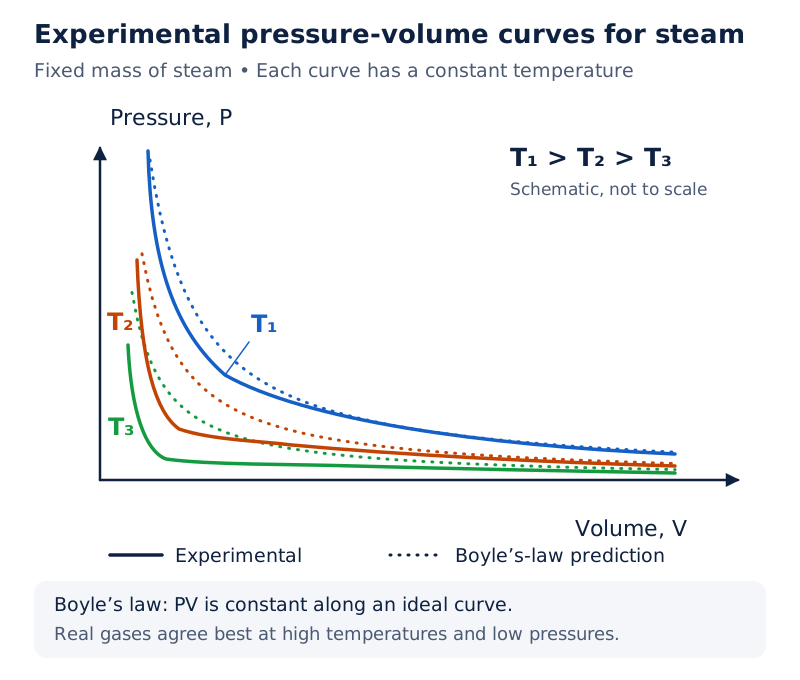
Pressure P is on the vertical axis and volume V on the horizontal axis. Solid experimental curves are compared with dotted Boyle’s-law curves. Three temperatures are distinguished, with T₁ greater than T₂ and T₂ greater than T₃.
Drawn by One Young India.
In this figure, T₁, T₂ and T₃ label three different temperatures, rather than successive stages of one change. Experimental curves show measured behaviour; theoretical curves show the prediction of the law. The two are not identical throughout the graph.
What does the comparison establish?
The agreement with Boyle’s law is good at high temperatures and low pressures. Preserve this qualification when describing real gases. The graph does not establish that every real gas follows the law exactly at every pressure.
When explaining a graph, identify the axes, state what remains constant, describe the trend, and connect that trend to the equation. Merely saying that the line “goes down” omits the quantities and conditions that give the graph its meaning.
What does Charles’s law state and how is its equation obtained?
Definition: Charles’s law states that, at constant pressure, the volume of a fixed mass of gas is directly proportional to its absolute temperature.
Directly proportional means that the ratio of the two quantities remains constant. Here the ratio is volume divided by absolute temperature. Absolute temperature must be expressed in kelvin before forming that ratio.
Derivation: the volume-temperature equation
Let c represent the constant volume-to-absolute-temperature ratio for the chosen mass of gas at the chosen pressure. It is a proportionality constant, not a temperature in degrees Celsius.
- State the relationship V ∝ T for a fixed mass of gas at constant pressure.
- Introduce the constant c to write V = cT.
- Divide by T to obtain V/T = c.
- For initial and final conditions, V₁/T₁ = c and V₂/T₂ = c. T₁ and T₂ now denote the initial and final absolute temperatures.
V₁/T₁ = V₂/T₂
V = cT
V/T = c
Multiplying by the final absolute temperature gives a useful expression for the final volume. Dividing and rearranging instead can give the final absolute temperature.
V₂ = V₁T₂/T₁
T₂ = T₁V₂/V₁
Connecting the law to molecular motion
When the gas is heated, its average molecular kinetic energy increases. If the volume were held fixed, its pressure would increase. At constant pressure, the gas expands, reducing the number of molecules per unit volume and allowing the pressure to remain unchanged.
Thus heating at constant pressure increases volume, while cooling at constant pressure decreases it. Both statements refer to the same mass of gas and to conditions where the gas-law approximation is suitable.
Keep a clear distinction between a temperature and a temperature change. A ratio of temperatures must use their absolute values. A Celsius reading has a different zero point and therefore cannot replace an absolute temperature in V/T.
The proportionality constant c applies to the selected sample and pressure. Calling the ratio constant does not mean that every quantity of every gas at every pressure has the same value of V/T.
A calculation using a temperature ratio
Worked example 2. A fixed mass of gas is heated from 200 K to 400 K at constant pressure. Using Charles’s law, calculate the ratio of final volume to initial volume.
Answer: V₂/V₁ = T₂/T₁ = 400/200 = 2. The volume doubles. No starting volume is needed because the question asks for a ratio, and both temperatures are already in kelvin.
How should Charles’s-law graphs be interpreted?
Absolute temperature and a straight line
For the ideal relationship V = cT, plotting volume vertically against absolute temperature horizontally produces a straight line through the origin. The origin is the point where both graph coordinates are zero.
This follows because V/T has a constant value at constant pressure. A steeper line has a larger volume-to-temperature ratio. Keep the same mass of gas and the same pressure while following any one such line.
The axes may also be interchanged. A graph of absolute temperature vertically against volume horizontally is still a straight line for the ideal relationship, because T/V is also constant. Always read the axis labels before identifying a plotted ratio.
What the figure shows
Temperature-volume curves for carbon dioxide
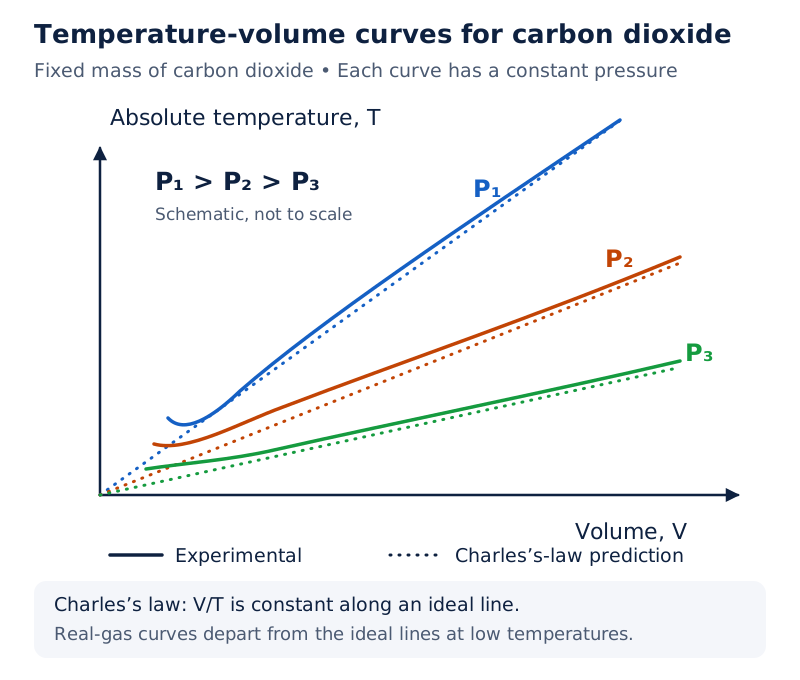
Temperature T is plotted vertically and volume V horizontally. Solid experimental curves are compared with dotted Charles’s-law lines. Three pressures are labelled P₁, P₂ and P₃, with P₁ greater than P₂ and P₂ greater than P₃.
Drawn by One Young India.
Here the pressure subscripts distinguish three separate constant-pressure curves. They do not identify initial and final pressures for a single Charles’s-law change. Carbon dioxide is the gas represented in this comparison.
Why the Celsius graph has a different intercept
A Celsius-temperature axis uses a different zero from an absolute-temperature axis. The intercept is the point where a graph meets an axis. Extending the ideal straight-line relationship towards lower Celsius temperatures gives a zero-volume intercept at absolute zero.
This is an extrapolation, meaning an extension beyond the measured range. It is not evidence that a real gas has actually been cooled until its volume disappears. Real gases depart from ideal predictions at low temperatures.
How are Celsius and Kelvin temperatures converted?
Using the correct zero point
Let t denote the numerical temperature reading in degrees Celsius, written °C, and T the corresponding numerical reading in kelvin, written K. The scales have equal-sized intervals but different zero points. Their relationship is:
T = t + 273.15
t = T − 273.15
Add 273.15 when converting a Celsius reading to kelvin. Subtract 273.15 when converting kelvin to Celsius. The minus sign in a Celsius reading must be retained during the calculation.
For simple gas-law calculations, the rounded relationship T = t + 273 is also used. Keep the precision consistent with the question. The more precise value of absolute zero is −273.15 °C; −273 °C is its rounded form.
Note: Write the Kelvin unit as K. A temperature of 0 °C is 273.15 K, so it is not absolute zero. Temperature ratios require kelvin values, even when the given readings use degrees Celsius.
Worked temperature conversions
Worked example 3. Convert a temperature of 0 °C to kelvin using the offset 273.15.
Answer: T = t + 273.15. Substituting the Celsius reading gives T = 0 + 273.15 = 273.15 K. Adding the offset changes the scale used to describe the temperature, not the physical condition.
Worked example 4. Convert a temperature of 100 °C to kelvin using the offset 273.15.
Answer: T = 100 + 273.15 = 373.15 K. The temperature unit in the answer is kelvin because the required result is an absolute temperature.
Worked example 5. Convert 24.57 K to degrees Celsius using the offset 273.15.
Answer: t = T − 273.15 = 24.57 − 273.15 = −248.58 °C. The Celsius result is negative because the Kelvin reading is below 273.15 K.
Worked example 6. Convert 216.55 K to degrees Celsius using the offset 273.15.
Answer: t = 216.55 − 273.15 = −56.60 °C. A negative Celsius temperature can therefore correspond to a positive absolute temperature.
Check the direction of conversion before substituting numbers. Adding the offset to a Kelvin reading would move the numerical result in the wrong direction. In the last two examples, the final unit must be °C because a Celsius reading was requested.
What is absolute zero and what does extrapolation mean?
The limiting temperature
Absolute zero is the zero point of the Kelvin scale. It is 0 K, corresponding to −273.15 °C. The ideal-gas relationship leads to this limiting temperature when suitable straight-line gas graphs are extended towards lower temperatures.
Consider a fixed quantity of gas at constant volume. Its pressure is proportional to absolute temperature. Over a large temperature range, a graph of pressure against Celsius temperature is linear, meaning it follows a straight-line relationship.
At low temperatures, measurements on real gases deviate from ideal-gas predictions. Nevertheless, extending the straight line suggests a common limiting temperature. The extension is a mathematical operation, rather than an additional series of measurements at every point on the extended line.
What the figure shows
Extrapolation towards absolute zero
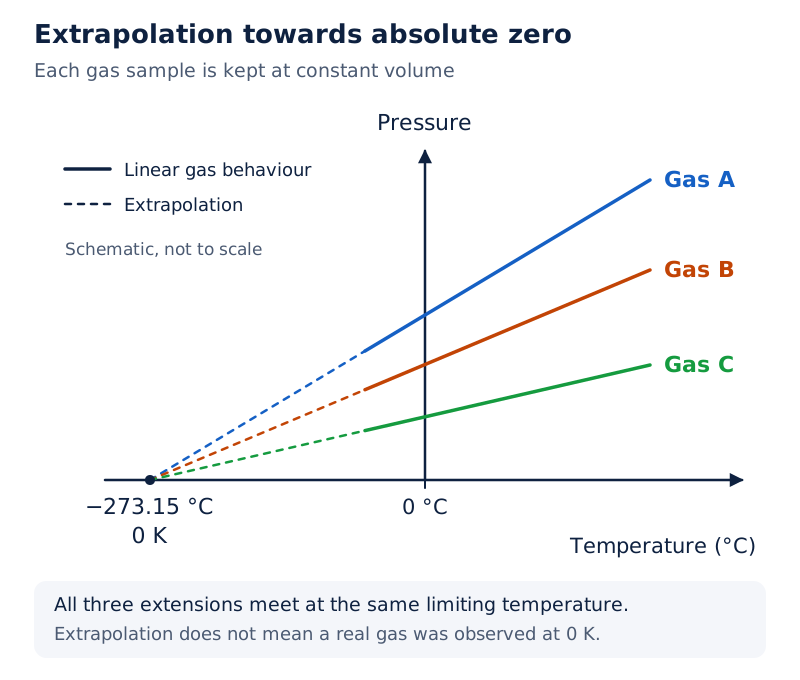
The vertical axis is pressure and the horizontal axis is temperature. Lines labelled Gas A, Gas B and Gas C have different inclinations but extend towards the same point marked −273.15 °C and 0 K.
Drawn by One Young India.
The qualification that must be retained
It looks as though the pressure might reach zero with decreasing temperature if the gas continued to be a gas. This conditional statement matters. It does not claim that the plotted gases have been observed as gases at zero pressure and absolute zero.
The same care applies to extending a Charles’s-law volume-temperature line. Its ideal zero-volume intercept indicates the temperature-scale origin. It does not demonstrate that actual molecules lose their size or that a material sample ceases to exist.
An ideal gas is a theoretical gas that satisfies the ideal gas equation exactly at all pressures and temperatures. No real gas is truly ideal. Real gases approach ideal behaviour at low pressures and high temperatures.
Keep the model and the measurements distinct. The model supplies a useful mathematical relationship; its successful use under suitable conditions does not remove the qualifications required when applying it to real gases.
How are the two laws combined into the gas equation?
Connecting two changes
Boyle’s law describes changes at constant temperature, while Charles’s law describes changes at constant pressure. The combined gas equation connects pressure, volume and absolute temperature when both pressure and temperature change for the same fixed mass.
Imagine an intermediate condition used only to connect the initial and final states mathematically. Let Vᵢ mean the intermediate volume. Begin with pressure P₁, volume V₁ and absolute temperature T₁; finish with P₂, V₂ and T₂.
Derivation: the combined gas equation
- First change pressure from P₁ to P₂ at constant temperature T₁. Boyle’s law gives P₁V₁ = P₂Vᵢ.
- Next change temperature from T₁ to T₂ at constant pressure P₂. Charles’s law gives Vᵢ/T₁ = V₂/T₂.
- Rearrange the second relation to obtain Vᵢ = V₂T₁/T₂, and substitute this into the first relation.
- The result is P₁V₁ = P₂V₂T₁/T₂. Divide by T₁ to put the initial and final quantities on opposite sides.
P₁V₁/T₁ = P₂V₂/T₂
Equivalently, PV/T has a constant value for the fixed sample. This relation brings the two simpler laws together. It does not require both pressure and temperature to remain constant.
Choosing the appropriate form
| Condition for a fixed mass | Relationship | Reason |
|---|---|---|
| Temperature remains constant | P₁V₁ = P₂V₂ | Equal absolute temperatures cancel. |
| Pressure remains constant | V₁/T₁ = V₂/T₂ | Equal pressures cancel. |
| Volume remains constant | P₁/T₁ = P₂/T₂ | Equal volumes cancel. |
| Pressure and temperature change | P₁V₁/T₁ = P₂V₂/T₂ | Retain all the changing quantities. |
To calculate a final volume when both pressure and temperature change, rearrange the combined equation before inserting the data. This keeps the two pressure values and two temperature values in their correct positions.
V₂ = P₁V₁T₂/(P₂T₁)
Consistent units remain essential. Use the same pressure units on both sides, the same volume units on both sides, and kelvin for every temperature. A fixed-mass equation must not be used across a change in which gas enters or leaves.
What are STP and the steps for solving gas-law calculations?
Standard reference conditions
STP means standard temperature and pressure. The convention used here is 0 °C and 1 atmosphere. The pressure unit atmosphere has the symbol atm; 1 atm is approximately 1.013 × 10⁵ Pa.
The temperature 0 °C is 273.15 K, commonly rounded to 273 K in simple calculations. State the convention and rounding used when reporting a volume at STP. Standard conditions provide a shared reference for comparing gas volumes.
For conversion to STP, treat standard pressure and standard absolute temperature as the final values in the combined gas equation. Keep the original pressure, volume and temperature together as the initial condition.
- Identify the fixed quantity of gas and write the initial and final data separately.
- Convert every Celsius temperature to kelvin using the stated offset.
- Choose the law from the stated constant condition, or retain the combined gas equation.
- Rearrange for the unknown quantity, substitute consistent units, and calculate.
- Give the answer with its unit and check whether its direction of change agrees with the law.
Calculations at constant volume
A gas thermometer uses a temperature-dependent property of a gas to measure temperature. At constant volume, pressure can serve this purpose because P/T remains constant for a fixed quantity of ideal gas.
The triple point is a condition at which solid, liquid and vapour coexist in equilibrium, meaning their overall condition remains steady. For the following thermometer data, the water triple-point reference temperature is 273.16 K. This particular reference value is distinct from the Celsius-to-Kelvin offset of 273.15. A normal melting point is a melting temperature at standard atmospheric pressure.
Worked example 7. A constant-volume oxygen gas thermometer reads 1.250 × 10⁵ Pa at 273.16 K and 1.797 × 10⁵ Pa at the normal melting point of sulphur. Find that melting-point temperature, treating the gas as ideal and its quantity as fixed.
Answer: Formula: r = P₂/P₁, where r is the dimensionless pressure ratio, meaning a ratio without a unit; T₂ = rT₁. Substitute: r = (1.797 × 10⁵)/(1.250 × 10⁵) = 1.4376. Therefore T₂ = 1.4376 × 273.16 = 392.7 K, rounded to one decimal place.
Worked example 8. A constant-volume hydrogen gas thermometer reads 0.200 × 10⁵ Pa at 273.16 K and 0.287 × 10⁵ Pa at the normal melting point of sulphur. Find that temperature using the ideal-gas relationship for a fixed quantity.
Answer: Formula: r = P₂/P₁; T₂ = rT₁, with r again denoting the pressure ratio. Substitute: r = (0.287 × 10⁵)/(0.200 × 10⁵) = 1.435. Therefore T₂ = 1.435 × 273.16 = 392.0 K, rounded to one decimal place.
Each calculation uses both pressures in the same unit, so their ratio is dimensionless, meaning it has no unit. Multiplying that ratio by the reference temperature leaves kelvin as the answer’s unit.
The fixed-volume form is a direct application of the combined gas equation. Volume need not be supplied numerically because the unchanged initial and final volumes cancel. The unknown temperature is higher because the final pressure is higher.
Glossary
- Gas — A state of matter that fills its container and has no definite shape or volume of its own.
- Pressure — The normal force exerted per unit area of a surface.
- Volume — The space occupied by a gas under the stated conditions.
- Kinetic theory — An explanation of gas behaviour based on the continuous random motion of its particles.
- Kinetic energy — Energy associated with motion; molecular kinetic energy is connected with gas temperature.
- Boyle’s law — At constant temperature, the pressure of a fixed mass of gas is inversely proportional to volume.
- Charles’s law — At constant pressure, the volume of a fixed mass of gas is directly proportional to absolute temperature.
- Absolute temperature — Temperature measured on the Kelvin scale, with absolute zero as its zero point.
- Absolute zero — The zero point of the Kelvin scale, corresponding to −273.15 degrees Celsius.
- Ideal gas — A theoretical gas satisfying the ideal gas equation exactly at all pressures and temperatures.
- Extrapolation — Extension of an established graph or relationship beyond the measured range.
- STP — Standard temperature and pressure, here taken as zero degrees Celsius and one atmosphere.
- Combined gas equation — The relationship equating pressure multiplied by volume divided by absolute temperature for two conditions of a fixed gas mass.
Common errors and misconceptions
- Misconception: Pressure and volume increase together in Boyle’s law. Correct: For a fixed mass at constant temperature, their relationship is inverse and their product remains constant.
- Misconception: Boyle’s law needs constant pressure. Correct: Its restriction is constant temperature. Charles’s law instead requires constant pressure, and both laws require a fixed gas mass.
- Misconception: Celsius readings can be inserted directly into temperature ratios. Correct: Convert them to kelvin before using Charles’s law or the combined gas equation.
- Misconception: Zero degrees Celsius is absolute zero. Correct: It is 273.15 K. Absolute zero is 0 K, corresponding to −273.15 °C.
- Misconception: An extrapolated zero-volume point proves that real gas molecules vanish. Correct: The point comes from extending an ideal relationship; real gases depart from ideal predictions at low temperatures.
- Misconception: Every real gas obeys the ideal gas equation exactly. Correct: No real gas is truly ideal; real gases approach ideal behaviour at low pressures and high temperatures.
- Misconception: The fixed-mass gas equation also covers a sample losing gas. Correct: The same quantity of gas must remain under consideration in the two-state equation used here.
- Misconception: Molecules stop moving when the pressure becomes steady. Correct: Molecular motion and collisions continue even when average properties remain constant.
Exam-style questions with model answers
Q1. State Boyle’s law, including both conditions under which it applies. [2 marks]
- For a fixed mass of gas, pressure is inversely proportional to volume.
- The temperature must remain constant, so the product PV remains unchanged, where P is pressure and V is volume.
Q2. Explain in four points why compressing a fixed mass of gas at constant temperature increases its pressure. [4 marks]
- Gas molecules move continuously and randomly, colliding with the walls of the container and exerting force on them.
- At constant temperature, the average molecular kinetic energy remains unchanged; compression is not being explained by an increase in temperature.
- Reducing the volume places the same number of molecules in a smaller space, increasing wall collisions per unit area per unit time.
- The force per unit area therefore increases. This is an increase in gas pressure, consistent with Boyle’s law.
Q3. Convert 24.57 K and 216.55 K to degrees Celsius, using Celsius reading = Kelvin reading − 273.15. [2 marks]
- For 24.57 K, subtract the given offset: 24.57 − 273.15 = −248.58 °C.
- For 216.55 K, use the same conversion: 216.55 − 273.15 = −56.60 °C. Both results are negative Celsius readings.
Q4. State Charles’s law and describe its ideal graph with volume vertically and absolute temperature horizontally. Explain why Celsius readings cannot replace absolute temperatures in the ratio. [3 marks]
- For a fixed mass of gas at constant pressure, volume is directly proportional to absolute temperature, so volume divided by absolute temperature is constant.
- The ideal graph is a straight line through the origin. Its horizontal axis must use kelvin for this origin-based proportional relationship.
- Celsius and Kelvin scales have different zero points. Consequently, Celsius readings do not give the absolute-temperature ratio required in Charles’s law.
Q5. Derive the combined gas equation for a fixed mass initially at pressure P₁, volume V₁ and absolute temperature T₁, and finally at P₂, V₂ and T₂. Use an intermediate volume Vᵢ at P₂ and T₁. [5 marks]
- First consider a change at constant temperature T₁ from the initial pressure P₁ to the final pressure P₂, reaching the intermediate volume Vᵢ.
- Boyle’s law applies to this first change, giving P₁V₁ = P₂Vᵢ because the gas mass and temperature remain unchanged.
- Next change temperature from T₁ to T₂ at constant pressure P₂. Charles’s law gives Vᵢ/T₁ = V₂/T₂, hence Vᵢ = V₂T₁/T₂.
- Substitute this expression for intermediate volume into the Boyle’s-law relation to obtain P₁V₁ = P₂V₂T₁/T₂.
- Divide both sides by T₁ to obtain P₁V₁/T₁ = P₂V₂/T₂. Temperatures are absolute temperatures, and the same fixed mass is retained throughout.
Q6. A fixed quantity of ideal oxygen gas is held at constant volume. Its pressure is 1.250 × 10⁵ Pa at 273.16 K and 1.797 × 10⁵ Pa at an unknown temperature. Find that temperature in kelvin to one decimal place and check its trend. [5 marks]
- Let P₁ and T₁ denote initial pressure and temperature: P₁ = 1.250 × 10⁵ Pa and T₁ = 273.16 K. Let P₂ = 1.797 × 10⁵ Pa and T₂ be the unknown temperature.
- The gas quantity and volume remain constant, so the combined equation reduces to P₁/T₁ = P₂/T₂.
- Rearrange to obtain T₂ = T₁(P₂/P₁). The pressure ratio is (1.797 × 10⁵)/(1.250 × 10⁵) = 1.4376.
- Substitute to obtain T₂ = 273.16 × 1.4376 = 392.694816 K, giving 392.7 K to one decimal place.
- The calculated temperature is higher than the initial temperature, as expected because pressure increases with absolute temperature at constant volume.
Q7. Compare Boyle’s law and Charles’s law in four points: their constant condition, changing quantities, mathematical relationship and common restriction. [4 marks]
- Boyle’s law requires constant temperature, whereas Charles’s law requires constant pressure. The condition is part of each law’s statement.
- Boyle’s law relates pressure and volume; Charles’s law relates volume and absolute temperature, measured in kelvin.
- Boyle’s law keeps the product of pressure and volume constant. Charles’s law keeps the ratio of volume to absolute temperature constant.
- Both laws compare conditions of a fixed mass of gas. Adding or removing gas violates this common restriction.
Q8. Define absolute zero and explain why extrapolating an ideal gas graph to it does not prove that an actual gas has been measured there. [3 marks]
- Absolute zero is the zero point of the Kelvin scale: 0 K, corresponding to −273.15 °C.
- Extrapolation extends an established straight-line relationship beyond the measured range. The extended part therefore does not itself supply measurements at the temperatures it represents.
- Real gases deviate from ideal predictions at low temperatures. Pressure might reach zero on the ideal extension if the gas continued to be a gas; that qualification must be retained.
Q9. Two cylinders have equal capacities. One contains an ideal gas at 1 atm, and the other contains no gas. After they are connected, the same gas fills both cylinders at the unchanged initial temperature. Calculate the final pressure in atmospheres. [3 marks]
- Let V₁ denote the volume of one cylinder and V₂ the final gas volume. Since both cylinders have equal capacities, V₂ = 2V₁.
- The gas mass and the initial and final temperatures are unchanged. Boyle’s-law comparison therefore gives P₁V₁ = P₂V₂, where P₁ and P₂ are initial and final pressures.
- Substituting P₁ = 1 atm and V₂ = 2V₁ gives P₂ = (1 atm × V₁)/(2V₁) = 0.5 atm.
Q10. A fixed mass of gas is heated from 200 K to 400 K at constant pressure. Calculate the ratio of its final volume to its initial volume using Charles’s law. [2 marks]
- Charles’s law gives the final-to-initial volume ratio as the final-to-initial absolute-temperature ratio, because pressure and gas mass remain constant.
- The required ratio is 400/200 = 2. Thus the final volume is twice the initial volume.
Key takeaways
- Gas pressure arises from molecular collisions with container walls; steady pressure does not mean that the molecules have stopped moving.
- Boyle’s law relates pressure inversely to volume for a fixed gas mass at constant temperature.
- Charles’s law relates volume directly to absolute temperature for a fixed gas mass at constant pressure.
- Convert Celsius readings to kelvin before forming temperature ratios, and keep the conversion precision consistent throughout the calculation.
- Absolute zero is 0 K or −273.15 °C; a graph extrapolation must be distinguished from an actual measurement.
- The combined gas equation compares pressure, volume and absolute temperature for the same fixed quantity of gas.
- STP here means 0 °C and one atmosphere; the Kelvin temperature is commonly rounded to 273 K.
- Real gases approach ideal behaviour at low pressures and high temperatures, so ideal-law predictions require appropriate qualifications.
Test yourself
What causes a gas to exert pressure on its container?
Molecules collide with the container walls and exert force; the force per unit area is pressure.
What must remain fixed when using Boyle’s law?
The mass of gas and its temperature must remain fixed while pressure and volume change.
What remains constant in Charles’s law besides the gas mass?
The pressure remains constant while the gas volume varies with its absolute temperature.
Using the offset 273.15, convert 100 °C to kelvin.
Add the offset to the Celsius reading: 100 + 273.15 gives an absolute temperature of 373.15 K.
Why is a negative Celsius temperature not necessarily below absolute zero?
The scales have different zero points; absolute zero is −273.15 °C, so negative Celsius readings above that value correspond to positive kelvin readings.
Which quantities cancel from the combined gas equation at constant volume?
The equal initial and final volumes cancel, leaving pressure divided by absolute temperature unchanged.
What qualification is needed when extending a gas-pressure graph towards absolute zero?
The ideal extension suggests pressure might reach zero if the gas continued to be a gas; real gases deviate at low temperatures.
Why must an answer for a gas volume include its conditions?
The volume of a given quantity of gas depends on its pressure and temperature, so those conditions identify what the measurement represents.
Write about it
Turn a question from this chapter into a paper.
The Writing Studio has a structure guide, a rubric and citation tools for 15 formats, from essays to research papers. Drafting is free with an account. Learnacy Essential adds feedback from an AI writing coach and submission to The OYI Review.
Learnacy Essential is ₹1,499 for the year. Publication depends on review and is not guaranteed.