
The Periodic Table | ICSE Class 9 Chemistry Notes
On this page
Watch & explore
Start with a few high-quality watches, then dive into the notes below.
This note covers the classification of elements, Dobereiner’s triads, Newlands’ law of octaves, Mendeleev’s periodic law and contributions, atomic number, modern periodic law, groups and periods, the placement of transition and inner transition elements, and the alkali metal, alkaline earth metal, halogen and noble gas families.
Why do chemists classify elements?
An element is a substance made of one kind of atom. An atom is the basic particle of an element that takes part in chemical reactions. Classifying elements means organising them so that similarities and differences in their properties become easier to recognise.
Studying each element and all its compounds separately would involve a large collection of disconnected facts. A compound is a substance in which different elements are chemically combined. Classification brings related elements together and helps chemists predict properties as well as organise observations.
Physical properties can be observed without changing a substance’s identity. Chemical properties describe its behaviour in chemical changes, in which new substances form.
What does periodicity mean?
Periodicity means the recurrence of similar properties at intervals when elements are arranged in a systematic order. A periodic table presents this order in rows and columns. The early attempts used atomic weight; the modern arrangement uses atomic number.
A proton is a positively charged particle in the nucleus, the atom’s small central region. A neutron is an uncharged particle in the nucleus. An electron is a negatively charged particle outside the nucleus. These particles will help explain the modern table.
Atomic weight, also called relative atomic mass, compares the average mass of an element’s atoms with one-twelfth of the mass of a carbon-12 atom. Carbon-12 is a form of carbon whose atoms contain six protons and six neutrons. Relative atomic mass has no unit.
Keep the aim of classification in view: a useful arrangement must connect an element’s position with its properties. A numerical pattern alone is insufficient if it brings together elements with very different chemical behaviour.
How did Dobereiner’s triads reveal a relationship between elements?
In 1829, Johann Dobereiner recognised similarities among several sets of three elements. He called these sets triads. The elements in a triad had similar physical and chemical properties, and the atomic weight of the middle element was about halfway between those of the other two.
Definition: A Dobereiner triad is a group of three similar elements in which the middle element’s atomic weight is approximately the arithmetic mean of the other two atomic weights.
The arithmetic mean of two numbers is their sum divided by two. The calculation must use the lightest and heaviest members of the triad, with the elements first placed in increasing order of atomic weight.
| Elements in increasing atomic weight | Atomic weights in that order | Mean of the outer values | Middle value |
|---|---|---|---|
| Lithium, sodium, potassium | 7, 23, 39 | 23 | |
| Calcium, strontium, barium | 40, 88, 137 | 88 | |
| Chlorine, bromine, iodine | 35.5, 80, 127 | 80 |
What did the triads achieve, and where did they fail?
The lithium, sodium and potassium calculation gives the middle value exactly for the listed atomic weights. The other two examples show why approximately matters: the observed middle value is close to the calculated mean, but is not identical to it.
Dobereiner also observed that the properties of the middle member lay between those of the other two. His work drew attention to a relationship between atomic weight and properties, making it an early step towards periodic classification.
The limitation was its restricted applicability. The relationship seemed to work only for a few elements, so it did not provide a general arrangement for the whole collection. A successful example therefore supports the triad relationship without proving that every element belongs to a triad.
Note: Similar properties and an approximate atomic-weight relationship belong together in a triad. Do not identify a triad merely because three numbers happen to give a convenient average.
What did Newlands’ law of octaves propose?
In 1865, John Alexander Newlands arranged elements in increasing order of atomic weight. He noticed that the properties of every eighth element resembled those of the first. He compared this recurrence with musical octaves, in which the eighth note resembles the first.
Definition: Newlands’ law of octaves states that, when elements are arranged in increasing atomic weight, every eighth element has properties similar to the first.
Here an octave means the pattern of repetition on reaching the eighth member. Count the starting element as number one. Counting eight additional elements after the starting element would test a different relationship.
| Position within each displayed row | 1 | 2 | 3 | 4 | 5 | 6 | 7 |
|---|---|---|---|---|---|---|---|
| First row | Lithium | Beryllium | Boron | Carbon | Nitrogen | Oxygen | Fluorine |
| Next row | Sodium | Magnesium | Aluminium | Silicon | Phosphorus | Sulphur | Chlorine |
Read the first row from lithium to fluorine, then continue with sodium in the next row. Sodium is eighth when lithium is counted first. Similarly, magnesium is eighth when beryllium is counted first. These pairs illustrate the kind of resemblance Newlands recognised.
Why was the octave pattern useful but limited?
Its merit was the recognition of recurring properties in a continuous arrangement of elements. Dobereiner had identified separate sets of three; Newlands sought a repeating relationship across an ordered series.
However, Newlands’ law seemed to be true only for elements up to calcium. It could not serve as a satisfactory general arrangement beyond that range. The limitation concerns the fixed repetition after seven positions, rather than a denial that similarities recur at all.
This distinction matters when comparing early classifications. Dobereiner’s triads used a three-member relationship; Newlands’ octaves used an eighth-member resemblance. Both connected properties with atomic weight, but neither supplied a sufficiently general classification.
How did Mendeleev organise his periodic table?
Dmitri Mendeleev made periodicity the basis of a more comprehensive classification. In 1869, Mendeleev and Lothar Meyer independently recognised that arranging elements by increasing atomic weight brought similar physical and chemical properties back at intervals.
Meyer studied repeating patterns in physical properties such as melting point and boiling point. Mendeleev used a broader range of physical and chemical evidence and published the periodic law. His work connected the arrangement of elements with the properties of their compounds.
Definition: Mendeleev’s periodic law states that the properties of elements recur periodically with their atomic weights.
How were order and similarity used together?
Mendeleev arranged elements in horizontal rows and vertical columns. A group, also called a family, is a vertical column containing related elements. His aim was to place elements with similar properties in the same group while using increasing atomic weight as the main ordering principle.
He compared the empirical formulae of compounds, meaning formulae that give the simplest whole-number ratio of their constituent atoms. Similarities in such formulae and in compound properties helped him recognise relationships between elements.
He did not follow atomic weight mechanically when it conflicted with chemical similarity. Iodine had a lower atomic weight than tellurium, yet he placed iodine with fluorine, chlorine and bromine because their properties were similar.
These positions used historical group labels: tellurium belonged to Group VI and iodine to Group VII. Roman numerals VI and VII mean six and seven. They should not be confused with the modern numbered Groups 6 and 7.
What the figure shows
Mendeleev’s arrangement
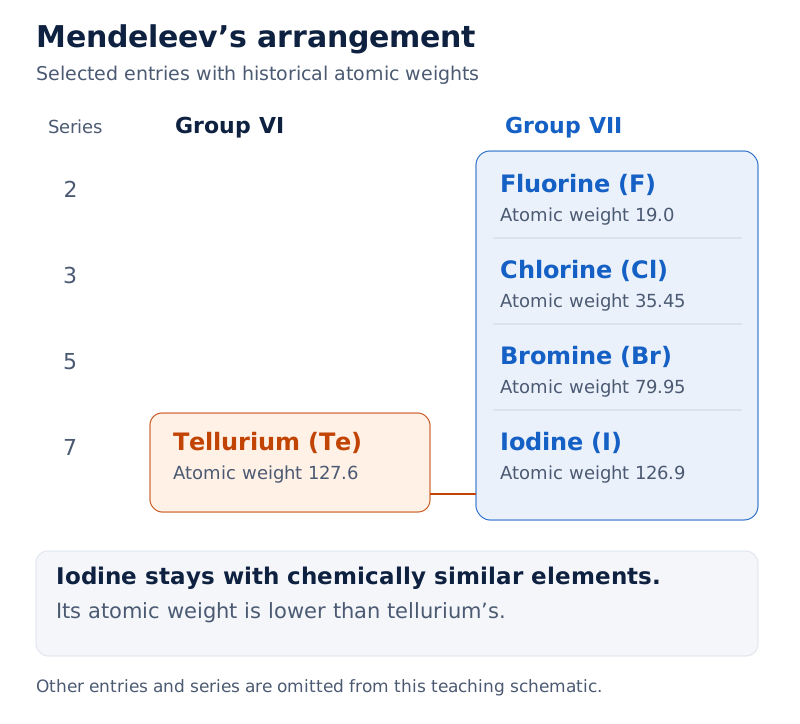
The table is headed “Periodic System of the Elements in Groups and Series”. Group headings run across it, numbered series run down it, and entries contain element names, symbols and atomic weights. Iodine appears in the column containing fluorine, chlorine and bromine.
Drawn by One Young India.
The important relationship is therefore between position and chemical similarity. Atomic weight supplied an ordering method, but the chemical behaviour of an element could make a departure from strict weight order necessary.
What were the merits and limitations of Mendeleev’s classification?
Mendeleev treated missing places as opportunities for prediction. Instead of forcing every known element into an unsuitable position, he left gaps where an element with particular properties should occur. This made the table a tool for investigating unknown elements.
What did the gaps predict?
He left a gap below aluminium for eka-aluminium and another below silicon for eka-silicon. The later discoveries of gallium and germanium, respectively, supported these predictions. The significance lay in predicting properties as well as the existence of missing elements.
Density is mass per unit volume. The density values below use grams per cubic centimetre, meaning the mass in grams contained in one cubic centimetre of the substance.
| Comparison | Eka-aluminium predicted | Gallium found | Eka-silicon predicted | Germanium found |
|---|---|---|---|---|
| Atomic weight | 68 | 70 | 72 | 72.6 |
| Density in grams per cubic centimetre | 5.9 | 5.94 | 5.5 | 5.36 |
| Location of the predicted gap | Below aluminium | Corresponds to eka-aluminium | Below silicon | Corresponds to eka-silicon |
The atomic-weight comparison shows close agreement, rather than an exact match in every case. A useful prediction need not reproduce every measured value perfectly. The observed agreement strengthened confidence in the arrangement and in the relationships it expressed.
Three merits stand out: similar elements were studied together, gaps allowed the inclusion of undiscovered elements, and the positions of those gaps supported predictions about their properties. Together these made the classification more powerful than a list arranged by weight alone.
Why was a different basis still needed?
The iodine and tellurium case exposed a difficulty with strict atomic-weight order. Chemical similarity required an order that did not simply follow increasing weight. Mendeleev suspected that some atomic-weight measurements might be incorrect, but atomic weight was not the final basis of classification.
A further distinction follows from isotopes: atoms of the same element have the same atomic number but different mass numbers. The mass number is the total number of protons and neutrons in one atom’s nucleus. Isotopes show why mass differences do not necessarily mean different elements.
Mendeleev developed his arrangement before the internal structure of atoms was understood. His table revealed recurring properties, but the later discovery of atomic number and understanding of electrons supplied the foundation for explaining this recurrence.
When assessing his work, keep its achievement and limitation together. The table successfully organised and predicted chemical properties; its use of atomic weight still needed replacement by a more fundamental property.
How did atomic number lead to the modern periodic law?
Atomic number is the number of protons in the nucleus of an atom. It is represented by the symbol Z. A neutral atom has no overall electrical charge, so its number of electrons equals its number of protons.
In 1913, Henry Moseley studied the characteristic X-rays emitted by elements. X-rays are a penetrating form of radiation, meaning energy transmitted through space. His observations showed that atomic number was more fundamental to an element’s identity than atomic mass, providing a new basis for periodic classification.
Definition: The modern periodic law relates the recurring physical and chemical properties of elements to their atomic numbers.
What changes when atomic number replaces atomic weight?
The modern table places elements in increasing atomic number. The ordering quantity is a count of protons, not a comparison of atomic masses. This change separates an element’s identity from differences in the mass of its atoms.
For example, hydrogen has atomic number 1 and helium has atomic number 2. A neutral hydrogen atom therefore contains one electron, while a neutral helium atom contains two. The electron count follows from atomic number provided the atom is neutral.
Isotopes belong to the same element because their proton counts are the same. Their masses differ because their neutron counts differ. Thus atomic number provides one identity for an element even when that element has more than one isotopic form.
What explains the recurrence of properties?
Electronic configuration means the distribution of electrons within an atom. At the shell level, a shell is an electron energy level surrounding the nucleus. Similar arrangements in the outer part of atoms recur as atomic number increases.
These repeating outer arrangements explain why groups of elements have similar chemical behaviour. The modern law is therefore more than a new sorting rule: it connects periodic classification with atomic structure.
How are groups and periods arranged in the modern table?
The modern periodic table has 18 groups and seven periods. Groups are vertical columns. A period is a horizontal row. These directions must be distinguished before interpreting an element’s position.
The group numbering from 1 to 18 is recommended by the International Union of Pure and Applied Chemistry, abbreviated to IUPAC. It replaces older group labels. Use the modern numbers consistently when locating families.
| Feature | Group | Period |
|---|---|---|
| Direction | Vertical column | Horizontal row |
| Numbering | 1 to 18 | 1 to 7 |
| Structural relationship | Similar outer electronic arrangements | Same highest occupied main shell number |
| Example | Lithium and sodium belong to Group 1 | Sodium and magnesium belong to Period 3 |
How long are the early periods?
Period 1 contains hydrogen and helium, so it has two elements. Period 2 contains eight elements, from lithium to neon. Period 3 also contains eight, from sodium to argon. The fourth period begins with potassium and ends with krypton, containing 18 elements.
The unequal lengths show why the periodic table cannot be explained by extending an eighth-element rule through every row. The recurrence of similar properties remains important, but the interval is not fixed at the length proposed in Newlands’ octaves.
The period number corresponds to the highest occupied main shell number. In the simple shell descriptions used here, count the occupied shells from the nucleus outwards. Sodium’s arrangement, 2, 8, 1, gives three occupied shells and therefore Period 3.
What the figure shows
Long form of the periodic table
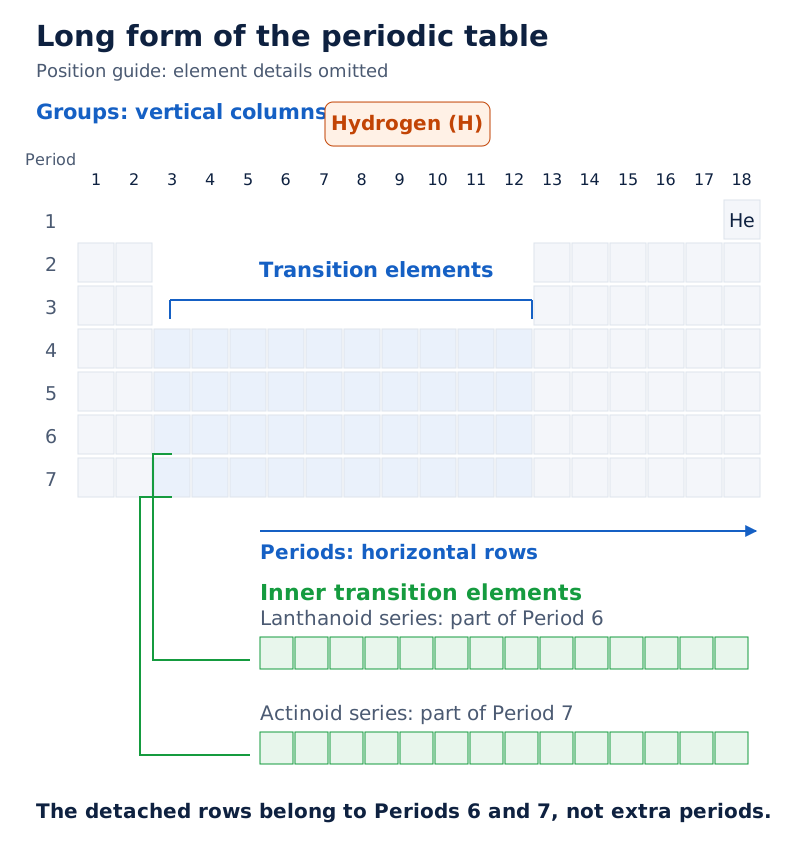
Group numbers appear above the columns and period numbers beside the rows. The central region is labelled for transition elements. Two separate rows below the main table are labelled for inner transition elements. Hydrogen is shown separately above the main arrangement.
Drawn by One Young India.
Moving down a group compares related elements across different periods. Moving across a period compares elements in increasing atomic-number order within that row. The two directions answer different questions, even though both are part of the same table.
Where are transition and inner transition elements placed?
The periodic table has a central region between its left-hand and right-hand groups. The transition elements occupy this central region, associated with Groups 3 to 12. Their position helps explain the longer periods beyond the first three.
The inner transition elements are displayed in two separate rows below the main body. The upper of these rows is the lanthanoid series, associated with Period 6. The lower is the actinoid series, associated with Period 7.
Why do the lower rows not create extra periods?
These rows are parts of the sixth and seventh periods, even though they are drawn beneath the table. They are separated to maintain the table’s structure while preserving the grouping of elements with similar properties. Their printed location does not make them additional periods.
| Set of elements | Displayed position | Relationship to the main table |
|---|---|---|
| Transition region | Centre, Groups 3 to 12 | Between the left and right portions |
| Lanthanoid series | Upper detached row | Part of Period 6 |
| Actinoid series | Lower detached row | Part of Period 7 |
The transition region and the two lower series contain metals. Metals are good conductors of heat and electricity. They are malleable, meaning they can be hammered into sheets, and ductile, meaning they can be drawn into wires. Their common broad classification does not mean that all their properties are identical.
What the figure shows
Regions of the periodic table
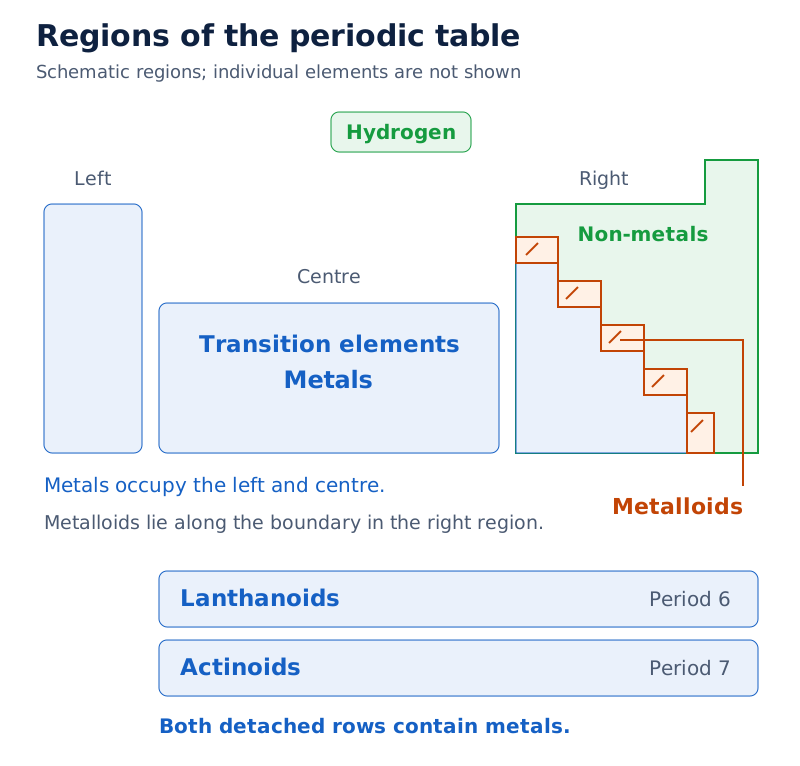
The diagram separates the left, central and right regions and places two rows underneath. The lower rows are labelled “Lanthanoids” and “Actinoids”. Colours distinguish metals, non-metals and metalloids in the displayed arrangement.
Drawn by One Young India.
Non-metals are poor conductors of heat and electricity. Metalloids show properties characteristic of both metals and non-metals. These broad categories describe properties; they are different from the labels identifying the positions of the transition and inner transition regions.
What distinguishes alkali metals from alkaline earth metals?
Alkali metals form the Group 1 metal family. Lithium, sodium and potassium are examples. Alkaline earth metals form Group 2; examples include beryllium, magnesium and calcium. The two families occupy neighbouring columns on the left of the table.
The valence shell is the outermost occupied electron shell, and its electrons are called valence electrons. Alkali metals have one valence electron. Alkaline earth metals have two. This difference helps explain their different common ion charges.
How are their ions formed?
An ion is a particle carrying an electrical charge. A positively charged ion is a cation; a negatively charged ion is an anion. Losing electrons produces positive charge, while gaining electrons produces negative charge.
Alkali metals readily lose their one outer electron to form ions with a single positive charge, written as 1+. Alkaline earth metals readily lose two outer electrons to form ions with two positive charges, written as 2+.
| Comparison | Alkali metals | Alkaline earth metals |
|---|---|---|
| Group | 1 | 2 |
| Valence electrons | One | Two |
| Electron loss in common ion formation | One electron | Two electrons |
| Resulting charge | 1+ | 2+ |
| Examples | Lithium, sodium, potassium | Beryllium, magnesium, calcium |
For sodium, the arrangement 2, 8, 1 shows why one outer electron is available for loss. For magnesium, 2, 8, 2 shows two outer electrons. Both atoms have three occupied shells, but their different outer electron counts place them in different groups.
Hydrogen is a special case. It has one electron and can be associated with Group 1, but it is a non-metal rather than an alkali metal. It can also gain an electron to attain a noble gas arrangement, showing a resemblance to the halogens.
Thus “one outer electron” identifies an important structural resemblance, but does not justify calling every such element an alkali metal. Family names must be used with the element’s properties as well as its position.
What characterises halogens and the zero group?
The halogens are the Group 17 family. Fluorine and chlorine are examples with seven valence electrons. The noble gases form Group 18, traditionally called the zero group. Helium, neon and argon are examples.
Why do halogens readily gain one electron?
An octet is a set of eight electrons in the valence shell. Fluorine has the shell arrangement 2, 7, while chlorine has 2, 8, 7. Gaining one electron completes an octet in each case.
For chlorine, this produces a chloride ion with a single negative charge. The name chloride refers here to chlorine’s anion. Seven valence electrons therefore do not mean that chlorine must gain seven electrons: only one is needed to complete its octet.
Valency means combining capacity. In the simple electron model, it is described by the number of electrons lost, gained or shared to attain a complete outer arrangement. Chlorine has seven valence electrons but a common valency of one.
Why do noble gases have very low reactivity?
Noble gas atoms have filled valence shells. Neon has the arrangement 2, 8, and argon has 2, 8, 8. Helium is different: its complete first shell contains two electrons, an arrangement called a duplet.
It is very difficult to alter a noble gas atom’s stable arrangement by adding or removing electrons. Noble gases therefore exhibit very low chemical reactivity. This describes their behaviour more accurately than saying that they are incapable of reacting.
| Family | Group | Outer arrangement | Main distinction |
|---|---|---|---|
| Halogens | 17 | Seven valence electrons | Readily gain one electron to complete an octet |
| Noble gases | 18 | Filled valence shell | Very low chemical reactivity |
| Helium within the noble gases | 18 | Two electrons in the first shell | A complete duplet, not an octet |
Helium illustrates why completeness of the outer shell matters more than applying the number eight without checking which shell is occupied. Its filled first shell gives it the characteristic low reactivity of the noble gases.
How can electronic configurations help compare positions?
Use electronic configurations to connect the table’s layout with the atom. In a shell arrangement such as 2, 8, 1, the numbers record electrons in successive shells, beginning nearest the nucleus. Their sum gives the total electron count.
How can a comparison be made step by step?
- Check whether the given configuration describes a neutral atom before equating its total electron count with atomic number.
- Count the occupied shells to identify the period in the simple shell model.
- Read the last number to find the number of valence electrons.
- Compare that outer arrangement with the named families, remembering hydrogen’s special position and helium’s filled first shell.
Consider sodium and magnesium, with arrangements 2, 8, 1 and 2, 8, 2. Their electron totals are and , respectively. Both have three occupied shells, so both belong to Period 3. Their outer counts differ, placing sodium in Group 1 and magnesium in Group 2.
Now compare lithium and sodium, with arrangements 2, 1 and 2, 8, 1. Lithium has electrons; sodium has eleven. Both have one valence electron and belong to Group 1. Lithium has two occupied shells, while sodium has three, so their periods differ.
Finally compare chlorine and argon, with arrangements 2, 8, 7 and 2, 8, 8. Their electron totals are and , respectively. Both occupy Period 3. Chlorine has an incomplete octet and belongs to Group 17; argon has a filled outer shell and belongs to Group 18.
Note: A period number, a group number and a valence-electron count are different pieces of information. For chlorine they are 3, 17 and 7 respectively. Do not substitute one for another.
These comparisons explain two complementary patterns: similar outer arrangements recur down a family, while the outer arrangement changes across a period. Connecting both patterns to electron distribution makes the table easier to understand than memorising isolated positions.
Glossary
- Periodicity — The recurrence of similar properties at intervals in a systematic arrangement of elements.
- Triad — Three similar elements whose middle atomic weight is approximately the mean of the outer two.
- Law of octaves — Newlands’ proposal that every eighth element resembles the first when ordered by increasing atomic weight.
- Relative atomic mass — Average atomic mass compared with one-twelfth of the mass of a carbon-12 atom.
- Atomic number — The number of protons in an atom’s nucleus, identifying which element it belongs to.
- Isotopes — Atoms of the same element with equal atomic numbers but different mass numbers.
- Group — A vertical column of the periodic table containing elements with related outer electronic arrangements.
- Period — A horizontal row in the periodic table, associated with the highest occupied main shell.
- Electronic configuration — The distribution of an atom’s electrons, represented here as numbers occupying successive shells.
- Valence electrons — Electrons occupying the outermost shell of an atom and influencing its chemical behaviour.
- Alkali metals — The Group 1 metal family, characterised by one electron in the valence shell.
- Alkaline earth metals — The Group 2 metal family, characterised by two electrons in the valence shell.
- Halogens — The Group 17 family whose atoms have seven electrons in their valence shell.
- Noble gases — Group 18 elements with filled valence shells and very low chemical reactivity.
- Inner transition elements — Elements displayed in two detached rows that belong to the sixth and seventh periods.
Common errors and misconceptions
- Misconception: Every triad calculation must match exactly. Correct: The middle atomic weight is approximately the mean of the outer two; calcium, strontium and barium illustrate a close rather than exact match.
- Misconception: Newlands’ eighth element means eight places after the first. Correct: Count the starting element as one; sodium is eighth in the sequence beginning with lithium.
- Misconception: Mendeleev used atomic number. Correct: His law used atomic weight; the modern periodic law uses atomic number.
- Misconception: Groups are horizontal rows. Correct: Groups are vertical columns, while periods are horizontal rows.
- Misconception: The two detached rows are extra periods. Correct: The lanthanoid and actinoid rows belong to Periods 6 and 7 respectively.
- Misconception: Hydrogen is an alkali metal because it has one electron. Correct: Hydrogen is a non-metal with a special position and similarities to more than one family.
- Misconception: Every noble gas needs eight outer electrons. Correct: Helium has a complete first shell with two electrons.
- Misconception: Noble gases can never react. Correct: Their filled outer shells give them very low chemical reactivity; “never” overstates this property.
Exam-style questions with model answers
Q1. State the modern periodic law and name the quantity used instead in Mendeleev’s periodic law. [2 marks]
- The modern periodic law states that the physical and chemical properties of elements recur periodically with their atomic numbers.
- Mendeleev’s periodic law used atomic weight, rather than atomic number, as the basis of the recurring properties.
Q2. Lithium, sodium and potassium have similar properties and atomic weights 7, 23 and 39 respectively. Apply Dobereiner’s triad rule, identify the middle member and explain what the calculation establishes. [3 marks]
- Arrange the supplied values in increasing order: lithium 7, sodium 23 and potassium 39. Sodium is therefore the middle member of this set.
- The arithmetic mean of the outer atomic weights is (7 + 39) ÷ 2 = 23. This equals the supplied atomic weight of sodium.
- The numerical result, together with the stated similarity of properties, supports identifying this set as a Dobereiner triad. It does not establish that all elements form triads.
Q3. The sequence lithium, beryllium, boron, carbon, nitrogen, oxygen, fluorine, sodium is arranged in increasing atomic weight. Identify the first and eighth elements, state the resemblance Newlands proposed, and give his law’s range of apparent validity. [3 marks]
- Counting lithium as the first element gives sodium as the eighth element in the supplied sequence. The starting element is included in the count.
- Newlands proposed that the eighth element would have properties similar to the first. Here the comparison is therefore between sodium and lithium.
- The law of octaves seemed to be true only for elements up to calcium. It was not a satisfactory general classification for elements beyond that range.
Q4. Iodine has lower atomic weight than tellurium but resembles fluorine, chlorine and bromine. Mendeleev placed it with those three elements. He also left gaps below aluminium and silicon; gallium and germanium were later discovered to match those predictions. Explain five features of his approach using these facts. [5 marks]
- Mendeleev used increasing atomic weight as his main ordering principle, while also examining chemical properties. His arrangement therefore involved more than sorting a list of atomic weights.
- He placed elements with similar properties in the same group. The supplied resemblance explains why iodine was grouped with fluorine, chlorine and bromine.
- He departed from strict atomic-weight order where it conflicted with chemical similarity. The iodine and tellurium example illustrates this limitation of using weight alone.
- He left gaps for elements that were not yet discovered. The gaps below aluminium and silicon allowed his arrangement to make predictions about missing members.
- The later identification of gallium and germanium with these predictions supported the table’s usefulness. Its merit was predicting unknown elements as well as organising known ones.
Q5. Neutral lithium and sodium atoms have shell arrangements 2, 1 and 2, 8, 1 respectively. Determine their atomic numbers and periods, and explain their common Group 1 placement. [4 marks]
- Lithium has 2 + 1 = 3 electrons. Because its atom is neutral, it also has three protons, so its atomic number is 3.
- Sodium has 2 + 8 + 1 = 11 electrons. Its neutral atom therefore has eleven protons and atomic number 11.
- Lithium has two occupied shells and belongs to Period 2; sodium has three occupied shells and belongs to Period 3.
- Both atoms have one electron in the outermost shell. This shared outer arrangement explains their common placement among the Group 1 alkali metals.
Q6. Chlorine has shell arrangement 2, 8, 7 and argon has 2, 8, 8. Both are neutral atoms. Identify each family, explain their contrasting outer-shell behaviour and state their common period. [5 marks]
- Chlorine has seven valence electrons, shown by the final number in its configuration. It therefore belongs to Group 17, the halogen family.
- Chlorine can gain one electron to complete an octet in its outer shell. This gain produces a chloride anion carrying a single negative charge.
- Argon already has eight valence electrons and belongs to Group 18, the noble gas family. Its outer shell therefore has a complete octet.
- The filled outer arrangement of argon is difficult to alter by adding or removing electrons. This accounts for its very low chemical reactivity.
- Both configurations contain three occupied shells. Chlorine and argon consequently belong to Period 3, even though their outer electron counts place them in different groups.
Q7. State where the transition region, lanthanoid series and actinoid series are displayed in the modern periodic table, identifying the periods of the two detached series. [3 marks]
- The transition region occupies the centre of the main periodic table, associated with Groups 3 to 12 between the left-hand and right-hand portions.
- The lanthanoid series is displayed in the upper of the two detached rows below the main table. It belongs to Period 6.
- The actinoid series is displayed in the lower detached row and belongs to Period 7. The two detached rows therefore do not create extra periods.
Q8. Helium has two electrons filling its first shell; neon has arrangement 2, 8 with a filled outer shell. Explain their common Group 18 placement and distinguish a duplet from an octet. [2 marks]
- Both atoms have filled outer shells, explaining their common placement in Group 18 and their very low chemical reactivity.
- Helium’s complete first shell is a duplet of two electrons; neon’s complete outer shell is an octet of eight electrons.
Key takeaways
- Dobereiner’s triads connected similar properties with an approximate arithmetic relationship between the atomic weights of three elements.
- Newlands recognised eighth-element resemblance in atomic-weight order, but his law seemed to work only up to calcium.
- Mendeleev grouped similar elements together, left gaps for undiscovered elements and predicted properties later supported by discoveries.
- Moseley’s work established atomic number as more fundamental than atomic mass, supporting the modern basis of periodic classification.
- The modern table has 18 vertical groups and seven horizontal periods; electronic arrangements help explain its organisation.
- Transition elements occupy the centre; the detached lanthanoid and actinoid rows belong to Periods 6 and 7.
- Alkali metals and alkaline earth metals have one and two valence electrons respectively, accounting for their common positive ion charges.
- Halogens have seven outer electrons, whereas noble gases have filled outer shells; helium’s filled shell contains two electrons.
Test yourself
Why is “approximately” necessary in the description of a triad?
The mean of the outer atomic weights need not equal the middle value exactly; the calcium, strontium and barium triad illustrates this.
How should the first element be counted when testing Newlands’ octaves?
Count the starting element as one, then compare it with the eighth member of the sequence.
Which discoveries corresponded to eka-aluminium and eka-silicon?
Gallium corresponded to eka-aluminium, while germanium corresponded to eka-silicon, supporting Mendeleev’s predictions.
What does atomic number count, and when does it equal electron number?
It counts protons in the nucleus and equals the number of electrons when the atom is neutral.
Why are the detached lower rows not additional periods?
The lanthanoid and actinoid rows are parts of Periods 6 and 7, displayed separately to maintain the table’s structure.
Why is hydrogen not simply classified as an alkali metal?
Hydrogen is a non-metal with a special position. Its single electron gives a resemblance to Group 1, but it also resembles halogens.
How many electrons must chlorine with arrangement 2, 8, 7 gain for an octet?
It must gain one electron, producing the arrangement 2, 8, 8 and a negatively charged chloride ion.
Why is helium stable with two electrons instead of eight?
Its two electrons completely fill the first shell, giving a stable duplet and very low chemical reactivity.
Write about it
Turn a question from this chapter into a paper.
The Writing Studio has a structure guide, a rubric and citation tools for 15 formats, from essays to research papers. Drafting is free with an account. Learnacy Essential adds feedback from an AI writing coach and submission to The OYI Review.
Publication depends on review and is not guaranteed.