
The Language of Chemistry | ICSE Class 9 Chemistry Notes
On this page
Watch & explore
Start with a few high-quality watches, then dive into the notes below.
This note covers chemical symbols, valency, ions and radicals, chemical formulae, chemical equations, balancing by trial, relative atomic and molecular masses, formula unit masses, and percentage composition.
What do chemical symbols and formulae represent?
An element is a substance consisting of one kind of atom. An atom is the basic particle of an element that takes part in chemical reactions. A chemical symbol is the short written representation of an element.
The first letter of a symbol is a capital letter. A second letter, where present, is lower case. For example, the symbol for chlorine is Cl. Reading both letters together identifies one element; they are not separate symbols.
| Element | Symbol | Element | Symbol |
|---|---|---|---|
| Hydrogen | H | Oxygen | O |
| Carbon | C | Nitrogen | N |
| Sodium | Na | Magnesium | Mg |
| Aluminium | Al | Chlorine | Cl |
| Sulphur | S | Calcium | Ca |
| Potassium | K | Barium | Ba |
| Iron | Fe | Copper | Cu |
| Zinc | Zn | Silver | Ag |
| Lead | Pb | Fluorine | F |
How does a formula add information?
A compound contains different elements chemically combined in fixed proportions. Its chemical formula identifies the elements and their numerical relationship. Water has the formula H₂O. The small, lowered number is a subscript; it belongs to the symbol immediately before it.
A molecule is an electrically neutral entity, with no overall charge, containing more than one atom, capable of independent existence and showing the properties of the substance. One water molecule contains two hydrogen atoms and one oxygen atom. An unwritten subscript means one.
The distinction between O and O₂ is therefore meaningful: O represents an oxygen atom, whereas O₂ represents an oxygen molecule containing two oxygen atoms. Similarly, H₂ represents a hydrogen molecule. A formula must preserve the identity and composition of the substance it represents.
How does valency describe an atom's combining capacity?
Definition: Valency is the combining capacity of an atom. It can be related to the number of hydrogen atoms with which one atom of an element combines.
Hydrogen has a combining capacity of one. In water, one oxygen atom combines with two hydrogen atoms, so oxygen has valency two. In ammonia, NH₃, one nitrogen atom combines with three hydrogen atoms, so nitrogen has valency three.
Monovalent, divalent, trivalent and tetravalent mean having valencies one, two, three and four respectively. These terms describe combining capacity; they do not state the number of atoms in every molecule of the element.
What is the connection with electrons?
An electron is a negatively charged particle in an atom. The outermost occupied electron shell, or energy level, is the valence shell. Its electrons are valence electrons. An octet means eight electrons in this outermost shell.
Elements with a complete octet, or two outermost electrons in helium, are largely unreactive and more stable. Atoms with incomplete valence shells are usually more reactive. They can lose, gain or share electrons to complete their outer shell.
Generally, an atom with fewer than four valence electrons tends to lose electrons; one with more than four tends to gain electrons. Valency counts the electrons lost, gained or shared in achieving the stable arrangement. Carbon cannot easily gain or lose its four valence electrons and can share them.
| Element | Valence electrons | Combining behaviour in these examples | Valency |
|---|---|---|---|
| Sodium | 1 | Loses one electron | 1, monovalent |
| Magnesium | 2 | Loses two electrons | 2, divalent |
| Aluminium | 3 | Loses three electrons | 3, trivalent |
| Carbon | 4 | Shares four electrons | 4, tetravalent |
| Oxygen | 6 | Gains or shares two electrons | 2, divalent |
Valence-electron count and valency are therefore different quantities. Oxygen has six valence electrons but valency two. Some compounds appear to violate the usual valency rule, so this simple approach should not be turned into an unrestricted rule for every compound.
What are ions and the radicals used in formula writing?
An ion is an atom or group of atoms carrying an electric charge. A cation has positive charge; an anion has negative charge. Losing electrons produces a positive ion, while gaining electrons produces a negative ion.
The raised symbols show charge. Na⁺ means a sodium ion with one positive charge; Mg²⁺ means a magnesium ion with two positive charges. Cl⁻ means a chloride ion with one negative charge. The signs ⁺ and ⁻ indicate positive and negative charge respectively.
An ion containing one atom is a monoatomic ion. A polyatomic ion contains a group of bonded atoms carrying an overall charge. In elementary formula writing, a charged atom or group that acts as a unit is also called a radical.
| Polyatomic ion | Formula and charge | Valency |
|---|---|---|
| Hydroxide | OH⁻ | 1 |
| Nitrate | NO₃⁻ | 1 |
| Hydrogencarbonate | HCO₃⁻ | 1 |
| Carbonate | CO₃²⁻ | 2 |
| Sulphate | SO₄²⁻ | 2 |
| Ammonium | NH₄⁺ | 1 |
How are charge and valency different?
The valency of each ion in this table is the numerical magnitude of its charge. Sulphate has charge two negative and valency two. Its four oxygen atoms do not make its valency four. The charge applies to the entire group.
Some elements form ions with different charges. Ferrous iron is Fe²⁺, while ferric iron is Fe³⁺. Cuprous copper is Cu⁺, while cupric copper is Cu²⁺. The name must therefore be read before selecting the charge for a formula.
Generally, metals form cations and non-metals form anions. In an ionic compound, name the cation first and the anion second. Simple anion names end in -ide, as in chloride; polyatomic ion names generally do not end in -ide. Hydroxide is a useful reminder of that hedge.
How are chemical formulae constructed from valencies?
A correct formula must agree with the combining capacities of its constituents. In an ionic compound, oppositely charged ions are held together by attraction. Their numbers must give an electrically neutral compound, with equal total positive and negative charges.
- Write the cation symbol first and the anion symbol or group formula second.
- Write the charge on each ion and identify its numerical magnitude.
- Cross these numbers over to become subscripts of the opposite constituent.
- Reduce the resulting subscripts to the simplest whole-number ratio where they share a common factor.
- Omit subscripts of one and check that the total positive and negative charges balance.
Calcium chloride contains Ca²⁺ and Cl⁻. One calcium ion needs two chloride ions, giving CaCl₂.
Derivation: How is the formula of aluminium oxide obtained?
- Aluminium oxide contains Al³⁺ and O²⁻. A neutral formula requires equal total positive and negative charges.
- The smallest common multiple of the charge magnitudes, three and two, is six. Two aluminium ions provide positive charges, while three oxide ions provide negative charges.
- The simplest ion ratio is therefore . Use these numbers as subscripts and omit the charge signs from the neutral compound's formula.
The resulting formula is .
Diagram
Crossing charges for aluminium oxide
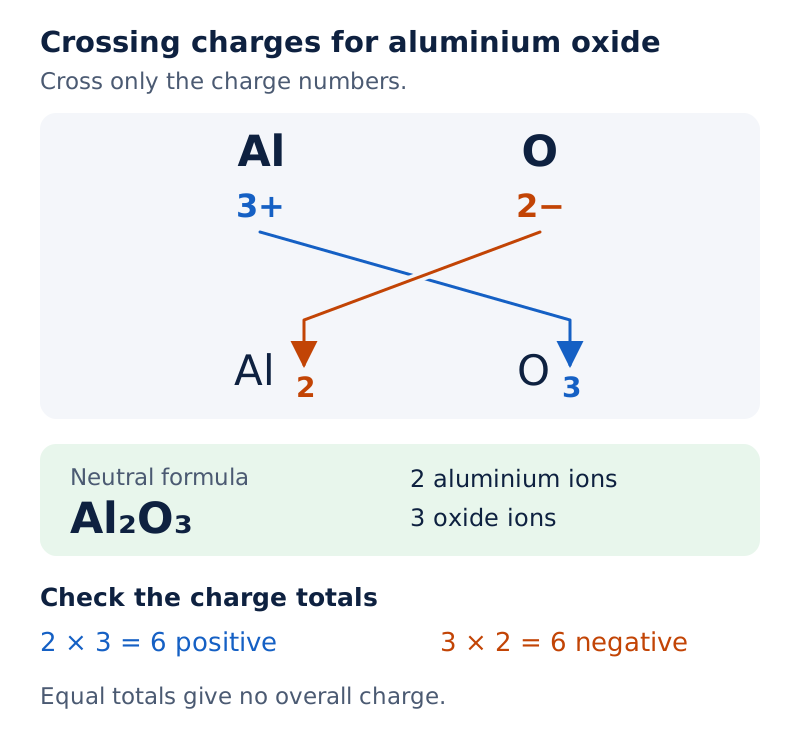
Write Al and O side by side, with 3+ and 2− beneath them. Draw crossing arrows from the charge numbers to the opposite subscripts. Finish with Al₂O₃ and check that both charge totals have magnitude six.
Drawn by One Young India.
Derivation: Why is the simplest formula of magnesium oxide MgO?
- Magnesium oxide contains Mg²⁺ and O²⁻, whose charge magnitudes are both two.
- Crossing these magnitudes gives . Divide both subscripts by their common factor of two to obtain the simplest ratio, .
- One magnesium ion supplies two positive charges and one oxide ion supplies two negative charges. The charges balance, and subscripts of one are omitted.
The resulting formula is . Leaving the unsimplified ratio would fail to show the simplest proportion of ions.
A covalent compound contains atoms joined by sharing electrons. For simple examples, cross their valencies: hydrogen and chlorine, both monovalent, give HCl, hydrogen chloride; hydrogen and divalent sulphur give H₂S, hydrogen sulphide; tetravalent carbon and monovalent chlorine give CCl₄, carbon tetrachloride.
Note: Charges belong in the working for ions. They are not retained as charges on the final formula of a neutral compound. Crossing numbers is a way to find the required ratio, followed by a check of the chemistry.
Why do some chemical formulae need brackets?
When a formula contains more than one copy of a polyatomic ion, put brackets around the complete group and write its number outside. The outside subscript multiplies every atom inside the brackets. It does not change the internal composition of the ion.
Magnesium hydroxide contains Mg²⁺ and OH⁻. Two hydroxide ions balance one magnesium ion, giving Mg(OH)₂. The formula contains one magnesium atom, two oxygen atoms and two hydrogen atoms. Writing MgOH₂ would not represent those two complete hydroxide groups.
Diagram
Brackets in magnesium hydroxide
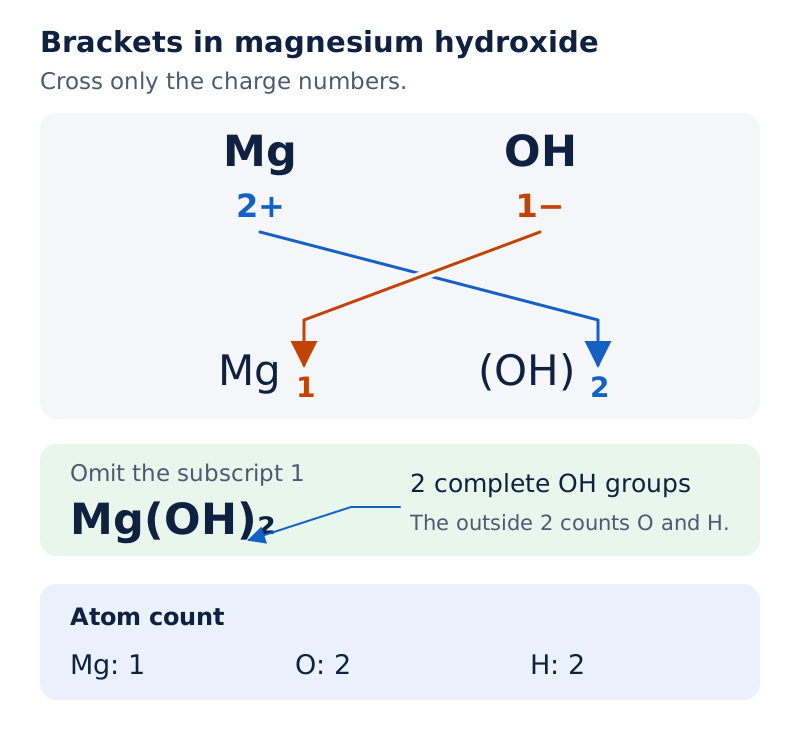
Write Mg with charge 2+ and the intact group OH with charge 1−. Cross the charge numbers, put brackets around OH, and show Mg(OH)₂. Label the outside 2 as applying to both O and H.
Drawn by One Young India.
How do larger groups affect atom counting?
Aluminium sulphate contains Al³⁺ and SO₄²⁻. Two aluminium ions balance three sulphate ions, giving Al₂(SO₄)₃. There are two aluminium atoms, three sulphur atoms and twelve oxygen atoms in the composition represented by one formula unit.
Diagram
Aluminium sulphate formula
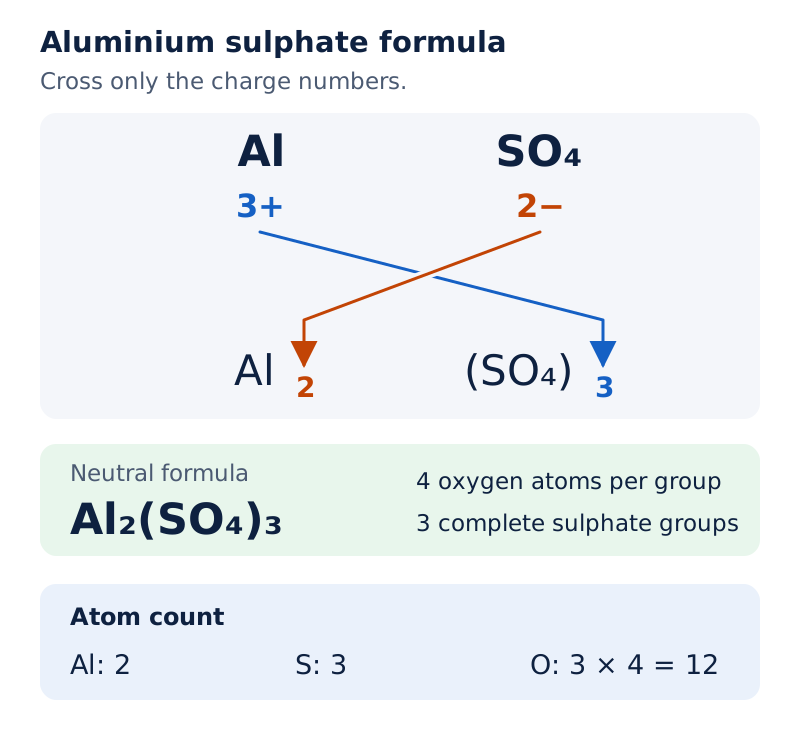
Put Al and SO₄ side by side with charges 3+ and 2−. Cross the numbers to show Al₂(SO₄)₃. Keep the subscript 4 inside the sulphate group and place the subscript 3 outside its brackets.
Drawn by One Young India.
| Compound | Formula | Meaning of the grouping |
|---|---|---|
| Aluminium hydroxide | Al(OH)₃ | Three complete hydroxide groups per aluminium ion |
| Calcium carbonate | CaCO₃ | One carbonate group per calcium ion |
| Calcium nitrate | Ca(NO₃)₂ | Two complete nitrate groups per calcium ion |
Brackets are unnecessary when only one polyatomic anion is present. Calcium and carbonate each have charge magnitude two, so their ratio simplifies to one to one. CaCO₃ preserves the three oxygen atoms within carbonate; that internal subscript is not part of the ratio being simplified.
How do free radicals affect the atmosphere and living organisms?
A free radical is an atom or group containing an unpaired electron, meaning an electron without a partner in its orbital. An orbital is a region associated with the probability of finding an electron. Free radicals are very reactive.
In homolytic cleavage, a shared electron pair in a bond divides equally: each fragment receives one electron. This can produce neutral free radicals. A dot, as in Cl•, denotes the unpaired electron; it is not a charge sign. Cl• is a chlorine radical, whereas Cl⁻ is a chloride ion.
What happens in ozone depletion?
Ozone, O₃, is a form of oxygen with three atoms per molecule. Ozone in the stratosphere, the atmospheric layer above the lowest layer, protects life by absorbing harmful ultraviolet radiation, abbreviated UV, from the Sun.
Chlorofluorocarbons, abbreviated CFCs, contain carbon, chlorine and fluorine. Although stable compounds, they can decompose under ultraviolet radiation and release chlorine radicals. These radicals take part in a chain of reactions that destroys ozone.
One step is Cl• + O₃ → ClO• + O₂. Here → means “forms”, and + separates reacting substances or products. ClO• is a chlorine monoxide radical. In a following step, ClO• + O → Cl• + O₂; the chlorine radical is regenerated.
Regeneration allows the chain to continue. Ozone depletion allows more harmful ultraviolet radiation to reach the Earth's surface. Such radiation is highly damaging to organisms and is known to cause skin cancer in humans. This effect must be distinguished from the charge-balancing role of ions in formulae.
Reducing the source of ozone-destroying radicals means reducing CFC use and release. Replacing CFCs in refrigeration is one approach. The aim is to reduce production of these damaging radicals, rather than assuming that every charged radical in a salt causes ozone depletion.
How does a chemical equation represent a reaction?
A chemical reaction changes starting substances into substances with different chemical identities. The starting substances are reactants; the substances formed are products. A chemical equation represents that change using symbols and formulae.
A word equation uses names: magnesium + oxygen → magnesium oxide. Replacing names with formulae gives Mg + O₂ → MgO. This is a skeletal equation, showing the substances involved before their atom numbers have been balanced.
Magnesium burns in air with a dazzling white flame and forms a white powder of magnesium oxide. The balanced equation is 2Mg + O₂ → 2MgO. The large number before a formula is its coefficient, multiplying the whole formula.
What do state symbols and conditions mean?
| Notation | Meaning | How it is read |
|---|---|---|
| (s) | Solid | Mg(s) is solid magnesium |
| (l) | Liquid | H₂O(l) is liquid water |
| (g) | Gas | H₂O(g) is water vapour or steam |
| (aq) | Aqueous, dissolved in water | NaCl(aq) is sodium chloride solution |
Usually physical states are not included unless it is necessary to specify them. Sometimes reaction conditions, such as temperature, pressure or a catalyst, are written near the arrow. A catalyst changes reaction rate without being consumed overall in the reaction.
The distinction between liquid water and steam matters in the equation 3Fe(s) + 4H₂O(g) → Fe₃O₄(s) + 4H₂(g). Fe₃O₄ is the iron oxide produced. The state symbol identifies the water as steam rather than liquid water.
An equation communicates composition and relative numbers. Observations and conditions add information about what is seen and how the reaction is carried out. A bare arrangement of formulae should not be treated as a complete description of every experimental detail.
How are equations balanced by the hit-and-trial method?
The law of conservation of mass states that mass can neither be created nor destroyed in a chemical reaction. The number of atoms of each element remains the same before and after the reaction, although their combinations change.
For a mass measurement to account for all products, prevent matter from escaping or include it in the measured total. A closed system prevents exchange of matter with its surroundings. In an open vessel, a gas may escape and leave less material to be weighed.
What steps make the atom totals equal?
- Write the correct formulae for every reactant and product. Treat each formula as fixed.
- List the number of atoms of each element on both sides of the arrow.
- Try coefficients before formulae to equalise one element, then adjust the others.
- Recount every element after each adjustment because a coefficient changes the whole formula.
- Finish with the smallest whole-number coefficients and verify every atom total.
It is often convenient to start with the compound containing the maximum number of atoms. For Fe + H₂O → Fe₃O₄ + H₂, start with the four oxygen atoms in Fe₃O₄. Place 4 before H₂O, giving four oxygen atoms on each side.
Those four water molecules contain eight hydrogen atoms, so place 4 before H₂. Finally, place 3 before Fe to balance the three iron atoms. The result is 3Fe + 4H₂O → Fe₃O₄ + 4H₂.
| Element | Atoms in reactants | Atoms in products |
|---|---|---|
| Iron | 3 | 3 |
| Hydrogen | 8 | 8 |
| Oxygen | 4 | 4 |
Note: Balance by changing coefficients, not subscripts. Writing H₂O₄ instead of 4H₂O changes the formula and no longer represents four water molecules. A balanced equation preserves both substance identity and atom totals.
Which reactant and product patterns occur in equations?
Count the different substances on each side, rather than adding their coefficients. Two molecules of one substance still represent one kind of reactant. This distinction helps separate an equation's pattern from the numerical adjustments needed to balance it.
What examples show the different patterns?
| Pattern | Balanced equation | Condition or observation |
|---|---|---|
| One reactant, two products | CaCO₃ → CaO + CO₂ | Heating calcium carbonate gives calcium oxide and carbon dioxide |
| One reactant, three products | 2Pb(NO₃)₂ → 2PbO + 4NO₂ + O₂ | Heating lead nitrate gives lead oxide, brown nitrogen dioxide fumes and oxygen |
| Two reactants, one product | 2Mg + O₂ → 2MgO | Burning magnesium forms white magnesium oxide |
| Two reactants, two products | Na₂SO₄ + BaCl₂ → BaSO₄ + 2NaCl | Mixing aqueous sodium sulphate and barium chloride gives a white barium sulphate precipitate |
| Two reactants, three products | CaCO₃ + 2HCl → CaCl₂ + H₂O + CO₂ | Calcium carbonate reacts with hydrochloric acid, producing carbon dioxide gas |
A precipitate is an insoluble solid formed in a solution during a reaction. In the fourth equation, BaSO₄ is barium sulphate and NaCl is sodium chloride. The insoluble sulphate appears as the white solid.
In the heating example, Pb(NO₃)₂ is lead nitrate, PbO is lead oxide and NO₂ is nitrogen dioxide. A decomposition reaction breaks one reactant into simpler products. Heating supplies the condition needed in these examples; it is not an extra reactant.
The final equation produces calcium chloride, water and carbon dioxide. Two HCl units supply the two hydrogen atoms in water and the two chlorine atoms in calcium chloride. The three oxygen atoms from calcium carbonate are distributed between water and carbon dioxide.
Every example still requires the same final check: each element has equal atom totals on both sides. The number of product substances may differ from the number of reactant substances without violating conservation of mass.
What do relative atomic mass and the atomic mass unit mean?
Atomic masses are extremely small, so they are compared with a reference mass. Historically, hydrogen was assigned a relative mass of one. The carbon-12 standard provides the reference used for the modern atomic mass scale.
Carbon-12 is an isotope of carbon. Isotopes are atoms of the same element with different mass numbers. A mass number counts protons and neutrons in the nucleus; protons are positively charged particles and neutrons are uncharged particles in that central region.
Definition: One unified atomic mass unit, written u, is exactly one-twelfth of the mass of one carbon-12 atom. Relative atomic mass compares an element's average atomic mass with this reference mass.
Use Aᵣ for relative atomic mass in the following relationship. Both masses in the division must use the same unit. The subscript r means relative.
Aᵣ = average mass of an atom ÷ (mass of one carbon-12 atom ÷ 12)
The SI unit of mass is the kilogram, written kg. A gram, written g, is one-thousandth of a kilogram: . Grams are commonly used for the small quantities of chemicals measured in laboratories.
Relative atomic mass has no unit because it is a ratio of masses. An atomic mass expressed in u does have a unit. Thus an oxygen atomic mass of 16 u corresponds to a relative atomic mass of 16 in these calculations.
Why can an atomic mass be fractional?
For an element with naturally occurring isotopes, take account of their relative abundances, meaning their proportions in the sample. The average is a weighted average, not necessarily the simple average of the isotope masses.
For chlorine isotopes of masses 35 u and 37 u in a ratio of 3:1, the weighted average is (35 × 3 + 37 × 1) ÷ 4 = 35.5 u. The simple average, 36 u, would incorrectly assume equal amounts.
This does not mean that each chlorine atom has mass 35.5 u. It describes the average for the mixture. In numerical problems, use the atomic masses supplied consistently; do not replace some rounded values with more precise values halfway through a calculation.
How are molecular masses and formula unit masses calculated?
Relative molecular mass, written Mᵣ, compares the mass of a molecule with one-twelfth of the mass of a carbon-12 atom. It is calculated by adding the relative atomic masses of all atoms in that molecule. Like relative atomic mass, it has no unit.
Mᵣ = sum of the relative atomic masses in one molecule
Molecular mass expressed in u uses atomic masses in u in the same addition. An ionic solid does not consist of separate molecules. A formula unit represents its simplest whole-number ratio of ions, and its formula unit mass is the corresponding sum of atomic masses.
How should the calculation be organised?
- Read the formula and list every element present.
- Count the atoms of each element, multiplying through any brackets.
- Multiply each atom count by the given atomic mass.
- Add all contributions and identify whether the result is relative mass or mass in u.
For the following examples, the atomic masses are: hydrogen 1 u, carbon 12 u, nitrogen 14 u, oxygen 16 u, sodium 23 u, magnesium 24 u and calcium 40 u. Each example states the values it needs again.
Worked example 1. Find the molecular mass of water, H₂O, using hydrogen 1 u and oxygen 16 u. Answer: two hydrogen atoms contribute 2 u and one oxygen atom contributes 16 u. Molecular mass = 2 × 1 u + 16 u = 18 u; Mᵣ = 18.
Mᵣ(H₂O) = 2 × 1 + 16
Worked example 2. Find the molecular mass of carbon dioxide, CO₂, using carbon 12 u and oxygen 16 u. Answer: carbon contributes 12 u and the two oxygen atoms contribute 32 u. The molecular mass is 44 u and its relative molecular mass is 44.
Mᵣ(CO₂) = 12 + 2 × 16
Worked example 3. Find the formula unit mass of sodium oxide, Na₂O, using sodium 23 u and oxygen 16 u. Answer: the two sodium atoms contribute 46 u and oxygen contributes 16 u. The formula unit mass is 62 u.
Formula mass(Na₂O) = 2 × 23 u + 16 u
Worked example 4. Find the formula unit mass of calcium nitrate, Ca(NO₃)₂, using calcium 40 u, nitrogen 14 u and oxygen 16 u. Answer: calcium contributes 40 u; two nitrate groups contribute 2 × (14 + 3 × 16) u = 124 u. Total = 164 u.
Formula mass(Ca(NO₃)₂) = 40 u + 2 × (14 + 3 × 16) u
Worked example 5. Find the formula unit mass of magnesium hydroxide, Mg(OH)₂, using magnesium 24 u, oxygen 16 u and hydrogen 1 u. Answer: magnesium contributes 24 u and two hydroxide groups contribute 34 u. The formula unit mass is 58 u.
Formula mass(Mg(OH)₂) = 24 u + 2 × (16 + 1) u
The main risk in bracketed formulae is counting only the atom beside the outside subscript. In calcium nitrate, the 2 multiplies both nitrogen and oxygen: there are two nitrogen atoms and six oxygen atoms. Reading the formula correctly comes before performing the arithmetic.
How is percentage composition calculated?
Percentage composition by mass states the mass of each element as a percentage of the compound's total mass. The symbol % means “per hundred”. It compares masses, so it need not match the ratio of atom numbers in the formula.
For example, water has hydrogen and oxygen atoms in a 2:1 ratio. Using relative atomic masses of 1 and 16, their mass contributions are 2 and 16, giving a mass ratio of 1:8. Atom count and mass contribution answer different questions.
Mass percentage = mass of the element ÷ mass of the compound × 100
How can a formula supply the required masses?
Calculate the molecular or formula unit mass. Then calculate the contribution from the element of interest using its full atom count. Divide the contribution by the total and multiply by 100. The masses must refer to the same quantity of compound.
Worked example 6. Calculate the mass percentage of hydrogen in H₂O using hydrogen 1 u and oxygen 16 u. Let M be the molecular mass and h the hydrogen mass contribution. Formula: M = hydrogen contribution + oxygen contribution; h = mass of both hydrogen atoms. Substitute: M = 2 × 1 u + 16 u = 18 u; h = 2 × 1 u = 2 u. The percentage calculation gives . Answer: the mass percentage of hydrogen is 11.11 per cent, approximately.
The oxygen contribution is 16 u, giving approximately 88.89%. These values add to 100%. A useful check is whether all elemental contributions account for the whole compound, allowing for rounding in the displayed percentages.
Worked example 7. Calculate the mass percentage of oxygen in CO₂ using carbon 12 u and oxygen 16 u. Let M be the molecular mass and o the oxygen mass contribution. Formula: M = carbon contribution + oxygen contribution; o = mass of both oxygen atoms. Substitute: M = 12 u + 2 × 16 u = 44 u; o = 2 × 16 u = 32 u. The percentage calculation gives . Answer: the mass percentage of oxygen is 72.73 per cent, approximately.
The carbon contribution is 12 u, so its mass percentage is approximately 27.27%. The two oxygen atoms must both be included in the numerator. Using 16 instead of 32 would count only half the oxygen represented in the formula.
The law of constant proportions states that a given compound contains its elements in fixed proportions by mass, irrespective of its source. Percentage composition expresses those proportions on a scale of one hundred and provides another way to describe a compound's composition.
How do mass totals and fixed proportions solve problems?
Worked example 8. In a closed container, 4.0 g of calcium carbonate reacts with 2.92 g of hydrochloric acid. The products are 1.76 g of carbon dioxide, 0.72 g of water and 4.44 g of calcium chloride. Check conservation of mass.
The reactant total is . The product total is .
Answer: both totals are 6.92 g, so mass is conserved. Including the carbon dioxide in the measured products is essential to this comparison.
Worked example 9. A reaction combines 12 g of carbon with 32 g of oxygen to form 44 g of carbon dioxide. Calculate the carbon dioxide produced when 2.4 g of carbon reacts completely with oxygen.
The carbon mass is times the original amount. Scale the product mass by the same factor: .
Answer: 8.8 g of carbon dioxide is produced.
Worked example 10. Sodium chloride contains sodium and chlorine in the mass ratio . Find the chlorine required when 46 g of sodium reacts completely.
The sodium mass is times the sodium part of the ratio. Multiply the chlorine part by the same factor: .
Answer: 71 g of chlorine is required. Doubling the sodium mass doubles the chlorine mass needed to preserve the fixed proportion.
Worked example 11. A compound contains 40 per cent sulphur and 60 per cent oxygen by mass. Find the oxygen mass in a sample containing 20 g of sulphur.
The sulphur-to-oxygen mass ratio is . Oxygen therefore has times the mass of sulphur: .
Answer: 30 g of oxygen is present. The sample totals , and confirms the oxygen percentage.
Glossary
- Chemical symbol — A short representation identifying an element, using a capital first letter and a lower-case second letter where needed.
- Valency — The combining capacity of an atom, related to electrons lost, gained or shared during combination.
- Valence electrons — Electrons occupying the outermost occupied shell of an atom and involved in its combining behaviour.
- Ion — An atom or group of atoms carrying an overall positive or negative electric charge.
- Polyatomic ion — A bonded group of atoms carrying a charge and acting as a unit in formula writing.
- Free radical — An atom or group with an unpaired electron, represented with a dot and capable of high reactivity.
- Chemical formula — A representation showing the constituent elements and the numerical relationship between them in a substance.
- Coefficient — A number written before a chemical formula that multiplies the complete formula when counting particles or atoms.
- Balanced equation — A chemical equation containing equal numbers of atoms of every element on both sides of its arrow.
- Atomic mass unit — A mass unit, symbol u, equal to exactly one-twelfth of the mass of one carbon-12 atom.
- Relative atomic mass — The ratio of an element's average atomic mass to one-twelfth of the mass of a carbon-12 atom.
- Relative molecular mass — The ratio of a molecule's mass to one-twelfth of the mass of one carbon-12 atom.
- Formula unit mass — The sum of atomic masses represented by the simplest whole-number ratio of ions in an ionic compound.
- Percentage composition — The mass contribution of each constituent element expressed as a percentage of the compound's total mass.
Common errors and misconceptions
- Misconception: Oxygen has valency six because it has six valence electrons. Correct: Its usual valency here is two, corresponding to the two electrons needed to complete its octet.
- Misconception: The four oxygen atoms in sulphate make its valency four. Correct: SO₄²⁻ has charge magnitude two and valency two; the subscript counts oxygen atoms.
- Misconception: Crossing magnesium and oxide charges gives a final formula Mg₂O₂. Correct: Reduce the ionic ratio to its simplest form, MgO.
- Misconception: Mg(OH)₂ and MgOH₂ have the same atom counts. Correct: Brackets make the outside 2 multiply both oxygen and hydrogen in the hydroxide group.
- Misconception: Changing H₂O to H₂O₄ is an acceptable balancing step. Correct: Formulae remain fixed; coefficients such as 4H₂O change the number of complete molecules.
- Misconception: Every radical is a negatively charged ion. Correct: Formula-writing radicals may have either charge; free radicals are identified by an unpaired electron rather than a negative charge.
- Misconception: Relative molecular mass must be written in u. Correct: Relative molecular mass is a unitless ratio; molecular mass expressed on the atomic mass scale uses u.
- Misconception: Water's 2:1 atom ratio is also its mass ratio. Correct: With hydrogen 1 and oxygen 16, its hydrogen-to-oxygen mass ratio is 2:16, or 1:8.
Exam-style questions with model answers
Q1. Oxygen has six valence electrons and gains two electrons to complete an octet. State its valency and explain why it differs from its valence-electron count. [2 marks]
- Oxygen has valency two because it gains two electrons to complete the outer-shell octet described in the question.
- Six counts the electrons already present in its valence shell; valency counts those involved in completing that shell.
Q2. Write aluminium oxide's formula using aluminium ions Al³⁺ and oxide ions O²⁻. Show the ion ratio, charge check and final formula. [3 marks]
- The smallest whole-number combination is two aluminium ions for three oxide ions. The charge magnitudes three and two supply the opposite subscripts.
- Two Al³⁺ ions provide six positive charges, while three O²⁻ ions provide six negative charges. These totals balance, so the compound is electrically neutral.
- The formula is Al₂O₃. The ratio two to three cannot be reduced further, and the ionic charge signs are omitted from the neutral compound's formula.
Q3. Magnesium hydroxide contains Mg²⁺ and OH⁻ ions. Derive its formula, explain its brackets and give the numbers of magnesium, oxygen and hydrogen atoms represented. [4 marks]
- One magnesium ion carries two positive charges. It therefore needs two hydroxide ions, each carrying one negative charge, to form a neutral combination.
- The resulting formula is Mg(OH)₂, representing one magnesium ion combined with two complete hydroxide groups.
- Brackets keep OH together, and the outside subscript two multiplies the whole group rather than hydrogen alone.
- The formula represents one magnesium atom, two oxygen atoms and two hydrogen atoms. Both oxygen and hydrogen occur once in each hydroxide group.
Q4. Balance Fe + H₂O → Fe₃O₄ + H₂ by the hit-and-trial method, starting with oxygen. Give three balancing steps, the final equation and an atom-count check. Do not change any formula. [5 marks]
- Fe₃O₄ contains four oxygen atoms, while H₂O contains one. Place coefficient four before water to give Fe + 4H₂O → Fe₃O₄ + H₂.
- Four water molecules now contain eight hydrogen atoms. Place coefficient four before H₂ so that the products also contain eight hydrogen atoms.
- The product Fe₃O₄ contains three iron atoms. Place coefficient three before Fe on the reactant side to equalise the iron counts.
- The completed equation is 3Fe + 4H₂O → Fe₃O₄ + 4H₂. All original formulae have been preserved; only coefficients have changed.
- Check each element: reactants and products each contain three iron atoms, eight hydrogen atoms and four oxygen atoms. These are the smallest whole-number coefficients.
Q5. Calculate the formula unit mass of Ca(NO₃)₂ using atomic masses Ca = 40 u, N = 14 u and O = 16 u, where u is the unified atomic mass unit. Show atom counts, contributions and the total. [3 marks]
- The formula contains one calcium atom and two complete nitrate groups. Multiplying the group by two gives two nitrogen atoms and six oxygen atoms.
- Calcium contributes 1 × 40 u = 40 u, nitrogen contributes 2 × 14 u = 28 u, and oxygen contributes 6 × 16 u = 96 u.
- The formula unit mass is 40 u + 28 u + 96 u = 164 u. The outside subscript has been applied to both elements inside the brackets.
Q6. Calculate the mass percentages of hydrogen and oxygen in H₂O using relative atomic masses H = 1 and O = 16. Show the total relative molecular mass, both mass contributions, both percentages and a check. Round percentages to two decimal places. [6 marks]
- Water contains two hydrogen atoms and one oxygen atom. Its relative molecular mass is therefore 2 × 1 + 16 = 18, with no unit.
- The hydrogen contribution to this total is 2 × 1 = 2. Both hydrogen atoms must be counted before calculating its percentage.
- The oxygen contribution is 1 × 16 = 16. The contributions therefore add to the same total of 18.
- Hydrogen's mass percentage is its contribution divided by the total and multiplied by one hundred: (2 ÷ 18) × 100 = 11.11%, approximately.
- Oxygen's mass percentage is (16 ÷ 18) × 100 = 88.89%, approximately, using the same total and rounding convention.
- The displayed percentages sum to 100.00%. They describe mass composition; the atom ratio remains two hydrogen atoms to one oxygen atom.
Q7. A chlorine radical reacts by Cl• + O₃ → ClO• + O₂, followed by ClO• + O → Cl• + O₂. A dot denotes an unpaired electron; O₃ is protective stratospheric ozone. Explain radical regeneration and why reducing CFC release helps when ultraviolet radiation breaks CFCs down to release chlorine radicals. [3 marks]
- The chlorine radical is consumed in the first reaction, which converts ozone into oxygen while forming a chlorine monoxide radical.
- The second reaction regenerates the chlorine radical. It can therefore participate in another cycle, so repeated reactions can continue to deplete the protective ozone.
- Reducing release of chlorofluorocarbons, or CFCs, reduces the source of chlorine radicals described in the question. This addresses the origin of the ozone-destroying reaction chain.
Q8. A closed container initially contains 4.0 g calcium carbonate and 2.92 g hydrochloric acid. The products are 1.76 g carbon dioxide, 0.72 g water and 4.44 g calcium chloride. Here g means gram. Use the totals to check conservation of mass. [2 marks]
- The initial total mass is 4.0 g + 2.92 g = 6.92 g.
- The final total is 1.76 g + 0.72 g + 4.44 g = 6.92 g. The equal totals verify conservation of mass.
Key takeaways
- A chemical symbol identifies an element; a formula records its atoms or the simplest ionic proportion in a compound.
- Valency describes combining capacity and should be distinguished from the number of electrons already occupying the valence shell.
- Use ionic charge magnitudes to construct neutral formulae, then reduce subscripts to the simplest whole-number ratio.
- Brackets keep a polyatomic group together, so an outside subscript multiplies every atom inside that group.
- Balance equations by changing coefficients while keeping formulae fixed, and finish by checking every element's atom totals.
- Free radicals contain unpaired electrons; chlorine radicals can be regenerated in reaction chains that deplete stratospheric ozone.
- Relative atomic and molecular masses are ratios without units, whereas atomic, molecular and formula unit masses may be expressed in u.
- Percentage composition compares each element's mass contribution with the compound's total mass, rather than simply comparing atom numbers.
Test yourself
What does the subscript in O₂ tell you?
It shows that one oxygen molecule contains two oxygen atoms, whereas O represents one oxygen atom.
Why is MgO the formula obtained from Mg²⁺ and O²⁻?
One magnesium ion balances one oxide ion. The crossed ratio two to two reduces to one to one.
How many oxygen atoms are represented in Al₂(SO₄)₃?
There are twelve oxygen atoms: each sulphate group contains four, and the formula contains three such groups.
How does Cl• differ from Cl⁻?
Cl• denotes a chlorine radical with an unpaired electron. Cl⁻ denotes a chloride ion with one negative charge.
What does the notation (aq) mean after a formula?
It means aqueous: the substance is present as a solution in water.
Why must you not change subscripts while balancing an equation?
Changing subscripts changes the chemical formula and therefore the substance represented. Coefficients change the amount while preserving the formula.
Using atomic masses C = 12 u and H = 1 u, what is methane's molecular mass for CH₄?
One carbon atom and four hydrogen atoms contribute 12 u + 4 × 1 u = 16 u.
Using relative atomic masses H = 1 and O = 16, why is water's mass ratio not 2:1?
Its two hydrogen atoms contribute two mass units relative to oxygen's sixteen, so the mass ratio is 2:16, or 1:8.
Write about it
Turn a question from this chapter into a paper.
The Writing Studio has a structure guide, a rubric and citation tools for 15 formats, from essays to research papers. Drafting is free with an account. Learnacy Essential adds feedback from an AI writing coach and submission to The OYI Review.
Learnacy Essential is ₹1,499 for the year. Publication depends on review and is not guaranteed.