
Trial Balance and Rectification of Errors | CBSE Class 11 Accountancy Notes
On this page
This note covers the meaning and objectives of a trial balance, preparation by the balance method, agreement and limitations, types of accounting errors, methods of locating errors, rectification entries, and the opening and clearing of a suspense account.
What is a trial balance and why is it prepared?
Definition: A trial balance is a statement of the balances, or debit and credit totals, of ledger accounts, prepared to check the arithmetical accuracy of posting.
A ledger contains the individual accounts of a business. Posting means transferring recorded transactions to those accounts. A debit is an entry on an account’s left side; a credit is an entry on its right side. The difference between the two sides is its balance.
The double entry system records equal debit and credit amounts for each transaction. A trial balance brings the accounts together so that total debit balances can be compared with total credit balances. It is a statement, rather than an account.
What are its three objectives?
- Check arithmetical accuracy: examine whether the ledger’s debit and credit postings and the balancing of accounts are arithmetically consistent.
- Help locate errors: unequal column totals indicate that at least one error has occurred and that the records require checking.
- Help prepare financial statements: collect account balances in one place, avoiding the need to search the whole ledger again.
Financial statements present the business’s financial results and position. Revenue and expense accounts go to the trading and profit and loss account; assets, liabilities and capital go to the balance sheet. Revenue is income from business activities, while expenses are costs incurred.
Assets are resources of the business; liabilities are its obligations; capital is the proprietor’s investment.
A trial balance is usually prepared with account balances. It is normally prepared at the end of an accounting year, but an organisation may prepare it monthly, quarterly, half yearly or annually according to its requirements.
Its role is therefore both checking and summarising. Equal totals allow the accountant to proceed with a useful summary, but they do not establish that every transaction has been recorded in the correct account.
How is a trial balance prepared by the balance method?
The balance method lists each ledger account’s balance in the appropriate debit or credit column. It is the most widely used method in practice. A balance summarises the net effect of transactions relating to an account and helps in preparing financial statements.
What is the preparation sequence?
- Ascertain the balance of each account after posting transactions to the ledger.
- List the account titles and enter each balance in the debit or credit column, as appropriate.
- Total the debit balance column carefully.
- Total the credit balance column separately.
- Compare the two totals. If they do not agree, check the account balances and locate the errors.
An account with a zero balance may be included with zero in the column for its normal balance. Do not treat this permission as a requirement that every zero-balance account must appear.
What the figure shows
Trial balance format
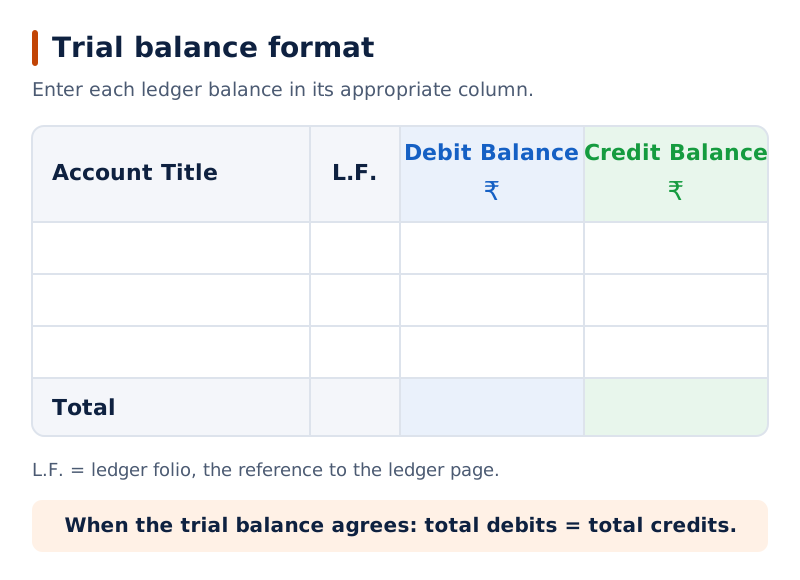
The format has columns headed Account Title, L.F., Debit Balance and Credit Balance, with a Total row at the bottom. The two amount columns show the rupee symbol.
Drawn by One Young India. See Fig. 6.1 in your NCERT textbook
L.F. means ledger folio, the reference to the ledger page. ₹ denotes rupees; = means equals in calculations. A receivable is an amount due to the business, while a payable is an amount owed by it. Debtors owe the business money; creditors are owed money.
Assets, expenses and receivables have debit balances, while liabilities, revenues and payables have credit balances. Sundry debtors means debtors considered together; sundry creditors means creditors considered together. Normally, their combined figures appear instead of each individual account balance.
Read the account’s nature before choosing its column. Sales returns are goods returned by customers; purchases returns are goods returned to suppliers. The former has a debit balance and the latter a credit balance. Purchases and sales therefore do not share the same column as their respective returns.
The preparation process ends with comparison, not merely addition. If the totals differ, the statement has identified a problem requiring investigation; entering an unexplained balancing amount does not correct the underlying account.
How do account balances appear in a worked trial balance?
Balance-method preparation requires the amount and nature of every listed account. Drawings are withdrawals by the proprietor for personal use. Goodwill is an intangible business asset. Bank overdraft is an amount owed to the bank when withdrawals exceed the available balance.
Discount allowed is a reduction granted to a customer; interest received is interest income. Stock means goods held by the business. The stock balance dated at the beginning of the accounting period is opening stock.
Worked example 1. Prepare a trial balance as at March 31, 2014 from these balances: capital ₹1,00,000; drawings ₹16,000; machinery ₹20,000; sales ₹2,00,000; purchases ₹2,10,000; sales return ₹20,000; purchases return ₹30,000; wages ₹40,000; goodwill ₹60,000; interest received ₹15,000.
The remaining balances are discount allowed ₹6,000; bank overdraft ₹22,000; bank loan ₹90,000; debtors Nathu ₹55,000 and Roopa ₹20,000; creditors Reena ₹35,000 and Ganesh ₹25,000; cash ₹54,000; stock on April 01, 2013 ₹16,000.
Answer: Classify each balance as below. Each column totals ₹5,17,000. “Not applicable” identifies the unused amount column; it does not represent an additional account balance.
| Account title | Debit balance, ₹ | Credit balance, ₹ |
|---|---|---|
| Capital | Not applicable | 1,00,000 |
| Drawings | 16,000 | Not applicable |
| Machinery | 20,000 | Not applicable |
| Sales | Not applicable | 2,00,000 |
| Purchases | 2,10,000 | Not applicable |
| Sales return | 20,000 | Not applicable |
| Purchases return | Not applicable | 30,000 |
| Wages | 40,000 | Not applicable |
| Goodwill | 60,000 | Not applicable |
| Interest received | Not applicable | 15,000 |
| Discount allowed | 6,000 | Not applicable |
| Bank overdraft | Not applicable | 22,000 |
| Bank loan | Not applicable | 90,000 |
| Nathu | 55,000 | Not applicable |
| Roopa | 20,000 | Not applicable |
| Reena | Not applicable | 35,000 |
| Ganesh | Not applicable | 25,000 |
| Cash | 54,000 | Not applicable |
| Stock on April 01, 2013 | 16,000 | Not applicable |
| Total | 5,17,000 | 5,17,000 |
The creditors, loan and overdraft enter the credit column because they represent amounts owed. Cash, machinery, goodwill and debtor balances enter the debit column as assets. Drawings, purchases, wages, sales return and discount allowed also appear on the debit side.
Here each debtor and creditor is listed by name so that every amount can be checked directly; in practice the sundry debtors and sundry creditors figures normally replace them. After classifying the balances, add each column independently. The equality establishes agreement of the trial balance, subject to the limitations discussed below.
Why is agreement of a trial balance not conclusive proof of accuracy?
A tallied trial balance has equal debit and credit totals. Normally, this means both debit and credit entries have been made correctly for each transaction. However, it proves only to a certain extent that ledger posting is arithmetically correct.
The entry itself may still be wrong. A correct amount debited to the wrong account gives incorrect account balances without changing total debits. Similarly, an incorrect amount recorded equally as a debit and credit preserves equality while misstating both accounts.
Where can an error arise?
A journal is a book of original entry in which transactions are first recorded. Subsidiary books are special-purpose books for particular transactions, such as credit sales or credit purchases. The cash book records cash transactions.
- Amounts may be totalled incorrectly in subsidiary books.
- Journal entries may be posted incorrectly to ledger accounts.
- Ledger balances may be calculated incorrectly.
- Account balances may be omitted or transferred incorrectly to the trial balance.
- The trial balance’s own debit or credit column may be totalled incorrectly.
The two broad outcomes must be kept separate. Some errors disturb debit-credit equality; others leave it intact. Equal totals do suggest that several types of errors probably have not occurred, but accounting accuracy is not thereby ensured.
Note: “The trial balance agrees” and “all the accounts are correct” are different conclusions. Agreement cannot establish that every original entry used the correct account and amount.
An error that leaves the totals equal still requires correction. Otherwise the financial statements may use incorrect balances even though their starting trial balance tallies. Thus the statement is a checking aid and a link to financial statements, not a substitute for examining the underlying records.
When the totals do not agree, at least one error exists. When they do agree, continue to distinguish arithmetic consistency from correct recording, classification and posting.
How do the four types of accounting errors differ?
Errors of commission are clerical mistakes involving recording, posting, totalling or balancing. Casting means totalling a book; overcasting makes its total too large and undercasting makes it too small. Most errors of commission affect trial balance agreement.
Raj Hans Traders paid Preetpal Traders ₹25,000 and recorded the payment correctly in the cash book, but debited Preetpal’s ledger account with only ₹2,500. The mistake is in posting the amount, so it is an error of commission.
How do complete and partial omission differ?
An error of omission arises when recording or posting is left out. Complete omission means the transaction is entirely absent from the books of original entry. Credit sales to Mohan of ₹10,000 not entered in the sales book illustrate this.
Partial omission means only part of the recording process is omitted. If the same sales are entered in the sales book but not posted to Mohan’s account, the omission is partial. The missing debit then affects trial balance agreement.
What are principle and compensating errors?
An error of principle violates an accounting principle, such as classifying capital expenditure as revenue expenditure. Capital expenditure is expenditure treated as part of an asset; revenue expenditure is treated as an expense.
Additions to a building should be debited to the asset account. Debiting maintenance and repairs instead treats the addition as a revenue expense. Such classification may understate or overstate income, assets or liabilities. Errors of principle do not affect the trial balance.
Compensating errors are two or more mistakes whose effects on debit-credit equality cancel. If purchases are overcast by ₹10,000 and sales returns undercast by ₹10,000, the excess debit and short debit offset each other. Both accounts nevertheless remain incorrect.
| Error type | Essential distinction | Effect on agreement |
|---|---|---|
| Commission | Wrong amount, posting, casting or balancing | Most affect agreement; the actual effect must be examined |
| Omission | Complete or partial failure to record or post | Complete omission leaves equality intact; a missing one-sided posting disturbs it |
| Principle | Violation of accounting principles | Does not affect agreement |
| Compensating | Errors cancel one another’s net effect | Does not affect agreement |
How should an accountant search for errors?
When a trial balance does not tally, locating the cause requires checking the records systematically. Recasting means adding a column or book again. Begin with the trial balance itself before checking the ledger and original entries.
- Recast both the debit and credit columns of the trial balance.
- Compare each account title and amount with the ledger, looking for omissions and differences.
- Compare the current trial balance with the previous year’s, checking additions, deletions and large unexplained changes.
- Recalculate individual ledger account balances.
- Recheck postings from the books of original entry to the ledger.
- Use the amount of the difference to investigate possible wrong-side postings, omissions and transposed figures.
What clues can the difference provide?
If the difference is divisible by two, there is a possibility that half the difference was posted on the wrong side. A debit excess of ₹1,500 may result from a credit item of ₹750 posted as a debit. Scan debit entries of ₹750.
The same ₹1,500 difference may instead arise from an omitted credit posting of ₹1,500. Therefore, check credit items of that amount as well. The numerical clue narrows the search; it does not establish which error occurred.
Transposition means putting figures in the wrong order. If a debit amount of ₹459 is posted as ₹954, the debit excess is ₹495, calculated as ₹954 − ₹459. The symbol − means subtraction. This difference is divisible by nine.
A difference divisible by nine could arise from transposition. Wrong placement of a decimal point may also be checked by this method. Neither divisibility test removes the need to compare the transaction and posting.
Note: A divisible difference is a clue, not proof. Preserve the distinction between a possible explanation and an error actually located in the accounts.
Once an error is found, identify the account, side and amount affected. Only then decide the correction. Finding a difference in the trial balance is not itself enough to determine which account should be debited or credited.
How are errors that do not affect the trial balance rectified?
Rectification means correcting an accounting error. Errors that do not affect agreement usually involve two accounts and can be corrected through a journal entry. These are called two-sided errors. The correction cancels the wrong effect and restores the correct effect.
A short debit or short credit is an amount recorded below what was required. An excess debit or excess credit is an amount above what was required. Compare the actual entry with the entry that should have been made.
| Account’s wrong effect | Required correction |
|---|---|
| Short debit | Debit the short amount |
| Excess credit | Debit the excess amount |
| Excess debit | Credit the excess amount |
| Short credit | Credit the short amount |
In entries below, A/c means account and Dr. means debit. To introduces the credited account. The narration is the brief explanation of what the entry corrects. An account already correctly recorded need not be altered.
How do omission and wrong recording change the entry?
Worked example 2. Credit sales to Mohan of ₹10,000 were completely omitted from the sales book.
Answer: Mohan’s A/c Dr. ₹10,000; To Sales A/c ₹10,000. Both the customer’s debit and the sales credit are missing, so the usual credit-sales entry supplies both effects.
Worked example 3. Credit sales to Mohan of ₹10,000 were recorded as ₹1,000 in the sales book and posted accordingly.
Answer: Mohan’s A/c Dr. ₹9,000; To Sales A/c ₹9,000. The short amount is ₹10,000 − ₹1,000, giving ₹9,000 on each side. Recording another ₹10,000 would give ₹11,000 in each account, an excess of ₹1,000.
If the same ₹10,000 sale was instead recorded as ₹12,000, both sides contain an excess of ₹2,000. The correction reverses that excess: Sales A/c Dr. ₹2,000; To Mohan’s A/c ₹2,000.
How is a wrong account corrected?
Worked example 4. Credit sales to Mohan of ₹10,000 were correctly entered in the sales book but debited to Ram’s account.
Answer: Mohan’s A/c Dr. ₹10,000; To Ram’s A/c ₹10,000. This supplies Mohan’s missing debit and cancels Ram’s incorrect debit. Sales was already correctly credited and is not changed.
Similarly, rent paid of ₹2,000 wrongly debited to the landlord’s personal account is corrected by Rent A/c Dr. ₹2,000; To Landlord’s A/c ₹2,000. The cash payment was correctly recorded, so cash is not entered again.
How are one-sided errors corrected before and after opening suspense?
One-sided errors affect only one account and disturb trial balance agreement. Examples include wrong casting, wrong balancing, omitted postings, and posting to the correct account with the wrong amount or on the wrong side.
Before a suspense account is opened, the affected account may be corrected by an additional posting with an explanatory note. A suspense account temporarily holds the difference in a trial balance until the errors causing that difference are located and rectified.
How can the ledger be corrected directly?
If Shyam’s account was credited short by ₹190, enter an additional ₹190 on its credit side with an explanation. If the purchases book was undercast by ₹1,000, debit purchases by ₹1,000, explaining the undercasting.
An error discovered in original recording before ledger posting may be corrected by crossing out the wrong amount with a single line, writing the correct amount above it and initialling it. A wrong amount posted to the correct account may also be corrected similarly.
Errors should never be corrected by erasing or overwriting. These methods reduce the authenticity of the records and can give an impression that something is concealed. An explanatory correction shows how the error was neutralised.
How does suspense complete a rectification entry?
- Identify the account affected by the error.
- Find its excess or short debit or credit.
- Credit the account for an excess debit or short credit.
- Debit the account for an excess credit or short debit.
- Complete the journal entry with the opposite debit or credit in suspense account.
Worked example 5. Credit sales to Mohan of ₹10,000 were correctly recorded, but his account was debited with only ₹7,000. A suspense account has been opened.
Answer: Mohan’s A/c Dr. ₹3,000; To Suspense A/c ₹3,000. Short debit = ₹10,000 − ₹7,000. Sales is already correct; suspense supplies the counterpart to the additional customer debit.
If Mohan was instead debited with ₹12,000 for that correctly recorded ₹10,000 sale, the correction is Suspense A/c Dr. ₹2,000; To Mohan’s A/c ₹2,000. Excess debit = ₹12,000 − ₹10,000. This removes his excess debit without changing the correct sales credit.
Why must the stage and side of an error be identified?
“Recorded wrongly” and “posted wrongly” describe different stages. An error in the books of original entry is assumed to have been posted accordingly. If the error is at the posting stage, recording in the subsidiary book is assumed to be correct.
Which assumptions guide the analysis?
- A wrong account with no side or amount specified implies the correct side and amount.
- A correct account with a wrong amount but no side specified implies the correct side.
- A wrong account and wrong side with no amount specified imply the originally recorded amount.
- A wrong account and wrong amount with no side specified imply the correct side.
- A correct account on the wrong side with no amount specified implies the correct amount.
Errors in individual postings from subsidiary books concern individual accounts. Errors in casting subsidiary books affect the account receiving the total and leave individual personal accounts unaffected. Thus, a wrong purchases-book total is different from a wrong credit to one supplier.
Worked example 6. The purchases book is overcast by ₹1,000 and a suspense account is open. Individual suppliers’ accounts have been correctly posted.
Answer: Suspense A/c Dr. ₹1,000; To Purchases A/c ₹1,000. Purchases contains the excess debit because it receives the book’s total. The correctly posted suppliers’ accounts require no correction.
Why can a wrong-side correction be twice the transaction?
Worked example 7. Credit purchases from Raghu of ₹20,000 were correctly recorded but posted to the debit of his account. A suspense account is open.
Answer: Suspense A/c Dr. ₹40,000; To Raghu’s A/c ₹40,000. Correction credit = ₹20,000 + ₹20,000, where + means addition. Credit ₹20,000 to cancel the wrong debit and another ₹20,000 to establish the correct credit. The purchases debit remains unchanged.
The journal proper records transactions outside the special-purpose books. If a transaction recorded there “was not posted”, both accounts are affected unless stated otherwise. Depreciation, the reduction in an asset’s recorded value charged as an expense, illustrates this distinction.
Depreciation on machinery of ₹2,000 not posted at all requires Depreciation A/c Dr. ₹2,000; To Machinery A/c ₹2,000. If only machinery posting was omitted, debit suspense and credit machinery. If only depreciation posting was omitted, debit depreciation and credit suspense, each by ₹2,000.
For a transaction already recorded in the cash book, a posting error concerns the other affected account, not cash or bank. This prevents correcting a cash-book entry that was already right.
How is a suspense account opened and eventually cleared?
When one-sided errors remain unidentified, the accountant puts the trial balance difference on its shorter side as suspense. This permits the accounting process to continue. It does not mean the original error has been located or corrected.
Worked example 8. A sales book contains sales to Ashok Traders ₹20,000, Bimal Service Centre ₹10,000, Chopra Enterprises ₹5,000 and Diwakar and Sons ₹15,000. Sales is credited with ₹50,000, but the debit posting to Diwakar and Sons is omitted.
Answer: The debit total is ₹35,000 and the credit total ₹50,000. Trial balance difference = ₹50,000 − ₹35,000. Put ₹15,000 on the debit side as suspense. When the omission is located, debit Diwakar and Sons ₹15,000 and credit suspense ₹15,000 to remove this difference.
Suspense is temporary and is not placed in any particular category of accounts. As errors are identified, correction entries transfer amounts between suspense and the relevant accounts. When all errors causing the difference have been corrected, the account closes.
What if a balance remains?
Clearing the errors so far detected does not necessarily clear suspense. A remaining balance indicates that errors affecting trial balance agreement have not all been located. The balance is carried forward and eliminated as the remaining errors are found.
Anant Ram’s suspense account illustrates this. Its opening debit difference is ₹16,000; a correction concerning Mohit adds a debit of ₹3,000. Corrections concerning purchases and repairs credit ₹1,000 and ₹600 respectively. The remaining debit balance is ₹17,400.
| Debit particulars | Amount, ₹ | Credit particulars | Amount, ₹ |
|---|---|---|---|
| Difference as per trial balance | 16,000 | Purchases | 1,000 |
| Mohit | 3,000 | Repairs | 600 |
| No further debit entry | Not applicable | Balance carried down | 17,400 |
| Total | 19,000 | Total | 19,000 |
Balance carried down is the balancing amount entered to close the account for the period and carry its balance onward. Its position on the credit side here balances the ledger; the account’s remaining balance is a debit balance.
If errors are not corrected before financial statements are finalised, suspense cannot close and carries forward. For errors found in the next accounting year, a profit and loss adjustment account replaces expense, loss, income and gain accounts to avoid affecting the next period’s income statement.
Glossary
- Trial balance — A statement listing ledger balances or totals to check the arithmetical accuracy of posting.
- Balance method — Preparation of a trial balance using the balances of individual ledger accounts.
- Error of commission — A clerical mistake in recording, posting, totalling or balancing accounting entries.
- Complete omission — Failure to record a transaction at all in the books of original entry.
- Partial omission — Failure to complete part of the recording or posting of a transaction.
- Error of principle — An error caused by violating or ignoring an accepted accounting principle.
- Compensating errors — Two or more errors whose net effect on debit-credit equality is nil.
- Overcasting — Totalling a book at an amount greater than its correct total.
- Undercasting — Totalling a book at an amount lower than its correct total.
- Transposition — An error in which figures are recorded in the wrong order.
- Rectification entry — An entry cancelling an incorrect accounting effect and restoring the required correct effect.
- Suspense account — A temporary account holding the trial balance difference until relevant errors are located and corrected.
Common errors and misconceptions
- Misconception: Equal trial balance totals prove that every entry is correct. Correct: Equality checks arithmetic only to a certain extent; complete omissions, principle errors and compensating errors can remain undetected.
- Misconception: Every error of commission makes the trial balance disagree. Correct: Most do, but equal wrong amounts on both sides or posting to a wrong account on the correct side can preserve agreement.
- Misconception: Complete omission and partial omission have identical effects. Correct: Complete omission leaves both aspects absent; omission of one ledger posting leaves one aspect missing and affects agreement.
- Misconception: A wrong-side posting is corrected by the original amount alone. Correct: The correction must cancel the wrong effect and restore the correct one, which can require twice the original amount.
- Misconception: A wrong subsidiary-book total requires changing every personal account. Correct: A casting error affects the account receiving the total; correctly posted individual accounts remain unaffected.
- Misconception: Suspense must close after the detected errors are corrected. Correct: A balance can remain because errors affecting agreement are still undiscovered; carry that balance forward.
- Misconception: A difference divisible by nine proves transposition. Correct: It suggests a possible transposition or decimal-placement error, which must be checked against the records.
Exam-style questions with model answers
Q1. Define a trial balance and state one limitation. [2 marks]
- A trial balance lists ledger account balances or debit and credit totals to check the arithmetical accuracy of posting.
- Agreement is not conclusive proof of correctness because errors that leave debit-credit equality unchanged can remain in the accounts.
Q2. Explain the three objectives of preparing a trial balance. [3 marks]
- It checks arithmetical accuracy by comparing debit and credit totals after accounts have been posted and balanced.
- It helps locate errors because disagreement indicates that at least one mistake has occurred in recording, posting, balancing or preparation.
- It assists preparation of financial statements by collecting balances in one statement, so the accountant need not consult the whole ledger again.
Q3. Credit sales to Mohan of ₹10,000 were recorded in the sales book as ₹1,000 and posted accordingly. Identify the error, explain its effect on agreement, calculate the correction and give the rectification entry. [4 marks]
- This is an error of commission because the transaction amount was wrongly recorded in the sales book.
- Trial balance agreement is unaffected: Mohan and Sales received equal debit and credit amounts, although both amounts were too small.
- The short debit and short credit are each ₹9,000, calculated by subtracting the recorded ₹1,000 from the correct ₹10,000.
- Record Mohan’s A/c Dr. ₹9,000; To Sales A/c ₹9,000. This supplies the missing amount in both accounts.
Q4. Credit purchases from Raghu of ₹20,000 were correctly entered in the purchases book but debited to his account. Purchases was correctly debited and suspense has been opened. Explain the wrong and correct effects, the corrective amount, the journal entry and why purchases is unchanged. [5 marks]
- Raghu’s account wrongly contains a debit of ₹20,000. This is a posting error rather than an error in the original purchases-book entry.
- The correct effect should be a credit of ₹20,000 in Raghu’s account, reflecting the credit purchase from him.
- The correction requires a credit of ₹40,000: ₹20,000 cancels the wrong debit and another ₹20,000 supplies the correct credit.
- Record Suspense A/c Dr. ₹40,000; To Raghu’s A/c ₹40,000. Suspense completes the entry correcting the wrong-side posting.
- Purchases remains unchanged because its debit of ₹20,000 was already correct. Debiting purchases again would alter an account that requires no correction.
Q5. A trial balance has debit totals exceeding credit totals by ₹1,500. Explain two possible causes and what entries should be checked for each. Do not assume either cause is confirmed. [4 marks]
- A credit item of ₹750 may have been wrongly posted as a debit, increasing the difference to twice that amount.
- Check debit entries of ₹750 against their original records to establish whether any should have been credits.
- Alternatively, a credit posting of ₹1,500 may have been omitted, leaving the credit column short by the stated difference.
- Verify credit items of ₹1,500 against the ledger. These are possible explanations, so the actual error must be located before rectification.
Q6. Anant Ram’s suspense account has an opening debit of ₹16,000, a further debit concerning Mohit of ₹3,000, and credits concerning purchases of ₹1,000 and repairs of ₹600. Calculate its balance and explain its treatment in five separate points. [5 marks]
- The debit side totals ₹19,000, obtained by adding the opening debit difference of ₹16,000 and the further Mohit-related debit of ₹3,000.
- The corrective credits total ₹1,600, comprising ₹1,000 relating to purchases and ₹600 relating to repairs.
- The account therefore retains a debit balance of ₹17,400, calculated by subtracting ₹1,600 from ₹19,000. Enter this balance on the credit side to balance the account.
- The remaining balance indicates that errors affecting trial balance agreement have not all been located, despite correction of the errors already detected.
- Carry the balance forward to the next accounting period and eliminate it as the remaining errors affecting agreement are found and rectified.
Q7. The purchases book is overcast by ₹10,000 and the sales returns book undercast by ₹10,000. Explain the effect of each error and their combined effect on trial balance agreement. [3 marks]
- Overcasting the purchases book produces an excess debit of ₹10,000 in Purchases, because that account receives the book’s total.
- Undercasting the sales returns book produces a short debit of ₹10,000 in Sales Returns, reducing debits by the same amount.
- These compensating errors have a nil net effect on debit-credit equality, so the trial balance still agrees although both accounts remain incorrect.
Key takeaways
- A trial balance summarises ledger balances, checks arithmetic, assists error detection and helps prepare financial statements.
- The balance method is the most widely used method, presenting each balance in its appropriate debit or credit column.
- Agreement does not guarantee correct accounts because some errors preserve equality between total debits and credits.
- Distinguish commission, omission, principle and compensating errors by their nature, then analyse their actual accounting effects.
- Rectification cancels wrong effects and supplies correct effects; an account already correctly recorded should remain unchanged.
- A wrong-side posting may need twice the transaction amount because the incorrect entry must be cancelled and replaced.
- Suspense temporarily holds the trial balance difference; a remaining balance shows that relevant errors are still undiscovered.
- Divisibility by two or nine supplies possible error-search clues, each requiring verification against the accounting records.
Test yourself
Is a trial balance an account or a statement?
It is a statement summarising ledger balances or debit and credit totals for checking arithmetical accuracy.
Must a trial balance be prepared only at the accounting year’s end?
No. It is normally prepared then, but may also be prepared monthly, quarterly or half yearly according to requirements.
What is complete omission?
It is the failure to record a transaction at all in the books of original entry.
Does an error of principle affect trial balance agreement?
No. It can leave agreement unchanged while causing incorrect classification and affecting financial statements.
Which side receives the initial suspense amount?
The shorter side of the trial balance receives the difference as the suspense amount.
How is an excess debit in an account corrected?
Credit that account with the excess amount to cancel the incorrect additional debit.
Why should errors not be erased or overwritten?
Doing so reduces the authenticity of accounting records and may suggest that something is being concealed.
What happens when suspense retains a balance after detected errors are corrected?
The balance is carried forward because errors affecting agreement remain undiscovered; it is eliminated as those errors are located and rectified.
Write about it
Turn a question from this chapter into a paper.
The Writing Studio has a structure guide, a rubric and citation tools for 15 formats, from essays to research papers. Drafting is free with an account. Learnacy Essential adds feedback from an AI writing coach and submission to The OYI Review.
Learnacy Essential is ₹1,499 for the year. Publication depends on review and is not guaranteed.