
Financial Statements - I | CBSE Class 11 Accountancy Notes
On this page
This note covers financial statements, users of accounting information, capital and revenue items, trading and profit and loss accounts, closing entries, gross profit, closing stock, operating profit, balance sheets, classification of assets and liabilities, grouping, marshalling and opening entries.
What are financial statements and who uses them?
Financial statements are periodic reports presenting business results and financial position. Financial performance means results over a period; financial position means assets, liabilities and capital at a date. Their objectives are to present a true and fair view of both. A business prepares a set of statements that, in general, meets its users' information needs.
A sole proprietorship is a business owned by one person, the proprietor. A stakeholder is a person associated with the business. A stake may be monetary or non-monetary, active or passive, direct or indirect. Owners and lenders have monetary stakes; government, consumers and researchers have non-monetary stakes.
Users are normally classified as internal users, who are inside the business, and external users, who are outside it. Their objectives differ, so the information each needs also differs.
Which information matters to each user?
Profit is the excess of revenue, or business income, over expenses, the costs consumed in earning that income. Assets are resources held by the business; liabilities are obligations to outsiders. Capital is the owner's claim, also called equity.
| User | Classification | Information required |
|---|---|---|
| Current owners | Internal | Profit for the last accounting period and the current position of assets and liabilities, to assess their investment and wealth. |
| Managers | Internal | Profit and financial position, because financial statements report the results of their work as agents of owners. |
| Government | External | Profitability and other information for taxation, regulation and protection of stakeholders' rights. |
| Prospective owners | External | Past profits and financial position as indications of likely future performance before investing. |
| Banks | External | Adequacy of profits and the form of assets, to assess timely repayment of the principal and interest. |
Principal means the loan amount, while interest is the periodic return on it. Liquidity concerns assets held as cash or near cash. A bank therefore considers both earnings and the form in which the business holds its assets.
What the figure shows
Users of accounting information
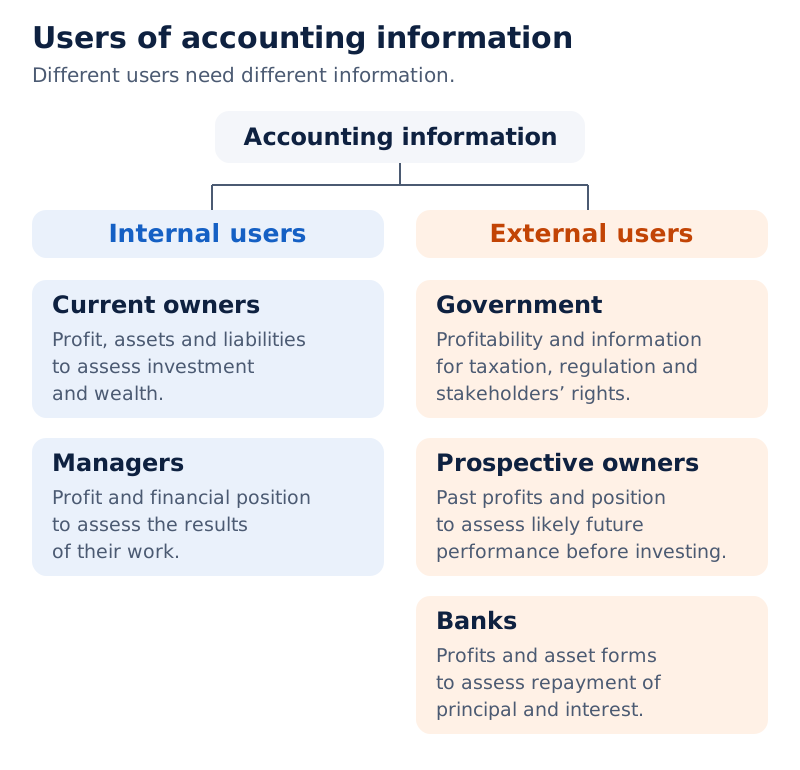
The table links current owners, managers, government, prospective owners and banks with their classification, objectives and information requirements.
Drawn by One Young India. See Fig. 8.1 in your NCERT textbook
How does the accounting process lead to financial statements?
An accounting period is the period for which business results are determined. Financial statement preparation follows the recording and summarising of transactions, which are business dealings measured in money. The records provide the balances needed to report performance and position.
What is the sequence?
- Identify the transactions to be recorded. Transactions recorded in the books must be measurable in money.
- Record transactions in the journal, the book of original entry, or appropriate special journals. Under the double entry system, the debit and credit aspects of each transaction are recorded. Debit and credit are the two sides of an account.
- Post entries to the ledger, which contains the respective accounts. Posting means transferring the information from the original books into those accounts.
- Balance the accounts and list their balances in the trial balance, a statement comparing total debit and credit balances.
- Use the trial balance and additional information, if any, to prepare the trading and profit and loss account and balance sheet.
Subsidiary books are special journals for repeated transactions of the same nature. Credit sales go into the sales book and credit purchases into the purchases book. Credit dealings involve payment later. The cash book records cash and bank transactions; the journal proper records residual entries.
What do the two statements show?
The trading and profit and loss account, also called the income statement, reports profit earned or loss sustained during the period. The balance sheet reports assets, liabilities and capital at a given date. The firm usually prepares both statements.
Expense and loss balances move to the debit side of the income statement; revenue balances move to its credit side. A loss arises when expenses exceed revenues. Assets, liabilities and capital remain for presentation in the balance sheet.
How do capital and revenue expenditure differ?
Definition: Expenditure is a payment or an outlay incurred for a purpose other than settling an existing liability. It is incurred with a view to obtaining benefits for the business.
Revenue expenditure benefits one accounting period. Normally, it is incurred for the day-to-day conduct of business, such as salaries and rent. Capital expenditure benefits more than one accounting period, such as acquiring furniture for use in the business.
What determines the classification?
Fixed assets are assets held for long-term use rather than resale. Depreciation is the expense representing the portion of their cost charged for a period. Outstanding expenses are expenses due but unpaid; prepaid expenses are expenses paid in advance.
| Basis | Capital expenditure | Revenue expenditure |
|---|---|---|
| Earning capacity | Increases earning capacity. | Maintains earning capacity. |
| Purpose | Acquires fixed assets for business operations. | Meets day-to-day business needs. |
| Recurrence | Non-recurring by nature. | Generally recurring. |
| Benefit period | Benefits more than one accounting year. | Normally benefits one accounting year. |
| Presentation | Recorded in the balance sheet, subject to depreciation. | Transferred to trading and profit and loss account, subject to outstanding and prepaid adjustments. |
Expense is narrower than expenditure: it is the portion perceived as used or consumed in the current year. Thus, acquiring furniture creates an asset, while the portion consumed during the year becomes an expense.
Worked example 1. Furniture costs ₹50,000 and is expected to be used for five years. Here and throughout, ₹ means Indian rupees. What annual expense is illustrated?
Answer: ₹50,000 ÷ 5 = ₹10,000 per year, called depreciation. The symbol ÷ means divided by; = means equals.
What is deferred revenue expenditure?
Deferred revenue expenditure is revenue expenditure likely to benefit more than one accounting period. Advertising is normally revenue expenditure, but heavy advertising expenditure is likely to give benefits beyond one period. Such expenditure is written off over its expected benefit period.
How do capital and revenue receipts affect the accounts?
A receipt is money received by the business. A capital receipt involves an obligation to return money, or arises from selling a fixed asset. Additional capital from the owner, a bank loan and the sale of old machinery or furniture are examples.
The obligation associated with an owner's contribution is equity; the obligation to an outside lender is a liability. These receipts must be distinguished from income earned through business activities when preparing the financial statements.
Revenue receipts are receipts without an obligation to return the money and outside the sale of fixed assets. Examples include sales and interest received on investments. Investments are funds placed in assets such as government securities or company shares.
Why does correct classification matter?
Revenue items enter the trading and profit and loss account; capital items help prepare the balance sheet. Wrong classification therefore affects both the calculation of profit and the presentation of financial position. Each item must be identified by its nature before it is placed in the statements.
Worked example 2. Revenue is ₹10,00,000 and recorded expenses are ₹8,00,000. Machinery repairs of ₹20,000 were wrongly added to machinery instead of expenses. Find the correct profit.
Answer: Reported profit is ₹2,00,000. Correct expenses are ₹8,20,000, so correct profit is ₹1,80,000. The reported profit is overstated by ₹20,000.
The repair expenditure was omitted from current expenses when it was treated as capital expenditure. Restoring it to expenses reduces the profit. Repairs here mean expenditure to keep an existing asset in working condition.
The reverse error also matters. If furniture bought for use is treated as purchases of goods, profit and assets are understated. Purchases in a trading account means goods acquired for resale, rather than every item bought by the business.
Which items belong in trading and profit and loss accounts?
The trading account deals with basic operations involving manufacturing, purchasing and selling goods. Direct expenses are expenses directly connected with manufacture, purchase and bringing goods to the point of sale. Indirect expenses are dealt with in the profit and loss account.
How are stock, purchases and sales treated?
Opening stock is goods held at the beginning of the accounting year and carried forward from the previous year. It appears on the debit side of the trading account because it forms part of the current year's cost of goods sold, meaning the cost attributable to goods sold.
Purchases include goods bought for cash and on credit. Purchases returns, also called returns outwards, are goods returned to suppliers. Sales returns, also called returns inwards, are goods returned by customers. Each return reduces its related total.
Net purchases = Purchases − Purchases returns
Net sales = Sales − Sales returns
Here, − means subtract. Net purchases and net sales mean the respective amounts after returns. Sales include cash and credit sales; net sales appear on the trading account's credit side.
How are common expenses classified?
Commission is remuneration connected with transactions through agents. Salaries are payments for staff services, and wages here are payments to workers directly engaged in handling or producing goods.
| Item | Meaning or treatment |
|---|---|
| Wages | Remuneration to workers directly engaged in loading, unloading and production; debit trading account. |
| Carriage or freight inwards | Transport cost of bringing purchased goods to the business; debit trading account. |
| Fuel, water, power and gas | Production inputs that form part of production expenses. |
| Packaging material | Small containers forming part of goods sold; a direct expense. |
| Packing for transport | Large transport containers; an indirect expense in profit and loss account. |
| Salaries | Payment to administration and warehouse staff, including benefits in kind; debit profit and loss account. |
| Interest and commission paid | Financing charges and payments to agents; debit profit and loss account. |
| Repairs and miscellaneous expenses | Maintenance costs and small expenses grouped together; debit profit and loss account. |
Other incomes credited to profit and loss account include rent, interest, commission and discount received. Discount received is an allowance received. Bad debts, debts that cannot be recovered, are treated as an expense or loss.
How do closing entries transfer account balances?
Closing entries transfer the balances of expense and revenue accounts to the trading and profit and loss account. They bring together the information needed to determine the period's result. The individual revenue and expense accounts are closed through these transfers.
In journal notation, A/c means account, Dr. means debit and Cr. means credit. The word To introduces a credited account in a journal entry. Each transferred debit balance is matched by a corresponding credit, and vice versa.
Which accounts are debited and credited?
Net profit is the final excess of income over expenses; net loss is the reverse excess. Gains are favourable results such as profit on the sale of an investment.
| Transfer | Debit | Credit |
|---|---|---|
| Opening stock, purchases and direct expenses | Trading A/c | Opening stock A/c, Purchases A/c, Wages A/c, Carriage inwards A/c and other direct expense accounts individually. |
| Purchases returns | Purchases return A/c | Purchases A/c |
| Sales returns | Sales A/c | Sales return A/c |
| Sales | Sales A/c | Trading A/c |
| Indirect expenses and losses | Profit and Loss A/c | Individual expense and loss accounts. |
| Other incomes and gains | Individual income and gain accounts. | Profit and Loss A/c |
| Net profit | Profit and Loss A/c | Capital A/c |
| Net loss | Capital A/c | Profit and Loss A/c |
The returns entries reduce purchases and sales before their net amounts enter the trading account. Expense accounts are credited to close their debit balances; income accounts are debited to close their credit balances. These entries explain the eventual placement of each item.
For Ankit, purchases of ₹75,000 and wages of ₹8,000 are closed by debiting Trading A/c ₹83,000, crediting Purchases A/c ₹75,000 and crediting Wages A/c ₹8,000. Sales A/c is debited ₹1,25,000 and Trading A/c credited by the same amount.
Commission received of ₹5,000 is closed by debiting Commission Received A/c and crediting Profit and Loss A/c. The direction of the transfer differs from an expense because commission received has a credit balance before it is closed.
How are gross profit and net profit calculated?
Gross profit is the excess of sales over the cost of goods sold. The trading account determines this result from basic operations. Gross loss arises when the relevant cost exceeds sales. The result is transferred to the profit and loss account.
Where there is no opening or closing stock, the relationship is:
Gross profit = Sales − (Purchases + Direct expenses)
The symbol + means add, and brackets group amounts calculated together. Purchases and direct expenses constitute the cost of goods sold in this situation. Stock requires the further treatment explained below.
Net profit is the final excess after other incomes and indirect expenses are considered. Other incomes are incomes apart from sales, while indirect expenses are the expenses transferred to the second part of the income statement.
Net profit = Gross profit + Other incomes − Indirect expenses
How does Ankit's example work?
Worked example 3. Ankit has sales ₹1,25,000, purchases ₹75,000, wages ₹8,000, salaries ₹25,000, building rent ₹13,000, bad debts ₹4,500 and commission received ₹5,000. Calculate profit for the version without stock or interest adjustments.
Answer: Gross profit is ₹1,25,000 − (₹75,000 + ₹8,000) = ₹42,000. Indirect expenses are ₹42,500. Net profit is ₹42,000 + ₹5,000 − ₹42,500 = ₹4,500.
The trading account totals ₹1,25,000 on each side after inserting gross profit on the debit side. Gross profit is then brought into the credit side of profit and loss account. That account totals ₹47,000 on each side after inserting net profit.
Carried down, abbreviated c/d, shows a balance transferred from one part; brought down, abbreviated b/d, shows it in the next part. Net profit is transferred to capital, increasing the owner's balance. Net loss is transferred in the reverse direction and reduces capital.
What the figure shows
Gross and net profit
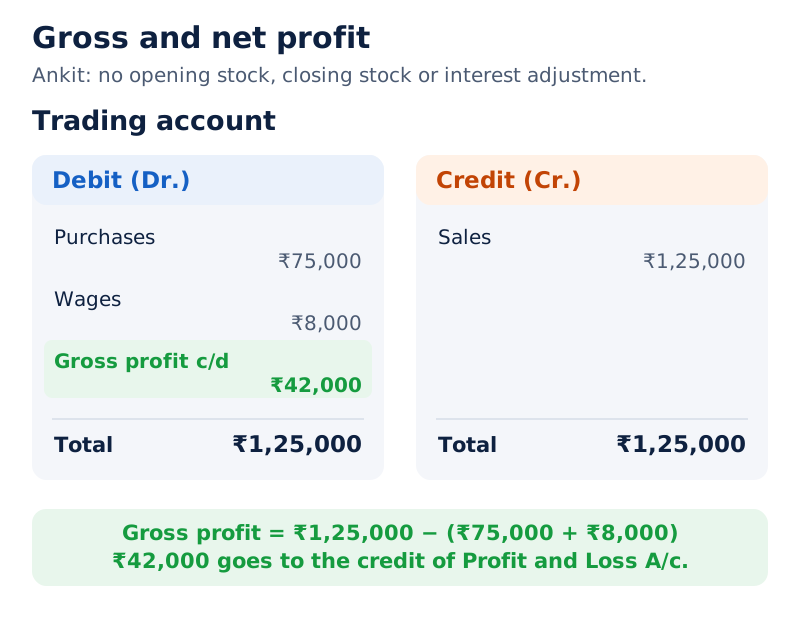
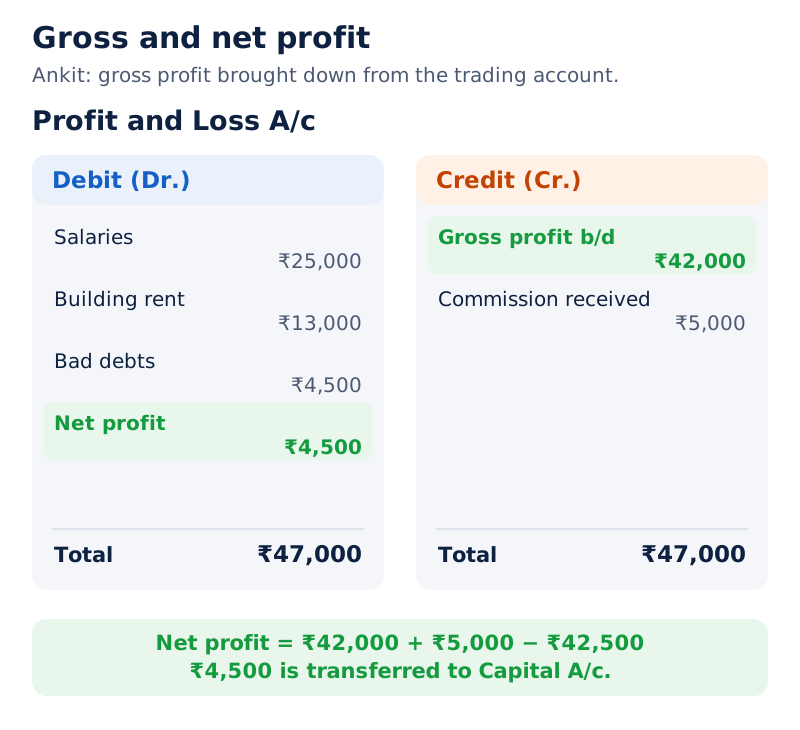
The upper account shows purchases, wages and gross profit opposite sales. The lower account shows salaries, building rent, bad debts and net profit opposite gross profit and commission received.
Drawn by One Young India. See Fig. 8.3 in your NCERT textbook
How does closing stock change the cost of goods sold?
Closing stock is unsold goods held at the end of the accounting period. If there is no opening or closing stock, purchases plus direct expenses give the cost of goods sold. With unsold goods, their cost must be excluded from that calculation.
Cost of goods sold = Opening stock + Net purchases + Direct expenses − Closing stock
The terms have their trading-account meanings: opening stock brings in goods from the previous year, net purchases add goods bought after returns, direct expenses bring goods to the point of sale, and closing stock removes the cost of goods still unsold.
What happens when some goods remain unsold?
In Ankit's stock version, purchases are ₹75,000 and wages ₹8,000. Of the purchases, goods costing ₹60,000 are sold, leaving ₹15,000 unsold. With sales of ₹1,25,000, gross profit becomes ₹57,000 instead of ₹42,000.
Closing stock does not normally form part of the trial balance. The entry is: debit Closing Stock A/c and credit Trading A/c. This opens an asset account, whose balance is transferred to the balance sheet. Closing stock becomes the next year's opening stock.
Note: Closing stock is credited to the trading account and appears as an asset when brought into the books by this adjustment. In most cases, a business has both opening and closing stock each year.
How is the full stock calculation made?
Worked example 4. Sales are ₹20,00,000, opening stock ₹3,00,000, purchases ₹15,00,000, wages ₹1,00,000, freight inwards ₹1,00,000 and closing stock ₹4,00,000. Find cost of goods sold and gross profit.
Answer: Cost of goods sold is ₹3,00,000 + ₹15,00,000 + ₹1,00,000 + ₹1,00,000 − ₹4,00,000 = ₹16,00,000. Gross profit is ₹20,00,000 − ₹16,00,000 = ₹4,00,000.
In the trading account for this example, sales and closing stock together make a credit total of ₹24,00,000. Opening stock, purchases and direct expenses total ₹20,00,000. Adding gross profit of ₹4,00,000 to the debit side makes the two sides equal.
What is operating profit and how is it found?
Operating profit is profit from normal business operations and activities: operating revenue exceeds operating expenses. Operating revenue is income from those operations, while operating expenses are the costs associated with them.
Purely financial incomes and expenses are excluded when calculating operating profit. Abnormal items, such as loss by fire, are also excluded. Non-operating expenses and non-operating incomes are the expenses and incomes excluded on these grounds.
Operating profit is described as profit before interest and tax, or EBIT, meaning earnings before interest and tax. It separates the result of normal activities from the financial and abnormal items included in net profit.
Operating profit = Net profit + Non-operating expenses − Non-operating incomes
Why are expenses added back?
A non-operating expense has already reduced net profit. Adding it back removes that reduction when measuring operating performance. Conversely, a non-operating income has increased net profit, so it is deducted when moving from net profit to operating profit.
Worked example 5. In Ankit's interest-adjusted version, net profit is ₹19,000. Non-operating interest expense is ₹500 and non-operating income is nil, meaning none. Calculate operating profit.
Answer: Operating profit is ₹19,000 + ₹500 − nil = ₹19,500. The interest expense is added back because it is a financial expense excluded from operating profit.
The interest comes from a ₹5,000 loan at 10% for the year: ₹5,000 × 10/100 = ₹500. The symbol % means per hundred, × means multiply, and / indicates division. Charging this interest reduces net profit from ₹19,500 to ₹19,000.
What the figure shows
Interest and profit
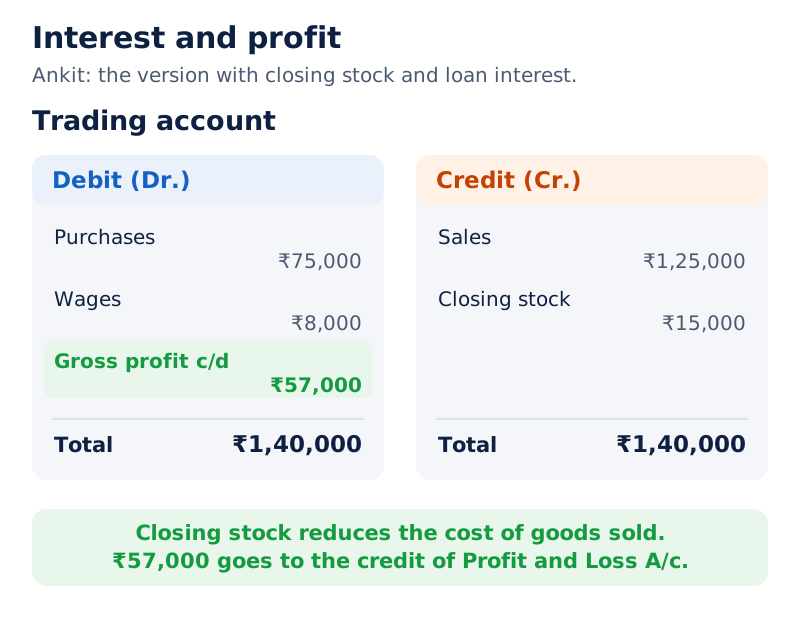
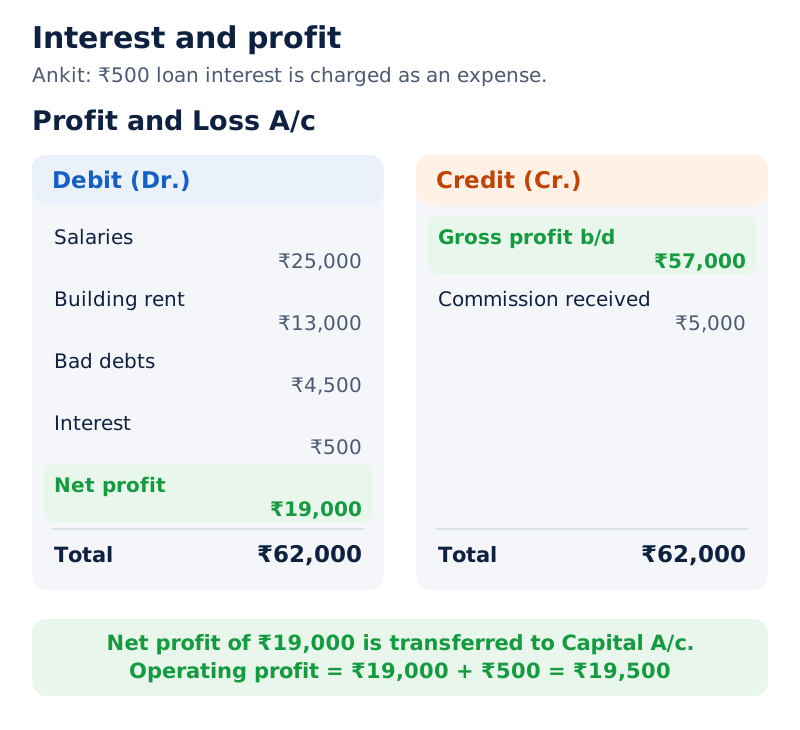
The trading account shows gross profit of ₹57,000. The profit and loss account includes interest of ₹500 on the debit side and net profit of ₹19,000.
Drawn by One Young India. See Fig. 8.6 in your NCERT textbook
What does a balance sheet show?
A balance sheet summarises the financial position at a given date. It is prepared after the trading and profit and loss account. It contains the balances of assets, liabilities and capital that remain after revenue and expense accounts have been closed.
The balance sheet is a statement, not an account. Its information relates to its stated date. In the horizontal presentation, capital and liabilities appear on the left and assets and other debit balances on the right.
How does it differ from the income statement?
| Basis | Trading and profit and loss account | Balance sheet |
|---|---|---|
| Purpose | Measures financial performance. | Shows financial position. |
| Time reference | For an accounting period. | At a given date. |
| Contents | Revenues, expenses, gains and losses. | Assets, liabilities and capital. |
| Result or relationship | Determines profit or loss transferred to capital. | Portrays the equality of assets and total claims against them. |
The accounting equation expresses the relationship between business assets and claims: assets equal capital plus outside liabilities. The totals of the two sides of the balance sheet are equal. Its balances are carried forward into the next accounting period.
How is Ankit's financial position presented?
For Ankit's original version, capital is ₹12,000 and net profit is ₹4,500. Capital after adding profit is ₹16,500. The long-term loan is ₹5,000 and creditors are ₹15,000. Creditors are parties to whom the business owes money.
Assets are furniture ₹15,000, cash ₹1,000, bank ₹5,000 and debtors ₹15,500. Debtors are parties owing money to the business. Assets and total capital plus liabilities each amount to ₹36,500.
Note: This balance sheet uses the original ₹4,500 profit version. The later examples that introduce closing stock and loan interest are separate stages and must be kept consistent with their own data.
How are assets, liabilities and capital classified?
Current assets are cash or assets convertible into cash within a year. Examples include cash in hand and at bank, debtors and stocks of raw materials, semi-finished goods and finished goods. Raw materials await production; semi-finished goods are partly processed; finished goods are ready for sale.
Current liabilities are liabilities expected to be paid within a year, usually out of current assets. Examples include creditors, short-term loans and outstanding expenses. Their expected settlement period distinguishes them from long-term obligations.
What are the other main categories?
Intangible assets cannot be seen or touched. Their examples include goodwill, business reputation value; a patent, a right over an invention; and a trademark, a protected identifying mark.
| Category | Meaning and examples |
|---|---|
| Fixed assets | Assets held on a long-term basis and not acquired for resale, such as land, buildings, machinery and furniture. |
| Intangible assets | Assets that cannot be seen or touched, such as goodwill, patents and trademarks. |
| Investments | Funds invested in government securities, company shares and similar holdings, shown at cost price. |
| Long-term liabilities | Liabilities other than current liabilities, usually payable after one year from the balance sheet date, such as long-term bank loans. |
| Capital | The excess of assets over liabilities due to outsiders, representing the proprietor's claim. |
| Drawings | Amounts withdrawn by the proprietor, which reduce the capital balance. |
If the market price of investments is below cost on the balance sheet date, a footnote to that effect may be appended. Investments remain shown at cost; a lower market price may be disclosed in a footnote.
How do withdrawals affect capital?
Drawings are transferred to the capital account when their account is closed. They appear as a deduction from capital in the balance sheet. Profits increase capital, while losses and drawings decrease it. The owner's claim is therefore updated before presentation.
How do grouping and marshalling organise the balance sheet?
Marshalling means arranging assets and liabilities in a particular order. Grouping means putting items of similar nature under a common heading. Both help present information usefully, but ordering balances and classifying balances perform different tasks.
How do permanence and liquidity differ?
In the order of permanence, the most permanent asset or liability comes first, followed by items of decreasing permanence. In the order of liquidity, the order is reversed. More liquid assets change their form sooner and are likely to become cash or cash equivalents.
| Side | Order of permanence in Ankit's example | Order of liquidity in Ankit's example |
|---|---|---|
| Assets | Furniture, debtors, bank, cash. | Cash, bank, debtors, furniture. |
| Capital and liabilities | Capital, long-term loan, creditors. | Creditors, long-term loan, capital. |
Furniture is the most permanent asset in this example. Debtors take longer to turn into cash than bank balances; cash is the most liquid asset. Capital tends to remain longer than the long-term loan, while creditors are discharged in the near future.
What does grouping add?
Cash, bank and debtors are grouped as current assets. Fixed assets and long-term investments are grouped as non-current assets, assets held beyond the current category. Capital appears under owners' funds, the owner's financial interest in the business.
The long-term loan is grouped under non-current liabilities, and creditors under current liabilities. The group headings make the different kinds of claims and resources visible without changing their amounts. Ankit's grouped statement retains the same total of ₹36,500 on each side.
What the figure shows
Grouped balance sheet
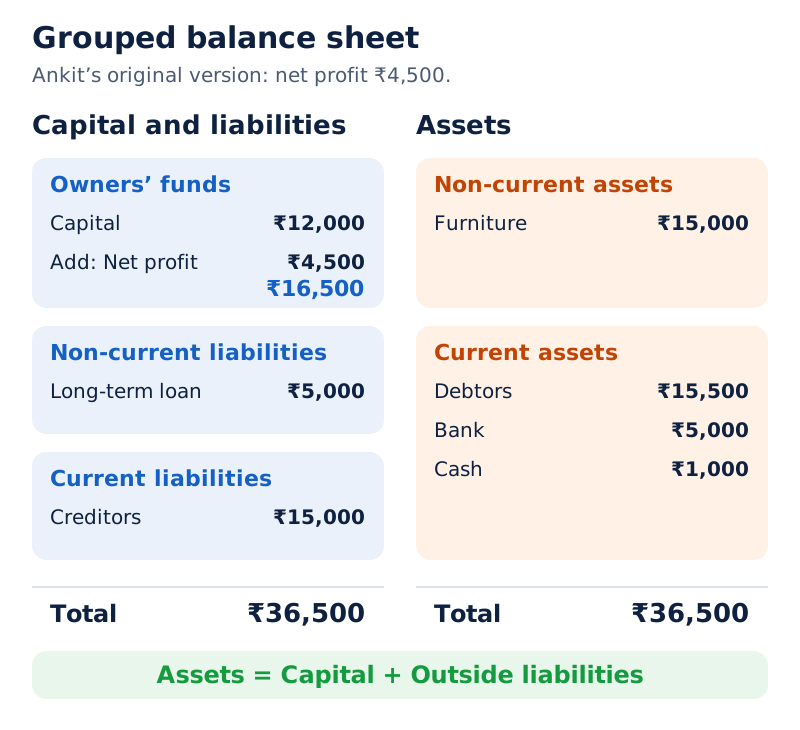
The left side groups owners' funds, non-current liabilities and current liabilities. The right side groups furniture under non-current assets and debtors, bank and cash under current assets.
Drawn by One Young India. See Fig. 8.10(c) in your NCERT textbook
How does an opening entry begin the next accounting period?
An opening entry brings the previous period's closing balance sheet balances into the next period's books. The balance sheet of one accounting period becomes the opening trial balance of the next. The entry opens the continuing asset, liability and capital accounts.
What is the procedure?
- Take the closing balances of assets, liabilities and capital from the balance sheet.
- Debit each asset account with its individual balance to open it in the new period.
- Credit the capital account and each liability account with their individual balances.
- Check that total debits equal total credits, maintaining the balance shown in the closing statement.
For Ankit, use furniture ₹15,000, debtors ₹15,500, bank ₹5,000 and cash ₹1,000. The corresponding credits are capital ₹16,500, the 10% long-term loan ₹5,000 and creditors ₹15,000. Capital includes the previous period's ₹4,500 profit.
| Entry direction | Account | Amount in ₹ |
|---|---|---|
| Debit | Furniture A/c | 15,000 |
| Debit | Debtors A/c | 15,500 |
| Debit | Bank A/c | 5,000 |
| Debit | Cash A/c | 1,000 |
| Credit | Capital A/c | 16,500 |
| Credit | 10% Long-term Loan A/c | 5,000 |
| Credit | Creditors A/c | 15,000 |
The debit total is ₹36,500 and the credit total is ₹36,500. The balances agree with the previous balance sheet. The new period therefore starts with the resources held and obligations outstanding at the end of the preceding period.
Closing entries and opening entries have different purposes. Closing entries collect the period's revenue and expense balances to determine profit or loss. The opening entry carries the continuing balance sheet accounts into the new period after that result has been transferred to capital.
Glossary
- Financial statements — Periodic reports presenting the results of business activities and the business's financial position.
- Stakeholder — A person associated with a business, whose stake may be monetary or non-monetary.
- Capital expenditure — Expenditure whose benefits extend beyond one accounting period, such as acquiring furniture for business use.
- Revenue expenditure — Expenditure benefiting one accounting period, normally incurred for the day-to-day conduct of business.
- Deferred revenue expenditure — Revenue expenditure likely to provide benefits for more than one accounting period.
- Capital receipt — A receipt involving an obligation to return money, or arising from selling a fixed asset.
- Revenue receipt — A receipt without a repayment obligation and outside the sale of fixed assets.
- Direct expenses — Expenses directly connected with manufacturing, purchasing and bringing goods to their point of sale.
- Gross profit — The excess of sales over the cost of goods sold during the accounting period.
- Net profit — Gross profit plus other incomes, after deducting the period's indirect expenses.
- Operating profit — Profit from normal business operations, excluding purely financial incomes and expenses and abnormal items.
- Closing stock — Unsold goods held at the end of an accounting period and carried into the next period.
- Balance sheet — A statement of assets, liabilities and capital showing financial position at a given date.
- Marshalling — Arranging assets and liabilities in a particular order, based on permanence or liquidity.
- Opening entry — A journal entry bringing closing balance sheet balances into the books of the next accounting period.
Common errors and misconceptions
- Misconception: Every payment is an expense of the current year. Correct: Expenditure and expense differ. The portion used or consumed during the current year is the expense; furniture can benefit several periods.
- Misconception: A bank loan is revenue because cash is received. Correct: The repayment obligation makes it a capital receipt. It creates a liability rather than sales income.
- Misconception: Purchases returns are deducted from sales. Correct: Purchases returns reduce purchases, while sales returns reduce sales. Each return belongs with the transaction it reverses.
- Misconception: Gross profit is the same as total sales or net profit. Correct: Gross profit deducts cost of goods sold; net profit also considers other incomes and indirect expenses.
- Misconception: Closing stock normally appears in the trial balance. Correct: It does not normally form part of it. The closing-stock adjustment credits trading account and creates an asset.
- Misconception: Loan interest is deducted again when finding operating profit from net profit. Correct: Non-operating interest already deducted in net profit is added back.
- Misconception: Grouping and marshalling mean the same thing. Correct: Grouping collects similar items under a common heading; marshalling puts assets and liabilities in a chosen order.
- Misconception: The opening entry reopens the previous year's expense accounts. Correct: It opens the continuing asset, liability and capital accounts carried forward from the balance sheet.
Exam-style questions with model answers
Q1. State the two basic objectives of preparing financial statements. [2 marks]
- To present a true and fair view of financial performance, including the profit earned or loss sustained during the accounting period.
- To present a true and fair view of financial position, showing the assets, liabilities and capital of the business.
Q2. Distinguish capital expenditure from revenue expenditure by benefit period, earning capacity and recurrence. [3 marks]
- Capital expenditure benefits more than one accounting year, whereas revenue expenditure normally benefits one accounting year and relates to that period's activities.
- Capital expenditure increases the earning capacity of the business, while revenue expenditure is incurred to maintain its existing earning capacity.
- Capital expenditure is non-recurring by nature, whereas revenue expenditure is generally recurring and is normally associated with the day-to-day conduct of business.
Q3. Revenue is ₹10,00,000 and recorded expenses are ₹8,00,000. Repairs of machinery of ₹20,000 were wrongly capitalised, meaning added to the machinery asset, and excluded from expenses. Calculate the reported profit, correct expenses, correct profit and effect of the error. [4 marks]
- The reported profit is ₹10,00,000 − ₹8,00,000 = ₹2,00,000, using the revenue and expenses as originally recorded.
- The repairs belong in expenses. Correct expenses are therefore ₹8,00,000 + ₹20,000 = ₹8,20,000 for the period.
- Correct profit is ₹10,00,000 − ₹8,20,000 = ₹1,80,000 after including the omitted revenue expenditure.
- Profit was overstated by ₹20,000 because an expense was treated as part of machinery rather than charged against current revenue.
Q4. Sales are ₹20,00,000, opening stock ₹3,00,000, purchases ₹15,00,000, wages ₹1,00,000, freight inwards ₹1,00,000 and closing stock ₹4,00,000. Calculate direct expenses, cost before deducting closing stock, cost of goods sold and gross profit; explain the closing-stock treatment. [5 marks]
- Direct expenses are wages plus freight inwards: ₹1,00,000 + ₹1,00,000 = ₹2,00,000. Both relate to bringing goods to their point of sale.
- Opening stock, purchases and direct expenses total ₹3,00,000 + ₹15,00,000 + ₹2,00,000 = ₹20,00,000 before deducting unsold goods.
- Cost of goods sold is ₹20,00,000 − ₹4,00,000 = ₹16,00,000, after excluding the closing stock remaining at the period end.
- Gross profit is sales less cost of goods sold: ₹20,00,000 − ₹16,00,000 = ₹4,00,000.
- Closing stock is credited to trading account through the adjustment and shown as an asset in the balance sheet, becoming next year's opening stock.
Q5. Ankit has sales ₹1,25,000, purchases ₹75,000, wages ₹8,000, commission received ₹5,000, salaries ₹25,000, building rent ₹13,000 and bad debts ₹4,500. For this version there is no opening or closing stock and no interest adjustment. Calculate cost of goods sold, gross profit, indirect expenses, total profit-and-loss credits and net profit, and give the net-profit transfer entry. [6 marks]
- Cost of goods sold is purchases plus wages: ₹75,000 + ₹8,000 = ₹83,000, because this version contains no opening or closing stock.
- Gross profit is ₹1,25,000 − ₹83,000 = ₹42,000. It is transferred from trading account to the credit side of profit and loss account.
- Indirect expenses are salaries, building rent and bad debts: ₹25,000 + ₹13,000 + ₹4,500 = ₹42,500.
- Total profit-and-loss credits are gross profit plus commission received: ₹42,000 + ₹5,000 = ₹47,000. Commission is other income here.
- Net profit is ₹47,000 − ₹42,500 = ₹4,500, the excess remaining after the indirect expenses have been deducted.
- Debit Profit and Loss A/c ₹4,500 and credit Capital A/c ₹4,500. This closes the net profit into the owner's capital.
Q6. Ankit's net profit is ₹19,000 after deducting ₹500 loan interest, the sole non-operating expense. There is no non-operating income. Define operating profit, state the formula and calculate it. [3 marks]
- Operating profit is the profit earned through normal business operations, excluding purely financial incomes and expenses and abnormal items when measuring that result.
- Operating profit equals net profit plus non-operating expenses minus non-operating incomes. The interest deducted in arriving at net profit must therefore be added back.
- Operating profit is ₹19,000 + ₹500 − nil = ₹19,500. No non-operating income needs to be deducted in the given case.
Q7. Ankit's balance sheet contains furniture, debtors, bank, cash, capital, a long-term loan and creditors. Define grouping and marshalling, then arrange the assets and the capital-and-liability items in order of permanence. [4 marks]
- Grouping puts items of similar nature under a common heading. For example, the given cash, bank and debtors are grouped as current assets.
- Marshalling arranges assets and liabilities in a particular order. The order of permanence begins with the items expected to remain longest.
- The assets are arranged as furniture, debtors, bank and cash. Furniture is the most permanent and cash the most liquid asset in this example.
- Capital and liabilities are arranged as capital, long-term loan and creditors. Capital tends to remain longest, while creditors will be discharged in the near future.
Q8. Ankit's closing balances are furniture ₹15,000, debtors ₹15,500, bank ₹5,000, cash ₹1,000, capital ₹16,500, 10% long-term loan ₹5,000 and creditors ₹15,000. State the purpose of the opening entry, give all its debits and credits, and verify equality. [5 marks]
- The opening entry carries the closing balance sheet balances into the next accounting period and opens the continuing accounts in the new books.
- Debit Furniture A/c ₹15,000 and Debtors A/c ₹15,500. These are asset balances carried forward from the preceding period's financial position.
- Debit Bank A/c ₹5,000 and Cash A/c ₹1,000. Together with furniture and debtors, total debits are ₹36,500.
- Credit Capital A/c ₹16,500, 10% Long-term Loan A/c ₹5,000 and Creditors A/c ₹15,000 to open the owner's claim and outside obligations.
- Total credits are ₹16,500 + ₹5,000 + ₹15,000 = ₹36,500, equal to total debits. The entry therefore preserves the balance sheet equality.
Key takeaways
- Financial statements report financial performance and financial position, helping users with different stakes make informed decisions about the business.
- Capital expenditure benefits more than one period; revenue expenditure normally benefits one period and supports the day-to-day conduct of business.
- Classify capital and revenue items correctly, because an error can distort both the reported profit and the value of assets.
- Trading account determines gross profit; profit and loss account considers other incomes and indirect expenses to determine net profit.
- Closing stock reduces cost of goods sold and, when introduced through the adjustment, appears as a balance sheet asset.
- Operating profit excludes purely financial and abnormal items, so non-operating expenses are added back and non-operating incomes deducted from net profit.
- Grouping combines similar balances under common headings; marshalling arranges assets and liabilities in order of permanence or liquidity.
- The opening entry debits continuing assets and credits capital and liabilities, carrying the closing financial position into the next accounting period.
Test yourself
Why do banks need information about both profits and asset forms?
Profits provide assurance about repayment of principal and interest. Asset forms indicate liquidity, showing whether resources are held in cash or near-cash form.
Why is buying furniture for use different from paying salaries?
Furniture benefits more than one accounting period and is capital expenditure. Salaries normally relate to the current period's work and are revenue expenditure.
How do returns outwards and returns inwards affect trading account?
Returns outwards reduce purchases to net purchases. Returns inwards reduce sales to net sales. They must be deducted from their respective totals.
What distinguishes packaging material from packing for transport?
Small containers forming part of goods sold are direct expenses. Large containers used for transporting goods are indirect expenses debited to profit and loss account.
Does closing stock normally form part of the trial balance?
No. It does not normally form part of the trial balance. The adjustment debits closing stock and credits trading account, creating an asset balance.
Why is a non-operating expense added to net profit when finding operating profit?
It has already reduced net profit. Adding it back removes its effect so that operating profit measures normal business operations.
How does the order of liquidity differ from permanence in Ankit's assets?
Permanence gives furniture, debtors, bank and cash. Liquidity reverses that order to cash, bank, debtors and furniture, placing the most liquid asset first.
Why does the next period's opening entry use the closing capital balance?
The closing capital balance already reflects the transferred profit or loss and withdrawals. It is the owner's continuing claim carried forward through the balance sheet.
Write about it
Turn a question from this chapter into a paper.
The Writing Studio has a structure guide, a rubric and citation tools for 15 formats, from essays to research papers. Drafting is free with an account. Learnacy Essential adds feedback from an AI writing coach and submission to The OYI Review.
Learnacy Essential is ₹1,499 for the year. Publication depends on review and is not guaranteed.