
Recording of Transactions - I | CBSE Class 11 Accountancy Notes
On this page

This note covers business transactions, source documents, accounting vouchers, the accounting equation, debit and credit rules, books of original entry, journal entries, Goods and Services Tax entries, ledger accounts, and posting from the journal.
What are business transactions and source documents?
How does a transaction affect accounting records?
A business transaction is an exchange of economic consideration between parties. It has a give aspect and a take aspect. Its twofold effect is recorded in at least two accounts, which are records of changes relating to particular items.
Buying a computer for ₹35,000 illustrates this exchange. Here ₹ means rupees. Cash is paid and a computer is received. Payment is the give aspect; delivery of the computer is the take aspect. Recording one aspect alone would leave the exchange incompletely recorded.
Definition: A source document, also called a voucher, is a document providing evidence of a transaction and forming the basis of its recording in the books of account.
Transactions are usually evidenced by appropriate documents, such as cash memos, invoices, sales bills, pay-in-slips, cheques and salary slips. A cash memo supports a cash purchase, as in the computer example. These documents connect the recorded transaction with evidence of what occurred.
A cash memo records a cash sale or purchase. An invoice or sales bill gives the details and amount of a sale. A pay-in-slip records a bank deposit; a cheque instructs a bank to pay an amount; a salary slip records salary details.
How is evidence organised?
At times, documentary evidence may be absent for certain items, such as petty expenses. In such a case, a voucher may be prepared with the necessary details and approved by the appropriate authority within the firm. Absence of an outside document does not remove this recording requirement.
- Identify the transaction that needs to be recorded.
- Obtain the source document or prepare the necessary approved voucher.
- Arrange the vouchers in chronological order, meaning the order of their dates.
- Number the vouchers serially and keep them in a separate file.
All recording in the books of account is based on vouchers. The accounting process then moves from identifying and analysing transactions to recording, classifying and summarising their effects. Finally, the information is communicated to interested users. Reliable documentation supports the beginning of this sequence.
How are accounting vouchers prepared and classified?
An accounting voucher sets out the accounts and amounts needed to record a transaction. Debit means an entry on an account's left side; credit means an entry on its right side. These terms identify recording sides, rather than automatically meaning increase or decrease.
There is no set format for accounting vouchers. Their design depends on the nature, requirements and convenience of the business. Different coloured paper and printing fonts are used to distinguish vouchers. In computerised accounting, vouchers show the code numbers and names of accounts to be debited and credited.
Which voucher suits each transaction?
| Voucher | Transaction recorded |
|---|---|
| Transaction voucher | A simple transaction with one debit and one credit |
| Debit voucher | A compound transaction with multiple debits and one credit |
| Credit voucher | A compound transaction with one debit and multiple credits |
| Complex or journal voucher | A complex transaction with multiple debits and multiple credits |
A compound voucher therefore involves several accounts on one side and one account on the other. A complex voucher provides for several accounts on both sides. The layout changes with the transaction, but the accounts and amounts still need clear identification.
What the figure shows
Transaction voucher
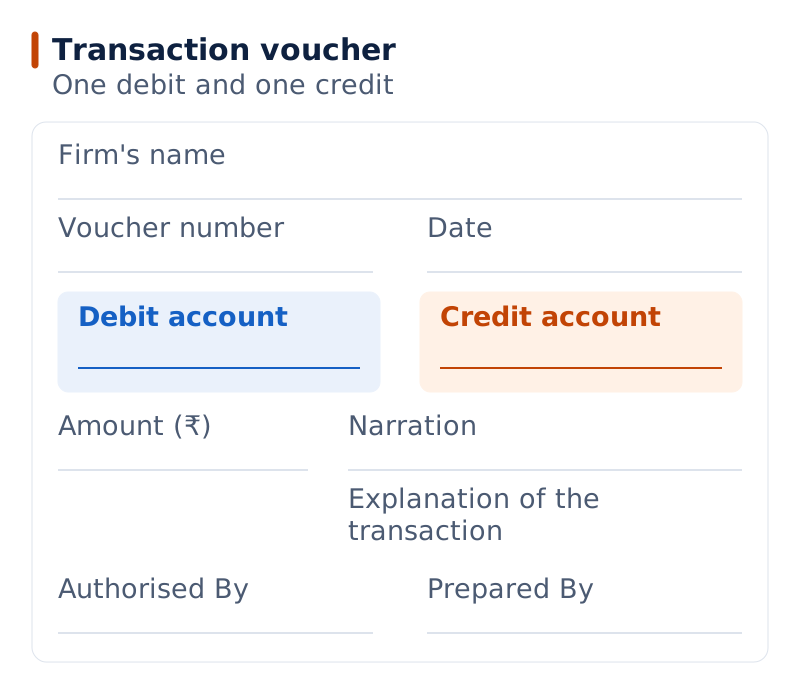
The specimen shows spaces for the firm's name, voucher number, date, debit account, credit account, amount and narration. Authorised By and Prepared By appear at the bottom. Narration means an explanation of the transaction.
Drawn by One Young India. See Fig. 3.1 in your NCERT textbook
What details must a voucher contain?
- Good quality paper and the firm's name printed at the top.
- The transaction date, rather than the date on which it is recorded.
- A voucher number following the serial order.
- The names of accounts to be debited or credited.
- Debit and credit amounts written in figures.
- An account-wise description of the transaction.
- The preparer's name and signature.
- The authorised person's name and signature.
Vouchers must be preserved, in any case, until the audit of the accounts and tax assessments for the relevant period are completed. An audit is an examination of accounts; a tax assessment determines the tax position for the relevant period.
What the figure shows
Compound and complex vouchers
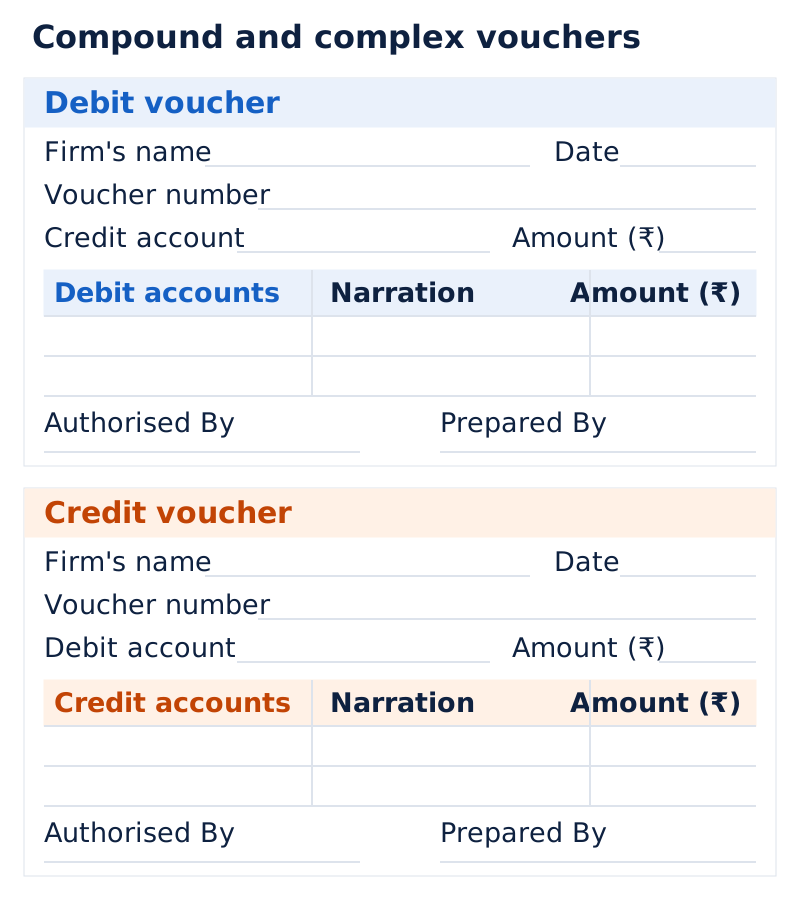
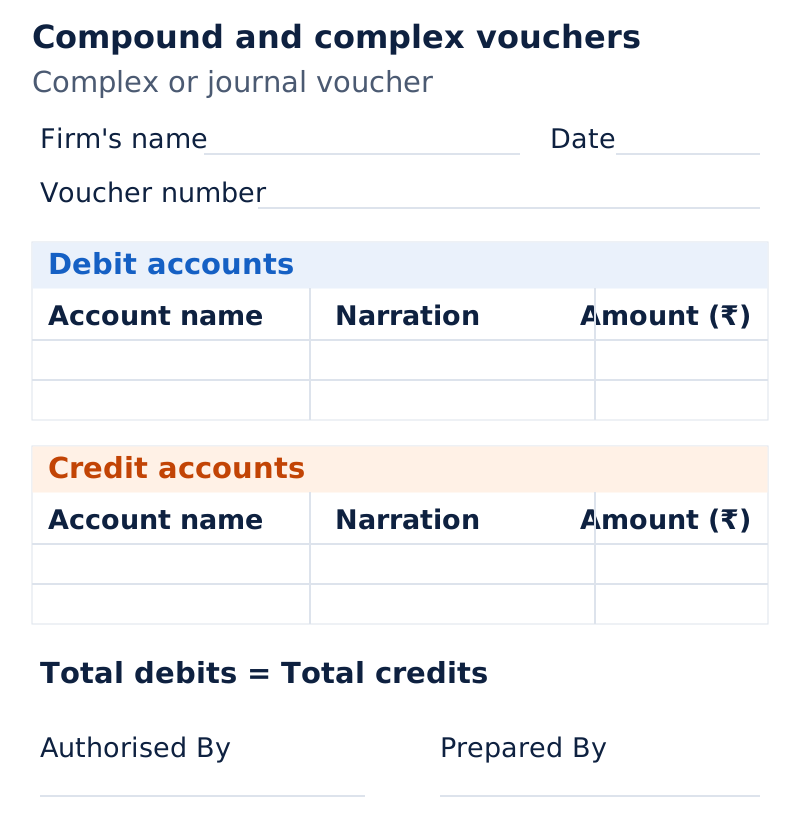
The debit voucher has a table for debit accounts; the credit voucher has a table for credit accounts. The journal voucher has separate debit and credit tables. Each provides narration and authorisation spaces.
Drawn by One Young India. See Figs. 3.2 and 3.3 in your NCERT textbook
How does the accounting equation express financial position?
Assets are resources owned by the business. Liabilities are outsiders' claims against those resources. Capital, or owner's equity, is the proprietor's claim. The resources of the business must equal the total claims of the people who finance them.
Definition: The accounting equation states that the assets of a business are always equal to its liabilities plus capital. It expresses the relationship between resources and the claims against them.
Let A mean assets, L mean liabilities and C mean capital. In the equations below, = means equals, + means addition and − means subtraction. The main equation and its rearrangements are:
A = L + C
C = A − L
L = A − C
The first form relates the three components. The second gives capital when assets and liabilities are known. The third gives liabilities when assets and capital are known. Each expresses the same equality, with a different item isolated.
Why is it also the balance sheet equation?
A balance sheet is a statement of assets, liabilities and capital showing financial position on a particular date. Its asset side lists what the business owns. Its liabilities side lists the owner's and outsiders' claims, showing what the business owes.
Since the equation connects these components, it is also called the balance sheet equation. Analysing a transaction means examining how it changes the elements of that statement. A change in one asset can be offset by another asset, or by a change in a claim.
Worked example 1. Rohit starts a business with ₹5,00,000 in cash. Show the initial relationship between the business's resources and their source.
Answer: Cash, an asset, is ₹5,00,000. Rohit's capital is ₹5,00,000, with no outsider's claim arising from this transaction. The resources and owner's claim are equal: assets of ₹5,00,000 equal capital of ₹5,00,000.
Profit increases the proprietor's invested amount, while a loss decreases it. Profit is the excess earned over the related cost; a loss represents the reverse. The equality is maintained even though the amounts and composition of its elements change.
How do transactions change assets, liabilities and capital?
Changes within assets
Rohit opens an account with State Bank of India by depositing ₹4,80,000 from the business's cash. Cash at bank increases and cash in hand decreases by the same amount. The business has changed where its money is held; the total resources remain unchanged.
Next, furniture costing ₹60,000 is bought by cheque. Furniture increases by ₹60,000 and the bank amount decreases by ₹60,000. Again, the composition of assets changes without changing their total. Payment by cheque must be traced through the bank account.
Changes involving outsiders' claims
Worked example 2. Rohit buys plant and machinery for ₹1,25,000 from Ramjee Lal, paying ₹10,000 in cash and leaving the balance payable. Analyse the effects.
Answer: Plant and machinery increase by ₹1,25,000. Cash decreases by ₹10,000. The amount payable to Ramjee Lal increases liabilities by ₹1,15,000. The net increase in assets and the increase in liabilities are both ₹1,15,000, so the equation remains balanced.
A creditor is a person or firm to whom the business owes money. Goods bought on credit from Sumit Traders for ₹55,000 increase goods and the creditor's claim by ₹55,000. Buying on credit means payment is still due rather than made immediately.
Changes involving a profit
Stock, also called inventory, means goods held by the business. A debtor is a customer owing money to it. In a credit sale, the debtor records the selling amount due; stock falls by the cost of the goods given up.
Worked example 3. Goods costing ₹25,000 are sold on credit to Rajani Enterprises for ₹35,000. Explain the effect on the accounting equation.
Answer: Stock decreases by ₹25,000, debtors increase by ₹35,000, and capital increases by the profit of ₹10,000. The net increase in assets is ₹10,000, matched by the increase in capital. The selling price and cost perform different roles in this analysis.
After these transactions, Rohit's balance sheet lists cash ₹10,000, bank ₹4,20,000, debtors ₹35,000, stock ₹30,000, furniture ₹60,000, and plant and machinery ₹1,25,000. Total assets are ₹6,80,000, matching creditors of ₹1,70,000 and capital of ₹5,10,000.
How are debit and credit rules applied?
Double entry accounting records each transaction in at least two accounts. Its total debit amount must equal its total credit amount. This requirement does not mean that every transaction changes exactly two accounts or that every debit increases an account.
Total debits = Total credits
Here total debits and total credits mean the sums recorded on the respective sides for a transaction. Dr. is the abbreviation for debit and Cr. is the abbreviation for credit. Both can indicate an increase or a decrease, depending on the account's nature.
What the figure shows
T-account
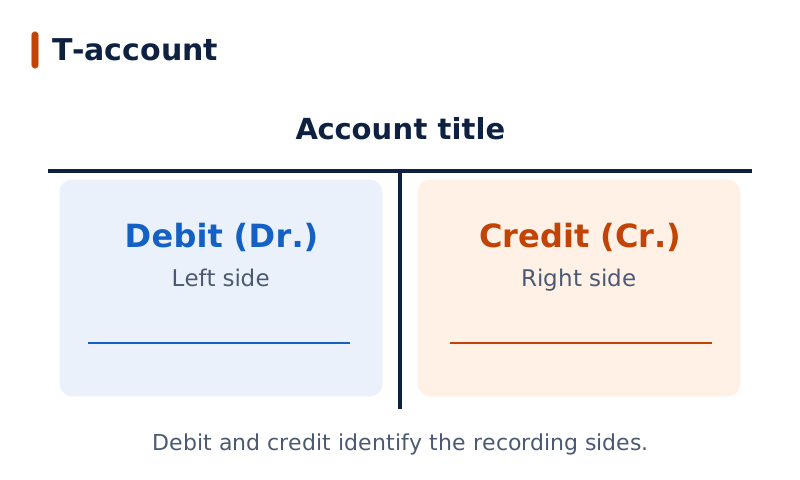
The account title appears above a horizontal line divided by a vertical line. The left and right sides provide the two recording areas. The left side is the debit side and the right side is the credit side.
Drawn by One Young India. See Fig. 3.4 in your NCERT textbook
What are the rules for the five categories?
Accounts are grouped into assets, liabilities, capital, expenses or losses, and revenues or gains. Expenses include costs such as rent and salaries. Revenue includes earnings such as sales; a gain is an increase in economic benefit recorded with revenue-type accounts.
| Account category | Increase | Decrease |
|---|---|---|
| Assets | Debit | Credit |
| Expenses or losses | Debit | Credit |
| Liabilities | Credit | Debit |
| Capital | Credit | Debit |
| Revenues or gains | Credit | Debit |
- Identify the accounts affected by the transaction.
- Classify each account under the appropriate category.
- Decide whether each account increases or decreases.
- Apply the debit and credit rule for that category and direction.
- Check that the total debit amount equals the total credit amount.
For monthly store rent of ₹2,500 paid in cash, debit Rent because the expense increases and credit Cash because the asset decreases. For salaries of ₹5,000 paid in cash, debit Salary and credit Cash. The expense explains the reduction in capital.
Note: A transfer from cash in hand to bank affects two assets. Debit Bank for its increase and credit Cash for its decrease. Double entry does not require every asset debit to have a liability or capital credit.
Why are transactions first entered in a journal?
A journal is the basic book of original entry, meaning the book in which a transaction is first recorded. It provides a complete record of the transaction in one place and connects its debit and credit effects. Entries follow chronological order.
Journalising means recording transactions in the journal. Posting means transferring those entries to individual accounts in the ledger. The ledger is the principal book containing the different accounts. The journal records each event before its effects are grouped account by account.
What does the journal format contain?
Ledger Folio, abbreviated L.F., means the page number of the ledger containing the relevant account. A/c is an abbreviation for account. These abbreviations help read journal headings and entries without confusing the name of an account with a page reference.
What the figure shows
Journal format
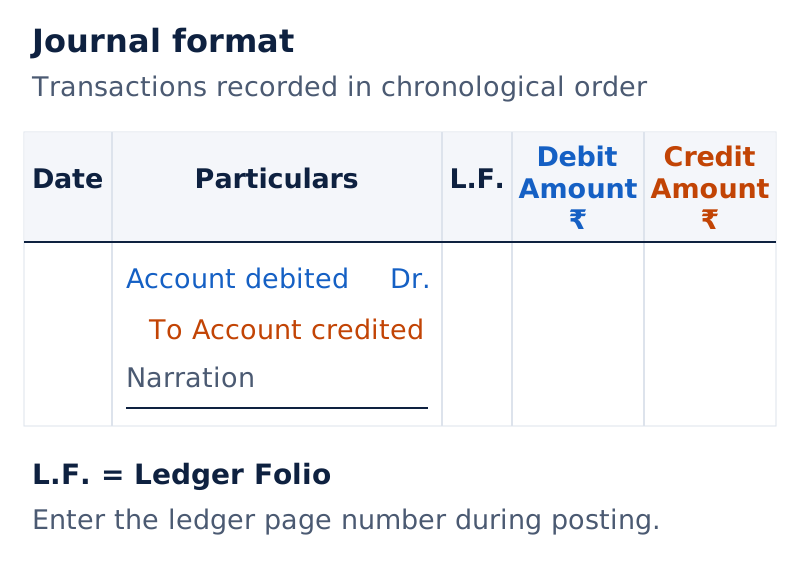
The ruled format has columns headed Date, Particulars, L.F., Debit Amount and Credit Amount. The two amount columns show the rupee unit. The Particulars column provides the broad space for account titles and narration.
Drawn by One Young India. See Fig. 3.5 in your NCERT textbook
- Enter the date on which the transaction took place.
- Write the account to be debited first, from the left, and put Dr. at the end of the Particulars column.
- Write the credited account on the next line with a left margin and the prefix To.
- Write a brief narration below the account titles, then draw a line ending the entry.
- Enter the corresponding amounts in the debit and credit columns.
The L.F. column is filled when posting takes place, rather than when the journal entry is initially made. At the end of a journal page, the amount columns are totalled and carried forward to the next page.
c/f means carried forward; b/f means brought forward. The same totals carried from one page are brought to the next. These references continue the journal's amount columns while the transaction entries retain their separate dates, accounts and narrations.
Why are there several books of original entry?
Because of the number and commonality of most transactions, the journal is subdivided into journal proper, cash book and other day books. The day books include purchases, sales, purchase returns, sale returns, bills receivable and bills payable books.
Journal proper is the general journal; specialised books group particular kinds of transactions. Purchase returns are goods sent back to suppliers, while sale returns are goods received back from customers. Bills receivable and payable concern written obligations to receive and pay money respectively.
How do simple and compound journal entries differ?
A simple journal entry involves two accounts, with one debit and one credit. A compound journal entry involves multiple accounts: more than one account is debited or credited. The equality of total debits and credits applies to both forms.
Recording goods and other assets
Goods bought for resale are entered in the Purchases Account. Their increase is not journalised by debiting a general Goods Account. Goods are dealt with through purchases, sales, purchases returns, sales returns and stock accounts. Each account records a different aspect of goods transactions.
An office asset is treated differently. Furniture acquired for office use increases the Furniture Account. The name of the asset matters: buying furniture does not turn it into goods bought for resale. The debit follows the item acquired and its account classification.
Worked example 4. Office furniture is purchased from Modern Furniture on July 4, 2017, for ₹25,000. Cash of ₹5,000 is paid immediately and ₹20,000 remains payable. Record the entry.
Answer: Debit Office Furniture Account ₹25,000; credit Cash Account ₹5,000; credit Modern Furniture Account ₹20,000. Narration: Purchase of office furniture from Modern Furniture. The asset increases by its full amount, while the credits distinguish the cash payment from the liability still due.
How are several routine transactions recorded?
The following entries show the debit and credit pairing. Drawings mean withdrawals by the proprietor for personal use. Outstanding salary means salary due but not yet paid. An expense may therefore be recorded even when it does not involve an immediate cash payment.
| Transaction | Debit account and amount | Credit account and amount |
|---|---|---|
| Goods bought on credit from Sumit Traders for ₹55,000 | Purchases ₹55,000 | Sumit Traders ₹55,000 |
| Goods sold on credit to Rajani Enterprises for ₹35,000 | Rajani Enterprises ₹35,000 | Sales ₹35,000 |
| Cash withdrawn for household purposes, ₹5,000 | Drawings ₹5,000 | Cash ₹5,000 |
| Salary outstanding, ₹5,500 | Salary ₹5,500 | Outstanding Salary ₹5,500 |
For the credit sale, journalising records the debtor and sales at the selling amount. The accounting-equation analysis separately considers the cost removed from stock and the resulting profit. These are two ways of explaining the transaction, with different presentation purposes.
How are returns, discounts and settlements recorded?
A sales return arises when a customer returns goods to the business. A purchase return arises when the business returns goods to a supplier. Keeping their accounts separate identifies returns rather than treating them as fresh purchases or sales.
Following the customer's account
Time Zone sells goods on credit to Lara India for ₹25,000 on December 12, 2017. The entry debits Lara India and credits Sales. On December 14, ₹10,000 cash is received: Cash is debited and Lara India is credited for that amount.
On December 16, Lara India returns goods worth ₹3,000. Sales Return is debited and Lara India is credited. The return reduces the customer's debt. The remaining amount is ₹12,000, obtained after the cash receipt and returned goods are deducted from the original credit sale. A discount allowed is a reduction accepted in the amount receivable from the customer.
Worked example 5. Lara India's original debt is ₹25,000. Cash of ₹10,000 has been received and goods worth ₹3,000 returned. A cheque for ₹11,500 is accepted in final settlement and deposited into bank the same day. Record the settlement.
Answer: The remaining debt is ₹12,000. Debit Bank ₹11,500 and Discount ₹500; credit Lara India ₹12,000. The ₹500 discount is the reduction accepted in the amount receivable. The combined debits equal the debt cleared, and the customer's account is settled.
Following the supplier's account
Time Zone buys goods on credit from Taranum for ₹32,000 on December 19, 2017. Purchases is debited and Taranum is credited. Goods worth ₹1,500 are returned on December 22: debit Taranum and credit Purchases Return for ₹1,500.
When a cheque for ₹20,000 is given to Taranum on account on December 26, debit Taranum and credit Bank. On account identifies a payment against an existing amount due. It need not mean final settlement; final settlement clears the remaining claim.
Note: A receipt from a debtor is not another sale. A payment to a creditor is not another purchase. Record the reduction in the existing personal account alongside the increase or decrease in cash or bank.
How are Goods and Services Tax entries separated from goods values?
Goods and Services Tax, abbreviated GST, is the tax component recorded separately from the underlying goods or service value in these entries. CGST means Central Goods and Services Tax; SGST means State Goods and Services Tax.
Input tax refers here to tax recorded on purchases and expenses; output tax refers to tax recorded on sales. Set-off means applying input tax against output tax. The following worked transactions assume CGST at 5% and SGST at 5%, within Delhi. The symbol % means per cent.
Credit purchase and credit sale
Shobit buys goods worth ₹1,00,000 on credit. Debit Purchases ₹1,00,000, Input CGST ₹5,000 and Input SGST ₹5,000. Credit Creditors ₹1,10,000. The creditor's claim includes both the goods value and the tax amounts.
He sells the goods on credit for ₹1,35,000. Debit Debtors ₹1,48,500; credit Sales ₹1,35,000, Output CGST ₹6,750 and Output SGST ₹6,750. The debtor owes the total amount, while revenue and the two tax components remain separately identified.
Other input amounts and settlement
| Transaction value | Input CGST | Input SGST | Bank credited |
|---|---|---|---|
| Railway transport ₹8,000 | ₹400 | ₹400 | ₹8,800 |
| Computer printer ₹10,000 | ₹500 | ₹500 | ₹11,000 |
| Postal charges ₹2,000 | ₹100 | ₹100 | ₹2,200 |
For each row, debit the named expense or asset by its value, debit the two input tax accounts by the stated amounts, and credit Bank by the total. The printer is recorded as an asset; transport and postal charges use their respective expense accounts.
Total Input CGST is ₹5,000 + ₹400 + ₹500 + ₹100 = ₹6,000. Input SGST has the same total. Each output tax amount is ₹6,750, leaving ₹750 payable for each tax after set-off. The combined balance paid is ₹1,500.
The set-off entry debits Output CGST and Output SGST by ₹6,750 each. It credits Input CGST and Input SGST by ₹6,000 each and Electronic Cash Ledger by ₹1,500. Here Electronic Cash Ledger is the account used for the balance of GST paid.
Note: The percentages in this worked illustration are stated assumptions. Retain the separate goods, input tax, output tax, debtor and creditor amounts when recording the transactions.
What does an interstate illustration show?
IGST means Integrated Goods and Services Tax. An interstate transaction crosses state boundaries; a local transaction occurs within the state. In Suman's business in Bihar, goods bought from Jharkhand and goods sold to Uttar Pradesh use IGST accounts.
For goods bought from Jharkhand for ₹3,50,000, debit Purchases ₹3,50,000 and Input IGST ₹63,000; credit Bank ₹4,13,000. For goods sold to Uttar Pradesh for ₹2,00,000, debit Bank ₹2,36,000 and credit Sales ₹2,00,000 and Output IGST ₹36,000.
The illustration assumes CGST at 9% and SGST at 9%. Its local credit sale of ₹4,00,000 debits Debtors ₹4,72,000 and credits Sales ₹4,00,000, Output CGST ₹36,000 and Output SGST ₹36,000. Keep the tax account names appropriate to each illustrated transaction.
What is a ledger, and how does it differ from a journal?
The ledger collects all accounts debited or credited in the journal proper and special journals. It may be a bound register, cards or separate sheets in a loose-leaf binder. Each account is opened preferably on a separate page or card.
Why is classification useful?
The journal records transactions by date; the ledger brings together all transactions affecting one account. The management can use it to find an amount due from a customer or payable to a supplier. Such information is difficult to ascertain from a chronological journal.
Accounts are arranged in a definite order to make posting and location easier. An index is provided at the beginning. In large organisations, accounts are also allotted code numbers for identification. The net result relating to a particular account can then be found in one place.
| Basis | Journal | Ledger |
|---|---|---|
| Place in recording | Book of first or original entry | Book of second entry |
| Record arrangement | Chronological record | Analytical record |
| Basis of classification | Transaction | Account |
| Recording process | Journalising | Posting |
| Relative importance as legal evidence | Greater importance as the source-entry book | Less than the journal |
What does an account's format show?
Journal Folio, or J.F., records the page of the original-entry book containing the transaction. It is completed during posting. The account title appears at the top and ends with Account; date, particulars and amount columns record the transaction details.
What the figure shows
Ledger format
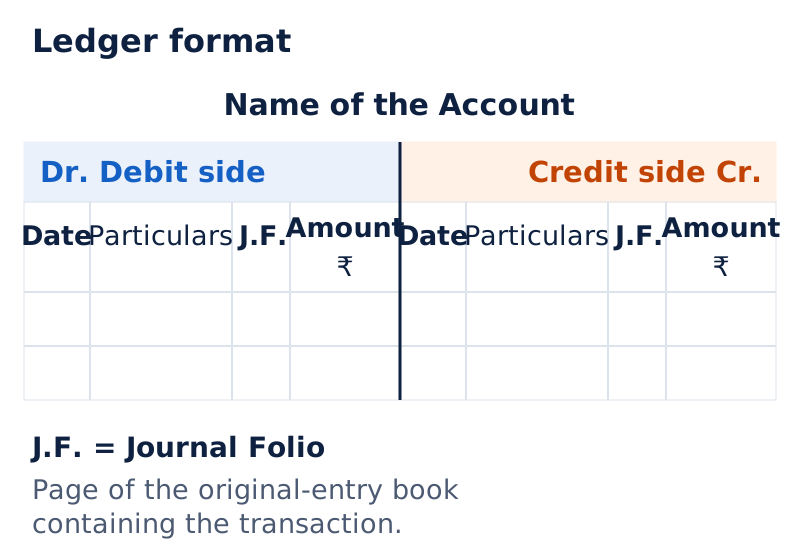
The account name is centred above two sides marked Dr. and Cr. Each side has Date, Particulars, J.F. and Amount columns. The amount headings show rupees, and the two sides share a central dividing line.
Drawn by One Young India. See Fig. 3.6 in your NCERT textbook
Permanent accounts include assets, liabilities and capital. They are balanced and carried forward to the next accounting period and appear in the balance sheet. An accounting period is the period for which accounts are prepared.
Temporary accounts include revenues and expenses. They are closed at the end of the accounting period by transfer to the trading and profit and loss account, the accounts used to determine trading results and profit or loss. This classification supports preparation of financial statements.
How are journal entries posted to ledger accounts?
Posting groups transactions relating to a particular account in one place. It is done periodically, may be weekly, fortnightly or monthly, according to the business's requirements and convenience. An account is opened only once in the ledger; later entries use that same account.
What is the posting sequence?
- Locate the ledger account that is debited in the journal.
- Enter the transaction date on its debit side.
- In Particulars, enter the name of the account through which it was debited in the journal.
- Enter the journal page in the ledger's folio column and the ledger page in the journal's folio column.
- Enter the relevant amount on the debit side, then follow the corresponding procedure for the credited account's credit side.
For furniture sold for cash of ₹34,000, the Cash Account has Furniture in its debit-side particulars. The Furniture Account has Cash in its credit-side particulars. Each entry identifies the corresponding account, meaning the other account involved in the transaction.
How is a compound entry distributed?
For Rohit's plant and machinery purchase of ₹1,25,000, ₹10,000 was paid in cash and ₹1,15,000 remained payable to Ramjee Lal. The journal debits Plant and Machinery and credits Cash and Ramjee Lal. Posting distributes these effects to the three accounts.
| Ledger account | Side | Particulars | Amount |
|---|---|---|---|
| Plant and Machinery | Debit | Cash | ₹10,000 |
| Plant and Machinery | Debit | Ramjee Lal | ₹1,15,000 |
| Cash | Credit | Plant and Machinery | ₹10,000 |
| Ramjee Lal | Credit | Plant and Machinery | ₹1,15,000 |
The Plant and Machinery Account therefore shows how its total debit is connected to the separate credits. The other accounts show the matching particulars and amounts. Posting preserves the journal's effects while rearranging information into account-wise records.
An account's balance is the difference between its two side totals. Bringing related entries together makes that net position visible. The cross-references supplied by L.F. and J.F. connect the original chronological entry with its classified ledger record.
Glossary
- Source document — A document providing evidence of a transaction and supporting its recording in the books of account.
- Accounting voucher — A record identifying the accounts and amounts to be debited and credited for a transaction.
- Accounting equation — The equality showing that business assets equal the total of liabilities and the proprietor's capital.
- Capital — The proprietor's claim against the resources of the business, also described as owner's equity.
- Debit — An entry on the left side of an account, whose effect depends on the account category.
- Credit — An entry on the right side of an account, whose effect depends on the account category.
- Journal — The basic book of original entry recording transactions chronologically with their debit and credit effects.
- Narration — A brief explanation of a transaction written below the account titles in a journal entry.
- Compound journal entry — An entry involving multiple accounts, with more than one account being debited or credited.
- Ledger — The principal accounting book collecting the separate accounts affected by entries in the original-entry books.
- Posting — The transfer of journal entries to ledger accounts, grouping transactions relating to each account together.
- Ledger Folio — The journal column recording the page of the ledger where the relevant account appears.
- Journal Folio — The ledger column recording the page of the original-entry book containing the relevant transaction.
- Permanent accounts — Asset, liability and capital accounts whose balances are carried forward to the next accounting period.
- Temporary accounts — Revenue and expense accounts closed by transfer to the trading and profit and loss account.
Common errors and misconceptions
- Misconception: Debit means increase and credit means decrease in every account. Correct: Their effect depends on the category. Assets increase by debit, whereas liabilities and capital increase by credit.
- Misconception: Every transaction affects exactly two accounts. Correct: Double entry requires at least two accounts and equal total debits and credits; compound entries can involve several accounts.
- Misconception: Buying office furniture requires a debit to Purchases. Correct: Debit the furniture asset account. Purchases records goods bought for resale, rather than every item acquired by the business.
- Misconception: The journal's L.F. column is filled while initially journalising. Correct: Fill it during posting, using the ledger page containing the relevant account.
- Misconception: A bank deposit from business cash increases total assets. Correct: Bank increases while cash in hand decreases equally, changing the composition of assets.
- Misconception: Money collected from a debtor is recorded as another sale. Correct: Record the receipt in cash or bank and reduce the debtor's existing account.
- Misconception: All vouchers must follow one fixed design. Correct: Their design depends on the business's needs and convenience, while essential account, amount, date and authorisation details remain necessary.
- Misconception: Revenue and expense balances are carried forward like assets. Correct: These temporary accounts are closed through the trading and profit and loss account at the period's end.
Exam-style questions with model answers
Q1. What is a source document, and what may be done when documentary evidence for a petty expense is unavailable? [2 marks]
- A source document provides evidence of a business transaction and forms the basis of recording it in the books.
- For a petty expense without documentary evidence, a voucher may be prepared with the necessary details and approved by the appropriate authority within the firm.
Q2. Distinguish debit from credit in terms of account side and their effect on an asset account. [2 marks]
- Debit is the left side of an account. An increase in an asset is recorded on this side.
- Credit is the right side of an account. A decrease in an asset is recorded on this side.
Q3. Goods costing ₹25,000 are sold on credit to Rajani Enterprises for ₹35,000. Explain the three effects on the accounting equation. [3 marks]
- Stock, an asset, decreases by ₹25,000 because the goods given to the customer leave the business at their cost.
- Debtors, also an asset, increase by ₹35,000 because Rajani Enterprises owes the business the full selling amount on this credit sale.
- Capital increases by the profit of ₹10,000, calculated as ₹35,000 less ₹25,000. This matches the net increase in assets and maintains the accounting equation.
Q4. On July 4, 2017, office furniture costing ₹25,000 is bought from Modern Furniture. ₹5,000 is paid immediately in cash and ₹20,000 remains payable. State the three account entries and explain why the entry is compound. [4 marks]
- Debit Office Furniture Account ₹25,000 on July 4, 2017. The asset increases by the complete cost of the furniture acquired.
- Credit Cash Account ₹5,000 because the immediate payment reduces the business's cash asset by that amount.
- Credit Modern Furniture Account ₹20,000 because the amount still due creates a liability to the supplier.
- This is a compound entry because one account is debited and two accounts are credited. Total credits of ₹25,000 equal the debit. Narration: Purchase of office furniture from Modern Furniture.
Q5. Give five distinctions between the journal and the ledger. [5 marks]
- The journal is the book of first or original entry. The ledger is the book of second entry, receiving information after original recording.
- The journal gives a chronological record in transaction-date order. The ledger gives an analytical record, bringing together transactions relating to each account.
- The journal has greater importance as legal evidence because it is the source-entry book. The ledger is prepared from entries already recorded.
- A transaction is the basis of classification within the journal. An account is the basis of classification within the ledger.
- Recording in the journal is called journalising. Transferring entries into the ledger is called posting, which groups the effects in individual accounts.
Q6. Lara India owes ₹25,000 for a credit sale. It pays ₹10,000 in cash, returns goods worth ₹3,000, and then gives a cheque for ₹11,500 accepted in final settlement and deposited into bank the same day. Explain the outstanding amount and the final settlement entry in five points. [5 marks]
- Start with the credit-sale debt of ₹25,000. Deduct the ₹10,000 cash receipt, which has already reduced the customer's amount payable to the business.
- Deduct the sales return of ₹3,000 as well. The amount outstanding before final settlement is ₹25,000 less ₹10,000 less ₹3,000, giving ₹12,000.
- Debit Bank Account ₹11,500 because the cheque accepted in settlement is deposited the same day and increases the business's bank asset.
- Debit Discount Account ₹500. This is the difference between the ₹12,000 debt and the ₹11,500 accepted, representing the reduction allowed to the customer.
- Credit Lara India Account ₹12,000 to clear the remaining debt. The combined debits of ₹11,500 and ₹500 equal this credit. Narration: Cheque received in final settlement.
Q7. Shobit buys goods on credit for ₹1,00,000 and sells them on credit for ₹1,35,000 within Delhi. Assume Central Goods and Services Tax (CGST) at 5% and State Goods and Services Tax (SGST) at 5% on each value. State the purchase and sale entries in four points, including tax calculations. [4 marks]
- For the purchase, debit Purchases ₹1,00,000 and debit Input CGST and Input SGST ₹5,000 each, calculated at 5% of ₹1,00,000.
- Credit Creditors ₹1,10,000, comprising the goods value plus both input tax amounts. Narration: Goods bought on credit.
- For the sale, debit Debtors ₹1,48,500, comprising the ₹1,35,000 selling value and two tax amounts of ₹6,750 each.
- Credit Sales ₹1,35,000, Output CGST ₹6,750 and Output SGST ₹6,750. Each tax is 5% of ₹1,35,000. Narration: Goods sold on credit.
Q8. Explain the five steps for posting the debit side of a journal entry to the ledger, including the cross-references. [5 marks]
- Locate in the ledger the account that has been debited in the journal. Use the account already opened for that item.
- Enter the transaction date in the Date column on the debit side of the account, keeping the transaction's date reference.
- In the debit-side Particulars column, write the name of the account through which the account was debited in the journal.
- Record the journal page in the ledger's Journal Folio column. In the journal, record the relevant ledger page in the Ledger Folio column.
- Enter the amount in the debit-side Amount column. Apply the corresponding procedure on the credit side of the account credited in the journal.
Key takeaways
- Source documents provide transaction evidence; approved vouchers support recording when documentary evidence is unavailable for certain petty expenses.
- The accounting equation links assets with liabilities and capital, and remains balanced as transactions change these elements.
- Debit and credit identify account sides; their increase or decrease effect depends on the category of account.
- A journal records complete transactions chronologically, linking the debit and credit effects with a brief narration.
- Compound journal entries involve multiple accounts, but their total debit and credit amounts must still be equal.
- Separate the goods value from input and output tax amounts when recording the stated GST illustration.
- The ledger classifies transactions account by account, helping identify amounts due from customers and payable to suppliers.
- Posting transfers journal effects to ledger accounts and adds cross-references through Ledger Folio and Journal Folio columns.
Test yourself
Does every transaction affect exactly two accounts?
No. It affects at least two accounts; a compound entry may involve several accounts while keeping total debits and credits equal.
Which date should be written on an accounting voucher?
Write the date of the transaction, rather than the date on which the transaction is recorded.
What happens to total assets when business cash is deposited into bank?
Total assets remain unchanged because cash at bank increases by the amount that cash in hand decreases.
Which account is debited when office machinery is bought?
Debit the machinery asset account, rather than Purchases, because the item acquired is office machinery.
When is the journal's Ledger Folio column filled?
It is filled during posting, with the page number of the ledger containing the relevant account.
What are the two effects of paying an existing creditor by cheque?
Debit the creditor to reduce the liability and credit Bank to record the decrease in the bank asset.
How do permanent and temporary accounts differ at the period's end?
Permanent accounts are balanced and carried forward. Temporary revenue and expense accounts are closed through the trading and profit and loss account.
What does the Journal Folio in a ledger record?
It records the page of the original-entry book containing the relevant transaction and is completed during posting.
Write about it
Turn a question from this chapter into a paper.
The Writing Studio has a structure guide, a rubric and citation tools for 15 formats, from essays to research papers. Drafting is free with an account. Learnacy Essential adds feedback from an AI writing coach and submission to The OYI Review.
Learnacy Essential is ₹1,499 for the year. Publication depends on review and is not guaranteed.