
Theory Base of Accounting | CBSE Class 11 Accountancy Notes
On this page
This note covers the theory base of accounting, generally accepted accounting principles, basic accounting concepts, accounting systems, cash and accrual bases, accounting standards, and the meaning, components, characteristics and advantages of Goods and Services Tax.
Why does accounting need a theory base?
Accounting records, classifies and summarises financial transactions and events, and interprets their results. Its information helps owners, managers, employees, investors, suppliers and tax authorities make decisions about a business.
A theory base is the body of principles, concepts, rules and guidelines developed to bring uniformity and consistency to accounting. Reliable information must also allow comparisons between businesses and between different periods of the same business.
What do GAAP, concepts and conventions mean?
Definition: Generally Accepted Accounting Principles (GAAP) are rules or guidelines adopted for recording and reporting business transactions, bringing uniformity to the preparation and presentation of financial statements.
Financial statements report financial performance and the position of a business. A concept is a fundamental assumption or idea underlying accounting practice. A convention is a custom or tradition guiding the preparation of accounting statements.
Terms such as principles, assumptions and conventions are used interchangeably in practice. Their practical application matters more than differences in terminology. Basic accounting concepts provide broad working rules for accounting activities.
GAAP developed through experience, customs, professional statements and government regulations. They have general acceptability among most accounting professionals. They are not static: changes in the legal, social and economic environment, together with users' needs, influence them.
Inter-firm comparison compares different businesses; inter-period comparison compares different periods of one business. Accounting policies are the principles and practices followed in preparing financial statements. Consistent policies support both. Uniformity is needed throughout identifying, measuring, recording, summarising and reporting transactions, rather than merely when the final statements are prepared.
How do business entity and money measurement define accounting records?
Why are the owner and the business separated?
The business entity concept treats a business as separate from its owner for accounting purposes. Records are prepared from the business's viewpoint. Capital is the owner's claim on the business, including money introduced by the owner.
Money brought in as capital is treated as a liability of the business to its owner. Drawings are withdrawals for personal use; they reduce the owner's capital. Personal transactions enter business records only when they involve an inflow or outflow of business funds.
Assets are resources of the business that provide services. Liabilities, in the accounting equation, represent outsiders' claims. The owner's personal assets and liabilities are excluded from the business's reported assets and liabilities.
What can money measurement record?
The money measurement concept records only transactions and happenings expressible in money. Sales and payments qualify. A manager's appointment, employees' capabilities, research creativity and the organisation's public image do not themselves find a place in these monetary records.
Assets expressed in acres, rooms, computers or tonnes cannot be meaningfully added together. Accounting therefore expresses their values in rupees and paise. The symbol ₹ denotes Indian rupees; lakh and crore denote one hundred thousand and ten million respectively.
The limitation is that money's value changes with prices. Adding a building purchased in 1995 for ₹2 crore to plant purchased in 2005 for ₹1 crore combines amounts from different dates. The records do not reflect the change in money's value.
Note: Being important to a business does not, by itself, make something recordable in money. Human capabilities and monetary transactions must not be confused.
How do going concern and accounting period work together?
The going concern concept assumes that a business will continue operating indefinitely, meaning for a fairly long period, and will not be liquidated in the foreseeable future. Liquidation means winding up the business rather than continuing its operations.
An asset represents a bundle of services used over time. Continuity allows the cost of services consumed in a period to be charged against that period's revenue, while the remaining cost is carried forward.
Revenue is the gross inflow of cash arising from sales of goods and services or from others using the enterprise's resources. Depreciation allocates the cost of a fixed asset over the periods in which it is used. A fixed asset serves the business over time.
Worked example 1. A computer costs ₹50,000 and has an estimated life of 5 years. Using an equal annual allocation, how much of its cost may be charged each year?
Answer: ₹50,000 divided by 5 gives ₹10,000 each year for 5 years. The whole purchase cost is not charged against the revenue of the purchase year under this allocation.
Annual charge = Computer cost ÷ Estimated life
Annual charge means the cost allocated to one year; computer cost is the purchase amount; estimated life is the expected number of years of service. The sign = means equals, and ÷ means divided by.
Why prepare statements before the business ends?
An accounting period is the span at whose end financial statements are prepared to measure profit or loss and the position of assets and liabilities. Profit is the excess of revenue over related expenses, while a loss arises when those expenses exceed revenue. Expenses are costs incurred to earn revenue. Statements are normally prepared after one year so that users receive timely information.
A continuing business cannot wait until it closes to assess its performance. Interim statements, prepared within the normal annual period, may be necessary, for example on a partner's retirement. Going concern explains continuity; accounting period divides that continuing life for reporting.
How do cost and objectivity support reliable asset values?
The cost concept records an asset at its purchase price together with acquisition, transportation, installation and other costs of making it ready for use. The recorded amount therefore need not equal the price paid to the seller alone.
Worked example 2. Shiva Enterprise bought an old plant in June 2005 for ₹50 lakh. Transportation cost ₹10,000, repairs to bring it into running condition cost ₹15,000, and installation cost ₹25,000. Find its recorded cost.
Answer: ₹50,00,000 + ₹10,000 + ₹15,000 + ₹25,000 = ₹50,50,000. All these amounts belong to the cost of bringing the plant into usable condition.
The sign + means addition. In this example, the relevant components can be expressed as:
Plant cost = Purchase price + Transportation + Repairs + Installation
Plant cost means its recorded acquisition cost. Purchase price is the seller's price; transportation brings it to the factory; repairs make it operational; installation puts it into position for use.
Why use historical cost?
Historical cost is the amount paid at acquisition. A later change in market value does not change that original purchase price. Historical cost is verifiable from purchase documents, whereas market values may change over time.
Objectivity means recording transactions free from the bias of accountants and others. Verifiable documents support it. A cash receipt supports a cash purchase; an invoice and delivery challan provide evidence for a credit purchase.
A credit purchase is a purchase for which payment is due later. An invoice records the transaction details, while a delivery challan documents delivery. Documentary support allows the amount recorded to be checked.
Historical cost also has a limitation: it does not show the business's true worth and may lead to hidden profits. During rising prices, market or replacement values can exceed the values shown in the accounts.
How does dual aspect produce the accounting equation?
The dual aspect concept, or duality, states that each transaction has a two-fold effect. At least two accounts are involved. An account is a record relating to a particular item, such as cash, capital or machinery.
Assets = Liabilities + Capital
Assets are the business's resources; liabilities are outsiders' claims; capital is the owner's claim. Equity means a claim on the business's assets. The equation expresses the equality between assets and the combined claims of owners and outsiders.
Worked example 3. Ram starts a business by introducing ₹50,00,000 in cash. Identify the two effects of this transaction.
Answer: The business's cash asset increases by ₹50,00,000 and Ram's capital increases by ₹50,00,000. Equal increases in assets and the owner's claim preserve the accounting equation.
Must both sides of the equation change?
A transaction may change two assets, rather than an asset and a claim. Buying goods for cash increases stock, meaning goods held by the business, and reduces cash. The total equality still remains intact.
| Transaction | First effect | Second effect |
|---|---|---|
| Ram introduces ₹50,00,000 | Cash increases by ₹50,00,000 | Capital increases by ₹50,00,000 |
| Goods worth ₹10,00,000 bought for cash | Stock increases by ₹10,00,000 | Cash decreases by ₹10,00,000 |
| Machine worth ₹30,00,000 bought on credit from Reliable Industries | Machinery increases by ₹30,00,000 | Liability increases by ₹30,00,000 |
A creditor is an outsider to whom the business owes money. In the machine purchase, Reliable Industries becomes a creditor. Each transaction's two-fold effect must be recorded; this principle forms the foundation of the double entry system.
When is revenue recognised as realised?
Revenue recognition, also called realisation, determines when revenue enters the accounting records. Revenue is assumed to be realised when a legal right to receive it arises, at the point when goods have been sold or services rendered.
A credit sale is a sale for which payment will be received later. It is treated as revenue on the date of sale, rather than the date on which the customer pays. Realisation therefore does not simply mean cash collection.
How is time-related income treated?
Rent, commission and interest are recognised on a time basis. Rent is income from allowing use of property, commission is income for services, and interest is income from allowing use of money.
| Income and timing | Period of recognition | Reason |
|---|---|---|
| Rent for March 2017 received in April 2017 | Financial year ending 31 March 2017 | The rent relates to March 2017 |
| Interest for April 2017 received in advance in March 2017 | Financial year ending March 2018 | The interest relates to April 2017 |
Income received in advance is a receipt relating to a later period. Receiving that money early does not make it revenue of the earlier period under the recognition principle.
What exceptions apply?
For a construction contract taking, say, 2 to 3 years, proportionate revenue based on the part completed by the period's end is treated as realised. Completion of the entire contract is not required for this proportionate recognition.
Under hire purchase, where goods are obtained through an instalment arrangement, amounts collected in instalments are treated as realised. These exceptions must be considered alongside the general rule based on the legal right to receive revenue.
How does matching determine the profit of a period?
The matching concept requires expenses incurred in an accounting period to be matched with the revenue of that period. An expense is the cost of an asset or service used to generate revenue.
Profit = Revenue − Expenses
Here profit is the excess of revenue over related expenses; revenue is the amount earned in the period; expenses are the related costs incurred. The sign − means subtraction. If related expenses exceed revenue, the result is a loss.
Why does payment timing not decide the expense?
Salaries, rent and insurance are recognised for the periods to which they relate, rather than simply when paid. Similarly, depreciation distributes a fixed asset's cost across the periods during which it is used.
For goods, sales revenue must be matched with the cost of goods sold, meaning the cost of the goods actually sold during the period. The cost of unsold goods is deducted from the cost of goods produced or purchased when determining the related cost.
Charging all purchases against sales would include costs of goods still unsold. Matching instead connects the revenue earned with the expenses incurred to earn it. This relationship gives the calculation of profit its period-specific meaning.
- Identify the revenue earned during the accounting year.
- Identify the expenses incurred to earn that revenue.
- Include these amounts whether cash has been received or paid during the year or not.
- Deduct the related expenses from revenue to ascertain the period's profit or loss.
Note: Revenue recognition establishes the period of revenue; matching connects that revenue with its related expenses. Cash receipt and payment dates do not replace these decisions.
How do full disclosure and materiality guide reporting?
Full disclosure requires all material and relevant facts about financial performance to be disclosed completely in the financial statements and accompanying footnotes. Footnotes are explanatory notes supplied with those statements.
This helps users assess profitability and financial soundness. It matters especially when the people managing a business are different from its owners, because financial statements communicate information to people who do not manage daily operations.
What makes a fact material?
Materiality depends on the nature of an item and the amount involved. A fact is material if its knowledge is reasonably believed to influence an informed user's decision. Accounting should focus on these facts rather than waste effort on immaterial details.
| Fact or expenditure | Significance |
|---|---|
| Expenditure creating additional theatre capacity | Increases the enterprise's future earning capacity |
| Change in the depreciation method | Significant information for users of financial statements |
| Liability likely to arise in the near future | Relevant to informed financial decisions |
| Very small amounts spent on erasers, pencils and scales | May be treated as the period's expense whether consumed or not |
In certain cases involving very small amounts, strict adherence to accounting principles is not required. Stationery bought during the period is treated as revenue expenditure, meaning expenditure charged as an expense of that period, rather than showing unused stationery as an asset.
Materiality and disclosure work together: materiality identifies what matters to a decision, and full disclosure requires that information to be communicated. A small amount does not supply a universal rule for every situation, because the item's nature also matters.
How do consistency and conservatism guide accounting choices?
Does consistency prevent every change?
Consistency requires uniform accounting policies and practices over time so that financial results can be compared. A change in the method of depreciation can affect reported profit and make comparisons between years difficult.
Comparison between different enterprises is meaningful when they use the same kinds of accounting methods and policies. Consistency also reduces personal bias in preparing information.
Note: Consistency does not prohibit a change in accounting policy. Necessary changes must be fully disclosed in the financial statements, including their probable effects on financial results.
What does prudence require?
Conservatism, or prudence, is the cautious approach that prevents overstatement of profit. Profits are not recorded until realised, while all losses, even those with a remote possibility, are provided for in the accounts.
Applications include valuing closing stock, the goods remaining unsold at the period's end, at cost or market value, whichever is lower. A rise in the value of unsold goods is not recognised as a gain before sale.
Another application is a provision for doubtful debts, an allowance for amounts that customers may fail to pay. A debtor is a customer or other party owing money to the business. Provision anticipates the possible loss from non-payment.
Overstated profit may result in distributing capital as dividend, meaning a distribution of profits to owners. Prudence protects creditors against an unwanted distribution of the firm's assets.
This approach may reflect a generally pessimistic attitude, but deliberate underestimation of assets should be discouraged. Such underestimation creates hidden profits called secret reserves. Caution is therefore not permission to deliberately understate asset values.
How do double entry and single entry systems differ?
The double entry system applies dual aspect by recording both effects of each transaction. Each transaction involves two or more accounts. A debit is an entry on an account's left side, and a credit is an entry on its right side.
Every debit has a corresponding credit. Recording both aspects makes double entry a complete system. It is accurate and more reliable, and minimises the possibilities of fraud and misappropriation, meaning improper use of business funds.
A trial balance is a statement used to check the arithmetic agreement of account balances. Arithmetic inaccuracies can mostly be checked by preparing it. Both large and small organisations can implement double entry.
Why is single entry described as incomplete?
The single entry system does not record both effects of every transaction. Only personal accounts and the cash book are maintained. Personal accounts record dealings with persons or entities; the cash book records cash transactions.
| Basis of comparison | Double entry | Single entry |
|---|---|---|
| Transaction effects | Both effects are recorded | One effect for some transactions, both for others |
| Completeness | Complete system | Incomplete records |
| Uniformity | Corresponding debit and credit | No uniform recording pattern |
| Use | Large and small organisations | Followed by small firms because it is simple and flexible |
Single entry records are incomplete and unsystematic, and therefore unreliable. Its name must not be interpreted as a rule that exactly one account is recorded for every transaction: the treatment varies across transactions.
How do cash basis and accrual basis differ?
The basis of accounting determines when revenue and costs are recognised. Under cash basis, transactions enter the books when cash is received or paid, rather than when receipt or payment becomes due.
Under accrual basis, revenue and costs are recognised in the periods in which they occur. Receiving cash is distinguished from the right to receive it; paying cash is distinguished from the legal obligation to pay it.
Which date controls recognition?
| Transaction | Cash basis | Accrual basis |
|---|---|---|
| Office rent for December 2014 paid in January 2015 | Recognised in January 2015 | Recognised in December 2014 |
| Goods sold on credit in January 2015, with cash received in April 2015 | Recognised in April 2015 | Recognised in January 2015 |
Cash basis is simple but incompatible with matching. Its profit calculation compares money received and disbursed during a period rather than recognising transactions when they occur. It is inappropriate for most organisations, not necessarily every organisation.
Accrual is a more appropriate basis for calculating profit because expenses are matched against the related revenue earned. An unpaid expense may belong to the current period, while cash received in advance may belong to a later period.
The distinction from accounting systems is important. Double entry and single entry concern how transaction effects are recorded. Cash and accrual bases concern when revenue and costs are recognised. These are different questions about the accounting process.
Why are accounting standards needed, and what are their limitations?
Accounting standards are written policy documents covering recognition, measurement, treatment, presentation and disclosure of transactions in financial statements. The Institute of Chartered Accountants of India (ICAI) is the professional accounting body issuing these authoritative statements.
Recognition concerns including a transaction in the accounts; measurement concerns assigning its monetary amount; treatment concerns how it is accounted for. Presentation and disclosure concern how the resulting information is shown and explained.
Different accounting policies and valuation methods can reduce comparability. Standards provide uniform policies, valuation norms and disclosure requirements to improve the reliability and credibility of information. They support comparison within an enterprise and between enterprises.
What benefits do standards provide?
- They help eliminate variations in accounting treatment when financial statements are prepared.
- They may call for disclosures not required by law but useful to the public, investors and creditors.
- They facilitate comparison of financial statements between companies and within the same company across periods.
Users can assess performance more effectively when statements follow comparable rules. Uniformity and full disclosure help accounting information serve different users' interests, even when alternative treatments would otherwise be available.
What limitations remain?
- Choosing between alternative accounting treatments can be difficult in applying standards.
- Rigid application restricts flexibility in accounting treatment.
- Standards cannot override law; they must be framed within the applicable legal framework.
Statute means written law. Standardisation therefore operates within the law, rather than replacing it. The usefulness of uniform accounting policies must be understood together with these limits on choice, flexibility and legal authority.
What is GST, and how are its components distinguished?
Goods and Services Tax (GST) is a destination-based tax on consumption of goods and services. Destination-based means that tax accrues to the authority having jurisdiction over the place of consumption, also called the place of supply.
GST is proposed to be levied at stages from manufacture to final consumption, with credit for taxes paid at previous stages available as a set-off. A set-off allows earlier tax paid to be adjusted against tax at a later stage.
Only value addition, the added value at a stage, is thereby taxed, and the final consumer bears the tax burden. The Centre and States levy GST on a common tax base, meaning the value on which tax is calculated.
Which component applies to which movement?
| Component | Meaning | Application or revenue |
|---|---|---|
| CGST | Central Goods and Services Tax | Central Government revenue on intra-state supplies |
| SGST | State Goods and Services Tax | State Government revenue on intra-state supplies |
| IGST | Integrated Goods and Services Tax | Inter-state transfers and imports; revenue divided between Centre and States at specified rates |
Intra-state means within one state; inter-state means between states. Thus, movement from Madhya Pradesh to Rajasthan attracts IGST. Imports of goods and services are also covered by IGST.
Worked example 4. Ramesh sells goods worth ₹10,000 to Seema within Punjab. The given GST rate is 18%, consisting of 9% CGST and 9% SGST. Find each component. The symbol % means per cent, or per hundred.
Answer: CGST is ₹10,000 multiplied by 9 and divided by 100, giving ₹900 to the Central Government. SGST is also ₹900, going to the Punjab Government.
India's Centre and States have distinct responsibilities and powers to raise resources. A dual GST structure reflects this division of powers. The Centre administers CGST and IGST, while the respective states administer SGST.
Diagram
GST components
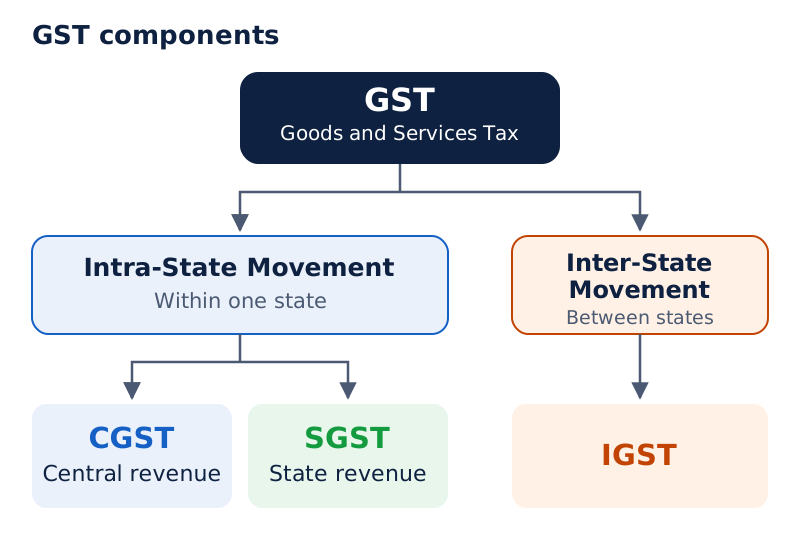
Draw GST at the top, branching into Intra-State Movement and Inter-State Movement. Put CGST and SGST below the first branch and IGST below the second. Label CGST as central revenue and SGST as state revenue.
Drawn by One Young India.
What characteristics and advantages explain the purpose of GST?
GST combines taxation of goods and services within a common framework. Its destination basis connects tax with consumption, while credit for earlier taxes links successive stages from manufacture to final consumption.
How does tax credit matter?
Input tax credit means credit for tax already paid at an earlier stage. It helps avoid the cascading effect, meaning tax accumulating on tax through successive stages. Value addition, rather than repeated taxation of the same value, is central to this arrangement.
GST replaces multiple types of taxes on goods and services. Its comprehensive approach covers both goods and services, with the benefit of credit or subtraction of value already accounted for at earlier stages.
What advantages are associated with GST?
- Abolition of multiple types of taxes simplifies the taxation of goods and services.
- A wider tax base increases revenue to the Centre and States while reducing government administrative cost.
- Reduced compliance cost, meaning the cost of meeting tax requirements, supports voluntary compliance.
- Removal of the cascading effect reduces repeated taxation through successive stages.
- GST will enhance manufacturing and distribution, affecting production costs and consequently increasing demand and production.
- It will eventually promote economic efficiency and sustainable long-term growth through neutrality towards business processes, models, organisational structures and locations.
- It would help goods and services produced in the country gain a competitive edge internationally, leading to increased exports.
These features connect the mechanism of credit with wider economic effects. The tax is collected through the supply process, but its burden falls on the final consumer. The distinction between collection at stages and final incidence is essential to understanding GST.
Glossary
- GAAP — Generally accepted rules and guidelines bringing uniformity to recording transactions and preparing financial statements.
- Business entity — The assumption that a business and its owner are separate entities for accounting purposes.
- Money measurement — The concept restricting accounting records to transactions and events that can be expressed in money.
- Going concern — The assumption that a business will continue for a fairly long period without foreseeable liquidation.
- Accounting period — The span at whose end statements measure financial results and the position of assets and liabilities.
- Historical cost — The acquisition cost of an asset, supported by documents showing the amount actually paid.
- Dual aspect — The principle that every business transaction has two-fold effects involving at least two accounts.
- Revenue recognition — Recognition of revenue when the legal right to receive it arises from a business transaction.
- Matching — The principle of relating a period's earned revenue to the expenses incurred to earn it.
- Full disclosure — Complete disclosure of material and relevant financial facts in statements and their accompanying explanatory notes.
- Consistency — Uniform use of accounting policies and practices that makes comparisons across periods and enterprises meaningful.
- Conservatism — A cautious approach providing for anticipated losses while withholding recognition of profits until they are realised.
- Materiality — The significance of a fact whose knowledge could influence an informed financial statement user's decision.
- Objectivity — Recording transactions without personal bias by relying on verifiable documents and evidence supporting their amounts.
- Accrual basis — Recognition of revenue and costs in the periods they occur, rather than when cash changes hands.
Common errors and misconceptions
- Misconception: The owner's personal property belongs in the business accounts. Correct: Business entity separates the owner's personal assets and liabilities from those of the business.
- Misconception: Anything important to a business must appear as a monetary entry. Correct: Money measurement excludes happenings that cannot be expressed in monetary terms, such as employee capabilities.
- Misconception: A purchased asset's entire cost must be charged in the purchase year. Correct: Going concern allows consumed cost to be charged over the periods benefiting from the asset.
- Misconception: Revenue is realised only when the customer pays cash. Correct: The general recognition rule uses the legal right to receive revenue, so credit sales are recognised when made.
- Misconception: Consistency prohibits changes in accounting policies. Correct: Necessary changes are allowed when fully disclosed with their probable effects on financial results.
- Misconception: Conservatism permits deliberate understatement of assets. Correct: Deliberate undervaluation should be discouraged because it creates hidden profits or secret reserves.
- Misconception: Single entry records exactly one aspect of every transaction. Correct: It records one aspect for some transactions and both for others, producing incomplete records.
- Misconception: A trial balance detects every arithmetic inaccuracy. Correct: Arithmetic inaccuracies can mostly be checked through a trial balance; this does not mean that every error is detected.
Exam-style questions with model answers
Q1. Explain how the business entity concept treats capital introduced by an owner and money withdrawn for personal use. [2 marks]
- The business is separate from its owner, so capital introduced is treated as the business's liability to the owner.
- Money withdrawn for personal use is drawings. It reduces the owner's capital and consequently the business's liability to the owner.
Q2. Shiva Enterprise buys an old plant for ₹50 lakh, pays ₹10,000 for transportation, ₹15,000 for repairs to make it operational and ₹25,000 for installation. State the relevant concept, calculate the recorded cost and explain the treatment of these additional costs. [3 marks]
- The cost concept applies. It records an asset at the purchase price together with the expenditure necessary to acquire it and make it ready for use.
- The recorded cost is ₹50,00,000 + ₹10,000 + ₹15,000 + ₹25,000 = ₹50,50,000.
- Transportation, the specified repairs and installation form part of this plant's acquisition cost because they bring it to the factory and into working condition.
Q3. Rent for March 2017 is received in April 2017, while interest for April 2017 is received in advance in March 2017. State the recognition rule, assign each receipt to its financial year, and identify the construction-contract and hire-purchase exceptions. [4 marks]
- Revenue is generally recognised when the legal right to receive it arises, rather than merely when cash is collected.
- The rent belongs to the financial year ending 31 March 2017 because it relates to March 2017, despite receipt in April.
- The advance interest belongs to the financial year ending March 2018 because it relates to April 2017.
- For long construction contracts, proportionate revenue is recognised according to the part completed by period-end. For hire purchase, amounts collected in instalments are treated as realised.
Q4. Explain the money measurement concept, why a common monetary unit is needed, and two limitations of monetary accounting records. [5 marks]
- Money measurement restricts accounting records to transactions and happenings that can be expressed in money. It defines which events can enter the monetary records of a business.
- Transactions are recorded in monetary units rather than only in physical units. This gives accounting records a common basis for expressing different assets.
- Different physical quantities cannot be added to provide meaningful information about total business worth. Expressing their values in money makes aggregation possible.
- Important non-monetary matters cannot be recorded merely because they affect a business. Matters that cannot be expressed in money fall outside these records.
- The value of money changes with prices. Adding asset costs from different dates combines different monetary values without reflecting changes in money's purchasing power.
Q5. Explain three benefits and three limitations of accounting standards. [6 marks]
- Accounting standards help eliminate differences in accounting treatment. Uniform treatment improves the consistency of financial statements prepared by different businesses.
- They may require information to be disclosed even when law does not require it. Such disclosure can help investors, creditors and the general public.
- They facilitate comparison between companies and within the same company over different periods. These comparisons help users assess financial performance.
- Choosing between different alternative accounting treatments can be difficult when applying standards. A common framework therefore does not remove every difficulty of choice.
- Rigid application can restrict flexibility. Following a prescribed treatment may leave less scope for adapting the accounting approach to particular circumstances.
- Accounting standards cannot override statute. Their requirements must operate within the applicable legal framework, rather than displacing the provisions of law.
Q6. Office rent for December 2014 is paid in January 2015. Goods are sold on credit in January 2015 and payment is received in April 2015. Give the recognition month for each transaction under cash basis and accrual basis, with reasons. [4 marks]
- Under cash basis, the rent is recognised in January 2015, because that is when payment is made rather than when the rent becomes due.
- Under accrual basis, the rent is recognised in December 2014, because the expense belongs to that month's use of the office.
- Under cash basis, the sale is recognised in April 2015, when the customer pays and cash is received.
- Under accrual basis, the sale is recognised in January 2015, when the goods are sold and the right to receive payment arises.
Q7. Ramesh in Punjab sells goods worth ₹10,000 to Seema in Punjab. The given GST rate is 18%, split into 9% CGST and 9% SGST. Identify the supply type and calculate each tax component, naming the government receiving it. [3 marks]
- This is an intra-state supply because seller and buyer are both in Punjab. The given rate is therefore split into the Central and State components.
- CGST is ₹10,000 multiplied by 9 and divided by 100, giving ₹900. This amount is revenue of the Central Government.
- SGST is likewise ₹10,000 multiplied by 9 and divided by 100, giving ₹900. This amount is revenue of the Punjab Government.
Q8. Explain conservatism, its treatment of profits and losses, its application to closing stock, and the limit on deliberate undervaluation. [5 marks]
- Conservatism, also called prudence, guides accounting through caution. It aims to prevent the reported profit of a business from being overstated.
- Profits should not be recorded until realised. An anticipated gain does not become recorded profit merely because an asset's market value has risen.
- All losses, even those with a remote possibility, are provided for. This cautious treatment protects creditors against an unwanted distribution of the firm's assets.
- Closing stock is valued at cost or market value, whichever is lower. An unrealised increase in the market value of unsold goods is not recognised as profit.
- Deliberate underestimation of asset values should be discouraged. It creates hidden profits, called secret reserves, rather than supplying an acceptable reason for arbitrary undervaluation.
Key takeaways
- GAAP brings uniformity to recording and reporting, while its development continues with changes in the environment and users' needs.
- Business entity separates the owner from the business, and money measurement limits recorded events to those expressible in money.
- Going concern supports carrying asset costs forward, while accounting period provides regular information about performance and financial position.
- Cost includes expenditure needed to make an asset usable; objectivity supports recorded amounts with verifiable documentary evidence.
- Dual aspect preserves the equality of assets with liabilities plus capital through the two-fold effects of every transaction.
- Revenue recognition and matching place earned revenue and related expenses in the appropriate period, independently of cash movement.
- Full disclosure and materiality support informed decisions; consistency permits disclosed changes, and conservatism discourages overstated profits without permitting deliberate asset undervaluation.
- Accounting standards improve uniformity and comparison; GST uses destination-based taxation and credit for taxes paid at earlier stages.
Test yourself
Why is an owner's withdrawal for personal use recorded in the business books?
It involves an outflow of business funds and reduces the owner's capital as drawings.
Why are employee capabilities excluded from monetary accounting records?
They cannot be expressed in monetary terms, even though they matter to the business.
What distinguishes going concern from accounting period?
Going concern assumes continued operation for a fairly long period. Accounting period divides that continuing life into intervals for financial reporting.
Does a cash purchase of goods necessarily increase total assets?
No. Stock increases while cash decreases by the same amount, preserving the accounting equation.
What must accompany a necessary change in accounting policy?
The change must be fully disclosed in the financial statements, including its probable effects on financial results.
Why is single entry not a uniform system?
Some transactions have only one aspect recorded, while others have both, so the resulting records are incomplete and unsystematic.
Can an accounting standard override a statute?
No. Accounting standards must operate within the applicable legal framework and cannot override law.
Which GST component applies to an inter-state transfer?
Integrated Goods and Services Tax applies to inter-state transfers; its revenue is divided between the Centre and States at specified rates.
Write about it
Turn a question from this chapter into a paper.
The Writing Studio has a structure guide, a rubric and citation tools for 15 formats, from essays to research papers. Drafting is free with an account. Learnacy Essential adds feedback from an AI writing coach and submission to The OYI Review.
Learnacy Essential is ₹1,499 for the year. Publication depends on review and is not guaranteed.