
Financial Statements - II | CBSE Class 11 Accountancy Notes
On this page
This note covers adjustments in financial statements, closing stock, outstanding and prepaid expenses, accrued and advance income, depreciation, bad debts, provisions for doubtful debts and discounts, manager’s commission, interest on capital, and preparation of adjusted final accounts.
Why are adjustments necessary when preparing financial statements?
Definition: Adjusting entries are entries recorded at the end of an accounting period to bring the effects of required adjustments into the accounts.
The accrual basis recognises revenue when earned and expenses when incurred. Revenue means income earned by the business; an expense is a cost incurred in earning that income. The accounting period is the period for which the business determines its profit or loss.
Cash received or paid during a year may relate partly to another year. Conversely, income earned or expenses incurred during the current year may still be unrecorded. Adjustments bring these items into the appropriate period so that profitability and financial position are correctly presented.
Which statements are affected?
The trading account determines gross profit from trading operations. The profit and loss account determines net profit after other incomes and expenses. The balance sheet shows assets, meaning business resources and amounts receivable, and liabilities, meaning obligations payable, together with the proprietor’s capital.
Capital is the proprietor’s investment in the business. Gross profit passes from the trading account into the profit and loss account. Net profit is transferred to capital. Thus, an adjustment affecting profit can also affect the amount of capital shown in the balance sheet.
How does double entry guide the treatment?
A trial balance lists account balances in debit and credit columns. Debit and credit are the two sides of an account. Under double entry, an adjustment has equal debit and credit effects. Additional adjustments therefore appear at two places in the final accounts.
Throughout the entries below, A/c means account, Dr. means debit, and “To” introduces the credited account. The symbol ₹ denotes rupees; % means per hundred. The signs +, −, ×, / and = mean addition, subtraction, multiplication, division and equality respectively.
- Identify whether the item belongs to the current accounting period.
- Check whether the trial balance already includes its accounting effect.
- Record the required debit and credit for any additional adjustment.
- Show both effects in the relevant final accounts.
How is closing stock treated inside and outside the trial balance?
Closing stock is the cost of goods remaining unsold at the end of the accounting period. Opening stock is the stock brought forward at the beginning of the period. The closing stock of one year becomes the opening stock of the following year.
Closing stock given as additional information
When closing stock is supplied outside the trial balance as an adjustment, credit it to the trading account and show it as an asset in the balance sheet. The entry is: Closing stock A/c Dr.; To Trading A/c. Both effects are necessary.
Worked example 1. Ankit’s closing stock on March 31, 2017 is ₹15,000, supplied as additional information. Show the adjustment.
Answer: Debit Closing stock A/c ₹15,000 and credit Trading A/c ₹15,000. Show ₹15,000 on the credit side of the trading account and ₹15,000 among the assets in the balance sheet.
Closing stock included with adjusted purchases
Sometimes opening and closing stocks are adjusted through the purchases account, which records goods bought for the business. Opening stock is transferred by debiting Purchases A/c and crediting Opening stock A/c. Closing stock is adjusted by debiting Closing stock A/c and crediting Purchases A/c.
The resulting amount is called adjusted purchases. The trial balance then contains adjusted purchases and closing stock, but does not show opening stock separately. Debit adjusted purchases to the trading account and show closing stock on the assets side of the balance sheet.
| Situation | Trading account treatment | Balance sheet treatment |
|---|---|---|
| Closing stock supplied as an adjustment | Credit closing stock | Show closing stock as an asset |
| Closing stock in the trial balance with adjusted purchases | Debit adjusted purchases; do not repeat opening or closing stock separately | Show closing stock as an asset |
Note: Crediting closing stock again after it has reduced purchases would repeat its effect. Read the trial balance before deciding whether a separate trading account adjustment is needed.
How do outstanding expenses affect profit and liabilities?
Outstanding expenses are expenses of the accounting period that remain unpaid at its end. Wages and salaries are payments for employees’ work; interest on a loan is the charge for borrowed money. These items usually require this adjustment. Their payment date does not decide which year should bear the expense.
Entry and financial statement effects
Record: Concerned expense A/c Dr.; To Outstanding expense A/c. The debit increases the current period’s expense. The credit recognises the amount still owed. Add the outstanding amount to the relevant expense in the trading or profit and loss account.
Show the unpaid amount as a liability in the balance sheet. For example, outstanding wages are added to wages in the trading account. The liability remains separately identifiable even though the expense is combined with wages already recorded.
Worked example 2. Ankit’s trial balance shows wages of ₹8,000. A further ₹500 of wages relating to 2016-17 remains unpaid. Calculate the expense and state both effects.
Answer: Wages expense = ₹8,000 + ₹500 = ₹8,500. Debit Wages A/c ₹500 and credit Wages outstanding A/c ₹500. Debit ₹8,500 to the trading account and show outstanding wages of ₹500 as a liability.
Here, Wages means the current year’s total wages expense, Paid wages means the ₹8,000 already recorded, and Outstanding wages means the additional ₹500 due for that year. For this example, Wages = Paid wages + Outstanding wages.
Why does the adjustment reduce profit?
Before adjustment, the expense excludes work already received but not yet paid for. Adding the unpaid amount increases the expense belonging to the current year. In Ankit’s sequence, gross profit falls from ₹57,000 to ₹56,500 and net profit from ₹19,500 to ₹19,000.
These decreases are both ₹500; they are not two separate expenses. The increased wage expense reduces gross profit, and that lower gross profit passes into the profit and loss account.
How are prepaid expenses separated from current expenses?
Prepaid expenses, also called unexpired expenses, are the part of a payment whose benefit belongs to the next accounting period. An expense paid during the current year may contain both a current benefit and a future benefit.
Entry and presentation
Record: Prepaid expense A/c Dr.; To Concerned expense A/c. Deduct the prepaid portion from the relevant expense in the trading or profit and loss account. Show the prepaid amount as an asset in the balance sheet because its benefit remains available for the next period.
Worked example 3. Ankit’s salaries of ₹25,000 include ₹5,000 paid in advance to an employee. Determine the current salary expense and the adjustment.
Answer: Current salary expense = ₹25,000 − ₹5,000 = ₹20,000. Debit Prepaid salary A/c ₹5,000 and credit Salary A/c ₹5,000. Show ₹20,000 as salary expense and ₹5,000 as a prepaid salary asset.
Here, Salary means expense belonging to the current period; Paid salary means the ₹25,000 recorded payment; Prepaid salary means the ₹5,000 relating to the following period. In this example, Salary = Paid salary − Prepaid salary.
How does the period covered matter?
A general insurance premium usually covers twelve months. A payment of ₹1,200 on July 01, 2016, covering twelve months, includes ₹300 for the period after March 31, 2017. The expense for 2016-17 is ₹900, while ₹300 is carried forward as prepaid insurance.
The important distinction is between payment and benefit. Excluding the future portion does not deny that cash was paid. It prevents the current year’s profit from bearing a cost whose benefit belongs to the next year.
In Ankit’s continuing example, removing prepaid salary raises net profit from ₹19,000 to ₹24,000. The corresponding ₹5,000 appears among assets. An outstanding expense adds to expense and creates a liability; a prepaid expense reduces expense and creates an asset.
How do accrued income and income received in advance differ?
Accrued income is income earned during the current accounting year but not received by its end. Interest, commission and rent may require this adjustment. Rent is a payment for using property, such as part of a building. Commission is remuneration for a service, such as introducing business to another person.
Income earned but not received
Record: Accrued income A/c Dr.; To Concerned income A/c. Add the accrued amount to the related income in the profit and loss account. Show the amount receivable as an asset in the balance sheet.
Worked example 4. Ankit has received commission of ₹5,000, and ₹1,500 more has been earned but remains receivable. Determine the commission income and adjustment.
Answer: Commission income = ₹5,000 + ₹1,500 = ₹6,500. Debit Accrued commission A/c ₹1,500 and credit Commission A/c ₹1,500. Credit ₹6,500 to the profit and loss account and show ₹1,500 as an asset.
Here, Income means current commission earned, Received income means the ₹5,000 already received for the current year, and Accrued income means the additional ₹1,500 earned but not received. For this case, Income = Received income + Accrued income.
Income received before it is earned
Income received in advance, or unearned income, is the portion received that belongs to the next accounting period. Record: Concerned income A/c Dr.; To Income received in advance A/c. Deduct it from current income and recognise a liability.
On March 31, 2017, Ankit receives rent for April, May and June at ₹1,000 per month. These three months belong to the next accounting year. The ₹3,000 must therefore be excluded from current income and shown as rent received in advance.
The adjustment is: Rent received A/c Dr. ₹3,000; To Rent received in advance A/c ₹3,000. This removes the advance amount from the income account in which it was recorded. The earlier cash receipt remains recorded.
| Basis | Accrued income | Income received in advance |
|---|---|---|
| Earning | Earned in the current year | Belongs to the next year |
| Receipt | Still to be received | Already received |
| Income adjustment | Add to the relevant income | Deduct from the relevant income |
| Balance sheet | Asset | Liability |
How is depreciation adjusted in the final accounts?
Depreciation is the decline in the value of an asset through wear and tear and passage of time. It represents writing off a portion of the asset’s cost used in earning profits. It is therefore treated as a business expense.
Recording the expense and reducing the asset
The adjustment entry is: Depreciation A/c Dr.; To Concerned asset A/c. Debit depreciation to the profit and loss account. In the balance sheet, show the asset at its cost less the depreciation charged under this treatment.
The two effects serve different purposes. The expense reduces the profit earned during the accounting period. The deduction from the asset reduces the value carried into the balance sheet. Omitting either effect leaves the adjustment incomplete.
Worked example 5. Ankit’s furniture account has a balance of ₹15,000. Depreciation is 10% per annum, meaning per year. Calculate depreciation for the year and the furniture value after adjustment.
Answer: Depreciation = ₹15,000 × 10/100 = ₹1,500. Debit Depreciation A/c ₹1,500 and credit Furniture A/c ₹1,500. Charge ₹1,500 to the profit and loss account and show furniture at ₹13,500 in the balance sheet.
Reading the calculation
Here, Cost means the ₹15,000 furniture balance used in the example, and Rate means the numerical annual percentage, 10. For this full-year calculation, Depreciation = Cost × Rate / 100. Dividing the rate by 100 converts the percentage into the fraction applied to cost.
In Ankit’s sequence, this adjustment reduces net profit from ₹25,500 to ₹24,000. Furniture falls from ₹15,000 to ₹13,500. Depreciation is an expense even though the adjustment does not involve a fresh cash payment at the year end.
What is the difference between recorded bad debts and further bad debts?
Debtors are persons from whom the business has amounts to receive. Bad debts are amounts that the firm has not been able to realise from them. The loss is recorded by debiting Bad debts A/c and crediting Debtors A/c.
Bad debts already in the trial balance
When bad debts appear in the trial balance, the loss has already been recorded in the books. The debtors balance therefore already reflects that write-off. A write-off removes an irrecoverable amount from the debtor’s account and recognises the loss.
Ankit’s trial balance contains bad debts of ₹4,500 and debtors of ₹15,500. The ₹4,500 is an existing recorded expense. It must not be deducted a second time from the ₹15,500 debtors balance.
Further bad debts supplied as an adjustment
Further bad debts are additional losses identified but not yet recorded. Suppose a debtor owing Ankit ₹2,500 has become insolvent, meaning unable to pay, and nothing is recoverable. Record: Bad debts A/c Dr. ₹2,500; To Debtors A/c ₹2,500.
Total bad debts then become ₹4,500 + ₹2,500 = ₹7,000. The remaining debtors become ₹15,500 − ₹2,500 = ₹13,000. The extra ₹2,500 has both an expense effect and an asset effect.
| Item | Bad-debt expense treatment | Effect on trial balance debtors |
|---|---|---|
| Recorded bad debts of ₹4,500 | Include the existing loss in the expense treatment | Do not deduct again |
| Further bad debts of ₹2,500 | Add the newly recognised loss | Deduct ₹2,500 |
Note: A provision for doubtful debts is an estimate of possible loss from debtors. Where an old provision exists, bad debts are adjusted against that provision. The distinction between recorded and further bad debts still determines whether debtors need an additional reduction.
How is provision for doubtful debts calculated and adjusted?
A provision for doubtful debts is a reasonable estimate of loss from debtors whose amounts may not be recovered. After known bad debts have been removed, it is quite possible that the whole remaining amount may not be realised.
The precise future loss cannot be known accurately. Creating a provision recognises an estimated loss without identifying every debtor who will fail to pay. This differs from writing off a debt already known to be irrecoverable.
Creating a new provision
Record: Profit and loss A/c Dr.; To Provision for doubtful debts A/c. The amount reduces current profit and is deducted from debtors on the assets side of the balance sheet.
Ankit’s debtors after further bad debts are ₹13,000. If 5% are considered likely to default next year, the provision is ₹13,000 × 5/100 = ₹650. The balance sheet shows ₹13,000 − ₹650 = ₹12,350 after this provision.
For this calculation, Provision means the new required doubtful-debt provision. Debtors means the balance after further bad debts have been deducted. Rate means the specified numerical percentage, here 5. Then Provision = Debtors × Rate / 100.
Taking an old provision into account
The provision carried forward from the previous year is the old provision, also called the opening provision. It is available to meet bad-debt losses during the current year. The new provision is the required estimate at the current year end.
Worked example 6. A trial balance shows debtors ₹32,000, bad debts ₹2,000 and an old provision ₹3,500. Further bad debts are ₹1,000. A new provision of 5% on the remaining debtors is required.
Answer: Remaining debtors = ₹32,000 − ₹1,000 = ₹31,000. New provision = ₹31,000 × 5/100 = ₹1,550. The profit and loss debit is ₹2,000 + ₹1,000 + ₹1,550 − ₹3,500 = ₹1,050. Net debtors are ₹29,450.
- Write off the further ₹1,000 by debiting Bad debts A/c and crediting Sundry debtors A/c. “Sundry debtors” means the various debtors collectively.
- Transfer total bad debts of ₹3,000 against the old provision by debiting Provision for doubtful debts A/c and crediting Bad debts A/c.
- Debit Profit and loss A/c ₹1,050 and credit Provision for doubtful debts A/c ₹1,050 to bring the provision to the required ₹1,550.
- Show debtors of ₹31,000 less the new provision of ₹1,550, giving ₹29,450 in the balance sheet.
The balance sheet uses the new required provision. The profit and loss account reflects the current bad debts and the adjustment needed after considering the old provision. These amounts answer different questions and need not be equal.
Why is provision for discount calculated on good debtors?
A discount on debtors is a reduction allowed to customers to encourage prompt payment. A provision for discount on debtors estimates the discount likely to be allowed. It reduces current profit and the amount expected to be realised from debtors.
The order of deductions
Good debtors are the debtors remaining after further bad debts and the provision for doubtful debts have been deducted. Provision for discount is made only on good debtors. Applying a discount percentage to the unreduced trial balance amount ignores this sequence.
- Begin with the debtors shown in the trial balance.
- Deduct further bad debts that still require recording.
- Deduct the required provision for doubtful debts.
- Calculate the provision for discount on the remaining good debtors.
The adjustment is: Profit and loss A/c Dr.; To Provision for discount on debtors A/c. Show the provision as an expense in the profit and loss account and as a further deduction from debtors in the balance sheet.
Ankit’s sequence of deductions
| Stage | Amount |
|---|---|
| Debtors before further adjustments | ₹15,500 |
| Further bad debts deducted | ₹2,500 |
| Debtors after further bad debts | ₹13,000 |
| Provision for doubtful debts deducted | ₹650 |
| Good debtors | ₹12,350 |
| Provision for discount deducted | ₹227 |
| Expected realisable amount | ₹12,123 |
The expected realisable amount is the amount expected to be collected after the stated deductions. In this sequence, the discount provision is a stated amount of ₹227. No discount percentage is needed to subtract that given provision from ₹12,350.
In the subsequent year, discount allowed is transferred to the provision for discount on debtors account. That account is treated in the same manner as the provision for doubtful debts account.
How is manager’s commission calculated before or after charging it?
A manager is sometimes given commission on the business’s net profit. The agreement may apply the percentage before charging the commission or after charging it. These bases produce different amounts from the same profit before commission.
Commission based on profit before commission
Let C mean commission in rupees, P mean profit in rupees before charging that commission, and r mean the numerical commission percentage. For commission based on profit before charging it, use C = P × r / 100.
The calculation applies the rate directly to the profit before the commission expense. In the absence of information specifying the basis, commission is assumed to be a percentage of net profit before charging such commission.
Worked example 7. A business has profit of ₹110 before commission. Its manager receives 10% of profit before charging commission. Calculate the commission.
Answer: Commission = ₹110 × 10/100 = ₹11. The ₹110 is the profit before the commission expense, and 10 is the numerical percentage applied to it.
Commission based on profit after commission
When commission is based on profit after charging it, use C = P × r / (100 + r). The symbols retain the meanings just defined. Although the agreement refers to profit after commission, P in this formula remains profit before commission.
The denominator includes the rate because the manager’s percentage applies to profit remaining after the expense has been charged. Using P × r / 100 for an after-commission agreement would apply the percentage to the wrong profit base.
Recording and presentation
The adjustment may be recorded as: Profit and loss A/c Dr.; To Manager’s commission A/c. The commission reduces net profit. An unpaid manager’s commission appears as a liability in the balance sheet.
Where an outstanding commission account is used, debit Manager’s commission A/c and credit Outstanding commission A/c, then charge the commission expense to profit and loss. Both presentations recognise the expense and the amount payable.
How does interest on capital affect profit and the proprietor’s capital?
Interest on capital is interest calculated on the proprietor’s investment at a given rate. Sometimes the proprietor may wish to know the business’s profit after providing for this interest. In that situation, it is treated as an expense for the business.
Capital amount and period
Interest is calculated on capital at the beginning of the accounting year. If additional capital is introduced during the year, interest may also be calculated on that amount from the date it enters the business. The relevant period therefore matters when capital changes.
The entry is: Interest on capital A/c Dr.; To Capital A/c. Debit the interest to the profit and loss account and add it to the proprietor’s capital in the balance sheet. It is not shown as a separate outside liability.
Worked example 8. Ankit’s opening capital is ₹12,000 and he provides interest on capital at 5% for the year. Find the interest and record its treatment.
Answer: Interest on capital = ₹12,000 × 5/100 = ₹600. Debit Interest on capital A/c ₹600 and credit Capital A/c ₹600. Charge ₹600 against profit and add ₹600 to capital in the balance sheet.
Why is the capital effect neutralised?
Charging the interest reduces net profit by ₹600. Consequently, the profit transferred to capital is ₹600 lower. However, interest on capital itself is added to capital. The reduction through the profit transfer is therefore offset by the direct capital addition.
This explains why an expense in the profit and loss account need not create an outside liability. Interest on capital adjusts the return attributed to the proprietor while leaving the combined effect of profit and that interest on capital unchanged in this example.
How can the adjustments be brought together in final accounts?
Preparing adjusted final accounts requires the balances and the additional information to be read together. Check the trading result, then the other income and expense adjustments, and finally the assets, liabilities and capital. Keep each additional adjustment’s two effects connected.
What the figure shows
Ankit’s trial balance
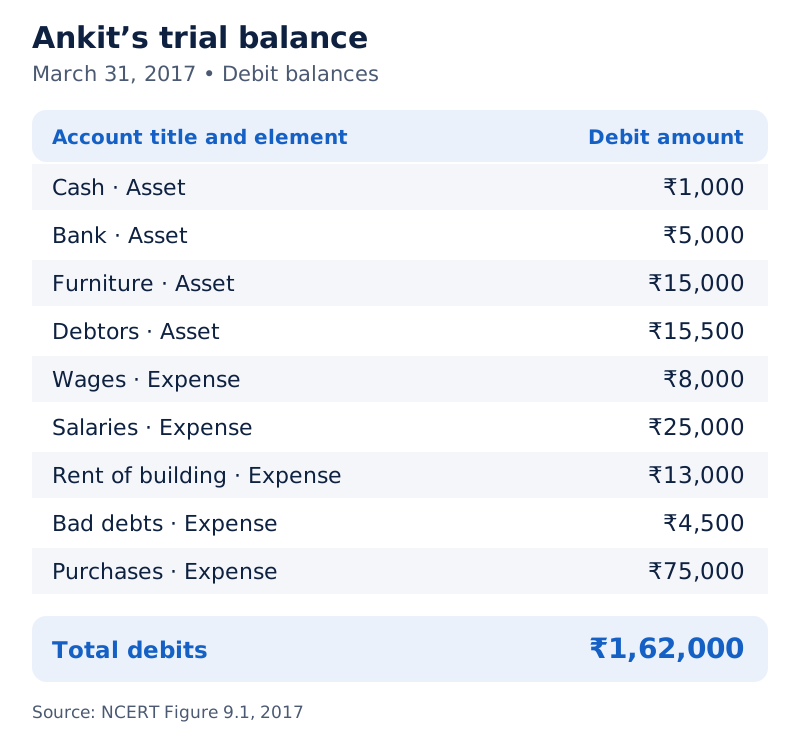
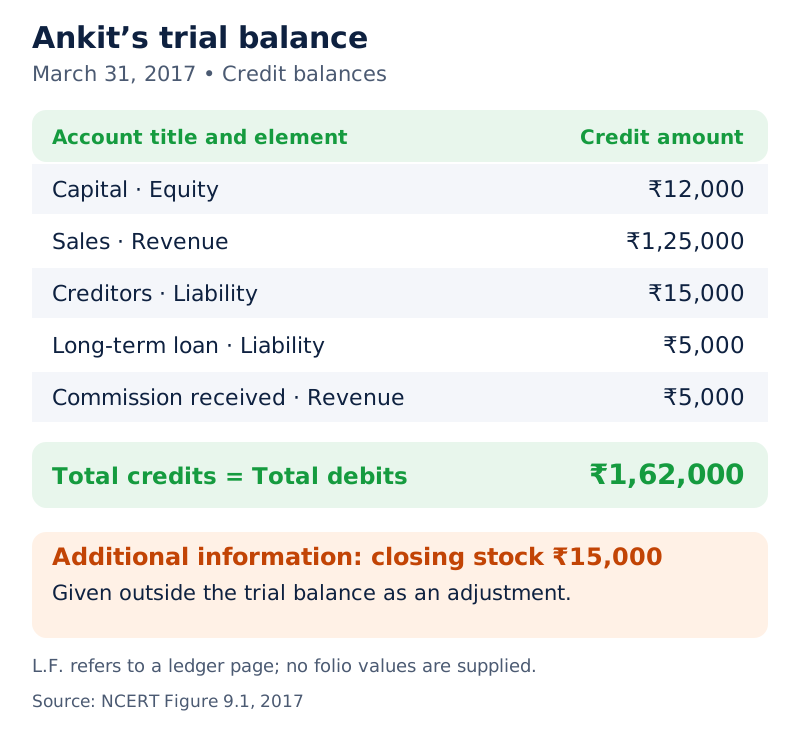
The printed table has columns for account title, elements, ledger folio, debit amount and credit amount. Both amount columns total ₹1,62,000. A ledger folio is the reference to an account’s page in the ledger, the book containing accounts. Closing stock of ₹15,000 is stated below the table as additional information.
Drawn by One Young India. See Fig. 9.1 in your NCERT textbook
Assemble the data before calculating
Consider Ankit’s accounts at March 31, 2017, through the adjustment for doubtful debts. The recorded balances and adjustments needed for the following results are set out here. Creditors means persons to whom the business owes money; a loan is borrowed money repayable by the business.
| Recorded item | Balance |
|---|---|
| Purchases | ₹75,000 |
| Sales | ₹1,25,000 |
| Wages | ₹8,000 |
| Salaries | ₹25,000 |
| Rent of building | ₹13,000 |
| Commission received | ₹5,000 |
| Bad debts | ₹4,500 |
| Debtors | ₹15,500 |
| Furniture | ₹15,000 |
| Bank | ₹5,000 |
| Cash before advance rent receipt | ₹1,000 |
| Capital | ₹12,000 |
| Creditors | ₹15,000 |
| Long-term loan | ₹5,000 |
Closing stock is ₹15,000; wages outstanding are ₹500; prepaid salary is ₹5,000; accrued commission is ₹1,500. Rent received in advance for the following April, May and June totals ₹3,000 and increases cash to ₹4,000.
Furniture depreciation is ₹1,500; further bad debts are ₹2,500; the new doubtful-debt provision is ₹650. No opening stock is listed in these balances. The following statements stop at the doubtful-debt adjustment, before discount provision, manager’s commission and interest on capital.
Determine gross profit and net profit
Trading account credits are sales ₹1,25,000 and closing stock ₹15,000, totalling ₹1,40,000. Its expenses are purchases ₹75,000 and adjusted wages ₹8,500. The resulting gross profit is ₹56,500.
The profit and loss account receives gross profit ₹56,500 and commission income ₹6,500, totalling ₹63,000. Charge salaries ₹20,000, building rent ₹13,000, depreciation ₹1,500, bad debts ₹7,000 and doubtful-debt provision ₹650. The resulting net profit is ₹20,850.
Present the adjusted balance sheet
| Side | Item after adjustment | Amount |
|---|---|---|
| Capital and liabilities | Capital including net profit | ₹32,850 |
| Capital and liabilities | Long-term loan | ₹5,000 |
| Capital and liabilities | Creditors | ₹15,000 |
| Capital and liabilities | Outstanding wages | ₹500 |
| Capital and liabilities | Rent received in advance | ₹3,000 |
| Capital and liabilities | Total | ₹56,350 |
| Assets | Furniture after depreciation | ₹13,500 |
| Assets | Debtors after further bad debts and provision | ₹12,350 |
| Assets | Prepaid salary | ₹5,000 |
| Assets | Accrued commission | ₹1,500 |
| Assets | Bank | ₹5,000 |
| Assets | Cash after advance rent receipt | ₹4,000 |
| Assets | Closing stock | ₹15,000 |
| Assets | Total | ₹56,350 |
What the figure shows
Treatment of adjustments
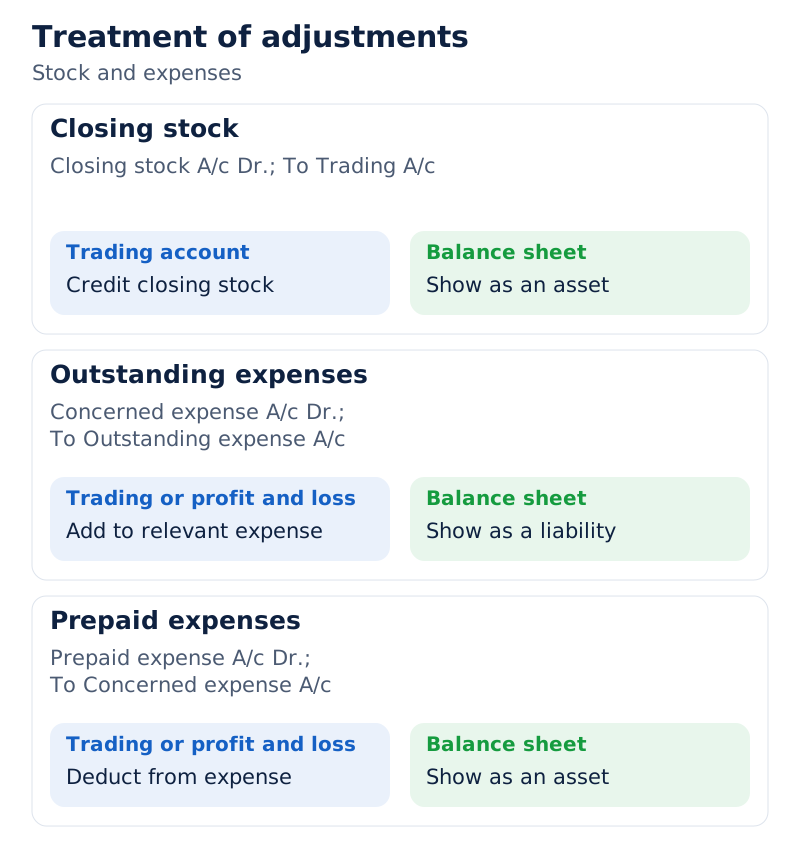
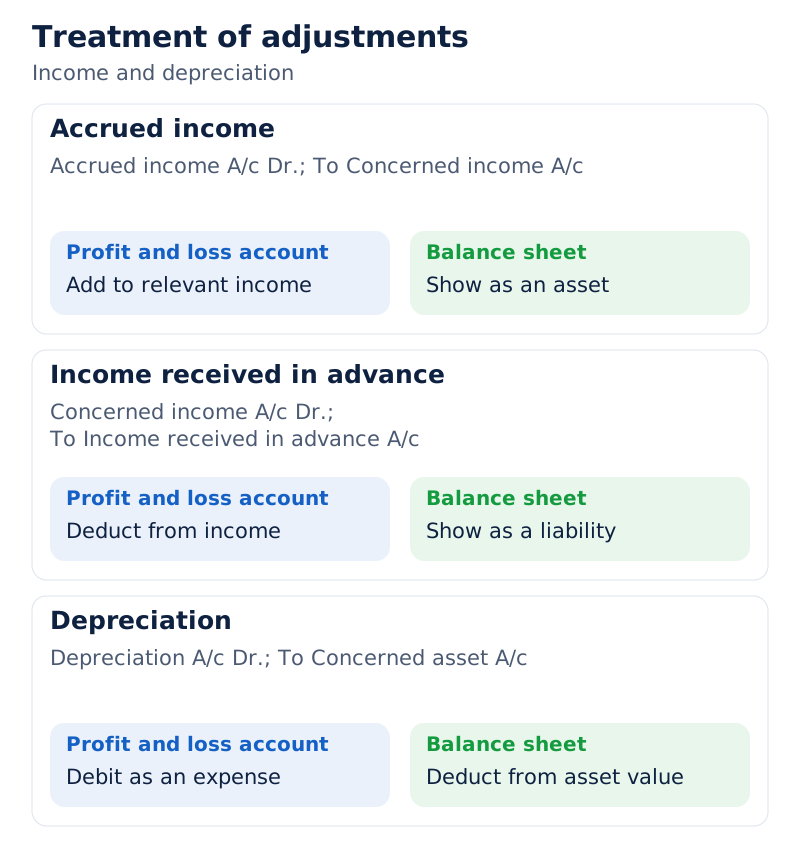
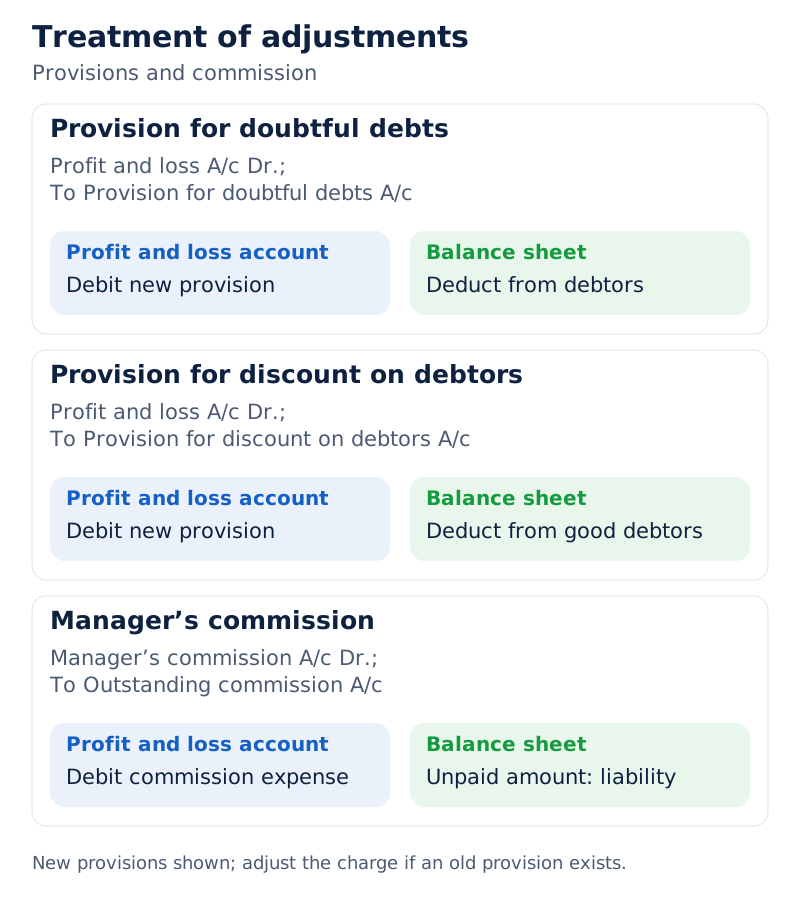
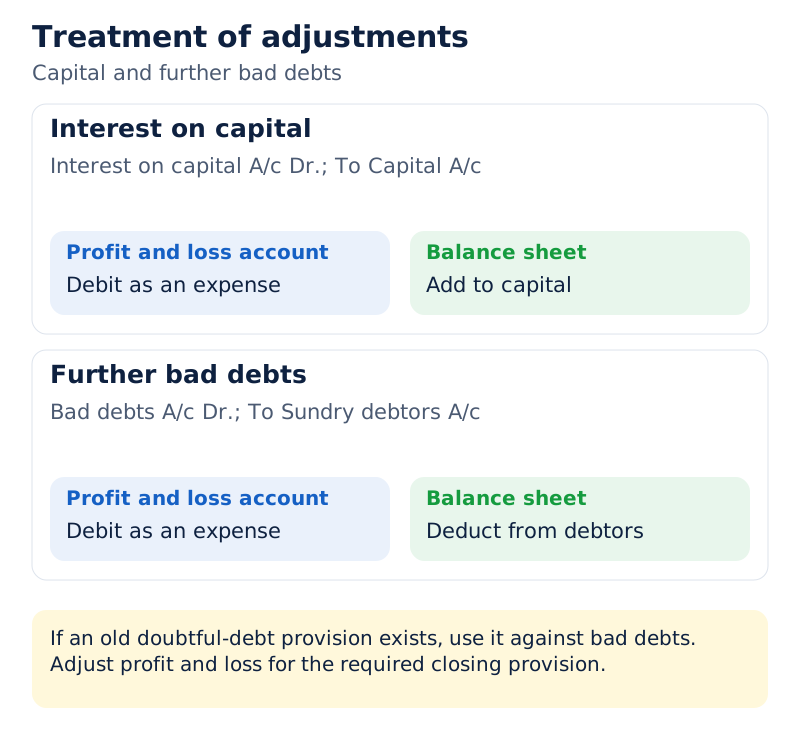
This is a four-column summary table. It lists eleven adjustments alongside their adjustment entries, their treatment in the trading and profit and loss account, and their treatment in the balance sheet.
Drawn by One Young India. See Fig. 9.2 in your NCERT textbook
Use the final statements to trace each adjustment. Outstanding wages link an increased trading expense with a liability. Prepaid salary and accrued commission link profit adjustments with assets. Depreciation and the doubtful-debt provision link expenses with deductions from assets.
Glossary
- Adjusting entry — An entry recorded to bring a required period-end adjustment into the business’s accounts.
- Accrual basis — Recognition of income when earned and expenses when incurred, rather than by cash receipt or payment.
- Closing stock — The cost of goods remaining unsold at the end of an accounting period.
- Adjusted purchases — The purchases balance after opening and closing stock have been adjusted through that account.
- Outstanding expense — An expense belonging to the current accounting period that remains unpaid at its end.
- Prepaid expense — The portion of an expense payment whose benefit belongs to the next accounting period.
- Accrued income — Income earned during the current accounting period but still to be received at its end.
- Unearned income — Income already received that belongs to the next accounting period rather than the current one.
- Depreciation — Decline in asset value from wear and tear and passage of time, treated as a business expense.
- Further bad debts — Additional irrecoverable amounts from debtors identified for adjustment but not yet recorded in the books.
- Provision for doubtful debts — An estimate of possible loss from debtors, charged against profit and deducted from debtors.
- Good debtors — Debtors remaining after deducting further bad debts and the provision for doubtful debts.
- Provision for discount on debtors — An estimate of discount likely to be allowed to good debtors for prompt payment.
- Manager’s commission — Remuneration calculated at an agreed percentage of profit before or after charging that commission.
- Interest on capital — Interest provided on the proprietor’s investment, charged as an expense and added to capital.
Common errors and misconceptions
- Misconception: Every cash payment is wholly an expense of the year of payment. Correct: A payment may include a prepaid portion whose benefit belongs to the next accounting period.
- Misconception: Closing stock must be credited to the trading account even when already included with adjusted purchases. Correct: In that situation, show closing stock as an asset without repeating the trading adjustment.
- Misconception: Outstanding expenses are assets because payment will occur later. Correct: They are unpaid obligations and therefore liabilities; the related expense belongs to the current period.
- Misconception: Accrued income and advance income have the same treatment. Correct: Accrued income increases current income and assets; advance income reduces current income and creates a liability.
- Misconception: Deduct trial balance bad debts from trial balance debtors again. Correct: Recorded bad debts have already reduced debtors; deduct further bad debts supplied as an adjustment.
- Misconception: Both provisions use the original debtors balance. Correct: Calculate doubtful-debt provision after further bad debts, then discount provision on good debtors after the doubtful-debt provision.
- Misconception: Manager’s commission uses the same calculation for both profit bases. Correct: Before-commission and after-commission agreements require different denominators when starting with profit before commission.
- Misconception: Interest on capital is an outside liability. Correct: It is charged to profit and loss and added to the proprietor’s capital in the balance sheet.
Exam-style questions with model answers
Q1. Why are adjusting entries necessary when accounts are prepared on the accrual basis? Give two reasons. [2 marks]
- They recognise income earned and expenses incurred in the current period even when the corresponding cash has not been received or paid.
- They separate amounts relating to other periods, helping the final accounts show the current year’s profit or loss and financial position correctly.
Q2. Ankit’s recorded wages are ₹8,000 and an additional ₹500 for the current year is unpaid. Give the adjusting entry, total wages expense and balance sheet treatment. [3 marks]
- Debit Wages A/c ₹500 and credit Wages outstanding A/c ₹500. This records the current year’s additional wage expense and the obligation to pay it.
- The total wages expense is ₹8,000 + ₹500 = ₹8,500. Debit this adjusted amount to the trading account.
- Show outstanding wages of ₹500 as a liability in the balance sheet. The unpaid amount belongs to the current year despite its later payment.
Q3. Ankit’s recorded salaries are ₹25,000, including ₹5,000 prepaid for the next period. Commission received for the current year is ₹5,000, with a further ₹1,500 earned but not received. State the four adjusted expense, income and asset amounts. [4 marks]
- Current salary expense is ₹25,000 − ₹5,000 = ₹20,000. Charge this amount to the profit and loss account after removing the future-period portion.
- Show prepaid salary of ₹5,000 as an asset, representing the benefit carried forward to the next period.
- Commission income is ₹5,000 + ₹1,500 = ₹6,500. Credit this earned amount to the profit and loss account.
- Show accrued commission of ₹1,500 as an asset because the business has earned the income but has not yet received it.
Q4. Debtors are ₹32,000, recorded bad debts ₹2,000, old doubtful-debt provision ₹3,500 and further bad debts ₹1,000. The required new provision is 5% of debtors remaining after further bad debts. Calculate the adjustments and final presentation in six steps. [6 marks]
- Record further bad debts of ₹1,000 by debiting Bad debts A/c and crediting Debtors A/c. The recorded ₹2,000 has already been written off.
- Remaining debtors are ₹32,000 − ₹1,000 = ₹31,000. This is the balance on which the new doubtful-debt provision is calculated.
- The new provision is ₹31,000 × 5/100 = ₹1,550. This is the required closing provision, rather than the expense charged automatically.
- Total bad debts are ₹2,000 + ₹1,000 = ₹3,000. Debit Provision for doubtful debts A/c and credit Bad debts A/c for this amount.
- Debit profit and loss by ₹3,000 + ₹1,550 − ₹3,500 = ₹1,050, crediting the provision account to establish the required closing balance.
- Show net debtors of ₹31,000 − ₹1,550 = ₹29,450 in the balance sheet. The deduction uses the new provision of ₹1,550.
Q5. Furniture stands at ₹15,000 and requires depreciation at 10% for the full year. Opening capital is ₹12,000 and interest on capital is allowed at 5% for the full year. Calculate both amounts and explain their entries and final-account treatment in five points. [5 marks]
- Furniture depreciation is ₹15,000 × 10/100 = ₹1,500 for the year. It recognises the portion of the furniture’s cost charged against the year’s earnings.
- Debit Depreciation A/c ₹1,500 and credit Furniture A/c ₹1,500. Charge depreciation as an expense in the profit and loss account.
- Show furniture at ₹15,000 − ₹1,500 = ₹13,500 in the balance sheet. This completes the asset effect of the depreciation adjustment.
- Interest on capital is ₹12,000 × 5/100 = ₹600. Debit Interest on capital A/c ₹600 and credit Capital A/c ₹600.
- Charge ₹600 to profit and loss and add ₹600 to capital. The interest reduces profit but is credited directly to the proprietor’s capital account.
Q6. Profit before manager’s commission is ₹110. Commission is 10% of profit before charging it and remains unpaid. Calculate it, give the entry and state its financial statement treatment. [3 marks]
- The commission is ₹110 × 10/100 = ₹11 because the agreement applies 10% directly to profit before the commission expense.
- Record Profit and loss A/c Dr. ₹11; To Manager’s commission A/c ₹11. This recognises the commission charged against the current profit.
- The profit and loss account bears a commission expense of ₹11. Since the commission remains unpaid, show ₹11 as a liability in the balance sheet.
Q7. Ankit’s closing stock of ₹15,000 is supplied outside the trial balance as an adjustment. State its two financial statement effects. [2 marks]
- Credit closing stock of ₹15,000 to the trading account when calculating the trading result for the year.
- Show closing stock of ₹15,000 as an asset in the balance sheet, representing goods remaining unsold at the year end.
Q8. Debtors are ₹15,500; further bad debts are ₹2,500; the new doubtful-debt provision is ₹650; and the given discount provision is ₹227. Show the deductions in order and give the entry for the discount provision. [4 marks]
- Deduct further bad debts of ₹2,500 from ₹15,500. The remaining debtors before the provisions are ₹13,000.
- Deduct the doubtful-debt provision of ₹650 from ₹13,000. Good debtors are therefore ₹12,350.
- Deduct the given discount provision of ₹227 from good debtors of ₹12,350. The balance sheet amount is ₹12,123.
- Debit Profit and loss A/c ₹227 and credit Provision for discount on debtors A/c ₹227. This recognises the estimated discount expense and its deduction from debtors.
Key takeaways
- Accrual accounting assigns income and expenses to the period to which they belong, regardless of the timing of cash movements.
- Closing stock supplied as an adjustment affects trading profit and assets; stock already included with adjusted purchases is not credited again.
- Outstanding expenses increase expense and create liabilities, while prepaid expenses reduce current expense and appear as assets.
- Accrued income is earned but unreceived; advance income is received but belongs to the following accounting period.
- Depreciation charges part of an asset’s cost against profit and reduces the asset amount shown in the balance sheet.
- Deduct further bad debts before calculating the doubtful-debt provision, and calculate discount provision on the resulting good debtors.
- Take the old doubtful-debt provision into account when calculating the current profit and loss charge, but deduct the new provision from debtors.
- Manager’s commission depends on its stated profit base; interest on capital reduces profit and is added directly to capital.
Test yourself
What entry records an outstanding expense?
Debit the concerned expense account and credit the outstanding expense account, recognising the expense and the unpaid obligation.
Where does prepaid salary appear after adjustment?
It is deducted from salary expense and shown as an asset in the balance sheet.
Why is rent received for the next accounting year a liability?
The receipt belongs to a future period and has not been earned as current-year income.
Should bad debts already in the trial balance be deducted from debtors again?
No. They have already been recorded; further bad debts supplied as an adjustment still require deduction.
What is the base for calculating provision for discount on debtors?
Good debtors: the debtors remaining after deducting further bad debts and the provision for doubtful debts.
Which provision is deducted from debtors in the closing balance sheet?
The new required provision for doubtful debts is deducted, rather than the old opening provision.
What commission basis is assumed when no basis is specified?
Commission is assumed to be a percentage of net profit before charging that commission.
What are the two effects of interest on capital?
It is debited as an expense to profit and loss and added to the proprietor’s capital.
Write about it
Turn a question from this chapter into a paper.
The Writing Studio has a structure guide, a rubric and citation tools for 15 formats, from essays to research papers. Drafting is free with an account. Learnacy Essential adds feedback from an AI writing coach and submission to The OYI Review.
Learnacy Essential is ₹1,499 for the year. Publication depends on review and is not guaranteed.