
Areas Related to Circles | CBSE Class 10 Maths Notes
On this page
Watch & explore
Start with a few high-quality watches, then dive into the notes below.

These Class 10 Mathematics notes cover sectors and segments of circles, arc length, minor and major regions, area formulae, triangle subtraction, quadrants, and applications involving clock hands, grazing fields, brooches, umbrellas, wipers and lighthouse warnings.
How do sectors and segments differ?
A sector is a circular region enclosed by two radii and their corresponding arc. A segment is enclosed by a chord and its corresponding arc. Identifying these boundaries is the first step in deciding which area to calculate.
Definition: A sector includes the region between two radii and an arc; a segment includes the region between a chord and an arc.
Which parts belong to each region?
Let denote the centre of a circle, and let and denote points on its circumference. The line segments and are radii, while is a chord. Joining the centre to the chord's endpoints forms a triangle.
Let denote a point on the smaller arc between the endpoints, and a point on the larger arc. The region is the minor sector, while is the major sector. The chord separates the minor segment from the major segment .
What the figure shows
Minor and major sectors
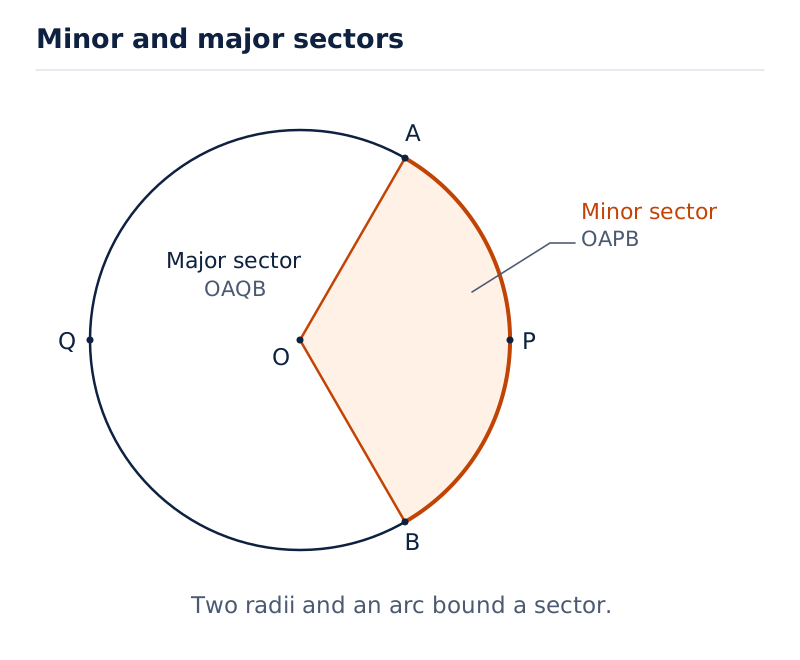
A circle has centre , radii to and , and a shaded minor sector containing arc point . Point lies on the larger arc surrounding the unshaded major sector.
Drawn by One Young India. See Fig. 11.1 in your NCERT textbook
What the figure shows
Minor and major segments
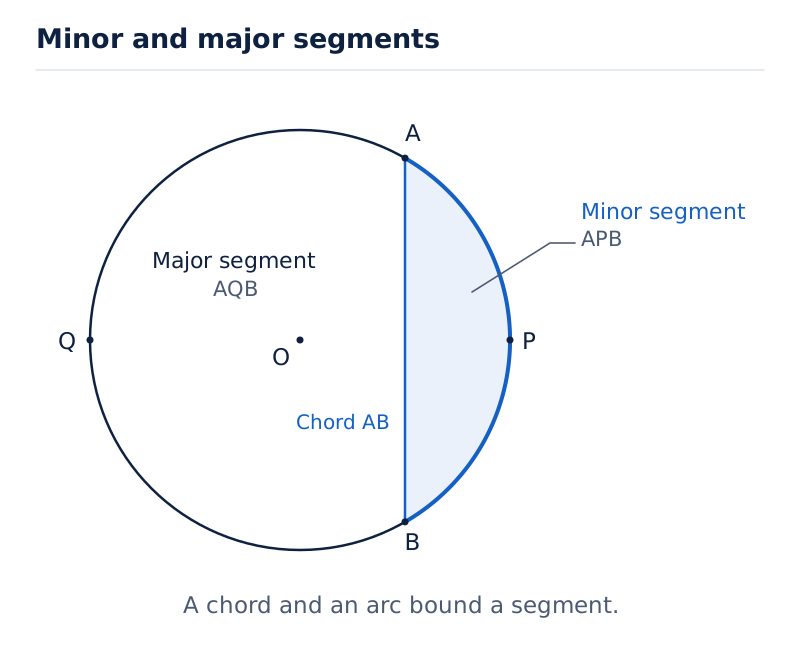
Chord cuts off a shaded minor segment containing arc point . The unshaded major segment contains centre , with point on its arc.
Drawn by One Young India. See Fig. 11.2 in your NCERT textbook
| Region | Straight boundary | Curved boundary |
|---|---|---|
| Minor sector | Two radii | Minor arc |
| Major sector | The same two radii | Major arc |
| Minor segment | A chord | Minor arc |
| Major segment | The same chord | Major arc |
The angle of a sector is measured at the centre between its radii. Unless stated otherwise, the words sector and segment here mean the minor sector and minor segment. Read an explicit request for a major region carefully before selecting the final answer.
How is the area of a sector derived and used?
Let denote the radius, the numerical measure of the central angle in degrees, and the circle constant relating circumference to diameter. Let denote the whole circular area and the sector area.
Result: Area of a sector
The sector area is the same fraction of the circular area as its central angle is of a complete turn. A smaller angle therefore selects a smaller fraction of the area when the radius is fixed.
Derivation: Sector area by the unitary method
- For a complete turn, the circular region has angle :
- Divide the whole area by the number of degrees in that turn. Let denote the area for a one-degree sector:
- Multiply the one-degree area by the degree measure of the required angle:
Use: Insert the radius, square it, and multiply the circle's area by the angle fraction. When the radius is measured in centimetres, express the resulting area in square centimetres.
Worked example 1. Find the minor and major sector areas for radius and central angle , using .
Answer: Let and denote the two sector areas. Keep the fraction until the final rounding.
- Calculate the area of the complete circle:
- Find the minor angle's share:
- Multiply to obtain the minor sector area:
- Subtract the unrounded minor area from the whole:
- Check directly using the remaining angle:
The two methods agree because the major and minor sectors together fill the circle. To one decimal place, the major sector area is . The requested precision determines how the calculated value is finally written.
Note: The major sector uses the remaining central angle. Using the minor angle again would calculate the smaller sector twice.
How is arc length related to the angle of a sector?
An arc length measures the curved part of the circumference between two points. It is a length, whereas a sector area measures a region. Both calculations use the same angle fraction, but they start from different measurements of the whole circle.
Result: Length of an arc
Let denote the circumference of the circle and the length of the selected arc. Radius and arc length must use the same length unit. The degree measure refers to the angle corresponding to that particular arc.
Derivation: Arc length by the unitary method
- A complete turn corresponds to the whole circumference:
- Let denote the arc length corresponding to one degree. Divide the circumference by the degree measure of a full turn:
- Multiply by the required degree measure:
Comparison: Arc length uses the circumference; sector area uses the circular area. A radius appears to the first power in the circumference expression and to the second power in the area expression.
Worked example 2. An arc subtends at the centre of a circle of radius . Find its length and its sector area. Use .
Answer: The arc and sector each represent the same fraction of their corresponding whole-circle measurement.
- Find the angle fraction:
- Calculate the whole circumference:
- Take one-sixth of the circumference:
- Calculate the complete circular area:
- Take one-sixth of that area:
Notice the different units in the two answers. The curved distance is in centimetres, while the enclosed region is in square centimetres. The common angle fraction does not make these quantities interchangeable.
How do you calculate minor segments and major regions?
A chord and its two radii enclose a triangle inside the corresponding minor sector. The curved region left after removing this triangle is the minor segment. Calculating a segment therefore requires both circular geometry and the area of a triangle.
Result: Segment area and complementary areas
Let denote the minor segment area and the area of the triangle formed by the radii and chord. The notation means the triangle whose vertices are the centre and the chord's endpoints.
- Split the minor sector into its triangle and segment:
- Rearrange to isolate the segment:
- Let denote the other segment area. Subtract the minor segment from the whole circle:
- Let denote the other sector area. Its corresponding subtraction is
These subtractions have different meanings. A major segment is paired with a minor segment across a chord; a major sector is paired with a minor sector around the centre. Write the required region's name beside its calculation.
Worked example 3. A chord subtends a right angle at the centre of a circle of radius . Find the minor segment area and the major sector area, using .
Answer: The triangle between the radii is right-angled, so the two radii form its perpendicular base and height.
- Calculate the minor sector:
- Calculate the right triangle:
- Subtract the triangle from the sector:
- Calculate the circle:
- Subtract the minor sector to obtain the major sector:
Note: Subtracting the minor segment in the last step would answer a different question: it would find the major segment rather than the major sector.
The segment answer must be smaller than its corresponding minor sector because a positive triangle area has been removed. This comparison checks the geometry of the subtraction before any numerical answer is accepted.
How does a perpendicular help with a segment calculation?
When the triangle between the radii is not right-angled, draw a perpendicular from the centre to the chord. This creates two right triangles. Their hypotenuses are equal radii, and they share the perpendicular side, so right angle-hypotenuse-side congruence applies.
Let denote the foot of this perpendicular on chord . Congruence makes the chord's midpoint and divides the angle at the centre equally. The perpendicular length supplies the triangle's height, while twice the half-chord supplies its base.
What the figure shows
Segment and auxiliary perpendicular
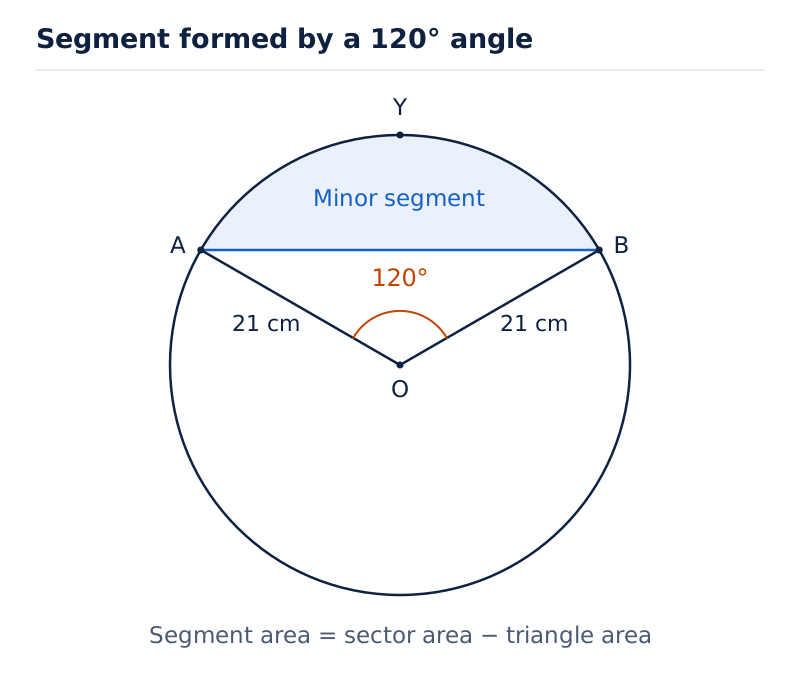
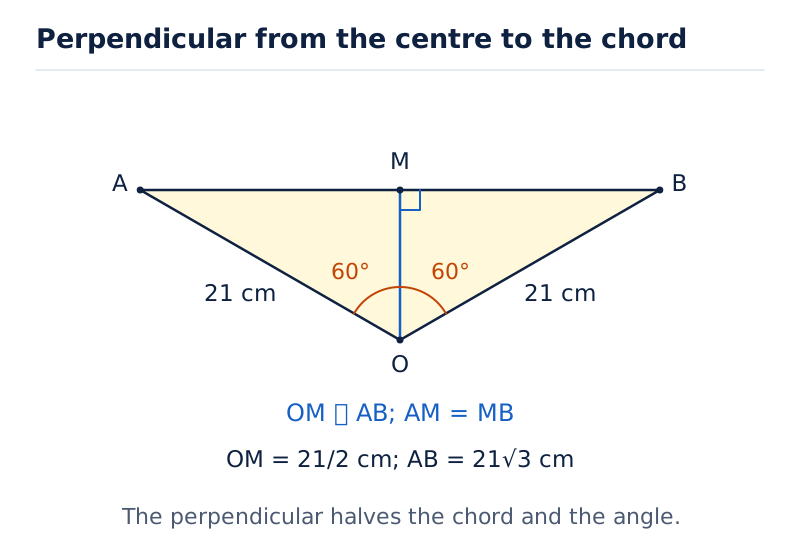
The shaded segment lies above chord , with marking its arc. The radii measure and enclose . The separate triangle drawing shows perpendicular to , splitting the central angle into two angles of .
Drawn by One Young India. See Figs. 11.6 and 11.7 in your NCERT textbook
How are the triangle's base and height found?
The cosine ratio gives the perpendicular side divided by the radius, and the sine ratio gives the half-chord divided by the radius. Here and denote the cosine and sine trigonometric functions. Both ratios refer to the angle at the centre of a right triangle. The symbol means the positive square root of three.
Worked example 4. Find the minor segment area for radius and central angle . Use .
Answer: Draw the perpendicular described above, calculate the sector and triangle separately, and subtract.
- Find the sector area:
- Halve the central angle using the congruent right triangles:
- Find the perpendicular height:
- Find half the chord:
- Double the half-chord:
- Calculate the triangle area using the chord and perpendicular:
- Subtract to obtain the exact segment area for the stipulated value of the circle constant:
Keeping the square root unevaluated preserves the exact triangle calculation. If a question supplies a decimal approximation for a square root, use that stated approximation consistently instead.
The essential construction is the perpendicular, not an extra radius. It creates the right triangles needed for the trigonometric ratios and provides the perpendicular height required by the triangle-area formula.
How do you find a quadrant area when circumference is given?
A quadrant is a quarter of a circular region. Its central angle is , so its area is one-quarter of the circle's area. If the question gives circumference, first recover the radius before applying the area formula.
How does the given length lead to an area?
Circumference describes the entire curved boundary. It is not a radius or a diameter. Let denote the quadrant area. The required calculation therefore has two stages: use circumference to obtain radius, then use radius to obtain area.
- Start from the relation between circumference and radius:
- Divide by twice the circle constant to isolate the radius:
- Use the quadrant's fraction of the circular area:
Worked example 5. Find the area of a quadrant of a circle whose circumference is . Use .
Answer: The given circumference is the full circle's circumference, so it must first be converted to radius.
- Substitute into the circumference relation:
- Divide to obtain the radius:
- Square this radius in the quadrant formula:
- Simplify the products and express the area:
The order of operations matters because the circular area depends on the square of the radius. Substituting the circumference directly in place of the radius would use the wrong length before the squaring even begins.
Keep the fractional radius through the calculation when convenient. The answer is an area even though the original measurement was a length. Writing square centimetres makes that change in the measured quantity explicit.
How does a clock hand sweep out a sector?
A rotating clock hand sweeps a sector whose radius is the hand's length. The central angle comes from the fraction of a complete revolution made during the stated time. Calculate that angle before substituting into the sector-area formula.
How is elapsed time converted into an angle?
A minute hand completes one turn in minutes. Let denote the elapsed time in minutes and the swept area. For the stated interval, use its fraction of an hour to determine the corresponding fraction of the circular region.
- Express the elapsed interval as a fraction of the time for one turn:
- Convert this fraction to a central angle:
- Use the same angular fraction in the sector-area formula:
Worked example 6. A clock's minute hand is long. Find the area it sweeps in minutes, using .
Answer: The hand length supplies the radius, and the elapsed time supplies the angle.
- Calculate the fraction of one revolution:
- Find the central angle:
- Calculate the full circular area for this hand length:
- Take the appropriate fraction:
The angle is ; the number of minutes is not itself the angle in degrees. The time-to-angle conversion connects the physical description to the circle formula and prevents this common substitution error.
The required answer concerns the region swept by the hand. If a question instead requested the distance travelled by its tip, that would concern an arc length, so the starting whole-circle quantity would be circumference.
How is a corner grazing region calculated?
When a horse is tied at a corner of a square field, the two sides meeting at that corner restrict its movement to a quadrant within the field. The rope length supplies the radius of the accessible circular region.
For the lengths used here, neither rope reaches the opposite sides of the square. The entire quadrant therefore fits inside the field. Use the angle at the corner, rather than a full circle, to calculate the accessible area.
How do you distinguish area from increase in area?
The increase in grazing area is the new accessible area minus the old accessible area. Calculate both areas separately before subtracting. The new total area and the increase are different quantities and should have separate labels.
Worked example 7. A horse is tied at one corner of a square grass field of side with a rope. Find its grazing area and the increase if the rope becomes long. Use .
Answer: Let and denote the grazing areas before and after the rope is lengthened, and their increase.
- The corner gives a right-angle sector, with area fraction
- Calculate the original grazing area:
- Calculate the new grazing area:
- Subtract the original area from the new area:
The field's side length is essential contextual data: it lets us check that the relevant circular portions fit within the square. The side length itself is not the grazing radius; the rope determines how far the horse can reach.
Note: Do not report the larger quadrant as the increase. The old grazing region remains part of the new region, so it must be subtracted when calculating the additional area.
How are equal sectors used in brooch and umbrella problems?
When a circle is divided into equal sectors, each sector takes an equal share of the full angle and full area. Let denote the number of equal sectors. Dividing by that number gives the angle and area of one part.
- Divide the complete angle equally:
- Substitute this angle measure in the sector formula:
The wire length of a circular design is a separate calculation. Count each physical wire once, including the outer circumference and the specified straight pieces. Diameters crossing at the centre remain separate pieces of wire.
What the figure shows
Circular brooch
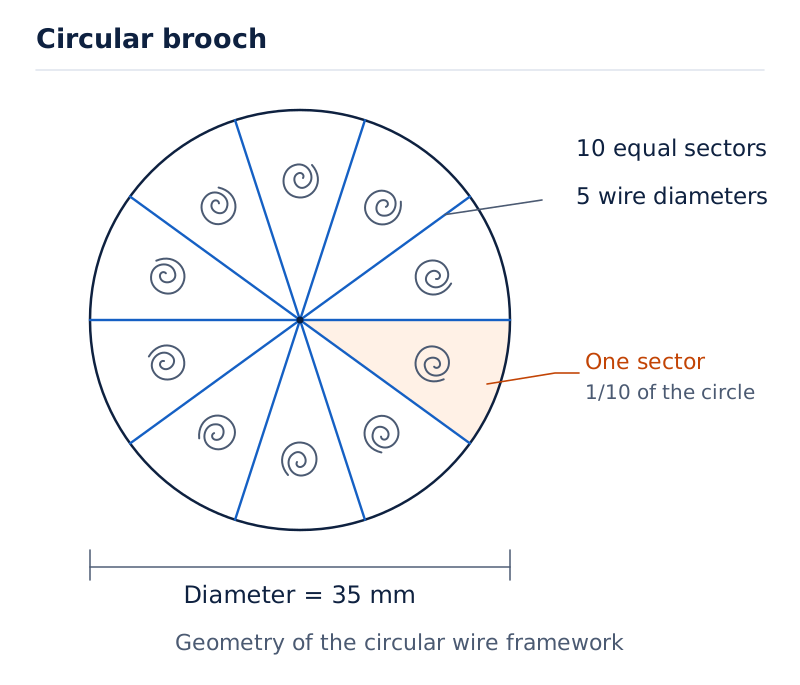
A circular outline contains straight lines through its centre, dividing the interior into ten sectors. Small decorative spiral patterns appear within the circular design.
Drawn by One Young India. See Fig. 11.9 in your NCERT textbook
How are the brooch's wire and sector area calculated?
Worked example 8. A brooch has a circular silver-wire boundary of diameter and five wire diameters dividing it into ten equal sectors. Find the total wire length and each sector's area. Use .
Answer: Let denote the diameter, the combined straight-wire length, and the total wire length.
- Find the radius from the diameter:
- Calculate the outer circumference:
- Calculate the five straight diameters:
- Add the physical wire lengths:
- Divide the circle's area among the ten sectors:
How does the same method apply to an umbrella?
Worked example 9. An umbrella has eight equally spaced ribs. Treat it as a flat circle of radius . Find the area between two consecutive ribs, using .
Answer: Consecutive ribs bound one of eight equal sectors of the assumed flat circular region.
- Determine one sector's angle:
- Square the radius:
- Multiply the circular area by one-eighth:
- Round the final result:
The flat-circle assumption belongs to this umbrella problem. It is what makes the plane sector-area formula applicable. Keep it in the question when practising the calculation, since the stated mathematical model is part of the data.
How are swept and illuminated sectors calculated?
A wiper sweeping through an angle and a lighthouse illuminating a sea region both lead to sector-area calculations. Identify the radius and central angle from the wording. Then decide whether the required region contains one sector or several sectors.
When may two swept areas be added?
If two cleaned regions do not overlap, adding their areas gives the total cleaned area. The non-overlap condition matters: it ensures that the same part of the windscreen is not counted twice in the stated problem.
Worked example 10. A car has two wipers whose swept regions do not overlap. Each blade has length and sweeps through . Find the total cleaned area at each sweep, using .
Answer: Let denote one wiper's cleaned area and the total for both wipers. Use the blade length as the sector radius in this model.
- Calculate the area swept by one blade:
- Square the blade length and simplify:
- Double the area because the two equal swept regions do not overlap:
- Round the total after the multiplication:
How is the lighthouse warning area obtained?
Worked example 11. A lighthouse spreads red light over a sector of angle to a distance of . Find the sea area over which ships are warned, using .
Answer: Let denote the warned sea area. The light's reach is the radius, and the given angle selects the relevant fraction of the circle.
- Simplify the angle fraction:
- Square the reach of the light:
- Calculate the circular area for that radius:
- Take the required sector:
Keep length units consistent through each problem. The wiper lengths lead to square centimetres, while the lighthouse distance leads to square kilometres. A correct numerical calculation still needs the area unit associated with its radius.
Before finishing either solution, reread the requested quantity. For the wipers it is the total from two non-overlapping sweeps; for the lighthouse it is one illuminated sector. The final operation follows that distinction.
How can segment areas be used to calculate a design cost?
A circular cover with six equal peripheral designs can be treated as six equal segments outside an inscribed regular hexagon. Join the centre to the hexagon's vertices. The resulting equal sectors each contain a triangle and one curved design.
What the figure shows
Six designs on a round table cover
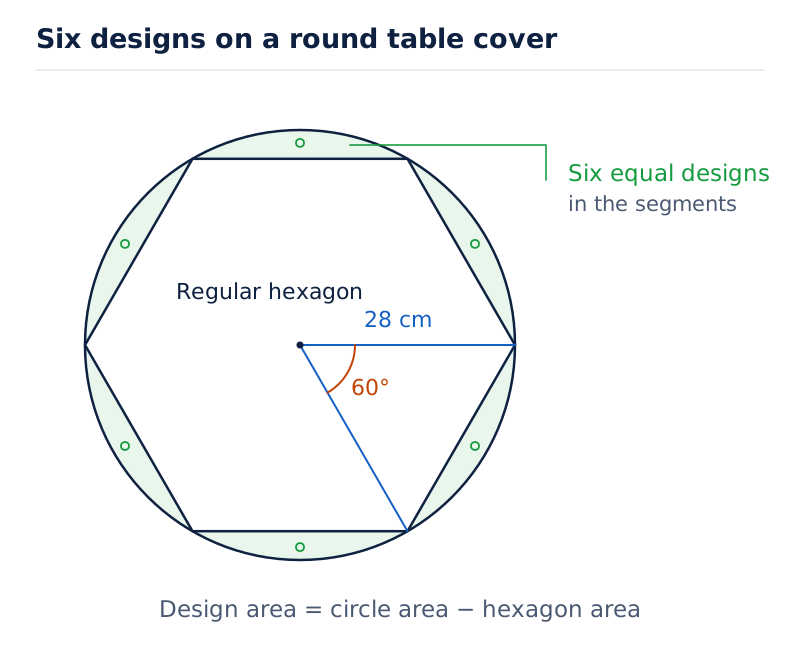
A hexagon occupies the centre of the circle. Six curved regions between the hexagon's sides and the circular boundary contain repeated small decorative marks.
Drawn by One Young India. See Fig. 11.11 in your NCERT textbook
How do area and rate determine the cost?
First calculate the total area occupied by the designs. Then multiply that area by the stated rate per square centimetre. Applying the rate to the full circular area would incorrectly include the central hexagonal region.
Worked example 12. A round table cover of radius has six equal segment-shaped designs outside an inscribed regular hexagon. Find their cost at ₹ per square centimetre, using and .
Answer: Let denote the height of one central triangle, the total design area, and the cost in rupees.
- Divide the full central angle among the six equal parts:
- Each central triangle has two equal radii and an included angle of , making it equilateral. Its side is . A perpendicular bisects the base:
- Use the right triangle to find the height:
- Calculate one triangle's area using the supplied square-root approximation:
- Calculate the full circular area:
- Subtract all six triangles from the circle:
- Apply the rate to the design area: The required cost is approximately ₹.
This method combines equal sectors, triangle subtraction and a rate calculation. Subtracting the six triangles together gives the same total as finding one segment and multiplying its area by six. The equality of the designs justifies that grouping.
The square-root approximation affects the triangle areas and therefore the final cost. Retain the approximation symbol when a supplied rounded value is used. It records the accuracy of the calculation rather than suggesting the decimal is an exact geometric area.
Glossary
- Radius — A line segment joining the centre of a circle to a point on its circumference.
- Diameter — A chord passing through the centre, with length twice the circle's radius.
- Circumference — The total length of the curved boundary of a circle.
- Arc — A portion of the circumference between two points on a circle.
- Chord — A straight line segment joining two points on a circle's circumference.
- Sector — The circular region enclosed by two radii and their corresponding arc.
- Segment — The circular region enclosed between a chord and its corresponding arc.
- Central angle — The angle at the centre formed by the radii bounding a sector.
- Minor sector — The smaller sector formed by two radii and the corresponding smaller arc.
- Major sector — The larger sector remaining when the corresponding minor sector is removed from a circle.
- Minor segment — The smaller region between a chord and its corresponding smaller arc.
- Major segment — The larger circular region remaining after the corresponding minor segment is removed.
- Quadrant — A quarter of a circular region, with a right angle at its centre.
- Unitary method — A method that first finds the amount for one unit, then for the required number.
Common errors and misconceptions
- Misconception: A sector and a segment are the same region. Correct: A sector has two radii as straight boundaries; a segment has a chord.
- Misconception: Arc length measures the enclosed area. Correct: Arc length measures a curved distance and uses length units; sector area uses square units.
- Misconception: The sector-area formula directly gives the minor segment area. Correct: Subtract the triangle between the radii and chord from the corresponding minor sector.
- Misconception: A major sector is found by subtracting a minor segment. Correct: Subtract the minor sector from the complete circular area to obtain the major sector.
- Misconception: The circumference can be used as the radius in an area formula. Correct: First determine the radius from the circumference relation.
- Misconception: A minute hand's elapsed minutes equal its angle in degrees. Correct: Convert the time into a fraction of a full revolution before finding the angle.
- Misconception: The new grazing area is the increase in grazing area. Correct: The increase is the new area minus the original area.
- Misconception: The entire table-cover area determines the decorative cost. Correct: Multiply the area occupied by the six designs by the stated rate.
Exam-style questions with model answers
Q1. Find the area of a sector with radius and central angle . Use . [2 marks]
- Use the given central angle to select one-sixth of the circular area:
- Square the radius and simplify the product:
Q2. A chord of a circle of radius subtends at the centre. Find the minor and major segment areas, using and . [3 marks]
- The radii and chord form an equilateral triangle. Let denote its perpendicular height. Bisect the base and apply Pythagoras: Its area is
- The minor sector occupies one-sixth of the circle. Subtract the triangle to find the minor segment:
- The major segment is what remains after the minor segment is removed from the complete circular region:
Q3. A chord of a circle of radius subtends at the centre. Find the minor segment area. Use and . [3 marks]
- Calculate the sector as one-third of the complete circle:
- Draw the perpendicular from centre to chord , meeting it at . It halves the central angle, giving Hence
- The required minor segment is the sector with this triangle removed. Subtract its area and retain square centimetres:
Q4. In a circle of radius , an arc subtends at the centre. Find the arc length, sector area and minor segment area. Use , leaving square roots unevaluated. [4 marks]
- The arc is one-sixth of the circumference, so its curved length is
- The sector is the same fraction of the circular area:
- The radii and chord form an equilateral triangle of side . Let denote its height. Bisect the base and apply Pythagoras: Therefore
- Remove that triangle from its sector to obtain the exact minor segment area: The arc answer is a length; both remaining answers are areas.
Q5. A chord subtends at the centre of a circle of radius . Derive the minor segment area by drawing a perpendicular to the chord. Use and retain square roots. [5 marks]
- Draw the perpendicular from to chord , with foot . The two right triangles share this perpendicular and have equal radii as hypotenuses. They are congruent, so the perpendicular bisects the chord and central angle:
- Use the cosine ratio to calculate the perpendicular height:
- Use the sine ratio for half the chord, then double it:
- Calculate the triangle and the sector separately, since their difference is the desired curved region:
- Subtract the triangle from the corresponding minor sector and retain the square root as requested:
Q6. A horse is tied at one corner of a square grass field of side , initially with a rope and then with a rope. Find both grazing areas and the increase. Explain the shape used. Take . [5 marks]
- The two field sides meeting at the corner enclose a right angle, so the reachable region inside the field is a quadrant. Each rope is shorter than the side of the field, so the opposite boundaries do not cut off this quadrant.
- Use the rope length as the radius. The right-angle sector represents one-quarter of a complete circle:
- Substitute the original rope length to find the original grazing area:
- Substitute the longer rope length to calculate the new total accessible area:
- The increase excludes the area already accessible with the shorter rope. Subtract the original area from the new area:
Key takeaways
- A sector is bounded by two radii and an arc; a segment is bounded by a chord and an arc.
- For a fixed radius, the sector's share of the circular area follows its central angle's share of a complete turn.
- Arc length uses the same angle fraction as sector area, but multiplies the circumference rather than the circular area.
- Find a minor segment by subtracting the triangle between the radii and chord from its corresponding minor sector.
- A perpendicular from the centre to a chord supplies a triangle height and divides the chord into equal halves.
- Calculate a major region by subtracting its corresponding minor region from the complete circular area.
- In applications, identify the radius and angle from the description before substituting numbers into a formula.
- Use the specified approximations consistently, give square units for areas, and distinguish a new total from an increase.
Test yourself
What distinguishes the straight boundaries of a sector and a segment?
A sector has two radii as straight boundaries; a segment has one chord.
What does the angle fraction in the sector-area formula represent?
It represents the central angle's share of a complete turn and therefore the sector's share of the circular area.
What must be subtracted from a minor sector to obtain its segment?
Subtract the area of the triangle formed by the two bounding radii and their chord.
How do you obtain a major sector from the whole circle?
Subtract the corresponding minor sector area from the complete circular area.
Why draw a perpendicular from the centre to the chord?
It supplies the triangle's height and creates two congruent right triangles for calculating the chord and central half-angle.
Why is the corner grazing region a quadrant in the given square-field problem?
The two adjoining field sides enclose a right angle, and the rope is shorter than either side.
Why can the two wiper areas in the worked example be added?
The question states that their swept regions do not overlap, so their areas can be added without counting any region twice.
Which area determines the cost of the table-cover designs?
The combined area of the six peripheral segments determines the cost, rather than the full circular area.
Write about it
Turn a question from this chapter into a paper.
The Writing Studio has a structure guide, a rubric and citation tools for 15 formats, from essays to research papers. Drafting is free with an account. Learnacy Essential adds feedback from an AI writing coach and submission to The OYI Review.
Learnacy Essential is ₹1,499 for the year. Publication depends on review and is not guaranteed.