
Introduction to Trigonometry | CBSE Class 10 Maths Notes
On this page
Watch & explore
Start with a few high-quality watches, then dive into the notes below.

This Mathematics note covers right-triangle sides, the six trigonometric ratios, similar triangles, finding unknown ratios and lengths, standard-angle values, undefined ratios, trigonometric identities and step-by-step proofs.
What does trigonometry tell us about a right triangle?
Trigonometry studies relationships between the sides and angles of a triangle. A right triangle provides the starting point: its side lengths can be compared through ratios associated with either acute angle. These ratios connect an angle with the relative lengths of the sides.
How are the sides named?
Let , and name the vertices of triangle , with the right angle at . The notation means the angle at vertex , while , and denote the corresponding side lengths.
The hypotenuse, , faces the right angle and is the longest side. Relative to the acute angle , side is the opposite side and side is the adjacent side. Here, adjacent means the side next to the chosen angle other than the hypotenuse.
What the figure shows
Naming the sides of a right triangle
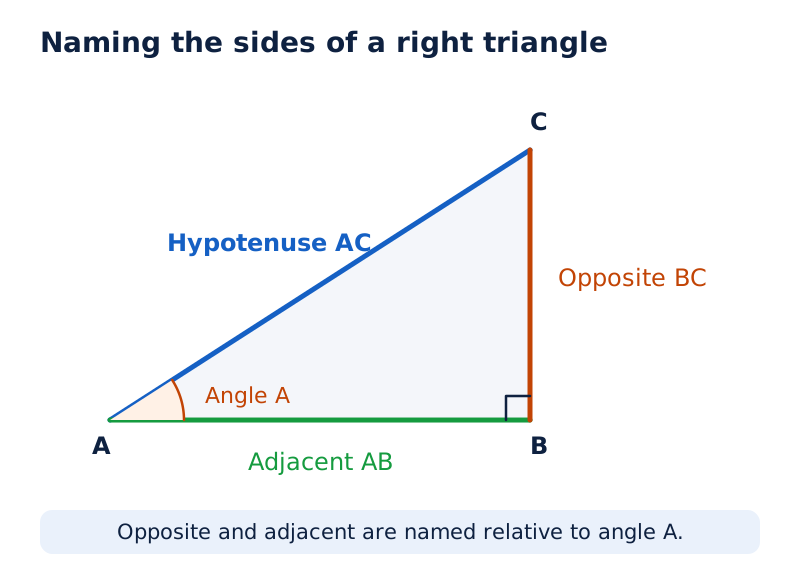
Vertex is at the lower left, at the lower right and above . The square marks the right angle at . The sloping side is labelled hypotenuse; the horizontal and vertical sides are labelled adjacent and opposite to angle .
Drawn by One Young India. See Fig. 8.4 in your NCERT textbook
What changes when the chosen angle changes?
For angle , side becomes opposite and side becomes adjacent. The hypotenuse stays . Thus, opposite and adjacent are names relative to a particular acute angle, rather than permanent names attached to the two shorter sides.
Right triangles can be imagined when looking towards the top of Qutub Minar, across a river, or towards a balloon. Trigonometric relationships help connect the heights and distances in such situations. The calculations begin by identifying the right angle and choosing the acute angle under consideration.
How are the six trigonometric ratios defined?
Keep triangle right-angled at , and use angle . The abbreviations , , , , and mean sine, cosine, tangent, cosecant, secant and cotangent respectively. Each complete expression names a ratio for the specified angle.
Definition: A trigonometric ratio compares two side lengths of a right triangle with respect to one of its acute angles.
| Ratio | Sides compared | Formula for angle |
|---|---|---|
| Sine | Opposite divided by hypotenuse | |
| Cosine | Adjacent divided by hypotenuse | |
| Tangent | Opposite divided by adjacent | |
| Cosecant | Hypotenuse divided by opposite | |
| Secant | Hypotenuse divided by adjacent | |
| Cotangent | Adjacent divided by opposite |
How are the ratios connected?
The reciprocal pairs are sine with cosecant, cosine with secant, and tangent with cotangent. For an acute angle their side lengths are positive, so these reciprocals are defined. At the endpoint angles, the possibility of a zero denominator must be checked separately.
- Write the quotient of sine and cosine using their definitions:
- Divide the fractions and cancel the common hypotenuse:
- Recognise the tangent ratio:
- Reverse the quotient to obtain cotangent:
Note: The notation means the sine of angle ; it is not multiplication of “sin” by the angle. Also, : the square applies to the value of the ratio.
The Greek letter , pronounced theta, also denotes an angle. Changing the angle symbol does not change a ratio's definition. Read the whole expression before substituting values, especially when a square or a reciprocal is present.
Why do the ratios depend on the angle rather than triangle size?
Two right triangles with the same acute angle are similar triangles. They have a common angle measure and a right angle, so the angle-angle similarity criterion applies. Their corresponding sides are proportional, which makes corresponding trigonometric ratios equal.
Result: Fixed-angle ratios remain unchanged
In triangle , right-angled at , let be a point on . Let be the foot of the perpendicular from to . These letters name points; , and denote the side lengths of the smaller right triangle.
- Both triangles share the angle at and have a right angle, so
- Write the corresponding side proportions:
- Rearrange the last two ratios to compare opposite side with hypotenuse:
- Similarly compare adjacent side with hypotenuse and opposite with adjacent:
The angle is the deciding quantity. Enlarging the triangle changes its side lengths together, but leaves these ratios unchanged. The reciprocal ratios also remain unchanged because they are reciprocals of the same sine, cosine and tangent values.
What the figure shows
Similar right triangles sharing an angle
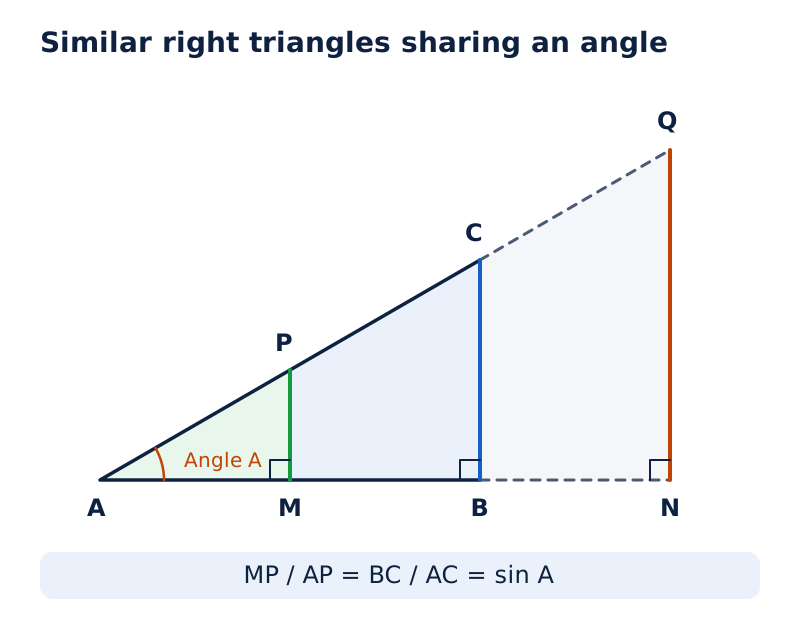
Points , , and lie along the horizontal line. Points , and lie on the sloping line from . Here is on the extension of , and is its perpendicular foot. Upright segments join to , to , and to .
Drawn by One Young India. See Fig. 8.6 in your NCERT textbook
This explains why knowing a ratio does not determine a triangle's absolute size. A ratio specifies relative lengths. An additional actual side length is needed when the aim is to calculate actual distances rather than further ratios.
How can one known ratio give the other ratios?
A known ratio identifies two sides in proportion. Let denote a positive scale factor. Multiples of can represent the two sides, and Pythagoras' theorem gives the third side. The scale factor cancels when the required side ratios are formed.
How does a tangent ratio determine five other ratios?
Worked example 1. Given the acute angle with , find the other five trigonometric ratios.
Answer: Use triangle , right-angled at , with opposite side , adjacent side and hypotenuse .
- Translate tangent into proportional sides:
- Apply Pythagoras' theorem:
- Take the positive length:
- Calculate sine and cosine:
- Take the required reciprocals:
Positive roots are essential when calculating lengths. A negative number cannot represent the length of a triangle side. For an acute angle, all six ratios are positive because their numerators and denominators are positive side lengths.
How are squared ratios calculated from given sides?
Worked example 2. Triangle is right-angled at , with units and units. Let . Find and .
Answer: Here the right angle has changed position, so is the hypotenuse. Relative to , is opposite and is adjacent.
- Find the missing side square:
- Take the positive square root:
- Form the ratios:
- Add their squares:
- Subtract their squares in the requested order:
The second calculation shows why the order of subtraction matters. The sum and difference use the same ratios, but the operations produce different answers. Square each ratio first, then combine the fractions using their common denominator.
How do equal sides and side differences help solve triangles?
Sometimes the information is a special ratio or a relationship between sides. First express that information as an equation. Then combine it with Pythagoras' theorem. This gives the side lengths needed for the requested ratios without guessing a value for the unknown angle.
What follows when tangent equals one?
Worked example 3. In triangle , right-angled at , suppose . Verify .
Answer: Tangent compares the two shorter sides, so its value immediately tells us that these sides are equal.
- Use the tangent definition and the positive scale factor :
- Calculate the hypotenuse square:
- Take its positive root and form the ratios:
- Substitute and multiply:
How can a difference between sides be used?
Worked example 4. Triangle is right-angled at . Its vertices are , and ; and . Determine and .
Answer: The abbreviation means centimetres. Let be the numerical length of in centimetres. Then the hypotenuse has numerical length in centimetres.
- Express the sides using the stated difference:
- Apply Pythagoras to numerical lengths in centimetres:
- Expand the square:
- Cancel equal terms and solve:
- Recover both side lengths:
- Use angle , whose opposite side is :
In the second example, the side difference makes the hypotenuse expressible using the other unknown side. Expanding the square leaves a linear equation because the equal squared terms cancel. The final ratios still depend on choosing the correct opposite and adjacent sides.
How are the trigonometric ratios of forty-five degrees derived?
The degree symbol indicates angle measurement in degrees. A right triangle with one acute angle of has its other acute angle equal to as well. Equal angles face equal sides, so its two shorter sides have the same length. This creates an isosceles right triangle.
Derivation: Ratios from equal perpendicular sides
Let be the positive length of each shorter side in triangle , right-angled at .
- Identify the equal sides:
- Use Pythagoras to calculate the hypotenuse:
- Divide a shorter side by the hypotenuse:
- Compare the two equal shorter sides:
- Take reciprocals:
The scale cancels. The value of does not appear in any final ratio. This is the fixed-angle property in action: every right triangle with these angle measures has the same side proportions.
Sine and cosine agree here because the opposite and adjacent sides are equal. That equality is linked to this particular angle; it is not a statement that sine and cosine have equal values for every acute angle.
The value of tangent is especially easy to check: equal positive quantities divided by one another give unity. The reciprocal ratios provide a second check, since the reciprocal of unity is unity, while the reciprocal of is .
How are the ratios of thirty and sixty degrees obtained?
Begin with an equilateral triangle and split it into two right triangles using an altitude. Each original angle is . The altitude bisects the base and the angle at the opposite vertex, producing an acute angle of in each half.
What the figure shows
Splitting an equilateral triangle
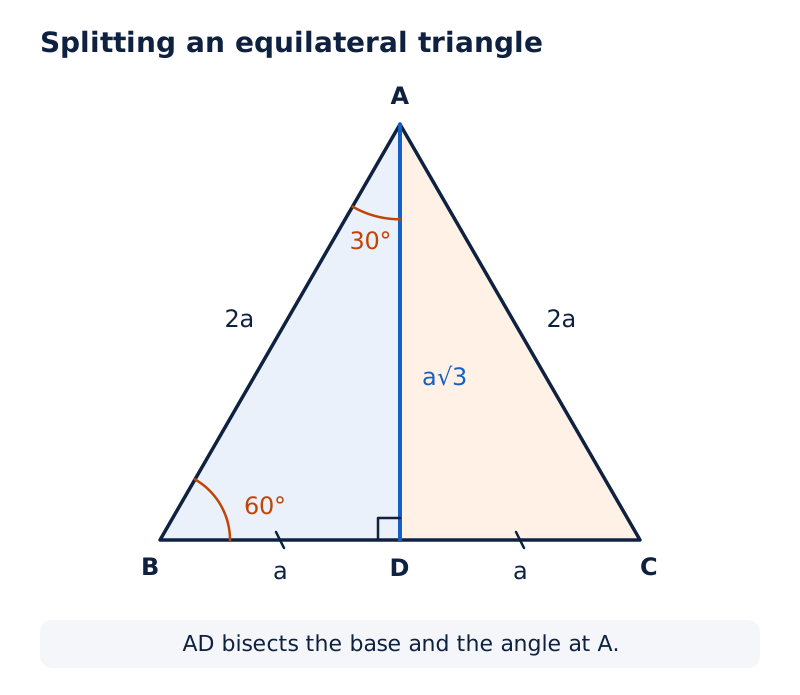
Vertex is above the base joining and . Point is the perpendicular foot on that base. Segment is drawn vertically, with a label beside at , and a label at .
Drawn by One Young India. See Fig. 8.15 in your NCERT textbook
Derivation: Ratios from half an equilateral triangle
Let the side length of equilateral triangle be , where is positive. In right triangle , the side opposite angle is , the adjacent side is , and the hypotenuse is .
- Use the equal halves of the base and vertex angle:
- Find the altitude square:
- Take the positive length:
- Form the ratios at the smaller acute angle:
- Change to the other acute angle:
- Obtain the remaining values by reciprocation:
Changing the reference angle exchanges the opposite and adjacent sides. The hypotenuse remains unchanged. This accounts for the exchanged sine and cosine values in these two rows of the standard-angle table.
The construction also explains why tangent can exceed unity. For the larger acute angle, the opposite side is longer than the adjacent side. Tangent compares those two sides, so the restriction applying to sine and cosine does not apply to tangent.
What are the standard values and when is a ratio undefined?
The acute-angle triangle definitions are extended to and . When angle becomes very close to zero, its opposite side becomes very small and the hypotenuse becomes nearly equal to its adjacent side. This motivates the endpoint sine and cosine values.
How are endpoint values defined?
The definitions are and . As the angle becomes very close to a right angle, the adjacent side becomes nearly zero and the hypotenuse becomes nearly equal to the opposite side. Accordingly, and .
The remaining endpoint values follow from the quotient and reciprocal relationships. A ratio with zero in its denominator is not defined. “Not defined” must therefore be retained as a distinct entry in the table, rather than replaced by zero.
| Ratio | |||||
|---|---|---|---|---|---|
| Not defined | |||||
| Not defined | |||||
| Not defined | |||||
| Not defined |
What patterns should be checked?
As the angle increases from to , sine increases from zero to unity and cosine decreases from unity to zero. Neither exceeds unity. Secant and cosecant are at least unity wherever they are defined in this interval.
Note: Tangent and secant are undefined at because their formulas divide by . Cotangent and cosecant are undefined at because their formulas divide by .
Use exact fractional and square-root values when substituting from the table. Before carrying out any multiplication or division, check the named ratio and the angle together. A defined value for one ratio does not make every ratio at that angle defined.
How are standard ratios used to find sides and angles?
To find a missing side, choose a ratio that contains that side and a side already known. To find an acute angle, calculate a ratio from two known sides and match it to a standard value. Correct side identification determines which ratio is appropriate.
How can a known angle and one side determine two sides?
Worked example 5. Triangle is right-angled at , with and . Find and .
Answer: Relative to angle , is opposite, is adjacent and is the hypotenuse.
- Choose tangent to connect the known side with :
- Rearrange to obtain the adjacent side:
- Choose sine to connect the known side with :
- Rearrange to obtain the hypotenuse:
- Check the hypotenuse with Pythagoras:
The ratio choice avoids solving for an unnecessary side first. Tangent gives the adjacent side directly, while sine gives the hypotenuse directly. The Pythagoras calculation confirms that the two answers are consistent with the right triangle.
How can two sides determine both acute angles?
Worked example 6. Triangle , whose vertices are , and , is right-angled at . Given and , determine and .
Answer: Side is the hypotenuse. Side is opposite the angle at .
- Form the sine ratio at :
- Match this ratio with the standard acute-angle value:
- Subtract the right angle and the known acute angle from the triangle's angle sum:
The acute-angle condition is part of this reasoning. The two angles sought are the non-right angles of a right triangle. After one has been determined, the other follows from their sum being a right angle.
How are the three fundamental trigonometric identities proved?
A trigonometric identity is an equation involving trigonometric ratios that holds for every value of the angle for which its expressions are defined. The three fundamental identities follow by dividing Pythagoras' theorem by the square of a different side.
Use triangle , right-angled at . Relative to angle , its opposite side is , adjacent side is , and hypotenuse is . The proof begins with positive side lengths; endpoint cases are checked using their defined values.
Identity: The sum of squared sine and cosine is unity
- Start with Pythagoras' theorem:
- Divide every term by the hypotenuse squared:
- Replace the side ratios with cosine and sine:
Domain: The identity also holds at both endpoints, so it applies throughout . Both sine and cosine are defined throughout that interval.
Identity: Secant squared minus tangent squared is unity
- Again begin with the side-length equation:
- Divide every term by the adjacent side squared:
- Recognise tangent and secant:
- Rearrange to the difference form:
Domain: This identity applies for . It holds at zero, but the right-angle endpoint is excluded because tangent and secant are undefined there.
Identity: Cosecant squared minus cotangent squared is unity
- Start from the same Pythagoras equation:
- Divide every term by the opposite side squared:
- Replace the quotients with trigonometric ratios:
- Rearrange to the difference form:
Domain: This identity applies for . Zero is excluded because cotangent and cosecant are undefined there, while the right-angle endpoint is included.
These identities connect squares of ratios, not the unsquared ratios. When solving for an individual ratio at an acute angle, take the positive square root. Keep the permitted angle range with each identity rather than treating all endpoint cases alike.
How can identities simplify expressions and prove equalities?
Identities allow an expression to be rewritten without changing its value. A useful approach is to replace secant, cosecant, tangent and cotangent by sine and cosine, combine fractions, and then use the fundamental identities. Every division requires a non-zero denominator.
How are other ratios expressed in terms of sine?
Worked example 7. For acute angle , express , and in terms of .
Answer: Begin with the identity connecting the squares of sine and cosine.
- Rearrange the identity:
- Use positivity of cosine for an acute angle:
- Substitute into the tangent quotient:
- Take the reciprocal of cosine:
The positive square root is justified by the angle condition. The formula for cosine does not require choosing a negative sign here. Tangent and secant then follow directly from definitions already established.
How does a difference of squares complete a proof?
Worked example 8. Prove, for acute angle , that .
Answer: Transform the left-hand expression into the required right-hand value.
- Replace secant and tangent:
- Combine the bracket and multiply the fractions:
- Multiply the conjugate factors:
- Use the fundamental identity and cancel:
For the acute angle used here, cosine is positive, so the final cancellation is permitted. The proof uses a difference of squares followed by the sine-cosine identity, rather than assigning a particular numerical angle.
How can factoring reveal a reciprocal ratio?
Worked example 9. For acute angle , prove .
Answer: Rewrite cotangent before trying to cancel anything.
- Substitute the quotient definition:
- Factor cosine from the numerator and denominator:
- Cancel the common non-zero factor:
- Recognise the reciprocal of sine:
Cancel factors, not separate terms. Factoring first makes the valid cancellation visible. The resulting expression matches the desired right-hand side, completing the proof for the stated acute-angle domain.
Glossary
- Trigonometry — The study of relationships between the sides and angles of a triangle.
- Hypotenuse — The longest side of a right triangle, opposite its right angle.
- Opposite side — The side facing the particular acute angle chosen in a right triangle.
- Adjacent side — The side next to the chosen acute angle, excluding the hypotenuse.
- Sine — The ratio of the opposite side to the hypotenuse for a chosen acute angle.
- Cosine — The ratio of the adjacent side to the hypotenuse for a chosen acute angle.
- Tangent — The ratio of the opposite side to the adjacent side for a chosen acute angle.
- Cosecant — The reciprocal of sine, comparing the hypotenuse with the opposite side.
- Secant — The reciprocal of cosine, comparing the hypotenuse with the adjacent side.
- Cotangent — The reciprocal of tangent, comparing the adjacent side with the opposite side.
- Similar triangles — Triangles with equal corresponding angles and proportional corresponding side lengths.
- Trigonometric identity — An equation involving trigonometric ratios, true for every angle value for which its expressions are defined.
Common errors and misconceptions
- Misconception: The opposite side has the same name whichever acute angle is chosen. Correct: Opposite and adjacent depend on the reference angle; changing to the other acute angle exchanges their roles.
- Misconception: The expression multiplies “sin” by . Correct: It names the sine of angle ; the ratio name and angle must be read together.
- Misconception: The notation means . Correct: It means , so the value of the ratio is squared.
- Misconception: Tangent must be less than unity because sine and cosine do not exceed unity. Correct: Tangent compares the two shorter sides; for example, .
- Misconception: A ratio with a zero denominator has value zero. Correct: It is undefined. In particular, , , and are undefined.
- Misconception: Sine and cosine both increase as an angle increases from to . Correct: Sine increases, but cosine decreases over this interval.
- Misconception: Cosecant and inverse sine are the same notation. Correct: Cosecant is , meaning the reciprocal of sine. The notation , called inverse sine, has a different meaning.
Exam-style questions with model answers
Q1. Triangle is right-angled at . Define and using its sides. [2 marks]
- Side is opposite angle , and is the hypotenuse. Therefore the sine ratio is
- Side is adjacent to angle , excluding the hypotenuse. Therefore the cosine ratio is
Q2. Using and , state why is undefined and find . [2 marks]
- Cosecant is the reciprocal of sine. Since the supplied sine value is zero, its reciprocal would divide by zero; therefore is undefined.
- Secant is the reciprocal of cosine, whose supplied value is unity:
Q3. For an acute angle , . Calculate and . [3 marks]
- Choose triangle , right-angled at . Since sine compares opposite side with hypotenuse, choose a positive scale factor and write
- Find the adjacent side using Pythagoras and choose its positive length:
- Divide the appropriate sides. Cosine uses adjacent over hypotenuse, while tangent uses opposite over adjacent:
Q4. For acute angle , . Calculate the other five trigonometric ratios. [3 marks]
- Secant compares hypotenuse with adjacent side. Taking as a positive scale factor, represent those lengths by and , respectively. The opposite side is the remaining unknown length.
- Let denote that opposite side length. By Pythagoras and positivity,
- Use the three side lengths to form each requested ratio, cancelling their common scale factor:
Q5. Triangle is right-angled at , and . Calculate and , using standard trigonometric values. [4 marks]
- Relative to the given angle at , side is opposite, side is adjacent and side is the hypotenuse. Tangent therefore connects the known side to .
- Substitute the standard tangent value and rearrange:
- Now choose sine because it connects the same known opposite side with the hypotenuse:
- Rearranging the last equation gives the hypotenuse: Both required side lengths are positive, as triangle lengths must be.
Q6. Triangle is right-angled at , units and units. With , calculate and . [4 marks]
- The hypotenuse is . Find the missing opposite side using Pythagoras and its positive square root:
- For the angle at , the adjacent side is . Hence the required ratios are
- Square both values and add with their common denominator:
- Subtract the squared values in the stated order to obtain the second answer:
Q7. Triangle is right-angled at , , and . Determine and , showing how the unknown sides are found. [5 marks]
- The right angle is at , so is the hypotenuse. Let be the numerical length of in centimetres. The given difference gives
- Apply Pythagoras to the numerical side lengths, keeping all measurements in the same unit:
- Expand the square, cancel the matching squared terms, and solve the resulting linear equation:
- Return to the side lengths to obtain Relative to angle , side is opposite and side is adjacent.
- Use these side roles to calculate the requested ratios:
Q8. For an acute angle , prove , showing the substitutions and identity used. [5 marks]
- Begin with the left-hand expression. Replace secant by the reciprocal of cosine and tangent by sine divided by cosine:
- The terms inside the bracket share the same denominator. Combine them to write the expression as
- Multiply the numerators and denominators, then use the difference-of-squares factorisation:
- The fundamental identity gives the required replacement for the numerator:
- Substitute and simplify: Cosine is positive for an acute angle, so this division is valid and the required equality is proved.
Key takeaways
- Choose the reference angle before naming opposite and adjacent sides; the hypotenuse faces the right angle.
- The six ratios compare pairs of sides, while reciprocal relationships connect sine, cosine and tangent with the remaining ratios.
- Similar right triangles have equal corresponding ratios, so changing their size does not change the ratios of a fixed angle.
- A given ratio supplies proportional sides; Pythagoras then supplies the missing side needed to calculate further ratios.
- The standard acute-angle values come from an isosceles right triangle and half of an equilateral triangle.
- Endpoint values require care: a zero denominator makes a ratio undefined, even when other ratios at that angle exist.
- The three fundamental identities follow from dividing Pythagoras' theorem by the square of each triangle side.
- In identity proofs, substitute definitions, factor carefully and check denominators before cancelling common factors.
Test yourself
Which side is the hypotenuse in triangle , right-angled at ?
Side is the hypotenuse because it lies opposite the right angle at .
What does the notation mean?
It means , the square of the sine ratio, rather than the sine of a squared angle.
Why do similar right triangles give the same sine for a corresponding angle?
Their corresponding sides are proportional, so dividing the opposite side by the hypotenuse gives the same ratio.
What are the reciprocal partners of sine, cosine and tangent?
Their reciprocal partners are cosecant, secant and cotangent, respectively, wherever the required reciprocals are defined.
What is , and why?
Its value is unity because the opposite and adjacent sides of the corresponding isosceles right triangle are equal.
Which two ratios are undefined at ?
Tangent and secant are undefined because their expressions divide by cosine, which is zero at that angle.
Which fundamental identity connects cosecant and cotangent?
The identity is , valid here for , where these ratios are defined.
Why is the positive square root chosen when recovering cosine for an acute angle?
Cosine is the ratio of two positive side lengths, so its value for an acute angle is positive.