
Probability | CBSE Class 10 Maths Notes
On this page
Watch & explore
Start with a few high-quality watches, then dive into the notes below.
This Class 10 Mathematics note covers theoretical probability, equally likely outcomes, elementary events, complementary events, impossible and certain events, coins, dice, cards, random selection, changing collections, and probability through lengths and areas.
What does theoretical probability measure?
Probability describes the chance of an event occurring. An experiment such as tossing a coin has possible outcomes, while an event specifies the outcome or outcomes of interest. Before calculating, identify both the experiment and the event precisely.
A fair coin is unbiased: there is no reason for it to fall more often on one side than the other. A random toss allows it to fall freely without interference. Disregarding landing on its edge, head and tail are equally likely outcomes.
A fair die has six equally likely outcomes, numbered from one to six. However, not every experiment has equally likely outcomes. A bag containing four red balls and one blue ball is more likely to yield red than blue, even though there are two colour descriptions.
How do empirical and theoretical probability differ?
Let denote the event being considered, and let mean the probability of that event. Empirical probability uses observed trials; theoretical probability uses equally likely possible outcomes. The notation must be interpreted according to the approach being used.
| Approach | Basis | Formula |
|---|---|---|
| Empirical probability | Results of repeated trials | |
| Theoretical probability | Equally likely possible outcomes |
Definition: The theoretical, or classical, probability of an event is the number of favourable outcomes divided by the number of all possible outcomes, assuming that the outcomes are equally likely.
Repeated experiments may be expensive or unfeasible. The theoretical approach avoids repetition when its assumptions are justified. As trials increase, we may expect empirical and theoretical probabilities to be nearly the same; this does not promise exact agreement in a particular experiment.
Note: Count equally likely individual outcomes before grouping them. Two colour names do not make the probabilities equal when the bag contains different numbers of balls of those colours.
What are elementary, impossible and certain events?
An elementary event contains only one outcome of an experiment. Getting a head in one coin toss is elementary. Getting a number greater than four on a die is not elementary, because either five or six satisfies that condition.
Result: Probabilities of elementary events add to one
The sum of the probabilities of all the elementary events of an experiment is one. The word all matters: together these events account for every possible individual outcome. For one coin toss, they are getting a head and getting a tail.
Worked example 1. A fair coin is tossed once. Find the probability of getting a head and of getting a tail.
Answer: Write for a head and for a tail. Inside probability notation, these letters represent the corresponding events.
- List the two equally likely outcomes: .
- Count the single outcome favourable to a head and divide by the total:
- Count the single outcome favourable to a tail and divide by the same total:
- Check that both elementary events together cover the experiment:
Result: Probability lies between zero and one
An impossible event cannot occur and has probability zero. A certain event, also called a sure event, must occur and has probability one. These are the two endpoints of the probability range.
Let be the number of favourable outcomes and the total number of equally likely possible outcomes, with positive. The range follows directly from counting:
- The favourable count cannot be negative or exceed the total:
- Divide by the positive total:
- Use the probability formula:
Check: A negative probability or a probability above one signals an error. For a standard die, getting eight is impossible, while getting a number less than seven is certain.
How do complementary events simplify a calculation?
The complement of an event contains the outcomes in which that event does not happen. The symbol means the complement of event , read as “not E”. An event and its complement together cover all possible outcomes without overlap.
Result: Complementary probabilities add to one
Using the favourable count and total count defined earlier, every outcome either belongs to the event or to its complement. This gives a direct derivation of the complement rule.
- Subtract the favourable outcomes from the total to count the complement:
- Divide each count by the total:
- Rearrange to obtain the required probability:
Interpretation: The probability of an event determines the probability of its complement. Count directly when the required outcomes are easy to list; subtract from one when the opposite event is easier to identify.
Which words identify the correct complement?
For one die throw, the complement of “greater than four” is “less than or equal to four”. It includes four itself. For two coin tosses, the complement of “at least one head” is “no head”, rather than “at least one tail”.
| Experiment | Event | Complement |
|---|---|---|
| One coin toss | Head | Tail |
| One die throw | Number greater than four | Number less than or equal to four |
| One card draw | An ace | Not an ace |
| Two coin tosses | At least one head | No head |
Read the complete event before subtracting. A complementary pair is tied to the same experiment and the same collection of possible outcomes. When objects are removed, establish the new collection before applying the rule to a later draw.
How are events counted when one die is thrown?
A standard fair die has the equally likely outcomes . A condition such as “greater than four” selects some of these outcomes. The denominator remains the full count of six, while the numerator depends on the condition.
Worked example 2. Throw a fair die once. Find the probabilities of getting a number greater than four and a number less than or equal to four.
Answer: Let denote getting a number greater than four and denote getting a number less than or equal to four.
- List all outcomes and count them: , giving six equally likely possibilities.
- For , the favourable outcomes are , giving two possibilities.
- Substitute and simplify by dividing numerator and denominator by two:
- For , the favourable outcomes are . Hence
- Check the complementary probabilities:
How do the extreme cases work?
The same method handles impossible and certain events. There is no special counting rule: the favourable count becomes either zero or the whole set of possibilities.
- No face shows eight, so there are zero favourable outcomes:
- Every face shows a number less than seven, so all six outcomes are favourable:
Neither event in the worked example is elementary: the first includes two outcomes and the second includes four. Distinguish the name of an event from the number of outcomes it contains. One verbal condition can cover several different results of the experiment.
How do random selections from bags and classes work?
When an object is selected at random, each individual object is equally likely to be selected. Colour categories need not be equally likely. The correct denominator is the number of objects available, not the number of colours or categories mentioned.
Worked example 3. A box contains three blue, two white and four red marbles. One marble is drawn at random. Find the probability of each colour.
Answer: Use descriptive event names so that each probability identifies the colour being selected.
- Add all marbles to obtain the total number of outcomes:
- There are two favourable white marbles:
- There are three favourable blue marbles; simplify the fraction:
- There are four favourable red marbles:
- Check that the colours cover the box:
Why does the selection procedure matter?
For choosing a class representative, write each student's name on a separate identical card, mix the cards thoroughly, and draw one. This procedure makes each name equally likely. It does not make the two categories of girls and boys equally likely.
Worked example 4. A class has forty students: twenty-five girls and fifteen boys. One representative is chosen using the identical, thoroughly mixed name cards. Find the probability of selecting a girl and of selecting a boy.
Answer: Count students through their individual name cards.
- There is one card per student, giving possible outcomes.
- The twenty-five girls give twenty-five favourable cards:
- The fifteen boys give fifteen favourable cards:
- Verify using the complement:
Both examples use the same counting principle. Identify equally likely individual choices first, then collect those satisfying the event. The larger group has more favourable outcomes even though the selection treats every individual choice in the same way.
How are probabilities calculated for playing cards?
A standard deck contains fifty-two cards divided into four suits of thirteen cards each. Spades and clubs are black; hearts and diamonds are red. Each suit contains an ace, king, queen, jack, and the numbered cards from ten down to two.
Face cards are kings, queens and jacks. An ace is a separate type of card. A well-shuffled deck makes each individual card equally likely to be drawn, so a single draw from the complete deck has fifty-two possible outcomes.
| Suit | Colour | Number of cards |
|---|---|---|
| Spades | Black | |
| Hearts | Red | |
| Diamonds | Red | |
| Clubs | Black |
Worked example 5. Draw one card from a well-shuffled deck of fifty-two cards. Find the probability that it is an ace and that it is not an ace.
Answer: There is one ace in each of the four suits.
- Count all possible card outcomes: .
- Count the favourable aces and divide by the total:
- Count the cards that are not aces:
- Use that count for the second event:
- Check by subtraction from one:
The words well-shuffled justify treating the card outcomes equally. After that, the calculation is a count. Distinguish the full deck from a smaller collection of named cards; the denominator must describe the cards actually available for that draw.
Likewise, “not an ace” includes every card except the aces. It is not restricted to face cards or to one colour. Translate the entire condition into a favourable count before simplifying the fraction.
How can given probabilities and birthdays use the complement rule?
Sometimes a question supplies a probability directly. There is then no need to invent a count of trials or outcomes. If the required event is its complement, subtract the given probability from one, keeping the meaning of both events clear.
Worked example 6. Sangeeta and Reshma play a tennis match. The probability of Sangeeta winning is . Find the probability of Reshma winning, treating their wins as complementary events.
Answer: Let denote Sangeeta winning and denote Reshma winning.
- Record the supplied probability:
- Apply the rule for complementary events:
- Substitute and subtract:
- Check the total:
Which assumptions are needed for birthdays?
For two friends' birthdays, ignore a leap year and assume all three hundred and sixty-five days are equally likely. Fixing one friend's birthday lets the other friend's possible birthdays supply the outcomes. The equal-likelihood assumption is part of this model.
Worked example 7. Savita and Hamida are friends. Ignoring a leap year and assuming equally likely birthday dates, find the probability that their birthdays are different and that they are the same.
Answer: Fix Savita's birthday and consider Hamida's date.
- Hamida has equally likely possible birthday dates.
- Exactly one matches Savita's birthday. The number of different dates is
- Divide the different-date count by the total:
- Use the complement and simplify:
In the tennis problem, the numerical probability is given; in the birthday problem, it comes from counting under stated assumptions. Both then use the same complement rule. Do not replace these assumptions with an unsupported claim about actual birthday frequencies.
How do two coins produce four equally likely outcomes?
With two different fair coins, preserve the identity of the first and second coin. Using for head and for tail, an ordered pair records the first coin's result first and the second coin's result second.
Thus and are different outcomes. Both contain one head, but the head belongs to a different coin. Combining these as “one of each” hides two equally likely possibilities inside a single verbal description.
| Outcome | First coin | Second coin | At least one head? |
|---|---|---|---|
| Head | Head | Yes | |
| Head | Tail | Yes | |
| Tail | Head | Yes | |
| Tail | Tail | No |
Worked example 8. Harpreet tosses two different fair coins simultaneously. Find the probability that she gets at least one head.
Answer: “At least one head” includes both one head and two heads.
- List the four equally likely outcomes: .
- List the favourable outcomes: . There are three.
- Divide the favourable count by the total count:
- Check the complement. Only has no head, so
Note: “Two heads”, “two tails”, and “one of each” are three descriptions, but they are not equally likely. Count the four ordered outcomes before combining them into events.
This distinction explains why the denominator is four rather than three. The probability formula needs equally likely outcomes, not merely a list of different phrases describing what might happen. The table also makes the complement visible without further counting.
How are outcomes counted when two dice are thrown?
For two dice, distinguish the dice before listing outcomes. With a blue die and a grey die, write the blue result first and the grey result second. For every blue result, there are six possible grey results, giving thirty-six ordered outcomes.
What the figure shows
Ordered outcomes for two dice
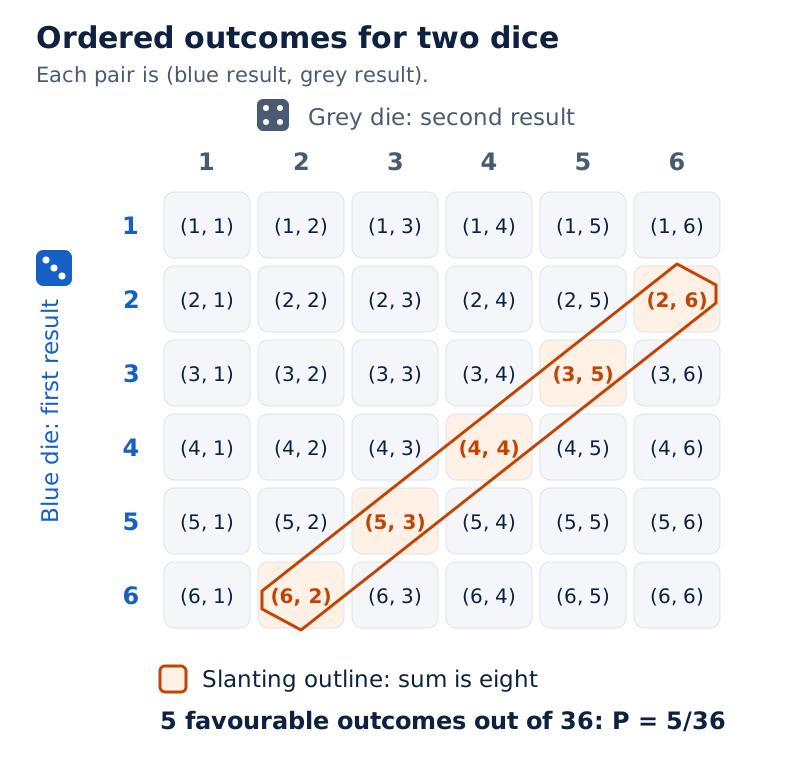
A blue die appears beside the rows and a grey die above the columns of a six-by-six outcome table. A slanting outline encloses the five ordered pairs whose entries add to eight.
Drawn by One Young India. See Fig. 14.3 in your NCERT textbook
The pair differs from because the dice show different individual results. Although their sums agree, they remain separate equally likely outcomes. Always distinguish an outcome pair from the sum calculated from that pair.
Worked example 9. Throw one blue and one grey fair die together. Find the probability that the sum is eight, thirteen, or less than or equal to twelve.
Answer: Use ordered pairs with the blue result first.
- Count the equally likely outcomes:
- The pairs giving eight are , giving five favourable outcomes.
- Calculate the first probability:
- No pair gives thirteen, so
- Every pair has a sum at most twelve, so
Why are the possible sums not equally likely?
The sums run from two to twelve, but the eleven sums occur through different numbers of ordered pairs. The sum two comes from , whereas the sum eight has the five pairs listed above. Counting sums as equal possibilities therefore gives incorrect probabilities.
Repeated throws can be treated similarly: throwing one die twice and throwing two dice simultaneously are treated as the same experiment for this counting method. For repeated throws, the first entry records the first throw and the second entry records the second throw.
How do acceptance rules and removal change favourable counts?
An event may combine several categories of objects. Read an acceptance rule carefully before counting. Someone who rejects only major defects accepts both good objects and objects with minor defects; their favourable count differs from someone accepting only good objects.
Worked example 10. A carton contains one hundred shirts: eighty-eight good, eight with minor defects and four with major defects. Jimmy accepts only good shirts; Sujatha rejects only major defects. Find each trader's probability of accepting one randomly drawn shirt.
Answer: The same carton supplies both calculations, but the acceptance events differ.
- Count the total:
- Jimmy accepts the eighty-eight good shirts:
- Sujatha accepts good shirts and shirts with minor defects, giving
- Calculate her probability:
What changes when a selected object is not replaced?
If an object is removed without replacement, the next draw is from a smaller collection. The total changes, and the favourable count may also change. Use the stated result of the first draw to establish what remains.
Worked example 11. Five cards, the ten, jack, queen, king and ace of diamonds, are shuffled face down. Find the probability of first drawing the queen. If the queen is drawn and put aside, find the probabilities of drawing an ace or a queen next.
Answer: Each draw is random from the cards available at that stage.
- Initially there are five cards and one queen:
- After the queen is put aside, the remaining count is
- The ace remains among those four cards:
- No queen remains, so
The second part describes a known removal, not an unspecified first draw. Update the collection before calculating. Keeping the original denominator would describe the original five-card collection instead of the four cards actually available.
How can lengths and areas extend the idea of probability?
Some experiments have infinitely many possible outcomes, such as every time within an interval or every point in a rectangle. The finite counting formula cannot be applied in its present form. Under suitable equal-likelihood assumptions, compare favourable length or area with the total.
How does a time interval give a probability?
What the figure shows
The stopping-time interval
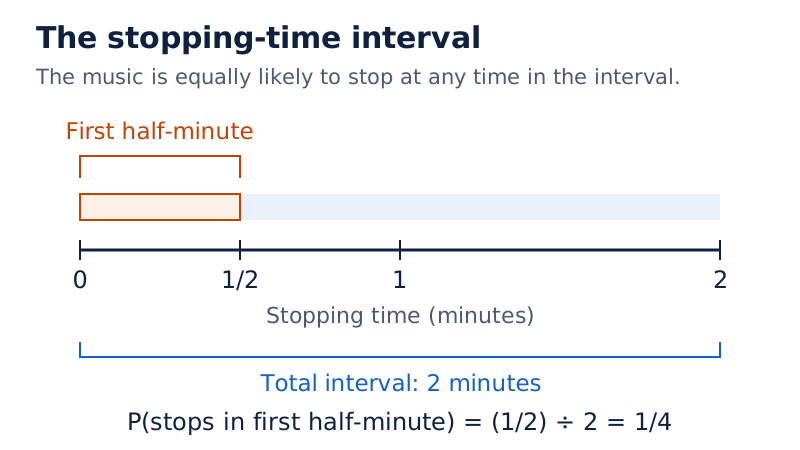
A number line marks zero, one-half, one and two. The interval from zero to two represents the possible stopping times in minutes; the first half-minute is the favourable interval.
Drawn by One Young India. See Fig. 14.1 in your NCERT textbook
Worked example 12. In a musical chair game, the music stops at an equally likely time within two minutes of starting. Find the probability that it stops within the first half-minute.
Answer: Compare the interval lengths measured in the same unit.
- The total interval has length minutes.
- The favourable interval has length minute.
- Form the ratio and simplify:
How does a rectangular region give a probability?
What the figure shows
A lake within a rectangular region
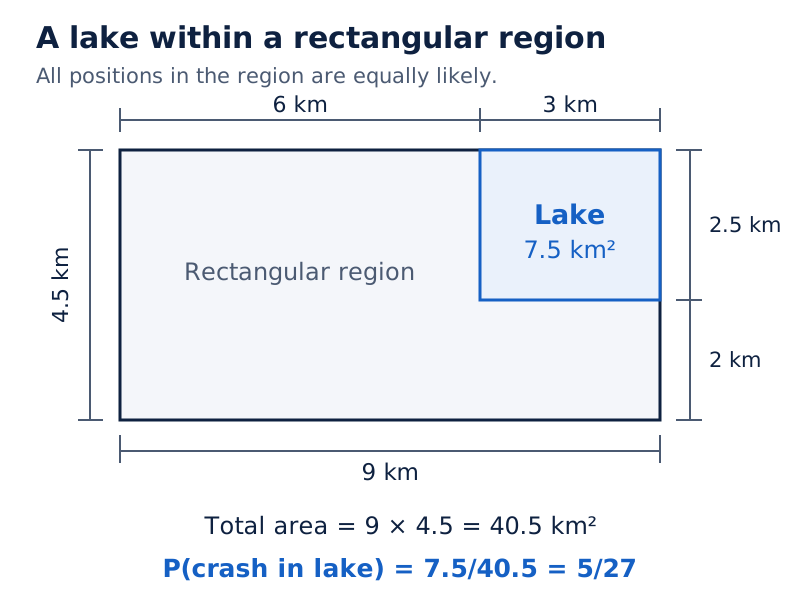
The outer rectangle is labelled nine kilometres across and four-and-a-half kilometres high. The lake occupies the upper-right rectangle. Six kilometres is marked to its left and two kilometres below it.
Drawn by One Young India. See Fig. 14.2 in your NCERT textbook
Worked example 13. Here km means kilometre, and means square kilometre. A missing helicopter is equally likely to have crashed anywhere in a rectangular region measuring km by km. The rectangular lake measures km by km. Find the probability that it crashed in the lake.
Answer: Use the favourable area divided by the total area.
- Calculate the area of the entire region:
- Calculate the lake's area:
- Divide and simplify:
These extensions retain the favourable-to-total ratio, but replace finite counts with lengths or areas. The assumption about where or when the outcome can occur remains essential. A diagram alone does not establish that all positions or times are equally likely.
Glossary
- Probability — A number describing the chance of an event, lying between zero and one inclusive.
- Theoretical probability — The ratio of favourable outcomes to all possible outcomes, assuming that the outcomes are equally likely.
- Empirical probability — The ratio of trials in which an event happened to the total number of trials.
- Outcome — A possible result of an experiment, such as head in a single coin toss.
- Event — An outcome or collection of outcomes specified by the condition being considered in an experiment.
- Favourable outcomes — The possible outcomes that satisfy the condition defining the event whose probability is required.
- Equally likely outcomes — Outcomes having the same possibility of occurring in the experiment under the stated assumptions.
- Elementary event — An event containing only one of the possible outcomes of an experiment.
- Complementary events — An event and the event that it does not occur, whose probabilities add to one.
- Impossible event — An event that cannot occur in the stated experiment and therefore has probability zero.
- Certain event — An event that is sure to occur in the stated experiment and has probability one.
- Fair coin — An unbiased coin for which head and tail are assumed equally likely in a random toss.
- Ordered pair — Two results recorded in a fixed order, distinguishing the first coin or die from the second.
- Face cards — The kings, queens and jacks in a deck, with these cards occurring in each suit.
Common errors and misconceptions
- Misconception: Two named outcomes must have equal probabilities. Correct: Equal likelihood needs justification. In a bag with four red balls and one blue ball, red and blue are not equally likely colour outcomes.
- Misconception: Divide by the number of colours in a marble problem. Correct: Count the equally likely individual marbles. Three blue, two white and four red marbles give nine possible selections.
- Misconception: The complement of “greater than four” excludes four. Correct: The complement is “less than or equal to four”, so four belongs to the complementary event.
- Misconception: “At least one head” means exactly one head. Correct: It also includes two heads when two coins are tossed. Only the no-head outcome is excluded.
- Misconception: Two heads, two tails and one of each are equally likely. Correct: One of each contains two distinct ordered outcomes, while each of the other descriptions contains one.
- Misconception: Each possible sum on two dice has the same probability. Correct: Equally likely ordered pairs produce different sums in different numbers of ways. Count the pairs satisfying the required sum.
- Misconception: A denominator stays unchanged after a card is removed. Correct: A later draw uses the remaining cards. Removing the queen from the five named diamond cards leaves four available cards.
- Misconception: Repeated trials must give exactly the theoretical probability. Correct: As trials increase, we may expect experimental and theoretical probabilities to be nearly the same, rather than exactly equal.
Exam-style questions with model answers
Q1. A fair coin is tossed once, with head and tail equally likely. Find the probability of a head and explain why tossing the coin is a fair way to choose between two teams. [2 marks]
- There are two equally likely outcomes and one favourable head outcome, so .
- Tail has the same probability, , giving each team the same chance when they are assigned opposite coin outcomes.
Q2. A fair die numbered one to six is thrown once. Find the probabilities of a number greater than four and of a number less than or equal to four. Check that the events are complementary. [3 marks]
- The six faces are equally likely. The outcomes greater than four are five and six, so the first probability is .
- The outcomes less than or equal to four are one, two, three and four, giving probability .
- The events cover every face without overlap and have total probability . They are therefore complementary events for this throw.
Q3. A box contains three blue, two white and four red marbles. Every marble is equally likely to be drawn. Find the probability of each colour and check the total. [4 marks]
- Count all individual marbles before grouping by colour. The total is , so nine is the denominator for every colour event.
- There are three blue marbles, giving .
- There are two white marbles and four red marbles, giving and .
- The three colours include every marble, and their probabilities total , as required.
Q4. One card is drawn from a well-shuffled deck of fifty-two cards containing four aces. Find the probability of an ace and of a non-ace, verify the complement rule, and explain why both calculations use the same denominator. [5 marks]
- Each of the fifty-two individual cards is equally likely to be drawn because the deck is well-shuffled. The total count for this experiment is therefore fifty-two.
- Four cards satisfy the ace condition. Divide this favourable count by the total and simplify by four: .
- Subtract the aces from the whole deck to count the other cards: . Therefore .
- The complement calculation confirms this result: .
- Both events describe the same single draw from the complete deck. The favourable counts differ, but the total number of possible card outcomes remains fifty-two.
Q5. Two fair dice, one blue and one grey, each numbered one to six, are thrown together. Treat their thirty-six ordered outcomes as equally likely. Find the probabilities of a sum of eight, a sum of thirteen, and a sum at most twelve. Explain why the eleven possible sums are not equally likely. [5 marks]
- Write the blue result first and the grey result second. Each of six blue results can accompany six grey results, giving equally likely ordered outcomes.
- A sum of eight comes from . Five favourable outcomes therefore give .
- No pair of these face numbers adds to thirteen, so this event is impossible: .
- Every ordered pair has a sum at most twelve, so this event is certain: .
- The sums have different favourable counts. Two comes only from , while eight has five pairs. Counting the eleven sums as equally likely would ignore this difference.
Q6. Sangeeta and Reshma play a tennis match in which their winning events are complementary. Sangeeta's probability of winning is . Find Reshma's probability of winning and verify your answer. [3 marks]
- The given winning events are complementary, so their probabilities sum to one. This allows the second probability to be calculated directly from the supplied first probability.
- Subtract Sangeeta's probability from one: .
- The verification is . The result also lies between zero and one, as every probability must do.
Q7. A carton has one hundred shirts: eighty-eight good, eight with minor defects and four with major defects. Jimmy accepts only good shirts. Sujatha rejects only major defects. One shirt is drawn at random. Find and explain each trader's probability of accepting it. [4 marks]
- The individual shirts are equally likely selections, with total count .
- Jimmy's acceptance event includes only the eighty-eight good shirts, giving .
- Sujatha accepts good shirts and those with minor defects. Her favourable count is , giving .
- The denominators agree because both events concern the same carton. The numerators differ because the traders apply different acceptance conditions to the minor defects.
Q8. Five cards, the ten, jack, queen, king and ace of diamonds, are well-shuffled face down. Find the probability of drawing the queen. If the queen is then put aside, find the probabilities that a random second card is an ace or a queen. [3 marks]
- Initially the five cards are equally likely and exactly one is the queen, giving .
- After the specified removal, cards remain. The ace is still present, so .
- The only queen has been put aside and is unavailable for the second draw. Therefore , an impossible event in the remaining collection.
Key takeaways
- Theoretical probability compares favourable outcomes with all possible outcomes, and its counting formula assumes those individual outcomes are equally likely.
- An elementary event contains one outcome; the probabilities of all elementary events in an experiment add to one.
- Impossible events have probability zero, certain events have probability one, and every probability lies between those endpoints.
- An event and its complement cover all possibilities without overlap, so subtracting one probability from one gives the other.
- In random selections, count individual cards, marbles or students before grouping them by the condition in the question.
- Distinguish the first coin or die from the second; ordered outcomes prevent different possibilities from being merged incorrectly.
- When an object is removed without replacement, establish both the new total and the remaining favourable count before calculating.
- Experimental results need not exactly match theoretical probabilities, although increasing trials may bring the two values close together.
Test yourself
What assumption makes the favourable-outcomes counting formula valid?
The individual possible outcomes must be equally likely. Merely listing different outcome descriptions does not establish equal likelihood.
What is an elementary event, and what is the total probability of all elementary events?
An elementary event contains one outcome. The probabilities of all elementary events of the experiment add to one.
What is the complement of getting a number greater than four on a standard die?
Getting a number less than or equal to four, including the face showing four itself.
Why does “one of each” conceal two outcomes when two different coins are tossed?
The first coin can show head and the second tail, or the first can show tail and the second head.
What makes getting eight on a standard six-faced die impossible?
No face is marked eight, so the event has no favourable outcome and its probability is zero.
Which cards are face cards, and is an ace included?
Kings, queens and jacks are face cards. An ace is not included among these face cards.
Why should a second draw be reconsidered after a card is put aside?
The available collection is smaller, and the number of cards satisfying the event may also have changed.
Why can the finite counting formula not directly handle every point inside a rectangle?
The rectangle contains infinitely many possible points. With the appropriate equal-likelihood assumption, an area ratio extends the probability idea.
Write about it
Turn a question from this chapter into a paper.
The Writing Studio has a structure guide, a rubric and citation tools for 15 formats, from essays to research papers. Drafting is free with an account. Learnacy Essential adds feedback from an AI writing coach and submission to The OYI Review.
Learnacy Essential is ₹1,499 for the year. Publication depends on review and is not guaranteed.