
Some Applications of Trigonometry | CBSE Class 10 Maths Notes
On this page

These Mathematics notes cover heights and distances, lines of sight, angles of elevation and depression, the choice of trigonometric ratios, observer height, ladders and ropes, flagstaffs, shadows, buildings, river widths, broken trees and movement problems.
What are the line of sight and the angles of elevation and depression?
How is the viewing angle measured?
Definition: The line of sight is the line drawn from an observer’s eye to the point on an object that the observer views.
The angle of elevation is the angle between the line of sight and the horizontal when the viewed point is above the observer’s horizontal level. Looking towards the top of a minar illustrates this situation: the observer raises their head.
The angle of depression is the angle between the line of sight and the horizontal when the viewed point is below the observer’s horizontal level. A girl on a balcony looking down towards a flower pot illustrates this situation.
What the figure shows
Looking above and below the horizontal
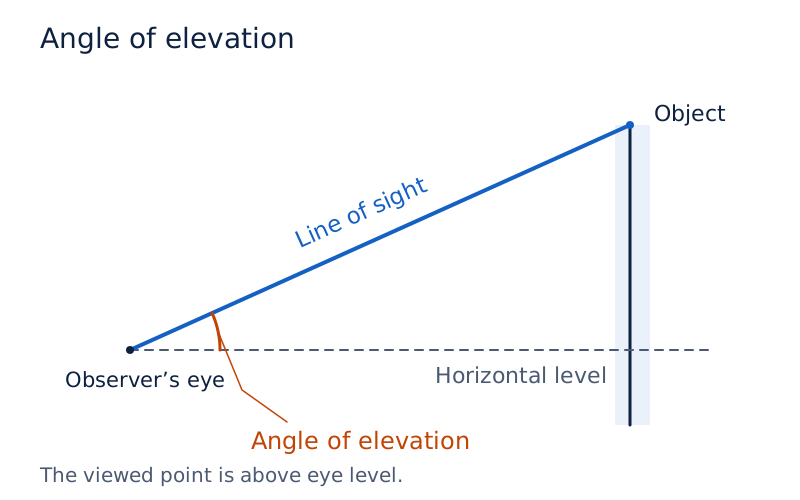
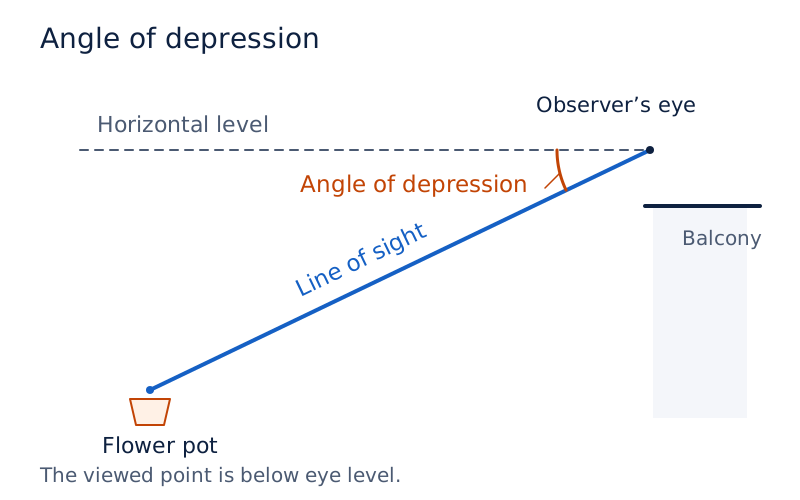
The first drawing labels an upward line of sight, an object, a horizontal level and an angle of elevation. The second labels a downward line of sight and an angle of depression from a balcony.
Drawn by One Young India. See Figs. 9.2 and 9.3 in your NCERT textbook
The horizontal through the eye is the reference line for both angles. A vertical wall or pole can help form a right triangle, but the stated viewing angle is measured from the horizontal, rather than from that vertical side.
| Feature | Elevation | Depression |
|---|---|---|
| Position of viewed point | Above the observer’s horizontal level | Below the observer’s horizontal level |
| Direction of sight | Upwards from the eye | Downwards from the eye |
| Reference line | Horizontal through the eye | Horizontal through the eye |
A useful first action is to mark the observer’s eye and the point being viewed. This identifies the actual line of sight before any side lengths or ratios are introduced. The two ends of the line of sight need not be at ground level.
Which trigonometric ratios connect height, distance and sloping length?
Choose a right triangle containing the known angle, a known length and the required length. The appropriate ratio depends on those sides. A height is not the same measurement as a ladder or rope that slopes from the ground.
Let denote the acute angle with the horizontal, the vertical height within the triangle, its horizontal distance and its hypotenuse length. The symbols , and mean tangent, sine and cotangent respectively.
Result: Tangent relates vertical height to horizontal distance
The vertical side is opposite the chosen angle and the horizontal side is adjacent to it. This is the pairing needed in the tower, chimney and shadow problems.
- Write the tangent ratio:
- Multiply by the horizontal distance:
- Alternatively, divide by the tangent to find distance:
Result: Sine relates vertical height to the hypotenuse
The hypotenuse is opposite the right angle. In the ladder problem it is the ladder itself. Sine uses this sloping length together with the height reached, so it avoids introducing an unnecessary horizontal unknown.
- Write the sine ratio:
- Multiply by the hypotenuse length:
- Divide by the sine to obtain the length:
Result: Cotangent relates horizontal distance to vertical height
The cotangent ratio uses the same two sides as tangent, in reverse order. It is useful when the vertical height is known and the horizontal distance is required.
- Write the cotangent ratio:
- Multiply by the vertical height:
- Compare the two ratios:
The standard values used below include , , and . Here means the positive square root of three, and the degree sign measures an angle in degrees. Lengths below use , meaning metres.
How do you turn a tower problem into a right triangle?
How should the information be organised?
A vertical tower on horizontal ground supplies two perpendicular sides: its height and the ground distance from its foot. The line joining the observation point to the top forms the sloping side. Mark the angle at the observation point.
Draw a simple labelled figure before calculating. Decide which side is unknown, then select a ratio involving that side and a known side. Substitute the given angle and distance only after the relationship is clear. Finish by identifying the required quantity and its unit.
What the figure shows
Tower viewed from the ground
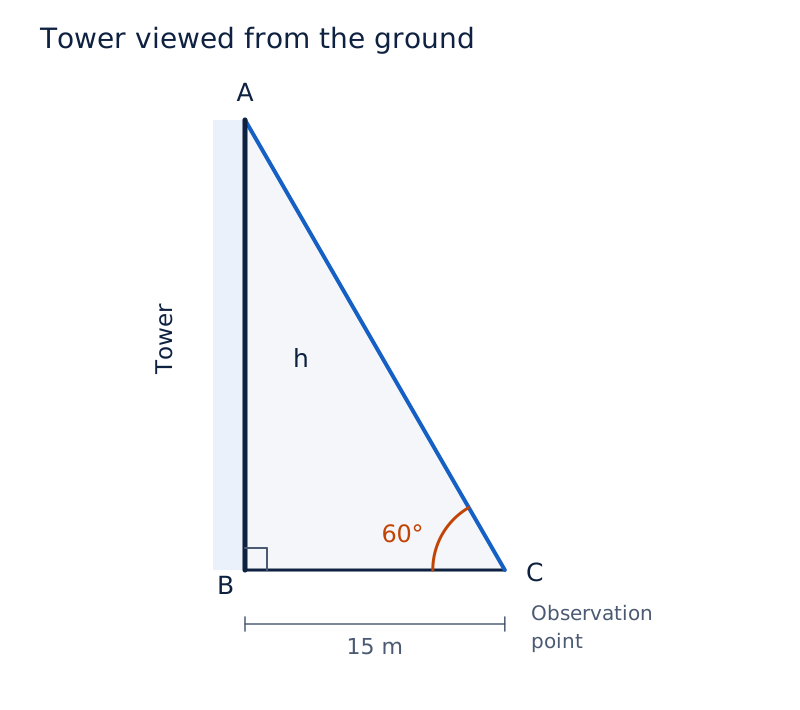
Point is the tower top, its foot and the observation point. The horizontal segment is labelled , and the angle at is .
Drawn by One Young India. See Fig. 9.4 in your NCERT textbook
Worked example 1. A tower stands vertically on the ground. From a point from its foot, the angle of elevation of its top is . Find its height.
Answer: Let be the height of the tower in metres. The known ground distance is the side adjacent to the angle, and the required height is the opposite side.
- Choose tangent:
- Insert the standard value:
- Multiply both sides by the denominator:
- State the required height:
The ground-level observation point matters here. The triangle’s vertical side represents the whole tower. If the line of sight began at a person’s eye above the ground, this vertical side would instead represent the height above eye level.
The exact surd answer preserves the trigonometric value without introducing rounding. A numerical approximation is needed only when the problem asks for one or supplies a value to use for the square root.
How are ladder lengths and stretched ropes calculated?
Which length is the hypotenuse?
A ladder leaning against a pole forms a right triangle with the pole and the ground. Its length is the hypotenuse, while the vertical side measures how high it reaches. First identify the contact point: it may be below the top of the pole.
Worked example 2. An electrician must reach a point below the top of a pole. A ladder makes with the horizontal. Find its length and the distance of its foot from the pole. Use .
Answer: Let be the height reached, the ladder length and the distance of its foot from the pole, all in metres.
- Subtract the unused top section:
- Use sine for the ladder:
- Insert the standard value and rearrange:
- Use the supplied approximation:
- Use cotangent for the horizontal distance:
- Rearrange and evaluate:
The ladder length is approximately , and its foot should be approximately from the pole.
How does a tightly stretched rope use the same idea?
A tightly stretched rope running from a pole top to the ground also forms the hypotenuse. The wording about stretching matters because the triangle uses a straight sloping side. Use the angle between that side and the ground.
Worked example 3. A circus artist climbs a rope stretched tightly from the top of a vertical pole to the ground. The rope makes with the ground. Find the pole’s height.
Answer: Let be the pole height in metres. The given rope length is the hypotenuse, so use sine.
- Relate height to rope length:
- Use the standard sine value:
- Multiply to obtain the height:
- State the result:
These two problems reverse the known and unknown measurements. In the ladder problem the height reached is known; in the rope problem the hypotenuse is known. The side relationship remains the same.
Why must an observer’s height be included?
What does the calculated vertical side represent?
When a person looks upwards, the horizontal reference passes through their eyes. The right triangle therefore begins above ground level. The vertical height calculated from its tangent ratio is the height of the object above that horizontal reference.
To obtain the object’s full height, add the observer’s eye height. Equivalently, when the full height is given, subtract eye height before using tangent. Both operations keep the triangle’s vertical and horizontal sides connected to the same observation level.
What the figure shows
Observer and chimney
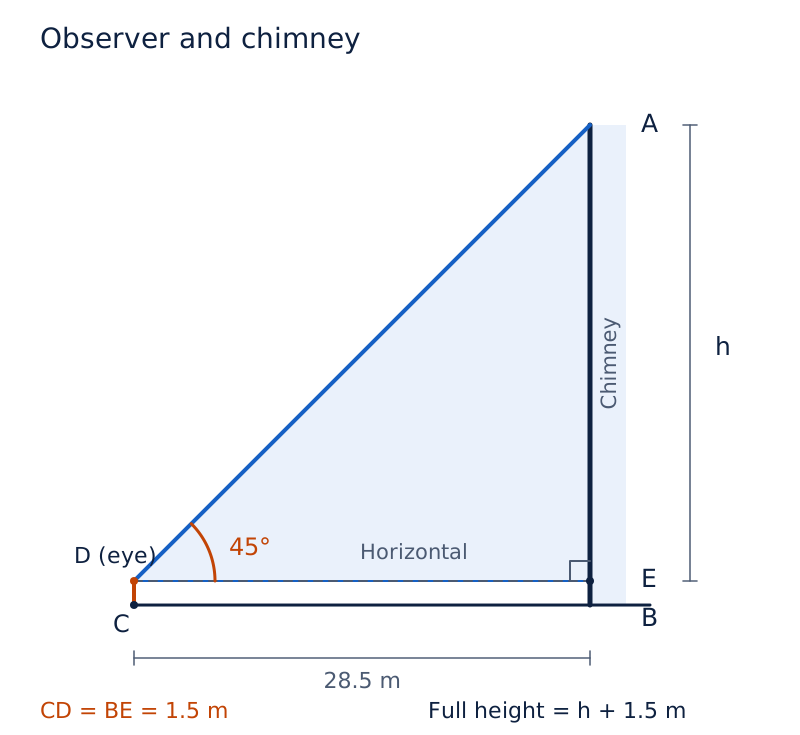
Point is the chimney top and its foot. Point is the observer’s eye above ground point . The horizontal from meets the chimney at ; the viewing angle at is .
Drawn by One Young India. See Fig. 9.6 in your NCERT textbook
Worked example 4. An observer tall stands from a chimney. The angle of elevation of its top from her eyes is . Find the chimney height, taking her eye level as the stated observer height.
Answer: Let be the height above eye level and the total chimney height, both in metres.
- Write the tangent ratio for the eye-level triangle:
- Substitute the tangent value:
- Calculate the vertical height above the eyes:
- Add the observer’s height:
The chimney is high.
Note: A height obtained from an eye-level triangle needs to be identified before it is used as a final answer. In this example, is the height above the eyes, while is the full chimney height.
How do two elevation angles reveal a flagstaff’s height?
Which distance is shared by the two triangles?
A flagstaff on a building gives two targets on the same vertical line. The building top and flagstaff top produce separate right triangles from the same observation point. Their horizontal distance is shared, but their vertical heights differ.
Start with the triangle containing the known building height. Its angle allows the shared distance to be found. Then use that distance in the triangle extending to the flagstaff top. Subtract the building height from the combined height.
Worked example 5. From one point on the ground, the top of a building has elevation , and the top of its flagstaff has elevation . Find the distance from the building and the flagstaff length. Use .
Answer: Let be the horizontal distance, the flagstaff length and the combined height, all in metres.
- Use the building triangle:
- Substitute and solve for distance:
- Evaluate the distance:
- Use the triangle reaching the flagstaff top:
- Insert the tangent value and rearrange:
- Subtract the building height:
- Evaluate the flagstaff length:
The distance is approximately , and the flagstaff is approximately long.
The larger triangle contains the total height, not the flagstaff alone. Keeping the building height visible in the equation prevents a common substitution error. The two angles refer to different targets viewed from one point, rather than to one target viewed from two points.
How can a change in shadow length determine a tower’s height?
How are the two shadow lengths related?
For a tower on level ground, the Sun’s altitude gives the angle of elevation of the tower top from the shadow tip. Two altitudes produce two triangles with a shared tower height. The ground sides are the corresponding shadow lengths.
When the difference between the shadows is given, represent one shadow by an unknown and express the other using that difference. The stated difference is a separate ground segment; it is not automatically the full length of either shadow.
What the figure shows
Two shadows of one tower
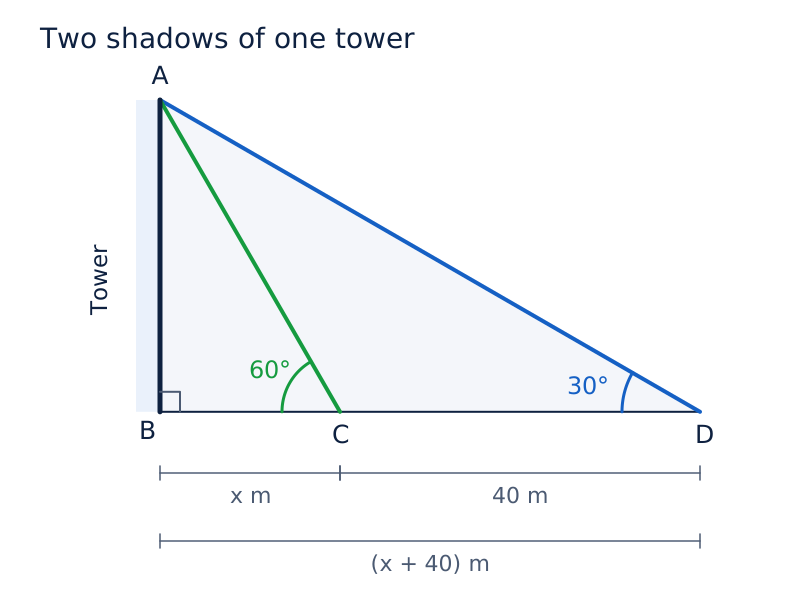
Point is the tower top and its foot. Point is the nearer shadow tip at , and is the farther tip at . Segment is labelled .
Drawn by One Young India. See Fig. 9.8 in your NCERT textbook
Worked example 6. A tower’s shadow on level ground is longer when the Sun’s altitude is than when it is . Find the tower height.
Answer: Let be the tower height and the shorter shadow length, both in metres. The longer shadow measures .
- Use the shorter shadow:
- Use the longer shadow:
- Substitute the first expression for the height:
- Cross-multiply:
- Collect terms and divide:
- Calculate the height:
The tower height is .
Both equations describe the same tower height. That shared measurement connects the triangles. A useful check is to substitute the calculated shorter shadow back into the longer-shadow expression and confirm that the given difference remains satisfied.
How are depression angles used for buildings of different heights?
Why can the viewing angle be transferred?
The horizontal through an observer and a horizontal through the viewed point are parallel lines. A line of sight crossing them is a transversal. Its alternate interior angles are equal, so a depression angle can be used as the corresponding elevation angle in the triangle below.
When viewing a shorter building, the line to its top involves the difference in heights. The line to its foot involves the full height of the taller building. Both triangles have the same horizontal separation.
Worked example 7. From the top of a multi-storeyed building, the angles of depression of the top and foot of an building are and , respectively. Find the taller building’s height and the distance between them, with both feet on the same horizontal level.
Answer: Let be the taller building’s height, the separation and the excess height above the shorter building, all in metres.
- Express the full height using the excess height:
- Use the angle to the shorter building’s foot:
- Use the angle to the shorter building’s top:
- Equate the expressions for the shared distance:
- Collect the unknown terms:
- Rationalise the denominator:
- Add the shorter building’s height:
- Use the equality obtained from the larger angle:
Both the taller building’s height and the separation are .
The equality of height and separation comes from the angle of in this particular triangle. It is not an instruction to treat height and ground distance as equal in every depression problem.
When should horizontal distances be added?
How does a bridge divide a river width?
A point on a bridge can lie above a point between the two banks. A perpendicular from that observation point to bank level divides the width into two adjacent horizontal segments. The total river width is their sum.
Each bank gives a separate right triangle with the bridge height as its vertical side. Transfer each depression angle to its corresponding elevation angle, calculate the two horizontal distances, and then combine them according to their positions.
What the figure shows
Viewing opposite banks from a bridge
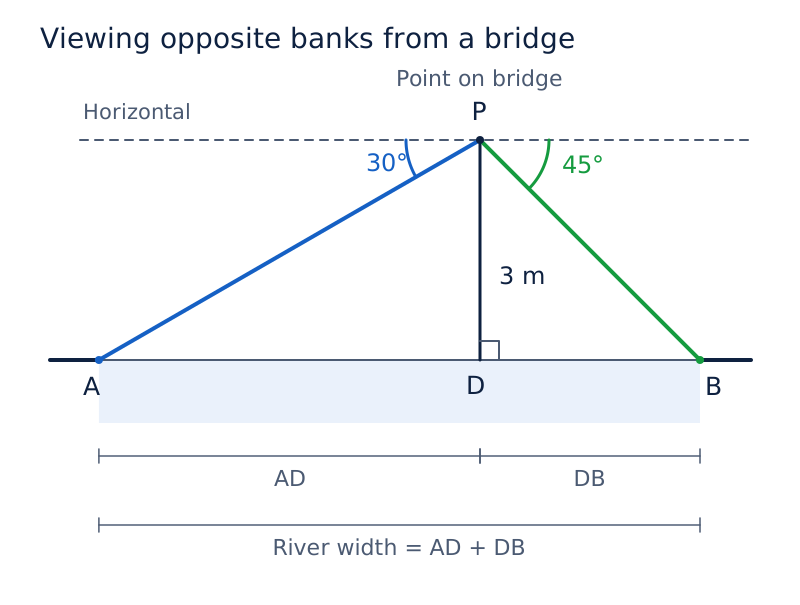
Point is on the bridge above point . Bank points and lie on opposite sides of . The vertical segment is labelled , with depression angles and .
Drawn by One Young India. See Fig. 9.10 in your NCERT textbook
Worked example 8. From a point on a bridge above bank level, the angles of depression of opposite banks are and . The perpendicular foot lies between the banks. Find the river width.
Answer: Let be the horizontal distance towards the bank viewed at , the distance towards the other bank and the river width, all in metres.
- Use the first triangle:
- Substitute and rearrange:
- Use the second triangle:
- Substitute and solve:
- Add the distances on opposite sides of the perpendicular foot:
The width is .
The positions of the points decide whether to add or subtract. Two distances measured outwards in opposite directions combine by addition. For two positions along the same direction from a common reference point, their separation is obtained by subtraction.
How do changing angles measure movement towards an object?
What stays fixed while the observer moves?
When an observer walks towards a building while looking at its top, two observations share the same vertical height above the eyes. Each observation has a different horizontal distance. Calculate these distances separately and subtract the final distance from the initial distance.
The observer’s height must be subtracted from the building height before either triangle is used. Otherwise, both triangles would have an incorrect vertical side even if the correct tangent values were substituted.
Worked example 9. A boy tall walks towards a building. The elevation of its top from his eyes increases from to . Find the distance walked, taking eye level as his stated height and his path directly towards the building.
Answer: Let be the vertical height above his eyes, the initial horizontal distance, the final distance and the distance walked, all in metres.
- Subtract eye height:
- Write the initial tangent equation:
- Substitute and rearrange:
- Write the final tangent equation:
- Substitute and rearrange:
- Subtract the two distances:
The boy walks .
| Situation | Shared measurement | Required combination |
|---|---|---|
| Boy approaching a building | Height above eye level | Initial distance minus final distance |
| Bridge above opposite banks | Height above bank level | Sum of the two horizontal segments |
| Flagstaff on a building | Horizontal observation distance | Combined height minus building height |
Read the movement words alongside the geometry. “Towards” identifies which ground distance becomes smaller. An increased elevation angle fits the nearer position in this problem, providing a check on the ordering of the two calculated distances.
How is the original height of a broken tree found?
Why must a sloping length be added to a vertical length?
A tree that breaks and touches the ground has two parts: the standing portion and the broken portion. The standing part is vertical, while the fallen part forms a sloping side. Their lengths together give the original tree height.
The ground distance from the foot to the point of contact is a third length. It is used to calculate the two parts, but it is not itself part of the original tree. Distinguishing these three lengths is the central step.
Worked example 10. A tree breaks in a storm. Its broken part bends until the top touches the ground at to the ground. The contact point is from the foot. Find the original height.
Answer: Let be the standing height, the length of the broken part and the original tree height, all in metres.
- Use tangent for the standing portion:
- Insert the tangent value and solve:
- Use sine to relate the standing and broken portions:
- Substitute the sine value and rearrange:
- Add the two parts of the tree:
- Simplify the exact result:
The original height is .
The triangle gives two component lengths, so the calculation is incomplete until they are combined. This is similar to adding observer height or subtracting building height: the final operation depends on what the requested quantity represents in the original situation.
How can changing depression angles determine travel time?
Why is uniform speed necessary?
For a car approaching a tower along a straight highway, observations from the tower top give two right triangles. The tower height stays fixed, and the horizontal distance decreases. Depression angles transfer to elevation angles using the parallel horizontal lines.
The geometry determines the relationship between the distances. The statement that the car moves at uniform speed then allows distances to be compared with travel times. A remaining distance that is half the distance already covered takes half the time.
Worked example 11. A man at the top of a tower observes a car approaching its foot along a straight highway at uniform speed. The depression angle changes from to in six seconds. Find the time needed to reach the foot from the second position.
Answer: Let be the tower height, the initial distance and the remaining distance, all in metres. Let be the remaining travel time in seconds.
- Use the first viewing angle:
- Use the second viewing angle:
- Subtract to find the distance covered in six seconds:
- Compare the remaining distance with the distance just covered:
- Use uniform speed to equate the time ratio and distance ratio:
- Multiply to find the remaining time:
The car takes three seconds to reach the tower’s foot from the second position.
The unknown height cancels from the distance ratio, so its numerical value is unnecessary. This is why the question can be solved using the two angles, the elapsed time and the condition of uniform speed.
Glossary
- Line of sight — The line drawn from an observer’s eye to the point on an object being viewed.
- Angle of elevation — The angle between the line of sight and the horizontal when the viewed point is above horizontal level.
- Angle of depression — The angle between the line of sight and the horizontal when the viewed point is below horizontal level.
- Horizontal level — The level through the observer’s eye used as the reference for elevation and depression angles.
- Right triangle — A triangle containing a right angle, used to connect vertical, horizontal and sloping lengths.
- Hypotenuse — The side opposite the right angle, represented by the ladder in the pole repair problem.
- Opposite side — The side across from the chosen angle, such as the vertical tower height in a ground-level observation.
- Adjacent side — The non-hypotenuse side next to the chosen angle, such as horizontal ground distance in a tower problem.
- Tangent — The trigonometric ratio of the opposite side to the adjacent side for the selected acute angle.
- Sine — The trigonometric ratio of the opposite side to the hypotenuse for the selected acute angle.
- Cotangent — The trigonometric ratio of the adjacent side to the opposite side for the selected acute angle.
- Sun’s altitude — The elevation angle used with the tower height and its shadow on level ground.
Common errors and misconceptions
- Misconception: A depression angle is measured from the vertical side of a building. Correct: It is measured downwards from the horizontal through the observer’s eye to the line of sight.
- Misconception: A tangent calculation from a person’s eye gives the full object height. Correct: It gives the height above eye level in these problems; add the observer’s stated height when finding the total.
- Misconception: A ladder’s length equals the vertical height reached. Correct: The ladder is the hypotenuse. Use the sine ratio when relating the ladder length to the opposite vertical side.
- Misconception: The flagstaff’s elevation angle uses the flagstaff length alone above the ground. Correct: The larger triangle contains the building and flagstaff together. Subtract the building height after calculating their combined height.
- Misconception: The stated difference between two shadows is one complete shadow. Correct: Represent the longer shadow as the shorter shadow plus the given difference, then write one equation for each angle.
- Misconception: Two calculated horizontal distances should be added in every problem. Correct: Add the opposite-bank segments in the bridge problem, but subtract distances when finding movement towards a building along the same line.
- Misconception: A broken tree’s original height equals its standing portion plus the ground distance. Correct: Add the standing portion and the sloping broken portion, because those are the two parts of the tree.
Exam-style questions with model answers
Q1. Define the angle of elevation and the angle of depression. [2 marks]
- The angle of elevation is the angle between the line of sight and the horizontal when the viewed point is above the observer’s horizontal level.
- The angle of depression is the angle between the line of sight and the horizontal when the viewed point is below the observer’s horizontal level.
Q2. A vertical tower stands on level ground. Its top has an elevation of from a ground point from its foot. Find its height. [3 marks]
- Let be the tower height in metres. The tower is opposite the known angle and the ground distance is adjacent, so the required relationship is
- Insert the tangent value and multiply by the known distance:
- Simplify the surd and attach the unit to the requested height:
Q3. A kite is above the ground. Its string is tied to a ground point and makes with the ground. Assuming no slack, find the string length. [3 marks]
- Let be the string length in metres. The taut string is the hypotenuse, and the vertical kite height is opposite the ground angle. Therefore,
- Substitute the standard sine value and multiply across to obtain the length:
- Divide and simplify. This gives the sloping string length, rather than the horizontal distance:
Q4. Two straight slides have tops at heights and above level ground. Their inclinations are and , respectively. Find the length of each slide. [4 marks]
- Let and be the first and second slide lengths in metres. Each is a hypotenuse. For the first slide,
- Use the sine value to calculate the first length: Thus the first slide is long.
- For the second slide, use its own height and angle:
- Rearrange and simplify the second length: Thus the second slide is long.
Q5. From one point on level ground, the elevation angles of the top of a building and the top of a vertical flagstaff on it are and . Find the horizontal distance and flagstaff length. Use . [5 marks]
- Let be the horizontal distance and the flagstaff length, both in metres. Begin with the known building height because it allows the common horizontal distance to be found:
- Substitute the tangent value and rearrange the equation: The observation point is approximately from the building.
- The larger triangle reaches the flagstaff top and contains the combined vertical height. Using the shared horizontal distance,
- Replace the tangent by its value and multiply by the denominator:
- Subtract the building height and evaluate the flagstaff length: The flagstaff is approximately long.
Q6. A vertical tower’s shadow on level ground is longer at a Sun’s altitude of than at . Find the tower height. [5 marks]
- Let be the tower height and the shorter shadow length, both in metres. The longer shadow is . Both triangles contain the same vertical tower height.
- Use the larger altitude with the shorter shadow. Applying tangent and rearranging gives
- Use the smaller altitude with the longer shadow. Substituting the standard value gives the second relationship:
- Substitute the height expression from the first triangle and solve for the shorter shadow:
- Put the shorter shadow into the height expression to obtain the requested quantity: The tower height is therefore .
Q7. A boy whose eye level is above level ground walks directly towards a vertical building. The elevation angle of its top changes from to . Find the distance walked. [5 marks]
- Let be the height above the eyes, the initial distance, the final distance and the distance walked, all in metres. The shared vertical height is
- At the first position, tangent connects this height to the initial ground distance:
- At the second position, use the same height with the new angle:
- The boy moves towards the building along the same line, so subtract the final distance from the initial distance:
- Combine the two terms to obtain the distance walked: The boy walks ; this is a difference of horizontal distances, not the length of a line of sight.
Q8. A point on a bridge is above two banks at the same level. Its perpendicular foot lies between them. Their depression angles are and . Find the river width. [4 marks]
- Let and be the horizontal distances towards the banks viewed at and , respectively, and the width, all in metres. Parallel horizontals give equal elevation and depression angles.
- For the bank viewed at the smaller angle,
- For the other bank,
- The banks lie on opposite sides of the perpendicular foot, so add: The river width is .
Key takeaways
- Measure elevation and depression angles from the horizontal through the observer’s eye to the line of sight.
- Choose a right triangle containing the known angle, a known length and the length you need to calculate.
- Use tangent for vertical height and horizontal distance, and sine when the opposite side and hypotenuse are involved.
- Account for eye height: add it to a calculated height above the eyes, or subtract it from a given total height.
- In problems with two triangles, identify the shared height or distance before writing and combining their equations.
- For a flagstaff on a building, the larger triangle includes both heights; subtract the building height to isolate the flagstaff.
- Add horizontal distances on opposite sides of a perpendicular foot, but subtract distances when calculating movement along the same direction.
- Keep exact surd values through the calculation, use supplied approximations where requested, and state the unit with the final length.
Test yourself
What two points determine a line of sight?
The observer’s eye and the point on the object being viewed determine the line of sight.
Which reference line is used for both elevation and depression angles?
Both angles use the horizontal through the observer’s eye as their reference line.
Why does the ladder repair problem begin by subtracting part of the pole’s height?
The repair point lies below the pole’s top, so the ladder needs to reach that lower vertical height.
Why is eye height added after calculating the chimney height above eye level?
The triangle begins at eye level; adding the observer’s height extends the measurement down to ground level.
What measurement is shared by the two flagstaff triangles?
They share the horizontal distance from the observation point to the foot of the building.
Why are depression and corresponding elevation angles equal in the building problem?
The line of sight crosses parallel horizontal lines, producing equal alternate interior angles at the two viewing levels.
Why are the two bridge-to-bank horizontal distances added?
The perpendicular foot lies between the banks, so the two adjacent horizontal segments together form the river width.
Which two lengths give the original height of a broken tree?
Add the standing vertical portion and the sloping broken portion, which are the two parts of the original tree.
Write about it
Turn a question from this chapter into a paper.
The Writing Studio has a structure guide, a rubric and citation tools for 15 formats, from essays to research papers. Drafting is free with an account. Learnacy Essential adds feedback from an AI writing coach and submission to The OYI Review.
Learnacy Essential is ₹1,499 for the year. Publication depends on review and is not guaranteed.