
Circles | CBSE Class 10 Maths Notes
On this page
Watch & explore
Start with a few high-quality watches, then dive into the notes below.

These CBSE Class 10 Mathematics notes cover circles, secants, tangents, points of contact, perpendicular radii, the number of tangents from a point, equal tangent lengths, angle relations, concentric circles, and applications to chords and circumscribed polygons.
What distinguishes a tangent from a secant?
Circle, centre and radius
A circle consists of all points in a plane at a fixed distance from a fixed point. The fixed point is its centre, and the fixed distance is its radius. Points inside or outside the circle do not belong to the circle itself.
For a circle and a straight line in the same plane, classify the line by counting their common points. This gives three possibilities: no common point, two common points, or exactly one common point. The position of the line determines which description applies.
| Type of line | Common points | Meaning |
|---|---|---|
| Non-intersecting line | None | The line does not meet the circle. |
| Secant | Two | The line cuts the circle at two distinct points. |
| Tangent | One | The line touches the circle at one point. |
Definition: A tangent to a circle is a line that intersects the circle at exactly one point. That common point is the point of contact.
Line and segment
A secant is a whole line. The segment between its two points of intersection is a chord. Similarly, a tangent is a whole line, while a tangent length refers to a particular finite segment measured from an external point to the point of contact.
What the figure shows
Three positions of a line
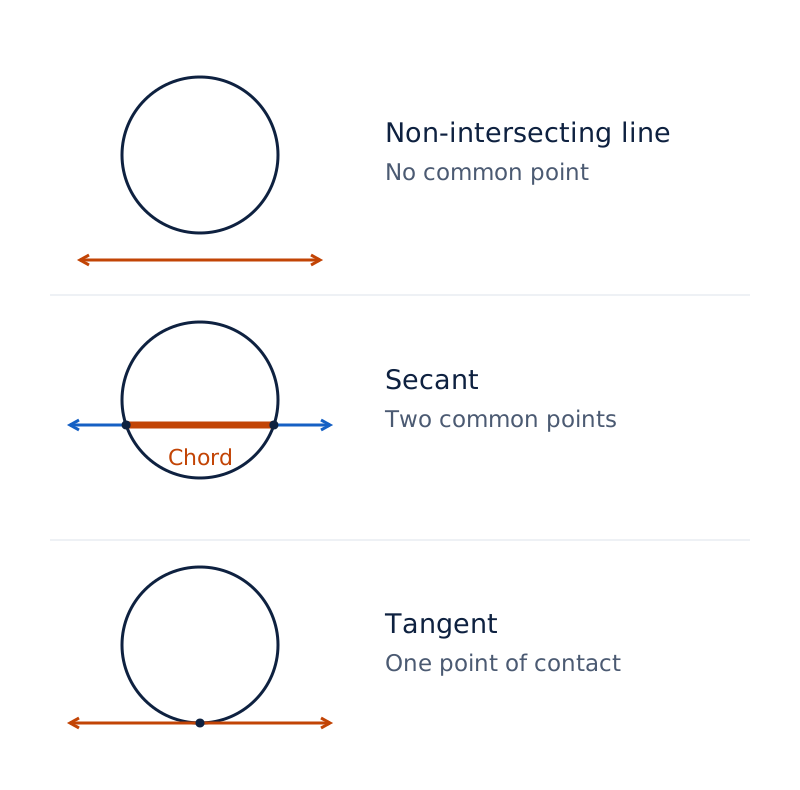
The three drawings show a line missing a circle, cutting a circle at two points, and touching a circle at one point. The middle drawing includes the chord between the two intersections.
Drawn by One Young India. See Fig. 10.1 in your NCERT textbook
The one-point condition is essential. A line passing through the interior of the circle has two intersections with the circle and is a secant. Calling such a line a tangent because it passes through a particular point on the circle ignores its second intersection.
How can the existence and uniqueness of a tangent be understood?
Rotating a secant about a point
Imagine a straight wire attached to a circular wire at a fixed point on the circle. Rotate the straight wire in the plane of the circle. In most positions it intersects the circular wire at the fixed point and at another point.
As the straight wire approaches the touching position, its second intersection moves towards the fixed intersection. In the touching position, the two intersections coincide. Rotating beyond this position produces a second intersection again, now on the other side of the fixed point.
This activity shows a tangent as a special case of a secant, when the endpoints of the corresponding chord coincide. It also illustrates that exactly one tangent can be drawn at a specified point of a circle.
Moving parallel lines across a circle
Start with a secant and draw lines parallel to it on both sides. As the perpendicular distance of these lines from the centre increases towards the radius, their intercepted chords become shorter. At each extreme touching position, the chord endpoints coincide and the chord length becomes zero.
There are two parallel tangents in a specified direction, one on each side of the circle. This does not mean that a circle has only two tangents altogether. The restriction concerns tangents parallel to one given secant.
What the figure shows
Parallel secants approaching tangents
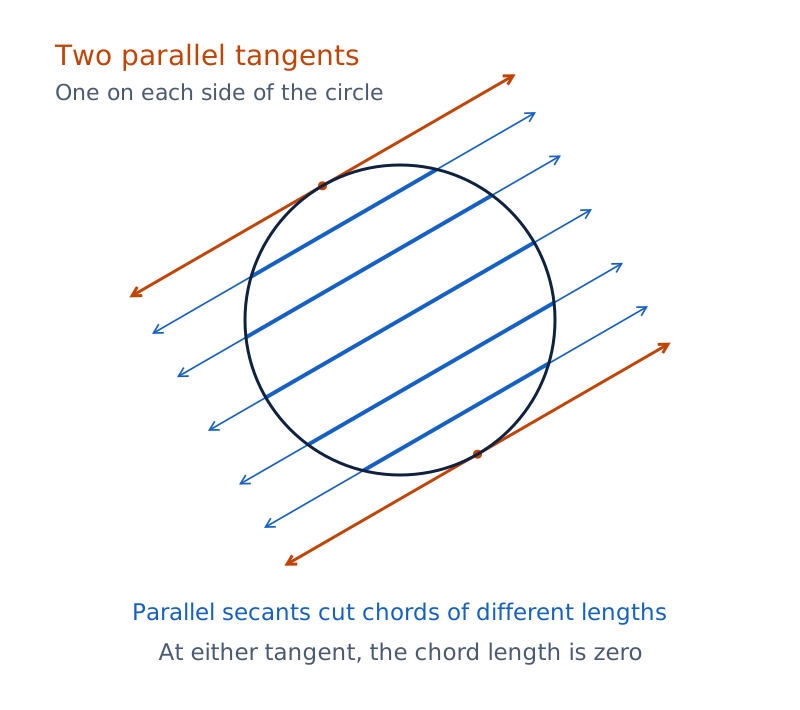
A family of parallel slanting lines crosses a circle. The extreme touching lines lie on opposite sides, while the intervening secants cut chords of different lengths.
Drawn by One Young India. Reference: NCERT Class 10 Figure 10.3(ii)
The distinction between the two activities matters. Rotation keeps one point on the circle fixed and changes the direction of the line. Parallel movement keeps the direction fixed and changes the line's position. Both reveal the transition from two common points to one common point.
The wheel-and-ground picture gives another way to recognise contact: the ground represents a tangent, while the radius directed towards the contact point meets it at a right angle. The perpendicular relationship requires proof, rather than reliance on the appearance of a drawing.
Why is the tangent perpendicular to the radius at contact?
Theorem: Radius and tangent are perpendicular
Theorem 10.1: The tangent at any point of a circle is perpendicular to the radius through the point of contact. The specified radius must end at the point where the tangent touches the circle.
Let denote the centre, the point of contact, and the tangent line, named using two points and on it. Let be any other point on that line. Segment names also denote their lengths when used in calculations. The symbol means “is perpendicular to”.
Derivation: The shortest-distance proof
- Join the centre to the contact point and to the other chosen point. Since the tangent has no other point on the circle, and cannot pass through its interior, is outside the circle.
- The distance from the centre to this exterior point is greater than the radius:
- The same comparison holds for every other point of the tangent. Thus the shortest segment from the centre to the tangent is .
- The shortest distance from a point to a line is measured along the perpendicular. Therefore,
Conclusion: Joining the centre to the point of contact produces a right angle with the tangent.
What the figure shows
Radius and tangent
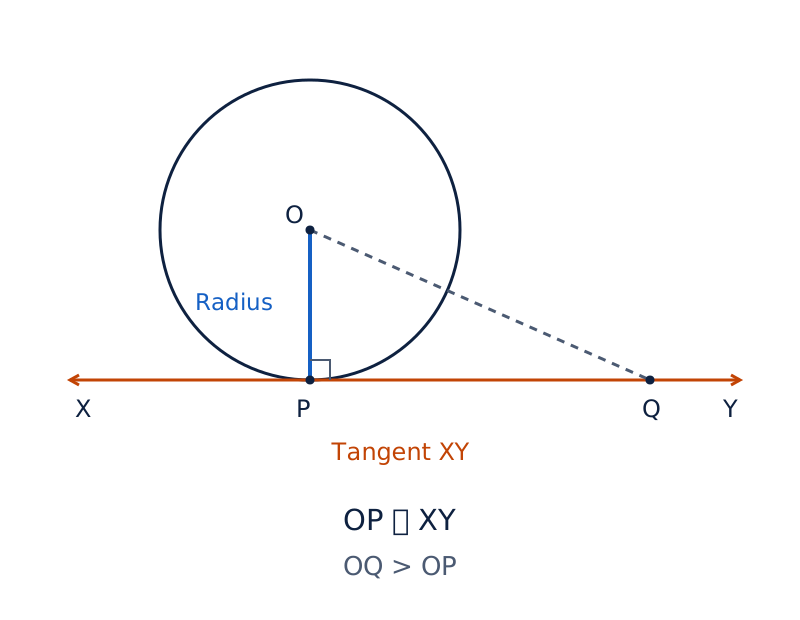
A horizontal tangent touches the bottom of a circle. The centre is joined vertically to the contact point and by a slanting dashed segment to another point on the tangent outside the circle.
Drawn by One Young India. See Fig. 10.5 in your NCERT textbook
Normal and uniqueness
The line containing the radius through the contact point is sometimes called the normal to the circle at that point. The normal and tangent meet perpendicularly. Consequently, the perpendicular to the tangent at contact passes through the centre.
There is exactly one tangent at a specified point of the circle. Its direction is fixed by its perpendicularity to the radius through that point. In numerical problems, this theorem supplies the right angle needed before applying the Pythagoras theorem.
How many tangents can pass through a given point?
Property: The position of the point determines the count
The answer depends on whether the point lies inside, on, or outside the circle. These are separate conditions, so a statement about the number of tangents must identify the position of the given point.
| Position of the point | Number of tangents through it | Reason or observation |
|---|---|---|
| Inside the circle | None | Every line through it cuts the circle at two points. |
| On the circle | Exactly one | The tangent is perpendicular to the radius at that point. |
| Outside the circle | Exactly two | Two lines through the point touch the circle. |
For an interior point, turning a line through the point cannot produce a tangent. The line still crosses the circle twice. For a point on the circle, the tangent exists at that point and has the unique direction described by the radius-tangent theorem.
For an external point, the two tangents touch the circle at different points. Their lengths are measured only as far as those contact points. Extending either line beyond its point of contact does not change the tangent length from the specified external point.
Definition: The length of a tangent from an external point is the length of the segment joining that external point to the point of contact.
What the figure shows
Tangents from three point positions
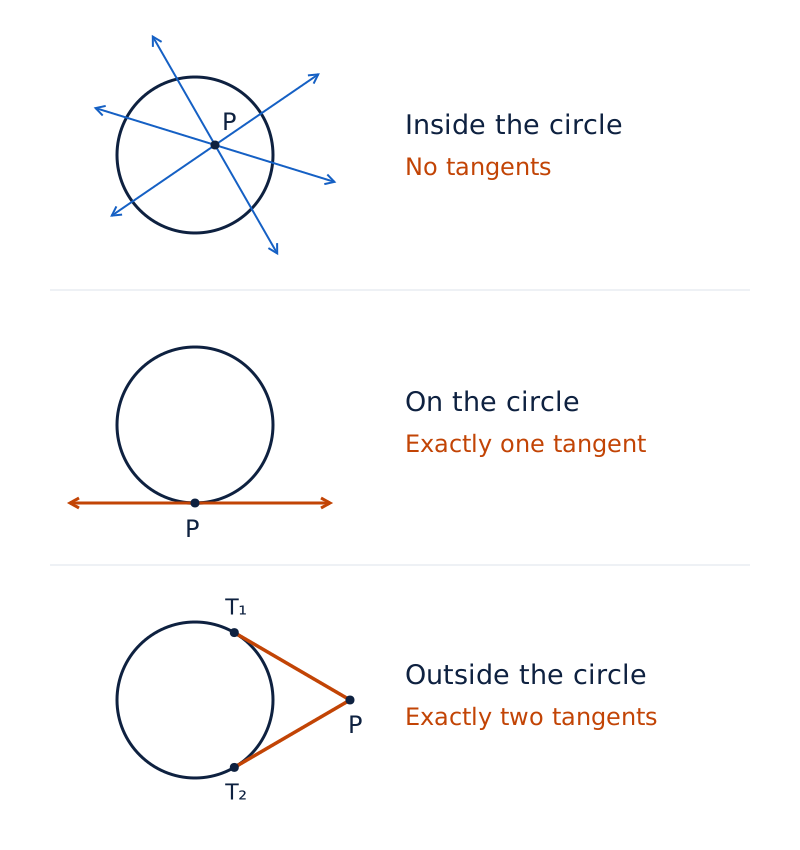
The first drawing shows lines through an interior point cutting the circle. The second shows one tangent at a point on the circle. The third shows two tangent segments from a common exterior point.
Drawn by One Young India. See Fig. 10.6 in your NCERT textbook
A whole circle versus one selected point
A circle has infinitely many tangents because each point on it has its own tangent. This is compatible with the counts in the table: the table counts tangents passing through one fixed point, whereas the whole-circle question allows the point of contact to vary.
Before choosing a theorem, check what the question fixes: a contact point, an external point, or a direction of parallel lines. These conditions lead respectively to one tangent, two tangents, or at most two parallel tangents.
Why are tangents from the same external point equal?
Theorem: Equal tangent lengths
Theorem 10.2: The lengths of tangents drawn from an external point to a circle are equal. The common external point and the common circle are both part of the statement.
Let be the centre, an external point, and and the contact points of tangents and . Join the centre to the three points. The symbol denotes an angle, with its middle letter naming the vertex. The symbols and denote a triangle and congruence, respectively.
Derivation: Congruent right triangles
- The radii are perpendicular to the respective tangents, so
- The radii of the same circle are equal:
- The two right triangles share the hypotenuse:
- By the right angle-hypotenuse-side criterion, abbreviated RHS,
- Corresponding parts of congruent triangles are equal, abbreviated CPCT. Hence
Angle-bisector consequence: The same congruence also gives . Thus the segment joining the external point to the centre bisects the angle between the tangents.
Derivation: An alternative using squares
- Apply the Pythagoras theorem to the first right triangle:
- Apply it to the second right triangle:
- Substitute the equality of the radii:
- Both tangent lengths are positive. Taking their positive square roots gives
Use the condition carefully: Tangents from different external points are not covered by this equality. In a polygon touching a circle, pair the two segments from one vertex before moving to another vertex.
The two proofs reach the same length result, but the congruence proof also directly supplies equal angles. That makes it particularly useful when a later step requires the angle bisector between the tangents.
How are missing tangent lengths and radii calculated?
Choosing the right triangle
Join the centre to the point of contact and to the external point. The radius and tangent segment form the perpendicular sides. The segment from the centre to the external point is the hypotenuse, because it lies opposite the right angle.
The Pythagoras theorem now relates the three lengths. First identify the hypotenuse, then decide whether the unknown is a perpendicular side or the hypotenuse. In each of the following problems, subtraction is needed because the hypotenuse and one other side are known.
Worked example 1. A circle has centre and radius . Its tangent at contact point passes through external point , where . Find .
Answer:
- The radius meets the tangent at a right angle:
- Apply the Pythagoras theorem, using the centre-to-external-point distance as hypotenuse:
- Rearrange and substitute the given lengths:
- Take the positive root:
- Check the squared lengths:
Worked example 2. From an external point , a tangent to a circle has length . The distance from to the centre is . Find the radius, denoted by .
Answer:
- Join the centre to the contact point to obtain a right triangle. Its hypotenuse is the centre-to-external-point segment.
- Write the relation between the lengths:
- Subtract the square of the tangent length:
- Take the positive root:
- Verify the result:
Worked example 3. An external point is from a circle's centre. The tangent from it has length . Find the radius, denoted by .
Answer:
- The radius at contact is perpendicular to the tangent, giving a right triangle with hypotenuse .
- Apply the Pythagoras theorem:
- Subtract and simplify:
- Use the positive root for a length:
- Recompute the hypotenuse square:
Length check: In all three examples, the hypotenuse exceeds each perpendicular side. Squaring a length produces square units during the calculation; taking its square root returns the answer to centimetres.
How are angles between two tangents related to central angles?
Result: Supplementary angles
Let denote a circle's centre, an external point, and and the contact points of its two tangents. The angle between the tangents and the angle at the centre between the contact radii are supplementary.
- The radius-tangent theorem gives the angles at the two contact points:
- The four interior angles of quadrilateral sum to a complete turn:
- Subtract the two right angles:
The central angle here is the interior angle of that quadrilateral. The relation follows from the two contact right angles; it does not require knowing the radius or either tangent length.
Worked example 4. Tangents and touch a circle with centre at and . Given , find .
Answer:
- Both angles at contact are right angles:
- Use the quadrilateral angle sum:
- Simplify to obtain
- Check the supplementary pair:
Worked example 5. Tangents and from external point touch a circle at and . The centre is , and . Find .
Answer:
- The centre-to-external-point segment bisects the tangent angle:
- The contact radius is perpendicular to its tangent:
- Use the angle sum of triangle :
- Check all three triangle angles:
Derivation: A related chord-angle identity
Return to the first configuration, with external point , contact points and , and centre . Let , pronounced theta, denote the angle between the two tangents.
- Equal tangents give , so triangle is isosceles and .
- Its two base angles are equal:
- Subtract the base angle from the right angle at contact:
- Replace theta by the tangent angle:
Keep the vertices distinct: The angle at the external point, the angle at the centre, and the angle between a radius and chord are different angles. Read the middle letter before applying an angle relation.
How does a tangent help solve problems on concentric circles?
A chord of one circle can touch another
Concentric circles have the same centre. A segment can be a chord of the larger circle while its containing line is tangent to the smaller circle. The two descriptions refer to two different circles, so they do not conflict.
Let be the common centre, and the endpoints of a chord of the larger circle, and its contact point with the smaller circle. Join the common centre to the point of contact.
- For the smaller circle, the radius is perpendicular to the tangent line:
- For the larger circle, this is a perpendicular from its centre to a chord. Such a perpendicular bisects the chord.
- Therefore, the two chord segments are equal:
What the figure shows
A chord touching a concentric circle
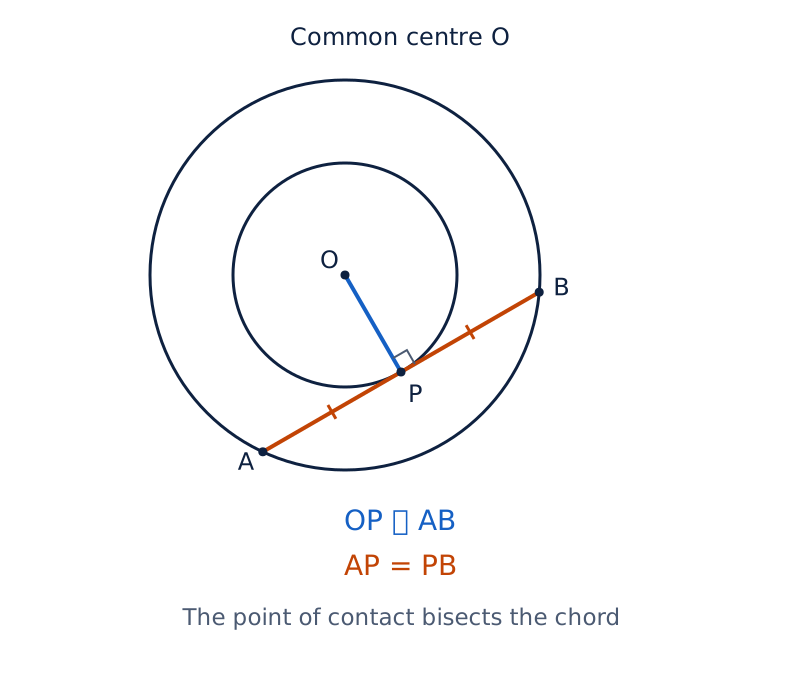
Two circles share a centre. A slanting chord of the outer circle touches the inner circle, and the centre is joined to that contact point.
Drawn by One Young India. See Fig. 10.8 in your NCERT textbook
The useful transfer is that the smaller circle supplies the perpendicular distance from the common centre to the chord. The larger circle supplies the radius joining the centre to a chord endpoint. Together they form a right triangle containing half the chord.
Worked example 6. Two concentric circles have radii and . Find the length of a chord of the larger circle that touches the smaller circle. Use the points just defined.
Answer:
- Identify the two radii:
- The contact radius is perpendicular to the chord, and the chord is bisected:
- Use right triangle :
- Take the positive root:
- Double the half-chord:
- Check the right triangle:
Final-step check: The right-triangle calculation gives the distance from contact to one endpoint. The requested full chord includes both equal halves. Stopping at the half-chord would leave the geometric task unfinished.
How can a known chord determine the length of its tangents?
Combining the two tangent theorems
When tangents at the ends of a chord meet, equal tangent lengths create an isosceles triangle. The line joining their intersection to the centre bisects the angle between them. In this isosceles triangle, that line also bisects the chord and meets it perpendicularly.
This gives a way to connect the radius, half the chord, and the unknown tangent length. First find the centre's distance from the chord. Then use similar triangles or the Pythagoras theorem in the two right triangles.
What the figure shows
Tangents at the ends of a chord
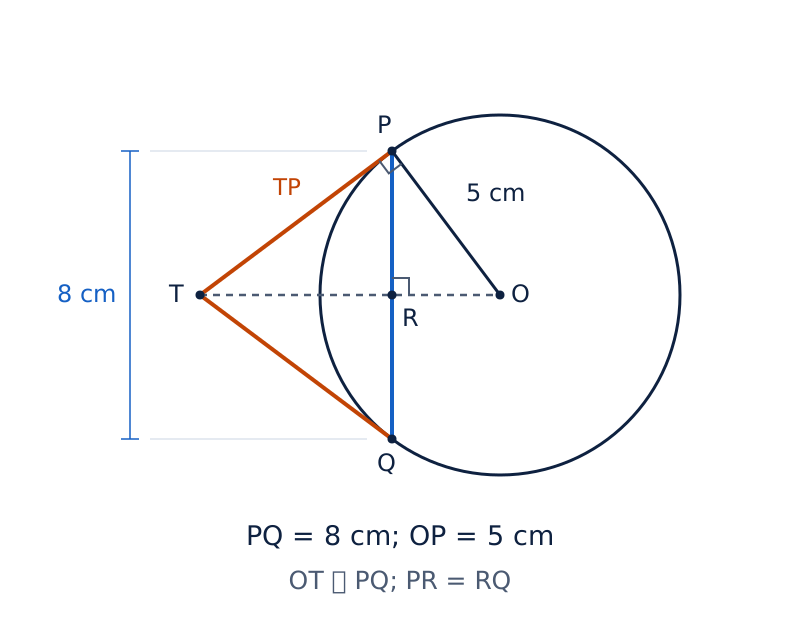
Tangents from a point to the left meet the endpoints of a vertical chord. A horizontal segment from that external point to the centre crosses the chord at a marked right angle. The chord and a radius are labelled with their lengths.
Drawn by One Young India. See Fig. 10.10 in your NCERT textbook
Worked example 7. A chord has length in a circle of radius and centre . Tangents at its endpoints and meet at external point . Find . Let be the intersection of with the chord.
Answer:
- Equal tangents make triangle isosceles, and bisects its vertex angle. Therefore,
- Use the radius and half-chord in right triangle :
- Take the positive root:
- Let denote the numerical value of in centimetres, and the numerical value of in centimetres. Right triangle gives
- The full centre-to-external-point distance is . Right triangle gives
- Subtract the equation in step 4 from the equation in step 5:
- Rearrange and divide:
- Substitute into step 4:
- Take the positive square root:
- Recompute using the larger right triangle:
Why the distances add: The chord lies between the external point and the centre in this configuration. Consequently, the full hypotenuse includes both the external-point-to-chord segment and the chord-to-centre segment. Using only the first segment would describe the smaller right triangle.
How do equal tangents solve circumscribed-polygon problems?
Result: Sums of opposite sides of a tangential quadrilateral
A circumscribed quadrilateral has each side touching a circle. Let its successive vertices be . Let the respective contact points on sides be . Match tangent segments from the same vertex.
- The equal-tangent theorem gives
- Express one pair of opposite sides using their contact segments:
- Replace each segment by its equal partner:
- Regroup the segments on the other two sides:
If the circumscribed quadrilateral is a parallelogram, its opposite sides are also equal. Substituting those equalities into the opposite-side-sum result shows that adjacent sides are equal, making the parallelogram a rhombus.
Derivation: Why the parallelogram is a rhombus
- Opposite sides of the parallelogram are equal:
- Substitute into the circumscribed-quadrilateral relation:
- Divide by two, then combine with step 1: Thus all four sides are equal.
Using equal segments around a triangle
Worked example 8. Triangle , with vertices , circumscribes a circle with centre and radius . Its contact point on side divides that side into and . Find and .
Answer:
- Let and be the contact points on and . Equal tangents give
- Let be the numerical value of each tangent length from , in centimetres. Then
- Let denote the numerical value of the semiperimeter in centimetres. Thus
- Let denote the numerical value of the area in square centimetres. Joining the centre to the vertices makes three triangles, each with altitude numerically equal to the radius. Therefore,
- Apply Heron's formula to the same triangle:
- Square the area from step 4 and equate:
- Since the lengths are positive, divide by the positive common factor:
- Solve the resulting equation:
- Substitute into the two required sides:
- Check using both area calculations:
What each condition supplies: The two base segments determine the tangent lengths from the base vertices. The radius provides the three perpendicular altitudes used for area. Both kinds of data are needed to determine the remaining tangent lengths and the two unknown sides.
Glossary
- Circle — The collection of all points in a plane at a fixed distance from a fixed point.
- Centre — The fixed point from which all points on a circle are equally distant.
- Radius — The fixed distance from the centre of a circle to any point on it.
- Chord — A line segment joining two distinct points on a circle.
- Secant — A straight line that intersects a circle at two distinct points.
- Tangent — A straight line that meets a circle at exactly one point.
- Point of contact — The single common point where a tangent touches its circle.
- Normal — The line containing the radius through a specified point of contact.
- External point — A point outside a circle from which exactly two tangents can be drawn.
- Tangent length — The length of the segment from an external point to the point of contact.
- Concentric circles — Circles that share the same centre while having different radii.
- Angle bisector — A line or ray dividing an angle into two equal angles.
- Circumscribed quadrilateral — A quadrilateral whose four sides each touch an enclosed circle.
Common errors and misconceptions
- Misconception: Any line through a point on a circle is tangent there. Correct: A tangent has exactly one common point with the circle; a secant has two.
- Misconception: A circle has only two tangents. Correct: Exactly two pass through a fixed external point. A circle has infinitely many tangents in total.
- Misconception: Every radius is perpendicular to a given tangent. Correct: Use the radius through that tangent's point of contact.
- Misconception: Tangents drawn from any two external points have equal lengths. Correct: The equal-tangent theorem pairs segments drawn from the same external point to the same circle.
- Misconception: The tangent segment is the hypotenuse of the radius-tangent triangle. Correct: The hypotenuse joins the centre to the external point.
- Misconception: A perpendicular from the centre gives the entire chord length. Correct: It bisects the chord, so the right-triangle calculation usually gives one half.
- Misconception: The tangent angle equals the angle between the two contact radii. Correct: These two interior angles are supplementary.
Exam-style questions with model answers
Q1. Define a tangent and state the relationship between it and the radius through the point of contact. [2 marks]
- A tangent is a line that intersects a circle at exactly one point, called its point of contact.
- The radius passing through that point of contact is perpendicular to the tangent.
Q2. An external point is from a circle's centre, and its tangent segment has length . Find the radius and justify your method. [3 marks]
- Join the centre to the contact point. The radius is perpendicular to the tangent there, so the centre-to-external-point segment is the hypotenuse of a right triangle.
- Let denote the radius in centimetres. Apply the Pythagoras theorem and subtract:
- A radius is positive, so . The required radius is , and the check is .
Q3. A circle has centre . From external point , tangents touch it at and . Prove that . [5 marks]
- Join the centre to the external point and to both contact points. The two triangles to compare are and , each containing one tangent segment.
- The radius-tangent theorem makes both triangles right-angled at their contact points:
- The radii belong to the same circle and are therefore equal: . The two triangles also have the same hypotenuse, the segment .
- The right angle-hypotenuse-side congruence criterion applies, because the hypotenuse and one corresponding side agree in the right triangles. Hence
- Corresponding sides of congruent triangles are equal. Their tangent sides therefore satisfy , which proves the required equality of lengths from the specified external point.
Q4. Two concentric circles have radii and . A chord of the larger circle touches the smaller circle. Find its length. [4 marks]
- Let be the common centre, the chord endpoints, and the contact point. Then and .
- The smaller circle's radius is perpendicular to the tangent chord: . A perpendicular from the larger circle's centre bisects its chord, so .
- In right triangle ,
- The full chord is twice its half-length:
Q5. Tangents from external point touch a circle with centre at and . Given , find the angle between the tangents. [3 marks]
- Join the centre to each contact point. The radius-tangent theorem gives , so the quadrilateral has two known right angles.
- The sum of its interior angles is . Therefore,
- Simplifying gives . This is the angle at the external point between the tangent segments, and checks the supplementary relation.
Q6. Quadrilateral circumscribes a circle touching sides at , respectively. Prove that . [5 marks]
- Pair tangent segments from each vertex to the same circle. From vertices and , the equal-tangent theorem gives and .
- Apply the same theorem separately at the other two vertices. From and , obtain and . Each equality uses a common external point.
- Split the first pair of opposite sides at their contact points: Every segment here belongs to one of the two selected sides.
- Replace each segment by the equal tangent from its vertex: The total is unchanged because each replacement uses an established equality.
- Regroup along the remaining two sides: Thus the sums of the two pairs of opposite sides are equal.
Key takeaways
- A tangent meets a circle at exactly one point, whereas a secant intersects the circle at two distinct points.
- The radius through the point of contact is perpendicular to the tangent, creating a useful right triangle.
- No tangent passes through an interior point; one passes through a point on the circle and two through an exterior point.
- The two tangent segments from the same external point to the same circle have equal lengths.
- The line joining an external point to the centre bisects the angle between its two tangents.
- The angle between two tangents and the interior angle between their contact radii are supplementary.
- A chord touching a concentric inner circle is bisected at contact by the common centre's perpendicular radius.
- Pair equal tangent segments vertex by vertex to prove that a circumscribed quadrilateral has equal sums of opposite sides.
Test yourself
What makes a line a secant of a circle?
It intersects the circle at two distinct points, unlike a tangent, which has exactly one common point.
Can a tangent pass through a point inside the circle?
No. Every line through an interior point cuts the circle at two points, so it is a secant.
How many tangents parallel to a given secant can a circle have?
It can have at most two, touching the circle on opposite sides.
Which radius is perpendicular to a tangent?
The radius joining the centre to that tangent's point of contact is perpendicular to it.
What condition permits two tangent lengths to be equated?
The tangent segments must start at the same external point and touch the same circle.
Which side is the hypotenuse in the radius-tangent right triangle?
The segment from the centre to the external point is the hypotenuse, opposite the contact right angle.
Why is a chord touching a concentric inner circle bisected at contact?
The smaller radius is perpendicular to the tangent chord, and a perpendicular from the common centre bisects the larger circle's chord.
What does the centre-to-external-point line do to the angle between the tangents?
It bisects that angle, dividing it into two equal angles.
Write about it
Turn a question from this chapter into a paper.
The Writing Studio has a structure guide, a rubric and citation tools for 15 formats, from essays to research papers. Drafting is free with an account. Learnacy Essential adds feedback from an AI writing coach and submission to The OYI Review.
Learnacy Essential is ₹1,499 for the year. Publication depends on review and is not guaranteed.