
Surface Areas and Volumes | CBSE Class 10 Maths Notes
On this page
Watch & explore
Start with a few high-quality watches, then dive into the notes below.
Surface Areas and Volumes in Class 10 Mathematics covers combinations of cuboids, cones, cylinders, spheres and hemispheres, exposed and hidden surfaces, curved surface area, total surface area, volumes of combined solids, hollow portions, container capacities, and calculations involving paint, canvas and the space available inside objects.
How can a complicated object be separated into familiar solids?
A combination of solids is an object whose shape can be understood using familiar solids. Identify the parts before choosing a formula. A rounded container can be treated as a cylinder with a hemisphere at each end; a test tube combines a cylinder and a hemisphere.
The same combination can lead to different questions. Painting requires the area of the relevant surface. Finding the air inside a shed requires its internal volume. Finding how much juice a glass holds requires its capacity after allowing for any raised portion inside it.
Which symbols and basic formulas are needed?
Let denote radius, diameter, perpendicular height, and the slant height of a right circular cone. Let denote a cube's edge. For a cuboid, let , and denote length, breadth and height respectively.
The constant is the ratio of a circle's circumference to its diameter. CSA means curved surface area, TSA means total surface area, and denotes volume. Descriptive subscripts identify the component or space whose area or volume is being calculated. The dimensions in a formula must refer to the particular solid being calculated.
| Solid | Surface area | Volume |
|---|---|---|
| Cube | ||
| Cuboid | ||
| Right circular cylinder | ; | |
| Right circular cone | ; | |
| Sphere | ||
| Hemisphere | ; |
A circular face has area , and the radius is . For the cone, . A hemisphere's height is its radius, which matters when a total height includes both a hemisphere and another solid.
What the figure shows
Basic solids and a rounded container
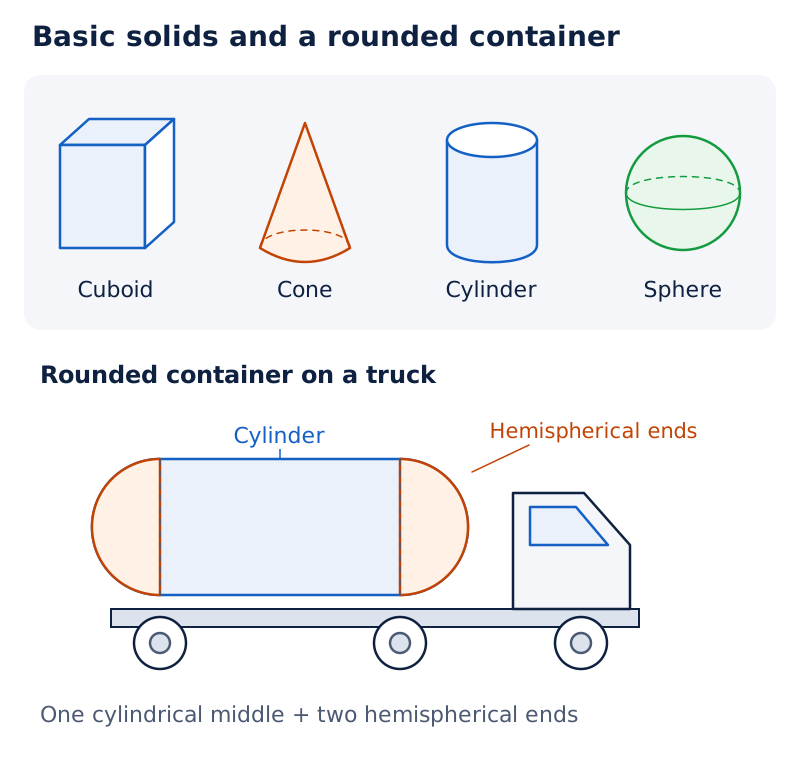
The first figure shows a cuboid, cone, cylinder and sphere. The second shows a truck carrying a container with a cylindrical middle and rounded ends.
Drawn by One Young India. See Figs. 12.1 and 12.2 in your NCERT textbook
Use square units for area and cubic units for volume. A surface measured using centimetres has its area in ; a volume calculated using centimetres is in . Convert mixed length units before substituting into formulas.
How do you decide which surfaces remain exposed after joining?
The exposed surface is the part of a solid's boundary included in the requested area. When flat faces are joined, the contacting parts become internal. Adding the total surface areas of the separate pieces would count these hidden parts.
Result: Surface area follows the exposed boundary
For a cylinder closed by two hemispheres of the same radius, neither circular cylinder end remains exposed. Neither flat hemisphere base remains exposed either. The exterior contains the curved cylinder surface and the two curved hemisphere surfaces.
What the figure shows
Assembling a rounded container
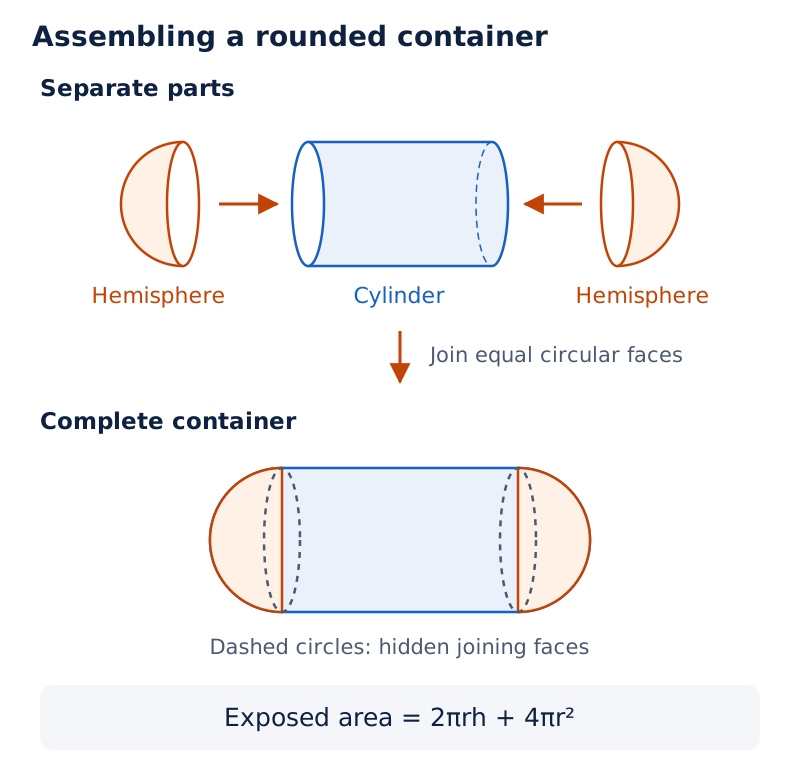
Two separate hemispheres and a cylinder are shown first. Arrows show the pieces moving together, followed by the complete container with one rounded end on each side.
Drawn by One Young India. See Fig. 12.4 in your NCERT textbook
Derivation: Area of a cylinder with two hemispherical ends
Here is the length of the cylindrical part, and is the common radius. Let denote the exposed surface area of the complete object.
- Count the curved surface of the cylinder:
- Count both curved hemisphere surfaces:
- Add these exposed areas:
The cylinder's length excludes both rounded ends. Each hemisphere contributes one radius along the length. Therefore, subtract one diameter from the full length before calculating the curved area of the cylindrical middle.
Worked example 1. A medicine capsule has total length and diameter . Its shape is a cylinder with a hemisphere at each end. Find its surface area using .
- Halve the diameter to obtain the common radius:
- Remove the lengths of both hemispheres from the total:
- Calculate the cylinder's exposed area:
- Calculate the area of the two rounded ends:
- Add the contributions:
Answer: The capsule's surface area is .
Check the boundary as well as the arithmetic. The result includes the entire curved exterior. Adding circular end areas would introduce surfaces inside the capsule rather than surfaces on its outside.
How is the surface area of a cone and hemisphere calculated?
A cone and a hemisphere can be joined along circular faces of equal radius. Their common circular face is hidden. The complete toy's exterior therefore consists of the cone's curved surface and the hemisphere's curved surface.
Result: Area of a cone joined to a hemisphere
Let again denote the complete exposed area, with the common radius and the cone's slant height. The rule is . The cone's perpendicular height must be found before its slant height if only the whole toy's height is given.
What the figure shows
Cone and hemisphere toy
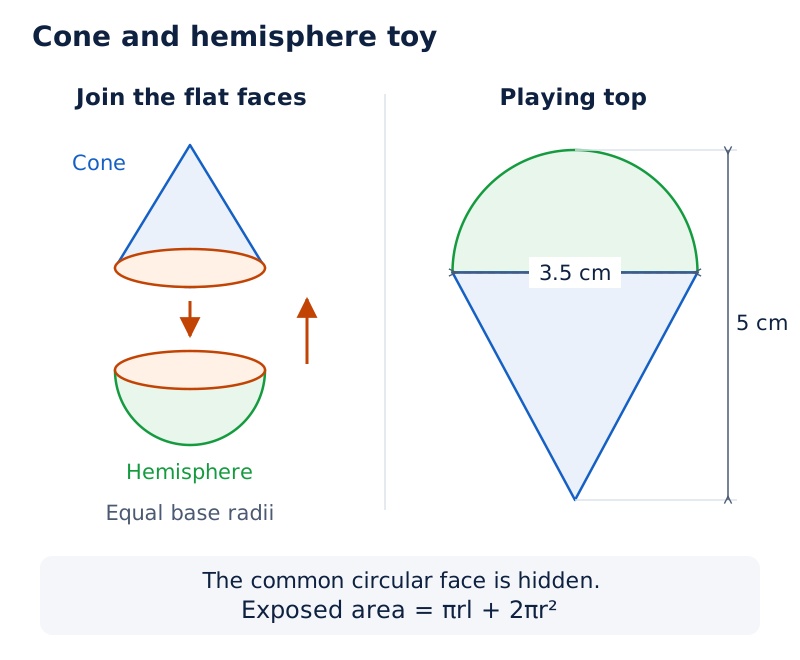
Figure 12.5 shows a cone and hemisphere brought together at their flat circular faces. Figure 12.6 shows a playing top labelled with total height and diameter .
Drawn by One Young India. See Figs. 12.5 and 12.6 in your NCERT textbook
Worked example 2. Rasheed's uncoloured playing top is a cone surmounted by a hemisphere. Its total height is , and its diameter is . Find the area to colour, using .
- Find the common radius:
- Subtract the hemisphere's height to obtain the cone's perpendicular height:
- Find the cone's slant height:
- Calculate the curved hemisphere area:
- Calculate the curved cone area, retaining the radical:
- Add and round the final area:
Answer: Approximately must be coloured.
The slant height runs along the cone's sloping surface; the perpendicular height runs from the vertex to the centre of its base. Interchanging them changes the cone's curved area. Retaining the radical until the last step also avoids unnecessary intermediate rounding.
What changes when a hemisphere covers part of a cube?
A hemisphere mounted on a cube covers a circular region of the cube's upper face. The remainder of that face is still exposed. Begin with the cube's total area, remove the covered circle, and add the curved area of the hemisphere.
Result: Replacing a covered circle with a curved surface
For cube edge , hemisphere radius , and complete surface area , the required relation is . This applies when the hemisphere's circular base fits on the cube's face.
Although the simplified expression contains just one additional circular area, the object has not gained a flat circle. The simplification represents a curved hemisphere added after the covered circular patch has been removed from the cube's exposed area.
Worked example 3. A decorative block has a cube of edge with a hemisphere of diameter fixed on top. Find the total surface area using .
- Find the radius of the hemisphere:
- Calculate the cube's total area before attachment:
- Calculate the covered circle:
- Calculate the exposed curved hemisphere area:
- Subtract the covered patch and add the curved surface:
Answer: The block's total surface area is .
A hemispherical depression cut into a cube also replaces a flat circular patch with a curved hemispherical surface. Its surface-area calculation can have the same form, even though its volume decreases rather than increases.
This distinction explains why the words surface area and volume must guide the operation. Removing material can expose a new interior surface. An area calculation follows that new boundary; a volume calculation follows the amount of material left.
How are different painted areas found when the radii are unequal?
If a cone's base is wider than the cylinder beneath it, the entire cone base is not hidden. The cylinder covers a smaller central circle, leaving an exposed circular ring. That ring belongs to the conical portion's painted area.
The cylinder also has an exposed lower base. Its upper base is covered by the cone. A colour question therefore needs two separate surface inventories before any substitution: which surfaces receive the cone's colour, and which receive the cylinder's colour?
How does the exposed ring affect the calculation?
In this example, , and refer to the cone's radius, perpendicular height and slant height. Let denote the cylinder's radius and its height. Let and denote the orange and yellow painted areas.
What the figure shows
Rocket and exposed ring
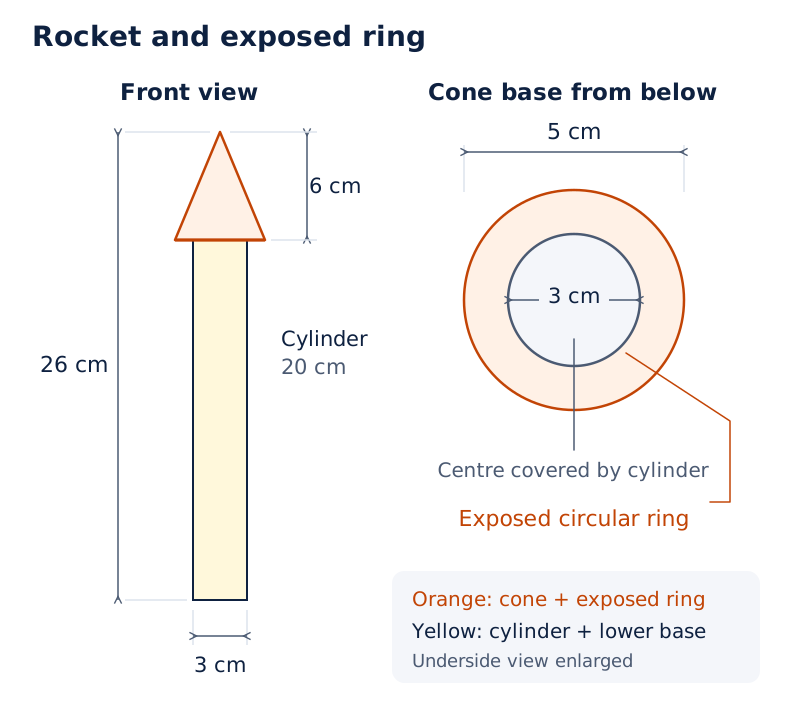
A cone sits on a narrower cylinder. The total height is labelled , and the cone's height is . A separate circular view shows base diameters and .
Drawn by One Young India. See Fig. 12.8 in your NCERT textbook
Worked example 4. A wooden toy rocket is high. Its cone is high with base diameter ; its cylinder has diameter . Find the orange conical area and yellow cylindrical area, including exposed bases, using .
- Find both radii and the cylinder's height:
- Find the cone's slant height:
- Calculate the exposed ring under the cone:
- Calculate the cone's curved surface:
- Add the orange surfaces:
- Calculate the cylinder's curved surface and exposed bottom:
- Add the yellow surfaces:
Answer: The orange area is , and the yellow area is .
Unequal radii require special care: removing the whole cone base would omit the visible ring. Conversely, including the whole cone base would count the central region already covered by the cylinder.
How do openings and depressions change the surface-area calculation?
An open base is not a surface to be covered. A tent with a cylindrical wall and conical roof needs canvas for those two curved surfaces. If its base is explicitly uncovered, the circular floor must be excluded from the canvas area.
A depression is different: it creates a curved interior surface. For a hemispherical hollow, include the curved hemisphere where the question asks for that surface. For a conical cavity in a cylinder, identify the curved cavity, outer cylinder wall and remaining base.
| Object | Surfaces to identify | Critical distinction |
|---|---|---|
| Tent with uncovered base | Cylindrical wall and conical roof | No canvas covers the circular floor |
| Open vessel with hemispherical bottom | Inner cylinder wall and curved hemispherical interior | The opening contributes no flat disk |
| Cylinder with a conical cavity | Outer curved wall, curved cavity and remaining circular base | The hollow exposes a new inner surface |
How is the cost of covering a tent found?
Worked example 5. A tent has a cylindrical part of height and diameter , with a conical roof of slant height . The base is uncovered. Find the canvas area and its cost at per , using .
- Find the common radius:
- Calculate the cylindrical wall area:
- Calculate the conical roof area using the given slant height:
- Add the two areas to obtain the canvas area:
- Let denote the canvas cost. Multiply the area by the given price per square metre:
Answer: The tent needs of canvas, costing .
Note: Use the dimensions and surfaces specified by the question. A slant height supplied for a cone can be used directly in its curved-area formula; it is not the perpendicular height used in the cone's volume formula.
The unit of the rate must match the area unit before multiplication. Here both refer to square metres. The calculation answers the stated canvas question using the two specified surfaces and the given rate.
Why are volumes added when solids are joined?
When basic solids meet at their boundaries without overlapping in their interiors, the volume of the combined solid is the sum of their volumes. The pieces still occupy their full three-dimensional spaces even though some surface faces become hidden.
Result: Volume is the sum of the constituent volumes
Let and denote the volumes of the first and second constituent solids. The complete volume is . This is why a joined face is excluded from an exterior-area calculation but does not require subtracting volume.
A shed with a half-cylinder roof combines a cuboid and half a cylinder. The roof's diameter is the breadth of the shed. The cylinder's axial length runs along the shed, so it must not be confused with the height of the cuboidal walls.
What the figure shows
Shed with a curved roof
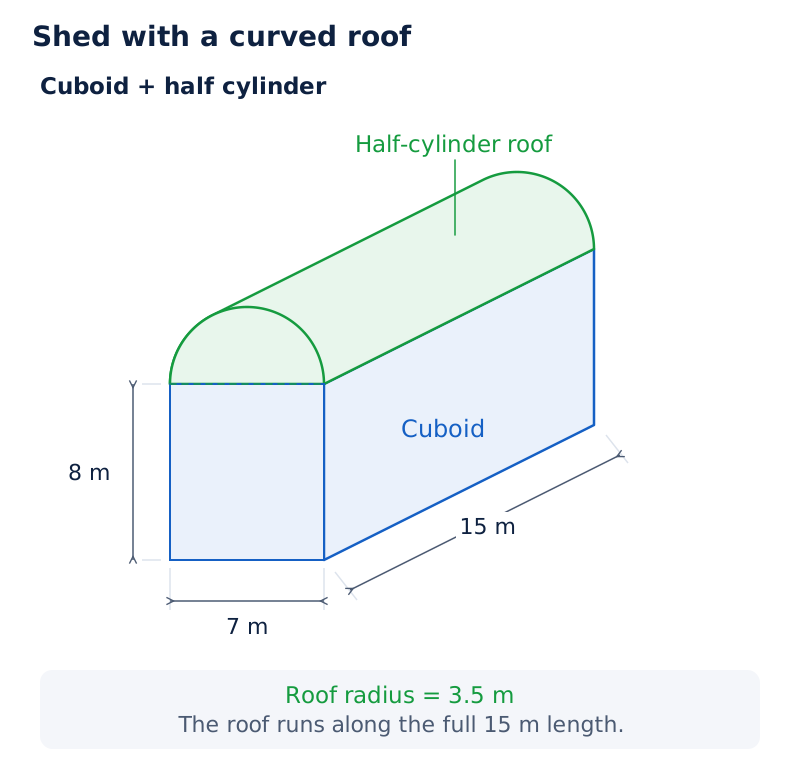
A cuboidal lower portion supports a half-cylinder roof. The drawing labels the breadth as , length as , and height of the cuboidal portion as .
Drawn by One Young India. See Fig. 12.12 in your NCERT textbook
How is occupied space removed from a shed's air volume?
Worked example 6. A shed has a cuboidal part with base by and height , topped by a half cylinder spanning the breadth and running along the length. Machinery occupies ; there are 20 workers, each occupying about . Find the empty capacity and the air remaining. Use .
- Identify the roof's radius and axial length:
- Calculate the cuboidal volume:
- Calculate the half-cylinder volume:
- Add the two spaces for the empty shed:
- Calculate the workers' combined occupied space using the stated average:
- Subtract machinery and workers from the empty capacity:
Answer: The empty shed holds ; approximately is air when the machinery and workers are inside.
The available air volume depends on occupied space as well as the building's shape. The word “about” attached to each worker's average occupied volume also makes the resulting occupied-shed air volume approximate.
Write the component volumes separately before combining them. This keeps the roof factor of one-half visible and makes it easier to check that the radius came from the breadth rather than the length of the shed.
How does a raised bottom reduce a container's capacity?
A glass can appear cylindrical while having a raised portion inside its bottom. Its apparent capacity is the full cylindrical space suggested by its inner diameter and height. Its actual capacity excludes the space occupied by the raised material.
For a hemispherical raised bottom, subtract the hemisphere's volume from the cylinder's volume. The curved surface area of the raised portion does not measure the amount of liquid displaced. Capacity is a volume question, so every contribution must have cubic units.
How are apparent and actual capacity compared?
What the figure shows
Glass with a raised bottom
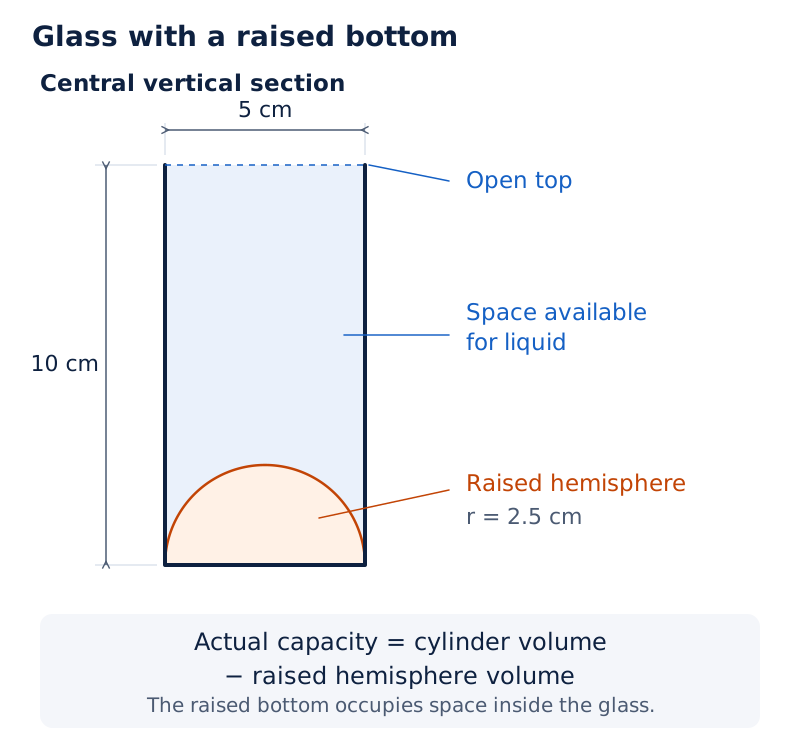
The glass is drawn as an open cylinder. Inside its lower end, an upward-curving hemispherical portion rises above the bottom and occupies part of the interior.
Drawn by One Young India. See Fig. 12.13 in your NCERT textbook
Worked example 7. A cylindrical glass has inner diameter and height . Its bottom contains a hemispherical raised portion of the same radius as the glass. Find its apparent and actual capacities using .
- Find the common internal radius:
- Let denote the full cylindrical capacity. Calculate it using the internal dimensions:
- Let denote the volume occupied by the hemisphere. Calculate it without rounding:
- Let denote the space available for liquid. Subtract the raised volume:
Answer: The apparent capacity is , while the actual capacity is approximately .
The inner dimensions determine liquid capacity. The raised hemisphere occupies space within the cylinder already calculated, so adding it would overstate the capacity. Keeping its exact fractional volume until subtraction prevents the rounding of one intermediate answer from affecting another.
How can a surrounding cylinder be compared with a solid toy?
A cylinder that circumscribes a cone-and-hemisphere toy surrounds it. For the arrangement considered here, its radius equals the common radius of the toy, and its height includes the cone's perpendicular height plus the hemisphere's radius.
The difference between the cylinder's volume and the toy's volume is the space inside the cylinder that the toy does not occupy. Work out both complete volumes before subtraction. The cylinder's height is not just the cone's height.
How are the two volumes calculated separately?
Worked example 8. A solid toy consists of a hemisphere surmounted by a right circular cone. The cone's height is , and its base diameter is . Find the toy's volume and the difference between it and a closely circumscribing cylinder. Use .
- Find the common radius from the diameter:
- Calculate the hemisphere volume:
- Calculate the cone volume:
- Add the constituent volumes:
- Let denote the surrounding cylinder's height. Include the hemisphere as well as the cone:
- Calculate the enclosing cylinder's volume:
- Subtract to find the unoccupied space:
Answer: The toy's volume is , and the required volume difference is also .
The equality of these two numerical answers follows from the particular dimensions supplied. The method remains to calculate the component volumes and subtract the toy from its enclosing cylinder, rather than assuming that the unused space has a fixed fraction in every arrangement.
Notice that perpendicular height enters both volume calculations. The cone's slant height is unnecessary here because neither requested quantity measures the cone's curved surface.
How is the volume remaining after cavities are removed found?
For an object with cavities, first calculate the volume of the original solid. Then subtract the volumes of the hollow portions. If several cavities have identical dimensions, calculate one cavity carefully and multiply by their number.
How do repeated conical depressions affect a pen stand?
A wooden pen stand can be modelled as a cuboid with conical depressions. The depth of a depression is the perpendicular height of its cone. The amount of wood depends on the volume removed, not on the area of the exposed cavity walls.
Worked example 9. A wooden pen stand is a cuboid measuring by by . It has four conical depressions, each with radius and depth . Find its wood volume using .
- Calculate the original cuboid's volume:
- Calculate one conical depression's volume using its radius and depth:
- Calculate the total volume removed in all four cavities:
- Subtract this volume from the original cuboid:
Answer: The pen stand contains approximately of wood.
The descriptive subscripts on identify the volume being measured: the original cuboid, one cavity, all removed material or the remaining wood. Keeping these quantities separate makes the subtraction and the number of depressions explicit.
How can a complete solution be checked?
- Identify the quantity: decide whether the question asks for an area, a volume, a capacity or a cost based on area.
- Identify the parts: mark joins, open faces, covered patches, raised portions and cavities before choosing formulas.
- Recover missing dimensions: halve diameters, subtract hemispherical heights where needed, and distinguish a cone's perpendicular height from its slant height.
- Combine the right quantities: add adjoining component volumes, subtract occupied or removed volumes, and count only the surfaces requested for area.
- Check units and rounding: use common length units during substitution, retain exact fractions where practical, and report square or cubic units as appropriate.
The final check should return to the original object. A removed cavity reduces the quantity of wood, a raised bottom reduces liquid capacity, and a covered joining face does not require paint. These interpretations help connect the numerical answer to the physical shape.
Glossary
- Combination of solids — An object whose shape is made from two or more familiar basic solids joined together.
- Curved surface area — The area of a solid's curved boundary, excluding any flat circular faces.
- Total surface area — The area of all boundary surfaces included when considering the complete solid.
- Exposed surface — A boundary surface remaining uncovered and included in the area being calculated.
- Common face — A shared contact face that becomes hidden when two solid parts are joined.
- Hemisphere — One half of a sphere, with a curved surface and a flat circular base.
- Slant height — The length along a right circular cone's surface from its vertex to the base rim.
- Perpendicular height — For a right circular cone, the perpendicular distance from its vertex to the centre of its base.
- Capacity — The internal volume available in a container for holding a substance such as liquid.
- Apparent capacity — The full cylindrical volume calculated before allowing for a raised portion inside a glass.
- Actual capacity — The volume available for liquid after subtracting the space occupied by an internal raised portion.
- Depression — A hollow portion removed from a solid, leaving an interior surface and reducing the material's volume.
Common errors and misconceptions
- Misconception: Add both total surface areas whenever two solids are joined. Correct: Identify the exposed surfaces first. Shared contact faces are hidden, and unequal joining radii can leave an exposed ring.
- Misconception: A given diameter can be substituted directly as the radius. Correct: Halve the diameter first, using , before calculating areas or volumes.
- Misconception: A cone's perpendicular height and slant height are interchangeable. Correct: Curved surface area uses , while volume uses ; their relation is .
- Misconception: A capsule's total length is its cylindrical length. Correct: Subtract both hemispherical radii from the total length before applying the cylinder formula.
- Misconception: Scooping out material means subtracting its curved area from the exterior area. Correct: A cavity creates an exposed inner surface. Subtract removed volume when calculating the material remaining.
- Misconception: A raised hemispherical bottom increases a glass's capacity. Correct: It occupies part of the cylindrical interior, so its volume must be subtracted from the apparent capacity.
- Misconception: Every tent calculation includes its circular base. Correct: When the base is uncovered, calculate canvas for the curved wall and roof, excluding the floor.
- Misconception: Area and volume can be expressed using the same units. Correct: Area uses square units and volume uses cubic units; convert mixed length units before substitution.
Exam-style questions with model answers
Q1. A cone and a hemisphere of equal radius are joined along their flat circular faces. Explain which surfaces determine the toy's exterior area and how its volume is found. [2 marks]
- The exterior area is the sum of the cone's and hemisphere's curved surface areas. The shared circular faces are hidden inside the toy.
- The volume is the sum of their individual volumes because the joined parts occupy adjoining spaces without overlapping interiors.
Q2. Two cubes, each of volume , are joined face to face to make a cuboid. Find the surface area of the resulting cuboid. [3 marks]
- Let denote each cube's edge. Recover the edge from the given volume: Both original cubes therefore have the same edge length.
- The joined cuboid has length , breadth and height . Joining along a whole face doubles one dimension.
- Use the cuboid's total-area formula so that the hidden joining faces are excluded:
Q3. An open vessel consists of a hollow hemisphere surmounted by a hollow cylinder of the same inner radius. Its inner diameter is , and its total inner height is . Find its inner surface area using . [3 marks]
- The common radius is . The hemisphere contributes its radius to the height, leaving cylinder height .
- The open vessel has no flat disk across its mouth. Its inner boundary consists of the cylinder's curved wall and the curved hemispherical bottom, so .
- Substitute the dimensions and add both contributions: This is the required inner area.
Q4. A hemisphere of diameter is fixed on one face of a cube of edge . Find the total exposed surface area of the combined block, using . [4 marks]
- The hemisphere's radius is . The cube's total area before attachment is .
- The circular patch covered by the hemisphere has area . This patch is no longer exposed.
- The hemisphere contributes its curved surface, whose area is . Its flat base is hidden.
- Subtract the covered cube patch and add the curved hemisphere: The remaining portions of all cube faces are included.
Q5. A wooden rocket consists of a cone on a narrower cylinder. Total height is ; the cone has height and base diameter ; the cylinder's diameter is . The conical portion is orange and the cylindrical portion yellow. Find both painted areas, including the exposed ring and bottom. Use . [5 marks]
- The cone's radius is ; the cylinder's radius is . The cylinder's height is , because the total height includes the conical top.
- Calculate the cone's slant height from its radius and perpendicular height: Its curved area is .
- The cone's exposed base ring has area . Adding it gives orange area .
- The cylinder's curved wall has area . Its upper circular face is covered by the cone. Only the curved wall and the uncovered lower base receive yellow paint.
- The exposed lower base has area . Hence the yellow area is .
Q6. A shed has a cuboidal part long, broad and high. Its half-cylinder roof has diameter and axial length . Machinery occupies , and 20 workers each occupy about . Find the empty capacity and remaining air volume, using . [5 marks]
- The cuboidal part encloses . This uses the wall height and excludes the roof space, which will be calculated separately.
- The roof radius is . Its half-cylinder volume is
- Add the two adjoining volumes to find the empty capacity: . Their shared boundary does not remove any enclosed space.
- Using the stated average, the workers occupy approximately . Together with the machinery, occupied space is approximately .
- Subtract occupied space from the empty capacity: . The answer remains approximate because the workers' individual occupied volumes were given approximately.
Q7. A solid cylinder has height and diameter . A conical cavity of the same height and diameter is hollowed out from one end. Find the total surface area remaining, to the nearest square centimetre. Use . [4 marks]
- The common radius is . The cavity's slant height is .
- The remaining boundary contains the outer cylindrical wall, the curved conical cavity and one circular base. The cavity's opening is not an additional flat disk.
- Calculate these areas separately: , , and , using the stated value of .
- Add the three exposed areas: . Rounded to the nearest square centimetre, the required total surface area is .
Key takeaways
- Separate a combined object into familiar solids, then identify the dimensions belonging to each part before choosing formulas.
- Surface area follows exposed boundaries; joined faces disappear from the exterior, while cavities expose additional interior surfaces.
- A hemisphere contributes its radius to a combined height, so subtract that contribution when finding a cone or cylinder height.
- Use a cone's slant height for curved surface area and its perpendicular height when calculating volume.
- When a wider cone rests on a narrower cylinder, include the exposed ring beneath the cone in its painted area.
- Add adjoining component volumes, then subtract cavities or occupied space when finding remaining material or available capacity.
- Use inner dimensions for capacity, and subtract any raised internal portion that takes up space otherwise available to liquid.
- Keep dimensions in consistent units, preserve exact intermediate values where practical, and distinguish square units from cubic units.
Test yourself
Why is the capsule's area not the sum of the total areas of a cylinder and two hemispheres?
The flat circular faces meet inside the capsule, so only the curved surfaces remain on its exterior.
How much length do two hemispherical ends contribute along a capsule's axis?
Each end contributes one radius. Together they contribute one diameter, which must be removed from the total to obtain the cylindrical length.
Which cone height is needed to calculate curved surface area?
Use the slant height in ; the perpendicular height is used to find volume.
Why is a circular patch subtracted when a hemisphere is fixed to a cube?
The hemisphere covers that patch of the cube, so the patch is no longer part of the exposed surface.
Which part of the rocket's cone base remains exposed when the cylinder is narrower?
The outer circular ring remains exposed around the smaller central circle covered by the cylinder.
Why does the shed roof calculation contain a factor of one-half?
The curved roof encloses half of a cylinder, so its volume is half the corresponding full-cylinder volume.
What must be subtracted from a cylindrical glass's apparent capacity when its bottom is raised hemispherically?
Subtract the raised hemisphere's volume, because that material occupies part of the space otherwise available for liquid.
How is the amount of wood found in a cuboidal pen stand with four identical conical depressions?
Calculate the cuboid's volume and subtract four times the volume of one conical depression.
Write about it
Turn a question from this chapter into a paper.
The Writing Studio has a structure guide, a rubric and citation tools for 15 formats, from essays to research papers. Drafting is free with an account. Learnacy Essential adds feedback from an AI writing coach and submission to The OYI Review.
Learnacy Essential is ₹1,499 for the year. Publication depends on review and is not guaranteed.