
Arithmetic Progressions | CBSE Class 10 Maths Notes
On this page
Watch & explore
Start with a few high-quality watches, then dive into the notes below.
These Class 10 Mathematics notes cover arithmetic progressions, common differences, finite and infinite lists, the general term, finding a term's position, sums of terms, numbered formula derivations, and applications involving salaries, savings, interest and production.
What makes a list an arithmetic progression?
Definition: An arithmetic progression, abbreviated AP, is a list of numbers in which each term after the first is obtained by adding a fixed number to the preceding term. That fixed number is the common difference.
A term is an individual number in the list. The order matters because the rule connects each number with the one immediately before it. A recognisable pattern alone does not make a list an AP: the amount added must remain fixed.
How do we describe an AP using symbols?
Let denote the first term and the common difference. Let be a positive integer giving a term's position, and let denote the term at that position. Thus , and denote the first, second and third terms.
The general form is . Both the first term and the common difference are needed to generate the list. The common difference can be positive, negative or zero; the terms need not be positive integers.
| List | First term | Common difference | Behaviour |
|---|---|---|---|
| Terms increase | |||
| Terms decrease | |||
| Terms remain equal | |||
| Decimal terms increase |
How do finite and infinite APs differ?
A finite AP has a finite number of terms and a last term. An infinite AP continues without a last term. For a finite AP containing terms, let denote its last term, so .
What the figure shows
Ladder with narrowing rungs
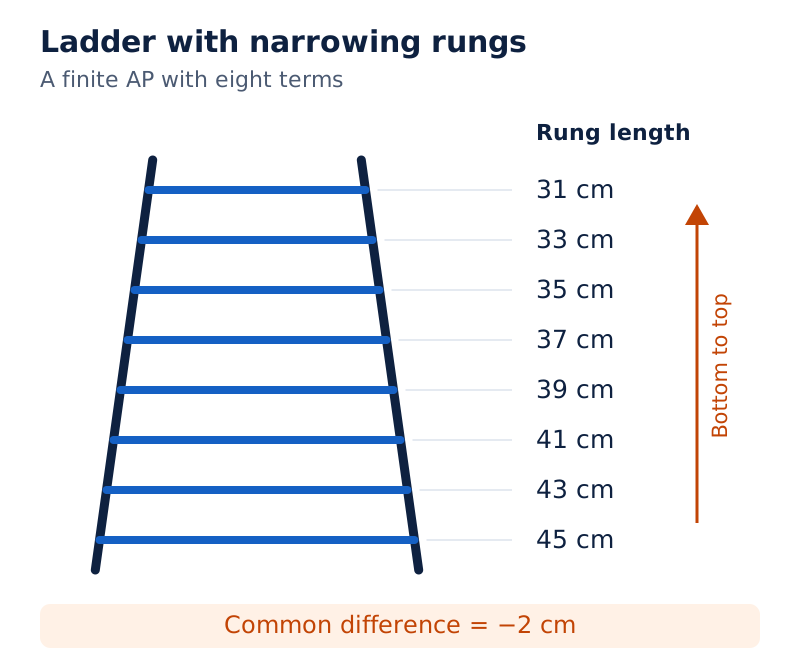
The drawing shows two side rails and eight horizontal rungs. The rungs become shorter towards the top. The side rails extend beyond the highest and lowest rungs.
Drawn by One Young India. See Fig. 5.1 in your NCERT textbook
The ladder's rung lengths, measured in centimetres from bottom to top, are . Each length is two centimetres less than the previous one. This gives a finite AP whose last term represents the top rung's length, rather than a continuation beyond the ladder.
How can we check whether a pattern is an AP?
Result: Equal consecutive differences identify an AP
Let denote a positive integer identifying a position for which a following term exists. Then is the term at that position and is the next term. The AP condition is , with the same value for every such position.
Subtract the earlier term from the later term. If the list is already known to be an AP, any consecutive pair gives its common difference. When deciding whether a list is an AP, compare successive differences; one pair alone cannot establish the pattern.
Worked example 1. Decide whether forms an AP and write the next two terms.
Answer: Compare the three displayed consecutive differences before extending the list.
- The first difference is .
- The second difference is .
- The third difference is . The differences agree, giving .
- Add the common difference to the fourth term: .
- Add it again: . The next two terms are and .
The list has a repeating pattern but is not an AP. The following numbered check shows why repetition and a fixed difference are different ideas.
- The first difference is .
- The next difference is .
- Since , the consecutive differences are unequal, so the list is not an AP.
What the figure shows
Squares divided into unit squares
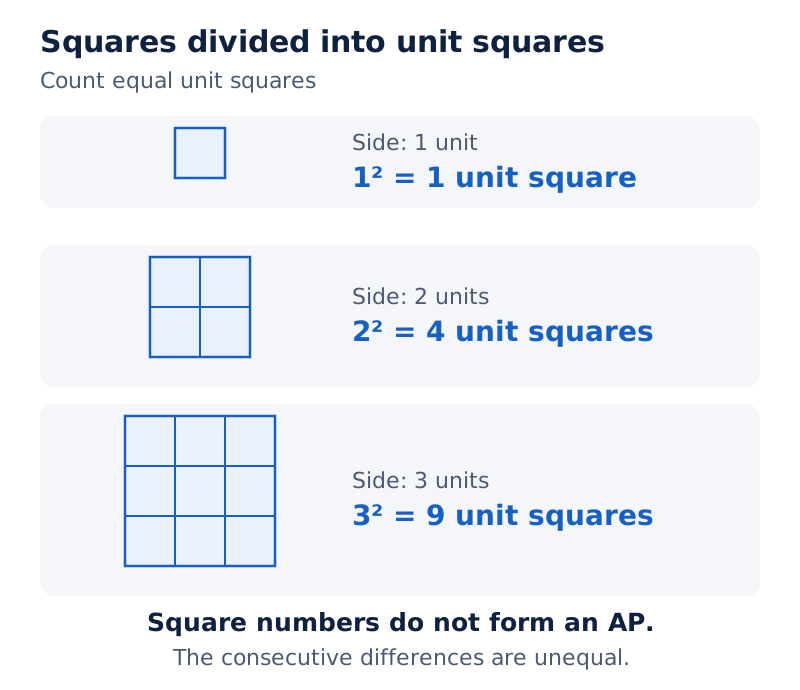
Three blue squares are shown. The first is undivided, the second has two rows and two columns, and the third has three rows and three columns.
Drawn by One Young India. See Fig. 5.2 in your NCERT textbook
The counts of unit squares follow . This is a pattern of square numbers, rather than an AP. Similarly, multiplying each term by a fixed number is a different rule from adding a fixed number.
Note: A few equal differences at the start are not enough if later displayed differences change. In , the first equal terms are followed by a change, so the list is not an AP.
How is the formula for the general term derived?
Result: The term at a given position
The general term gives a term directly from its position. To reach the second term, add the common difference once. To reach the third term, add it twice. The first term itself requires no addition of the common difference.
Derivation: Counting the additions
- At the first position,
- Add the common difference once to reach the second position:
- Add it again to reach the third position:
- For the fourth position,
- The term at position has additions after the first term, giving
The first term counts as a position. This explains the subtraction of one in the formula. The number of steps between the first and the required term is one less than the position number.
Worked example 2. Find the tenth term of the AP .
Answer: Use the first term, common difference and required position.
- Identify the first term: .
- Calculate the common difference: .
- The required position is , so .
- Substitute into the general term: .
- Calculate the increase: , so .
The same rule explains Reena's salary progression. Her starting monthly salary is ₹8000, and the annual increase in that monthly salary is ₹500. The monthly salaries in successive years therefore form an AP. A salary in one specified year is a term, rather than a sum.
Before substituting, decide what a single term represents. For a salary list it represents the monthly salary for a particular year; for a row of plants it represents the number in that row. The position identifies the year or row, not the numerical value of its term.
How do we find a term's position or test membership?
When the term value is known but its position is unknown, substitute the value for and solve for . This reverses the usual use of the general term. The solution must be a positive integer because it represents a position in the list.
How does a negative common difference affect the calculation?
Worked example 3. Which term of is , and does the AP contain zero?
Answer: Solve separately for each requested term value.
- Identify and calculate .
- For the first requested value, write .
- Expand the right side: .
- Subtract : . Divide by : . Thus is the thirty-fifth term.
- For zero, set .
- Rearrange: , then , giving . Zero is the eighth term.
A negative value of a term is allowed. A negative or fractional value of a position cannot identify a term in the list. Keep these roles separate when interpreting the result of an equation.
When does an algebraic solution reject membership?
Worked example 4. Check whether belongs to .
Answer: First establish the common difference, then test the proposed position.
- The displayed differences are , and . Thus and .
- Assume the proposed number is a term: .
- Expand: .
- Add one and divide by six: , so .
- The result is not an integer. Therefore is not a term of this AP.
Do not round the calculated position. Rounding would change the equation and identify a different term. A membership question ends with an interpretation of the position, not merely with the algebraic value obtained for it.
How can two known terms determine an AP?
Two terms at specified positions provide two equations involving the first term and common difference. Translate each position carefully using one fewer additions than its position number. Solving the resulting pair of linear equations determines the AP.
How do subtraction and substitution work together?
Worked example 5. Determine the AP whose third term is and seventh term is .
Answer: Express each given term using the general term formula.
- The third-term condition gives , so .
- The seventh-term condition gives , so .
- Subtract the first equation from the second: .
- Simplify and divide: , hence .
- Substitute into the first equation: , so .
- Generate the terms by repeated addition: , , , and . The AP is .
The subtraction removes the same first term from both equations. The remaining expression measures how much the terms change across the positions between them. Once the common difference is known, either original equation can be used to find the first term.
Keep the given positions attached to their values throughout the working. A third term is not the first term of the original AP merely because it is the first item mentioned in a question. Confusing these roles changes every later calculation.
This method also applies when the terms represent quantities such as annual production. In that setting, the first term describes production in the first year and the common difference describes the fixed yearly increase. Establishing the AP comes before calculating any later production or total.
What is the arithmetic mean of two numbers?
For three consecutive AP terms, let denote the middle term and the third term, with still denoting the first. The middle term is the arithmetic mean of the other two. Equal consecutive differences explain this relationship.
- Equality of the differences gives
- Add to both sides and simplify:
- Divide by two:
How do we count terms and work backwards from the end?
A counting problem often becomes a last-term equation. Identify the first eligible number and the last eligible number, determine the fixed difference, and solve for the last term's position. That position gives the number of terms when counting starts from the first term.
How can divisibility produce an AP?
Worked example 6. How many two-digit numbers are divisible by ?
Answer: The eligible numbers are .
- The first eligible number is , the common difference is , and the last is .
- Use the last-term equation: .
- Subtract the first term: .
- Divide by the common difference: .
- Include the first term: . There are eligible two-digit numbers.
The division in the fourth step counts intervals between the first and last numbers. Adding one converts that number of intervals into a number of terms. Both endpoints belong to the list and must be included.
How does reversing a finite AP help?
Worked example 7. Find the eleventh term from the end of .
Answer: Find the total number of terms, then locate the required term from the beginning.
- Identify , , and .
- Write , then subtract ten: .
- Divide by negative three: , hence .
- The eleventh position from the end corresponds to position from the beginning.
- Calculate .
- Check by reversing the AP: the new first term is and the new common difference is . Its eleventh term is .
When counting backwards, the last term occupies the first backward position. Reversing an AP also reverses the sign of its common difference. These two observations prevent errors in both the chosen position and the direction of change.
How is the sum of the first terms derived?
Let denote the sum of the first terms. A sum combines all terms up to the specified position. It differs from , which gives only the term at that position. The sum formula follows by writing the same terms in opposite orders.
Derivation: Adding a sum to its reverse
- Write the terms in forward order:
- Write the same sum in reverse order:
- Add corresponding terms in the two rows. The first pair gives . The next pair gives , and the same total continues.
- There are equal pair totals, so
- Divide both sides by two:
The reverse row is the same sum. It changes the order of addition, not the terms included. Adding the rows therefore doubles the required sum. Dividing by two at the end is necessary to recover the original total.
Result: The endpoint form of the sum
- Separate the first term inside the bracket:
- Replace the expression in braces by the general term:
- For a finite AP ending at its term in position , use :
Choose the form matching the data. The first formula uses the first term, common difference and number of terms. The endpoint form is convenient when the first term, last term and number of terms are given.
A last term alone does not reveal how many terms there are. If the first and last terms and a nonzero common difference are supplied, use the general-term formula to find the count, then substitute it into the sum formula. If the common difference is zero, the endpoint values do not determine the count; additional information is needed.
How do we calculate sums in different situations?
A sum may involve decreasing terms, positive integers or deposits made on successive birthdays. The meaning of the total changes with the situation, but the same AP formulas apply. Begin by identifying exactly which terms are to be added.
What happens when the common difference is negative?
Worked example 8. Find the sum of the first terms of .
Answer: Retain the negative common difference throughout substitution.
- Identify , , and .
- Substitute: .
- Calculate the factors: , , and .
- Simplify: .
A positive first term does not guarantee a positive sum. In a decreasing AP, later terms can be negative. The signs in the sum formula account for those terms, so a negative final total can be a valid result.
Result: Sum of the first positive integers
- The first positive integers form , with and .
- Substitute into the endpoint formula:
- Rearrange the factors:
Worked example 9. Find the sum of the first positive integers.
Answer: Apply the positive-integer sum formula.
- Use , with first term and last term .
- Substitute: .
- Simplify: .
How do birthday deposits become a total?
Worked example 10. Shakila deposits ₹100 on her daughter's first birthday, ₹150 on the second, ₹200 on the third, and increases each birthday's deposit by ₹50. Find the total collected through the twenty-first birthday.
Answer: Add the first deposits in the AP.
- Identify , , and , with deposits measured in rupees.
- Substitute: .
- Calculate inside the brackets: and .
- Add and multiply: .
- The total collected through that birthday is ₹12600.
The deposits are the individual terms; the amount collected is their sum. The twenty-first deposit and the total collected through that birthday answer different questions. Read words such as “in”, “through” and “total” carefully when deciding which formula is needed.
How can a known sum reveal missing information?
The sum formula links the first term, common difference, term count and total. When the count is at least two and the count, first term and sum are known, it can determine the common difference. That difference can then be used in a general-term calculation.
How do we move from a sum to a later term?
Worked example 11. An AP has first term and the sum of its first terms is . Find its twentieth term.
Answer: Find the common difference before calculating the requested term.
- Write the known data: and .
- Apply the sum formula: .
- Simplify: .
- Subtract and divide: , so and .
- Use the general term: .
- Calculate: . The twentieth term is .
Can two term counts give the same sum?
Worked example 12. How many terms of give a sum of ?
Answer: Solve the quadratic equation produced by the sum formula.
- Identify , , and .
- Substitute: .
- Simplify the bracket: .
- Multiply by two and rearrange: , so .
- Divide by three: .
- Factorise: , giving or .
- Check the first value: .
- Check the second value: .
Both counts are positive integers and both satisfy the original condition. The terms from the fifth through the thirteenth cancel to give zero. As a result, including those additional terms does not change the sum in this example.
How can consecutive sums recover a term?
Let denote the sum of the first terms. For a position after the first, subtracting this shorter sum from removes all earlier terms. The resulting relation is . For the first term itself, .
How do we find a sum from a formula for the terms?
Worked example 13. Find the sum of the first terms when the general term is .
Answer: Evaluate the first terms to identify the AP before using its sum formula.
- At the first position, .
- At the second position, .
- At the third position, . Each increase of one in the position increases the term by two, so and .
- For , substitute into the sum formula: .
- Calculate . Thus the first terms sum to .
The constant in a formula for the general term need not be the first term. Substitute the first position into the formula to obtain the first term before using any AP sum formula.
How do APs model interest and annual production?
Applications begin by identifying a quantity that changes by a fixed amount. The terms might describe accumulated simple interest or production in successive years. The question then asks for a particular term, an unknown position or the sum across several positions.
How does simple interest give an AP?
Worked example 14. ₹1000 is invested at simple interest of eight per cent per year. Find the interest at the end of each of the first three years, establish the AP, and calculate the interest at the end of thirty years.
Answer: Let denote simple interest in rupees, principal in rupees, the annual percentage rate and time in years.
- Use , with and .
- For the first year, .
- For the second year, .
- For the third year, .
- The interest totals form , with and .
- The thirtieth term is . Interest after thirty years is ₹2400.
Each term here already represents accumulated interest at the end of a year. To find interest after thirty years, calculate the thirtieth term. Adding all thirty accumulated interest values would answer a different question.
How do we combine equations, terms and sums?
Worked example 15. A TV manufacturer produces sets in the third year and in the seventh. Assuming production increases by a fixed number each year, find first-year production, tenth-year production and total production in the first seven years.
Answer: Let each AP term represent the number of sets produced in its year.
- The third year gives .
- The seventh year gives .
- Subtract: , so .
- Substitute into the third-year equation: , giving sets.
- For the tenth year, sets.
- For the seven-year total, .
- Simplify: sets.
The assumption of a fixed annual increase is essential to this model. The third-year and seventh-year figures alone do not establish how production changes in other years. Once the assumption is given, the two figures determine the AP and all three requested quantities.
Glossary
- Arithmetic progression — A list whose terms after the first are obtained by adding a fixed number to the preceding term.
- Term — An individual number occupying a particular position in a list of numbers.
- First term — The number at the beginning of an AP, denoted by .
- Common difference — The fixed number added to each term to obtain the next term of an AP.
- Consecutive terms — Terms that follow one another immediately in the given order of a list.
- Finite AP — An arithmetic progression containing a finite number of terms and having a last term.
- Infinite AP — An arithmetic progression that continues without having a last term.
- General term — An expression giving the value of a term from its position in an AP.
- Term position — The positive integer identifying where a term occurs when counting from the beginning.
- Last term — The final number in a finite AP, sometimes denoted by .
- Sum of terms — The total obtained by adding the terms included up to a specified position.
- Arithmetic mean — The middle of three consecutive AP terms, equal to half the sum of the other two.
- Simple interest — Interest calculated from principal, annual percentage rate and time using .
Common errors and misconceptions
- Misconception: Every recognisable numerical pattern is an AP. Correct: An AP requires the same difference between consecutive terms. A repeating list or a list of squares can have a pattern without meeting that condition.
- Misconception: The common difference must be positive. Correct: It may be positive, negative or zero. Decreasing lists and lists of equal terms can therefore be APs.
- Misconception: Subtract the smaller term from the larger to find the common difference. Correct: Subtract the earlier term from the following term, keeping the sign of the result.
- Misconception: The term in position requires additions of the common difference. Correct: The first term already occupies the first position, so the formula is .
- Misconception: A fractional solution for a position can be rounded. Correct: A term position must be a positive integer. A non-integer solution means the proposed value is not a term.
- Misconception: Finding the last term also gives the sum. Correct: The last term is one number, while the sum combines all included terms. Select the formula according to the requested quantity.
- Misconception: A sum question must have exactly one valid term count. Correct: Different positive integer counts can give the same sum when additional positive and negative terms cancel.
Exam-style questions with model answers
Q1. For the AP , find the first term and common difference. [2 marks]
- The first term is the first number listed, so .
- Subtract the first term from the second: . Thus the common difference is negative one.
Q2. Find the tenth term of the AP , showing the common difference and substitution. [3 marks]
- The first term is . Subtract the first term from the second to obtain the common difference: .
- The required position is . Use the general-term formula , giving .
- There are nine additions of the common difference after the first term. Therefore , so the tenth term is .
Q3. Determine whether is a term of the AP . Explain how the calculated position supports your conclusion. [3 marks]
- Here and . If is a term, it must satisfy for a positive integer position .
- Expand and rearrange: , so . Dividing gives .
- The result is not an integer, so it cannot identify a position in the AP. Therefore is not a term. Rounding this value would not satisfy the original equation.
Q4. An AP has third term and seventh term . Find its first term and common difference, then write its first five terms. [4 marks]
- The third term is reached after two additions of the common difference, so .
- The seventh term is reached after six additions. Hence . These two equations describe the same first term and common difference.
- Subtract the first equation from the second: , so . Substitute back: , giving .
- Add one successively: , , , and . The first five terms are .
Q5. How many terms of the AP must be added to obtain ? Check both roots and explain why both are admissible. [5 marks]
- The first term is , and the common difference is . The required sum is , with representing the unknown positive integer count.
- Apply the sum formula: . Multiply by two and rearrange to get .
- Divide by three and factorise: , so . The possible counts are therefore and .
- Check both sums: , and .
- Both counts are positive integers and satisfy the required sum. Both are admissible because the additional terms from the fifth through the thirteenth sum to zero, leaving the earlier sum unchanged.
Q6. A TV manufacturer produces sets in the third year and in the seventh year. Production increases by a fixed number each year. Find the first-year production, tenth-year production and total production in the first seven years. [5 marks]
- The fixed annual increase means annual production forms an AP. Let represent first-year production and the yearly increase. The given years produce the equations and .
- Subtract the first equation from the second to eliminate the first-year production: . Divide by four to obtain sets.
- Substitute into the third-year equation: , so . First-year production is therefore sets.
- The tenth year is nine increases after the first. Thus sets.
- Add the first seven annual outputs using . The total production over those seven years is sets.
Key takeaways
- An AP adds a fixed common difference to each term after the first; that difference may be positive, negative or zero.
- Calculate consecutive differences in the correct order by subtracting the earlier term from the following term.
- The formula counts one fewer additions than the position because the first term already occupies a position.
- A term value may be negative or fractional, but its position in the list must be a positive integer.
- A finite AP has a last term; an infinite AP continues without a last term.
- Find sums with , or use when the endpoints and count are known.
- Known terms can determine the first term and common difference through a pair of linear equations.
- Interpret whether a problem requests one term or a total, and check every admissible solution when solving for a count.
Test yourself
What condition separates an AP from a general numerical pattern?
Every term after the first must be obtained by adding the same fixed number to its predecessor.
Can an AP have equal terms throughout?
Yes. When the common difference is zero, adding it leaves each successive term unchanged.
What do , , and represent?
They represent the first term, common difference, positive integer position, and the value of the term at that position, respectively.
Why does the general-term formula use ?
The first term already occupies the first position, leaving one fewer additions of the common difference than the position number.
What does a non-integer position mean in a membership calculation?
The proposed value is not a term of the AP because positions must be positive integers.
When is the endpoint form of the sum formula useful?
Use it when the number of included terms and their first and last terms are known.
How does a finite AP change when written in reverse order?
Its last term becomes its first term, and the common difference changes sign.
Can increasing the number of included terms leave an AP sum unchanged?
Yes. Additional positive and negative terms can cancel, as happens between the fifth and thirteenth terms of .
Write about it
Turn a question from this chapter into a paper.
The Writing Studio has a structure guide, a rubric and citation tools for 15 formats, from essays to research papers. Drafting is free with an account. Learnacy Essential adds feedback from an AI writing coach and submission to The OYI Review.
Publication depends on review and is not guaranteed.