
Chemical Kinetics | CBSE Class 12 Chemistry Notes
On this page
Watch & explore
Start with a few high-quality watches, then dive into the notes below.
Learnacy Labs Try it hands-on: open the Rates of Reaction lab
Chemical kinetics covers reaction rates, average and instantaneous rates, concentration and rate laws, reaction order and molecularity, integrated equations for zero and first order reactions, half-life, pseudo first order reactions, temperature dependence, activation energy, catalysts and collision theory.
What does chemical kinetics explain about a reaction?
Chemical kinetics studies the rates of chemical reactions and their mechanisms. It connects measurements of changing concentrations with explanations involving reacting particles, intermediate species and the steps through which products form.
Feasibility, extent and speed
Thermodynamics helps predict whether a reaction is feasible. At constant temperature and pressure, the condition indicates feasibility, where is the Gibbs energy change of the reaction. Chemical equilibrium describes how far a reaction proceeds, while kinetics describes how quickly the change occurs.
These questions are different. Thermodynamic data indicate that diamond can convert into graphite, but the conversion is so slow that the change is not perceptible. A feasible change therefore need not occur at an easily observable speed.
| Rate category | Example | Observation |
|---|---|---|
| Very fast | Silver chloride precipitation | Precipitation occurs immediately when aqueous silver nitrate and sodium chloride are mixed. |
| Slow | Rusting of iron | Iron reacts gradually in the presence of air and moisture. |
| Moderate | Inversion of cane sugar and hydrolysis of starch | These changes proceed at moderate speeds. |
Macroscopic and molecular descriptions
At the macroscopic level, kinetics concerns amounts consumed or produced and their rates of change. At the molecular level, it concerns the energy and orientation of colliding molecules and the reaction mechanism.
Concentration, temperature, pressure and catalysts can affect reaction rates. Studying these factors helps explain food spoilage, the setting of dental filling materials and the burning of fuel. These are questions about the speed of change, rather than feasibility alone.
Definition: The rate of a reaction is the change in concentration of a reactant or product per unit time. It can be expressed through reactant disappearance or product appearance.
How do average and instantaneous reaction rates differ?
Consider at constant volume, with one mole of reactant giving one mole of product. Square brackets denote molar concentration. Reactant concentration decreases with time, while product concentration increases.
Average rate over an interval
For an interval between and , use the change in concentration divided by elapsed time. A negative sign makes the rate calculated from reactant disappearance positive.
The units are concentration divided by time, commonly . When gaseous concentrations are represented by partial pressures, the corresponding rate may be expressed in .
Worked example 1. In the hydrolysis of butyl chloride, its concentration falls from to during the first . Find the average rate.
Answer: Apply the reactant disappearance expression.
- Formula:
- Substitute:
- Calculate:
The answer describes the whole interval, rather than a particular instant within it.
Instantaneous rate at a specified time
The instantaneous rate is the limiting value of the average rate as the time interval approaches zero. Graphically, it is obtained using the tangent at the specified time on a concentration-time curve.
What the figure shows
Average and instantaneous rates
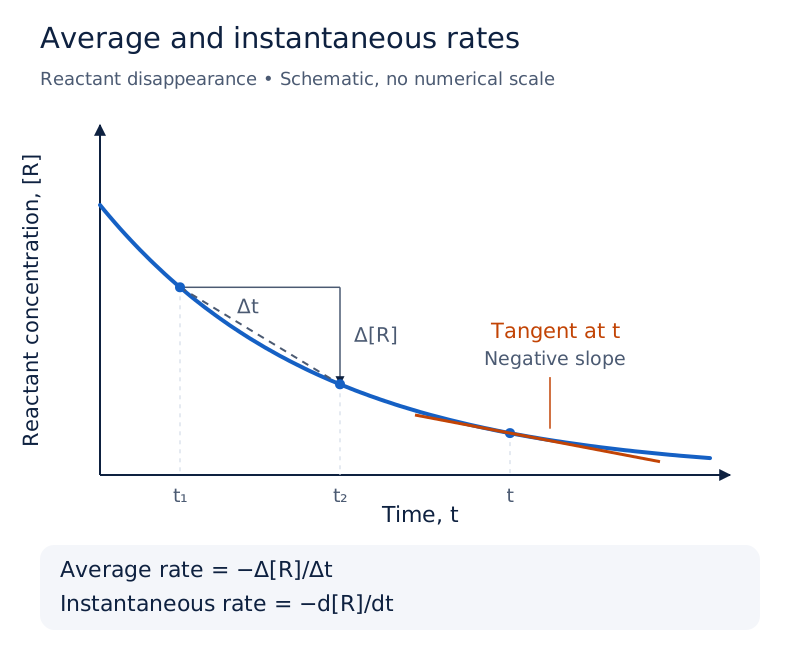
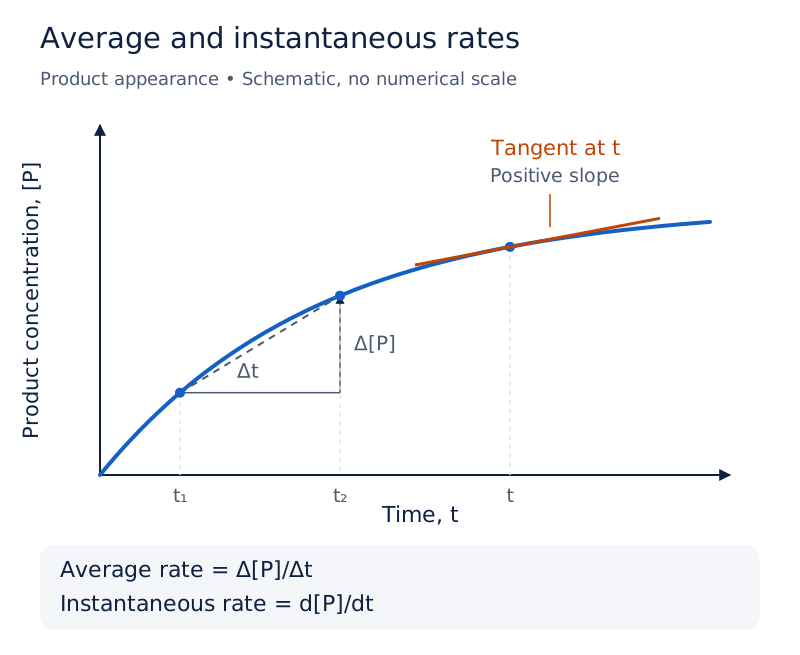
The reactant curve falls and the product curve rises with time. Marked concentration changes over finite intervals illustrate average rates; tangents illustrate instantaneous rates. The reactant tangent has a negative slope, while the product tangent has a positive slope.
Drawn by One Young India. See Fig. 3.1 in your NCERT textbook
As butyl chloride is consumed, the measured average rate decreases. Different time intervals therefore need not give the same rate. A tangent answers a different question from a finite concentration change: it describes how fast concentration changes at the chosen moment.
How are reaction rates related to stoichiometric coefficients?
A balanced equation specifies how much of each species is consumed or formed. When coefficients differ, their concentration changes per unit time differ too. Divide each species rate by its coefficient to obtain a common reaction rate.
For , A and B are reactants, C and D are products, and are their respective stoichiometric coefficients. At constant volume:
Consumption and formation are not interchangeable
For hydrogen iodide decomposition, . Hydrogen iodide disappears twice as fast as either product forms. Thus .
Worked example 2. At , N₂O₅ concentration falls from to in . For , calculate the average reaction rate and NO₂ production rate.
Answer: Include the stoichiometric factors before converting time units.
Formula: ; , where is the rate of NO₂ production.
- Substitute:
- Convert to hours:
- Convert to seconds:
- Find product formation:
Partial pressure can also follow a gaseous reaction. At constant temperature, gas concentration is proportional to its partial pressure. The pressure assigned to the reacting species must be distinguished from the total pressure of all gases present.
How do rate laws reveal reaction order and rate constants?
A rate law expresses reaction rate in terms of reactant concentrations raised to experimentally determined powers. For a general reaction, . The constant is the rate constant. The experimentally determined exponents and are the orders with respect to A and B respectively, and the overall order is .
Finding powers from experimental data
For , compare initial rates while keeping one reactant concentration constant. The following measurements concern the initial rate of NO₂ formation.
| Experiment | Initial NO concentration, | Initial O₂ concentration, | NO₂ formation rate, |
|---|---|---|---|
| 1 | 0.30 | 0.30 | 0.096 |
| 2 | 0.60 | 0.30 | 0.384 |
| 3 | 0.30 | 0.60 | 0.192 |
| 4 | 0.60 | 0.60 | 0.768 |
Doubling NO concentration at constant O₂ concentration quadruples the formation rate, so the power of NO is two. Doubling O₂ concentration at constant NO concentration doubles it, so the power of O₂ is one. The measured formation-rate law is .
The overall order is . The exponents happen to match the reactant coefficients here, but this cannot be assumed for other reactions. For example, the chlorination of chloroform has the experimental law .
Note: Determine order from the experimental rate expression, not by adding coefficients in the balanced equation. An order may be zero or fractional; a negative exponent must retain its sign when the powers are added.
How do the units of the rate constant change?
Dividing rate units by concentration raised to the overall order gives , when time is measured in seconds. Rate and rate constant therefore need not have identical units.
| Order | Units of rate constant | Concentration dependence for one reactant |
|---|---|---|
| Zero | ||
| First | ||
| Second |
Thus, a rate constant expressed in inverse seconds indicates first order kinetics. The numerical units depend on the time and concentration units selected, so comparisons require consistent units.
How does molecularity differ from reaction order?
An elementary reaction takes place in one step. A complex reaction proceeds through a sequence of elementary steps called its mechanism. The overall balanced equation gives the net change, but does not by itself reveal this sequence.
Molecularity is the number of reacting species participating in an elementary reaction, which must come together to bring about that event. These species may be atoms, ions or molecules.
Comparing order and molecularity
| Feature | Order | Molecularity |
|---|---|---|
| Meaning | Sum of concentration powers in the rate law | Number of reacting species in an elementary event |
| Determination | Experimental rate measurements | The specified elementary reaction step |
| Values | May be zero, integral or fractional | A positive integer; not zero or fractional |
| Application | Elementary and complex reactions | Elementary reactions; not an overall complex reaction |
Unimolecular, bimolecular and trimolecular reactions involve one, two and three reacting species respectively. Simultaneous encounters involving more than three species are very improbable. Trimolecular events are therefore rare.
What does a rate-determining step do?
The rate-determining step is the slowest step controlling the overall rate. In iodide-catalysed hydrogen peroxide decomposition in alkaline medium, the mechanism contains the following two bimolecular steps:
- Slow step: .
- Following step: .
The species IO⁻ is an intermediate: it is formed in one step and consumed in another, and is absent from the overall equation. Iodide is regenerated. The observed peroxide disappearance rate is .
This rate expression is first order in each of the two concentration terms. The mechanism explains why iodide concentration matters even though iodide cancels from the overall reaction. Assign molecularity to each elementary step, rather than to the complete multistep equation.
How is the integrated equation for a zero order reaction derived?
For a zero order reaction, the rate is independent of reactant concentration under the conditions in which zero order behaviour holds. The concentration term is raised to zero, so the differential equation becomes a constant rate of disappearance.
Derivation: Zero order integrated rate equation
- Write the differential law:
- Separate the variables:
- Integrate from the initial concentration to the concentration at time :
- Evaluate the integrals:
- Rearrange for concentration and rate constant:
Result: Reactant concentration decreases linearly with time while this rate law applies. An integrated equation relates directly measured concentrations and times, avoiding the need to measure a tangent slope at every instant.
What the figure shows
Zero order concentration plot
![Reactant concentration falls linearly with time from [R]₀, with slope −k.](/diagrams/chemical-kinetics-cbse-class-12-chemistry-notes/2.svg)
Concentration of R is on the vertical axis and time on the horizontal axis. A straight line slopes downwards from the initial concentration. Its slope is , and its vertical intercept is .
Drawn by One Young India. See Fig. 3.3 in your NCERT textbook
Why can a surface reaction be zero order?
Zero order reactions occur under special conditions. Gaseous ammonia decomposes on a hot platinum surface at high pressure, with the reaction shown at : .
The platinum surface becomes saturated with ammonia molecules. Increasing the gas concentration further does not change the amount adsorbed on the saturated surface, making the rate independent of ammonia concentration in this regime.
Some enzyme-catalysed reactions also show zero order behaviour. Thermal decomposition of hydrogen iodide on a gold surface provides another example. These examples emphasise the importance of experimental conditions when assigning an order.
How is the first order rate equation derived and applied?
A first order reaction has a rate proportional to the first power of reactant concentration. As reactant is consumed, its disappearance rate decreases. The integrated equation relates the fraction remaining to elapsed time.
Derivation: First order integrated rate equation
- Start with the differential law:
- Separate variables:
- Integrate between the initial and final states:
- Evaluate:
- Rearrange:
- Exponentiate to obtain concentration:
Result: The ratio inside the logarithm is dimensionless because the two concentrations use the same units. The rate constant has inverse-time units.
What the figure shows
First order straight-line plot
![The plot of log₁₀([R]₀/[R]) against time rises linearly from the origin with slope k/2.303.](/diagrams/chemical-kinetics-cbse-class-12-chemistry-notes/3.svg)
The vertical axis is and the horizontal axis is time. The straight line rises from the origin with slope .
Drawn by One Young India. See Fig. 3.5 in your NCERT textbook
Using concentration or amount remaining
Worked example 3. N₂O₅ follows first order kinetics at . Its concentration falls from to in . Find the rate constant.
Answer: Use the concentration ratio with the elapsed time.
- Formula:
- Substitute:
- Calculate:
At , the rate constant is expressed in inverse minutes because the elapsed time was measured in minutes.
Worked example 4. A first order reactant has . How long does its mass take to decrease from to ?
Answer: For the same substance at fixed volume, the mass ratio represents the concentration ratio. Let be the initial mass and the mass remaining at time .
- Formula:
- Substitute:
- Calculate:
The remaining mass is ; the logarithm must use that remaining amount.
Radioactive decay follows first order kinetics. Decomposition of N₂O₅ and N₂O also supplies examples. If measurements begin after the reaction starts, replace the initial time by the earlier observation time and use the concentrations at the two selected times.
How can pressure measurements give a first order rate constant?
For a gas reaction, the total pressure may change as the number of gas molecules changes. An integrated rate equation requires the reactant partial pressure. First use stoichiometry to express that pressure in terms of measured total pressure.
Derivation: Pressure relation for one reactant forming two products
Consider , starting with A alone at fixed temperature and volume. Let be its initial pressure, the total pressure at time , and the decrease in A's pressure.
- Write the partial pressures at time :
- Add the partial pressures:
- Find the pressure change:
- Obtain the reactant pressure:
- Use the first order equation:
Result: This particular pressure relation follows from the stated stoichiometry. A different equation can give a different relationship between reactant partial pressure and total pressure.
A different stoichiometric pressure relationship
Worked example 5. For the first order gas reaction , the vessel initially contains only N₂O₅, and total pressure rises from to in at constant volume and temperature. Find the rate constant.
Answer: Let N₂O₅ pressure fall by , so N₂O₄ and O₂ pressures rise by and .
Formula: ; ; , where is remaining N₂O₅ pressure.
- Substitute to find the change:
- Find the reactant partial pressure:
- Calculate the rate constant:
The total pressure after exceeds its initial value, even though the reactant partial pressure has fallen.
The pressure ratio inside the logarithm is dimensionless. Keeping the stoichiometric calculation separate from the kinetic calculation helps prevent substituting total pressure where the remaining reactant pressure is required.
How does half-life depend on reaction order?
The half-life, written , is the time needed for reactant concentration to become half its initial value. Substitute this condition into the appropriate integrated equation; the result depends on the reaction order.
Derivation: Zero order half-life
- Start with the zero order law:
- Apply the half-life condition:
- Rearrange:
- Obtain the result:
Result: At fixed rate constant, zero order half-life is directly proportional to the initial concentration. A larger initial concentration takes longer to fall to half its own starting value.
Derivation: First order half-life
- Use the integrated first order equation:
- Substitute the half-life condition:
- Solve for half-life:
Result: First order half-life is independent of initial concentration. This cancellation distinguishes it from the zero order result and allows either half-life or rate constant to be calculated from the other.
Worked example 6. Calculate the half-life for a first order reaction with .
Answer: Use the first order half-life expression.
- Formula:
- Substitute:
- Calculate:
The result uses seconds, matching the inverse-second unit of .
For first order reactions, the time for a specified fractional completion follows the same logarithmic equation. Use the fraction still present, rather than the fraction consumed, in its denominator.
Why do some reactions behave as pseudo first order reactions?
A pseudo first order reaction is a higher order reaction that behaves as first order under particular conditions. This can occur when one reactant is in such large excess that its concentration changes very little as the reaction proceeds.
Hydrolysis of ethyl acetate
Ethyl acetate reacts with water in the presence of acid: . Both ethyl acetate and water concentrations affect the underlying reaction, but water may be present in a large excess.
| Stage | Ethyl acetate | Water | Acetic acid | Ethanol |
|---|---|---|---|---|
| Initially | ||||
| At completion |
The water amount changes only slightly compared with its starting amount, while the ester is consumed. Water concentration can therefore be treated as approximately constant, and the observed rate depends on ethyl acetate concentration alone.
This approximation explains the word pseudo. Water participates in the reaction; its nearly constant concentration hides its variation from the observed rate law under these conditions. The apparent order describes the experimental situation.
Inversion of cane sugar
Acid-catalysed inversion of cane sugar is another example. Sucrose reacts with water to form glucose and fructose. With water in excess, the observed rate law is .
When identifying pseudo first order behaviour, explain both parts of the argument: the underlying reaction involves more than one reactant concentration, and one concentration remains nearly unchanged because that reactant is in excess.
How do temperature and activation energy affect the rate constant?
Most reactions become faster when temperature rises. The rate constant often approximately doubles for a temperature increase of , but the quantitative relationship is given by the Arrhenius equation, rather than a universal doubling rule.
Here is the pre-exponential factor, the activation energy, the gas constant and the absolute temperature. Use compatible units: in , , and temperature in kelvin.
Which units belong in kinetic calculations?
The SI unit of time is , and the SI unit of absolute temperature is . Keep these quantities consistent when using a rate constant expressed in inverse seconds with the Arrhenius equation.
The SI unit of a first order rate constant is . The SI unit of molar activation energy is , and the SI unit of the gas constant is .
Concentration-based calculations here use laboratory concentrations in . Their rate units therefore contain litres. The energy and temperature units cancel in the Arrhenius exponent, which must be dimensionless.
Energy distribution and the activated complex
Reactants must cross an energy barrier to form an unstable activated complex. The complex exists briefly and then produces products. Activation energy measures the energy needed to reach this state from the reactants.
Molecules have a distribution of kinetic energies. The most probable energy corresponds to the peak of the distribution. Increasing temperature increases the fraction of molecules with sufficient energy, so a larger proportion can participate in effective collisions.
What the figure shows
Temperature and molecular energies
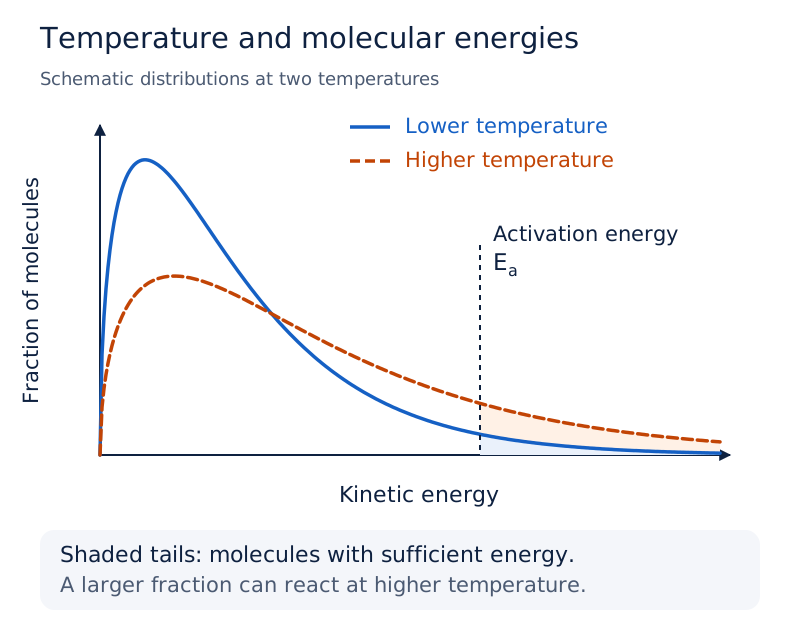
Two curves plot fraction of molecules against kinetic energy. The higher-temperature curve is broader and has a lower peak farther to the right. Beyond the marked activation energy, shaded areas show the larger fraction able to react at the higher temperature.
Drawn by One Young India. See Fig. 3.9 in your NCERT textbook
Derivation: Two-temperature Arrhenius equation
Treat the activation energy and pre-exponential factor as unchanged across the temperatures being compared.
- Take natural logarithms:
- Write the first-temperature equation:
- Write the second-temperature equation:
- Subtract to eliminate the pre-exponential factor:
- Convert to common logarithms:
Result: Rate measurements at two temperatures allow activation energy to be calculated. A plot of against is straight, with slope and intercept .
Worked example 7. A reaction has rate constants at and at . Find its activation energy and pre-exponential factor.
Answer: Obtain activation energy first, then substitute it into the Arrhenius equation.
Formula: ; .
- Substitute:
- Calculate:
- Find the pre-exponential factor without rounding the activation energy early:
- Calculate:
The temperature values and are absolute temperatures.
Worked example 8. Ethyl iodide decomposition has at and . Calculate the rate constant at .
Answer: Use consistent energy units throughout.
- Convert energy units:
- Substitute:
- Calculate:
The higher temperature of gives a larger rate constant.
How do catalysts and effective collisions change reaction rates?
A catalyst increases reaction rate without undergoing a permanent chemical change. It can form temporary bonds with reactants, produce an intermediate complex and be regenerated as that complex forms products.
An alternative pathway with a lower barrier
The catalyst provides an alternative mechanism with a lower activation energy. For example, manganese dioxide accelerates potassium chlorate decomposition: .
What the figure shows
Catalysed and uncatalysed pathways
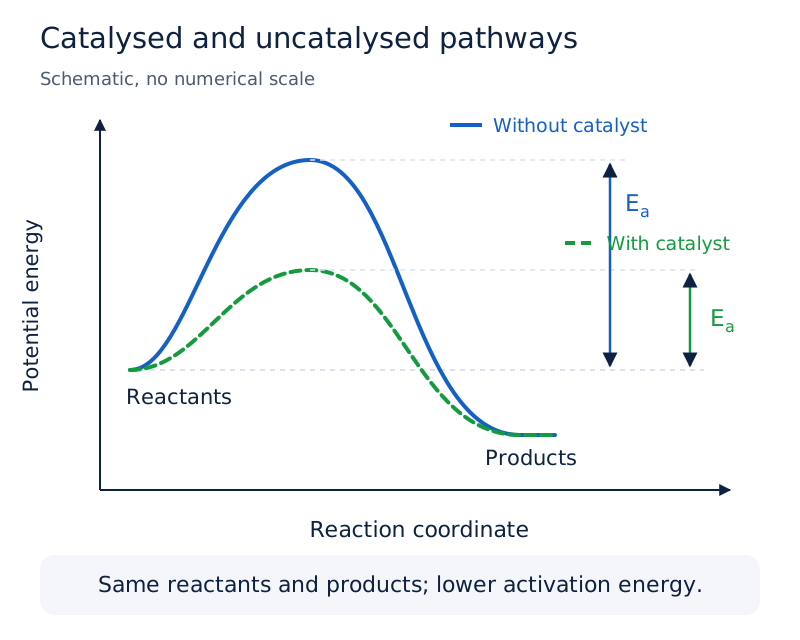
Potential energy is plotted against reaction coordinate. Both paths connect the same reactant and product levels, but the catalysed path has a lower peak. Vertical markings compare the activation energies with and without the catalyst.
Drawn by One Young India. See Fig. 3.11 in your NCERT textbook
A catalyst does not change the reaction's Gibbs energy or equilibrium constant. It speeds up the forward and reverse reactions so that equilibrium is reached sooner. A small catalyst amount can act on a large amount of reactants.
An inhibitor is a substance that reduces reaction rate. The distinction concerns the observed effect on the rate; increasing and decreasing the rate should not be described as the same catalytic action.
Why does every collision not produce products?
Collision frequency is the number of collisions per second per unit volume. Collision theory models reacting particles as hard spheres. For a bimolecular elementary reaction, collision frequency and activation energy both influence the rate.
Particles must collide with sufficient kinetic energy and a suitable orientation. Such effective collisions permit existing bonds to break and new bonds to form. A collision with an unsuitable orientation may produce no reaction despite the encounter.
Including the steric factor, , gives . Here is the collision frequency of A with B, and the exponential term represents the energetic fraction.
The factor accounts for the requirement of proper orientation. Thus, increasing the number of encounters alone does not fully explain reaction rate. Collision theory's hard-sphere picture also neglects detailed molecular structure, limiting its treatment of complex molecules.
Glossary
- Chemical kinetics — The study of reaction rates, factors influencing those rates and the mechanisms through which chemical reactions occur.
- Average rate — Concentration change per unit time measured over a specified finite interval during a reaction.
- Instantaneous rate — Reaction rate at a particular moment, obtained from the limiting concentration change over an infinitesimal time interval.
- Rate law — An experimentally determined expression relating reaction rate to reactant concentrations raised to specified powers.
- Rate constant — The proportionality constant connecting reaction rate with the concentration terms in the rate law.
- Reaction order — The sum of the powers of reactant concentrations appearing in the experimentally determined rate law.
- Molecularity — The number of reacting species that participate together in a specified elementary reaction.
- Rate-determining step — The slowest step in a reaction mechanism that controls the overall reaction rate.
- Half-life — The time required for the concentration of a reactant to decrease to half its initial value.
- Pseudo first order reaction — A higher order reaction showing first order behaviour because experimental conditions keep another reactant concentration approximately constant.
- Activation energy — The energy required for reactant species to reach the activated complex along the reaction pathway.
- Activated complex — An unstable, short-lived intermediate configuration formed as reacting species cross the energy barrier towards products.
- Effective collision — A collision with sufficient kinetic energy and proper orientation that allows reacting species to form products.
- Steric factor — A probability factor accounting for the requirement that colliding molecules have a suitable orientation for reaction.
Common errors and misconceptions
- Misconception: A thermodynamically feasible reaction must be fast. Correct: Feasibility and rate answer different questions; diamond's conversion to graphite is extremely slow despite its thermodynamic feasibility.
- Misconception: All species disappear or appear at the same rate. Correct: Their rates follow stoichiometric ratios. Divide each concentration-change rate by the corresponding coefficient to express a common reaction rate.
- Misconception: Reaction order is obtained by adding balanced-equation coefficients. Correct: Add the concentration exponents in the experimentally determined rate law, retaining the sign of each exponent.
- Misconception: Molecularity can be fractional, just like order. Correct: Molecularity counts species in an elementary step, so it is a positive integer and has no meaning for an overall complex reaction.
- Misconception: Every half-life is independent of initial concentration. Correct: First order half-life is independent, whereas zero order half-life is proportional to the initial concentration at fixed rate constant.
- Misconception: Total gas pressure can always replace reactant pressure in a first order equation. Correct: Use stoichiometry to obtain the remaining reactant partial pressure before applying the integrated equation.
- Misconception: A catalyst changes the equilibrium constant. Correct: It provides a faster pathway and helps equilibrium to be reached sooner without changing the equilibrium constant.
- Misconception: Every energetic collision gives products. Correct: Reacting species must also have a suitable orientation; energy and orientation together determine whether a collision is effective.
Exam-style questions with model answers
Q1. Distinguish average and instantaneous reaction rates. [2 marks]
- Average rate measures concentration change over a finite time interval, whereas instantaneous rate gives the rate at a specified moment.
- The instantaneous rate comes from the tangent slope on a concentration-time graph, with the appropriate sign for disappearance or appearance.
Q2. Explain why reaction order and molecularity are different. [3 marks]
- Order is the sum of reactant concentration powers in an experimental rate law. It expresses how the measured rate depends on concentrations and can be zero or fractional.
- Molecularity counts reacting species in a single elementary step. It is a positive integer and cannot be zero or fractional.
- Order can describe an overall complex reaction, but molecularity applies to individual elementary steps. Therefore, adding coefficients in an overall equation does not establish its molecularity or experimental order.
Q3. Derive the first order integrated equation and its half-life expression. [5 marks]
- Write the rate law for disappearance of a reactant whose rate is proportional to its concentration: .
- Separate concentration and time variables: . Integrate between initial concentration at zero time and remaining concentration at time : .
- Evaluating gives . Rearrangement produces , or . The concentration ratio is dimensionless.
- At half-life the remaining concentration is half the initial concentration. Substitution gives .
- Hence . Initial concentration cancels, so first order half-life is independent of it. Its time unit is determined by the inverse-time unit used for the rate constant.
Q4. Why is ethyl acetate hydrolysis pseudo first order when water is in large excess? [3 marks]
- The underlying hydrolysis depends on both ethyl acetate and water concentrations. It is therefore a higher order reaction when both changing concentrations must be considered.
- When water is taken in large excess, the amount consumed is small relative to its initial amount. Its concentration remains approximately constant during the reaction.
- The observed rate then varies with ethyl acetate concentration alone, giving first order behaviour under these conditions. Water still participates chemically; excess water explains why its changing concentration does not significantly affect the measured rate.
Q5. Calculate the time for a first order reactant with rate constant to decrease from to . [3 marks]
- For the same reactant at fixed volume, use the ratio of initial mass to remaining mass in the first order equation: . Both masses must use the same unit.
- Substitution gives . The mass units cancel within the logarithm, leaving a dimensionless ratio.
- Calculate . The result is a time in seconds because the rate constant was supplied in inverse seconds.
Q6. Explain the effect of a catalyst on activation energy and equilibrium. [3 marks]
- A catalyst supplies an alternative reaction mechanism with a lower activation energy. Temporary bonding and intermediate-complex formation can allow this pathway while regenerating the catalyst.
- The lower energy barrier increases the reaction rate. A small quantity of catalyst can consequently act on a large amount of reacting material without permanent chemical change.
- The catalyst does not alter the Gibbs energy change or equilibrium constant. It accelerates forward and reverse reactions so the same equilibrium state is reached more quickly.
Q7. Explain the Arrhenius equation and the energy and orientation requirements for reaction. [5 marks]
- The Arrhenius equation is . Here is the pre-exponential factor, the activation energy, the gas constant and the absolute temperature.
- Activation energy is the energy needed to reach the activated complex from the reactants. Increasing temperature raises the fraction of molecules with sufficient energy and usually increases the rate constant.
- Molecules must also approach with a suitable orientation. An energetic collision with an unsuitable orientation may fail to produce the bond changes necessary for products.
- Collision theory includes these requirements through , where collision frequency counts encounters and the steric factor accounts for orientation.
- Effective collisions therefore require both sufficient kinetic energy and proper orientation. The hard-sphere model has limitations because it does not fully represent molecular structure, especially for complex molecules.
Key takeaways
- Reaction rate describes concentration change with time; thermodynamic feasibility alone does not establish how quickly a reaction occurs.
- Divide disappearance or appearance rates by stoichiometric coefficients before equating them as a common reaction rate.
- Rate laws come from experiment, and reaction order is the sum of their concentration exponents.
- Molecularity counts species in an elementary event, while a complex mechanism contains multiple elementary steps.
- Zero order concentration decreases linearly with time; first order concentration decreases according to an exponential equation.
- First order half-life is independent of initial concentration, whereas zero order half-life depends directly on it.
- Excess reactant can make a higher order reaction behave as pseudo first order by keeping one concentration nearly constant.
- Temperature affects the energetic fraction of molecules; catalysts lower activation barriers, and effective collisions also require suitable orientation.
Test yourself
Why is a negative sign used for reactant disappearance?
Reactant concentration decreases, so its time derivative is negative. The minus sign expresses the disappearance rate as a positive quantity.
What determines the overall order in ?
The overall order is , the sum of the experimentally determined concentration powers in the rate law.
What units identify a first order rate constant when time is measured in seconds?
The units are ; concentration units cancel between rate and the first-power concentration term.
Which concentration-time graph is straight for a zero order reaction?
The graph of reactant concentration against time is straight, with slope and initial concentration as its vertical intercept.
What is an intermediate in a multistep reaction?
It is a species formed during one step and consumed during another, so it is absent from the overall balanced equation.
Why must water be in excess for ethyl acetate hydrolysis to appear first order?
Excess water keeps its concentration nearly constant, allowing the changing ethyl acetate concentration to determine the observed rate.
What does the slope of an Arrhenius plot represent?
For a plot of against , the slope is , allowing activation energy to be obtained.
What two requirements make a collision effective?
Reacting particles need sufficient kinetic energy and proper orientation to permit bond breaking and formation of products.