
Solutions | CBSE Class 12 Chemistry Notes
On this page
Watch & explore
Start with a few high-quality watches, then dive into the notes below.

This note covers types of solutions, concentration measures, solubility, Henry’s law, Raoult’s law, ideal and non-ideal solutions, azeotropes, colligative properties, molar-mass determination, osmosis, reverse osmosis and the van’t Hoff factor.
What is a solution, and how are solutions classified?
Definition: A solution is a homogeneous mixture of two or more components. Its composition and properties are uniform throughout the mixture.
The solvent is generally the component present in the largest quantity. It determines the physical state of the solution. The other component or components are called solutes. A binary solution contains two components, which may originally be gases, liquids or solids.
How does the solvent determine the type?
A gaseous solution has a gaseous solvent, a liquid solution has a liquid solvent, and a solid solution has a solid solvent. Classification therefore depends on the solvent rather than on the original physical state of the solute.
| Solution type | Solute state | Example |
|---|---|---|
| Gaseous | Gas | Oxygen and nitrogen mixture |
| Gaseous | Liquid | Chloroform mixed with nitrogen gas |
| Gaseous | Solid | Camphor in nitrogen gas |
| Liquid | Gas | Oxygen dissolved in water |
| Liquid | Liquid | Ethanol dissolved in water |
| Liquid | Solid | Glucose dissolved in water |
| Solid | Gas | Hydrogen in palladium |
| Solid | Liquid | Amalgam of mercury with sodium |
| Solid | Solid | Copper dissolved in gold |
The words dilute and concentrated describe relatively small and relatively large amounts of solute. They do not specify an exact composition. Quantitative concentration measures are needed when comparing solutions or calculating their physical properties.
A liquid solution can contain a gaseous, liquid or solid solute. Its behaviour depends on both composition and interactions between particles. Concentration calculations therefore begin by distinguishing the amount of solute, the amount of solvent and the amount of the complete solution.
How are percentages, parts per million and mole fraction used?
Which quantity forms the denominator?
Mass percentage compares the mass of a component with the total mass of solution. Volume percentage compares its volume with the final solution volume. Both require the whole solution in the denominator, rather than the solvent alone.
A glucose solution containing glucose by mass contains glucose and water in solution. An ethanol solution containing ethanol by volume contains ethanol in a final solution volume of .
Mass by volume percentage gives the mass of solute in grams per of solution. It is commonly used in medicine and pharmacy. The denominator is a volume even though the numerator is a mass.
Parts per million, abbreviated ppm, is useful for trace concentrations. The comparison may use mass, volume or mass per volume, so the basis should be stated.
What does mole fraction measure?
Mole fraction compares the number of moles of one component with the total moles of all components. It has no unit because the mole units cancel. For a binary mixture, the two mole fractions add to unity.
Here and are the mole fractions of components 1 and 2, and and are their respective amounts in moles.
Mass percentage, mass-based ppm and mole fraction do not depend on temperature. Mass and amount of substance do not change merely because a solution expands on heating. A measure based on volume requires greater care because volume changes with temperature.
Note: Mass fraction and mole fraction are different. Convert each component’s mass into moles before forming a mole fraction; directly dividing component masses gives a mass fraction.
How do molarity and molality differ in calculations?
Molarity is the number of moles of solute per litre of solution. Molality is the number of moles of solute per kilogram of solvent. The distinction involves both the physical quantity and whether the denominator describes solvent or solution.
Here denotes molarity, denotes molality and is the amount of solute in moles; is the solution volume in litres and is the solvent mass in kilograms.
| Feature | Molarity | Molality |
|---|---|---|
| Denominator | Volume of solution | Mass of solvent |
| Common unit | ||
| Temperature dependence | Changes when solution volume changes | Independent of temperature |
| Colligative-property use | Osmotic pressure | Boiling-point elevation and freezing-point depression |
The SI unit of molality is . Keep the symbol for molarity distinct from a molar mass: in the later expressions, denotes the solute’s molar mass, while denotes molality.
How are the denominator and units checked?
Worked example 1. Find the molarity of NaOH in solution. The molar mass is .
Formula: ; , where is the amount of solute in moles, is its mass in grams and is the solution volume in litres.
- Substitute to find amount: .
- Convert solution volume: .
- Divide by solution volume: .
Answer: . The denominator is the final solution volume.
Worked example 2. Find the molality of ethanoic acid in benzene, using a molar mass of .
Formula: ; .
- Substitute to obtain .
- Convert solvent mass: .
- Calculate .
Answer: . This calculation expresses the analytical amount of acid added per kilogram of benzene.
What controls solubility, and how does Henry’s law apply?
Solubility is the maximum amount of a substance that dissolves in a specified amount of solvent at a specified temperature. The nature of solute and solvent matters: polar solutes generally dissolve in polar solvents, while non-polar solutes dissolve in non-polar solvents.
During dissolution, solute enters the solution. During crystallisation, dissolved particles separate out. A saturated solution in contact with undissolved solute reaches dynamic equilibrium when these processes occur at equal rates. An unsaturated solution can dissolve more solute under the same conditions.
Heating generally increases solid solubility when dissolution is endothermic and decreases it when dissolution is exothermic. Pressure has little effect on solids dissolving in liquids because solids and liquids are highly incompressible. Gas solubility, however, increases with pressure and decreases with rising temperature.
What conditions belong with Henry’s law?
At constant temperature, Henry’s law relates the partial pressure of a gas above a liquid to its mole fraction in the solution:
Here is the gas’s partial pressure above the solution, is its mole fraction in the solution and is Henry’s law constant for the gas-solvent system at the stated temperature.
The SI unit of Henry’s law constant is when pressure is expressed in pascals. At a given pressure, a larger means lower gas solubility. Compare constants at the stated temperature and use the gas’s partial pressure.
Worked example 3. Nitrogen at has partial pressure above water. Use and water to find dissolved nitrogen.
Formula: ; for the very dilute solution.
- Convert .
- Substitute: , a dimensionless fraction.
- Find amount: .
- Convert .
Answer: approximately , or , of nitrogen dissolves.
High pressure increases dissolved CO₂ in sealed soft-drink bottles. Reduced pressure during a diver’s ascent can release dissolved nitrogen as bubbles. At high altitudes, reduced oxygen partial pressure lowers the amount dissolved in blood and tissues.
How does Raoult’s law describe two volatile liquids?
At a fixed temperature, Raoult’s law states that each volatile component’s partial vapour pressure is proportional to its mole fraction in the liquid. The proportionality constant is that component’s pure vapour pressure at the same temperature.
For component , where the index is 1 or 2, is its partial vapour pressure above the solution, is its liquid mole fraction and is its pure-component vapour pressure at the same temperature. The superscript zero denotes the pure component.
Derivation: total vapour pressure of a binary ideal solution
- Write Dalton’s law for the vapour mixture:
- Substitute the two Raoult expressions:
- Use the binary mole-fraction relation:
- Collect the terms:
Result: Total pressure varies linearly with liquid composition for an ideal solution at constant temperature. The pure-component vapour pressures give the endpoints.
What the figure shows
Ideal-solution vapour pressures
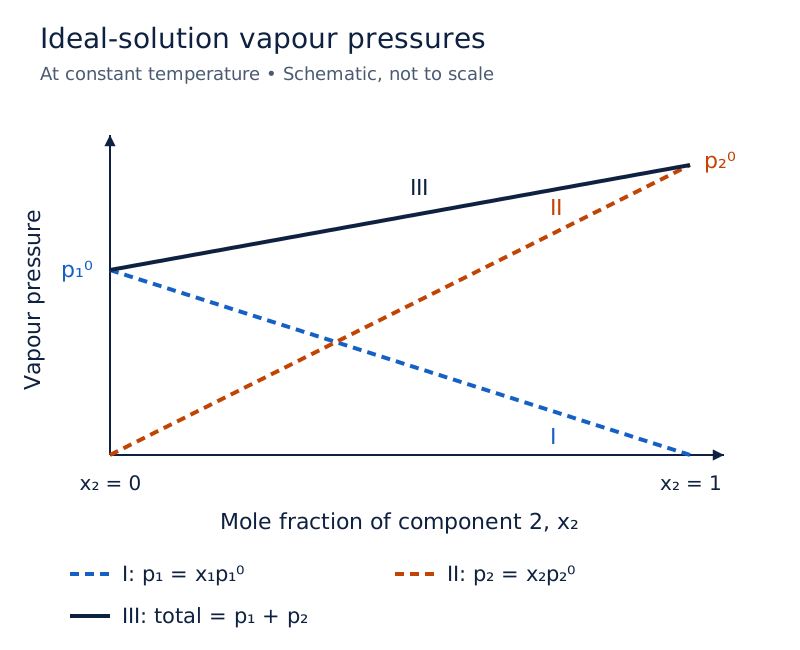
Vapour pressure is on the vertical axis and mole fraction on the horizontal axis. Two dashed straight lines show partial pressures, one rising and one falling. Line III shows their sum between the pure-component endpoints.
Drawn by One Young India. See Fig. 1.3 in your NCERT textbook
How is vapour composition calculated?
The vapour mole fraction, , differs from the liquid mole fraction, . Dalton’s law gives . The vapour is richer in the more volatile component, which has the higher pure vapour pressure.
Worked example 4. Mix CHCl₃ and CH₂Cl₂ at . Their pure vapour pressures are respectively and ; their molar masses are and .
Formula: ; ; .
- Substitute for amounts: ; .
- Calculate and , both dimensionless.
- Obtain and .
- Add .
- Calculate ; , both dimensionless.
Answer: total vapour pressure is approximately ; vapour mole fractions are approximately for dichloromethane and for chloroform.
Henry’s and Raoult’s laws both relate partial pressure to liquid mole fraction. Raoult’s law corresponds to the special case in which the Henry constant equals the pure component’s vapour pressure.
How do ideal solutions, deviations and azeotropes differ?
An ideal solution obeys Raoult’s law across the entire composition range. Mixing causes neither heat absorption nor heat evolution, and the final volume equals the sum of the component volumes.
Here is the enthalpy change on mixing and is the volume change on mixing.
Ideal behaviour occurs when unlike-molecule attractions are nearly equal to the corresponding like-molecule attractions. Nearly ideal examples include n-hexane with n-heptane, bromoethane with chloroethane, and benzene with toluene. Perfectly ideal solutions are rare.
Why can vapour pressure deviate in either direction?
| Feature | Positive deviation | Negative deviation |
|---|---|---|
| Measured vapour pressure | Higher than the Raoult prediction | Lower than the Raoult prediction |
| Unlike-molecule attractions | Weaker than corresponding like-molecule attractions | Stronger than corresponding like-molecule attractions |
| Escaping tendency | Increased | Decreased |
| Examples | Ethanol and acetone; carbon disulphide and acetone | Phenol and aniline; chloroform and acetone |
In an ethanol-acetone mixture, acetone disrupts some hydrogen bonding between ethanol molecules. Weaker interactions allow easier escape into the vapour. In a chloroform-acetone mixture, hydrogen bonding between unlike molecules reduces their escaping tendency.
What the figure shows
Deviations from Raoult’s law
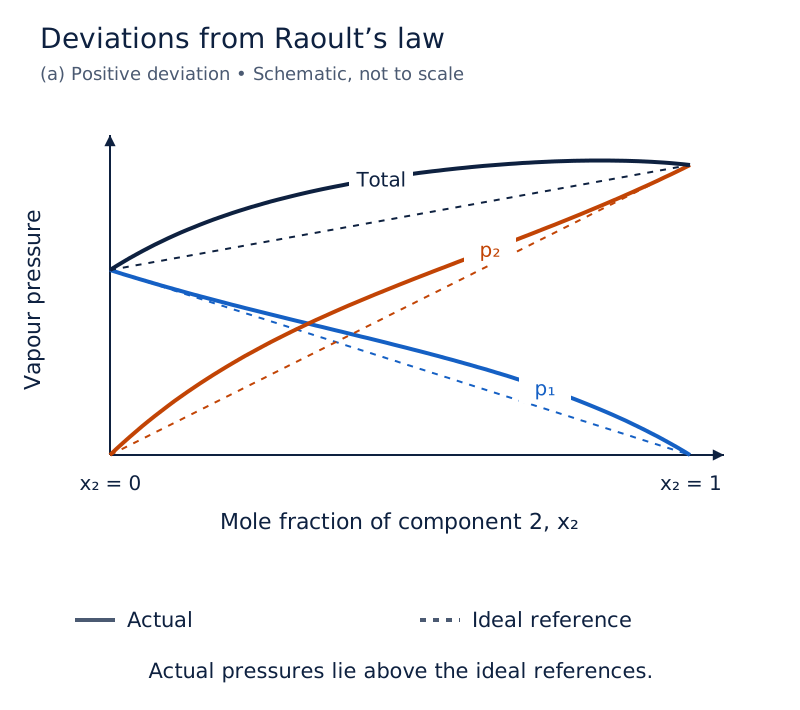
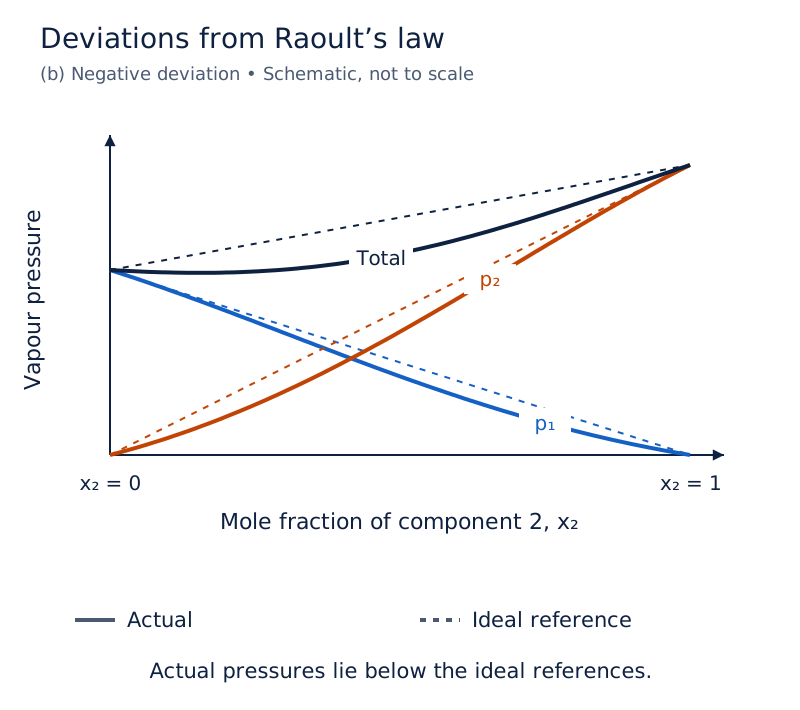
Both panels plot vapour pressure against composition. Curved partial-pressure and total-pressure plots lie above the straight ideal references in panel (a), and below them in panel (b).
Drawn by One Young India. See Fig. 1.6 in your NCERT textbook
Why does fractional distillation stop separating an azeotrope?
Azeotropes are binary mixtures that have the same liquid and vapour composition and boil at constant temperature. At the azeotropic composition, fractional distillation cannot further separate the components because the vapour offers no change in composition.
A sufficiently large positive deviation produces a minimum-boiling azeotrope. Ethanol and water provide an example, with an azeotropic composition of approximately ethanol by volume.
A sufficiently large negative deviation produces a maximum-boiling azeotrope. Nitric acid and water form one containing approximately nitric acid and water by mass, boiling at . A deviation alone does not mean every composition is azeotropic.
How does relative lowering of vapour pressure reveal molar mass?
Colligative properties depend on the number of solute particles relative to the solvent, rather than on their chemical identity. They include relative lowering of vapour pressure, elevation of boiling point, depression of freezing point and osmotic pressure.
When a non-volatile solute is dissolved in a volatile solvent, the solute contributes no appreciable vapour pressure. The solvent mole fraction decreases, and its vapour pressure is lower than that of the pure solvent at the same temperature.
Derivation: relative lowering and solute molar mass
Let component 1 be solvent and component 2 be a non-volatile solute. Assume Raoult’s law applies and the solute neither associates nor dissociates.
- Write the solvent’s pressure:
- Subtract from the pure-solvent pressure:
- Divide by the pure-solvent pressure:
- For a dilute solution, use : Here and are the solvent and solute masses in the same mass unit, and and are their respective molar masses.
- Rearrange for the solute’s molar mass:
Result: Relative lowering is dimensionless. The replacement of the total amount by the solvent amount is a dilute-solution approximation, rather than an exact identity.
Worked example 5. Adding non-volatile non-electrolyte to benzene reduces vapour pressure from to . Use .
Let denote the relative lowering of vapour pressure. Formula: ; .
- Substitute: .
- Find , which is dimensionless.
- Calculate .
Answer: approximately , using the dilute-solution relation.
Why does a non-volatile solute raise the boiling point?
A liquid boils when its vapour pressure equals the external pressure. A solution containing a non-volatile solute has lower vapour pressure than its pure solvent at the same temperature. It therefore needs a higher temperature to reach the same external pressure.
The elevation of boiling point is the solution boiling point minus the pure-solvent boiling point. For dilute solutions containing a solute that neither associates nor dissociates, it is proportional to molality.
Here is the solution boiling point, is the pure-solvent boiling point at the same pressure and is the boiling-point elevation.
The ebullioscopic constant, , depends on the solvent. The SI unit of the boiling-point elevation constant is . Multiplication by molality gives a temperature difference in kelvin.
What the figure shows
Elevation of boiling point
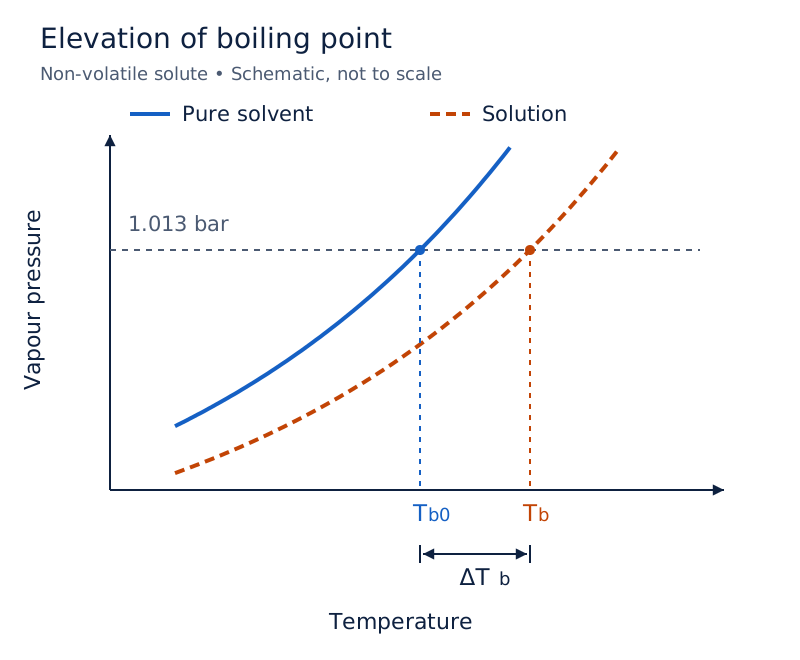
The solution vapour-pressure curve lies below the solvent curve. A horizontal line marks . Its intersection with the solution curve occurs at the higher temperature, and the horizontal temperature gap is labelled .
Drawn by One Young India. See Fig. 1.7 in your NCERT textbook
Derivation: molar mass from boiling-point elevation
- Convert solute mass to amount:
- For solvent mass in grams, form molality:
- Substitute into the elevation relation:
- Rearrange:
Result: Measured elevation and known solvent and solute masses determine molar mass when the solvent’s constant is known. The mass conversion is unnecessary if solvent mass is already in kilograms.
Worked example 6. Find the boiling point when glucose dissolves in water at . Use , and .
Formula: ; ; .
- Substitute: .
- Calculate .
- Find .
- Add .
Answer: the calculated boiling point is .
Worked example 7. Dissolving solute in benzene raises its boiling point from to . Use .
- Find .
- Convert .
- Calculate .
Answer: , or approximately to two significant figures.
Why does a dissolved solute lower the freezing point?
At the freezing point, the solid solvent and the liquid phase are in dynamic equilibrium. Their vapour pressures are equal. Adding a non-volatile solute lowers the liquid solvent’s vapour pressure, so equality with the solid solvent is reached at a lower temperature.
The depression of freezing point is defined as a positive difference by subtracting the solution freezing point from the pure-solvent freezing point. For a dilute ideal solution of a non-associating, non-dissociating solute, it is proportional to molality.
Here is the pure-solvent freezing point, is the solution freezing point and is the freezing-point depression.
The cryoscopic constant, , depends on the solvent. The SI unit of the freezing-point depression constant is . For water the constant is ; for benzene the tabulated value is .
What the figure shows
Depression of freezing point
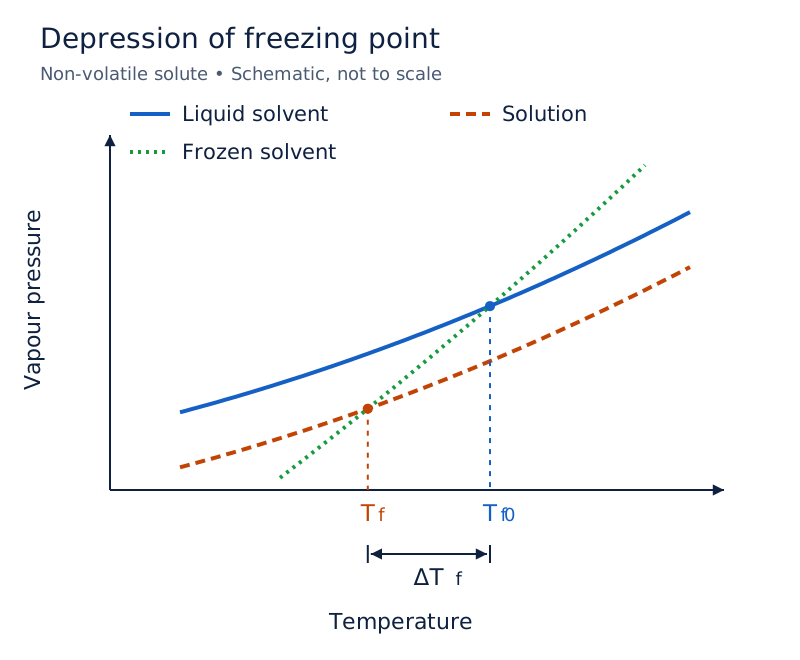
Vapour pressure is plotted against temperature. The solution curve lies below the liquid-solvent curve. Its intersection with the frozen-solvent curve occurs at the lower temperature, and the gap between freezing temperatures is labelled .
Drawn by One Young India. See Fig. 1.8 in your NCERT textbook
Derivation: molar mass from freezing-point depression
- Write the dilute-solution relation:
- Express molality using solvent mass in kilograms:
- Substitute the expression:
- Rearrange:
Result: A known mass of solute and a measured freezing-point depression provide its molar mass. Solvent mass, rather than total solution mass, must be used in the denominator.
Worked example 8. A non-electrolyte dissolved in benzene lowers its freezing point by . Find its molar mass using .
- Convert .
- Find .
- Obtain .
- Calculate .
Answer: the calculated molar mass is .
Boiling-point elevation and freezing-point depression both measure a change relative to the pure solvent. Keep that change separate from the final temperature: add the elevation to obtain a boiling point, but subtract the depression to obtain a freezing point.
What are osmosis and osmotic pressure?
A semipermeable membrane permits passage of solvent molecules while hindering solute passage. When it separates pure solvent from a solution, solvent flows into the solution. This movement is called osmosis.
Between a dilute and a more concentrated solution, solvent flows towards the more concentrated solution through the membrane. The excess pressure applied on the solution side that just prevents this flow is the solution’s osmotic pressure.
For a dilute solution at a given temperature, osmotic pressure is proportional to molarity. The temperature in the equation is absolute temperature, and the gas constant must use units compatible with the chosen pressure and volume.
Here is osmotic pressure, is molarity (the quantity previously denoted ), is the gas constant, is absolute temperature in kelvin, is the amount of solute in moles and is the solution volume.
The SI unit of osmotic pressure is . If volume is in litres and pressure in bar, use a gas constant expressed in . This keeps the units in the calculation consistent.
What the figure shows
Preventing osmosis
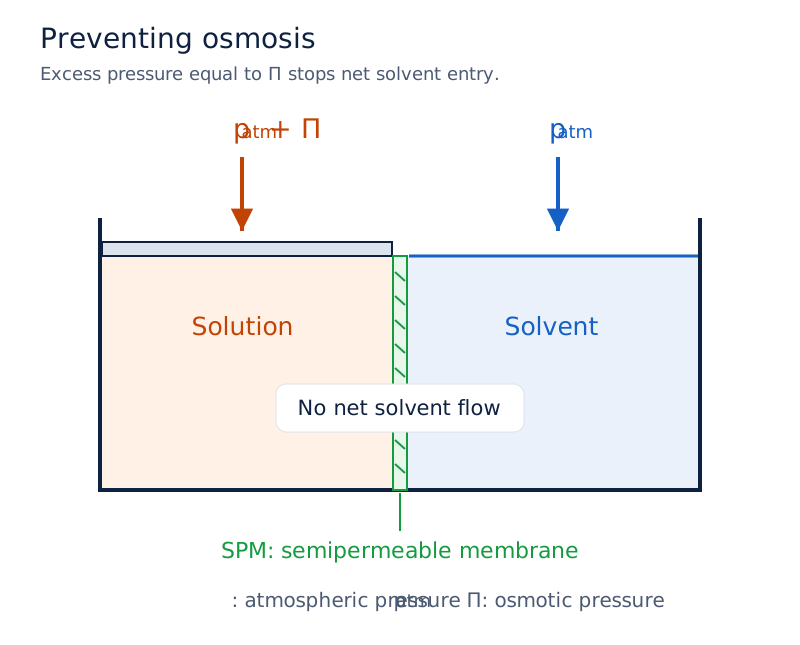
The solution and solvent occupy connected compartments separated by a membrane labelled SPM. The solution surface receives pressure , while the solvent surface receives . Here denotes atmospheric pressure. The extra pressure on the solution prevents solvent entry.
Drawn by One Young India. See Fig. 1.10 in your NCERT textbook
Derivation: molar mass from osmotic pressure
- Express molarity in terms of amount and solution volume:
- Substitute into the osmotic-pressure equation:
- Replace amount by mass divided by molar mass:
- Rearrange for molar mass:
Result: Osmotic pressure gives molar mass from solute mass, solution volume and temperature. Measurements near room temperature are useful for biomolecules that are unstable at higher temperatures.
Worked example 9. A protein solution contains protein in solution. At , its osmotic pressure is . Use .
- Convert .
- Find .
- Find .
- Calculate .
Answer: approximately , retaining the supplied gas-constant precision.
Even very dilute solutions can produce a measurable osmotic pressure. This makes the method useful for proteins, polymers and other macromolecules, whose low concentrations may give very small boiling-point or freezing-point changes.
How do isotonic solutions and reverse osmosis work?
What determines the direction of solvent movement?
Isotonic solutions have the same osmotic pressure at a given temperature. No net osmosis occurs when they are separated by a semipermeable membrane. Equal osmotic pressure is the defining condition; simply describing both solutions as dilute is insufficient.
A hypertonic solution has higher osmotic pressure than the reference solution. A hypotonic solution has lower osmotic pressure. These terms describe a comparison, so the reference must be clear.
Blood-cell fluid is isotonic with approximately mass-by-volume sodium chloride solution. In more concentrated saline, cells lose water and shrink. In less concentrated saline, water enters and the cells swell.
Osmosis also explains why raw mangoes lose water in concentrated brine, why wilted flowers revive in fresh water, and why a limp carrot can become firm when placed in water. In each case, solvent movement changes the water content of the cells.
How can pressure reverse the natural direction?
In reverse osmosis, the pressure applied to the solution exceeds its osmotic pressure. Solvent then passes out of the solution through the semipermeable membrane, reversing the direction of ordinary osmosis.
What the figure shows
Reverse osmosis apparatus
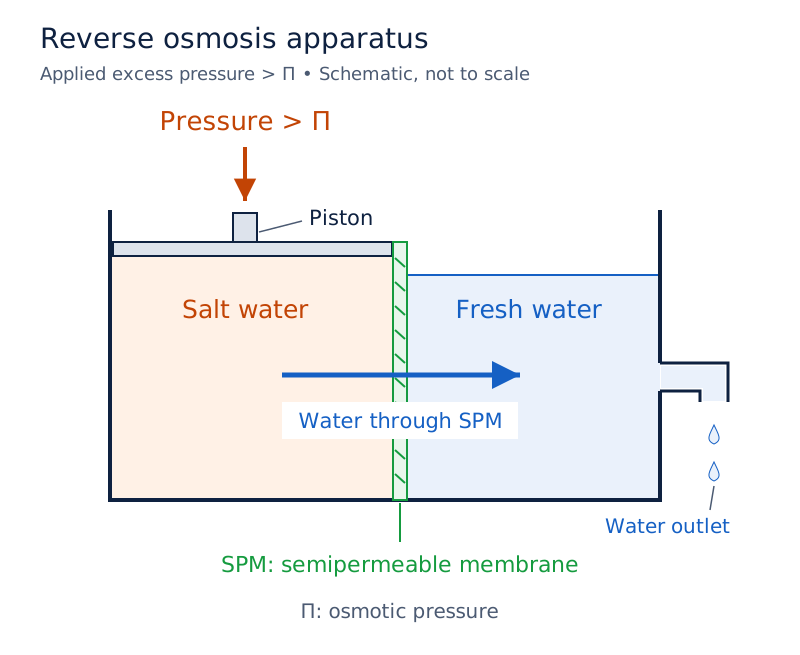
Fresh water and salt water occupy compartments separated by an SPM. A piston applies pressure greater than on the salt-water side. A water outlet on the fresh-water side is shown releasing drops.
Drawn by One Young India. See Fig. 1.11 in your NCERT textbook
Reverse osmosis is used to desalinate seawater. A supported cellulose acetate membrane allows water to pass while preventing passage of ions and impurities. The distinction between stopping and reversing osmosis is the magnitude of the applied pressure.
Note: An excess pressure equal to the osmotic pressure stops osmosis. An excess pressure greater than the osmotic pressure drives reverse osmosis. Apply this pressure on the solution side.
Why do association and dissociation produce abnormal molar masses?
A colligative-property calculation counts dissolved particles. Dissociation produces more particles than expected from undissociated solute. Association combines solute molecules and reduces the number of independent particles. Ignoring these changes gives an abnormal experimental molar mass.
Dissociation produces a larger colligative effect and an apparently smaller molar mass. Association produces a smaller colligative effect and an apparently larger molar mass. Ethanoic acid associates into dimers in benzene through hydrogen bonding.
How does the van’t Hoff factor correct the equations?
The van’t Hoff factor, , compares the observed effect with the calculated effect for a solute assumed neither to associate nor dissociate. It also equals the normal molar mass divided by the apparent experimental molar mass.
For association, ; for dissociation, . Complete dissociation of KCl ideally doubles the particle count, giving . Measured values need not equal this limit; they approach it as the solution becomes very dilute.
Derivation: the factor for dimer formation
- Let be the fraction of an initial amount that associates into dimers:
- The amount of unassociated molecules is
- Two monomers form one dimer, so
- Add both particle amounts and divide by the initial amount:
Result: Dimerisation lowers particle number. Complete dimerisation gives , and the degree of association follows from .
Worked example 10. Dissolving benzoic acid in benzene gives . For this problem use and normal molar mass .
- Convert .
- Calculate .
- Obtain , a dimensionless ratio.
- Find , so .
Answer: apparent molar mass is approximately , and approximately of the acid associates into dimers.
For ethanoic acid dissociating into hydrogen and acetate ions, the particle count instead increases. The corresponding relation is , where is the degree of dissociation. The particle balance must match the actual association or dissociation process.
Glossary
- Solution — A homogeneous mixture of two or more components with uniform composition and properties throughout.
- Solvent — The component generally present in the largest quantity, determining the physical state of the solution.
- Mole fraction — The amount of one component divided by the total amount of all components, measured in moles.
- Molarity — The number of moles of solute present per litre of the complete solution.
- Molality — The number of moles of solute present per kilogram of solvent in a solution.
- Solubility — The maximum amount of a substance dissolving in a specified amount of solvent at a specified temperature.
- Saturated solution — A solution that cannot dissolve more solute at the same temperature and pressure.
- Ideal solution — A solution obeying Raoult’s law over the entire range of composition at a given temperature.
- Azeotrope — A binary mixture with identical liquid and vapour compositions that boils at a constant temperature.
- Colligative property — A property depending on the number of dissolved solute particles relative to solvent, rather than their chemical identity.
- Ebullioscopic constant — The solvent-dependent proportionality constant relating boiling-point elevation to the molality of a dilute solution.
- Cryoscopic constant — The solvent-dependent proportionality constant relating freezing-point depression to the molality of a dilute solution.
- Osmotic pressure — The excess pressure applied to a solution that just prevents solvent entry through a semipermeable membrane.
- Reverse osmosis — Solvent flow out of a solution when applied pressure exceeds its osmotic pressure.
- Van’t Hoff factor — The ratio of observed colligative effect to that calculated assuming no solute association or dissociation.
Common errors and misconceptions
- Misconception: Molarity uses solvent volume. Correct: Molarity uses the final solution volume, while molality uses the solvent’s mass in kilograms.
- Misconception: A larger Henry constant means greater gas solubility. Correct: In , a larger constant gives a smaller mole fraction at the same partial pressure.
- Misconception: Heating increases every substance’s solubility. Correct: The effect depends on dissolution enthalpy; gas solubility in liquids decreases as temperature rises.
- Misconception: Liquid and vapour mole fractions are interchangeable. Correct: Liquid fractions determine partial pressures through Raoult’s law; vapour fractions follow from partial pressure divided by total pressure.
- Misconception: Lowering and relative lowering of vapour pressure have the same units. Correct: Lowering has pressure units, while relative lowering is a dimensionless pressure ratio.
- Misconception: Freezing-point depression should be added to the pure-solvent freezing point. Correct: Subtract the positive depression to obtain the lower solution freezing point.
- Misconception: Pressure equal to osmotic pressure causes reverse osmosis. Correct: Equal excess pressure stops osmosis; a greater excess pressure on the solution side reverses it.
- Misconception: An electrolyte always has the undissociated solute’s particle count. Correct: Dissociation increases particle number, so the van’t Hoff factor must be considered when interpreting colligative properties.
Exam-style questions with model answers
Q1. Define molality and explain why it does not change with temperature. [2 marks]
- Molality is the number of moles of solute per kilogram of solvent, expressed in .
- Its denominator is mass, which does not change merely because temperature changes. Molarity instead depends on solution volume and therefore changes with temperature.
Q2. State Henry’s law, explain its constant and give one application. [3 marks]
- At constant temperature, a gas’s solubility in a liquid is proportional to its partial pressure above the liquid. In mole-fraction form, , where is dissolved-gas mole fraction.
- The constant depends on the gas and temperature. At a given pressure, a larger constant corresponds to lower solubility because .
- Soft-drink bottles are sealed under high pressure to increase the amount of carbon dioxide dissolved in the liquid.
Q3. Distinguish positive and negative deviations from Raoult’s law, using examples. [3 marks]
- Positive deviation means the vapour pressure exceeds the ideal prediction. Unlike-molecule attractions are weaker than the corresponding like-molecule attractions, so molecules escape more readily.
- Ethanol and acetone show positive deviation because acetone disrupts some hydrogen bonding among ethanol molecules.
- Negative deviation means the vapour pressure lies below the ideal prediction. Stronger unlike-molecule attractions reduce escape. Chloroform and acetone show this behaviour because hydrogen bonding develops between the different molecules.
Q4. Derive the relative lowering of vapour pressure and show how it gives molar mass. State the approximation. [5 marks]
- For a volatile solvent and non-volatile solute in a solution obeying Raoult’s law, the solvent pressure is . The superscript zero denotes the pure solvent at the same temperature.
- Subtracting the solution pressure from the pure-solvent pressure gives .
- Dividing by the pure-solvent pressure gives the dimensionless relative lowering: .
- For a dilute solution, , so the denominator is approximately the solvent amount. Thus .
- Rearranging gives . Known masses, solvent molar mass and measured pressures determine the solute molar mass, provided the solute neither associates nor dissociates.
Q5. Explain why osmotic pressure is useful for determining macromolecular molar masses. [3 marks]
- For dilute solutions, . Substituting gives .
- Rearranging gives . Measure osmotic pressure at a known temperature for a solution of known volume and solute mass.
- Osmotic pressure remains appreciable even in very dilute solutions. Measurements are made near room temperature, helping with biomolecules unstable at higher temperatures. This method is also useful for poorly soluble polymers.
Q6. Explain abnormal molar masses, define the van’t Hoff factor and state the corrected colligative relations. [5 marks]
- Colligative properties depend on particle number. Dissociation increases the number of particles, giving a larger effect and an apparent molar mass lower than the normal value. Association reduces particle number and gives an apparent molar mass higher than normal.
- The van’t Hoff factor is . It also equals observed colligative effect divided by the value calculated for a solute that neither associates nor dissociates.
- Association gives , while dissociation gives . Ethanoic acid forms dimers in benzene; KCl dissociates into ions in water.
- The corrected temperature relations are and . Osmotic pressure becomes .
- For a dilute solution, relative lowering becomes approximately . The factor accounts for the change in effective solute-particle number.
Q7. What is an azeotrope, and why can fractional distillation not separate it further? [2 marks]
- An azeotrope is a binary mixture having the same liquid and vapour composition and boiling at constant temperature.
- At that composition, fractional distillation produces vapour with no compositional enrichment, so further separation of the components does not occur.
Q8. Distinguish osmosis, prevention of osmosis and reverse osmosis. Give an application of the last process. [4 marks]
- Osmosis is solvent flow through a semipermeable membrane from pure solvent or a more dilute solution towards the more concentrated solution.
- An excess pressure equal to the osmotic pressure, applied on the solution side, just prevents this solvent flow.
- If the applied excess pressure exceeds osmotic pressure, solvent flows out of the solution. This is reverse osmosis.
- Seawater desalination uses reverse osmosis: water passes through a suitable membrane while dissolved ions and impurities are retained.
Key takeaways
- Classify solutions by the solvent’s physical state, and distinguish solute amount from solvent amount before calculating concentration.
- Molarity uses solution volume; molality uses solvent mass, making molality independent of temperature changes.
- Henry’s law connects dissolved-gas mole fraction with partial pressure at constant temperature; a larger constant means lower solubility.
- Raoult’s law relates liquid mole fraction to partial vapour pressure, while vapour composition follows from Dalton’s law.
- Weaker unlike-molecule interactions cause positive deviations; stronger interactions cause negative deviations from the ideal vapour-pressure prediction.
- A non-volatile solute lowers solvent vapour pressure, raises boiling point and lowers freezing point under the stated dilute-solution conditions.
- Osmotic pressure can determine macromolecular molar masses near room temperature, and sufficient applied pressure can reverse solvent flow.
- Association reduces particle count and dissociation increases it; the van’t Hoff factor corrects colligative-property calculations for these changes.
Test yourself
Why is a mole fraction dimensionless?
Both numerator and denominator measure amount in moles, so their units cancel when the ratio is formed.
Does a saturated solution stop exchanging solute particles with the solid?
No. Dissolution and crystallisation continue at equal rates, maintaining dynamic equilibrium and a constant dissolved concentration.
What happens to dissolved-gas mole fraction if its partial pressure rises at constant temperature?
It increases according to Henry’s law, provided the same gas-solvent system and law conditions apply.
Which component enriches the vapour above an ideal binary liquid mixture?
The more volatile component, identified by its higher pure vapour pressure at the same temperature, enriches the vapour.
Why is relative lowering of vapour pressure a colligative property?
It depends on the solute-particle fraction rather than the chemical identity of a non-volatile solute.
Which mass belongs in a molality calculation?
Use the solvent mass in kilograms, rather than the total mass of solvent and solute.
What condition makes two solutions isotonic?
They must have equal osmotic pressures at the same temperature, giving no net osmosis across a semipermeable membrane.
Why does dimerisation give an apparent molar mass above the normal value?
Dimerisation reduces particle number and the colligative effect, so ignoring association makes the calculated molar mass too large.