
Electrochemistry | CBSE Class 12 Chemistry Notes
On this page
Watch & explore
Start with a few high-quality watches, then dive into the notes below.

This note covers electrochemical cells, electrode potentials, the Nernst equation, Gibbs energy, conductance, molar conductivity, Kohlrausch law, electrolysis, batteries, fuel cells and corrosion.
How do electrochemical cells convert energy?
Electrochemistry connects chemical change with electrical energy. A spontaneous redox reaction can supply electricity, while an external electrical source can drive a non-spontaneous chemical reaction. These two directions distinguish galvanic cells from electrolytic cells.
How does the Daniell cell work?
The Daniell cell contains zinc and copper electrodes immersed in solutions of their respective salts. Its overall reaction is:
Zinc undergoes oxidation, releasing electrons at the anode. Copper ions undergo reduction, accepting electrons at the cathode. The reactions occur in separate half-cells, connected externally by a metallic conductor and internally through a salt bridge.
Electrons travel through the external conductor from zinc to copper. Conventional current flows in the opposite direction. Ions carry current through the electrolyte. A salt bridge connects the two electrolyte solutions; when both electrodes share one electrolyte, a separate bridge may be unnecessary.
What the figure shows
Daniell cell
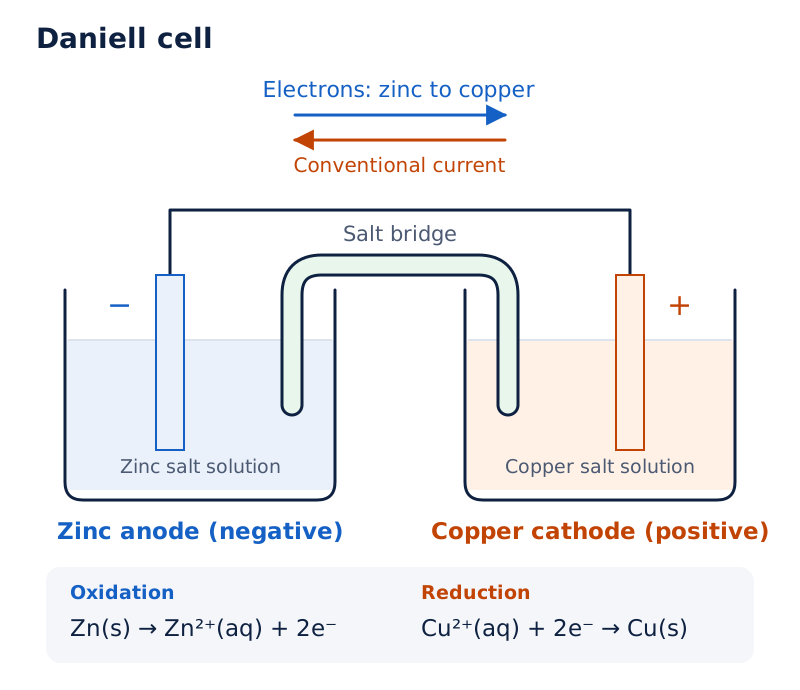
Two vessels contain zinc and copper electrodes in their salt solutions. A bent salt bridge joins the liquids. The external connection shows electron flow towards copper and current towards zinc, with negative zinc and positive copper terminals.
Drawn by One Young India. See Fig. 2.1 in your NCERT textbook
What happens when an opposing voltage is applied?
For the Daniell cell with both ion concentrations at , the potential is . An opposing external voltage smaller than this allows the original reaction to continue. At equality, current and the net chemical reaction stop.
If the opposing voltage exceeds the cell potential, the reaction reverses. Copper dissolves and zinc deposits. Electrical energy now drives a non-spontaneous transformation, so the arrangement functions as an electrolytic cell.
| Feature | Galvanic operation | Electrolytic operation |
|---|---|---|
| Energy conversion | Chemical to electrical | Electrical to chemical |
| Reaction driven | Spontaneous redox reaction | Non-spontaneous redox reaction |
| Anode | Oxidation; negative electrode | Oxidation; positive electrode |
| Cathode | Reduction; positive electrode | Reduction; negative electrode |
How are electrode potentials measured and compared?
At a metal-solution interface, metal ions tend to deposit on the electrode, while metal atoms tend to enter solution as ions. The resulting charge separation establishes an electrode potential. An individual half-cell potential cannot be measured independently; a potential difference between two electrodes is measured.
What reference does the hydrogen electrode provide?
The standard hydrogen electrode, or SHE, is assigned zero potential at all temperatures. It uses platinum coated with platinum black, immersed in acidic solution. Hydrogen gas at contacts the electrode, and the hydrogen-ion concentration is .
What the figure shows
Standard hydrogen electrode
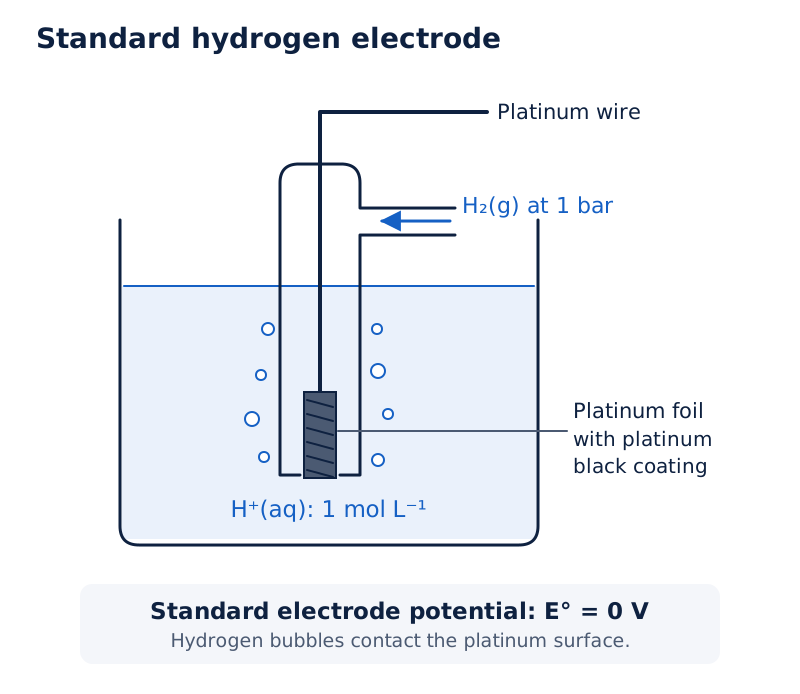
Hydrogen enters through a side tube and bubbles around a platinum foil coated with finely divided platinum. The drawing labels hydrogen at one bar and the surrounding hydrogen-ion solution as one molar.
Drawn by One Young India. See Fig. 2.3 in your NCERT textbook
Platinum provides a surface for the electrode reaction and conducts electrons without participating in the overall reaction. Such an electrode is called an inert electrode. Gold can also serve this purpose.
How is cell emf calculated?
The cell potential becomes its electromotive force, or emf, when no current is drawn. By convention, the galvanic anode is written on the left and the cathode on the right. Single vertical lines mark phase boundaries; the double line denotes the salt bridge.
Both electrode potentials in this subtraction are reduction potentials. The SI unit of cell potential is volt. Standard electrode potentials refer to standard conditions; the tabulated values below are at .
| Reduction couple | Standard electrode potential | Interpretation |
|---|---|---|
| Copper ions are reduced more readily than hydrogen ions under standard conditions. | ||
| Reference couple for the potential scale. | ||
| Zinc can reduce hydrogen ions under standard conditions. |
A more positive standard reduction potential indicates a greater tendency for reduction. Fluorine is the strongest oxidising agent in the tabulated series; lithium metal is the strongest reducing agent in aqueous solution in that series.
How does the Nernst equation account for concentration?
The Nernst equation relates electrode or cell potential to temperature and the composition of the reacting system. For a metal-ion reduction involving electrons, the concentration of the pure solid is taken as unity.
Here is the electrode potential, is its standard electrode potential, and denotes the metal-ion concentration expressed relative to in this dilute-solution treatment. The superscript denotes a standard-state value. is the gas constant, is temperature in kelvin, and is the Faraday constant. Use and . The electron number must correspond to the balanced reaction.
For an overall cell reaction, the reaction quotient is . In the concentration treatment of dilute solutions, concentrations represent the species participating in this quotient; pure solids have unit contribution.
Derivation: Nernst equation for the Daniell cell
- Write the copper reduction potential:
- Write the zinc reduction potential:
- Subtract the anode reduction potential from the cathode reduction potential:
- Combine the logarithms:
Result: Increasing copper-ion concentration increases the Daniell cell potential, whereas increasing zinc-ion concentration decreases it, with temperature and the other concentration fixed.
Worked example 1. Calculate the Mg-Ag cell potential at using , magnesium-ion concentration and silver-ion concentration .
Formula: ; .
Answer:
- Express concentrations relative to the standard molar concentration so the logarithm has a dimensionless argument:
- Substitute:
- Evaluate:
Note: The silver-ion concentration is squared because two silver ions occur in the balanced reaction. The electron number is two, even though each individual silver ion accepts one electron.
How are cell potential, equilibrium and Gibbs energy related?
As the Daniell cell discharges, zinc-ion concentration increases and copper-ion concentration decreases. Its potential falls. At equilibrium, the concentrations stop changing and the cell emf is zero. The reaction quotient then becomes the equilibrium constant.
Derivation: Equilibrium constant from standard cell potential
- Start with the Nernst equation:
- At equilibrium, substitute and :
- Rearrange and convert to common logarithms:
- At the specified temperature:
Result: A standard cell potential gives access to an equilibrium constant that may be difficult to measure directly. Zero actual emf at equilibrium does not require a zero standard emf.
What does the Gibbs-energy relation mean?
To obtain maximum electrical work, charge must pass reversibly. The decrease in Gibbs energy then equals the electrical work obtainable from the cell. Here is the Gibbs-energy change for the balanced reaction, and is its standard Gibbs-energy change:
Cell potential is an intensive quantity. Gibbs energy depends on the amount represented by the reaction. Doubling every coefficient doubles the transferred electron number and Gibbs-energy change, but leaves the cell potential unchanged.
Worked example 2. Find the standard Gibbs-energy change for the Daniell reaction using and .
Answer:
- Apply the standard relation:
- Insert the charge and potential:
- Convert energy units:
The negative sign identifies the spontaneous direction under standard conditions. The energy change belongs to the reaction with one mole of zinc reacting with one mole of copper ions.
How do resistance, conductance and conductivity differ?
Resistance measures opposition to current through a particular conductor. It increases with length and decreases with cross-sectional area. Resistivity characterises the material under the specified conditions, separating material behaviour from the dimensions of the conductor.
Here is length, is cross-sectional area, is resistivity, is conductance and is conductivity. Conductance is the reciprocal of resistance; conductivity is the reciprocal of resistivity.
| Quantity | Symbol | SI unit |
|---|---|---|
| Resistance | ||
| Resistivity | ||
| Conductance | ||
| Conductivity |
The SI unit of resistance is ohm. The SI unit of resistivity is ohm metre. The SI unit of conductance is siemens. The SI unit of conductivity is siemens per metre. Centimetre-based units also occur in solution measurements.
How do metals and electrolyte solutions conduct?
Electronic conductance in metals arises from moving electrons. It depends on the nature and structure of the metal, its valence electrons and temperature. The conductor's composition remains unchanged as electrons enter and leave. Metallic conductance decreases as temperature increases.
Ionic conductance arises from ions moving through solution. Conductivity depends on electrolyte identity, ion size and solvation, solvent viscosity, concentration and temperature. It increases with increasing temperature. Prolonged direct current can change solution composition through electrode reactions.
Conductors have large conductivity, insulators have very small conductivity, and semiconductors occupy an intermediate range. Graphite and some organic polymers conduct electronically, showing that electronic conductance is not restricted to metals.
How is conductivity measured and converted to molar conductivity?
A conductivity cell contains two platinum electrodes coated with platinum black. Their area and separation define a column of solution. Alternating current is used for resistance measurement because prolonged direct current changes the solution through electrochemical reactions.
What the figure shows
Conductivity cells
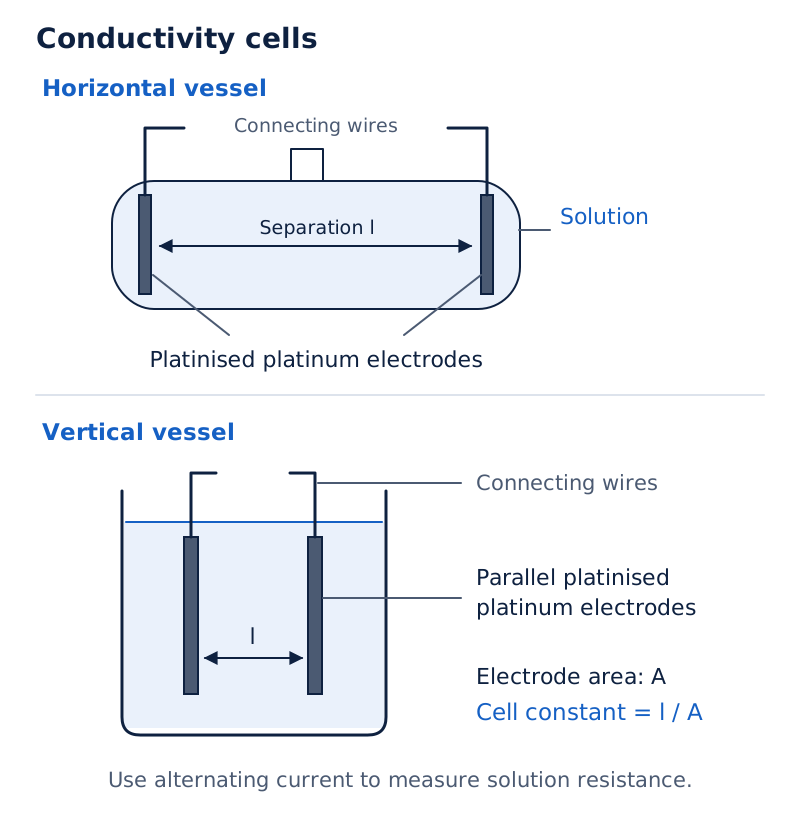
The two designs show platinised platinum electrodes with connecting wires. One places electrodes at opposite ends of a horizontal vessel; the other places two parallel electrodes inside a vertical vessel.
Drawn by One Young India. See Fig. 2.4 in your NCERT textbook
How is the cell constant established?
The cell constant depends on electrode geometry. Direct measurements of electrode area and separation are inconvenient and unreliable. Instead, a KCl solution of known conductivity is used to calibrate the cell at a specified temperature.
Do not confuse conductance with the cell constant. Their symbols are and , respectively. The SI unit of cell constant is inverse metre. Once it is known, the measured resistance of another solution gives that solution's conductivity.
A Wheatstone bridge arrangement uses an AC oscillator, a variable resistance and a suitable detector. At balance, no current passes through the detector. Conductivity meters can also directly measure the solution's conductance or resistance.
What does molar conductivity measure?
Molar conductivity refers to the conductance of the volume of solution containing one mole of electrolyte between electrodes separated by unit distance. Its SI unit is siemens metre squared per mole.
Here is molar conductivity and is the molar concentration of the electrolyte; is conductivity.
Use concentration in with conductivity in . For conductivity in and concentration in , include the volume conversion:
Worked example 3. A cell has resistance with KCl of conductivity . Its resistance with KCl is . Calculate the latter solution's conductivity and molar conductivity.
Formula: ; ; .
Answer:
- Calibrate the cell:
- Calculate conductivity:
- Convert concentration:
- Calculate molar conductivity:
Worked example 4. A NaOH solution forms a column of diameter , length , and resistance . Find resistivity, conductivity and molar conductivity, using .
Answer:
- Find cross-sectional area:
- Calculate resistivity:
- Take its reciprocal:
- Calculate molar conductivity without rounding the intermediate value:
Why do conductivity and molar conductivity respond differently to dilution?
At a given temperature, dilution reduces the number of current-carrying ions per unit volume. Therefore, conductivity decreases when either a strong or a weak electrolyte solution is diluted. This statement concerns a fixed volume of solution.
Molar conductivity increases on dilution. The volume containing one mole of electrolyte grows, and this increase more than compensates for the fall in conductivity. Confusing these two reference quantities leads to apparently contradictory predictions.
How do strong and weak electrolytes differ?
For strong electrolytes, the increase in molar conductivity on dilution is relatively slow. At a given solvent and temperature, the concentration dependence is represented by:
The graph of molar conductivity against the square root of concentration is a straight line. Its intercept is the limiting molar conductivity and its slope is . The constant depends on electrolyte type, determined by the charges of its ions.
For example, NaCl, CaCl₂ and MgSO₄ represent different electrolyte types. Electrolytes of the same type share the same value of the constant for the specified solvent and temperature.
Weak electrolytes such as acetic acid dissociate more extensively on dilution. The total number of ions in the volume containing one mole therefore increases. Their molar conductivity rises steeply, especially at very low concentration.
What the figure shows
Molar conductivity and concentration
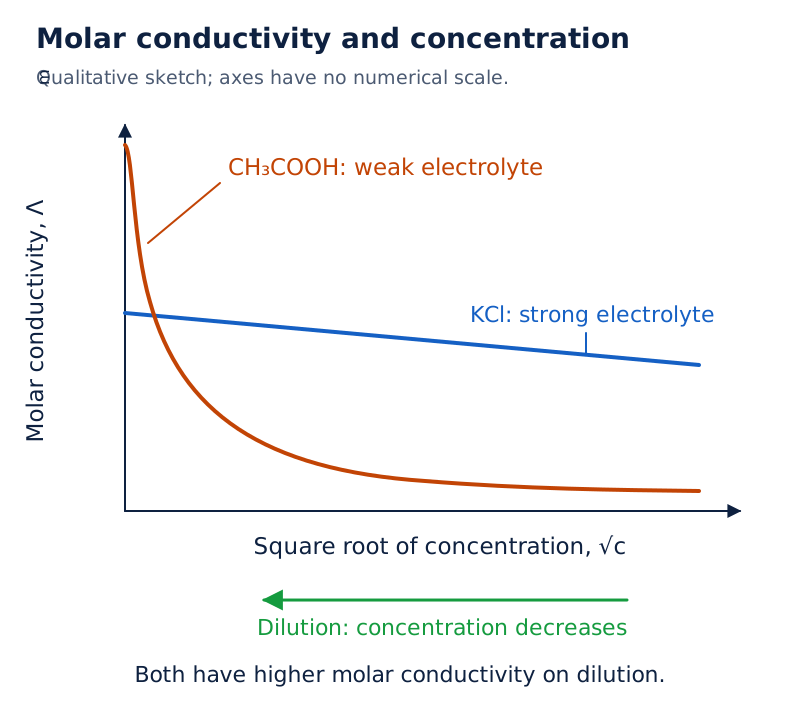
The vertical axis shows molar conductivity and the horizontal axis shows the square root of concentration. KCl follows a gently falling straight line; the acetic-acid curve rises sharply towards the vertical axis as concentration approaches zero.
Drawn by One Young India. See Fig. 2.6 in your NCERT textbook
For weak electrolytes, a simple linear extrapolation does not give a reliable limiting molar conductivity. At extremely low concentration, conductivity is too small to measure accurately. Kohlrausch law provides an alternative way to obtain the limiting value.
How does Kohlrausch law help analyse weak electrolytes?
Kohlrausch law of independent migration of ions states that the limiting molar conductivity of an electrolyte is the sum of the individual ionic contributions, multiplied by their stoichiometric numbers. It applies at infinite dilution.
Here and count the cations and anions produced by one formula unit. The ionic limiting conductivities are and . Ion counts must follow the dissociation formula, rather than simply adding one contribution of each kind.
How can strong electrolytes supply a weak electrolyte's limiting value?
Combining the limiting molar conductivities of HCl and sodium acetate, then subtracting that of NaCl, cancels the sodium-ion and chloride-ion contributions. The remaining terms belong to hydrogen and acetate ions.
Worked example 5. Find acetic acid's limiting molar conductivity from the values for HCl, sodium acetate and NaCl: , and , respectively.
Answer:
- Add the first two contributions:
- Subtract the NaCl contribution:
How are dissociation and its constant calculated?
For a weak electrolyte, the degree of dissociation can be approximated by the ratio of its molar conductivity at the given concentration to its limiting value. For acetic acid:
Here is the degree of dissociation, is the acid dissociation constant, and is the limiting molar conductivity.
Worked example 6. Acetic acid at has conductivity . Use its limiting molar conductivity of to find the dissociation constant.
Answer:
- Calculate molar conductivity:
- Divide by the limiting value; the units cancel:
- Substitute without premature rounding:
The concentration-based result is approximately ; the degree of dissociation is dimensionless.
How do Faraday's laws quantify electrolysis?
In electrolysis, an external source drives electrode reactions. With copper electrodes in copper sulphate solution, copper dissolves from the anode and deposits on the cathode. Making impure copper the anode provides a route to copper purification.
Faraday's first law states that the amount of chemical reaction at an electrode is proportional to the quantity of electricity passed. His second law compares different substances: the same charge liberates amounts proportional to their chemical equivalent weights.
How is charge linked to the electrode reaction?
At constant current, charge is the product of current and time. The SI unit of charge is coulomb. Current must be in amperes and time in seconds.
Here is electric charge, is the constant current, and is elapsed time. In this electrolysis formula, does not denote the reaction quotient.
The charge required to transfer one mole of electrons is represented by the Faraday constant. Approximate calculations may use . Reduction of one mole of silver ions needs one mole of electrons; magnesium ions need two and aluminium ions need three.
These differences come from the balanced half-reactions. The same charge therefore does not necessarily deposit the same mass of different metals. Determine the electron requirement before converting charge into moles and mass.
Worked example 7. A CuSO₄ solution is electrolysed for at . Find deposited copper using molar mass .
Formula: ; , where is the deposited mass, is molar mass and for copper-ion reduction.
Answer:
- Convert time:
- Calculate charge:
- Use the half-reaction:
- Convert charge to deposited mass:
Electrochemical reduction also produces metals such as sodium, magnesium and aluminium. Sodium and magnesium are obtained from fused chlorides; aluminium is obtained by electrolysing aluminium oxide in the presence of cryolite.
What determines the products of electrolysis?
Electrolysis products depend on the electrolyte, the species available for oxidation and reduction, their electrode potentials and the electrode material. Reactive electrodes participate in the reaction, whereas inert electrodes provide a surface and act as electron sources or sinks.
Why do molten and aqueous sodium chloride behave differently?
Molten NaCl contains sodium and chloride ions. Sodium forms at the cathode, while chlorine forms at the anode. In aqueous solution, water supplies additional possibilities, so the products differ.
| Electrolyte | Cathode product | Anode product | Other outcome |
|---|---|---|---|
| Molten NaCl | Sodium metal | Chlorine gas | The melt supplies the reacting ions. |
| Aqueous NaCl | Hydrogen gas | Chlorine gas | Sodium hydroxide remains in solution. |
The aqueous cathode reaction produces hydrogen and hydroxide ions. The chloride oxidation supplies chlorine. Their combined form is:
Why are electrode potentials alone insufficient?
A thermodynamically feasible process can be slow. The extra potential needed to make it proceed appreciably is called overpotential. Oxygen formation has an overpotential that favours chlorine production during the aqueous NaCl electrolysis described here.
Concentration also changes the relevant electrode potentials through the Nernst equation. During electrolysis of dilute sulphuric acid, water oxidation gives oxygen at the anode; at higher acid concentrations, sulphate oxidation can instead produce peroxodisulphate.
Note: Predicting products requires attention to the actual solution and electrodes. A ranking of standard potentials by itself does not account for concentration changes or the kinetic obstacle represented by overpotential.
How do primary and secondary batteries differ?
A useful battery should be reasonably light and compact, with voltage that changes little during use. Primary batteries cannot be reused after their reaction is exhausted. Secondary cells can be recharged by passing current in the opposite direction.
What are the main primary cells?
The dry cell, or Leclanche cell, uses a zinc container as anode. A graphite rod surrounded by manganese dioxide and carbon forms the cathode assembly. A moist paste of ammonium chloride and zinc chloride occupies the space between electrodes.
The approximate electrode reactions are:
Ammonia forms a complex with zinc ions. The cell potential is nearly . Its electrolyte is a moist paste, so the name does not imply absence of moisture.
The mercury cell uses zinc-mercury amalgam as anode, HgO and carbon paste as cathode, and KOH-ZnO paste as electrolyte. Its overall reaction is:
Its potential remains approximately , because the overall reaction does not involve solution ions whose concentrations change. It is suitable for low-current devices such as hearing aids and watches.
How is a lead storage battery recharged?
The lead storage battery has a lead anode, a lead grid packed with PbO₂ as cathode, and a sulphuric-acid solution. During discharge:
Charging reverses the overall reaction. Lead sulphate on the electrodes is converted back into lead and lead dioxide, and sulphuric acid is regenerated. A good secondary cell can undergo many charging and discharging cycles.
The nickel-cadmium cell is another secondary cell. It has a longer life than the lead storage cell but is more expensive to manufacture. Its discharge reaction is:
How does a hydrogen-oxygen fuel cell generate electricity?
A fuel cell converts the chemical energy of fuel directly into electrical energy. Reactants are supplied continuously and products are removed continuously. Hydrogen, methane and methanol are examples of fuels used in this type of cell.
What happens at the electrodes?
In the hydrogen-oxygen cell, gases are bubbled through porous carbon electrodes into concentrated aqueous sodium hydroxide. Finely divided platinum or palladium incorporated into the electrodes accelerates the reactions. Hydrogen is oxidised at the anode and oxygen is reduced at the cathode.
What the figure shows
Hydrogen-oxygen fuel cell
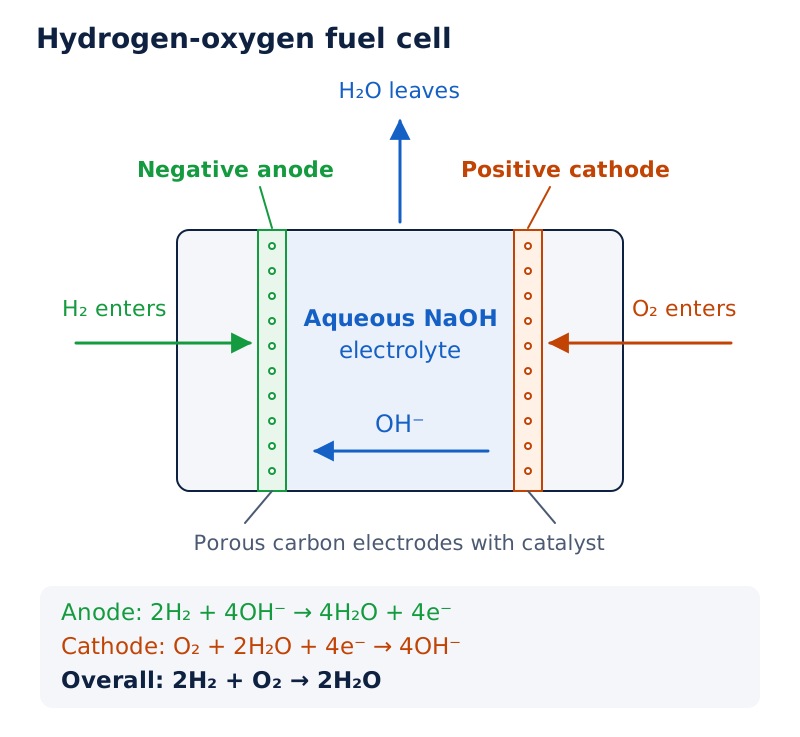
The drawing labels a negative anode on the left, a positive cathode on the right and aqueous electrolyte between them. Hydrogen enters from the left, oxygen from the right, and water leaves at the top.
Drawn by One Young India. See Fig. 2.12 in your NCERT textbook
The cell operates while reactants continue to arrive. In the Apollo space programme, it supplied electrical power; water produced in the reaction was condensed for the astronauts' drinking-water supply.
Direct energy conversion avoids the sequence of producing steam and driving a turbine used in thermal power generation. The hydrogen-economy proposal links water splitting using solar energy with hydrogen use in fuel cells. Both hydrogen production by electrolysis and its consumption in a fuel cell depend on electrochemical principles.
Why is corrosion an electrochemical process?
Corrosion includes rusting of iron, tarnishing of silver and the green coating that develops on copper and bronze. Rusting requires water and air. Different locations on an iron object can behave as anode and cathode, creating a local electrochemical arrangement.
Which reactions produce rust?
- At an anodic spot, iron loses electrons:
- Electrons move through the metal to another spot, where oxygen is reduced in the presence of hydrogen ions:
- The combined reaction produces ferrous ions:
- Atmospheric oxygen further oxidises ferrous ions. Rust separates as hydrated ferric oxide, represented by , where denotes the variable number of water molecules per formula unit of ferric oxide, with further production of hydrogen ions.
Hydrogen ions may be supplied by carbonic acid formed when atmospheric carbon dioxide dissolves in water. Other dissolved acidic oxides can also contribute. Thus, moisture participates in the electrochemical conditions that allow iron oxidation and oxygen reduction.
What the figure shows
Corrosion of iron
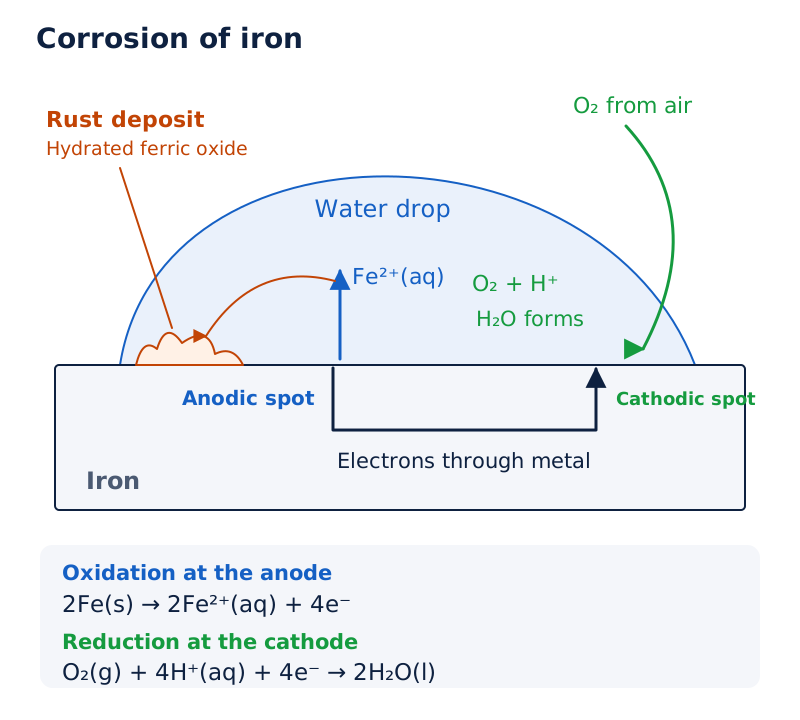
A water drop rests on an iron surface. The figure shows ferrous ions entering the drop, electrons moving through the metal, oxygen reduction near the surface and an iron-oxide deposit at the edge.
Drawn by One Young India. See Fig. 2.13 in your NCERT textbook
How can corrosion be prevented?
A protective paint layer limits contact with the atmosphere. Coatings of metals such as tin or zinc also protect the surface. Another approach supplies a sacrificial electrode, for example magnesium or zinc, which corrodes while protecting the iron object.
These methods either restrict exposure or alter which metal undergoes oxidation. Preventing corrosion protects material strength as well as appearance, reducing the risk of failure in objects such as bridges and other metal structures.
Glossary
- Galvanic cell — An electrochemical device that converts the energy of a spontaneous redox reaction into electrical work.
- Electrolytic cell — A device in which external electrical energy drives a non-spontaneous chemical reaction at electrodes.
- Anode — The electrode at which oxidation occurs during the operation of an electrochemical cell.
- Cathode — The electrode at which reduction occurs during the operation of an electrochemical cell.
- Electrode potential — The potential difference established across the interface between an electrode and its electrolyte.
- Cell emf — The potential difference between the electrodes when no current is drawn from the cell.
- Resistivity — The proportionality constant relating resistance to conductor length divided by its cross-sectional area.
- Conductivity — The reciprocal of resistivity, describing electrical conduction in a material under specified conditions.
- Molar conductivity — Conductance associated with the volume containing one mole of electrolyte between electrodes separated by unit distance.
- Limiting molar conductivity — The molar conductivity reached as electrolyte concentration approaches zero, corresponding to infinite dilution.
- Cell constant — The ratio of electrode separation to electrode area in a conductivity cell.
- Overpotential — The extra potential required for an electrochemical process that is feasible but kinetically slow.
- Fuel cell — A galvanic cell that converts fuel energy directly into electricity with continuous reactant supply.
- Sacrificial electrode — A metal electrode that corrodes while protecting another metal object from corrosion.
Common errors and misconceptions
- Misconception: The anode must be negative in every cell. Correct: Oxidation identifies the anode. It is negative in a galvanic cell and positive during electrolytic operation.
- Misconception: An individual electrode potential is directly measurable. Correct: Only a potential difference is measured; electrode potentials are assigned relative to a reference such as SHE.
- Misconception: Both potentials should be added when calculating cell emf. Correct: Subtract the anode reduction potential from the cathode reduction potential.
- Misconception: Dilution makes conductivity and molar conductivity increase together. Correct: Conductivity decreases, while molar conductivity increases because they refer to different amounts of solution.
- Misconception: Standard electrode potentials alone determine electrolysis products. Correct: Concentration, electrode material and overpotential also affect which reactions occur.
- Misconception: Doubling a balanced cell reaction doubles its emf. Correct: It doubles the electron number and Gibbs-energy change, while the intensive cell potential remains unchanged.
- Misconception: A weak electrolyte's limiting conductivity is found by the same straight-line extrapolation used for a strong electrolyte. Correct: Use Kohlrausch law because the weak-electrolyte curve rises steeply at low concentrations.
Exam-style questions with model answers
Q1. Distinguish a galvanic cell from an electrolytic cell. [2 marks]
- A galvanic cell converts chemical energy from a spontaneous redox reaction into electrical energy.
- An electrolytic cell uses an external electrical supply to drive a non-spontaneous chemical reaction.
Q2. Describe the standard hydrogen electrode and its reference conditions. [3 marks]
- The electrode is platinum coated with platinum black and immersed in an acidic solution. Pure hydrogen is bubbled over its surface.
- Hydrogen pressure is , and hydrogen-ion concentration is . The platinum surface supports the electrode reaction and conducts electrons.
- Its standard electrode potential is assigned zero at all temperatures. Coupling another half-cell to this reference allows its electrode potential to be determined from the measured cell potential.
Q3. Derive the relation between standard cell potential and equilibrium constant. [3 marks]
- The Nernst equation expresses the actual cell potential in terms of composition:
- At equilibrium, no net cell reaction proceeds and the emf becomes zero. The reaction quotient equals the equilibrium constant:
- Rearrangement gives Here the electron number belongs to the balanced cell reaction, and temperature must be expressed in kelvin.
Q4. Explain the measurement of conductivity and its conversion to molar conductivity. [5 marks]
- Place the solution in a conductivity cell containing two platinum electrodes coated with platinum black. The electrode separation and area determine the cell geometry.
- Use alternating current to measure solution resistance. Prolonged direct current can alter solution composition through electrochemical reactions and is unsuitable for this purpose.
- Calibrate using KCl solution of known conductivity at the measurement temperature. Multiply its resistance by its conductivity to determine the cell constant: .
- Measure the unknown solution's resistance in the same cell, then calculate . The cell constant remains associated with the electrode arrangement.
- Calculate . Conductivity in and concentration in give molar conductivity in . Convert litre-based concentration before substituting.
Q5. Explain the effect of dilution on conductivity and molar conductivity for strong and weak electrolytes. [3 marks]
- Conductivity decreases on dilution because fewer ions are present per unit volume to carry current. This applies to both strong and weak electrolytes.
- Molar conductivity increases because the growing volume containing one mole of electrolyte more than compensates for the decrease in conductivity.
- The increase is slow for strong electrolytes but steep for weak electrolytes, whose degree of dissociation increases markedly. Kohlrausch law supplies limiting molar conductivity for weak electrolytes.
Q6. Explain iron corrosion as an electrochemical process and state two preventive methods. [5 marks]
- Water and air allow different locations on an iron object to act as anode and cathode. Oxidation at the anodic spot releases ferrous ions and electrons:
- The electrons move through the metal to a cathodic spot, where oxygen is reduced in the presence of hydrogen ions:
- Hydrogen ions may originate from carbonic acid formed by atmospheric carbon dioxide dissolving in water, or from other dissolved acidic oxides.
- Atmospheric oxygen further oxidises ferrous ions. Hydrated ferric oxide separates as rust, with further hydrogen-ion production.
- Painting limits atmospheric contact. Alternatively, a sacrificial magnesium or zinc electrode corrodes while protecting the iron object. These methods reduce deterioration and the associated risk of structural failure.
Key takeaways
- Oxidation identifies the anode and reduction identifies the cathode; their electrical signs depend on whether the cell operates galvanically or electrolytically.
- Calculate cell emf by subtracting the anode reduction potential from the cathode reduction potential, keeping the balanced reaction clear.
- The Nernst equation connects potential with composition, while standard potential connects the reaction's Gibbs energy with its equilibrium constant.
- Conductivity decreases on dilution, but molar conductivity increases because the volume containing one mole of electrolyte increases.
- Kohlrausch law adds independent ionic contributions at infinite dilution and enables the analysis of weak-electrolyte dissociation.
- Electrolysis calculations connect current and time to charge, then use the balanced electrode reaction to determine the chemical amount.
- Primary cells are exhausted after use; secondary cells can be recharged, while fuel cells operate with continuous reactant supply.
- Corrosion involves coupled oxidation and reduction at different locations; protective coatings and sacrificial electrodes help prevent metal damage.
Test yourself
Which way do electrons move in the external circuit of a Daniell cell?
They move from the zinc anode to the copper cathode through the external metallic conductor.
When is the potential difference of a cell called its emf?
It is called emf when no current is drawn through the cell.
What becomes zero when a cell reaction reaches equilibrium?
The actual cell emf becomes zero, and the reaction quotient equals the equilibrium constant.
Why is AC used in measuring solution resistance?
Prolonged direct current changes solution composition through electrode reactions, so alternating current is used.
Why does weak-electrolyte molar conductivity rise sharply on dilution?
Dilution increases dissociation, increasing the number of ions in the volume containing one mole of electrolyte.
What does overpotential mean?
It is the extra potential required for an electrochemical process that is feasible but kinetically slow.
Why is the mercury cell's potential approximately constant?
Its overall reaction involves no solution ion whose concentration changes during the cell's operation.
How does a sacrificial electrode protect iron?
A metal such as magnesium or zinc corrodes while protecting the iron object from corrosion.