
Colonialism and the Countryside | CBSE Class 12 History Notes
On this page
Watch & explore
Start with a few high-quality watches, then dive into the notes below.

This note covers colonial land revenue systems, Bengal’s zamindars and jotedars, Paharia and Santhal livelihoods, forest clearance, the cotton boom, peasant indebtedness, the Deccan revolt, and the interpretation of official archives.
What was the colonial context of the Permanent Settlement?
Revenue, property and agricultural investment
The English East India Company acquired the Diwani of Bengal in 1765. Bengal became an early centre of experiments with land rights and revenue collection. By the 1770s, recurrent famines and declining agricultural output had placed its rural economy under severe pressure.
Company officials hoped that secure property rights and a permanently fixed revenue demand would encourage agricultural investment. Landholders could retain the benefit of increased production without facing a higher state demand. The Company expected a regular income and a loyal class of prosperous agricultural proprietors.
The Permanent Settlement began in 1793, when Charles Cornwallis was Governor General of Bengal. It was concluded with rajas and taluqdars, who were classified as zamindars. A taluq was a territorial unit; a taluqdar was its holder.
How did the settlement operate?
The zamindar contracted to pay the revenue assessed on an entire estate. An estate could contain several villages, sometimes as many as 400. He collected village rents, paid the Company’s demand and retained the difference as income.
In this arrangement the zamindar functioned as the state’s revenue collector, rather than simply as a landowner within one village. Failure to pay could lead to the auction of his estate. A fixed demand therefore offered possible future gains but imposed an immediate payment obligation.
Definition: The Permanent Settlement fixed the revenue payable by Bengal’s zamindars in perpetuity, while holding them responsible for regular payment to the Company.
The settlement’s consequences depended on more than its written rules. Harvests, prices, village power and resistance affected collection. Zamindars, cultivators and wealthy village intermediaries could obstruct or modify the way the new arrangement worked.
Why did zamindars default on revenue payments?
High assessments and inflexible deadlines
Many zamindars accumulated arrears, meaning unpaid balances. The Company initially assessed revenue very high because it would not be able to increase its demand later. Officials expected rising production and prices eventually to make the burden easier to bear.
- High initial demand: assessments anticipated future prosperity before that prosperity had arrived.
- Depressed prices: agricultural prices were low during the 1790s, making it difficult for cultivators to pay rent.
- Rigid payment rules: revenue remained payable regardless of harvest conditions and had to arrive punctually.
- Reduced collection powers: the Company curtailed zamindars’ authority while continuing to demand payment from them.
Under the Sunset Law, an estate became liable to auction if the required payment did not arrive by sunset on the specified day. Permanence meant that the assessment was fixed; it did not mean that the obligation was easy to meet.
Company control and village resistance
Zamindars’ troops were disbanded, customs duties abolished and their courts placed under a Company-appointed Collector. They lost control over local justice and policing. The collectorate became an alternative centre of authority, limiting the zamindar’s autonomy.
An amlah, an officer of the zamindar, usually visited villages to collect rent. Poor harvests could prevent payment, but some cultivators also delayed deliberately. Wealthy peasants and village headmen welcomed opportunities to weaken zamindari authority.
Legal action offered no quick solution. In Burdwan alone, more than 30,000 suits concerning unpaid rent were pending in 1798. Estates were auctioned on a large scale, but an auction record does not by itself establish that the previous zamindar actually lost control.
How did different social groups exercise power in rural Bengal?
Zamindars and their village authority
Zamindars controlled numerous villages and distributed the estate’s revenue demand, called the jama, among them. Their position connected village rent payments to Company revenue. Their authority could also rest on local loyalties that survived financial difficulty and auction sales.
Jotedars and village influence
Jotedars were wealthy peasants who became especially powerful in North Bengal. By the early nineteenth century, some possessed several thousand acres. They combined substantial landholdings with control over local trade and moneylending, making poorer cultivators dependent on them.
Much of their land was cultivated by adhiyars or bargadars, sharecroppers who supplied their own ploughs and labour and handed over half the harvest. Unlike zamindars who often lived in towns, jotedars remained in villages and exercised direct influence over poorer residents.
They resisted increases in the village jama, obstructed zamindari officers, mobilised dependent cultivators and delayed payments. They also purchased estates sold for revenue default. Elsewhere in Bengal, influential rich peasants and headmen were known as haoladars, gantidars or mandals.
Ryots and under-ryots
Ryot was the spelling used in British records for raiyat, meaning peasant. Bengal’s ryots did not necessarily cultivate all their holdings themselves. They could cultivate some land and lease other portions to under-ryots, who paid them rent.
What the figure shows
Power in rural Bengal
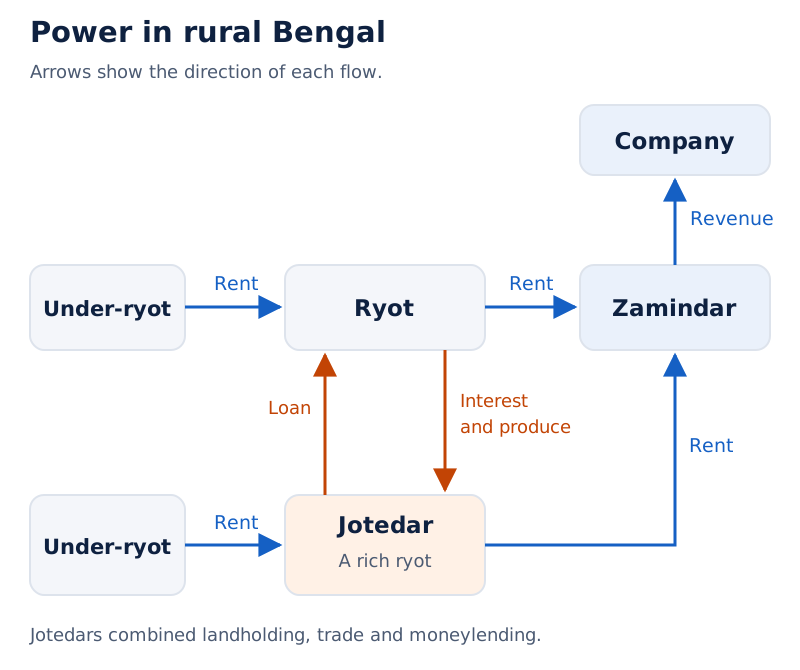
Boxes place the Company above the zamindar, with a ryot and a jotedar below and two under-ryots at the bottom. Arrows connect these levels and link the ryot and jotedar. Zamindars paid revenue to the Company, village ryots paid rent to zamindars, and under-ryots paid rent to ryots. Jotedars lent money to other ryots and sold their produce.
Drawn by One Young India. See Fig. 9.5 in your NCERT textbook
Buchanan’s account of Dinajpur describes jotedars delaying instalments, holding more land than their contracts allowed and using legal complaints against zamindari officers. Village society therefore contained competing interests rather than a single undifferentiated body of peasants.
How did zamindars retain their estates despite auctions?
The Burdwan auction of 1797
In 1797, estates belonging to the Raja of Burdwan were auctioned because of unpaid revenue. The highest bidders appeared to have purchased them. The Collector then discovered that many buyers were the raja’s servants and agents: over 95 per cent of the sale was fictitious.
The raja had also transferred some property to his mother because the Company had ruled that women’s property would not be taken over. These strategies used the new rules themselves to protect older power.
- The zamindar withheld revenue and allowed arrears to accumulate.
- When property was auctioned, his agents outbid competing purchasers.
- The agents refused to pay the purchase price, making another auction necessary.
- Repeated auctions exhausted the authorities and rival bidders, allowing the estate eventually to return cheaply to the zamindar.
Benami transactions concealed the real beneficiary behind another person’s name. Between 1793 and 1801, four major Bengal zamindaris, including Burdwan, made benami purchases worth as much as 30 lakh rupees. Across the total auction sales discussed, over 15 per cent were fictitious.
Resistance beyond the auction room
Outsiders who purchased estates could encounter attacks by lathyals, the former zamindar’s armed strongmen. Some ryots also resisted newcomers because they regarded themselves as their old zamindar’s proja, or subjects. A sale threatened their loyalties and sense of identity.
Those zamindars who survived the difficulties of the 1790s benefited when prices recovered and revenue-payment rules became somewhat more flexible. Their position strengthened during the early nineteenth century. During the Great Depression of the 1930s, zamindari power finally collapsed, while jotedars consolidated their power.
Note: Do not confuse an advertised sale, a completed auction and an actual transfer of control. Fictitious purchases and local resistance could preserve the former zamindar’s authority.
How did colonial expansion affect the Paharias?
A forest-based way of life
The Paharias lived around the Rajmahal hills. They practised shifting cultivation by clearing patches of forest, burning undergrowth and growing pulses and millets in soil enriched by the ash. They used hoes and left exhausted plots fallow before moving elsewhere.
Forests supplied mahua flowers for food, silk cocoons and resin for sale, and wood for charcoal. Undergrowth and fallow land supported cattle. Hunting, gathering and cultivation were connected activities, making access to forests essential to survival and collective identity.
Chiefs settled disputes, maintained group unity and led battles. Paharia raids on the plains supplied food during scarcity, asserted power and helped negotiate relations with outsiders. Plains zamindars paid tribute, while traders paid for passage and received protection from the chiefs.
Repression and pacification
As settled agriculture expanded in the late eighteenth century, forests and pastures contracted. The British wanted more revenue, export crops and a population they considered easier to govern. Their descriptions of forest people as unruly expressed colonial prejudices, not neutral facts.
In the 1770s, British officials pursued violent extermination campaigns. By the 1780s, Augustus Cleveland, Collector of Bhagalpur, proposed pacification: chiefs would receive annual allowances and become responsible for maintaining order among their people.
Many chiefs refused. Those who accepted most often lost standing because they appeared to be paid subordinates of the colonial government. Paharias withdrew deeper into the hills and resisted outsiders. These experiences explain their suspicion of Buchanan during his journey in the winter of 1810 to 1811.
Santhal settlement brought another pressure. Clearance and plough cultivation spread into the lower hills, reducing Paharia access to fertile land. The conflict between the hoe and the plough concerned different livelihoods and unequal control over land.
Why did the Santhals rebel, and what were the consequences?
Settlement in Damin-i-Koh
Santhals began entering Bengal around the 1780s. Zamindars hired them to reclaim land, and colonial officials encouraged settlement. Around 1800, they entered the Rajmahal region, cleared forests and expanded plough cultivation where Paharias had resisted similar changes.
By 1832, a large territory had been marked out as Damin-i-Koh for Santhal settlement. Surveying, mapping and boundary pillars separated it from neighbouring regions. The grants required at least one-tenth of the land to be cleared and cultivated within the first ten years.
| Indicator in Damin-i-Koh | 1838 | 1851 |
|---|---|---|
| Santhal villages | 40 | 1,473 |
| Santhal population | 3,000 | Over 82,000 |
Settlement increased cultivation and Company revenue. Santhals grew commercial crops and dealt with traders and moneylenders. Paharias, meanwhile, were pushed towards poorer and rockier upper land, undermining shifting cultivation and hunting.
From settlement to rebellion
The land Santhals had cleared became vulnerable to outside claims. Heavy state taxes, high-interest loans and the seizure of land for unpaid debts created resentment. Zamindars also asserted control over the Damin. Moneylenders were identified as dikus, outsiders.
By the 1850s, Santhals sought to overthrow these pressures and establish a world in which they would rule themselves. Sidhu Manjhi was a leader of the Santhal rebellion of 1855 to 1856.
After the revolt, the colonial government created the Santhal Pargana, taking 5,500 square miles from Bhagalpur and Birbhum. A separate territory and special laws were intended to conciliate the Santhals.
Illustration: Hill village in Santhal country, sketched by Walter Sherwill in the early 1850s and published in the Illustrated London News, 23 February 1856 (Figure 9.10). Huts stand among large trees, with small human figures in the open village space. Published in 1856 from an earlier sketch, the image presents a calm settlement, contrasting with subsequent representations of rebellion and repression.
How did the ryotwari system differ from the Permanent Settlement?
Changing official ideas
After 1810, rising agricultural prices increased Bengal zamindars’ incomes without increasing the Company’s fixed revenue. Officials wanted access to such gains in newly acquired territories. They therefore favoured temporary settlements rather than widely extending the Permanent Settlement.
During the 1820s, David Ricardo’s ideas influenced revenue thinking. Officials believed that landowners should retain an average rent while the state taxed the surplus. They feared that untaxed gains would produce rentiers, people living on rental income without improving the land.
| Feature | Permanent Settlement in Bengal | Ryotwari in the Bombay Deccan |
|---|---|---|
| Revenue relationship | Settlement with zamindars | Settlement directly with ryots |
| Assessment | Demand fixed for the estate | Soil income and the ryot’s payment capacity assessed |
| Revision | State demand fixed permanently | Land resurveyed every 30 years and rates increased |
| Pressure | Default could bring estate auctions | Heavy demand encouraged borrowing, migration and arrears |
Revenue pressure and indebtedness
Early Deccan settlements imposed severe demands. In areas of poor soil and uncertain rainfall, peasants struggled to pay and sometimes abandoned villages. Collectors seized crops and imposed fines on entire villages when payments failed.
Prices fell sharply after 1832, while famine during 1832 to 1834 deepened distress. Surviving cultivators lacked reserves and borrowed for revenue, consumption and production. By the 1840s, officials recognised widespread indebtedness and the severity of earlier assessments.
Revenue demands were moderated during the recovery of the mid-1840s. Prices rose after 1845, encouraging cultivation to expand into new land and pastures. Yet expansion required cattle, ploughs, seeds and land, so recovery itself generated fresh borrowing.
Note: Direct settlement with the ryot did not remove the need for credit. A cultivator could owe revenue directly to the state while depending heavily on a moneylender to obtain the cash.
How did the American Civil War produce a cotton boom and crisis?
International demand and easy credit
Before the 1860s, America supplied three-fourths of Britain’s raw cotton imports. British manufacturers feared dependence on this source. The Cotton Supply Association was founded in 1857 and the Manchester Cotton Company in 1859 to encourage supplies from other regions.
The American Civil War began in 1861 and disrupted supplies. Britain turned urgently towards India. Bombay export merchants advanced money to urban sahukars, who passed credit to rural moneylenders able to secure cotton from cultivators.
- The interruption of American supplies increased demand for Indian cotton.
- Rising cotton prices encouraged merchants to offer advances.
- Rural lenders passed credit to ryots who expanded cotton cultivation.
- Expansion increased production, but for the large majority of cotton producers it meant heavier debt.
Ryots received advances of 100 rupees for each acre planted with cotton. Cotton acreage in the Bombay Deccan doubled between 1860 and 1864. By 1862, India supplied over 90 per cent of Britain’s cotton imports. Some rich peasants benefited, but most producers accumulated heavier debts.
The end of the boom
When the Civil War ended in 1865, American cotton production revived and Indian exports to Britain declined. Merchants and sahukars restricted advances and demanded repayment. Moneylenders doubted cultivators’ ability to repay and became unwilling to provide further loans.
At the same time, the next revenue settlement raised demands by 50 to 100 per cent. Falling prices, existing debts, increased revenue and restricted credit combined to intensify distress. The international boom had made village livelihoods more dependent on unstable market conditions.
What the figure shows
The cotton boom
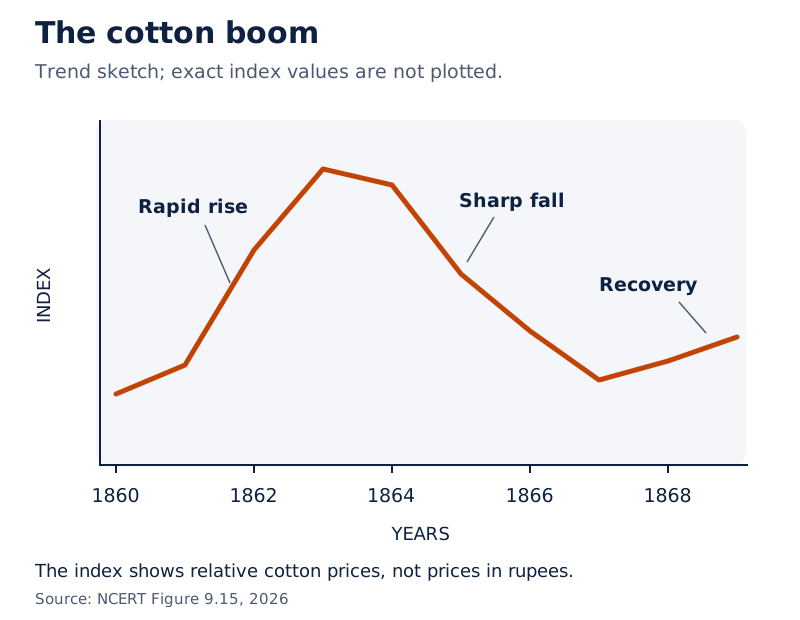
The horizontal axis shows years and the vertical axis is labelled “INDEX”. The line rises steeply in the early 1860s, reaches a peak between the 1862 and 1864 labels, then falls sharply before a later recovery. The index is not a rupee price.
Drawn by One Young India. See Fig. 9.15 in your NCERT textbook
Why did debt laws and written bonds become symbols of injustice?
Custom, credit and the Limitation Law
Peasants objected not simply to borrowing but to the violation of customary expectations. One general norm held that interest should not exceed the principal, meaning the original loan. A case investigated by the Deccan Riots Commission recorded over 2,000 rupees in interest on a 100-rupee loan.
The Limitation Law of 1859 limited the validity of loan bonds to three years, aiming to check the accumulation of interest. Moneylenders instead required a new bond every three years. They incorporated the old principal and unpaid interest into the new principal.
Fresh interest then accumulated on this larger amount. A petition described repeated renewal of bonds at a monthly rate stated as 3 rupees and 2 annas per hundred rupees. Its central complaint was that renewal made accumulated interest part of the next interest-bearing debt.
Petitions and the deed of November 1873
A ryot from Mirajgaon complained that sahukars charged credit customers 25 or 50 per cent more for clothes and grain than customers paying cash. Harvests were taken without the promised account credits, and receipts were refused.
A deed of hire dated November 1873 shows another form of dependence. A debtor sold two carriages and four bullocks to his creditor, then hired back those same possessions for four rupees each month. Without them he could not continue cultivation.
The deed required a receipt in the creditor’s handwriting. Without a receipt, the peasant agreed not to claim that he had paid the hire charge. The document thus recorded both his loss of ownership and the conditions for continuing to use essential agricultural property.
Why did documents cause fear?
Ryots reported fictitious entries, missing receipts, cheap acquisition of harvests and eventual seizure of property. Many signed or marked documents without understanding their clauses. Yet lenders would not advance money without legally enforceable bonds.
British officials distrusted informal agreements and favoured written contracts enforceable in court. For peasants, bonds and deeds consequently became tangible symbols of an oppressive relationship. This helps explain why rebels deliberately destroyed them.
How did the Deccan revolt unfold, and what were its effects?
Supa and the spread of resistance
On 12 May 1875, ryots gathered at Supa, a market village in Poona district, and attacked shopkeepers and moneylenders. They demanded bahi khatas, or account books, and debt bonds. They burned these records, looted grain shops and sometimes set sahukars’ houses on fire.
A sahukar combined moneylending with trade. Attacks on sahukars therefore targeted both creditors and important suppliers of village goods. Destroying records challenged the written evidence through which debts and property claims could be enforced.
The movement spread from Poona to Ahmednagar and further during the following two months. More than thirty villages across 6,500 square kilometres were affected. Frightened sahukars fled, often leaving property behind.
Suppression and enquiry
British officials feared a repetition of 1857. Police posts and troops were deployed; 951 people were arrested and many convicted. It nevertheless took several months to restore control. Suppression was followed by investigation into the causes of the unrest.
The Government of India pressed Bombay’s government to appoint an enquiry commission. Its report reached Parliament in 1878. The investigation collected testimony from peasants, moneylenders and eyewitnesses, together with revenue statistics, price information and collectors’ reports.
The commission attributed the unrest to moneylenders rather than government revenue demands. That conclusion must be examined critically alongside the evidence of high assessments, increased revenue demands and the withdrawal of credit. The revolt exposes both peasants’ experience of injustice and the government’s wish to defend its administration.
How should historians interpret official sources and visual evidence?
The Fifth Report and parliamentary criticism
The Fifth Report, submitted to the British Parliament in 1813, examined Company administration. Its 1,002 pages included over 800 pages of appendices containing petitions, collectors’ reports, revenue tables and administrative information.
Private traders challenged the Company’s monopoly, manufacturers wanted access to Indian markets, and political critics questioned Company rule. Parliamentary regulation, including the Regulating Act of 1773, formed part of this scrutiny. The report’s evidence was assembled within that contentious setting.
Its description of Bengal exaggerated the collapse of old zamindari power. Estate archives and district records reveal that sales did not necessarily displace previous holders. An apparent statistical record of change must therefore be compared with evidence about possession and control.
| Year in the Fifth Report | Assessment on land advertised for sale, in sicca rupees | Assessment on land actually sold, in sicca rupees | Purchase money, in sicca rupees |
|---|---|---|---|
| 1796 to 1797 | 28,70,061 | 14,18,756 | 17,90,416 |
| 1797 to 1798 | 26,66,191 | 22,74,076 | 21,47,580 |
These figures distinguish assessments from purchase prices. They concern two years and cannot alone establish a long-term collapse of zamindari authority. The identity of purchasers and their success in taking possession require separate investigation.
Buchanan, petitions and enquiry reports
Francis Buchanan worked in the Bengal Medical Service from 1794 to 1815 and conducted Company-funded surveys. He recorded crops, rocks, minerals and local practices, but assessed landscapes according to their commercial potential. His vision of improvement and his priorities differed from those of the local inhabitants.
The Deccan report of 1878 preserves varied testimony but also an official interpretation. A newspaper account in Native Opinion on 6 June 1876 described peasants watching for officials before demanding creditors’ bonds. Such material offers a different perspective, though its language also needs scrutiny.
Historians compare official reports with newspapers, legal records, unofficial accounts and, where possible, oral evidence. They ask who produced each record, why it was written, whose voices appear and what its categories conceal.
Images as arguments
Illustration: Santhal prisoners being taken away, Illustrated London News, 1856 (Figure 9.14). Officials ride on an elephant near the centre of a procession. Mounted figures, marching soldiers and escorted prisoners occupy the foreground. The arrangement presents British power and the containment of rebellion, rather than an unmediated account of Santhal experience.
Peaceful village scenes and images of repression encouraged different impressions of Santhals among readers in Britain. Visual evidence must therefore be examined for its composition and political message as well as the people and activities it depicts.
What timeline connects the major agrarian changes?
The sequence connects revenue experiments, forest settlement, commercial expansion and rebellion. Bengal’s Permanent Settlement preceded the Deccan’s revisable assessments. Santhal settlement and the cotton boom expanded cultivation, yet neither process guaranteed secure livelihoods for cultivators.
| Date or period | Event and significance |
|---|---|
| 1765 | The Company acquired the Diwani of Bengal. |
| 1773 | The Regulating Act sought to regulate Company activities. |
| 1793 | The Permanent Settlement began in Bengal. |
| 1797 | The Burdwan auction demonstrated the use of fictitious purchases. |
| Around 1800 | Santhals entered the Rajmahal region and expanded cultivation. |
| 1813 | The Fifth Report was submitted to Parliament. |
| 1818 | First revenue settlement in the Bombay Deccan. |
| 1820s | Early Deccan assessments imposed severe pressure on cultivators. |
| 1832 | Damin-i-Koh was demarcated by this year. |
| 1832 to 1834 | Famine aggravated distress in the Deccan. |
| After 1845 | Recovering agricultural prices encouraged cultivation to expand. |
| 1855 to 1856 | The Santhal rebellion challenged colonial and local exploitation. |
| 1859 | The Limitation Law restricted the validity of loan bonds. |
| 1861 | The American Civil War began and the Indian cotton boom developed. |
| 1865 | The war ended; renewed American supplies undermined Indian cotton exports. |
| November 1873 | A deed recorded a debtor hiring back carriages and bullocks he had sold. |
| 12 May 1875 | Ryots attacked moneylenders and debt records at Supa. |
| 1878 | The Deccan Riots Report was presented to Parliament. |
Read these events through their connections: revenue demands encouraged borrowing, market changes altered the availability of credit, and the loss of customary protections intensified resentment. Rebellions then generated investigations whose records require the same critical examination as earlier surveys and revenue reports.
Glossary
- Permanent Settlement — Revenue arrangement introduced in Bengal in 1793 that permanently fixed the state demand payable by zamindars.
- Zamindar — Estate revenue contractor who collected village rents and paid the Company’s fixed demand under the Permanent Settlement.
- Ryot — Peasant described in British records; in Bengal, a ryot could cultivate directly or lease land to under-ryots.
- Jotedar — Wealthy peasant whose landholdings, trading activities and moneylending gave substantial influence over poorer villagers.
- Jama — Revenue demand distributed by a zamindar among the villages within his estate.
- Adhiyar or bargadar — Sharecropper who supplied ploughs and labour and transferred half the harvest to the jotedar.
- Benami — Transaction conducted in another person’s name while the real beneficiary remains unnamed.
- Lathyal — Strongman associated with a zamindar, whose name literally refers to wielding a stick.
- Shifting cultivation — Cultivation of cleared plots for a few years, followed by leaving them fallow and moving to other land.
- Damin-i-Koh — Territory demarcated by 1832 for Santhal settlement and the expansion of plough agriculture.
- Ryotwari — Revenue system settling directly with cultivators, with periodic surveys and revision of revenue rates.
- Rentier — Person who lives on the rental income received from property rather than cultivating it directly.
- Sahukar — Person combining the roles of trader and moneylender within the rural economy.
- Principal — Original amount borrowed, distinguished from the interest charged on the loan.
- Bahi khata — Account book recording transactions, targeted by Deccan rebels alongside creditors’ debt bonds.
Common errors and misconceptions
- Misconception: A permanent demand was necessarily affordable. Correct: High assessments, low prices and strict deadlines caused repeated zamindari defaults.
- Misconception: Every auction displaced the old zamindar. Correct: Benami purchases, unpaid bids and local resistance could preserve his control.
- Misconception: Jotedars and zamindars performed identical roles. Correct: Jotedars were rich peasants with direct village influence, trade and credit networks; zamindars contracted to pay estate revenue.
- Misconception: Paharias and Santhals had the same agricultural practices. Correct: Paharia livelihoods centred on forests and shifting cultivation, while Santhal settlers expanded plough agriculture.
- Misconception: The cotton boom enriched all producers. Correct: Some rich peasants gained, but most cultivators accumulated heavier debts.
- Misconception: Renewing a bond cancelled the old interest. Correct: Moneylenders added unpaid interest to the principal of the new bond.
- Misconception: The Deccan rebels destroyed papers without a purpose. Correct: Account books and bonds represented enforceable debts and an oppressive credit relationship.
- Misconception: Official reports are complete and impartial. Correct: Their evidence is valuable, but their purposes and conclusions must be tested against other records.
Exam-style questions with model answers
Q1. Under the Sunset Law, revenue had to reach the Company by sunset on a specified date, regardless of harvest conditions; default could lead to auction. Explain two risks this created for a zamindar. [2 marks]
- A poor harvest could reduce rent receipts without reducing the revenue obligation, creating a payment shortfall.
- Even a delayed payment exposed the estate to auction, threatening the zamindar’s control over it.
Q2. Jotedars possessed large holdings, lived in villages, controlled trade and loans, mobilised dependent ryots and resisted higher jama. Using these facts, explain why they could challenge zamindars. [4 marks]
- Large holdings gave jotedars substantial economic resources within village society and strengthened their bargaining position.
- Residence in the villages allowed them to exercise direct influence over poorer cultivators.
- Control of trade and loans made other ryots dependent on them, giving their influence an economic basis.
- They could organise resistance to increased jama and obstruct payment, weakening the zamindar’s ability to collect the revenue for which he remained responsible.
Q3. At Burdwan in 1797, over 95 per cent of the auction sale was fictitious: many buyers were the raja’s servants and agents, and he retained control. What limitation does this reveal in using auction figures to measure dispossession? [2 marks]
- A recorded sale does not necessarily mean that control passed to an independent purchaser.
- Historians must identify the buyers and examine actual possession before treating auction statistics as evidence of the old zamindar’s displacement.
Q4. Paharias depended on shifting cultivation, forest produce and access to new fertile plots. Santhals cleared lower land for plough agriculture in Damin-i-Koh. Paharias were pushed towards rocky upper hills. Explain the effects on Paharia livelihoods. [4 marks]
- Loss of access to fertile lower land reduced the range of plots available for shifting cultivation.
- Being confined to poorer upper land made it harder to move between suitable plots and use natural soil fertility.
- Clearing forests for cultivation also disrupted hunting, undermining the livelihoods of Paharia hunters.
- These restrictions impoverished the Paharias in the long term by undermining the cultivation and forest resources on which they depended.
Q5. Santhals cleared land and settled in Damin-i-Koh. They then faced heavy state taxes, high-interest loans, loss of land for unpaid debts and zamindari claims. They rebelled in 1855 to 1856, after which a separate Santhal Pargana and special laws were introduced. Explain the causes and the government’s response. [6 marks]
- Settlement had encouraged Santhals to invest labour in clearing land and establishing cultivation. Their subsequent insecurity threatened the land on which their settled livelihoods depended.
- Heavy state taxes placed pressure on cultivators, connecting their difficulties directly with colonial revenue demands.
- High-interest loans and the transfer of land when debts remained unpaid made moneylenders another focus of resentment.
- Zamindari claims added a further challenge to control over the territory. The combined pressures explain why resistance targeted several sources of power.
- The government created Santhal Pargana as a separate territory for the Santhals after the rebellion.
- It imposed special laws within the new territory in an attempt to conciliate the Santhals.
Q6. The American Civil War began in 1861, disrupting cotton supplies to Britain. Indian prices and credit rose, and Deccan cotton acreage doubled between 1860 and 1864. After the war ended in 1865, American supplies revived, Indian prices fell, lenders restricted credit and demanded repayment, while revenue demands rose by 50 to 100 per cent. Explain how the boom became a crisis. [6 marks]
- The interruption of American supplies increased British demand for Indian cotton and raised cotton prices.
- Higher prices encouraged merchants and lenders to advance money for expanded cotton cultivation.
- Cotton acreage doubled as cultivation expanded with borrowed money. Some rich peasants gained, but for the large majority of cotton producers this expansion meant heavier debt, leaving them vulnerable when the boom ended.
- The revival of American production after 1865 reduced the demand supporting Indian prices. Cultivators faced weaker returns while still owing earlier loans.
- Lenders then restricted further advances and sought repayment. This removed a source of finance precisely when cultivators were struggling to meet existing obligations.
- The increase in revenue demands added another burden. Falling income, debt repayment and reduced access to loans combined to turn the earlier expansion into an agrarian crisis.
Q7. A November 1873 deed records that a debtor sold two carriages and four bullocks to his creditor, then hired the same property for four rupees monthly. Payment required a receipt in the creditor’s handwriting; without one, the debtor would not claim payment. Explain three forms of dependence visible here. [3 marks]
- The debtor lost ownership of property essential to cultivation, transferring valuable productive resources to his creditor.
- Continued use required a recurring hire payment. The peasant therefore paid to use equipment and animals that had previously belonged to him.
- Proof of payment depended on obtaining the creditor’s written receipt. The deed made documentary evidence crucial and placed the cultivator in a vulnerable position if a receipt was not supplied.
Q8. The Fifth Report criticised Company administration and overstated zamindari displacement. Buchanan’s surveys assessed commercial resources for the Company. The Deccan Riots Commission collected varied testimony but blamed lenders rather than government revenue. Explain how historians should use these sources. [6 marks]
- Historians should identify the institution and purpose behind each record. Criticism of Company administration, commercial surveying and defence of government policy could shape what writers emphasised.
- The Fifth Report’s interpretation should be tested against evidence of actual possession, because overstating displacement could misrepresent the consequences of estate sales.
- Buchanan’s observations should be read in light of the Company’s commercial priorities, which differed from those of local inhabitants.
- His observations of existing landscapes should be distinguished from his proposals to clear forests and make the land more commercially productive.
- The Deccan Commission’s testimony should be distinguished from its final explanation. Collecting varied evidence does not guarantee an impartial conclusion about responsibility.
- Reports should be compared with legal documents, newspapers, unofficial accounts and available oral evidence. Critical comparison preserves their value while testing their omissions and assumptions.
Key takeaways
- The Permanent Settlement fixed state revenue, but high assessments and weakened collection powers exposed many zamindars to default.
- Jotedars combined landholding, trade and moneylending with direct village influence, often challenging the authority of zamindars.
- Benami purchases and local loyalties show why auction statistics cannot automatically be treated as evidence of dispossession.
- Forest clearance and Santhal settlement restricted Paharia access to the land and resources supporting their livelihoods.
- Santhal resistance grew from taxation, indebtedness, land loss and zamindari claims over the territory they had cultivated.
- Revisable Deccan assessments and dependence on credit connected cultivators’ survival to both revenue policy and market conditions.
- The cotton boom encouraged expansion, but falling demand and restricted credit after the war left indebted cultivators vulnerable.
- Peasant petitions and the destruction of bonds reveal anger at violations of custom and legally enforceable debt relationships.
- Official archives preserve essential evidence while also reflecting the purposes, assumptions and political interests of their producers.
Test yourself
What did permanence mean in the Permanent Settlement?
The Company’s revenue demand was fixed permanently; the zamindar still had to make payments regularly.
What did Bengal’s sharecroppers contribute and surrender?
They supplied ploughs and labour, then gave half the harvest to the jotedar.
Why did Paharia chiefs sometimes reject colonial allowances?
Accepting payment could make chiefs appear subordinate to the colonial government and weaken their authority within the community.
What cultivation condition accompanied the Santhal land grants?
At least one-tenth of the granted area had to be cleared and cultivated within the first ten years.
How did renewed bonds increase the burden of debt?
Unpaid interest was added to the principal of a new bond, so subsequent interest applied to a larger amount.
Why were account books targeted at Supa?
They recorded creditors’ claims and symbolised the debt relationships that peasants regarded as oppressive.
What should be checked before accepting an official report’s conclusions?
Identify its authors, purpose and institutional interests, then compare its evidence and interpretation with other available sources.
What distinction matters when reading the cotton graph?
Its vertical scale is a price index, rather than a direct statement of prices in rupees.