
Thinkers, Beliefs and Buildings | CBSE Class 12 History Notes
On this page

This note covers early religious debates, Jainism, the Buddha’s life and teachings, the Buddhist monastic community, sacred places, stupas, Sanchi and Amaravati, sculpture, devotional traditions, temples, historical sources and the preservation of ancient monuments.
What was the historical background of new religious ideas?
A changing world
The main period of cultural developments extends from about 600 BCE (Before Common Era) to 600 CE (Common Era). The mid-first millennium BCE is often regarded as a turning point in world history, when thinkers examined existence and humanity’s relationship with the cosmic order.
These thinkers included Zarathustra in Iran, Kong Zi in China, Socrates, Plato and Aristotle in Greece, and Mahavira and Gautama Buddha in India. New kingdoms and cities were developing, while social and economic life in the Ganga valley was changing.
Buddhism developed through debates and dialogues with several other traditions. Its ideas therefore need to be understood alongside older sacrificial practices, new philosophical questions and changing social relationships.
Earlier sacrifices and new questions
The Rigveda, a collection of hymns praising deities, was compiled between about 1500 BCE and 1000 BCE. Agni, Indra and Soma were especially prominent. Many hymns accompanied sacrifices in which people prayed for cattle, sons, good health and long life.
At first, sacrifices were collective. Later, from about 1000 BCE to 500 BCE onwards, heads of households performed some sacrifices for domestic well-being. Chiefs and kings performed elaborate rituals, including rajasuya and ashvamedha, with the assistance of Brahmana priests.
Verses invoking Agni, the god of fire, sought nourishment, wealth, cattle and offspring. Agni was often identified with the sacrificial fire through which offerings reached other deities. These hymns used Vedic Sanskrit and were taught orally to men of priestly families.
The Upanishads, texts exploring questions of life and ultimate reality from about the sixth century BCE onwards, asked about life after death, rebirth and past actions. Other thinkers questioned whether a single ultimate reality existed and reconsidered the significance of sacrifice.
In the Chhandogya Upanishad, the self within the heart is described as smaller than a seed yet greater than the worlds. Another passage presents the purifying wind as a sacrifice, broadening reflection beyond the performance of a ritual.
How did competing schools compare their explanations of existence?
Buddhist texts mention as many as 64 schools of thought. Travelling teachers debated with one another and with laypersons, meaning people outside the monastic community. Discussions took place in groves or in a kutagarashala, literally a hut with a pointed roof.
If a teacher convinced a rival, that rival’s followers also became the teacher’s disciples. Support for a school could therefore grow or shrink. Mahavira and the Buddha questioned Vedic authority and stressed individual agency, the capacity of people to strive for liberation themselves.
This contrasted with the Brahmanical position that a person’s existence was determined by birth in a particular caste or gender. Debate concerned both the nature of reality and whether personal action could change one’s condition.
| Tradition or teacher | Position presented | Important qualification |
|---|---|---|
| Upanishadic thinkers | Examined the self, ultimate reality, life after death and rebirth. | These were questions for debate, not a single identical answer shared by every thinker. |
| Makkhali Gosala and the Ajivikas | Pleasure and pain could not be altered during samsara, the passage through successive lives. | Ajivikas have often been described as fatalists, who believe everything is predetermined. |
| Ajita Kesakambalin and the Lokayatas | A person’s elements returned to earth, water, fire and air at death; survival after death was denied. | Lokayatas are usually described as materialists, here denying survival beyond the material body. |
In a conversation reported in the Sutta Pitaka, the collection containing the Buddha’s teachings, King Ajatasattu recounts Gosala’s comparison of existence to a thrown ball of string unwinding fully. Wise and foolish people alike would complete their allotted course.
Note: Texts of the Ajivika and Lokayata traditions have not survived. Their ideas are known only through other traditions’ works, so these accounts must be read with attention to who preserved them.
What did Mahavira teach, and how did Jainism spread?
The basic philosophy of Jainism existed in north India before Vardhamana, later known as Mahavira, was born in the sixth century BCE. According to Jaina tradition, 23 earlier teachers preceded him.
These teachers were called tirthankaras, literally guides who take men and women across the river of existence. The most important Jaina idea is that the entire world is animated: even stones, rocks and water have life.
Non-injury and renunciation
Ahimsa, non-injury to living beings, is central to Jaina philosophy, especially regarding humans, animals, plants and insects. Its emphasis within Jainism left a mark on Indian thinking as a whole.
According to Jaina teachings, karma, action shaping birth and rebirth, binds people to that cycle. Asceticism, disciplined renunciation of worldly pleasures, and penance, acts of religious self-discipline, are required for release. This can be achieved only by renouncing the world, making monastic existence necessary for salvation.
Jaina monks and nuns took five vows:
- Abstain from killing.
- Abstain from stealing.
- Abstain from lying.
- Observe celibacy, abstaining from sexual relations.
- Abstain from possessing property.
Teaching through stories
The Uttaradhyayana Sutta, a Prakrit text, tells how Queen Kamalavati urged her husband to renounce his kingdom. She argued that possessions cannot satisfy desire or save a person at death, and compared freedom from attachment to a bird escaping confinement.
Mahavira’s disciples recorded his teachings, often as stories appealing to ordinary people. Jainism gradually spread across many parts of India. Scholars wrote in Prakrit, Sanskrit and Tamil, and temple libraries preserved manuscripts for centuries.
Devotees of the tirthankaras produced some of the earliest stone sculptures associated with religious traditions. Such sculptures have been recovered from several sites across the subcontinent, providing material evidence alongside Jaina literature.
How did the Buddha explain suffering and liberation?
The quest for enlightenment
Hagiographies, biographies of saints or religious leaders, preserve traditions about Siddhartha, the Buddha’s birth name. Many were written at least a century after his time. They often praise achievements and may not always be literally accurate, while revealing followers’ beliefs.
According to these traditions, Siddhartha was the son of a Sakya chief and grew up sheltered in a palace. Seeing an old man, a sick man and a corpse made him confront bodily decay and death.
He also saw a homeless mendicant, a person living on alms, who seemed to have found peace. Siddhartha left the palace to seek truth. After bodily mortification, extreme physical self-denial, brought him near death, he abandoned it, meditated and attained enlightenment.
He became the Buddha, the Enlightened One, and taught dhamma, the path of righteous living, for the rest of his life.
Moderation, action and ethical relationships
| Idea | Meaning |
|---|---|
| Anicca | The world is transient and constantly changing. |
| Anatta | The world is soulless, with nothing permanent or eternal in it. |
| Dukkha | Sorrow is intrinsic to human existence within this changing world. |
| Nibbana | The extinguishing of ego and desire, ending the cycle of suffering for those who renounced the world. |
The path of moderation lay between severe penance and self-indulgence. In the earliest forms of Buddhism, whether god existed was irrelevant. Individual effort and righteous action were central to liberation.
Some stories describe miraculous powers; others suggest persuasion through reason. When a grieving woman whose child had died approached him, the Buddha convinced her of death’s inevitability rather than restoring her son to life. Stories used ordinary people’s language.
The Buddha regarded the social world as a human creation and urged humane, ethical conduct. In advice to the wealthy householder Sigala, employers should assign suitable work, provide food and wages, care for sick workers, share delicacies and grant leave.
Sigala was also advised to support samanas, people who had renounced the world, and Brahmanas through affection in action, speech and thought, an open house and provision for worldly needs. Ethical relationships connected individual conduct with wider social life.
Who joined the sangha, and why did different social groups participate?
The Buddha established the sangha, an organisation of monks who also taught dhamma. Monks possessed basic necessities, including a bowl for receiving food once daily from the laity. Because they lived on alms, they were called bhikkhus.
Women entering the community
Initially, only men could join. According to Buddhist texts, Ananda persuaded the Buddha to admit women. Mahapajapati Gotami, the Buddha’s foster mother, became the first ordained bhikkhuni, or Buddhist nun.
Many women became teachers of dhamma and theris, respected women who had attained liberation. The Therigatha, verses composed by bhikkhunis within the Sutta Pitaka, reveals women’s social and spiritual experiences.
One contributor, Punna, was a dasi, or slave woman, who fetched water. She challenged a Brahmana’s belief that ritual bathing removed wrongdoing: if water purified conduct, aquatic animals would also reach heaven. She urged him instead to stop committing the acts he feared.
Wealthy supporters and humbler followers
The Buddha’s followers included kings, wealthy men and householders, as well as workers, slaves and craftspeople. Within the sangha, all were regarded as equal, having shed earlier social identities on becoming monks or nuns.
Discussion sought agreement in community decisions; when this failed, members voted. This organisation drew on traditions of ganas and sanghas, assemblies whose procedures involved discussion and collective decision-making.
Shared discipline and attraction
The Vinaya Pitaka, rules for the monastic order, regulated possessions and conduct. A new felt blanket or rug had to last at least six years; earlier replacement required authorisation or forfeiture and confession.
A monk offered cakes or cooked grain-meal could accept two or three bowlfuls and should share them with fellow monks. Bedding laid out in a sangha lodging had to be put away on departure, personally or through someone else.
Buddhism appealed to many dissatisfied with existing religious practices and confused by rapid social change. Conduct mattered more than birth-based claims to superiority. Metta, fellow feeling, and karuna, compassion, especially towards younger and weaker people, drew women and men to it.
The Buddha’s message spread across the subcontinent and beyond, through Central Asia to China, Korea and Japan, and through Sri Lanka across the seas to Myanmar, Thailand and Indonesia.
Why were stupas built, and how were they organised?
Sacred places and relics
People tended to regard striking natural places, special trees and unique rocks as sacred. Sites with small shrines were sometimes called chaityas. The term may also have derived from chita, a funeral pyre, and by extension a funerary mound.
| Sacred place | Association with the Buddha |
|---|---|
| Lumbini | His birth. |
| Bodh Gaya | His enlightenment. |
| Sarnath | His first sermon. |
| Kusinagara | His attainment of nibbana. |
About 200 years after the Buddha’s time, Asoka erected a pillar at Lumbini marking his visit. Other sacred sites housed relics, bodily remains or objects used by the Buddha, beneath mounds called stupas; the Sanskrit word means a heap.
The stupa tradition may have been pre-Buddhist. Relics made the entire structure an object of veneration and an emblem of Buddhism. According to the Ashokavadana, Asoka distributed relics to important towns and ordered stupas over them.
By the second century BCE, stupas existed at Bharhut, Sanchi and Sarnath. The Mahaparinibbana Sutta, part of the Sutta Pitaka, records advice to Ananda about erecting a stupa at crossroads, where offerings and reverence could bring people peace and joy.
Donors, structure and worship
Donative inscriptions on railings and pillars record support from kings such as the Satavahanas, monks, nuns and other women and men. A guild, an occupational group, of ivory workers financed part of a Sanchi gateway. Donors sometimes recorded occupations, relatives and places of origin.
- The anda was the semi-circular mound, originally made of earth.
- The harmika, a balcony-like structure above it, represented the abode of the gods.
- The yashti was a mast rising from the harmika, often topped by a chhatri, or umbrella.
- A railing separated sacred space from the secular world. Richly carved gateways stood at the four cardinal directions.
Early Sanchi and Bharhut stupas were plain apart from railings and gateways. Worshippers entered from the east and moved clockwise, keeping the mound to their right, imitating the sun’s course. Later stupas at Amaravati and Shah-ji-ki-Dheri had elaborately carved mounds.
What the figure shows
Great Stupa plan and elevation
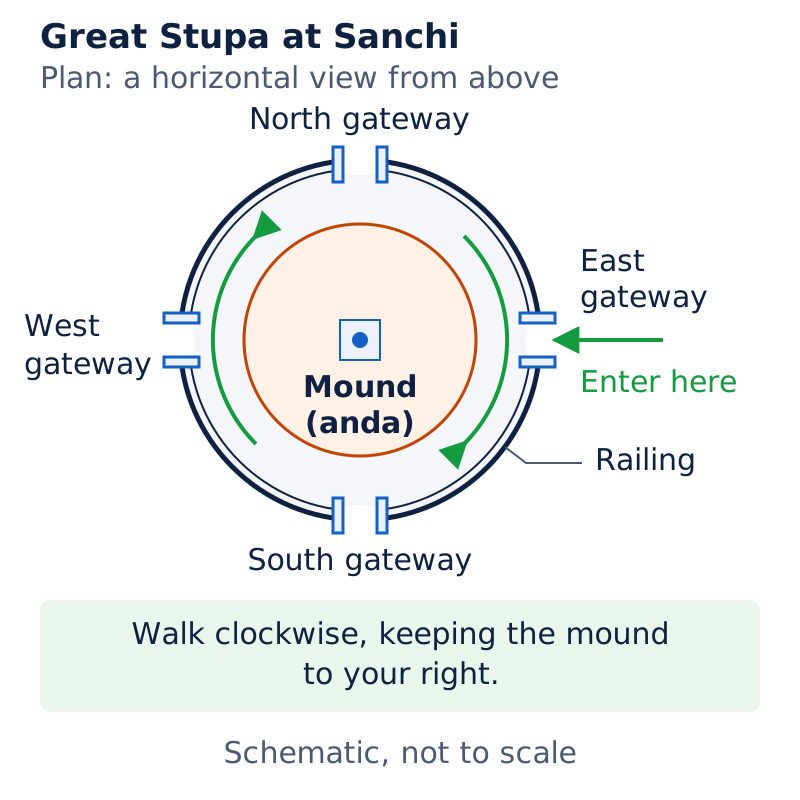
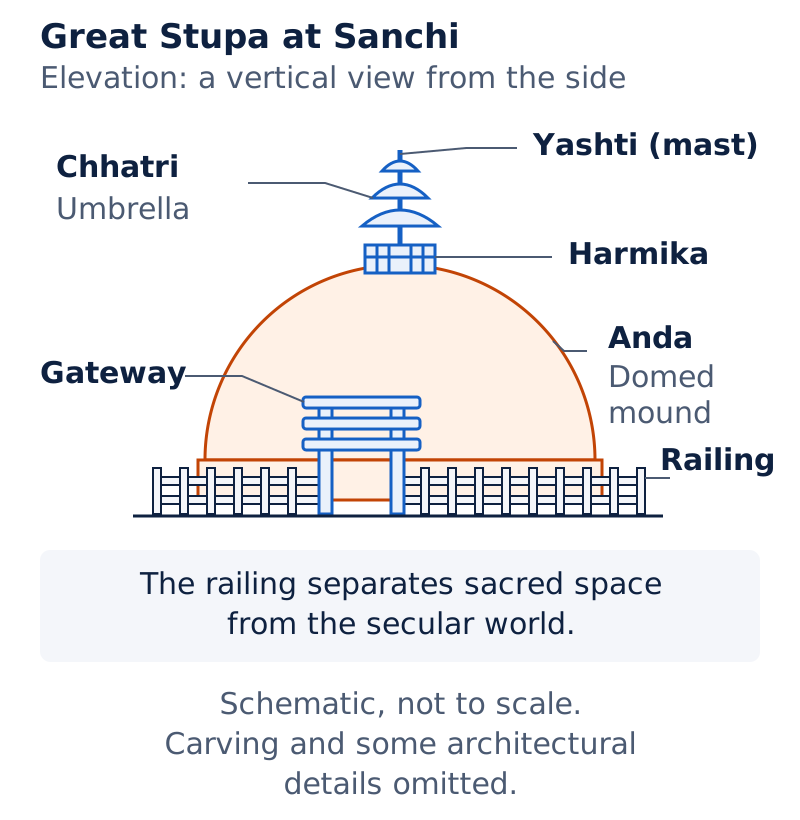
The plan, a horizontal view, shows circular enclosures and gateways around the centre. The elevation, a vertical view, shows the domed mound, railings, gateways and the structure rising above its summit.
Drawn by One Young India. Reference: NCERT Class 12 Figure 4.10a and Figure 4.10b
What were the consequences of removing sculptures from Amaravati?
Discovery and dispersal
In 1796, a local raja building a temple encountered Amaravati’s ruins. He decided to reuse the stone and thought treasure might lie inside the mound. Colin Mackenzie later recorded sculptures through detailed drawings, but these reports were never published.
In 1854, Walter Elliot, commissioner of Guntur, removed sculptural panels to Madras. They became known as the Elliot marbles. He found the western gateway’s remains and judged Amaravati one of the largest and most magnificent Buddhist stupas.
By the 1850s, slabs were being dispersed to Calcutta, Madras and London. Sculptures also appeared in British administrators’ gardens. Later officials justified further removals by citing the actions of their predecessors.
Removing sculpture also removed it from the building to which it belonged. The great stupa, or mahachaitya, at Amaravati was left as a small mound stripped of its former splendour. Its history shows the consequences of treating ancient objects as reusable stone or collectible art.
How did Sanchi survive, compared with Amaravati?
Local patronage and preservation
When Sanchi was “discovered” in 1818, three gateways stood, the fourth lay where it had fallen, and the mound was in good condition. French and English proposals to remove a gateway eventually gave way to acceptance of plaster-cast copies.
Shahjehan Begum, ruler of Bhopal from 1868 to 1901, and her successor Sultan Jehan Begum funded preservation. Sultan Jehan supported the museum, John Marshall’s guesthouse and publication of his Sanchi volumes, which he dedicated to her.
The archaeologist H.H. Cole advocated plaster copies for museums and in situ preservation, meaning preservation on the spot, for originals. His argument succeeded at Sanchi but failed at Amaravati. Sanchi also escaped railway contractors, builders and collectors seeking objects for European museums.
| Aspect | Amaravati | Sanchi |
|---|---|---|
| Treatment of remains | Stone reused and sculptures dispersed. | Original gateway retained; copies supplied. |
| Preservation outcome | The great stupa became a small mound stripped of its former splendour. | The complex survived and was restored by the Archaeological Survey of India. |
Note: Perhaps Amaravati was discovered before scholars understood the finds’ value and the importance of retaining them on site. Sanchi’s survival involved several factors, including patronage, decisions about preservation and good luck.
How do sculptures and paintings communicate religious ideas?
Stories and symbols
Historians often compare sculptures with texts to identify their meanings. At Sanchi, a scene with huts and trees has been identified as the Vessantara Jataka, a Buddhist narrative about a generous prince who gave everything to a Brahmana and entered the forest with his family.
Many early sculptors represented the Buddha through symbols rather than human form. Their meaning depends on knowledge of Buddhist traditions. An empty seat indicated meditation, a stupa represented mahaparinibbana, the Buddha’s final passing, and a wheel represented his first sermon at Sarnath.
What the figure shows
Symbols of worship at Sanchi
Photographs: “Worshipping the Bodhi tree” shows a tree above an empty seat with surrounding figures; “Worshipping the stupa” shows a stupa surrounded by figures; “Setting in motion the wheel of dharma” shows a prominent wheel above a group. The objects carry meanings beyond their literal appearance.
See Figs. 4.14, 4.15 and 4.16 in your NCERT textbook
Popular traditions and uncertain identities
Other Sanchi sculptures were perhaps not directly inspired by Buddhist ideas. A woman holding a tree could represent a shalabhanjika, a woman whose touch, in popular belief, made trees flower and bear fruit. It is likely that this was regarded as an auspicious symbol.
This motif, a recurring decorative image, suggests that converts brought pre-Buddhist and non-Buddhist beliefs into Buddhism. Animals included elephants, horses, monkeys and cattle. It is likely that many created lively scenes; animals also often symbolised human attributes, with elephants signifying strength and wisdom.
A woman amid lotuses and elephants is interpreted differently: some historians identify her as Maya, the Buddha’s mother, others as Gajalakshmi, the goddess of good fortune. Devotees possibly identified both. The elephants seem to sprinkle water as if performing abhisheka, or consecration.
The serpent motif seems to derive from popular traditions that were not always recorded in texts. James Fergusson, unfamiliar with largely untranslated Buddhist literature, interpreted Sanchi as a centre of tree and serpent worship by studying the images alone.
Painting as another visual medium
Surviving cave paintings at Ajanta portray Jataka stories, courtly life, processions, work and festivals. Artists used shading to create three-dimensional effects, and some paintings are extremely naturalistic. Stone sculpture survives more readily, but it was not the only visual medium.
What the figure shows
A painting from Ajanta
The painting shows a seated central figure with attendants serving him, arranged around and behind him. The figures overlap, and differences of tone help give their bodies a sense of volume.
See Fig. 4.20 in your NCERT textbook
How did Mahayana Buddhism and Puranic Hinduism develop?
The saviour and the Bodhisatta
By the first century CE, changes in Buddhist ideas and practices are evident. Earlier teachings stressed personal effort, regarding the Buddha as a human being who attained enlightenment and nibbana himself. Gradually, belief in a saviour who could ensure salvation developed.
The Bodhisatta was understood as a deeply compassionate being who accumulated merit but used it to help others, rather than attaining nibbana and abandoning the world. Worship of images of the Buddha and Bodhisattas became important.
This tradition was called Mahayana, the “great vehicle”. Its supporters called the older tradition Hinayana, the “lesser vehicle”. Older-tradition followers described themselves as theravadins, followers of the path of respected teachers called theras.
Devotion, deities and religious integration
Vaishnavism worshipped Vishnu as the principal deity; Shaivism regarded Shiva as the chief god. Both increasingly emphasised a chosen deity. The relationship of love and devotion between worshipper and god was called bhakti.
Vaishnavism recognised ten avatars, or incarnations, believed to appear when evil threatened the world with disorder. It is likely that different avatars were popular in different regions. Recognising local deities as forms of Vishnu helped create a more unified tradition.
Shiva was symbolised by the linga, an emblem representing him, and occasionally shown in human form. Divine attributes were expressed through ornaments, headdresses, poses and ayudhas, weapons or auspicious objects held by deities.
The Puranas, collections including stories of gods and goddesses, were compiled by Brahmanas by about the middle of the first millennium CE. They preserved material circulating for centuries. Generally written in simple Sanskrit verse, they were intended for public recitation, including to women and the social group called Shudras, who did not have access to Vedic learning.
Religious ideas developed through exchanges among priests, merchants and other travellers. Vasudeva-Krishna, an important deity around Mathura, came to be worshipped more widely over centuries. Understanding these traditions helps explain images such as Vishnu’s boar incarnation, Varaha, rescuing the earth goddess.
What was the impact of image worship on temple architecture?
From a small shrine to larger complexes
As stupas such as Sanchi acquired their present form, temples began to house images of gods and goddesses. An early temple consisted of a small square garbhagriha, the room containing the deity’s image, with a single doorway for worshippers.
A tall structure called the shikhara gradually rose above the central shrine. Walls were often decorated with sculpture. Later temples included assembly halls, large enclosing walls and gateways, and arrangements for water.
What the figure shows
Temple at Deogarh
This photograph shows steps leading up to a raised platform and the shrine’s doorway, with the surviving upper structure above it. The temple in Uttar Pradesh dates to about the fifth century CE.
See Fig. 4.25 in your NCERT textbook
Rock-cut traditions
Some early temples were hollowed out of huge rocks as artificial caves. This practice had older precedents. Asoka ordered some of the earliest artificial caves in the third century BCE for renouncers of the Ajivika sect, including the example at Barabar in Bihar.
The tradition developed through several stages and culminated much later, in the eighth century, in the Kailashnatha Temple at Ellora in Maharashtra. Kailashnatha is a name of Shiva. The entire temple was carved from a single piece of rock.
A copperplate inscription records the chief sculptor’s amazement at his own achievement. Temples and their images therefore provide evidence of religious beliefs together with the skills and ambitions of sculptors, masons and architects.
How do historians use sources and recognise their limitations?
Compiling and transmitting texts
Buddhist, Jaina and Brahmanical texts, inscriptions, monuments and images provide different kinds of evidence. The Buddha taught orally; men and women, perhaps children as well, attended. None of his speeches was written down during his lifetime.
After his death, about the fifth to fourth century BCE, disciples compiled teachings at a council of elders at Vesali, Pali for Vaishali. The compilations were the Tipitaka, literally “three baskets”, transmitted orally before being written and classified.
| Collection | Content |
|---|---|
| Vinaya Pitaka | Rules and regulations of the monastic community. |
| Sutta Pitaka | The Buddha’s teachings. |
| Abhidhamma Pitaka | Philosophical matters. |
Some oldest texts are in Pali, later works in Sanskrit. Sri Lankan histories included the Dipavamsa, “chronicle of the island”, and Mahavamsa, “great chronicle”. Chinese pilgrims Fa Xian and Xuan Zang collected texts in India; translations and Asian monasteries helped preserve them.
Modern accounts and interpretive problems
Shahjehan Begum’s history of Bhopal, translated by H.D. Barstow in 1876, describes Cunningham’s drawings, inscription-reading and shafts bored into Sanchi’s domes. Cunningham’s Bhilsa Topes appeared in 1854; Marshall and Alfred Foucher published The Monuments of Sanchi in 1914.
Earlier scholarship included Ram Raja’s architectural essay in 1834 and Fergusson’s site surveys from 1835 to 1842. Rajendra Lala Mitra’s study of Buddha Gaya appeared in 1878. These works formed part of the modern investigation of ancient religious buildings.
Conservation also acquired institutional and written forms: Cole became Curator of Ancient Monuments in 1880, and Marshall published the Conservation Manual in 1923. Studies of monuments thus developed alongside efforts to preserve them.
Such records reveal modern investigation as well as ancient remains. Early European scholars often judged Indian sculpture against Greek models. Images closest to familiar Greek statues were considered the best, showing how inherited standards could shape interpretation.
Texts do not resolve every image. For the Mahabalipuram rock panel, some historians propose the Ganga’s descent: the central cleft might represent the river. Others see Arjuna’s penance to acquire weapons, pointing to an ascetic, a person practising religious self-discipline.
Many daily rituals and special observances left no permanent monument, image or painting. Communities may have had rich religious traditions without preserving lasting records. Surviving evidence therefore reveals only part of the religious life of the past.
What timeline connects religious developments with discovery and preservation?
Major religious developments
Approximate dates distinguish broad cultural developments from precisely dated modern events. Traditions changed over long periods and interacted with one another.
| Period | Development |
|---|---|
| About 1500 BCE to 1000 BCE | Early Vedic traditions. |
| About 1000 BCE to 500 BCE | Later Vedic traditions. |
| About the sixth century BCE | Early Upanishads, Jainism and Buddhism. |
| About the third century BCE | First stupas. |
| About the second century BCE onwards | Development of Mahayana Buddhism, Vaishnavism, Shaivism and goddess cults. |
| About the third century CE | Earliest temples. |
Discovery, scholarship and conservation
The modern record includes removals, museum-building, research and efforts to preserve monuments. It explains why some objects remain within their original setting while others were dispersed. Sanchi’s history connects local rulers’ support with archaeological investigation and decisions about keeping remains on site.
| Date | Event |
|---|---|
| 1796 | A local raja encountered the ruins at Amaravati while seeking to build a temple. |
| 1814 | The Indian Museum was founded in Calcutta. |
| 1818 | Sanchi was “discovered” with three gateways standing and the fourth lying nearby. |
| 1834 | Ram Raja’s Essay on the Architecture of the Hindus was published; Cunningham explored Sarnath’s stupa. |
| 1835 to 1842 | James Fergusson surveyed major archaeological sites. |
| 1851 | The Government Museum was established in Madras. |
| 1854 | Cunningham published Bhilsa Topes; Walter Elliot removed Amaravati panels to Madras. |
| 1868 to 1901 | Shahjehan Begum ruled Bhopal. |
| 1876 | H.D. Barstow’s translation of Shahjehan Begum’s history of Bhopal appeared. |
| 1878 | Rajendra Lala Mitra published Buddha Gaya: The Heritage of Sakya Muni. |
| 1880 | H.H. Cole was appointed Curator of Ancient Monuments. |
| 1888 | The Treasure Trove Act was passed, giving government the right to acquire all objects of archaeological interest. |
| 1914 | John Marshall and Alfred Foucher published The Monuments of Sanchi. |
| 1923 | John Marshall published the Conservation Manual. |
| 1955 | Prime Minister Jawaharlal Nehru laid the foundation stone of the National Museum, New Delhi. |
| 1989 | Sanchi was declared a World Heritage Site. |
Glossary
- Ahimsa — Non-injury to living beings, central to Jaina philosophy and influential in Indian thinking more widely.
- Tirthankara — A Jaina teacher who guides men and women across the river of existence.
- Hagiography — A saint’s or religious leader’s biography, often praising achievements and revealing followers’ beliefs.
- Dhamma — The path of righteous living taught by the Buddha after attaining enlightenment.
- Nibbana — The extinguishing of ego and desire, ending suffering’s cycle for those who renounced the world.
- Sangha — The Buddhist monastic organisation whose members lived simply and taught the path of dhamma.
- Tipitaka — Literally three baskets: Buddhist compilations containing monastic rules, the Buddha’s teachings and philosophical matters.
- Stupa — A mound associated with sacred relics, venerated as an emblem of the Buddha and Buddhism.
- Harmika — The balcony-like structure above a stupa’s mound, representing the abode of the gods.
- In situ — On the spot; preserving an object or monument where it was found.
- Bodhisatta — A compassionate being understood to use accumulated merit to help others rather than abandon the world.
- Bhakti — Love and devotion connecting a worshipper with a chosen god in devotional traditions.
- Garbhagriha — The small central shrine room containing a deity’s image in an early temple.
- Shikhara — The tall structure that developed above the central shrine of a temple.
Common errors and misconceptions
- Misconception: Mahavira created Jaina philosophy without predecessors. Correct: Its basic philosophy existed before him; Jaina tradition names 23 earlier tirthankaras who guided people towards liberation.
- Misconception: The Buddha advocated extreme bodily suffering. Correct: He abandoned extreme mortification and taught moderation between severe penance and self-indulgence, emphasising personal effort and righteous conduct.
- Misconception: Buddhist speeches were written during the Buddha’s lifetime. Correct: Teaching was oral; disciples compiled the teachings after his death, and oral transmission preceded written classification.
- Misconception: Women could never join the sangha. Correct: They were admitted later, with Ananda’s mediation according to Buddhist texts; Mahapajapati Gotami became the first ordained bhikkhuni.
- Misconception: Every Sanchi image has one certain Buddhist meaning. Correct: Some perhaps drew on other traditions, and figures such as the woman with elephants have competing interpretations.
- Misconception: Hinayana was the older tradition’s own chosen name. Correct: Mahayana supporters used that description; older-tradition followers described themselves as theravadins, following the path of respected teachers.
- Misconception: Amaravati and Sanchi received identical treatment. Correct: Amaravati’s sculptures were dispersed, whereas patronage, plaster copies and support for in situ preservation helped Sanchi survive.
Exam-style questions with model answers
Q1. Makkhali Gosala’s reported teaching says that pleasure and pain cannot be changed during successive lives. Mahavira and the Buddha emphasised that women and men could strive for liberation themselves. State Gosala’s position and the contrasting emphasis of Mahavira and the Buddha. [2 marks]
- Gosala’s position presents the course of pleasure and pain as fixed, beyond a person’s power to alter.
- Mahavira and the Buddha emphasise individual agency, allowing people to strive actively for liberation.
Q2. Jaina teaching regards even stones, rocks and water as living; stresses non-injury; connects birth and rebirth with karma; and requires asceticism, penance and renunciation for release. Explain three central features of this teaching using these details. [3 marks]
- The entire world is regarded as animated, extending life beyond humans and animals to stones, rocks and water.
- Non-injury is central: the emphasis on living beings gives ahimsa an essential place within Jaina religious conduct.
- Karma shapes birth and rebirth. Release requires asceticism and penance through renouncing the world, so monastic existence is necessary for salvation.
Q3. In advice to Sigala, the Buddha tells a master to assign work according to employees’ strength, supply food and wages, tend them in sickness, share delicacies and grant leave at times. Explain these five responsibilities. [5 marks]
- Work should match employees’ strength. The master must take their capacity into account when deciding what tasks they should perform.
- Employees should receive food and wages. Providing these is one of the responsibilities placed upon the master in the advice.
- The master should care for employees when they are sick, extending concern to their condition during illness as well as work.
- Delicacies should be shared with employees, making the sharing of special food part of the master’s conduct towards them.
- Employees should receive leave at times. The advice therefore includes granting time away among the master’s responsibilities towards those employed.
Q4. An inscription records that the Buddhist nun (bhikkhuni) Dhanavati installed a Bodhisatta at Madhuvanaka with her father and mother, in year 33 of the Kushana ruler Huvishka, on the eighth day of the first month of the hot season. It calls her the sister’s daughter of bhikkhuni Buddhamita and the female pupil of the Buddhist monk (bhikkhu) Bala; it mentions knowledge of the Tipitaka. Identify the dating method and full date, the donor and installation site, the relatives named or mentioned, and the teacher and text. [4 marks]
- The inscription dates the installation by naming Huvishka and specifying year 33, the eighth day of the first month of the hot season.
- The donor was the Buddhist nun Dhanavati, who installed the Bodhisatta at Madhuvanaka together with her parents.
- She mentioned her father and mother and named Buddhamita, whose sister’s daughter she was, establishing the family relationship.
- Her named teacher was the Buddhist monk Bala. The text mentioned in connection with Buddhist learning was the Tipitaka.
Q5. Sanchi had three standing gateways and a sound mound when found in 1818. French and English collectors accepted plaster copies. Shahjehan Begum and Sultan Jehan Begum financed preservation; Sultan Jehan also funded the museum, Marshall’s guesthouse and publication. Cole’s plea for keeping originals on site succeeded there. Sanchi also escaped railway contractors, builders and collectors. Explain six factors that helped it survive. [6 marks]
- The complex was already comparatively well preserved in 1818: three gateways stood and the mound remained in good condition.
- French and English acceptance of plaster copies allowed an original gateway to remain at the site instead of being removed.
- Shahjehan Begum and Sultan Jehan Begum provided money for preservation, giving practical financial support to the ancient complex.
- Sultan Jehan supported the museum, Marshall’s guesthouse and publication, funding facilities and work associated with studying and preserving Sanchi.
- Cole’s plea for preserving originals where they were found was adopted, helping protect the relationship between objects and their site.
- Good luck also mattered: Sanchi escaped railway contractors, builders and collectors seeking objects, alongside the deliberate measures for its protection.
Q6. Many early Buddhist sculptors showed the Buddha’s presence through symbols. An empty seat indicated his meditation, a stupa represented mahaparinibbana, the Buddha’s final passing, and a wheel represented his first sermon at Sarnath. Explain the meanings of these three symbols. [3 marks]
- The empty seat indicated the Buddha’s meditation. His presence could therefore be conveyed without carving him as a human figure.
- The stupa represented mahaparinibbana, the Buddha’s final passing. Its meaning in the image extended beyond showing a mound or building.
- The wheel stood for the first sermon delivered at Sarnath. Understanding that association connects the visible object with a religious event.
Q7. Early temples had a small square garbhagriha with a deity’s image and one doorway. A tall structure called the shikhara developed above the shrine; walls were often sculpted. Later temples added halls, enclosing walls, gateways and water arrangements. Some temples were hollowed from rock, culminating much later in the eighth-century Kailashnatha Temple at Ellora, carved from one rock. Explain five architectural features or developments. [5 marks]
- The garbhagriha formed the early temple’s small square shrine, housing the deity’s image and allowing access through a single doorway.
- The shikhara developed as a tall structure above the central shrine, adding an upper structure to the temple’s form.
- Temple walls were often decorated with sculpture. Images thus became part of the building’s surfaces as well as its shrine.
- Later temples became more elaborate through assembly halls, enclosing walls, gateways and arrangements for water, expanding the facilities around worship.
- Some temples were hollowed from rock. Much later, the eighth-century Kailashnatha Temple at Ellora was carved from a single rock.
Key takeaways
- Early religious thinking developed through debates about sacrifice, existence, rebirth and personal action amid changing social and economic conditions.
- Jainism emphasised an animated world, non-injury, karma and renunciation, with five vows governing the lives of monks and nuns.
- The Buddha taught change, sorrow, moderation and individual effort, while encouraging humane conduct within everyday social relationships.
- The sangha admitted people of varied backgrounds; women entered later and contributed as teachers and composers of religious verses.
- Stupas combined sacred relics, symbolic structures, collective donations and clockwise worship, linking religious ideas with material forms.
- Sanchi survived through patronage, preservation decisions and good luck; Amaravati’s removal and dispersal show how archaeological contexts were damaged.
- Mahayana, Vaishnavism and Shaivism developed forms of devotion and image worship that found expression in sculpture and architecture.
- Texts, images, inscriptions and monuments must be interpreted together, while acknowledging uncertain identifications and traditions that left no lasting records.
Test yourself
What was a kutagarashala, and what happened there?
It was literally a hut with a pointed roof, used for discussions and debates among teachers and others about their philosophies.
What five vows did Jaina monks and nuns take?
They abstained from killing, stealing and lying, observed celibacy, and abstained from possessing property as part of renouncing worldly life.
How did Punna challenge the claim that bathing removed wrongdoing?
She pointed out that aquatic animals would then reach heaven and urged the Brahmana to stop committing the acts that made him afraid.
How did the sangha take decisions?
Members sought agreement through discussion. If discussion failed to produce consensus, they took decisions by voting on the subject.
How do the anda, harmika, yashti and chhatri fit together?
The anda is the mound; the harmika stands above it. The yashti rises from the harmika and is often topped by a chhatri.
Why is the woman with elephants not given a single certain identity?
Some historians identify her as Maya, others as Gajalakshmi. It is also possible that worshippers associated the figure with both.
What was the purpose of the Puranas’ simple Sanskrit verse?
They were generally composed in simple verse for reading aloud to everybody, including women and Shudras who lacked access to Vedic learning.
What are the competing interpretations of the Mahabalipuram rock panel?
Some historians see the Ganga’s descent, with the cleft possibly representing the river; others identify Arjuna’s penance to obtain weapons.