
Conic Sections | CBSE Class 11 Maths Notes
On this page
Watch & explore
Start with a few high-quality watches, then dive into the notes below.

These CBSE Class 11 Mathematics notes cover sections of a cone, circles, parabolas, ellipses and hyperbolas, their geometric definitions, standard equations, axes, foci, vertices, eccentricity, latus rectum, worked examples and applications.
How does a plane cutting a cone produce different conic sections?
A conic section is a curve obtained by intersecting a plane with a double-napped right circular cone. The type of curve depends on the position of the cutting plane and its inclination to the cone's axis.
How is the cone formed?
Let be a fixed vertical line and a line meeting it at a fixed point . Let be the constant angle between these lines. Rotating about generates the cone's surface.
The point is the vertex, the line is the axis, and the rotating line is a generator. The vertex separates the cone into two parts called nappes, extending indefinitely in opposite directions.
Let denote the angle between the intersecting plane and the vertical axis. When the cutting plane does not pass through the vertex, its inclination distinguishes the four curves below.
| Condition on the cutting plane | Conic obtained | Nappes cut |
|---|---|---|
| Circle | One nappe | |
| Ellipse | One nappe | |
| Parabola | One nappe | |
| Hyperbola | Both nappes |
What the figure shows
Plane sections of a cone
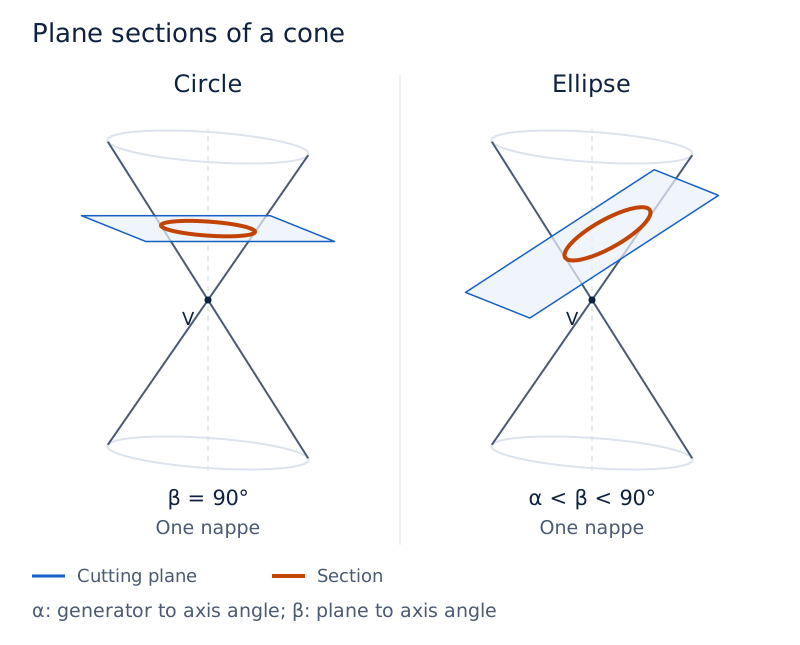
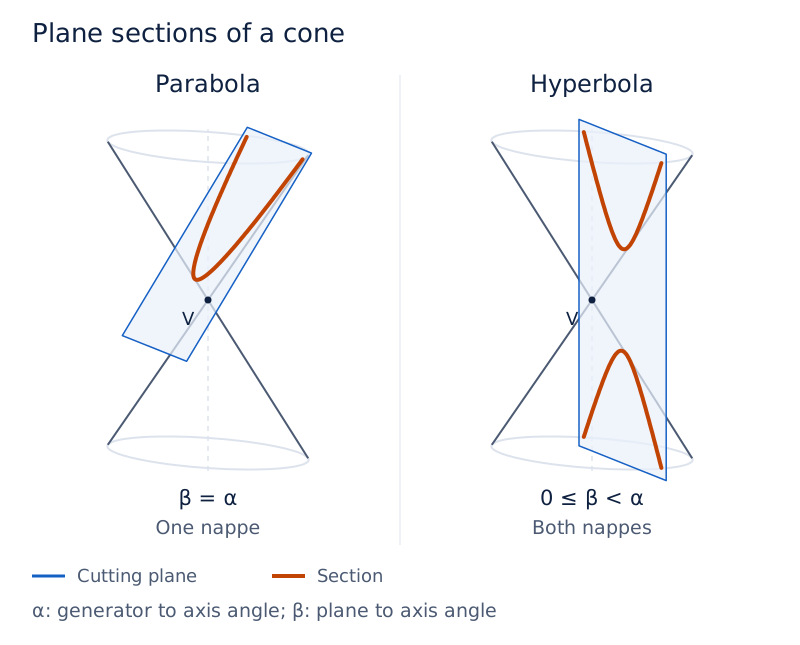
Blue cutting planes cross the double cone. The circle and ellipse appear as closed sections; the parabola cuts one nappe, while the hyperbola has portions on both nappes.
Drawn by One Young India. See Figs. 10.4 to 10.7 in your NCERT textbook
What happens when the plane passes through the vertex?
A plane through the vertex produces a degenerate conic. For , the section is a point. For , it is a straight line, the degenerate case of a parabola.
For , the section is a pair of intersecting straight lines, the degenerate case of a hyperbola. Thus the angle condition must be considered together with whether the cutting plane passes through the vertex.
How is the equation of a circle obtained from its definition?
Definition: A circle is the set of all points in a plane equidistant from a fixed point in that plane. The fixed point is its centre; the fixed distance is its radius.
Write the centre as , where and are its horizontal and vertical coordinates. Let be the positive radius and any point on the circle, with coordinates and .
Derivation: Equation from the distance formula
- The defining condition is that the distance from the centre to the moving point equals the radius:
- Apply the distance formula to the two points:
- Substitute the distance into the defining condition:
- Square both non-negative sides to obtain the standard equation:
Result: The centre is read from the quantities subtracted inside the brackets. The right-hand side gives the square of the radius, so the radius itself is its positive square root.
Result: Circle with centre at the origin
When the centre is the origin, both centre coordinates vanish. Substitution gives , and hence . This equation expresses that every point has the same distance from the origin.
Worked example 1. Find the equation of the circle with centre and radius .
Answer:
- Identify the centre coordinates and radius: , , and .
- Substitute into the standard form:
- Simplify the signs and square the radius:
The positive sign inside the first bracket corresponds to a negative horizontal coordinate of the centre. Reading the sign without comparing the whole bracket with the standard form would reverse the centre's position.
How do completing squares and point conditions determine a circle?
A circle may be given in expanded form rather than as two squared brackets. Completing the square restores the standard form and makes the centre and radius visible. Group the horizontal-coordinate terms and vertical-coordinate terms separately before adding the missing constants.
How do you recover the centre and radius?
Worked example 2. Find the centre and radius of .
Answer:
- Move the constant to the right and group terms:
- Half the linear coefficients and square them:
- Add these quantities to both sides:
- Factor the completed squares and add:
- Compare with the standard equation: the centre is , and the radius is .
Adding constants inside the brackets changes the left-hand side. The same total must be added on the right. The radius is a distance, so use the positive square root when interpreting the final constant.
How do two points and a centre condition work together?
Worked example 3. Find the circle through and , whose centre lies on .
Answer:
- Use centre and radius . Substitution of the two points gives
- Expand both equations:
- Subtract the first equation from the second and rearrange:
- The centre condition gives , hence . Therefore
- Use the first point to calculate the squared radius:
- The required equation is
The point conditions express equal distances from the unknown centre. Subtracting eliminates both the squared radius and the squared centre coordinates. The remaining linear equation, together with the given line, determines the centre before the radius is calculated.
What defines a parabola, and how is its standard equation derived?
Definition: A parabola is the set of points in a plane equidistant from a fixed point and a fixed line in that plane, where the point does not lie on the line.
The fixed point is the focus, and the fixed line is the directrix. The line through the focus perpendicular to the directrix is the axis. Its intersection with the parabola is the vertex.
For the right-opening standard parabola, let be the origin and vertex, the focus, and the positive vertex-to-focus distance. The directrix is , so the vertex lies halfway between the focus and directrix.
Derivation: Parabola with a horizontal axis
- Take a point on the parabola. Let be the foot of the perpendicular from that point to the directrix. The definition gives
- Write the two distances:
- Equate and square the non-negative distances:
- Expand the squared brackets:
- Cancel common terms and rearrange:
- Conversely, substituting this equation into the focus distance gives Thus the equation also implies the defining distance condition.
Result: The equation represents the parabola with vertex at the origin, focus , and directrix .
What the figure shows
Focus and directrix construction
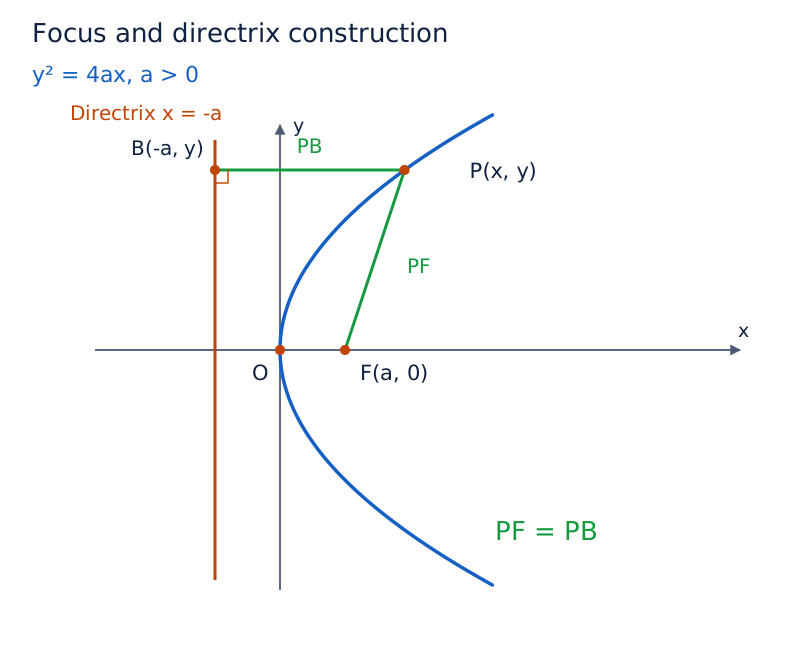
The curve opens right from the origin. A point on the curve is joined to the focus and horizontally to the directrix. These segments show the two distances equated in the derivation.
Drawn by One Young India. See Fig. 10.16 in your NCERT textbook
Since a square is non-negative and , this equation requires . The curve extends into the first and fourth quadrants. Changing the sign of the vertical coordinate leaves the equation unchanged, showing symmetry about the horizontal axis.
How do you identify a parabola's direction and latus rectum?
In the standard forms below, the vertex is the origin and is positive. The squared coordinate determines the axis; the sign of the coefficient of the unsquared coordinate determines the opening direction.
| Equation | Opening | Focus | Directrix |
|---|---|---|---|
| Right | |||
| Left | |||
| Upwards | |||
| Downwards |
Result: Length of the parabola's latus rectum
The latus rectum is the line segment through the focus, perpendicular to the axis, with endpoints on the parabola. For the right-opening form, its endpoints have horizontal coordinate equal to the focal distance. The symbol below denotes both positive and negative choices.
- Set in the parabola:
- Take both square roots to obtain the endpoint coordinates:
- Subtract their vertical coordinates to find the full length:
Worked example 4. Find the focus, axis, directrix and latus rectum length of .
Answer:
- Compare with : , so .
- The squared vertical coordinate gives the horizontal axis; the positive coefficient means the parabola opens right.
- The focus is , the axis is , and the directrix is .
- The latus rectum length is .
Worked example 5. Find the parabola with vertex , symmetric about the vertical axis, and passing through .
Answer:
- The negative vertical coordinate of the given point requires the downward-opening form: .
- Substitute the point: , giving and .
- Substitute the focal distance: .
- Multiply through by three: .
Note: Symmetry about the vertical axis alone does not specify the vertex's position. The origin condition in the preceding example is needed to use these standard forms directly.
What defines an ellipse, and how are its axes and foci related?
Definition: An ellipse is the set of points in a plane whose distances from two fixed points have a constant sum. This sum is greater than the distance between the fixed points.
The fixed points are the foci. Their midpoint is the centre. The segment through the foci with endpoints on the ellipse is the major axis; the perpendicular segment through the centre is the minor axis.
For an ellipse, let denote the semi-major axis length, the semi-minor axis length, and the centre-to-focus distance. The full axis lengths are and ; the distance between the foci is .
Derivation: Relation between the semi-axes and focal distance
- At an endpoint of the major axis, the distances to the foci are and . Their sum is
- At an endpoint of the minor axis, each focus is at distance . The sum there is
- Equate the sums because both points lie on the same ellipse:
- Divide by two and square:
Result: The focal distance is found by subtracting the squared semi-minor axis from the squared semi-major axis and taking the positive square root.
How is eccentricity defined?
The eccentricity, denoted by , is the ratio of the centre-to-focus distance to the centre-to-vertex distance: . Therefore . The vertices are the endpoints of the major axis, rather than the endpoints of the minor axis.
For an ellipse with distinct foci and positive semi-minor axis, , so . These inequalities are consistent with the requirement that the constant distance sum exceed the separation of the foci.
What the figure shows
Two orientations of an ellipse
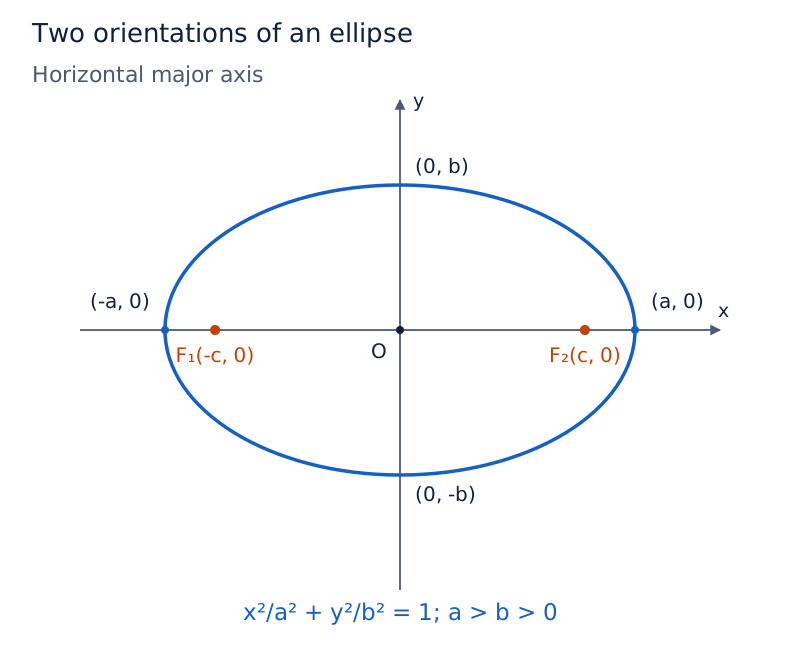
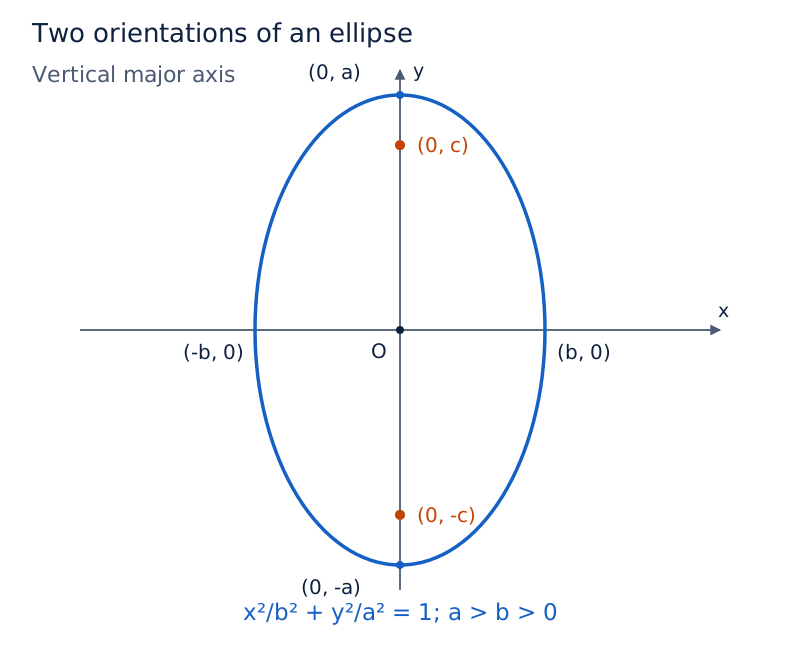
The left ellipse is wider horizontally, with its two foci on the horizontal axis. The right ellipse is taller vertically, with its foci on the vertical axis. Both centres coincide with the origin.
Drawn by One Young India. See Fig. 10.24 in your NCERT textbook
How are the standard equations and latus rectum of an ellipse obtained?
Place the centre at the origin and the foci on the horizontal axis. Denote the left focus by , the right focus by , and a point on the ellipse by .
Derivation: Standard equation of an ellipse
- Express the constant sum using the distance formula:
- Isolate the first radical and square both sides:
- Subtract common terms and rearrange:
- Square again and expand:
- Collect terms and multiply by the squared semi-major axis:
- Use and divide through by :
- For the converse, the equation gives . Substitution into the distance expressions gives and , both positive since . Thus .
Result: The equation and the constant-sum definition describe the same ellipse. When the major axis is vertical, exchange the roles of the coordinate directions, keeping the larger semi-axis attached to the major axis.
| Major axis | Standard equation | Foci | Vertices |
|---|---|---|---|
| Horizontal | |||
| Vertical |
In both rows, . The larger denominator identifies the major axis after the equation has been normalised to have one on the right.
Derivation: Length of the ellipse's latus rectum
The latus rectum passes through a focus perpendicular to the major axis. Let be its positive half-length for the horizontal ellipse.
- The upper endpoint through the right focus has coordinates . Substitute it:
- Rearrange and use the focal relation:
- Take the positive root and double it for the full segment:
Result: Both standard orientations have latus rectum length . The quantity calculated before doubling is the distance from the focus to one endpoint.
What the figure shows
Latus recta of an ellipse
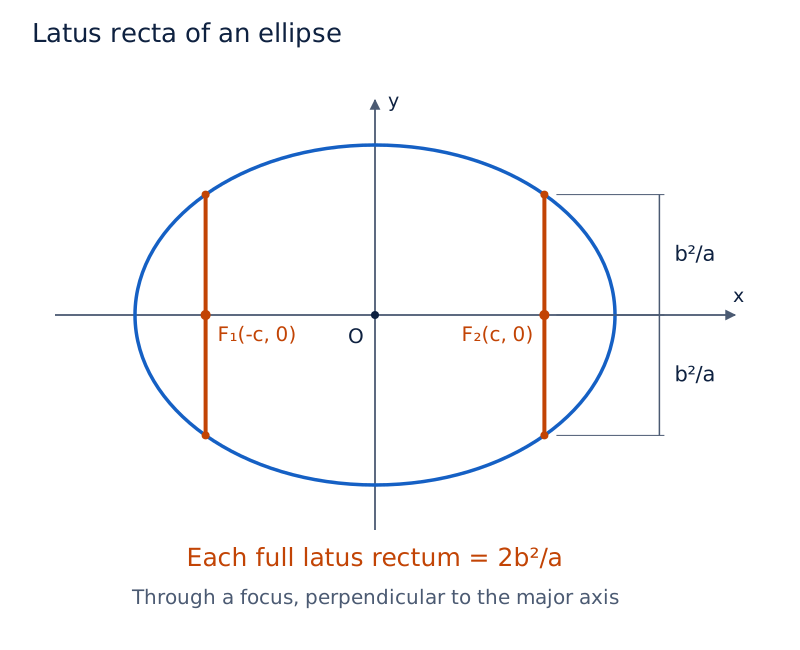
Two vertical chords pass through the foci of a horizontal ellipse. Each chord meets the curve above and below the horizontal axis, showing the two halves of a latus rectum.
Drawn by One Young India. See Fig. 10.26 in your NCERT textbook
How do you calculate an ellipse's features or construct its equation?
Begin by writing the ellipse with one on the right-hand side. Then compare the denominators of the squared coordinates. The larger denominator gives the square of the semi-major axis, regardless of which coordinate it accompanies.
How are the features read from a standard equation?
Worked example 6. Find the foci, vertices, axis lengths, eccentricity and latus rectum length of .
Answer:
- The larger denominator is under the horizontal coordinate: , , hence and .
- Calculate the focal distance: , so .
- The foci are , and the vertices are .
- The major and minor axis lengths are and , respectively.
- The eccentricity is .
- The latus rectum length is .
Worked example 7. Find the foci, vertices, axis lengths and eccentricity of .
Answer:
- Divide every term by the right-hand constant:
- The major axis is vertical. Thus , , , and .
- Find the focal distance: , so .
- The foci are , and the vertices are .
- The axis lengths are and ; the eccentricity is .
How do given vertices and foci determine the equation?
Worked example 8. Find the ellipse with vertices and foci .
Answer:
- The common midpoint is the origin, and the major axis is horizontal. Read the distances and .
- Use the ellipse relation: .
- Insert the squared semi-axis lengths into the horizontal standard form:
The negative coordinate of one focus does not make the focal distance negative. Distances are measured from the centre, while signed coordinates indicate on which side of the centre the corresponding point lies.
What distinguishes a hyperbola, and how is its equation derived?
Definition: A hyperbola is the set of points in a plane for which the distance to the farther of two fixed points minus the distance to the nearer one is constant.
The two fixed points are the foci, and their midpoint is the centre. The line through them is the transverse axis. The perpendicular line through the centre is the conjugate axis.
For a hyperbola, let be half the distance between its vertices, the centre-to-focus distance, and . The transverse and conjugate axis lengths are and , respectively.
For the non-degenerate standard hyperbola, . The constant difference is , and the eccentricity is . Unlike an ellipse, its focal relation is .
Derivation: Hyperbola with horizontal transverse axis
Take foci and , and first take on the right branch, where the left focus is farther away.
- Write the constant difference:
- Move the second radical to the right and square:
- Cancel common terms and isolate the radical:
- Square again and expand:
- Collect terms:
- Use and divide:
- Conversely, on the right branch the equation gives and , hence . On the left branch the order reverses, giving .
Result: Both branches satisfy the same positive difference of distances, although the farther focus changes between branches. The absolute-value form expresses both cases together.
Property: The positive term identifies the transverse axis
For , the transverse axis is horizontal. For , it is vertical. The positive term identifies the direction, even when its denominator is smaller.
The horizontal equation requires , so or . No part of that curve lies between those two vertical lines. Both standard hyperbolas are symmetric about both coordinate axes.
What the figure shows
Horizontal and vertical hyperbolas
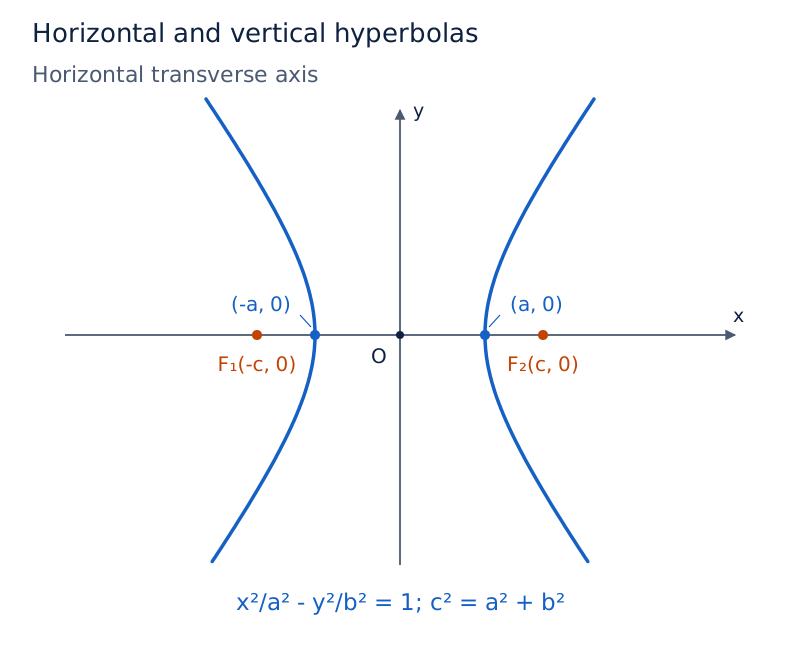
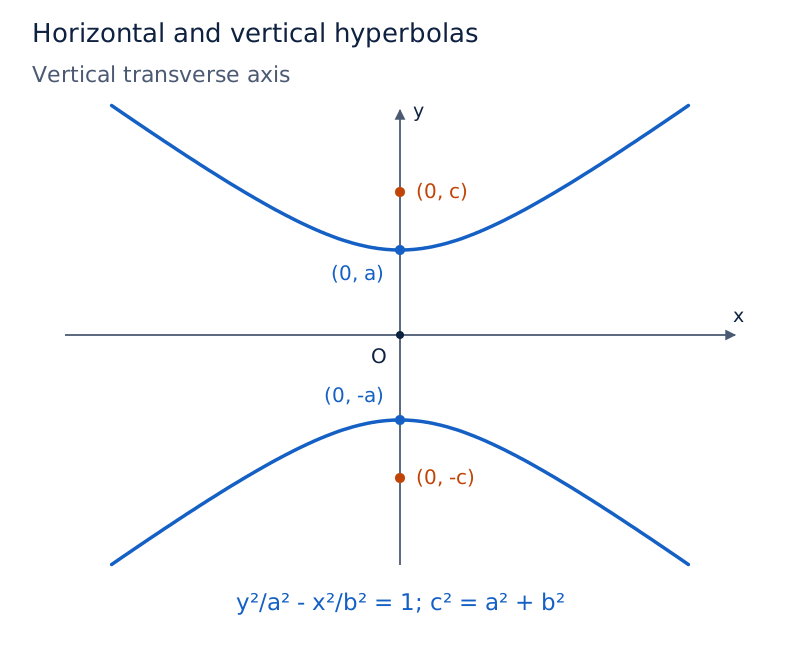
One graph has branches opening left and right, with foci and vertices on the horizontal axis. The other has branches opening upwards and downwards, with foci and vertices on the vertical axis.
Drawn by One Young India. See Fig. 10.29 in your NCERT textbook
How do you solve hyperbola problems and use conics in applications?
The latus rectum of a hyperbola passes through a focus perpendicular to the transverse axis, with endpoints on the curve. Its length is , as for an ellipse, but the focal relation uses addition.
How are a hyperbola's features calculated?
Worked example 9. Find the foci, vertices, eccentricity and latus rectum length of .
Answer:
- The positive horizontal term gives a horizontal transverse axis: , , so and .
- Calculate , giving .
- The foci are , and the vertices are .
- The eccentricity is .
- The latus rectum length is .
Worked example 10. Find the hyperbola with foci and latus rectum length .
Answer:
- The foci give and a vertical transverse axis. The form is .
- Use the latus rectum length: , so .
- Substitute into the focal relation: , or .
- Factor: . Reject because it is a length, leaving .
- Calculate , while .
- The equation is , equivalently .
A hyperbola with is called an equilateral hyperbola. Equality of these two parameters is possible for a hyperbola; it does not replace the difference of squared terms by the sum used for an ellipse.
How does a parabolic mirror problem use coordinates?
Worked example 11. A parabolic mirror has its focus from its vertex and is deep. Find its opening width.
Answer:
- Place the vertex at the origin and the mirror axis along the positive horizontal axis. Measure both coordinates in centimetres, giving .
- The cross-section equation is .
- The rim is at depth , so .
- The upper and lower rim coordinates are and .
- The opening width is their separation: .
What the figure shows
Parabolic mirror
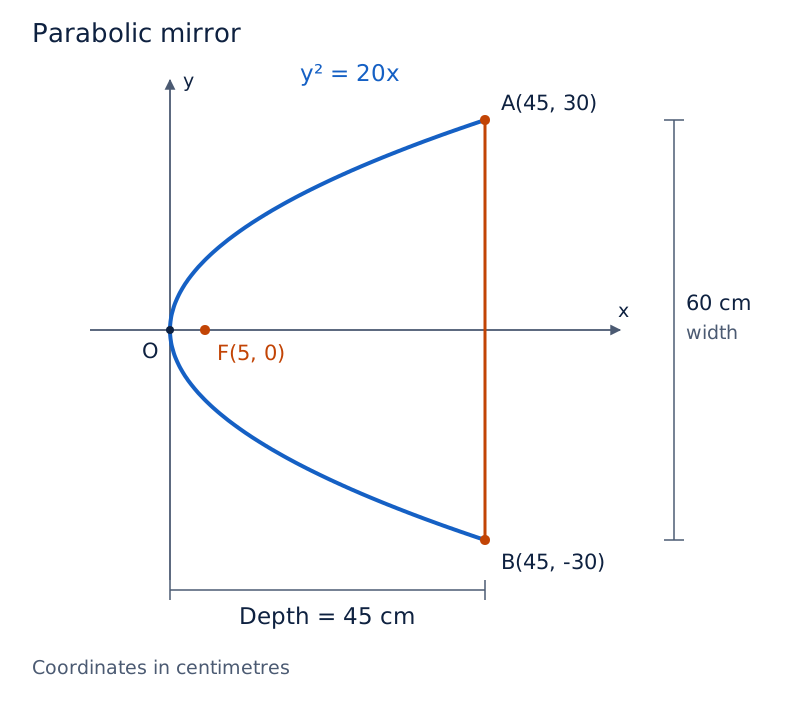
The mirror extends rightwards from the origin to a vertical rim. Its horizontal depth is labelled , and the upper and lower rim points are labelled and , respectively.
Drawn by One Young India. See Fig. 10.31 in your NCERT textbook
The vertical coordinate at the rim measures half the opening. Taking just the positive root gives this half-width, so the final answer requires the distance between both endpoints. Choosing the vertex as origin makes the given depth directly usable as a coordinate.
Glossary
- Conic section — A curve obtained when a plane intersects a right circular cone.
- Nappe — Either of the two parts of a double cone separated by its vertex.
- Circle — The set of points in a plane at a fixed distance from a fixed point.
- Parabola — The set of points equidistant from a fixed point and a fixed line not containing that point.
- Directrix — The fixed line used with a focus to define a parabola through equal distances.
- Focus — A fixed point used in the geometric distance definition of a parabola, ellipse or hyperbola.
- Vertex — An intersection with the axis of a parabola, or an endpoint of an ellipse's major axis or hyperbola's transverse axis.
- Ellipse — The set of points whose distances from two fixed points have a constant sum exceeding their separation.
- Major axis — The longer segment through an ellipse's foci, with both endpoints on the curve.
- Minor axis — The segment through an ellipse's centre, perpendicular to its major axis, with endpoints on the ellipse.
- Hyperbola — The set of points having a constant difference between distances to the farther and nearer of two fixed points.
- Transverse axis — The line through a hyperbola's foci; its intersections with the curve are the vertices.
- Conjugate axis — The line through a hyperbola's centre perpendicular to its transverse axis.
- Eccentricity — For an ellipse or hyperbola, the ratio of centre-to-focus distance to centre-to-vertex distance.
- Latus rectum — A segment through a focus, perpendicular to the relevant axis, whose endpoints lie on the conic.
Common errors and misconceptions
- Misconception: A positive sign inside a circle's squared bracket gives a positive centre coordinate. Correct: Compare with ; the centre coordinates are the quantities being subtracted.
- Misconception: The right-hand constant in a circle's standard equation is its radius. Correct: It is the squared radius. Take the positive square root to obtain the radius itself.
- Misconception: A parabola containing the squared vertical coordinate has a vertical axis. Correct: In the standard forms, gives a horizontal axis, while gives a vertical axis.
- Misconception: The coefficient of the unsquared coordinate equals the focal distance. Correct: In , the coefficient is , while the vertex-to-focus distance is .
- Misconception: The denominator under the horizontal coordinate always gives the squared semi-major axis. Correct: For an ellipse in standard form, the larger denominator identifies the major axis, which may be vertical.
- Misconception: The same focal relation applies to ellipses and hyperbolas. Correct: Use for an ellipse and for a hyperbola.
- Misconception: A hyperbola's larger denominator determines its transverse axis. Correct: After normalisation to one on the right, the positive squared term determines the transverse direction, irrespective of denominator size.
- Misconception: A focus-to-endpoint distance gives the full latus rectum. Correct: That distance is half the segment; the full lengths are for a parabola and for an ellipse or hyperbola.
Exam-style questions with model answers
Q1. Define a parabola and explain the meanings of focus and directrix. [2 marks]
- A parabola is the set of points in a plane equidistant from a fixed point and a fixed line, with the fixed point not on that line.
- The fixed point is called the focus, and the fixed line is called the directrix of the parabola.
Q2. Find the centre and radius of the circle , showing the completed-square form. [3 marks]
- Group the terms and move the constant: . Half the linear coefficients and square them to find the additions and .
- Add these quantities to both sides and factor: , so .
- Compare the brackets with the centre-radius form. The centre coordinates are the negatives of the added bracket constants, giving . The radius is the positive square root, .
Q3. For , find the axis and opening direction, focus and directrix, and latus rectum length. [3 marks]
- Compare the given equation with the standard form , where is the positive vertex-to-focus distance. Thus and . The squared vertical coordinate gives a horizontal axis, and the positive coefficient gives rightward opening.
- The axis is . The focus lies the distance to the right of the origin, giving , while the directrix is .
- The full latus rectum length is . This is the segment's full length through the focus, not its half-length.
Q4. For the ellipse , identify its major-axis direction, find both axis lengths, the foci, vertices, eccentricity and latus rectum length. [5 marks]
- The equation is already in standard form. The larger denominator accompanies the horizontal coordinate, so the major axis is horizontal. The semi-major and semi-minor lengths are and .
- Double these lengths to obtain the full axes: the major axis has length , and the minor axis has length .
- Let be the centre-to-focus distance. The ellipse relation gives , hence . The foci are therefore and .
- The vertices are the endpoints of the major axis, so their coordinates are and . The eccentricity is .
- The latus rectum is perpendicular to the major axis through a focus. Its full length is .
Q5. Find the equation of the hyperbola with foci and latus rectum length . Show how the positive semi-transverse axis length is selected. [5 marks]
- The midpoint of the foci is the origin, and the transverse axis is vertical. Write the equation as , where is the positive semi-transverse length and the positive semi-conjugate length.
- The centre-to-focus distance is . The given latus rectum length gives , which simplifies to .
- Use the hyperbola relation . Substituting the known distance and the preceding expression gives , hence .
- Factor the quadratic: . The solutions are and . Reject the negative solution because an axis length must be positive; therefore .
- Now and . The required equation is , or, after multiplying by the common denominator, .
Q6. A parabolic mirror has its focus from its vertex and is deep. Find its opening width, taking the vertex as origin and the axis along the positive horizontal axis. [2 marks]
- Measure coordinates in centimetres. With focal distance , the parabola is . At the rim, , so .
- The two rim coordinates are . The width is their vertical separation, .
Key takeaways
- A cutting plane produces a circle, ellipse, parabola or hyperbola according to its position and inclination relative to the cone.
- A circle has a fixed centre and radius; completing squares recovers these directly from its expanded equation.
- A parabola equates the distance from a moving point to its focus with the perpendicular distance to its directrix.
- For standard parabolas, identify the squared coordinate and coefficient sign before deciding the axis and opening direction.
- An ellipse has a constant sum of focal distances; its larger standard-form denominator identifies the major axis.
- A hyperbola has a constant positive difference of focal distances; its positive squared term identifies the transverse axis.
- Distinguish ellipse and hyperbola focal relations carefully, and calculate full axis lengths by doubling the corresponding semi-axis lengths.
- The latus rectum passes through a focus perpendicular to the relevant axis, and its full length includes both halves.
Test yourself
What is the difference between the axis and generator of a cone?
The axis is the fixed line of rotation. The generator is the inclined rotating line that creates the cone's surface.
What are the centre and radius of ?
The centre is , because the brackets subtract those coordinates. The radius is the positive square root, .
Why does , with , open rightwards?
The squared vertical coordinate is non-negative, requiring . The curve is symmetric about the horizontal axis and extends to the right.
What distinguishes an ellipse's major axis from its minor axis?
The major axis passes through both foci. The minor axis passes through the centre perpendicular to the major axis and is shorter.
Which focal-distance relations distinguish an ellipse from a hyperbola?
Using the defined semi-axis lengths and focal distance, an ellipse satisfies , while a hyperbola satisfies .
Why must the order of focal distances change between a hyperbola's branches?
The definition subtracts the nearer distance from the farther distance. The farther focus changes when moving from one branch to the other.
For an ellipse or hyperbola, how does a latus rectum differ from its half-length?
The focus divides the latus rectum into equal halves. Each half has length , while the full segment has length .
Why is the positive vertical coordinate at a parabolic mirror's rim insufficient for its width?
It measures the distance from the axis to the upper rim. The full width also includes the equal distance below the axis.
Write about it
Turn a question from this chapter into a paper.
The Writing Studio has a structure guide, a rubric and citation tools for 15 formats, from essays to research papers. Drafting is free with an account. Learnacy Essential adds feedback from an AI writing coach and submission to The OYI Review.
Learnacy Essential is ₹1,499 for the year. Publication depends on review and is not guaranteed.