
Probability | CBSE Class 11 Maths Notes
On this page
Watch & explore
Start with a few high-quality watches, then dive into the notes below.
These Class 11 Mathematics notes cover events and their types, algebra of events, mutually exclusive and exhaustive events, probability axioms, equally likely outcomes, addition and complement rules, and probability calculations involving coins, dice, cards, discs and committees.
What is an event, and when does it occur?
How does an event relate to a sample space?
A sample space, denoted by , serves as the universal set for the experiment being considered. An event, denoted by , is any subset of that sample space. Its elements are the outcomes that satisfy the description of the event.
Definition: Any subset of a sample space is called an event. The notation means that every outcome belonging to the event also belongs to the sample space.
For two successive tosses of a coin, let mean a head and mean a tail. The order records the first toss followed by the second toss. Thus and describe different outcomes, even though both contain exactly one head.
The sample space is . The event of exactly one head is . Identifying an event therefore means selecting the appropriate outcomes from the complete sample space, rather than writing only a verbal description.
| Event description | Corresponding subset |
|---|---|
| Exactly two tails | |
| At least one tail | |
| At most one head | |
| Second toss is not a head | |
| At most two tails | |
| More than two tails | , the empty set |
What does occurrence mean?
Let , read as omega, denote the actual outcome of an experiment. An event occurs when , where means “belongs to”. It does not occur when , meaning that the outcome does not belong to the event.
For a die throw, the event “a number less than four appears” contains the outcomes . Any one of these outcomes makes the event occur. Occurrence requires the actual outcome to belong to the set; it does not require every listed outcome to appear.
How are impossible, sure, simple and compound events different?
Which events contain no outcomes or all outcomes?
The impossible event is the empty set . No outcome of the experiment satisfies its condition. The sure event is the whole sample space , because every possible outcome belongs to it. These descriptions depend on the experiment and its sample space.
For a die with faces numbered from one to six, getting a multiple of seven is impossible. Getting an odd or an even number is sure. In the second case, the event includes all six outcomes, rather than just the odd outcomes or just the even outcomes.
How many sample points does the event contain?
A simple event, also called an elementary event, contains exactly one sample point. A compound event contains more than one sample point. Let denote the number of distinct elements in a finite sample space. There are exactly simple events, one for each element.
For two coin tosses, the four simple events are , , and . Each set contains one complete outcome. The number of tosses within the outcome does not determine whether an event is simple or compound.
| Event for three coin tosses | Outcomes | Classification |
|---|---|---|
| Exactly one head | Compound | |
| At least one head | Compound | |
| At most one head | Compound |
The expressions exactly, at least and at most select different sets. Exactly one head excludes both no heads and two or three heads. At most one head includes no heads, while at least one head includes every outcome except three tails.
How do set operations describe combinations of events?
What do “or”, “and” and “not” mean?
Let and denote two events in the same sample space. Their union, written , represents “A or B”. It includes outcomes in either event and also outcomes common to both. The word “or” here includes the possibility that both occur.
The intersection represents “A and B”. It contains only their common outcomes. The complement represents “not A”, and consists of all outcomes in the sample space that do not belong to .
The difference represents “A but not B”. It contains outcomes in the first event after excluding those also in the second event. Equivalently, , where is the complement of . The order of the events matters in a difference.
Worked example 1. A die is rolled. Let be getting a prime number and be getting an odd number. Find their union, intersection, the event “A but not B”, and the complement of A.
Answer: Start with the sample space and the two event sets, then apply each operation separately.
- List the possible outcomes and the two events:
- Combine all elements, without repeating common elements:
- Retain only the elements common to both sets:
- Remove the odd elements from the prime-number event:
- Take the outcomes of the sample space outside the prime-number event:
This example also shows why union and intersection must be kept distinct. Getting three or five satisfies both descriptions. Getting two satisfies the prime-number description alone, while getting one satisfies the odd-number description alone.
How do mutually exclusive and exhaustive events differ?
Does the condition concern overlap or coverage?
Two events are mutually exclusive if the occurrence of either excludes the occurrence of the other. They have no common outcome, so . For one die throw, the odd-number event and the even-number event are mutually exclusive.
Events are exhaustive if their union is the whole sample space. At least one must occur whenever the experiment is performed. Exhaustiveness concerns coverage of all outcomes; mutual exclusivity concerns the absence of overlap between events.
For example, consider three die events: , and , where denotes the third event. Their union is , so they are exhaustive. However, the first two events overlap at three, so these events are not pairwise mutually exclusive.
Worked example 2. A coin is tossed three times. Let mean no head, mean exactly one head, and mean at least two heads. Check mutual exclusivity and exhaustiveness.
Answer: Check the individual sets, their union and every pairwise intersection.
- List the complete sample space:
- Translate each description:
- Check coverage: The events are exhaustive because every possible outcome appears.
- Check overlap separately: They are pairwise mutually exclusive.
Distinct simple events are mutually exclusive because each contains a different single sample point. Complementary events are both mutually exclusive and exhaustive: an outcome either belongs to the event or belongs to its complement, and cannot belong to both.
What conditions must a valid probability assignment satisfy?
What are the probability axioms?
Probability quantifies the chance of occurrence or non-occurrence of an event. Let denote the probability function, so means the probability of event . Its domain is the power set of , meaning the collection of all subsets of the sample space.
The values assigned lie in , the interval from zero to one including both endpoints. The axioms require non-negativity, probability one for the whole sample space, and addition of probabilities for mutually exclusive events.
| Axiom | Mathematical statement | Meaning |
|---|---|---|
| Non-negativity | An event cannot have negative probability. | |
| Sure event | The actual outcome belongs to the sample space. | |
| Additivity for disjoint events | Here is another event and . |
Result: The impossible event has probability zero
- The empty event has no overlap with any event:
- Use additivity for these mutually exclusive events:
- Since adjoining the empty set changes nothing, subtract the probability of the original event:
Outcome assignments in a finite sample space must also add to one. Equal probabilities are permitted, but the axioms do not require all outcomes to have equal probabilities.
Worked example 3. A sample space has six outcomes. Test these assignments: each outcome receives ; one receives one and the others zero; or the six receive , respectively.
Answer: Check the individual values and the total in every case.
- For the equal assignment, every value lies between zero and one, and The assignment is valid.
- For the second assignment, the endpoints zero and one are allowed, and This assignment is also valid.
- For the decimal assignment, the individual values are allowed, but Since the total exceeds one, the assignment is invalid.
How is an event probability found from individual outcomes?
Why must outcome probabilities be added?
For a finite sample space, the probability of an event is the sum of the probabilities of its constituent sample points. The elementary events for distinct sample points are mutually exclusive, which permits the addition of their probabilities.
Let denote the outcome with index , where identifies a particular sample point. The notation is shorthand for the probability of the singleton event . The summation symbol means to add the specified terms.
The rule is . Only outcomes belonging to the event are included in this sum. For the full sample space, all outcome probabilities add to one. Different events may require different selections from the same assignment.
Worked example 4. For two coin tosses, the assigned probabilities are , , and . Find the probabilities of identical results on the two tosses and of exactly two heads.
Answer: The given outcomes are not equally likely, so add their assigned probabilities.
- Verify the assignment. All four values are non-negative and
- Let denote identical results. Its outcomes are
- Add these two outcome probabilities:
- Let denote exactly two heads. Then
Note: Counting two favourable outcomes among four outcomes does not justify probability one-half here. The unequal assignments are part of the problem, and each favourable outcome contributes its own stated probability.
This distinction separates an event set from its probability. The event identifies which outcomes matter. The probability assignment determines the numerical contribution made by each of those outcomes.
When can probability be calculated by counting outcomes?
Result: The equally likely outcome formula
Suppose the sample space is finite and all its outcomes are equally likely. Let be the total number of outcomes, the number favourable to event , and the common probability of each individual outcome.
- Add the identical probabilities over the entire sample space:
- Collect the terms and solve for the common probability:
- Add that probability for the favourable outcomes:
- Using for the number of elements in the event and for the number in the sample space, write
Both conditions matter: the sample space must be finite and its outcomes equally likely. The denominator counts all possible outcomes of the stated experiment, while the numerator counts only those satisfying the event condition.
Worked example 5. Three consecutive pens are classified as good or bad. Let denote a good pen and a bad pen within an outcome string. Each of the eight strings has assigned probability . Find probabilities of exactly one bad pen and at least two bad pens.
Answer: Use the explicitly equal assignments to count favourable strings.
- List the eight outcomes:
- Exactly one bad pen corresponds to , so
- At least two bad pens corresponds to , so
The event “at least two” includes the case of three bad pens. The equal assignment is an explicit part of this example; classifying pens as good or bad by itself does not establish that all eight strings have equal probability.
How does the addition rule handle overlapping events?
Theorem: Probability of the union of two events
For any two events and associated with the same experiment, the addition rule is . Adding the individual probabilities counts their common outcomes twice. Subtracting the intersection once leaves each outcome counted once.
How is the addition rule derived?
- Separate the union into disjoint parts:
- Apply additivity to those parts:
- Separate the second event into its overlap and its remaining part:
- Rearrange the previous equality:
- Substitute into the union expression:
What the figure shows
Overlapping events
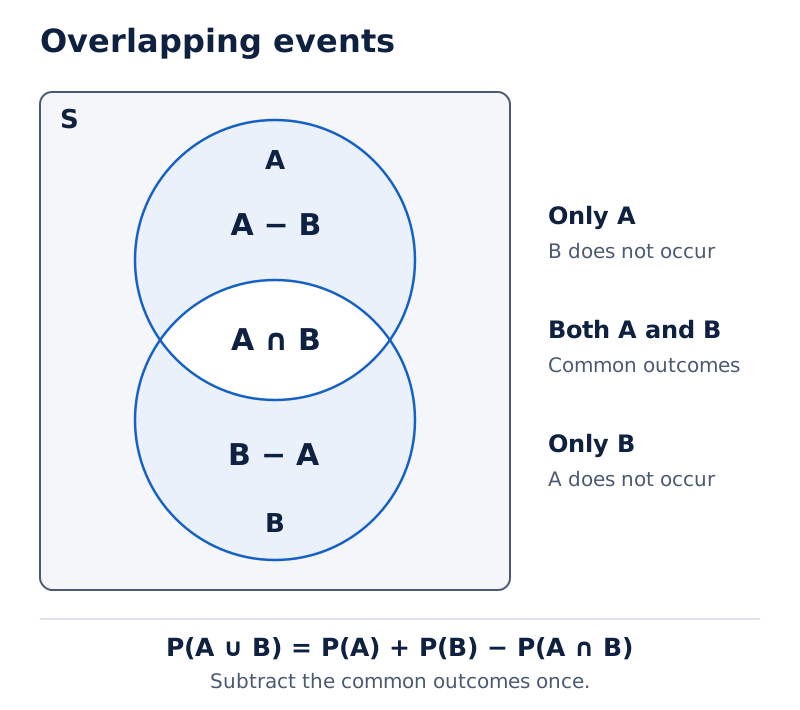
A rectangle labelled contains overlapping circles labelled and . Their outer regions, labelled and , are blue. The white overlap is labelled .
Drawn by One Young India. See Fig. 14.1 in your NCERT textbook
Worked example 6. For three coin tosses with eight equally likely outcomes, let and . Find the probability of their union.
Answer: Identify the overlap before using the addition rule.
- Each event contains three outcomes:
- The common outcomes are
- Subtract the repeated contribution:
- Check by listing the union: Its four outcomes confirm the result.
If the events are mutually exclusive, their intersection is empty and has probability zero. The addition rule then reduces to . The shortened formula is justified by the absence of common outcomes.
Result: The addition rule for three events
For a third event , the same reasoning gives a three-event rule. Introduce as the event that either or occurs, so .
- Apply the two-event rule to the first event and the combined event:
- Expand the combined event probability:
- Distribute the intersection over the union:
- Use the addition rule on these two intersections:
- Substitute both expansions:
The triple intersection is added back after subtracting the three pairwise intersections. Each subtraction removes an overlap contribution, and the final term gives the correct contribution for outcomes common to all three events.
How does the complement rule simplify probability calculations?
Result: Probability of an event not occurring
The complement rule finds the probability that an event does not occur from the probability that it does occur. It follows from two set facts: the event and its complement are disjoint, and together they cover the whole sample space.
- State the relations between the event and its complement:
- Apply additivity and the probability of the sure event:
- Subtract the event probability:
For ten equally likely cards numbered from one to ten, consider . Its complement is . The card numbered ten remains in the complement because it is absent from the specified event, even though it is even.
Worked example 7. One card is drawn from a well-shuffled deck of fifty-two cards, with all cards equally likely. The deck contains thirteen diamonds, four aces and twenty-six black cards. Find probabilities of a diamond, not an ace, a black card, not a diamond and not a black card.
Answer: Use favourable counts for direct events and subtraction from one for their complements.
- There are thirteen favourable diamond cards among fifty-two:
- First find the ace probability, then its complement:
- Count the black cards:
- Subtract the diamond probability from one:
- Subtract the black-card probability from one:
The complement is always taken relative to the sample space. It includes all outcomes outside the event, not merely one alternative outcome. This is especially useful when the event named after “not” has a straightforward favourable count.
How are “neither”, “at least one” and “exactly one” handled?
How does mutually exclusive addition work in a bag problem?
Translate the requested event before choosing a formula. A union means at least one of the named events occurs. Its complement means neither occurs. Exactly one excludes the intersection, while at least one includes the intersection.
Worked example 8. A bag contains nine discs of the same shape and size: four red, three blue and two yellow. One is drawn at random. Find probabilities of red, yellow, blue, not blue, and red or blue.
Answer: Each disc is an equally likely outcome; the three colour descriptions contain different numbers of outcomes.
- Confirm the total and find the red probability:
- Count the yellow and blue discs separately:
- Use the complement of blue:
- A single disc cannot be both red and blue, so add:
How do the different verbal conditions change the answer?
Worked example 9. Anil qualifies an examination with probability , Ashima with probability , and both qualify with probability . Find probabilities that neither qualifies, at least one does not qualify, and exactly one qualifies.
Answer: Let mean Anil qualifies and mean Ashima qualifies. Use the given joint probability in the calculations.
- Find the probability that at least one qualifies:
- Neither qualifies is the complement of this union. De Morgan's law gives , so
- At least one does not qualify is the complement of both qualifying:
- Find the two separate “only” probabilities:
- The two “only” events are mutually exclusive. Add them:
Neither and at least one does not describe different sets. Neither excludes every outcome in which either qualifies. At least one does not qualify excludes only the outcome category in which both qualify. The different complements explain the different answers.
How do combinations help count equally likely selections?
When does order matter?
Some experiments involve selecting a group rather than recording an ordered sequence. In a committee selection, the same people form the same committee regardless of the order in which their names are listed. Combinations count such selections.
Write for the number of ways to select objects from distinct objects without regard to order. Here denotes the total available and the number selected. The numerator and denominator of a probability must count selections on the same basis.
Worked example 10. A committee of two people is selected from two men and two women, with every two-person committee equally likely. Find the probabilities of no man, one man and two men.
Answer: Count all committees first, then count the committees meeting each condition.
- There are four people available. The total number of two-person committees is
- No man means selecting both women. The favourable count is , so
- One man means one man and one woman. There are two choices for each:
- Two men means selecting both available men. Thus
- Check the exhaustive possibilities by adding their probabilities:
The favourable count for one man includes a choice of woman as well. Counting only the choices of man would omit part of the committee selection. The no-man and two-men cases each specify one complete committee.
For ordered experiments, such as a finishing order in a race, exchanging positions gives a different outcome. For group selections, exchanging the listing order does not. Decide which kind of outcome the experiment records before calculating the total number of possibilities.
Glossary
- Sample space — The set serving as the universal set of outcomes for the experiment under consideration.
- Event — Any subset of a sample space, containing outcomes that satisfy a specified condition.
- Occurrence of an event — The situation in which the actual outcome of the experiment belongs to the event.
- Impossible event — The empty event, containing no outcome that can satisfy its stated condition.
- Sure event — The entire sample space, containing every possible outcome of the experiment being considered.
- Simple event — An event containing exactly one sample point, also called an elementary event.
- Compound event — An event containing more than one sample point of the associated sample space.
- Complementary event — The event consisting of all outcomes in the sample space outside the original event.
- Union of events — The event containing outcomes belonging to either event, including outcomes belonging to both.
- Intersection of events — The event containing only outcomes common to both of the events being considered.
- Mutually exclusive events — Events that cannot occur simultaneously because they have no sample point in common.
- Exhaustive events — Events whose union is the whole sample space, ensuring that at least one occurs.
- Equally likely outcomes — Outcomes assigned the same probability, giving each elementary event an equal chance of occurrence.
Common errors and misconceptions
- Misconception: “A or B” excludes outcomes common to both. Correct: The union includes outcomes in either event and those in their intersection.
- Misconception: Exhaustive events must be mutually exclusive. Correct: Exhaustiveness concerns coverage; mutually exclusive events have no overlap. The die events , and cover every outcome but overlap.
- Misconception: Favourable outcomes divided by total outcomes works for every assignment. Correct: This counting formula requires a finite sample space of equally likely outcomes. Otherwise, add the assigned probabilities.
- Misconception: Values between zero and one automatically form a valid assignment. Correct: The probabilities of all outcomes must also add to one; the decimal assignment in Worked example 3 fails this condition.
- Misconception: “At most one head” and “exactly one head” are identical. Correct: At most one head includes the no-head outcome, while exactly one head excludes it.
- Misconception: The probabilities of two events can simply be added to obtain their union. Correct: Subtract the intersection probability when applying the general addition rule.
- Misconception: “Neither qualifies” means the same as “at least one does not qualify”. Correct: Neither is the complement of the union; at least one not qualifying is the complement of the intersection.
- Misconception: Selecting one man is enough to count a two-person committee with one man. Correct: The woman must also be selected, so both choices contribute to the favourable count.
Exam-style questions with model answers
Q1. Define an event and state when it occurs in an experiment. [2 marks]
- An event is any subset of the sample space associated with an experiment.
- It occurs when the actual outcome belongs to the event, written .
Q2. A die numbered from one to six is rolled. Let mean a prime number and mean an odd number. Find their union, intersection and the event “A but not B”. [3 marks]
- The event sets are and . Combining their elements without repetition gives , representing at least one of the two descriptions.
- The common outcomes are three and five. Hence , the event that the result is both prime and odd.
- Removing the odd outcomes from the prime-number event leaves . This represents a prime result that is not odd.
Q3. A coin is tossed three times. Let mean no heads, exactly one head and at least two heads. Determine whether these events are mutually exclusive and exhaustive. [4 marks]
- The sample space is , where means head and means tail in successive tosses.
- The event sets are , and , obtained by counting heads in each outcome.
- Their union is . Every possible outcome is included, so the events are exhaustive.
- Every pair has an empty intersection: . They are therefore mutually exclusive as well.
Q4. Two coin tosses have assigned probabilities , , , , where and mean head and tail. Verify the assignment and find the probability of identical results. [3 marks]
- Each assigned probability is non-negative and does not exceed one. Thus the individual values satisfy the required bounds for probabilities of outcomes.
- The total is . Therefore the probabilities form a valid assignment to the sample space.
- Let denote identical results. Since , its probability is , obtained by adding the two given probabilities.
Q5. For events and in the same sample space, derive the general addition rule using disjoint event decompositions. State its form for mutually exclusive events. [5 marks]
- Decompose the union as . Here means the outcomes in the second event that are outside the first, so the two displayed parts are disjoint.
- By additivity for disjoint events, . The symbol denotes the probability assigned to the event inside the brackets.
- Also, , a disjoint union. Hence , giving .
- Substitution gives . The subtraction removes the contribution counted twice in the separate event probabilities.
- For mutually exclusive events, , so . The rule becomes .
Q6. A bag contains nine similar discs: four red, three blue and two yellow. One disc is selected at random, with each disc equally likely. Find probabilities of red, not blue, and red or blue. [3 marks]
- There are nine possible disc outcomes and four are red. Therefore , using the favourable count divided by the total count.
- The probability of blue is . By the complement rule, , including red and yellow discs.
- Red and blue are mutually exclusive colours for the selected disc. Hence ; their intersection contributes zero.
Q7. Anil qualifies with probability , Ashima with probability , and both qualify with probability . Find probabilities that neither qualifies, at least one does not qualify, and exactly one qualifies. [5 marks]
- Let denote Anil qualifying and denote Ashima qualifying. First apply the addition rule: .
- Neither qualifies is the complement of at least one qualifying. Therefore .
- At least one does not qualify is the complement of both qualifying. Thus .
- Only Anil qualifies with probability . Only Ashima qualifies with probability , subtracting the shared case from each individual event.
- The two “only” events cannot occur together. Adding their probabilities gives . This excludes the case in which both qualify.
Q8. Two people form a committee selected from two men and two women. All two-person committees are equally likely. Find the probability that the committee contains exactly one man. [2 marks]
- The total number of committees is , counting selections without regard to order.
- Choose one man and one woman in ways. The required probability is .
Key takeaways
- An event is a subset of the sample space and occurs when the actual outcome belongs to that subset.
- Simple events contain one sample point; compound events contain more than one, regardless of how many stages the experiment has.
- Mutual exclusivity means no common outcome, while exhaustiveness means that the union covers the entire sample space.
- Valid outcome probabilities lie between zero and one, and all probabilities in a finite sample space add to one.
- Use favourable outcomes divided by total outcomes only for a finite sample space whose outcomes are equally likely.
- The addition rule subtracts the intersection probability because adding the separate probabilities counts their common outcomes twice.
- The complement rule subtracts an event probability from one and requires the complement to include every remaining outcome.
- In selection problems, count favourable and total outcomes consistently, distinguishing an unordered committee from an ordered sequence.
Test yourself
What is the event of exactly one head in two coin tosses?
It is , where means head and means tail; the positions record the toss order.
What is the difference between an impossible event and a sure event?
The impossible event is the empty set ; the sure event is the whole sample space .
Can exhaustive events have a common outcome?
Yes. Exhaustiveness requires their union to cover the sample space; it does not require their intersections to be empty.
What does the event mean?
It means event occurs but event does not; equivalently, it is .
Why is the intersection subtracted in the addition rule?
Common outcomes contribute to both individual event probabilities, so their probability must be subtracted once to avoid double counting.
What must be checked before using a favourable-count ratio?
Check that the sample space is finite and all its individual outcomes are equally likely.
Which event is the complement of both and occurring?
It is at least one of the two events not occurring, represented by .
What does the symbol count?
It counts selections of objects from distinct objects when their order does not matter.
Write about it
Turn a question from this chapter into a paper.
The Writing Studio has a structure guide, a rubric and citation tools for 15 formats, from essays to research papers. Drafting is free with an account. Learnacy Essential adds feedback from an AI writing coach and submission to The OYI Review.
Learnacy Essential is ₹1,499 for the year. Publication depends on review and is not guaranteed.