
Limits and Derivatives | CBSE Class 11 Maths Notes
On this page
Watch & explore
Start with a few high-quality watches, then dive into the notes below.

These Class 11 Mathematics notes cover the intuitive idea of derivatives, limits and one-sided limits, algebra of limits, polynomial and rational limits, standard trigonometric limits, derivatives from first principles, the geometrical meaning of differentiation, and derivatives of polynomial and trigonometric functions.
How does a rate of change lead to the idea of a derivative?
Average velocity over a time interval
Calculus studies change in the value of a function as points in its domain change. A useful starting point is a falling body whose distance from the top of a cliff changes with time.
Let denote the distance travelled in metres and the elapsed time in seconds. For the falling body considered here, . Let and denote the starting and ending times of an interval.
The average velocity, denoted by , is the distance travelled during that interval divided by its duration:
Worked example 1. For , find the average velocity between second and seconds.
- Calculate the initial distance:
- Calculate the final distance:
- Find the distance change:
- Divide by the time interval:
Answer: the average velocity is .
Approaching an instant from both sides
Shortening the interval ending at two seconds gives average velocities closer to the velocity at that instant. Shortening an interval beginning at two seconds gives a second sequence. The two sequences suggest a common limiting value.
| Time interval in seconds | Average velocity |
|---|---|
| to | |
| to | |
| to | |
| to |
These computations place the instantaneous velocity between and . This is the intuitive idea of a derivative: an instantaneous rate obtained by considering average rates over successively smaller intervals.
What does the limit of a function mean?
Values near a point
Let be a real input variable, a real-valued function, the input being approached, and the limiting output. The notation means the value of the function at input .
Definition: If the values of approach as approaches , the number is called the limit of the function at that point. We write .
The symbol denotes a limit, and means that the input tends to the stated number. It directs attention to nearby inputs. It does not instruct us to replace every expression immediately by its value at that number.
For the square function, , values approach zero as the input approaches zero. Thus . A limit can also exist when the function has no value at the point being approached.
A missing value need not prevent a limit
Worked example 2. Find , where the quotient is defined only for .
- Factorise the numerator:
- At nearby inputs the cancelled factor is non-zero:
- Take the limit of the simplified expression:
Answer: the limit is , although the original quotient is undefined at .
What the figure shows
A line with a missing point
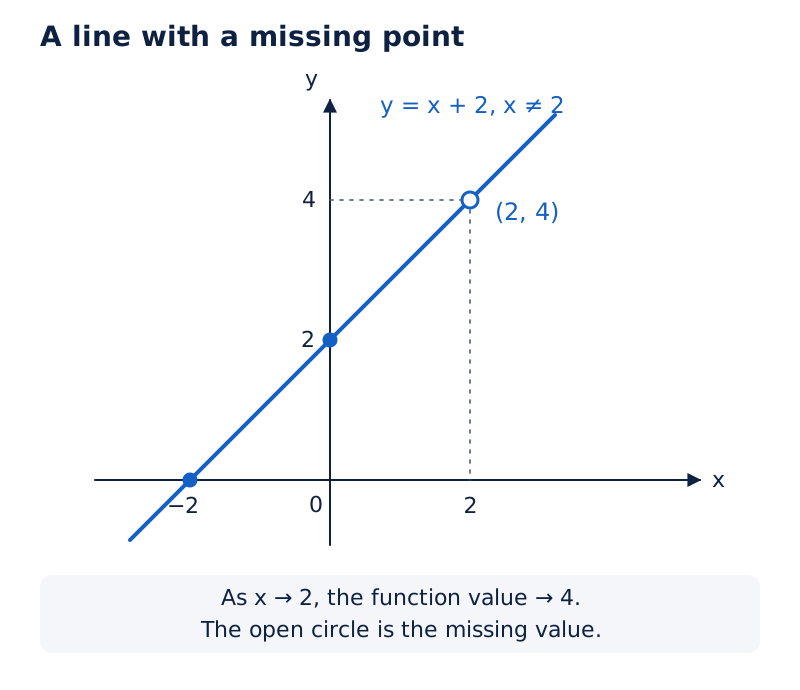
The rising straight line passes through and . An open circle marks , with dotted guides to the axes. The vertical coordinate is the function value.
Drawn by One Young India. See Fig. 12.2 in your NCERT textbook
The open circle marks the missing value. Approaching that position along either part of the line gives the same limiting height. This separates the question about nearby behaviour from the question about whether a value has been assigned at the point itself.
How do left-hand and right-hand limits determine existence?
The two directions of approach
The left-hand limit uses inputs smaller than the point being approached. The right-hand limit uses inputs greater than it. Their notations are and , respectively; the superscript signs specify the direction.
A two-sided limit exists when both one-sided limits exist and coincide. Their common value is then the limit. Knowing the value of the function at the point does not replace the comparison of the two approaches.
Worked example 3. Determine the limit at zero of the function defined by for and for .
- Use the branch for negative inputs:
- Use the branch for positive inputs:
- Compare the results: The two-sided limit therefore does not exist.
Answer: there is no limit at zero, even though .
What the figure shows
Unequal one-sided limits
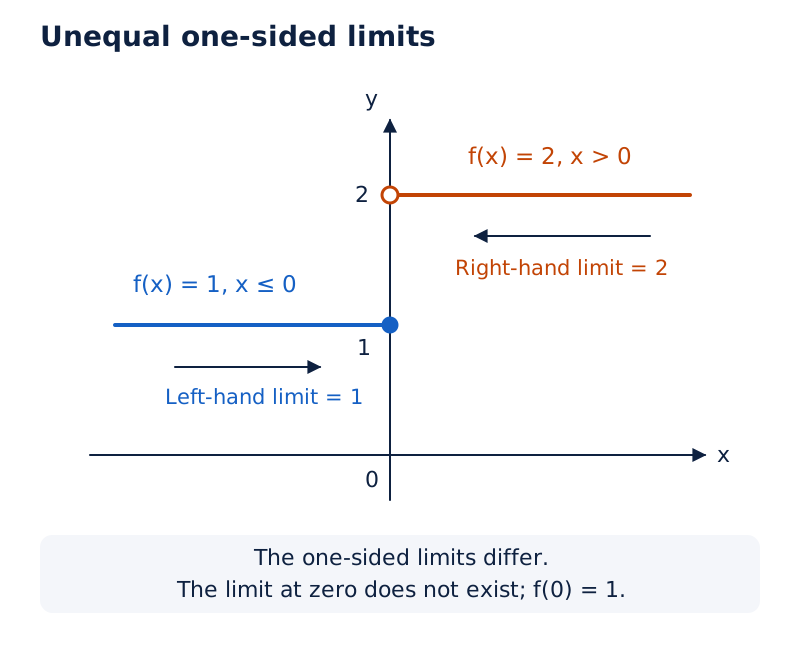
Two horizontal pieces lie at heights one and two. The lower piece extends leftwards from a filled point at ; the upper piece extends rightwards from an open point at .
Drawn by One Young India. See Fig. 12.3 in your NCERT textbook
A limit can differ from the assigned value
Consider instead the function defined by when , and . On both sides of one, nearby values approach three. Consequently, , while the assigned value remains zero.
Three situations must therefore be distinguished: the limit and function value may agree; a limit may exist without an assigned value; or both may exist but differ. A defined function value also does not guarantee a limit, as the horizontal-piece example shows.
Note: For a piecewise function, choose the formula using the side from which the input approaches. The formula assigned exactly at the boundary is a separate part of the definition.
Which algebraic laws simplify limits?
Theorem: Algebra of limits
Let denote a second real-valued function. Suppose the limits of both functions exist as the input approaches the same point. Write for the limit of , for the limit of , and for a fixed real constant.
| Operation | Limit rule | Condition |
|---|---|---|
| Sum | Both individual limits exist | |
| Difference | Both individual limits exist | |
| Product | Both individual limits exist | |
| Quotient | Both limits exist and | |
| Constant multiple | The function limit exists |
The quotient condition concerns the limiting denominator. Having a denominator that is non-zero at nearby inputs is insufficient for direct substitution if its limit is zero. The numerator and denominator must then be examined more carefully.
Result: Limits of polynomials
A polynomial is a finite sum of constant multiples of non-negative integer powers of the variable. Since the limit of each power is its value at the approached input, the sum and constant-multiple laws give for a polynomial.
Worked example 4. Evaluate .
- Recognise a polynomial, so substitution is valid:
- Evaluate the powers:
- Complete the arithmetic:
Answer: the limit is .
This method does not require a table of nearby values. The laws justify the substitution for the whole polynomial. When working term by term, preserve every coefficient and sign, especially the subtraction before a power.
How are rational limits evaluated when substitution gives zero over zero?
Check the denominator before simplifying
A rational function is a quotient of polynomials, defined where its denominator is non-zero. If the denominator remains non-zero at the approached input, evaluate both polynomials there and divide. This is a direct application of the quotient law.
If both polynomials vanish, substitution gives the form . This is not a numerical answer. A common factor may explain why both vanish. Factorisation can produce a simpler expression with the same values at the nearby inputs relevant to the limit.
Worked example 5. Evaluate .
- Check substitution:
- Factorise both polynomials:
- Cancel the common factor for nearby admissible inputs:
- Evaluate the simplified limit:
Answer: the required limit is .
Different powers of a common factor
Cancellation may leave an extra vanishing factor in the numerator, giving a zero limit. If a vanishing factor remains in the denominator while the numerator approaches a non-zero number, a finite limit does not exist. Thus the initial form alone does not determine the outcome.
Worked example 6. Evaluate .
- Factorise the numerator and denominator:
- Cancel one common factor:
- Substitute into the simplified quotient:
Answer: the limit is .
Cancellation is justified because the approaching variable differs from the excluded input during the calculation. It does not assign a value to the original function there. Keep the original domain restriction even when the simplified expression has a wider domain.
How does the standard power limit help with algebraic expressions?
Theorem: Difference of powers
Let denote a positive integer. The standard power limit is . The result also holds for a rational exponent when the fixed number is positive.
Both numerator and denominator vanish at the approached input, but the factorisation of a difference of powers removes the common factor. The surviving sum has a fixed number of terms, making the limit straightforward.
Derivation: The power limit
- Factorise the difference of powers:
- Divide at inputs other than the approached point:
- Every term approaches the same power:
- Add the terms:
Key condition: The displayed factorisation proves the positive-integer case. The extension to rational exponents is used with a positive approached value.
Worked example 7. Evaluate .
- Rewrite using two standard difference quotients:
- Evaluate the numerator limit:
- Evaluate the denominator limit:
- Apply the quotient law:
Answer: the limit is .
The advantage of the standard result is that a long factorisation need not be written in full each time. First match the numerator to a difference of like powers, then check that the denominator supplies the corresponding difference of inputs.
Why are the standard trigonometric limits valid?
Theorem: The sandwich theorem
Let , and be real-valued functions on a common domain. If , and both outer functions approach the same limit as , then the middle function also approaches .
What the figure shows
A function between two others
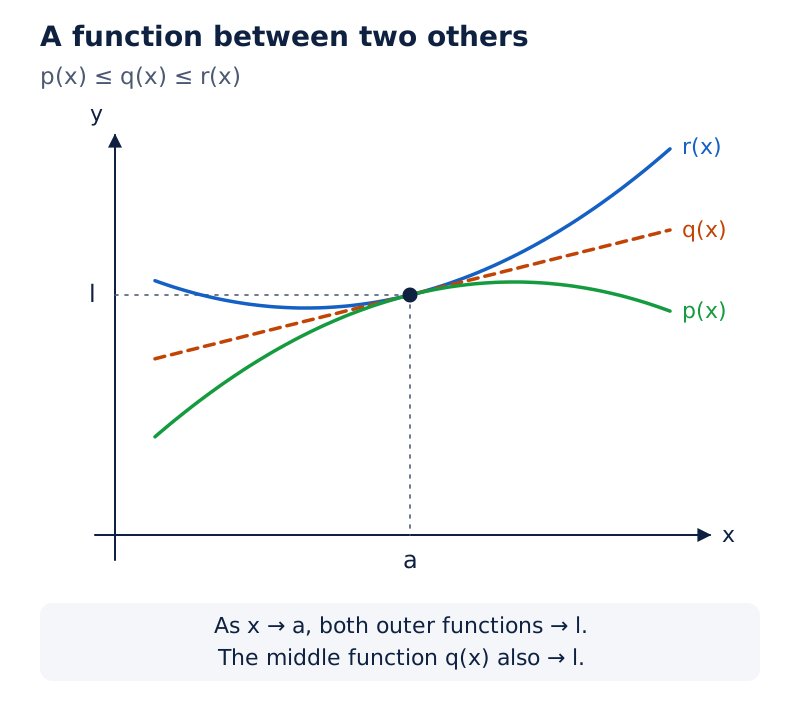
Three labelled curves are ordered vertically on either side of the marked input. They meet at a common height above it. A dashed vertical line connects that position to the horizontal axis.
Drawn by One Young India. See Fig. 12.9 in your NCERT textbook
For trigonometric limits, angles are measured in radians. The symbols , , , , and denote sine, cosine, tangent, secant, cotangent and cosecant. The constant has its usual circle-ratio meaning.
Derivation: The sine limit
In a unit circle, let be the centre, and points on the circle, and the intersection of the ray through with the tangent at . The angle is .
- For an acute positive angle, compare the inscribed triangle, sector and outer triangle:
- Express their areas using the unit radius:
- Divide by the positive sine and take reciprocals:
- Use and to extend the bound to negative angles close to zero. Since both bounding functions tend to one,
Standard result: The sine limit concerns a ratio at nearby non-zero angles, despite the ratio being undefined at zero itself.
What the figure shows
Circle, sector and triangles
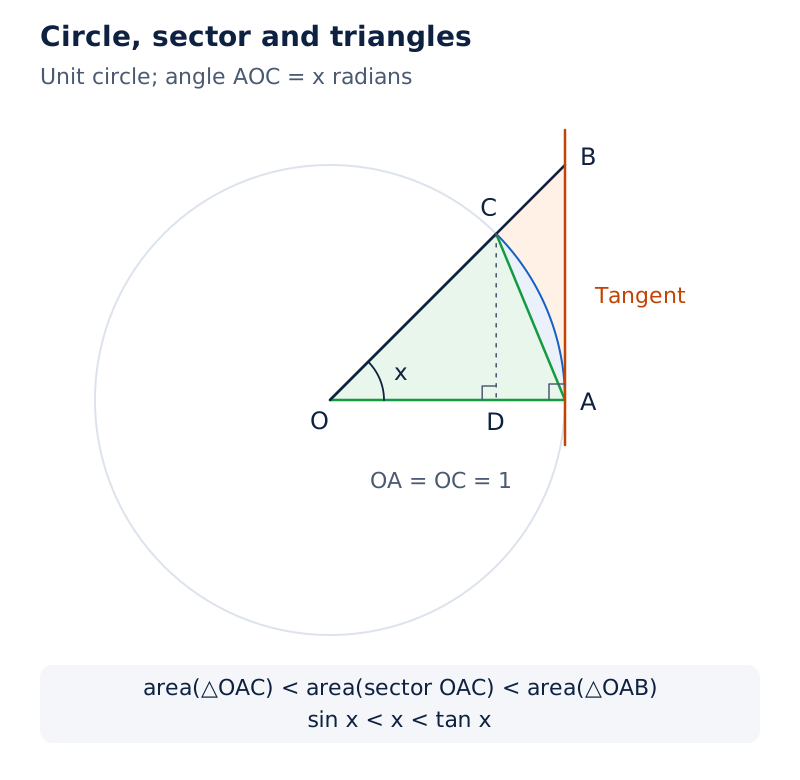
The circle has centre , with on the right and above it on the circumference. The vertical from meets the horizontal radius at , the perpendicular foot; lies above .
Drawn by One Young India. See Fig. 12.10 in your NCERT textbook
Derivation: The cosine difference limit
- Use the half-angle identity:
- Separate a standard sine quotient:
- As the half-angle also tends to zero, apply the product law:
Check the angle: The argument inside the sine must match the denominator of the standard sine quotient.
Worked example 8. Evaluate , with angles in radians.
- Insert matching angle factors:
- Both angles tend to zero, so
- Multiply the limits:
Answer: the limit is .
How is a derivative defined from first principles?
A limit of difference quotients
Let denote a non-zero increment in the input. The difference quotient compares the output change to this input change. The prime mark in denotes the derivative at the fixed input .
Definition: For a point in the domain of the function, its derivative is , provided this limit exists.
At a general input, the same definition gives . This is differentiation from first principles. The derivative itself is a function on the inputs where this limit exists.
If denotes the output, so that , the notation means the derivative of the output with respect to the input. The operator indicates differentiation with respect to that variable.
Worked example 9. Find the derivative of from first principles.
- Replace the input by its incremented value:
- Subtract the original output:
- Divide by the non-zero increment:
- Take the limit with the original input fixed:
Answer: .
The slope of a tangent
Let be the point and the nearby point . Their joining chord has slope equal to the difference quotient. As the increment tends to zero, the limiting chord position gives the tangent at the first point.
What the figure shows
From chord to tangent
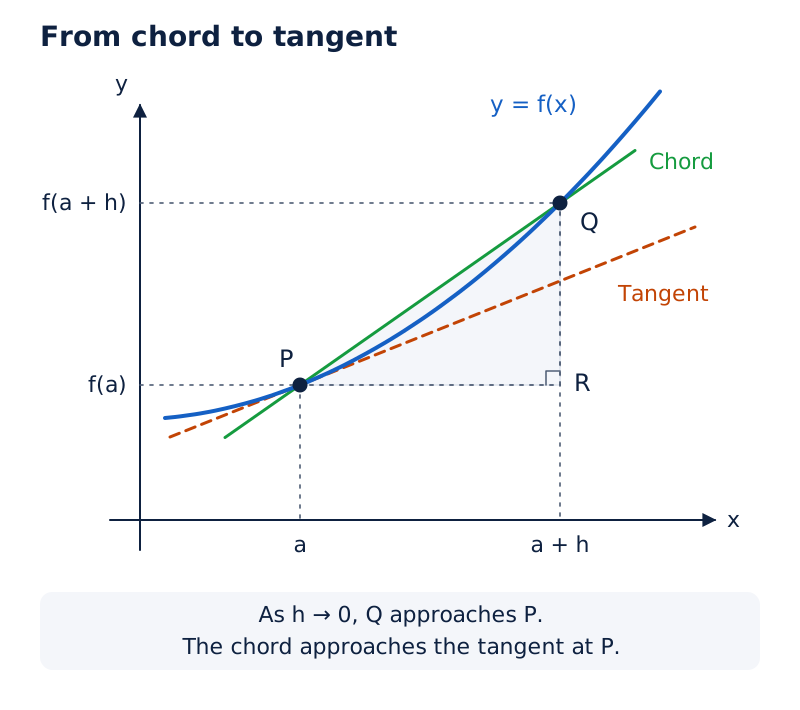
The curve carries points and . Horizontal and vertical dotted guides show their input and output coordinates. Point , the right-angle corner below , forms a triangle with them; a tangent is drawn through .
Drawn by One Young India. See Fig. 12.11 in your NCERT textbook
The geometrical interpretation is that the derivative gives the tangent's slope where this limiting slope exists. This connects the algebraic definition with the earlier idea of instantaneous velocity as the slope of a distance-time curve.
How do the rules for sums, products and quotients of derivatives work?
Theorem: Algebra of derivatives
Let and denote differentiable functions of the same input, and let and denote their derivatives. The following rules apply where the functions and derivatives involved are defined.
| Operation | Derivative | Practical reminder |
|---|---|---|
| Sum | Differentiate each term | |
| Difference | Preserve the subtraction | |
| Product | Keep one factor unchanged in each term | |
| Quotient | Require |
The product rule, also called the Leibnitz rule, contains two contributions. Merely multiplying the two derivatives omits the unchanged factors. The quotient rule has an ordered subtraction and the square of the original denominator.
Worked example 10. Differentiate for .
- Choose the numerator and denominator functions:
- Differentiate each function:
- Substitute into the quotient rule:
- Simplify the numerator:
- State the derivative and restriction:
Answer: the derivative is wherever the original function is defined.
Choosing a useful form before differentiating
The same function may allow more than one method. A product can sometimes be expanded into a polynomial, while a quotient may be split into simpler terms. The rules explain why valid methods agree, provided the original domain restrictions are retained.
Keep the function and its derivative distinct in working. First identify the factors or numerator and denominator, then calculate their derivatives, and only then substitute into the appropriate rule. This sequence makes signs and unchanged factors easier to check.
How are powers and polynomials differentiated?
Result: The power rule
For a positive integer exponent, the power rule is . The power becomes a multiplier and is then reduced by one. The derivative of a fixed constant is zero, because its output does not change.
The rule extends to real powers where the functions and derivatives are defined. Polynomial differentiation uses the positive-integer case together with the rules for sums and constant multiples, so each term can be handled separately.
Derivation: The power rule by induction
- Establish the first power directly:
- For an integer , assume the preceding power satisfies
- Write the next power as a product and differentiate:
- Collect equal powers:
Constant coefficients remain multipliers when their terms are differentiated. A constant term disappears because its derivative is zero.
Worked example 11. Differentiate .
- Differentiate the first term:
- Differentiate the second term with its sign:
- Differentiate the linear term:
- Combine the derivatives:
Answer: the derivative is .
To find a derivative at a point, first obtain the derivative function and then substitute the specified input. Substituting into the original function instead gives an output value, which answers a different question from the rate of change.
How are trigonometric functions differentiated?
Derivation: The derivative of sine
The trigonometric derivative formulas use radians. The standard sine limit is central to obtaining them from first principles. For the sine function, an identity for a difference of sines converts the difference quotient into a product with a recognisable limit.
- Start with the definition:
- Rewrite the difference of sines:
- Express the quotient as a product:
- Take the limits of the factors:
Standard derivatives can then be combined with the sum, product and quotient rules. The reciprocal and quotient trigonometric functions retain their domain restrictions.
| Function | Derivative | Domain condition |
|---|---|---|
| Every real input | ||
| Every real input | ||
Worked example 12. Differentiate , with the angle in radians.
- Write the square as a product:
- Apply the product rule:
- Replace both sine derivatives:
- Combine the equal terms and use the double-angle identity:
Answer: the derivative is .
This example shows why it helps to recognise a product hidden inside a power. It also illustrates the difference between squaring a function and differentiating it: the square of sine does not have the square of cosine as its derivative.
Glossary
- Calculus — The branch of mathematics concerned mainly with changes in function values as points in the domain change.
- Limit — The value approached by a function as its input approaches a specified point.
- Left-hand limit — The limiting value obtained by approaching a point through smaller input values.
- Right-hand limit — The limiting value obtained by approaching a point through greater input values.
- Polynomial function — A finite sum of constant multiples of non-negative integer powers of the input variable.
- Rational function — A quotient of polynomial functions, defined at inputs where its denominator is non-zero.
- Sandwich theorem — A result determining a middle function's limit when two bounding functions approach the same value.
- Average velocity — The distance travelled during a specified interval divided by its duration in the falling-body example.
- Derivative — The limit of a function's difference quotient, measuring its instantaneous rate of change where defined.
- First principles — The method of finding a derivative directly from the limiting difference quotient.
- Product rule — The rule adding two terms, each formed by differentiating one factor and retaining the other.
- Quotient rule — The differentiation rule using an ordered numerator subtraction divided by the square of the denominator.
Common errors and misconceptions
- Misconception: A limit must equal the value assigned at the approached point. Correct: Nearby behaviour determines the limit; the assigned value can differ, or it may be absent altogether.
- Misconception: A defined value guarantees that a two-sided limit exists. Correct: Compare the left-hand and right-hand limits. If they differ, the two-sided limit does not exist.
- Misconception: The form means the limit is zero. Correct: It does not provide a value. Simplify the expression or apply an appropriate standard limit before reaching a conclusion.
- Misconception: Cancelling a factor makes the original quotient defined at its excluded input. Correct: Cancellation is valid at nearby inputs where that factor is non-zero; it does not change the original domain.
- Misconception: The standard sine limit can be used without checking the angle unit. Correct: The formula uses radian measure.
- Misconception: The increment should be set to zero before simplifying the difference quotient. Correct: Keep it non-zero while dividing, then take its limit after the necessary algebra.
- Misconception: A product's derivative is the product of the derivatives. Correct: Use , retaining the unchanged factor in each of the two terms.
- Misconception: Differentiating a quotient means dividing its derivatives. Correct: Use , preserve the subtraction order, and require a non-zero denominator.
Exam-style questions with model answers
Q1. State the condition for a two-sided limit at an interior point to exist. Must it equal the function's value there? [2 marks]
- The left-hand and right-hand limits must both exist and have the same value. This common value is the two-sided limit.
- No. The function value may differ from the limit, or the function may have no assigned value at that point.
Q2. Evaluate , showing factorisation and explaining cancellation. [3 marks]
- Direct substitution makes both numerator and denominator zero, so factorise before evaluating the limit:
- At nearby inputs other than two, the common factor is non-zero and can be cancelled:
- The simplified denominator tends to a non-zero number, permitting substitution: This evaluates the limit without defining the original quotient at two.
Q3. Evaluate , with angles measured in radians. [3 marks]
- Rewrite the ratio so that each sine is paired with its own angle:
- As the input tends to zero, both angle arguments tend to zero. The standard sine limit and its reciprocal therefore give
- Use the product law to combine the constant and both limits:
Q4. Using first principles, find the derivative of and state its geometrical meaning at a general input. [5 marks]
- Let denote a non-zero change in the input. The first-principles definition is provided the limit exists.
- Evaluate the function at the incremented input and expand the square:
- Subtract the original function value and divide by the increment while it is non-zero:
- Keep the original input fixed and take the limit of the simplified expression:
- Geometrically, the derivative is the slope of the tangent to the curve at the chosen input. Thus the tangent to , where denotes the output, has slope .
Q5. For , find the derivatives at zero and minus one, then verify . [4 marks]
- Differentiate the polynomial term by term, retaining its coefficients and noting that the constant term contributes zero:
- Substitute minus one into the derivative function, rather than the original polynomial:
- Substitute zero into that same derivative function:
- Insert the two calculated values into the required expression and simplify: This verifies the stated relation.
Q6. Differentiate , for , using the quotient rule. [3 marks]
- Let be the numerator function and the denominator function. Then
- The denominator is non-zero on the stated domain. Apply the quotient rule, keeping the subtraction in the specified order:
- Expand the bracket in the numerator and simplify to obtain The restriction continues to apply.
Q7. Differentiate using the product rule, with angles in radians. [3 marks]
- Recognise the square as a product of the sine function with itself: This permits a direct application of the product rule.
- Differentiate one factor in each term while keeping the other unchanged:
- The two terms are equal. Add them and use the double-angle identity:
Q8. Find the derivative at of . [3 marks]
- Apply the power rule to each non-constant term and differentiate the constant to zero:
- Substitute the specified input into the derivative. Every power of one is one, giving the sum
- Evaluate this sum of consecutive positive integers, including both endpoints: This is the requested derivative value.
Key takeaways
- A limit describes nearby function values and may exist even when the function has no assigned value at the approached input.
- A two-sided limit requires agreement between the left-hand and right-hand limits; an assigned function value cannot replace that check.
- Polynomial limits allow direct substitution, while the quotient law additionally requires the denominator's limit to be non-zero.
- The form calls for further work, such as factorisation and cancellation at nearby admissible inputs.
- Standard trigonometric limits use radians; match the angle inside a sine with the denominator of its standard quotient.
- A derivative is a limiting difference quotient, representing an instantaneous rate of change and, geometrically, a tangent slope.
- The product and quotient rules preserve unchanged factors; their structures differ from simply multiplying or dividing derivatives.
- Differentiate a function before substituting an input when the required quantity is its derivative at a specified point.
Test yourself
Can a limit exist where a function is undefined?
Yes. Nearby values may approach a common number even when the function has no value at the point itself.
What must be checked before applying the quotient law for limits?
Both individual limits must exist, and the denominator's limit must be non-zero before their quotient can be used.
Why does the form not finish a limit calculation?
It supplies no numerical value. The expression needs further analysis, often by cancelling common factors at nearby inputs.
What happens when the two one-sided limits are different?
The two-sided limit does not exist, regardless of whether a function value is assigned at the point.
Which angle unit is used in the standard sine limit?
Angles are measured in radians when using and the associated trigonometric derivative formulas.
What does the derivative represent on a graph?
It represents the slope of the tangent at the chosen point where that limiting slope exists.
Why is the derivative of a constant zero?
A constant has no output change, so its difference quotient is zero for every permitted non-zero increment.
What two features of the quotient rule are easy to lose?
The numerator uses an ordered subtraction, and the denominator is the square of the original denominator function.
Write about it
Turn a question from this chapter into a paper.
The Writing Studio has a structure guide, a rubric and citation tools for 15 formats, from essays to research papers. Drafting is free with an account. Learnacy Essential adds feedback from an AI writing coach and submission to The OYI Review.
Learnacy Essential is ₹1,499 for the year. Publication depends on review and is not guaranteed.