
Introduction to Three Dimensional Geometry | CBSE Class 11 Maths Notes
On this page
Watch & explore
Start with a few high-quality watches, then dive into the notes below.
These Class 11 Mathematics notes cover coordinate axes and planes, ordered triples, octants, points on axes and planes, the distance formula and its derivation, collinearity, triangle and parallelogram checks, equations describing sets of points, and finding a missing vertex from a triangle’s centroid.
Why are three coordinates needed to locate a point in space?
A point in a plane can be located using two numbers measured with reference to two mutually perpendicular coordinate axes. A point in space needs an additional number because its position may also vary above or below that plane. This leads to three dimensional geometry.
Consider the lowest tip of a bulb hanging from a room’s ceiling. Its perpendicular distances from two adjacent walls do not fully locate it. Its height above the floor is also needed. The floor and the two walls provide three mutually perpendicular reference planes.
How are the axes and origin chosen?
Let the origin, denoted by , be the common intersection of three mutually perpendicular planes. Their pairwise intersections form three mutually perpendicular lines called the coordinate axes. The letters , and name the three coordinate directions.
The axis lines are labelled , and , where the unprimed endpoints indicate the positive directions and the primed endpoints indicate the negative directions. Together, these lines form a rectangular coordinate system.
Each pair of axes determines a coordinate plane. The plane containing the first two axes is the -plane; the other two are the -plane and the -plane. The names identify the axes that lie within each plane.
Definition: Coordinate planes are the three mutually perpendicular planes determined by pairs of coordinate axes. Their common intersection is the origin, and their pairwise intersections are the coordinate axes.
What the figure shows
Coordinate axes and planes
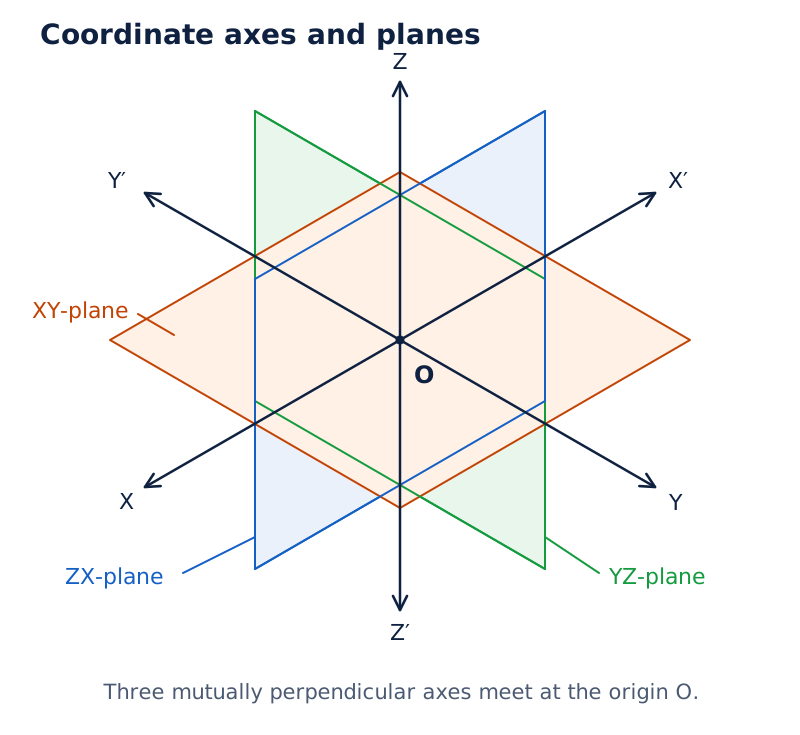
Three outlined planes intersect at . Arrows label the positive and negative directions of each axis. The drawing shows above the origin and below it, with the other axes passing through the same point.
Drawn by One Young India. See Fig. 11.1 in your NCERT textbook
The drawing represents a spatial arrangement on a flat page. Read the axis labels and perpendicular relationships when interpreting it. The three axes are mutually perpendicular in space even though their drawn directions cannot all appear at right angles on the page.
How does an ordered triple identify a point in space?
Let denote a point in space. Its coordinates are written as the ordered triple , where the three entries give its signed perpendicular positions relative to the -, - and -planes, respectively. The order of the entries matters.
A coordinate includes a sign as well as a magnitude. Positive and negative values distinguish opposite sides of a coordinate plane. Thus a negative coordinate describes position, while an ordinary distance is non-negative. Keep this distinction when moving from locating points to calculating lengths.
How is the point constructed from its coordinates?
- Choose , the point on the -axis corresponding to the first coordinate . This fixes the position measured along the first axis.
- In the -plane, draw through a line parallel to the -axis. Locate , the point on this line corresponding to the second coordinate .
- Through , draw a perpendicular to the -plane. Locate on this line using the third coordinate , with its sign determining the direction.
Here and are intermediate construction points. In the positive octant, the successive lengths are , and . Reversing the construction finds the coordinates of a point whose spatial position is already given.
What the figure shows
Locating a point
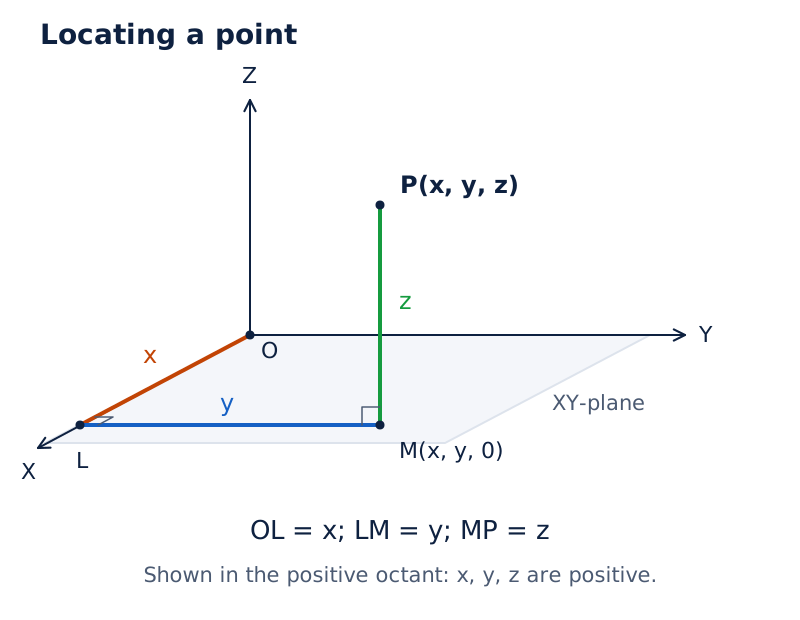
The point is above its foot in the coordinate plane. The construction also marks on the -axis and labels the successive coordinate lengths.
Drawn by One Young India. See Fig. 11.2 in your NCERT textbook
Result: A fixed coordinate system gives a unique ordered triple
For a fixed system, each point has one ordered triple of real coordinates, and each ordered triple identifies one point. This one-to-one correspondence connects a geometric position with an algebraic description. Three entries are therefore needed even when one or more entries are zero.
An alternative construction uses three planes through the point, each parallel to a coordinate plane. Their intersections with the axes specify the three coordinate values. Both constructions describe the same point and retain the same order of coordinates.
How do coordinate signs identify the eight octants?
The three coordinate planes divide space into eight regions called octants. For a point away from all three coordinate planes, the signs of its coordinates determine its octant. Use the signs in the order , just as the coordinates themselves are written.
Octants I to IV have a positive third coordinate. Octants V to VIII have a negative third coordinate. The sign patterns of the first two coordinates repeat in the same sequence in these two groups, making the table easier to read systematically.
| Octant | First coordinate | Second coordinate | Third coordinate |
|---|---|---|---|
| I | Positive | Positive | Positive |
| II | Negative | Positive | Positive |
| III | Negative | Negative | Positive |
| IV | Positive | Negative | Positive |
| V | Positive | Positive | Negative |
| VI | Negative | Positive | Negative |
| VII | Negative | Negative | Negative |
| VIII | Positive | Negative | Negative |
How should an octant question be solved?
Worked example 1. Find the octants containing the points and .
Answer: Read each entry’s sign before comparing the point with the octant table.
- For the first point, , and . Its signs are negative, positive and positive, respectively.
- The negative, positive, positive pattern identifies octant II, so lies in the second octant.
- For the second point, , and . Its signs are negative, positive and negative.
- The negative, positive, negative pattern identifies octant VI, so lies in the sixth octant.
The two points have identical first and second coordinates but different signs in the third position. That change places them on opposite sides of the -plane. Their octant numbers must therefore be read from different halves of the table.
Note: A zero coordinate places a point on a coordinate plane. It is not a positive or negative sign, so the eight open-region sign patterns should not be assigned to that point.
What do zero coordinates tell us about a point’s position?
Zero coordinates express exact geometric restrictions. If a point lies in a coordinate plane, its perpendicular displacement from that plane is zero. If it lies on a coordinate axis, both coordinates belonging to the other two directions are zero.
Result: Coordinate forms for planes, axes and the origin
| Position | Coordinate form | What is fixed? |
|---|---|---|
| -plane | ||
| -plane | ||
| -plane | ||
| -axis | ||
| -axis | ||
| -axis | ||
| Origin |
The letters left unrestricted in the table may take real values. For example, being in the -plane does not require either of the last two coordinates to be zero. It requires the first coordinate to be zero because that measures position perpendicular to this plane.
What the figure shows
Parallel coordinate planes through a point
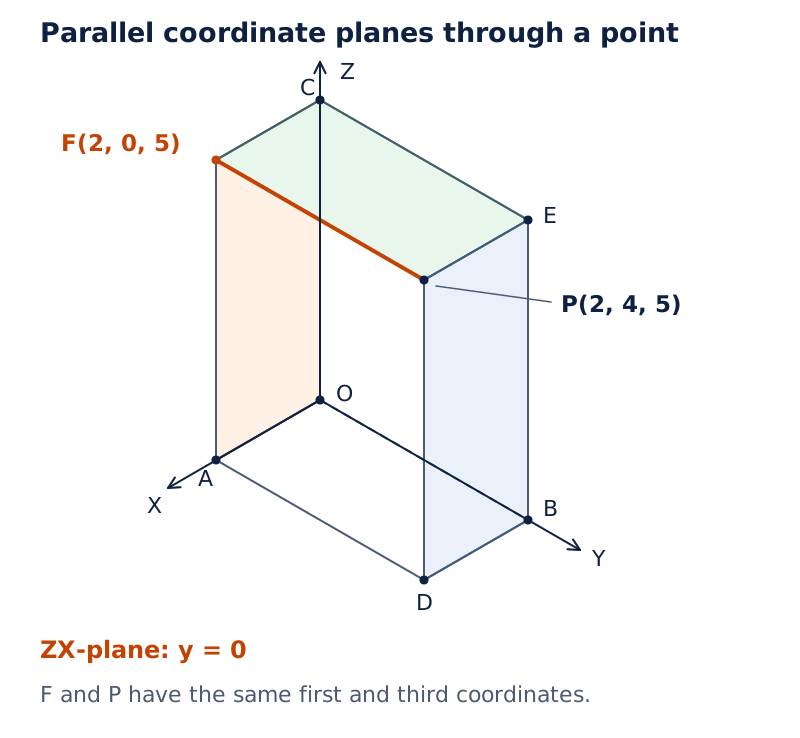
A box-like construction places at a corner away from the origin. The labelled point is on the face in the -plane, at the same first and third coordinates as .
Drawn by One Young India. See Fig. 11.3 in your NCERT textbook
Worked example 2. In this construction, . The point lies in the -plane and has the same first and third coordinates as . Find .
Answer: Apply the coordinate restriction imposed by the plane.
- The shared first coordinate is , so retain the first entry of the given point.
- Membership of the -plane gives , replacing the second entry.
- The shared third coordinate is . Hence the required point is .
This example also shows why the plane name is useful: its two letters identify the directions retained within the plane. The coordinate corresponding to the missing letter is zero. The names -plane and -plane refer to the same plane.
How is the distance formula derived in three dimensions?
Let and be two points. The subscript one identifies the coordinates of ; the subscript two identifies those of . The notation denotes the non-negative length of the line segment joining them.
Result: Distance between two points
The distance formula is It combines the changes in all three coordinate directions. The positive square root gives the length; the squared differences account for changes in either direction along an axis.
What the figure shows
Rectangular box for the distance formula
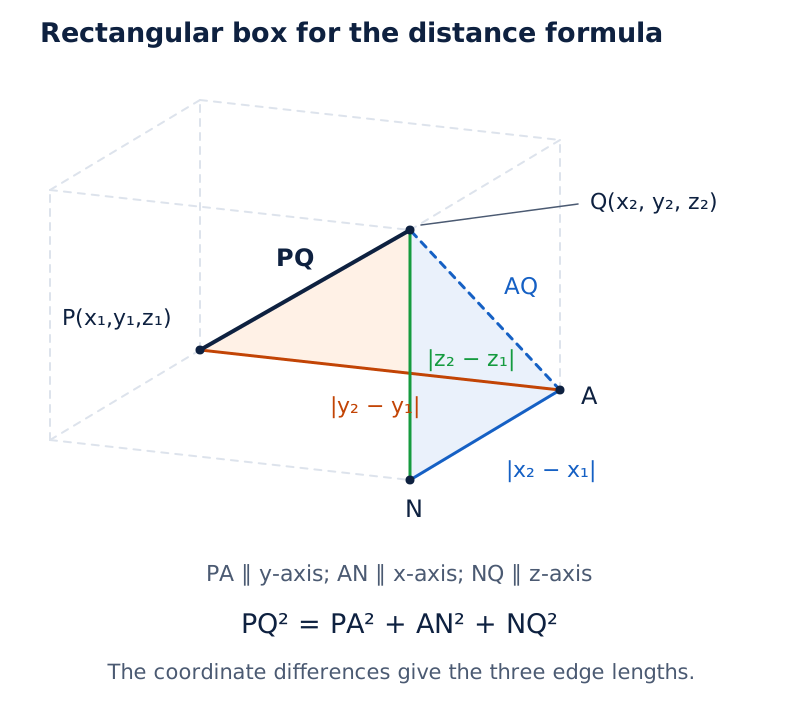
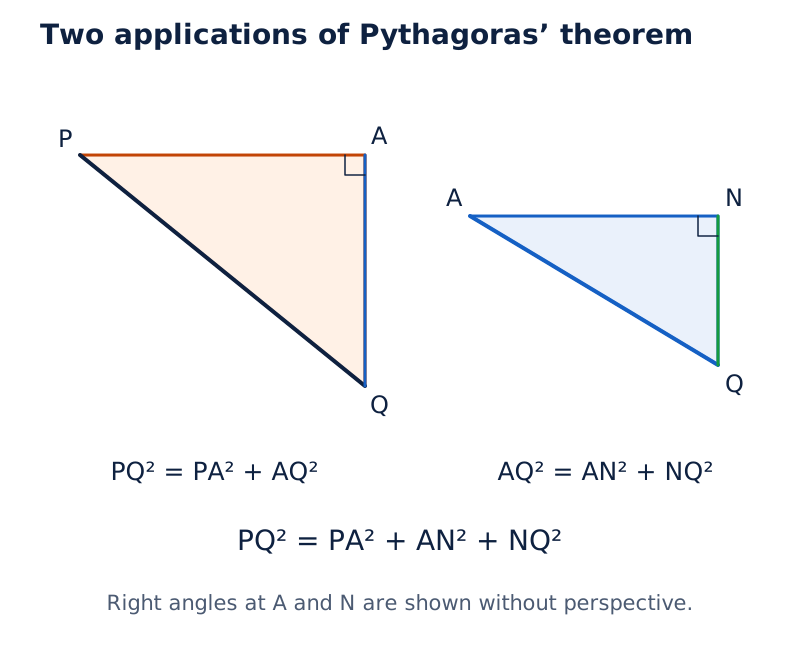
The drawing marks and at opposite corners of a rectangular box. Auxiliary corners and form the right triangles used in two successive applications of Pythagoras’ theorem.
Drawn by One Young India. See Fig. 11.4 in your NCERT textbook
Derivation: Two applications of Pythagoras’ theorem
Here and are auxiliary vertices chosen so that , and run parallel to the second, first and third coordinate axes, respectively.
- In the right triangle with vertices , the right angle is at . Therefore
- In the right triangle with vertices , the right angle is at . Therefore
- Substitute the second equation into the first to combine the three perpendicular contributions:
- The squared edge lengths equal the squared coordinate differences:
- Substitution gives
- Take the non-negative square root because the required quantity is a length:
Geometric meaning: The first application resolves the box diagonal using a face diagonal; the second resolves that face diagonal into two perpendicular edges. Together they account for all three directions.
Using squared edge lengths avoids treating a negative coordinate difference as a negative physical length. Reversing the order of the endpoints changes the signs of the differences but leaves their squares, and therefore the final distance, unchanged.
How do we calculate distances and use the origin formula?
A distance calculation begins by matching corresponding coordinates. Subtract first from first, second from second and third from third. Keep negative entries inside brackets during substitution. Square the differences separately before adding them and simplifying the square root.
How does a negative coordinate affect subtraction?
Worked example 3. Find the distance between the points and .
Answer: Use the three coordinate differences in the distance formula.
- Subtract the corresponding coordinates:
- Square each difference:
- Add the squares:
- Take and simplify the square root:
The second difference involves subtracting a negative number, so it becomes a sum. In the last difference, a negative result is expected before squaring. Both signs are handled by the same formula; neither changes the rule that the final distance is non-negative.
How is distance from the origin obtained?
Let now denote any point whose distance from the origin is required. Since all coordinates of are zero, the general formula gives a useful special case.
- Substitute the origin as the first endpoint:
- Simplify the three differences:
- Take the non-negative square root:
The origin formula does not require a new geometric argument. It follows directly by choosing a particular endpoint in the distance formula. In both forms, use all three coordinates even if a zero difference contributes nothing to the sum.
Note: When comparing squared lengths, retain the sums of squares until the comparison is complete. A squared distance and a distance are different quantities, so keep the square on the length symbol throughout that calculation.
How can distances show that three points are collinear?
Three points are collinear if they lie on one straight line. For three distinct points, calculate all three pairwise distances. If the sum of two distances equals the third, the points lie on a line, with their common endpoint between the other two.
The relevant equality involves lengths themselves. Comparing a sum of squared lengths with another squared length tests a different relationship. Simplify the square roots carefully so that an exact length equality can be recognised without rounding.
How do we identify the point between the other two?
Worked example 4. Show that , and are collinear, where label the three given points.
Answer: Calculate the three lengths and compare their sum.
- For the first pair, the coordinate differences are . Thus giving .
- For the second pair, the differences are . Thus giving .
- For the outer pair, the differences are . Thus giving .
- Compare the lengths: Hence the three points are collinear, with between and .
The largest length here joins the two outer points. The equality establishes both the straight-line arrangement and the position of the intermediate point. The common radical also makes the comparison exact: adding its coefficients is sufficient after each square root has been simplified.
How can distances test triangles and parallelograms?
The distance formula converts a spatial figure into side and diagonal lengths. These lengths can then be checked against familiar geometric properties. A right-angled triangle satisfies Pythagoras’ relation, while a parallelogram has equal opposite sides.
How is a right angle tested?
Compare the largest squared side with the sum of the other two squared sides. The largest side would have to be the hypotenuse. There is no need to calculate square roots before making this comparison.
Worked example 5. Are the points , and vertices of a right-angled triangle? Here label the candidate vertices.
Answer: Compute and compare all three squared side lengths.
- The first squared side is
- The second squared side is
- The third squared side is
- The largest value is . However, Therefore the triangle is not right-angled.
How do side and diagonal checks work together?
Worked example 6. Show that the four vertices , , and form a parallelogram , but not a rectangle.
Answer: Compare opposite sides first, then compare the diagonals.
- Compute so .
- Compute so .
- Compute so .
- Compute so . Thus and . Also, the midpoints of and are both . The diagonals therefore bisect each other, establishing the parallelogram.
- For the first diagonal, so .
- For the second diagonal, so . Since , the parallelogram is not a rectangle.
The opposite-side calculation and the diagonal calculation answer separate parts of the question. The common midpoint of the diagonals establishes the parallelogram in this example; unequal diagonal lengths exclude a rectangle. Stopping after the side calculation would leave the second requested conclusion unproved.
How do distance conditions become equations for sets of points?
A set of points can be described by a distance condition. Write a general point as , substitute the distance formula, and simplify. The resulting equation specifies which coordinate triples satisfy the original condition.
For equal distances, squaring both sides preserves equality because distances are non-negative. For a sum of squared distances, substitute squared-distance expressions directly. These are different starting conditions and must be translated accurately before any expansion.
How is a sum of squared distances expanded?
Worked example 7. Let the fixed points be and . Find the equation for points satisfying , where is a given constant.
Answer: Introduce the coordinates and expand both squared distances.
- Write the first squared distance:
- Write the second squared distance:
- Expand each expression separately:
- Add the expressions and use the given condition:
- Move the constant term to the other side: This is the required equation.
How is an equal-distance condition simplified?
Worked example 8. Find the equation of the points equidistant from the fixed points and .
Answer: Let and compare its squared distances from the two fixed points.
- Equidistance means . Since these are non-negative lengths, this is equivalent to
- Substitute both expressions:
- Expand and collect terms on each side:
- Cancel the matching square terms and move all remaining terms to the left:
- Multiply by negative one to give This equation describes the required set of points.
The squared terms cancel in the equal-distance example because they occur identically on opposite sides. They add in the sum-of-squares example. Checking whether terms should cancel or combine helps detect a mistranslated condition before the final answer is written.
How can a triangle’s centroid determine a missing vertex?
The centroid of a triangle is the common point of its medians. Its coordinates are obtained by averaging the corresponding coordinates of the three vertices. First coordinates are averaged together, then second coordinates, then third coordinates.
How is the coordinate average used?
Let denote the centroid, with coordinates . Let the three vertices be , and ; each subscript identifies one vertex. The centroid relations are
If two vertices and the centroid are known, each relation contains one unknown coordinate of the remaining vertex. Solve the three equations separately and then combine the answers into one ordered triple. Checking the averages confirms both the values and their order.
Worked example 9. A triangle has centroid and vertices and . Find its third vertex .
Answer: Write , with denoting its unknown first, second and third coordinates.
- Use the first-coordinate average:
- Use the second-coordinate average:
- Use the third-coordinate average:
- Combine the coordinates:
- Recheck the averages: This agrees with the given centroid.
The three coordinate equations are independent arithmetic calculations with the same averaging structure. A negative entry must retain its sign when included in the sum. The final substitution checks the original condition rather than merely repeating the rearrangement used to obtain the answer.
Glossary
- Coordinate axes — Three mutually perpendicular lines used as reference directions for locating points in space.
- Coordinate planes — Three mutually perpendicular planes, each determined by a pair of coordinate axes.
- Origin — The common intersection of the coordinate axes, with all three coordinates equal to zero.
- Rectangular coordinate system — A coordinate arrangement whose three reference axes are mutually perpendicular to one another.
- Ordered triple — Three real numbers written in a fixed order to specify a point’s spatial coordinates.
- Octant — One of the eight regions into which the three coordinate planes divide space.
- Coordinate sign — The positive or negative indication distinguishing a point’s position relative to a coordinate plane.
- Perpendicular distance — A length measured along a line meeting the reference plane at a right angle.
- Distance formula — The rule finding the length between two points from the squares of corresponding coordinate differences.
- Collinear points — Points that lie on the same straight line in the coordinate space.
- Equidistant point — A point whose distances from two specified reference points are equal.
- Centroid — The meeting point of a triangle’s medians, whose coordinates are the averages of corresponding vertex coordinates.
Common errors and misconceptions
- Misconception: Two coordinates completely locate every point in space. Correct: Spatial position needs three coordinates relative to a fixed system. The third distinguishes positions that share the first two coordinates but lie at different heights.
- Misconception: A point in the -plane must have its last two coordinates zero. Correct: Its first coordinate is zero, so its form is . The other coordinates specify its location within that plane.
- Misconception: A point with a zero coordinate belongs to whichever octant has similar signs. Correct: It lies on a coordinate plane. Zero is neither positive nor negative and cannot replace either sign in the octant table.
- Misconception: Subtracting a negative coordinate makes the difference more negative. Correct: Keep brackets around negative entries: . Complete the subtraction before squaring, and square the whole difference rather than individual terms separately.
- Misconception: Collinearity follows by adding squared distances. Correct: The test used here compares actual lengths. For the three points in worked example 4, the relevant relation is , with the middle point shared by the shorter segments.
- Misconception: A right-angle check needs the square roots of all side squares. Correct: Compare the largest squared length with the sum of the other two squared lengths. The comparison is exact without evaluating any square roots.
- Misconception: Proving equal opposite sides also proves that a parallelogram is a rectangle. Correct: The rectangle claim needs a further check. In worked example 6, unequal diagonals show that the parallelogram is not a rectangle.
Exam-style questions with model answers
Q1. State the coordinate form of a point on the -axis and of a point in the -plane. Explain the zero entries. [2 marks]
- A point on the -axis has the form . It lies in both the - and -planes, so its perpendicular distances from those planes, and hence its second and third coordinates, are zero.
- A point in the -plane has the form , because its displacement perpendicular to that plane is zero.
Q2. Find the distance between and . Show subtraction, squaring and simplification. [4 marks]
- Use the distance formula, where denotes the length joining the given points:
- Subtract corresponding coordinates while retaining the brackets around negative entries. The three differences are , and , respectively.
- Square those differences and add them: This is the squared distance, before taking a square root.
- Take the non-negative square root and simplify its square factor:
Q3. Identify the octants containing and , and explain which coordinate accounts for their different octants. [3 marks]
- The first point has negative, positive and positive coordinates, in that order. This sign pattern places in octant II.
- The second point has negative, positive and negative coordinates, respectively. This sign pattern places in octant VI.
- Only the third coordinate changes sign. It measures signed position relative to the -plane, so the points lie on opposite sides of that plane while retaining their first two coordinates.
Q4. Derive the distance formula for and , where the subscripts identify the two points. Choose auxiliary box vertices so that are parallel to the axes respectively, and triangles are right-angled at . [5 marks]
- In the right triangle , apply Pythagoras’ theorem to the length , which is the box diagonal:
- Resolve the face diagonal using the right triangle . A second application of Pythagoras’ theorem gives
- Substitute this expression into the first equation. The squared length now contains contributions from three mutually perpendicular directions:
- Replace squared edge lengths by squared coordinate differences, using the stated parallel directions:
- Reorder the terms and take the non-negative square root, since a distance is non-negative: This gives the distance between the two specified points.
Q5. Find the equation of all points equidistant from and . [5 marks]
- Let , where are the unknown point’s coordinates. Equidistance gives , equivalently , because both distances are non-negative.
- Write the first squared distance with the correct sign for the negative third coordinate:
- Write the second squared distance and equate it to the first. Subtract each fixed coordinate from the corresponding variable coordinate, retaining the signs inside brackets:
- Expand both sides. The matching terms cancel, leaving the linear and constant terms:
- Collect terms on one side and multiply by negative one: This is the required equation.
Q6. A triangle has centroid and vertices and . Find the third vertex using coordinate averages. [3 marks]
- Let , with these letters denoting its unknown coordinates. The first-coordinate average gives
- Average the second coordinates, preserving both signs of the given entries:
- The third-coordinate average similarly gives Combining the results in their original coordinate order gives the missing vertex .
Q7. Show that , , and form a parallelogram that is not a rectangle. [6 marks]
- Use the distance formula for the first side: The differences follow the given order of coordinates.
- For the next side, the coordinate differences are :
- Calculate the opposite side: Thus the first pair of opposite sides has equal lengths.
- The remaining side gives Hence and . The midpoints of and are both , so the diagonals bisect each other and is a parallelogram.
- Calculate its first diagonal: This length will be compared with the other diagonal.
- The other diagonal has The diagonals are unequal, so the parallelogram is not a rectangle.
Key takeaways
- A rectangular coordinate system uses three mutually perpendicular axes, three coordinate planes and a common origin to locate spatial points.
- Write coordinates in their fixed order: the first, second and third entries describe signed positions relative to the corresponding coordinate planes.
- The signs of non-zero coordinates identify one of eight octants; a zero coordinate instead places the point on a coordinate plane.
- The distance formula combines three squared coordinate differences, then takes the non-negative square root to obtain the joining length.
- Collinearity can be checked by adding two actual lengths and comparing their sum with the distance joining the outer points.
- Squared side lengths test a right angle; opposite-side lengths and diagonal lengths help establish and distinguish properties of a parallelogram.
- Translate a distance condition into an equation before expanding, and average corresponding vertex coordinates when using a triangle’s centroid.
Test yourself
How many coordinate planes and octants occur in three dimensional space?
There are three coordinate planes, and together they divide space into eight octants.
What is the coordinate form of a point on the -axis?
Its form is : the first two coordinates vanish, while the third specifies position along that axis.
Which coordinate is zero for a point in the -plane?
The second coordinate is zero, because it measures signed displacement perpendicular to the -plane.
Which octant contains a point with all three coordinates negative?
The negative, negative, negative sign pattern identifies octant VII in the standard octant table.
Why does swapping endpoints leave the distance unchanged?
Each coordinate difference reverses sign, but its square remains unchanged, so the sum and its non-negative square root remain unchanged.
For , and , what equality establishes collinearity?
The length equality is : specifically, , placing between the other two points.
What happens to the quadratic terms when squared distances from two fixed points are equated?
The matching coordinate-square terms cancel from the two sides, leaving the linear and constant terms to be simplified.
How are a triangle’s centroid coordinates calculated?
Average the three first coordinates, then the three second coordinates, then the three third coordinates, preserving that order.
Write about it
Turn a question from this chapter into a paper.
The Writing Studio has a structure guide, a rubric and citation tools for 15 formats, from essays to research papers. Drafting is free with an account. Learnacy Essential adds feedback from an AI writing coach and submission to The OYI Review.
Learnacy Essential is ₹1,499 for the year. Publication depends on review and is not guaranteed.