
Straight Lines | CBSE Class 11 Maths Notes
On this page
Watch & explore
Start with a few high-quality watches, then dive into the notes below.
This Mathematics note covers coordinate geometry, inclination and slope, parallel and perpendicular lines, angles between lines, different forms of a straight-line equation, perpendicular distances, concurrency and reflection of a point in a line.
How do coordinates connect algebra with straight lines?
Coordinate geometry describes geometric positions using numbers. A point written as has horizontal coordinate , called its abscissa, and vertical coordinate , called its ordinate. The origin, denoted by , is the intersection of the coordinate axes.
An equation of a line gives a condition satisfied by the coordinates of every point on that line. Substituting a point's coordinates tests whether it lies on the line. This connects a geometric drawing with an algebraic statement involving two variables.
Which earlier coordinate formulae are useful?
Let and be two points, where the subscripts identify their respective coordinates. Their distance, denoted by , and the coordinates of their midpoint are given below.
| Quantity | Formula and meaning |
|---|---|
| Distance between two points | . |
| Midpoint of a segment | , obtained by averaging corresponding coordinates. |
| Internal division | For a point dividing the segment in the ratio , where and are positive ratio terms, its coordinates are . |
For a third point , where the subscript identifies the third pair of coordinates, let denote the triangle's area. Then The vertical bars mean absolute value. An area of zero indicates collinear points, which lie on one straight line.
Worked example 1. Find the distance between and .
Answer:
- Assign coordinates consistently: .
- Calculate the differences: and .
- Substitute into the distance formula: .
- Take the non-negative square root: units.
The two coordinate differences measure horizontal and vertical separation. Their signs disappear after squaring, so reversing the order of the endpoints leaves the distance unchanged. In contrast, a slope calculation uses signed differences before division, making consistent subtraction especially important.
What are inclination and slope, and how are they calculated?
Definition: The inclination of a line is the angle measured anticlockwise from the positive horizontal axis to the line. Its slope or gradient, denoted by , is , provided .
A horizontal line has zero inclination and zero slope. A vertical line has inclination , for which the tangent is undefined. The slope of a vertical line is therefore undefined; it must not be recorded as zero.
Result: Slope from two points
For distinct points and on a non-vertical line, The numerator is the signed vertical change and the denominator is the signed horizontal change.
- For the acute-inclination construction, draw the horizontal segment and vertical segment , where is the right-angle vertex.
- Express tangent using the right triangle: .
- Replace the lengths by coordinate differences: .
- For an obtuse inclination, the tangent is negative. Using signed coordinate differences gives the same final formula, including its negative sign.
What the figure shows
Inclination and a slope triangle
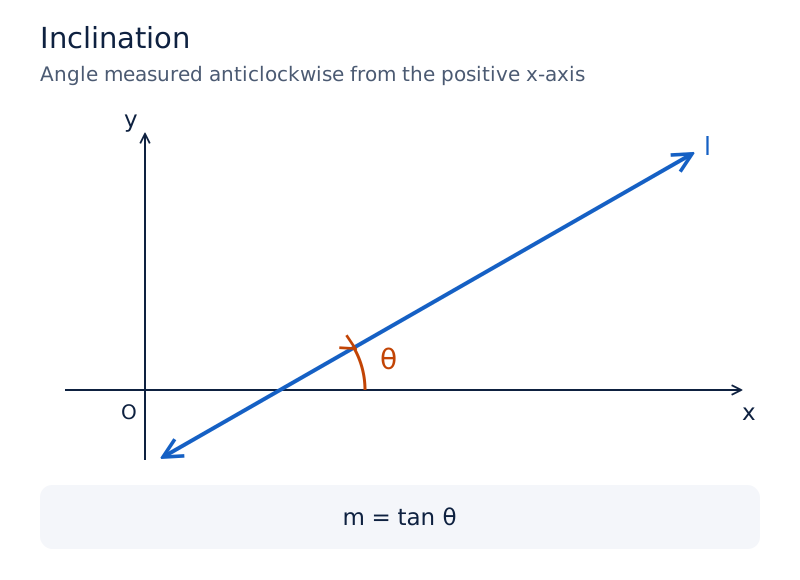
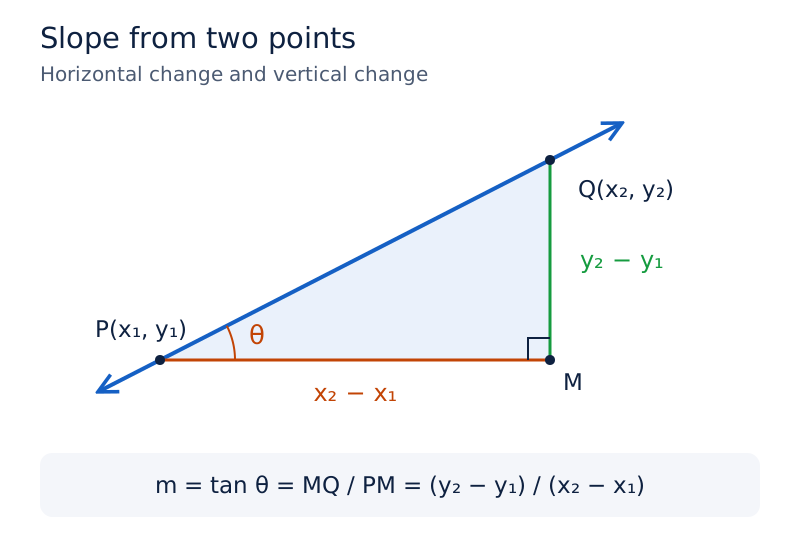
The first drawing marks between the positive horizontal axis and line , the label for the sloping line. The second labels points , and , with horizontal , vertical , and a right angle at .
Drawn by One Young India. See Figs. 9.2 and 9.3(i) in your NCERT textbook
How do signs identify the direction of a line?
Read the line from left to right. An acute inclination gives positive slope; an obtuse inclination gives negative slope. A horizontal line has no change in ordinate. A vertical line has no change in abscissa, so the coordinate formula would require division by zero.
Worked example 2. Find the slope through and , then compare the horizontal and vertical cases through .
Answer:
- For the given pair, calculate and .
- Divide in the same order: .
- With second point , the slope is , so this line is horizontal.
- With second point , the denominator is , while the numerator is . Its slope is undefined, so this line is vertical.
How do slopes identify parallel and perpendicular lines?
Parallelism and perpendicularity can be tested algebraically when the relevant slopes are defined. Let and denote the slopes of two non-vertical lines, and let and denote their respective inclinations.
Result: Equal slopes identify the same direction
- Parallel lines have equal inclinations: .
- Taking tangents gives .
- Therefore their slopes satisfy . Conversely, equal slopes give the same inclination and hence the same direction.
When two line equations describe the very same line, equal slopes alone do not distinguish coincidence from distinct parallel lines. The intercepts or an additional point must also be considered. Two vertical lines have the same direction, although neither has a finite slope.
Result: Perpendicular slopes are negative reciprocals
- For two perpendicular non-vertical lines, choose the inclinations so that .
- Apply the tangent identity: .
- Substitute slopes to obtain , and hence .
- Conversely, this negative-reciprocal relationship makes the inclinations differ by a right angle, so the lines are perpendicular.
Note: A horizontal line and a vertical line are perpendicular, but their slopes cannot be multiplied in the usual way because the vertical slope is undefined. Recognise this pair directly from its orientation.
Worked example 3. The line through and is perpendicular to the line through and . Find the unknown abscissa .
Answer:
- Find the first slope: .
- Write the second slope: .
- Apply perpendicularity: , giving .
- Solve: , so .
- Check the result: , and .
This method also tests right angles in coordinate triangles without calculating three side lengths. Identify the two sides meeting at the proposed right-angle vertex, find their slopes, and apply the product condition, with a separate check for horizontal and vertical sides.
How is the angle between two lines found?
Intersecting lines form two pairs of vertically opposite angles. Adjacent angles are supplementary. Consequently, finding the acute angle also determines the obtuse angle. The calculation uses the two slopes rather than the individual inclinations.
Derivation: The angle formula
Let and be the inclinations of two non-vertical lines with slopes and . Let denote their acute angle and the adjacent obtuse angle.
- The directed difference of inclinations is .
- Use the tangent subtraction identity:
- Replace the tangents with slopes:
- Take the absolute value to select the acute angle:
- Obtain the other angle from .
Check the denominator first. If , the lines are perpendicular and the angle is . The tangent quotient is then undefined, so it should not be evaluated as an ordinary fraction.
Worked example 4. The angle between two lines is , where is the usual circle constant and the angle is in radians. One slope is . Find the other slope, denoted by .
Answer:
- Use to write .
- For the positive branch, . Thus , giving .
- For the negative branch, . Thus , giving .
- Check the first result: .
- Check the second result: . Both slopes satisfy the given angle.
The absolute value explains why there are two answers. A line can make the prescribed acute angle on either side of the known direction. Removing the modulus while retaining only one sign would discard a valid possibility.
How are horizontal, vertical and point-slope equations written?
A horizontal line keeps the ordinate constant while the abscissa varies. A vertical line keeps the abscissa constant while the ordinate varies. This makes their equations simpler than a general sloping-line equation.
If is a non-negative distance from the horizontal axis, the two possible horizontal lines are and . If is a non-negative distance from the vertical axis, the possible vertical lines are and .
What the figure shows
Lines parallel to the axes
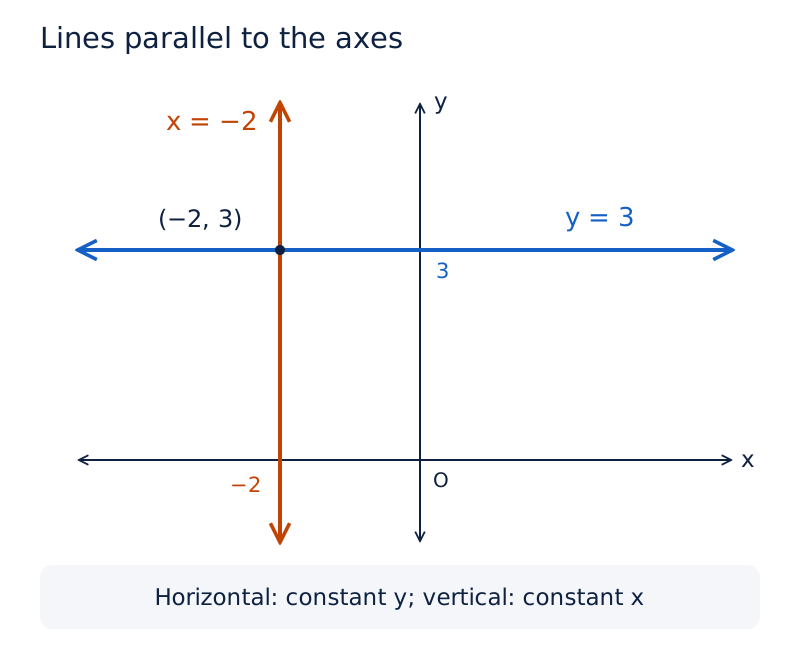
A horizontal line labelled and a vertical line labelled meet at the marked point . The origin is shown to the right and below their intersection.
Drawn by One Young India. See Fig. 9.9 in your NCERT textbook
Derivation: The point-slope form
Let be a fixed point on a non-vertical line, with and its coordinates. Let be another point on the line and its known slope.
- Apply the two-point slope formula: , initially for .
- Multiply by the denominator: .
- The fixed point also satisfies this final equation because substitution gives . It therefore represents the entire line.
Point-slope form is useful when one point and a direction are given. The direction may come directly as a slope, from an inclination, or from a parallel or perpendicular relationship with another line.
Worked example 5. Find the equation through with slope .
Answer:
- Identify the data: .
- Substitute into point-slope form: .
- Expand and collect terms: , giving .
- Check the point: . Rearranging gives , which has the required slope.
For the lines through the same point parallel to the axes, retain the relevant coordinate: for the horizontal line and for the vertical line. A vertical line must be handled directly because point-slope form requires a defined slope.
How does the two-point form determine a line?
Two distinct points determine a straight line. If their abscissae differ, first calculate the slope and then use either point in point-slope form. This gives the two-point form without introducing any additional geometric information.
Derivation: Combining two known points
- For points and , calculate , with .
- Use the first point in point-slope form: .
- Substitute the slope to obtain
If both points have the same abscissa, the line is vertical and its equation is . If their ordinates are equal but their abscissae differ, the slope is zero and the equation reduces to .
Worked example 6. Find the equation through and .
Answer:
- Calculate the slope: .
- Use the first point: .
- Expand: , so .
- Check both points: and . Both lie on the resulting line.
How can a third point be tested for collinearity?
Find the equation through two of the points, then substitute the third point. If the equation is satisfied, all three points are collinear. This method includes a direct membership check and avoids calculating an area.
The alternative slope test compares the slopes of segments joining pairs of points. Keep the coordinate subtraction order consistent, and handle the case of equal abscissae separately. A vertical arrangement can be recognised immediately when all three abscissae are equal.
For problems involving a median, first calculate the midpoint of the opposite side and then join it to the vertex. For a perpendicular bisector, combine the midpoint with the negative reciprocal of the segment's slope, allowing separately for axis-parallel segments.
How do intercept forms and the general equation describe a line?
An intercept records where a line meets an axis. Intercepts are signed coordinates: a crossing on the negative side of an axis has a negative intercept. They must therefore be distinguished from unsigned distances.
How is slope-intercept form derived?
Let denote the vertical intercept of a non-vertical line with slope . Its axis intersection is .
- Apply point-slope form at the intercept: .
- Simplify to obtain .
- If instead the horizontal intercept is , the known point is , giving .
Worked example 7. Find the lines with slope when the vertical intercept is , and when the horizontal intercept is .
Answer:
- For the vertical intercept, substitute into slope-intercept form: .
- Multiply by two and rearrange: , so .
- For the horizontal intercept, substitute into the other form: .
- Multiply and rearrange: , so .
- Check the intercepts by putting in the first equation and in the second. These give and , respectively.
Derivation: The intercept form
Now let and denote non-zero signed horizontal and vertical intercepts. The line passes through and .
- Use the two-point form: .
- Multiply by and collect terms: , so .
- Divide by the non-zero product:
Worked example 8. Find the line with horizontal intercept and vertical intercept .
Answer:
- Set and , giving .
- Multiply by six: .
- Rearrange: .
- Check both crossings: setting gives , while setting gives .
The general equation is , where , and are real constants and and are not both zero. If , rearranging gives .
| Known information | Convenient equation |
|---|---|
| One point and a slope | . |
| Slope and vertical intercept | . |
| Two non-zero axis intercepts | . |
| A vertical line through a known point | . |
How is the perpendicular distance from a point to a line calculated?
The distance from a point to a line is the length of the perpendicular drawn from the point to that line. It is not a distance measured along an arbitrary direction. The perpendicular foot may be different from either axis intercept.
Let be the given point and let the line be . Write for the perpendicular distance. Then The condition that and are not both zero keeps the denominator positive.
Derivation: Using the area of a triangle
For the intercept construction, take non-zero , and . Let and be the line's horizontal and vertical axis intersections, and let be the foot of the perpendicular from .
- Find the intercepts: and .
- Write triangle area using base and altitude: , where denotes the area of triangle .
- Use the coordinate area formula to obtain .
- Use the distance formula for the base: .
- Divide twice the area by the base and cancel the common factor: .
The final formula has wider applicability than this particular construction. It also applies when an axis intercept is absent or the line passes through the origin. Those situations make the intercept triangle unsuitable, rather than invalidating the stated distance formula.
What the figure shows
Perpendicular distance
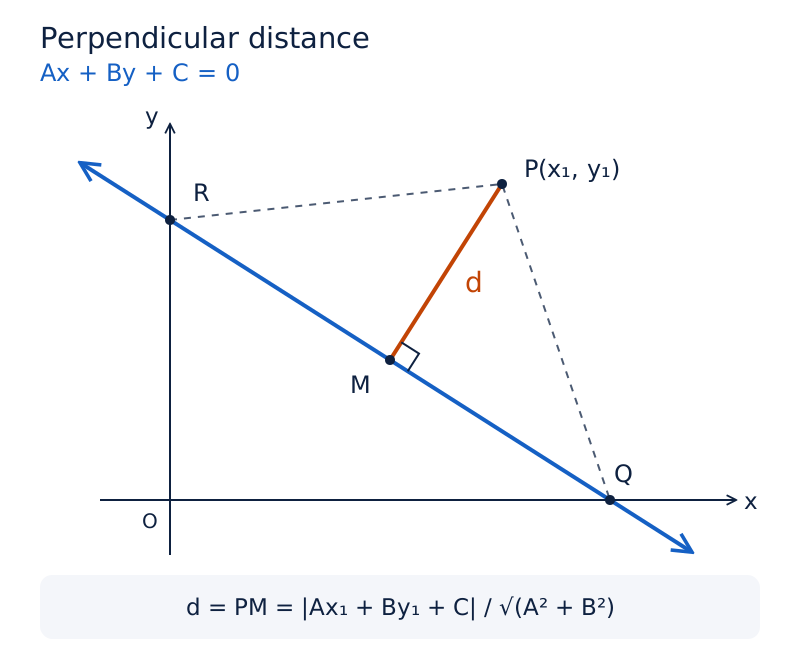
A descending line meets the axes at and . Point lies away from it, and segment , labelled , meets the line at a marked right angle. Dashed segments connect to the intercepts.
Drawn by One Young India. See Fig. 9.14 in your NCERT textbook
Worked example 9. Find the distance of from .
Answer:
- Identify .
- Evaluate the numerator: .
- Evaluate the denominator: .
- Divide to obtain unit. Both the absolute value and the positive square root ensure a non-negative distance.
A point on the line makes the numerator zero, agreeing with a distance of zero. When substituting negative coordinates or coefficients, retain brackets until multiplication is complete. This prevents a sign error from changing the numerator.
How is the separation of parallel lines found?
The distance between two distinct parallel lines is measured along a common perpendicular. Any point on one line can be used to calculate its perpendicular distance from the other. Their equal direction makes this separation independent of the point selected.
Derivation: Subtracting the constant terms
Write the lines as and , where and are their constant terms and the coordinate coefficients match exactly.
- Choose a point on the first line, so .
- Use the point-to-line distance formula for the second line: .
- Substitute the first relation:
In slope-intercept form, let and denote the vertical intercepts. For the lines and , the corresponding formula is .
Worked example 10. Find the separation of and .
Answer:
- The coordinate coefficients already match: and .
- The constant terms are and , so .
- The denominator is .
- Therefore unit.
Normalise the equations before subtracting constants. Multiplying an entire line equation by a non-zero number leaves its points unchanged, but changes all its coefficients. The subtraction shortcut assumes that the coefficients of both coordinate variables have first been made identical.
The point-to-line formula is itself unchanged by such a multiplication, because the numerator and denominator acquire the same positive scale factor after taking absolute values. This explains why equivalent equations give the same geometric distance.
How are line equations used in concurrency, directed distance and reflection?
Several coordinate problems combine the earlier results. Start by translating each geometric condition into an equation. Solve the resulting equations and then check that the answer satisfies the original geometry, especially any specified direction or perpendicularity condition.
What does concurrency mean?
Three lines are concurrent when they pass through a common point. Find the intersection of two lines and substitute it into the third. This converts a geometric condition into an equation for any unknown coefficient.
Worked example 11. Find the constant if , and are concurrent.
Answer:
- Add the first and third equations: , so .
- Substitute into the first equation: , giving .
- Insert the common point into the second equation: , so .
- Check all three expressions at : , , and .
How does distance along a specified line differ?
Worked example 12. Find the distance from to , measured along a line inclined at to the positive horizontal axis.
Answer:
- The measuring line has slope .
- Through the given point its equation is , or .
- On the target line, . Substitute to get , giving and .
- Call this intersection . Calculate units.
The required direction controls the intersection used in this calculation. The perpendicular-distance formula answers a different question unless the specified direction happens to be perpendicular to the target line. Read this condition before choosing a formula.
How is the image of a point located?
For reflection in a line, the mirror line is the perpendicular bisector of the segment joining a point to its image. Two conditions are therefore required: the joining segment is perpendicular to the mirror, and its midpoint lies on the mirror.
Worked example 13. Find the image of in .
Answer:
- Let be the image, where and are its unknown coordinates. The mirror's slope is , so the slope of is .
- Use the slope condition: , giving .
- The midpoint is . Substitute into the mirror equation: , giving .
- Use in the second relation: , hence and .
- Then . The image is .
- Check the midpoint : . Also , confirming perpendicularity.
Glossary
- Abscissa — The horizontal coordinate of a point, specifying its signed position relative to the vertical axis.
- Ordinate — The vertical coordinate of a point, specifying its signed position relative to the horizontal axis.
- Inclination — The angle measured anticlockwise from the positive horizontal axis to a given straight line.
- Slope — The tangent of a non-vertical line's inclination, also calculated as vertical change divided by horizontal change.
- Collinear points — Points that lie on one straight line and form a triangle of zero area.
- Parallel lines — Distinct coplanar lines with the same direction; when non-vertical, they have equal slopes.
- Perpendicular lines — Lines meeting at a right angle; their defined slopes are negative reciprocals of each other.
- Intercept — The signed coordinate at which a line crosses the relevant coordinate axis.
- Point-slope form — A line equation built from one known point and the line's defined slope.
- General equation — A linear equation in two coordinates whose coordinate coefficients are not both zero.
- Perpendicular distance — The length of the perpendicular segment drawn from a point to a given line.
- Concurrent lines — Three or more lines that pass through the same common point of intersection.
- Reflection — A transformation placing an image so that the mirror line perpendicularly bisects the point-image segment.
Common errors and misconceptions
- Misconception: A vertical line has zero slope. Correct: Its slope is undefined because the horizontal change is zero. A horizontal line has zero slope.
- Misconception: The two coordinate differences can be subtracted in opposite orders. Correct: Use the same point order in numerator and denominator, as in .
- Misconception: Every perpendicular pair can be tested by multiplying slopes. Correct: The condition applies when both slopes are defined. Handle a horizontal and vertical pair directly.
- Misconception: Intercepts must be positive because they are distances. Correct: Intercepts are signed coordinates. A crossing on the negative side of an axis has a negative intercept.
- Misconception: The angle formula gives just one possible unknown slope. Correct: An absolute-value equation may have positive and negative branches, both of which must be solved and checked.
- Misconception: Constants can be subtracted immediately for any parallel-line equations. Correct: First make the coefficients of the two coordinate variables identical, including their signs.
- Misconception: The point-to-line distance formula measures distance along any chosen direction. Correct: It gives perpendicular distance. A specified direction requires its own line equation and intersection.
- Misconception: Perpendicularity alone determines a reflected point. Correct: The midpoint of the original point and its image must also lie on the mirror line.
Exam-style questions with model answers
Q1. Find the slope of the line through and . [2 marks]
- Using the same subtraction order for both coordinates, the vertical change is , and the horizontal change is .
- The slope is therefore . Its negative sign means the line falls as the horizontal coordinate increases.
Q2. Find the equation of the line through with slope , and verify the point. [3 marks]
- Use point-slope form because one point and the slope are given. Substituting the coordinates and slope gives , with the bracket retaining the sign of the negative abscissa.
- Expand the right side: . Bringing all terms to one side gives the required equation .
- Substitute the specified point to check membership: . The rearranged equation also confirms the required slope.
Q3. Find the equation of the line whose horizontal and vertical intercepts are and , respectively. Check both intercepts. [3 marks]
- The intercepts are signed values. Use for the horizontal intercept and for the vertical intercept in , obtaining .
- Multiply throughout by six to remove the denominators: . Rearranging gives the equation .
- Set to get , hence . Set to get , hence , verifying both intercepts.
Q4. The line joining and is perpendicular to the line joining and . Find . [4 marks]
- Calculate the first line's slope using the two given points: .
- The second line's slope in terms of its unknown abscissa is .
- Perpendicular non-vertical lines have slope product . Thus , giving .
- Solving yields . This makes the second slope , whose product with is , so the required perpendicularity is verified.
Q5. Two lines make an acute angle of radians. One has slope . Find both possible slopes of the other line and check them. [5 marks]
- Let denote the unknown slope. The acute-angle formula uses an absolute value, so substituting the given data gives , since .
- For the positive branch, write . Collecting the unknown terms gives , hence the first possible slope is .
- For the negative branch, write . Then , giving the second possible slope .
- For the first candidate, . Its denominator is non-zero, and it gives the tangent of the required acute angle.
- For the second candidate, . Its denominator is also non-zero. Therefore both slopes satisfy the original condition and must be retained.
Q6. Find the perpendicular distance of from . [3 marks]
- Compare the given equation with : , , and . The point supplies and .
- Evaluate the absolute numerator carefully, retaining the negative coordinate in brackets: . The denominator is .
- Divide these values to obtain unit. This is a perpendicular length, and the absolute value ensures that the reported distance is non-negative.
Q7. Find so that , and are concurrent. [4 marks]
- Concurrent lines share a common point. Add the first and third equations to eliminate the ordinate: , so .
- Substitute into the first equation: . Thus , and their intersection is .
- The second line must contain that point. Substitution gives , from which .
- Verify the second equation with this coefficient: . The point already lies on the other two lines, proving the required concurrency.
Q8. Treat as a plane mirror. Find the image of and verify the midpoint condition. [6 marks]
- Let the image coordinates be . The mirror has slope , so the segment joining the original point to its image must have the perpendicular slope .
- Express that slope condition as . Multiplying and collecting terms gives the first relation, .
- The midpoint must lie on the mirror. Therefore , which simplifies to the second relation, .
- Substitute into the second relation. This gives , so and .
- Now calculate . The required reflected image is consequently .
- The midpoint is . Substitution gives , confirming that it lies on the mirror as required.
Key takeaways
- Calculate slope from signed coordinate differences in the same order; a vertical line has undefined slope.
- Equal defined slopes indicate the same direction, while negative reciprocal slopes identify perpendicular non-vertical lines.
- The acute-angle formula uses an absolute value; an unknown slope may therefore have two valid solutions.
- Choose point-slope, two-point or intercept form according to the information supplied in the problem.
- Axis intercepts are signed coordinates, so negative intercepts must retain their signs during substitution.
- Point-to-line distance means perpendicular distance; a prescribed measuring direction requires a separate line and intersection.
- Before finding parallel-line separation by subtracting constants, make the coordinate coefficients match exactly in both equations.
- A reflected point must satisfy both perpendicularity of the joining segment and membership of its midpoint on the mirror.
Test yourself
What is the slope of a line inclined at ?
Using the inclination definition, . This positive slope corresponds to an acute inclination.
Which equations describe the coordinate axes?
The horizontal axis has equation , while the vertical axis has equation .
Why cannot a vertical line be written using an ordinary finite slope?
Its two points have the same abscissa, so the slope quotient requires division by zero and is undefined.
What happens when in the angle calculation?
The two non-vertical lines are perpendicular. Their angle is , and the tangent quotient is undefined.
How can you decide whether a given point lies on a line?
Substitute its coordinates into the line equation. The point lies on the line precisely when the equation is satisfied.
What distance separates and ?
The coefficients match, so unit, measured along a common perpendicular.
How do you test three lines for concurrency?
Find the intersection of two lines, then check whether its coordinates also satisfy the third line's equation.
What two conditions determine reflection in a straight line?
The point-image segment is perpendicular to the mirror, and the midpoint of that segment lies on the mirror.
Write about it
Turn a question from this chapter into a paper.
The Writing Studio has a structure guide, a rubric and citation tools for 15 formats, from essays to research papers. Drafting is free with an account. Learnacy Essential adds feedback from an AI writing coach and submission to The OYI Review.
Learnacy Essential is ₹1,499 for the year. Publication depends on review and is not guaranteed.