
Coordinate Geometry | CBSE Class 10 Maths Notes
On this page
Watch & explore
Start with a few high-quality watches, then dive into the notes below.
Coordinate Geometry in Class 10 Mathematics covers coordinates and axes, the distance formula, geometric tests using lengths, equidistant points, internal division of a line segment, the section formula, midpoints and points of trisection.
How do coordinates connect algebra with geometry?
Coordinate geometry describes the positions of points using numbers, allowing geometric questions to be solved through algebra. A pair of perpendicular coordinate axes provides the reference for locating each point in a plane. Coordinates can then help determine lengths and positions without directly measuring a drawing.
What do the two coordinates represent?
Write a point as , where names the point, is its horizontal coordinate and is its vertical coordinate. The first coordinate is the abscissa; the second is the ordinate. Their order matters when plotting or calculating.
The horizontal coordinate measures position relative to the vertical axis, called the -axis. The vertical coordinate measures position relative to the horizontal axis, called the -axis. Coordinate signs record the side of an axis on which the point lies.
Definition: The coordinates of a point give its position relative to a pair of coordinate axes. The abscissa comes first and the ordinate second in the ordered pair.
| Position | Coordinate form | Meaning |
|---|---|---|
| On the horizontal axis | The ordinate is zero. | |
| On the vertical axis | The abscissa is zero. | |
| At the origin | , where names the origin | Both coordinates are zero. |
Which question does each formula answer?
The distance formula starts with two known points and produces a length. The section formula starts with two endpoints and a division ratio and produces the coordinates of another point. The midpoint formula is the equal-division case of the section formula.
Keep a clear distinction between these outputs. A distance is a non-negative number measured in length units. A point is an ordered pair. A ratio compares two lengths in a stated order; it is not itself the coordinate pair of the dividing point.
In a question about an unknown position, first translate the geometric condition into algebra. “On an axis” fixes one coordinate; “equidistant” gives equal distances; “bisects” gives equal halves. These interpretations determine which formula to use before any substitution begins.
How is the distance formula derived and used?
Result: Distance between two points
Let and be two points. Here are the coordinates of the first point and those of the second. The symbol denotes the distance between them.
The formula comes from Pythagoras' theorem. Horizontal and vertical separations form the perpendicular sides of a right triangle; the segment joining the original points forms its hypotenuse. Squaring the separations allows the formula to work with negative coordinates too.
What the figure shows
Distance construction
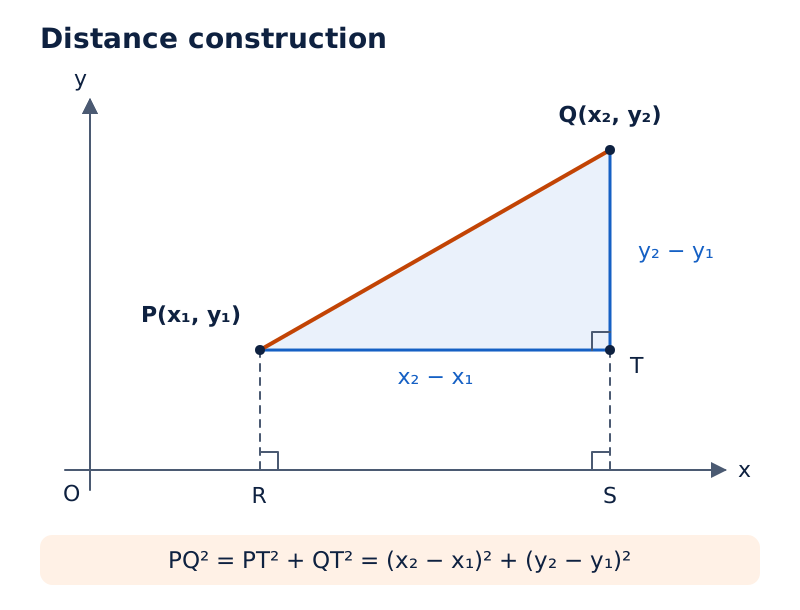
The points and have perpendiculars meeting the horizontal axis at and , respectively. A horizontal segment from meets the perpendicular through at , forming the right triangle .
Drawn by One Young India. See Fig. 7.5 in your NCERT textbook
Derivation: Distance formula
In this construction, and are the perpendicular feet, and is the right-angle vertex. The displayed arrangement places the second point above and to the right of the first.
- The horizontal side is the difference between the abscissae:
- The vertical side is the difference between the ordinates:
- Apply Pythagoras' theorem to the right triangle:
- Substitute both coordinate differences:
- Take the non-negative square root because the result represents a distance:
Sign check: Reversing the order of subtraction changes the signs of both differences, but their squares remain the same. Thus reversing the order of the endpoints does not change their distance.
Result: Distance from the origin
For the origin and a point , the general formula becomes . The symbols and are the point's coordinates, and is its distance from the origin.
Worked example 1. Town is km east and km north of town . Find the straight-line distance between them.
Answer: Take as the origin and use one kilometre per coordinate unit.
- The town coordinates are and .
- Substitute the coordinate differences:
- Square and add:
- Take the positive square root:
The eastward and northward movements are perpendicular components. Adding those two movements would measure a route with a turn. The distance formula instead gives the direct length of the segment joining the towns.
How can distances identify a right triangle?
Coordinates allow the three side lengths of a triangle to be calculated. Once those lengths are known, geometric properties can identify the triangle. The converse of Pythagoras' theorem tests whether the square of the longest side equals the sum of the other two squared lengths.
What must be checked before naming the triangle?
Three given points must form a triangle rather than lie on one straight line. For a triangle, the sum of any two side lengths exceeds the third. Keep exact square roots during this check so that a rounding error does not alter an equality or inequality.
Worked example 2. Determine whether , and form a triangle, and identify its type. Here name the three given points.
Answer: Calculate every side, then compare their lengths and squares.
- Calculate the first side:
- Calculate the second side:
- Calculate the third side:
- The two shorter sides exceed the longest when added. Indeed, Both sides being compared are positive, so . The other two triangle inequalities follow because each sum includes the longest side and a positive length.
- Compare the squared lengths:
- The longest side is , opposite vertex . Therefore , where denotes the angle at , and the triangle is right-angled at .
Exact comparison is especially useful here: the two larger lengths are close, but their squared values are different. Do not decide that two sides are equal merely because a rough sketch or rounded decimal values look similar.
Notice how the angle is located. The two lengths on the left of the Pythagorean equality belong to sides meeting at the right-angle vertex. Stating only that the triangle is right-angled leaves out information that the same calculation already establishes.
How can the distance formula prove that a quadrilateral is a square?
A square can be identified by showing that its four sides are equal and its two diagonals are equal. Coordinates make both checks possible without relying on the appearance of a sketch. Label consecutive vertices carefully so that sides and diagonals are not confused.
Which segments should be calculated?
For consecutive vertices , the sides are . The diagonals are and , which join opposite vertices. These symbols denote segment lengths when used in the calculations below.
Worked example 3. Show that , , and are the vertices of a square in the stated order.
Answer: Calculate all four sides and both diagonals.
- The first side is
- The second side is
- The third side is
- The fourth side is
- The first diagonal is
- The second diagonal is
- Thus and . All sides and both diagonals satisfy the required equalities, so the quadrilateral is a square.
How does the alternative right-angle check work?
After establishing that all four sides are equal, one can instead prove that one angle is a right angle. In this example the required check uses the two sides meeting at vertex and the diagonal opposite that vertex.
- Use the squared side lengths already calculated:
- Compare with the squared diagonal:
- The converse of Pythagoras' theorem gives , where is the angle at . Equal sides together with this right angle establish a square.
Note: Equal sides alone do not complete this square proof. Include either the equal-diagonal check or the right-angle check, and state the geometric conclusion supported by it.
How do distances show that three points are collinear?
Collinear points lie on one straight line. If one point lies between two others, the two shorter distances add to the full distance between the outer points. The distance formula can establish this equality even when the line is slanting across the coordinate plane.
How is a straight line distinguished from a triangle?
For three distinct points, equality between the longest distance and the sum of the other two identifies a straight-line arrangement. This contrasts with the strict triangle inequality used when the points form a triangle. Find all three lengths before deciding which comparison is appropriate.
Worked example 4. Ashima, Bharti and Camella sit at , and , respectively. Here label their positions. Determine whether they sit in a straight line.
Answer: Calculate the three pairwise distances and test their sum.
- The distance from Ashima to Bharti is
- The distance from Bharti to Camella is
- The distance from Ashima to Camella is
- Add the two shorter distances:
- The points are collinear, with between and . Therefore the three students sit in a straight line.
The middle point is determined by the equality: the two shorter segments share vertex . The longest segment joins the outer points. Naming the middle point explains why these particular lengths are added.
A drawing may suggest collinearity, but the exact equality provides the reason. Retain the common square-root factor while adding the lengths; converting each length to an approximate decimal can make an exact equality appear slightly unequal.
How are unknown coordinates found from equal distances?
Equidistant means at equal distances from the stated points. Write the two distance expressions and equate their squares. This avoids carrying square roots through the algebra. When a point lies on an axis, use its zero coordinate before forming the equation.
How does equal distance give a relation between coordinates?
Worked example 5. Find a relation between the coordinates and of a point equidistant from and . The letters and label the fixed points.
Answer: Translate equal lengths into equal squared distances.
- The condition is , hence .
- Substitute the coordinate differences:
- Expand each square:
- Cancel the common squared terms and combine constants:
- Collect the remaining terms:
- Rearrange and divide by the common factor:
The graph of this relation is the perpendicular bisector of the segment joining the fixed points. The answer is a relation between coordinates, rather than one isolated point, because the condition can be satisfied at different positions along that line.
How does an axis condition identify one point?
Worked example 6. Find a point on the -axis equidistant from and , where and are the given fixed points.
Answer: Let the required point be , with unknown ordinate .
- Equate the squared distances:
- Expand the squares:
- Cancel the common term and collect constants:
- Rearrange to solve:
- The candidate point is . Check the first distance:
- Check the second distance: The distances agree, so the required point is .
The axis restriction and equal-distance condition serve different purposes. The restriction supplies the zero abscissa; equal distances determine the remaining ordinate. The final substitution checks both the algebra and the interpretation of the point's location.
How is the internal section formula derived?
The section formula finds the point that divides a segment in a specified ratio. Let and be the endpoints, with their respective coordinates as indicated. Let be the dividing point between them.
Let and be positive numbers specifying the ordered ratio . The first ratio entry refers to the distance from the first endpoint to the dividing point. The second refers to the remaining distance to the second endpoint.
Result: Internal division of a segment
Each numerator combines the corresponding endpoint coordinates. The first ratio entry multiplies the second endpoint's coordinate, and the second ratio entry multiplies the first endpoint's coordinate. Both denominators contain the sum of the ratio entries.
What the figure shows
Internal section construction
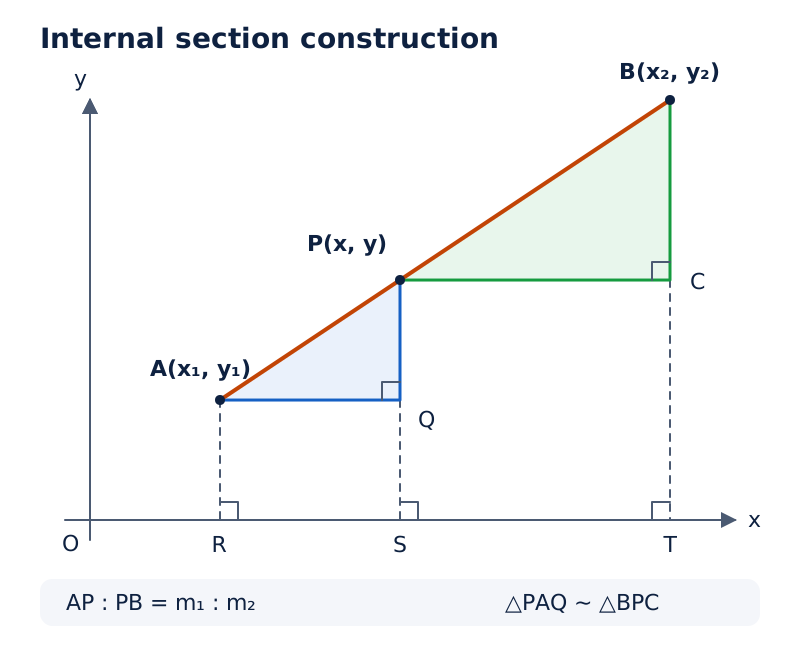
Points lie in that order on a rising segment. Their vertical perpendiculars meet the horizontal axis at . Horizontal segments from and meet the next perpendiculars at and , forming two right triangles.
Drawn by One Young India. See Fig. 7.10 in your NCERT textbook
Derivation: Section formula
Here name the perpendicular feet, while name the auxiliary intersections. The right triangles and are similar by the angle-angle criterion in the illustrated construction.
- Similarity gives equal corresponding-side ratios:
- Read the horizontal and vertical lengths from the construction:
- Use the horizontal ratio and cross-multiply:
- Expand and collect the terms containing the unknown abscissa:
- Divide by the positive sum of the ratio entries:
- Use the vertical ratio and cross-multiply:
- Expand and collect the ordinate terms:
- Divide to obtain the ordinate: Combine the abscissa and ordinate in that order to obtain the stated section formula.
Internal division means that the dividing point lies between the endpoints. The displayed derivation uses the non-horizontal, non-vertical arrangement in the figure; the resulting coordinate formula also gives points on horizontal or vertical segments.
Worked example 7. Find the point dividing the segment from to internally in the ratio .
Answer: Let be the required point, where are its coordinates.
- Identify the ordered ratio: .
- Calculate the abscissa:
- Calculate the ordinate:
- Combine the coordinates:
How can a division ratio or an axis intersection be found?
The section formula can be used in reverse when the endpoints and dividing point are known. Substitute the coordinates and solve for the unknown ratio. Because a point has two coordinates, the unused coordinate offers a useful independent check on the result.
How does a known point determine the ratio?
Worked example 8. Find the ratio in which divides the segment joining and .
Answer: Let , where are the positive ratio entries.
- Apply the section formula to the abscissa:
- Multiply by the denominator:
- Collect terms:
- The required ordered ratio is . Check the ordinate:
- Both coordinates agree with the given dividing point, confirming the ratio .
Writing an unknown ratio as , where is the positive quotient of the two ratio entries, can reduce the algebra to one unknown. This form expresses the same comparison as when .
How is the zero coordinate used at an axis intersection?
Worked example 9. Find the ratio in which the -axis divides the segment from to , and find the intersection point.
Answer: Let be the intersection and let , where is the unknown positive ratio value.
- The section formula gives the abscissa:
- On the vertical axis the abscissa is zero:
- The denominator is positive, so the numerator must vanish:
- Substitute into the ordinate formula:
- The ordered ratio is , and the intersection is .
Note: A vertical-axis intersection has zero abscissa. A horizontal-axis intersection has zero ordinate. Apply this condition to the matching coordinate expression before solving for the ratio.
The order of the endpoints fixes the meaning of the ratio. Keep that order throughout the substitution and final statement. A correct numerical ratio without its associated segment order can be misread as the reverse division.
How does the midpoint formula solve parallelogram problems?
A midpoint divides a segment into two equal parts. It is the internal section point with equal ratio entries. Consequently, its coordinates are the arithmetic means of the matching coordinates of the endpoints.
Result: Midpoint coordinates
For endpoints and , let denote their midpoint. The subscripted symbols are the endpoint coordinates, and below denote the midpoint's abscissa and ordinate.
Derivation: Midpoint formula
- Equal halves give the division ratio .
- Substitute equal entries into the abscissa formula:
- Substitute equal entries into the ordinate formula:
- Combine the two coordinates:
Corresponding coordinates must be averaged together: combine the two abscissae, then the two ordinates. Averaging unlike coordinates does not represent the midpoint of the given segment.
How does diagonal bisection supply an equation?
The diagonals of a parallelogram bisect each other. Therefore their midpoints have equal abscissae and equal ordinates. This turns a geometric property into coordinate equations that can determine a missing vertex coordinate.
Worked example 10. Points , , and are consecutive vertices of a parallelogram. Find , the unknown abscissa of .
Answer: Equate the midpoints of diagonals and .
- Let be the midpoint of . Calculate
- Let be the midpoint of . Calculate
- The diagonals bisect each other, so . Their ordinates already agree; equate their abscissae:
- Multiply by the common denominator and solve:
- Substitution gives Thus the required abscissa is .
The phrase taken in order determines which vertices are opposite. Here the diagonals join the first and third vertices and the second and fourth vertices. Their midpoint equality is the property needed for this calculation.
How are the points of trisection calculated?
Trisection divides a segment into three equal parts using two internal points. Each point divides the whole segment in a different ratio. Identify these whole-segment ratios before substituting into the section formula.
Why are the two division ratios different?
Let and be endpoints, and let be the trisection points in that order from . The condition is . The first point has one equal part before it and two after it; the second has two before and one after.
What the figure shows
Points of trisection
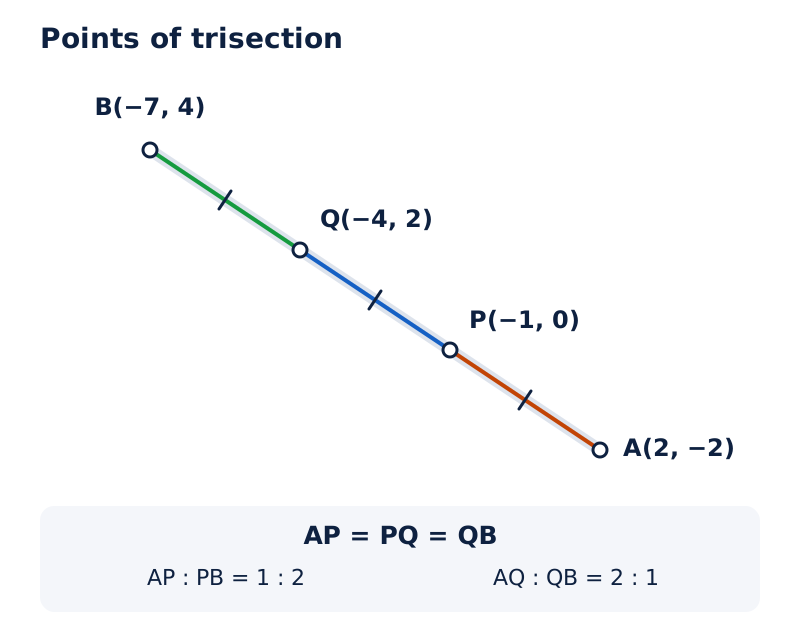
A straight segment is marked in the order . The endpoints are labelled and , and the two internal marks indicate the dividing points.
Drawn by One Young India. See Fig. 7.11 in your NCERT textbook
Worked example 11. Find the points of trisection of the segment from to .
Answer: Let be the first trisection point and the second, measured from .
- The first point divides the whole segment in the ratio .
- Let denote the abscissa of . Then
- Let denote the ordinate of . Then Hence .
- The second point divides the whole segment in the ratio .
- Let denote the abscissa of . Then
- Let denote the ordinate of . Then Hence .
- As an independent check, is the midpoint of :
The midpoint check uses the remaining segment after the first trisection point. It does not make either trisection point the midpoint of the original segment. Keeping the segment names visible prevents this change of reference from becoming confusing.
Internal division gives a point between the endpoints. A point on the same line but outside the segment represents external division instead. The internal section formula used here addresses the between-endpoints case.
Glossary
- Coordinate geometry — A method of studying geometric figures through algebra using coordinates to describe points.
- Coordinate axes — Two perpendicular reference lines used together to locate points in a plane.
- Abscissa — The first coordinate of a point, describing its horizontal position relative to the vertical axis.
- Ordinate — The second coordinate of a point, describing its vertical position relative to the horizontal axis.
- Origin — The intersection of the coordinate axes, where both coordinates of the point are zero.
- Distance formula — The formula calculating the length between two points from their corresponding coordinate differences.
- Collinear points — Points that lie on the same straight line in the coordinate plane.
- Equidistant point — A point whose distances from the stated reference points are equal.
- Internal division — Division of a line segment by a point lying between its two endpoints.
- Section formula — The formula finding coordinates of a point dividing a segment internally in a given ratio.
- Midpoint — The point dividing a line segment into two parts of equal length.
- Trisection points — The two internal points dividing a line segment into three equal parts.
Common errors and misconceptions
- Misconception: Negative coordinates require a negative distance. Correct: Distance is non-negative; square the coordinate differences, add them and take the non-negative square root.
- Misconception: A point on the vertical axis has zero ordinate. Correct: Its abscissa is zero. A point on the horizontal axis has zero ordinate.
- Misconception: Equal sides alone finish a square proof. Correct: Also establish equal diagonals or a right angle, as appropriate to the proof.
- Misconception: Three plotted points necessarily form a triangle. Correct: Check for collinearity; the longest distance may equal the sum of the other two.
- Misconception: Ratio entries multiply coordinates from the same endpoint position. Correct: In the internal section formula, the first ratio entry multiplies the second endpoint's coordinates.
- Misconception: Finding a ratio from one coordinate completes every check. Correct: Substitute it into the other coordinate expression to verify the given point.
- Misconception: Both trisection points divide the whole segment in the same ratio. Correct: In order from the first endpoint, their ratios are and .
Exam-style questions with model answers
Q1. Find the distance between and , using one kilometre per coordinate unit. [2 marks]
- Use the distance formula, where denotes the distance between the given points:
- Add the squared differences and take the positive square root:
Q2. Ashima, Bharti and Camella occupy , and . Show using distances whether they sit in a straight line. [3 marks]
- Calculate the first distance using corresponding coordinate differences: Here segment names denote lengths between the named students' positions.
- Calculate the other two lengths in the same way:
- Compare the sum with the longest distance: Therefore the points are collinear and the students sit in a straight line, with Bharti between the others.
Q3. Find the point on the -axis equidistant from and . Verify both distances. [4 marks]
- Let be the required point, where is its unknown ordinate. The zero abscissa expresses the stated axis restriction.
- Equate squared distances and expand:
- Cancel the squared terms and solve the resulting linear equation: The candidate point is .
- Check both lengths directly: The equal values verify that the point satisfies the distance condition as well as lying on the required axis.
Q4. Show that consecutive vertices , , , form a square. [5 marks]
- Use the distance formula for each segment, with segment names denoting lengths. The first side is
- Calculate the next two consecutive sides: These match the first side exactly.
- Complete the side check: Thus all four sides are equal, but the diagonal condition must still be established.
- Calculate both diagonals, joining opposite vertices:
- The four side lengths are equal and the two diagonal lengths are equal. Together these properties establish that the given quadrilateral is a square, completing the required coordinate proof. No estimate from a drawing is needed.
Q5. Find the point dividing the segment from to internally in the ratio . [3 marks]
- Let denote the required point, with abscissa and ordinate . Apply the internal section formula in the stated endpoint order; the first ratio entry multiplies the second endpoint's coordinates.
- Calculate the abscissa: The denominator is the sum of the two ratio entries.
- Calculate the ordinate: Hence the required ordered pair is .
Q6. Find both points of trisection of the segment joining to , showing the division ratios used. [5 marks]
- Let and be the trisection points in that order from . Three equal parts mean , so and .
- For the first point, apply the section formula with the first ratio: Both coordinates use the same endpoint order.
- Simplify each coordinate separately: This is the point nearer the first endpoint along the segment.
- For the second point, use the other whole-segment ratio:
- Check the second result as the midpoint of the remaining segment : The two required points are therefore and .
Key takeaways
- Coordinates locate points relative to perpendicular axes; the abscissa is written before the ordinate in each ordered pair.
- The distance formula applies Pythagoras' theorem to horizontal and vertical separations and gives a non-negative length.
- Exact squared distances help identify right triangles and verify side and diagonal conditions for a square.
- Three distinct points are collinear when the longest distance equals the sum of the other two distances.
- Equal-distance problems become algebraic equations; an axis restriction supplies the zero coordinate before substitution.
- The internal section formula depends on the endpoint order and the corresponding order of the division ratio.
- Midpoint coordinates are averages of corresponding endpoint coordinates; parallelogram diagonals have the same midpoint.
- Trisection uses two different ratios for the whole segment, corresponding to the first and second internal dividing points.
Test yourself
Which coordinate vanishes for a point on the vertical axis?
The abscissa vanishes; the ordinate specifies the point's vertical position on that axis.
Why does the distance formula use the non-negative square root?
The calculated quantity represents a distance, and a distance cannot be negative.
What happens to a distance when the order of both endpoint subtractions is reversed?
The distance is unchanged because both coordinate differences change sign while their squares stay unchanged.
What extra check accompanies equal sides in the square proof using diagonals?
The two diagonal lengths must also be shown equal to complete this square proof.
Why can squared distances be equated in an equidistant-point problem?
The original distances are equal and non-negative, so their squares are equal as well.
What division ratio defines the midpoint of a segment?
The ratio is , because the midpoint separates the segment into two equal lengths.
Which whole-segment ratios locate the two trisection points in order from the first endpoint?
The first ratio is and the second is , reflecting three equal parts.
Which parallelogram property makes midpoint equations useful for finding an unknown vertex coordinate?
The diagonals bisect each other, so both diagonals have exactly the same midpoint coordinates.
Write about it
Turn a question from this chapter into a paper.
The Writing Studio has a structure guide, a rubric and citation tools for 15 formats, from essays to research papers. Drafting is free with an account. Learnacy Essential adds feedback from an AI writing coach and submission to The OYI Review.
Learnacy Essential is ₹1,499 for the year. Publication depends on review and is not guaranteed.