
Exploring Algebraic Identities | CBSE Class 9 Maths Notes
On this page

This note covers algebraic identities and equations, geometrical models, squares of sums and differences, factorisation, algebra tiles, cubes, sums and differences of cubes, rational expressions, and applications to areas and volumes.
What makes an equation an algebraic identity?
An algebraic expression combines numbers and letters through mathematical operations. A variable is a letter representing a number whose value can change. A term is a part of an expression joined to other parts by addition or subtraction. An equation states that two expressions are equal, using the sign =.
Definition: An algebraic identity is an equation true for all values of the variables occurring in it. An equation need not be true for all values.
Let x and y represent numbers. The equation x² − 1 = 24 holds for x = 5 or x = −5. Here x² means x multiplied by itself, called its square. The equation is not an identity because other values need not satisfy it.
In contrast, (x + y)² = x² + 2xy + y² is an identity. The notation xy means x × y, the product of x and y; 2xy means twice that product. Brackets specify the expression being squared.
Why do patterns need a proof?
Consider the consecutive square numbers 1, 4 and 9, formed by squaring successive positive whole numbers. Adding the smallest and largest, then subtracting twice the middle, gives 1 + 9 − 2 × 4 = 2.
The same procedure gives (25 + 49) − 2 × 36 = 2. At this stage, the result always seems to be 2. Trying examples suggests a pattern; a general algebraic argument explains why the pattern holds.
An integer is a whole number, its negative, or zero. Let n be the middle positive whole number, so the three numbers are n − 1, n and n + 1. Their squares are (n − 1)², n² and (n + 1)². Expanding these expressions will later establish the result without checking each set separately.
How does a square explain the square-of-a-sum identity?
Let a and b first denote positive lengths measured in the same unit. Joining segments of these lengths gives a segment of length a + b. A square built on that segment has area (a + b)² square units.
Identity: Square of a sum
(a + b)² = a² + 2ab + b². Partitioning each side into lengths a and b divides the square into two squares and two rectangles. Their areas add to the area of the original square.
What the figure shows
Partitioned square
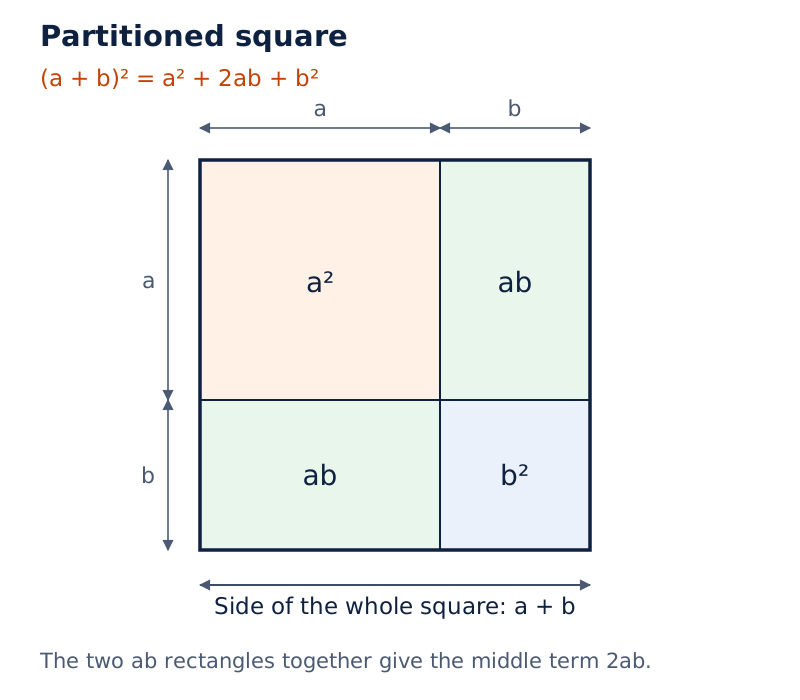
A square with side a + b contains a yellow square labelled a², a purple square labelled b², and two green rectangles labelled ab. The side divisions are marked a and b.
Drawn by One Young India. See Fig. 4.2 in your NCERT textbook
The two rectangles explain the term 2ab. Omitting either rectangle would leave part of the original square uncounted. The area model therefore explains why squaring a sum requires more than adding the separate squares.
How is the result proved for numbers?
Now let a and b represent numbers, not necessarily lengths. The distributive property means multiplying each term inside brackets by the outside factor. It gives the following argument:
- Write the square as a product: (a + b)² = (a + b)(a + b).
- Distribute the first bracket: a(a + b) + b(a + b).
- Multiply out: a² + ab + ba + b².
- Combine ab and ba to obtain a² + 2ab + b².
For a = −2 and b = −3, both sides equal 25. For a = −2/3 and b = 3/4, both equal 1/144. These checks illustrate the result; the distributive argument supplies the general justification.
Note: Checking particular negative numbers or fractions does not by itself prove the identity for all numbers. The geometrical picture uses lengths, while the algebraic proof establishes the general equality.
How can the square-of-a-sum identity simplify calculations?
A binomial is an expression with two terms. To expand an expression means to multiply out its brackets and collect terms with the same variable parts.
In (5x + 2y)², the entire expression 5x plays the role of a and the entire expression 2y plays the role of b. Substitution means replacing the letters in a general identity with the required numbers or expressions.
Worked example 1. Expand (5x + 2y)², where x and y are variables.
Answer: Take a = 5x and b = 2y. Then (5x + 2y)² = (5x)² + 2(5x)(2y) + (2y)² = 25x² + 20xy + 4y².
Notice that squaring 5x squares both 5 and x. The middle term uses twice the product of the complete terms. It is not obtained by doubling just one coefficient, where a coefficient is the numerical multiplier of a variable term.
Worked example 2. Calculate 43² using an identity.
Answer: Write 43 = 40 + 3. Then 43² = (40 + 3)² = 40² + 2 × 40 × 3 + 3² = 1600 + 240 + 9 = 1849.
What determines whether the square of a sum is larger?
The difference between (a + b)² and a² + b² is 2ab. With a = 10 and b = 2, the first expression equals 144 and the second equals 104. This comparison cannot be extended unchanged to all choices of a and b.
If ab is positive, the square of the sum is larger. If ab is negative, it is smaller. If ab is zero, the expressions are equal. Thus the sign of the product decides the comparison, rather than the presence of brackets alone.
How do identities help factor perfect-square expressions?
Factorisation means writing an expression as a product of factors. A factor is an expression multiplied by another to produce the original expression. Expanding and factorising move in opposite directions through the same identity.
A perfect-square expression can be written as the square of another expression. To recognise a² + 2ab + b², identify the two squared terms and then check that the remaining term is exactly twice the product of their bases. A base is the number or expression being raised to a power; in a², the base is a.
Worked example 3. Factor x² + 4x + 4.
Answer: Write x² + 4x + 4 = x² + 2(x)(2) + 2² = (x + 2)². Thus x + 2 is a factor appearing twice.
Worked example 4. Factor 36x² + 12x + 1.
Answer: Since 36x² = (6x)², 1 = 1² and 12x = 2(6x)(1), the expression is (6x + 1)².
When should a common factor be removed first?
A common factor multiplies every term of an expression. Taking it outside brackets can reveal a familiar identity inside. Keep that outside factor in the final answer: it is part of the original expression.
Worked example 5. Factor 50p² + 60pq + 18q², where p and q are variables.
Answer: Take out 2 to obtain 2(25p² + 30pq + 9q²). Inside, the terms are (5p)² + 2(5p)(3q) + (3q)². Therefore, the factorisation is 2(5p + 3q)².
The first and last squares are not enough to establish this pattern. The middle term must also match. In this example, 2(5p)(3q) gives 30pq inside the brackets, while the outside factor 2 restores the original middle term 60pq.
How does the square-of-a-difference identity work?
Identity: Square of a difference
(a − b)² = a² − 2ab + b². Replace b by −b in the square-of-a-sum identity. The middle term becomes negative, while (−b)² equals b². The last term therefore retains a plus sign.
For a geometrical interpretation, take positive lengths with a greater than b. Partition a square of side a into a smaller square and two rectangles. Subtracting the rectangles leaves the square whose side is a − b.
What the figure shows
Subtracting rectangular areas
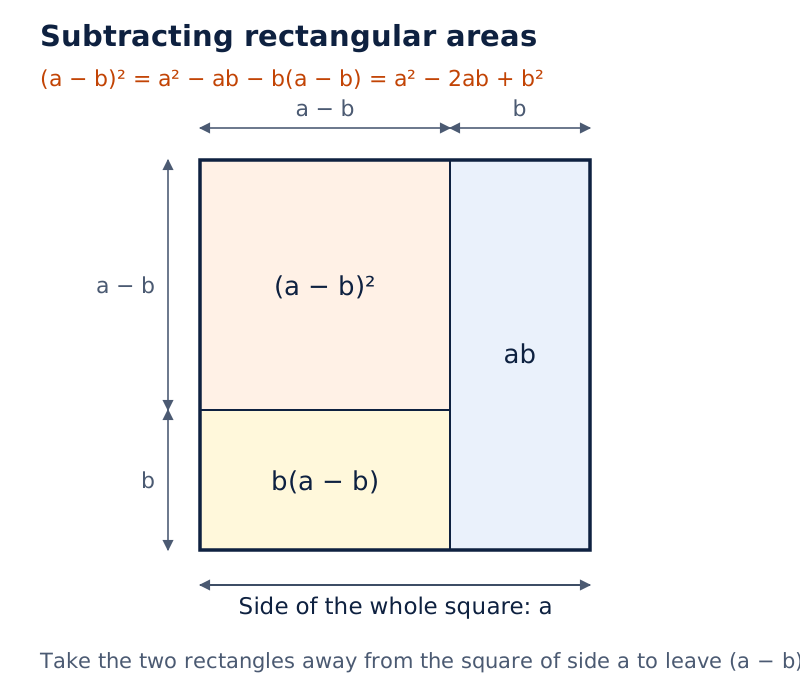
The outer square has side a. A top-left square is labelled (a − b)², the rectangle below it is labelled b(a − b), and the right-hand rectangle is labelled ab. Side divisions show a − b and b.
Drawn by One Young India. See Fig. 4.3 in your NCERT textbook
The remaining area is a² − ab − b(a − b). Distributing the subtraction gives a² − ab − ba + b², which simplifies to a² − 2ab + b². This accounts for the areas without treating both removed rectangles as identical.
Worked example 6. Calculate 29² using an identity.
Answer: Write 29 = 30 − 1. Then 29² = 30² − 2 × 30 × 1 + 1² = 900 − 60 + 1 = 841.
How is the consecutive-squares pattern proved?
Return to the consecutive numbers n − 1, n and n + 1. Expanding the outer squares gives (n − 1)² + (n + 1)² = n² − 2n + 1 + n² + 2n + 1 = 2n² + 2.
Subtracting twice the middle square, 2n², leaves 2. The opposite terms −2n and +2n cancel. The numerical pattern is now established by a proof, a general mathematical argument, rather than supported only by selected examples.
How do we square a sum of three terms?
Let c be a third number alongside a and b. Group b + c as one expression, temporarily called d. Applying the two-term square identity to a + d allows the three-term result to be built from something already known.
Identity: Square of a three-term sum
(a + b + c)² = a² + b² + c² + 2ab + 2bc + 2ca. There are three individual squares and twice each product of a pair of different terms.
- Put d = b + c and write (a + d)² = a² + 2ad + d².
- Replace d to obtain a² + 2a(b + c) + (b + c)².
- Expand the brackets to obtain a² + 2ab + 2ac + b² + 2bc + c².
- Collect the squares first, followed by 2ab, 2bc and 2ca.
What the figure shows
Three-part side divisions
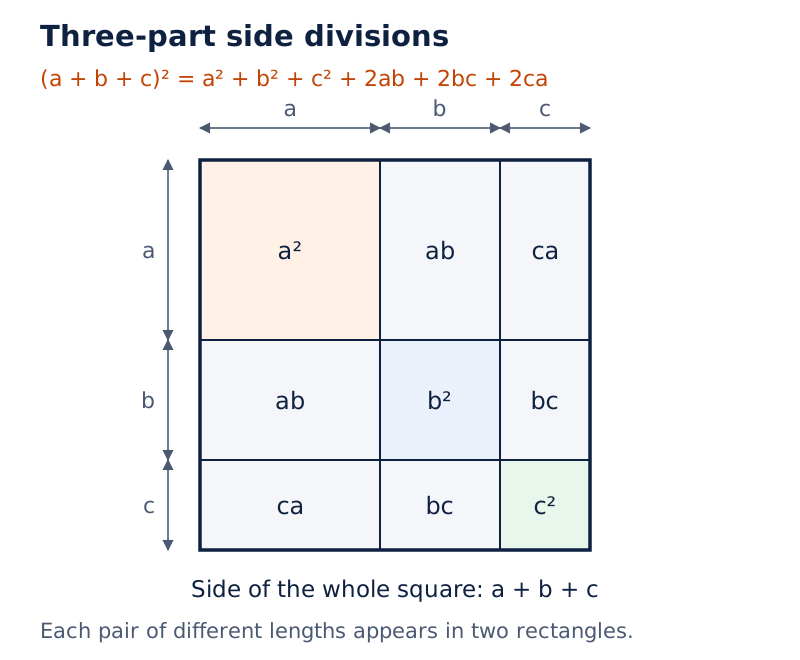
A coloured square is divided into nine regions by horizontal and vertical lines. Its top and left sides each show successive lengths a, b and c. These divisions give three squares and six rectangles.
Drawn by One Young India. See Fig. 4.4 in your NCERT textbook
Each rectangle contributes the product of its two side lengths. Each pair of different lengths occurs in two rectangles. This explains why the formula contains doubled pairwise products, not just the three separate squares.
Worked example 7. Find 119² by splitting 119 into three parts.
Answer: Write 119 = 100 + 10 + 9. Then 119² = 100² + 10² + 9² + 2(100)(10) + 2(100)(9) + 2(10)(9) = 10000 + 100 + 81 + 2000 + 1800 + 180 = 14161.
The same identity works when one of the substituted terms is negative. Include that sign in every product involving the term. Grouping and substitution preserve the identity; they do not permit omitting a pairwise product.
How does the difference of two squares simplify products?
Identity: Difference of squares
a² − b² = (a + b)(a − b). A difference of two squares factors into the sum of their bases multiplied by their difference. Expanding the product gives a² − ab + ab − b², where the middle terms cancel.
The power 2 indicates two copies of the base multiplied together. Similarly, x⁴ means four copies of x multiplied together. Identify the bases before forming the sum and difference factors.
Rearranging the identity gives a² = (a + b)(a − b) + b². This is useful when adding and subtracting the same number creates an easy product. The extra b² restores what was subtracted by the product of the two brackets.
Worked example 8. Calculate 55² using a difference-of-squares rearrangement.
Answer: Choose a = 55 and b = 5. Then 55² = (55 + 5)(55 − 5) + 5² = 60 × 50 + 25 = 3000 + 25 = 3025.
How do the square identities differ?
| Expression | Equivalent expression | Feature to recognise |
|---|---|---|
| (a + b)² | a² + 2ab + b² | A sum multiplied by itself |
| (a − b)² | a² − 2ab + b² | A difference multiplied by itself |
| (a + b)(a − b) | a² − b² | The same bases with opposite signs between them |
The table separates two frequently confused operations. Squaring a difference repeats the same bracket and produces a middle term. Multiplying a sum by the corresponding difference removes the middle terms. Decide which structure is present before choosing a rule.
This identity also supports further factorisation. For variables x and y, x⁴ − y⁴ is the difference of the squares of x² and y². Thus it equals (x² − y²)(x² + y²), and the first factor can be split again.
How do algebra tiles explain multiplication and factorisation?
Algebra tiles represent algebraic terms through areas. For a positive length x, an x²-tile is a square of side x, an x-tile is a rectangle of sides x and 1, and a unit tile is a square of side 1.
A rectangle with sides x + 3 and x + 4 has area (x + 3)(x + 4). Multiplication gives x² + 3x + 4x + 12 = x² + 7x + 12. Tiles connect these two ways of describing the same area.
What the figure shows
A rectangle made from algebra tiles
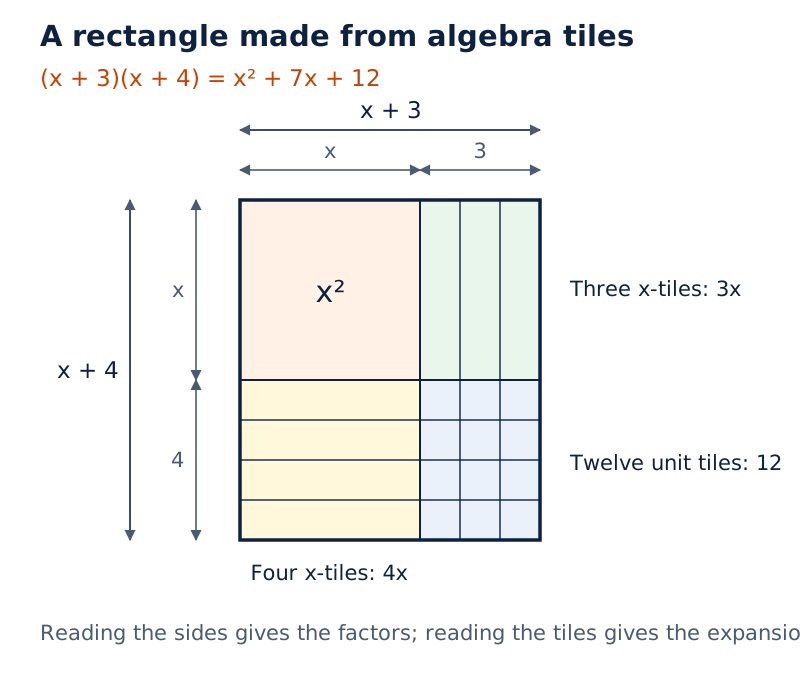
The horizontal side is labelled x + 3 and the vertical side x + 4. One x² square has three x rectangles to its right and four below it. Twelve unit squares fill the remaining three-column, four-row corner.
Drawn by One Young India. See Fig. 4.7 in your NCERT textbook
Reading the side lengths from the tiled rectangle gives the linear factors x + 3 and x + 4. Linear means that the variable appears to the first power. Reading all the tile areas gives the expanded expression.
What general product does the arrangement suggest?
(x + a)(x + b) = x² + (a + b)x + ab. Here x is the variable and a and b represent numbers. The coefficient of x is the sum a + b; the constant term, independent of x, is their product ab.
For more general factors, let p and q be the coefficients of x and a and b the constant terms. Distributing every term gives (px + a)(qx + b) = pqx² + (pb + qa)x + ab.
The coefficient of x² comes from multiplying px by qx. The two products involving just one x combine into (pb + qa)x. The constants multiply to ab. Algebra supplies this rule even when a particular choice of numbers cannot represent positive tile lengths.
How can quadratic expressions be factorised without tiles?
A quadratic expression in x has highest power x² after like terms are collected, with a non-zero coefficient of x². For expressions beginning with x², use x² + (a + b)x + ab = (x + a)(x + b).
The two numbers a and b must meet both conditions: their sum equals the coefficient of x, and their product equals the constant term. A pair that meets just one condition does not give the required factorisation.
Worked example 9. Factor x² + 11x + 30.
Answer: We need a + b = 11 and ab = 30. Choose 5 and 6. Then x² + 11x + 30 = x² + (5 + 6)x + 30 = (x + 5)(x + 6).
The pairs 2 and 15, or 3 and 10, both have product 30 but fail the required sum. This is why listing factors of the constant must be followed by checking the middle coefficient.
Worked example 10. Factor x² − 5x + 6.
Answer: Find two numbers with sum −5 and product 6. They are −2 and −3. Thus x² − 5x + 6 = (x − 2)(x − 3).
How does splitting the middle term help?
Splitting the middle term means writing it as two terms whose sum is unchanged. For x² + 7x + 12, write 7x as 3x + 4x. This is the algebraic version of arranging the seven x-tiles along two sides.
For x² − 5x + 6, write the middle term as −2x − 3x. The signs must satisfy the sum and product together. Multiplying the proposed factors back out checks that all three original terms, including their signs, are recovered.
Factorisation therefore uses the same distributive property as expansion. The task is to recognise a suitable product whose expansion matches the whole expression, rather than merely matching its first and last terms.
How are cube identities constructed and visualised?
The cube of a number a is a³ = a × a × a. Geometrically, a cube with edge length a has volume a³ cubic units. A cuboid is a rectangular solid whose volume is the product of its length, breadth and height.
Identity: Cube of a sum
(a + b)³ = a³ + 3a²b + 3ab² + b³. Multiply (a + b) by the known expansion a² + 2ab + b². Distribute both terms of the first bracket and collect matching products.
What the figure shows
Partitioning a cube
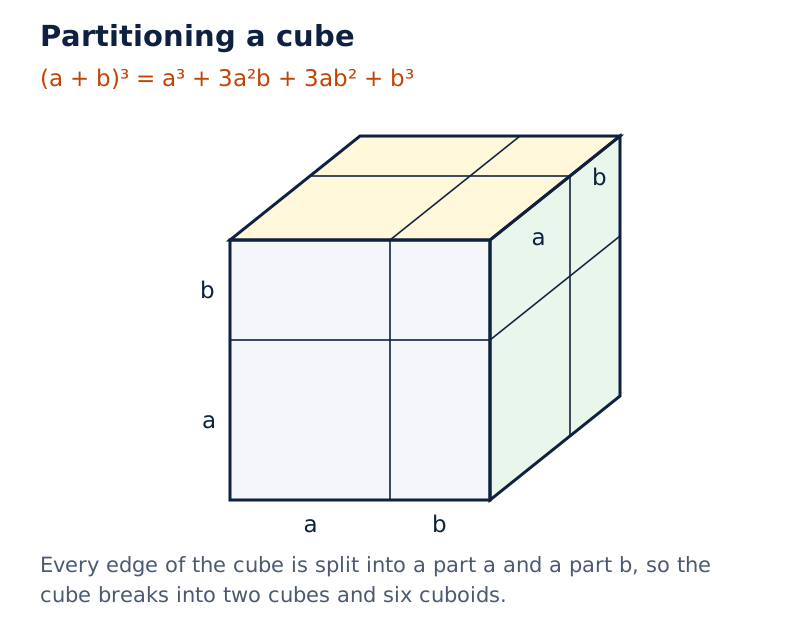
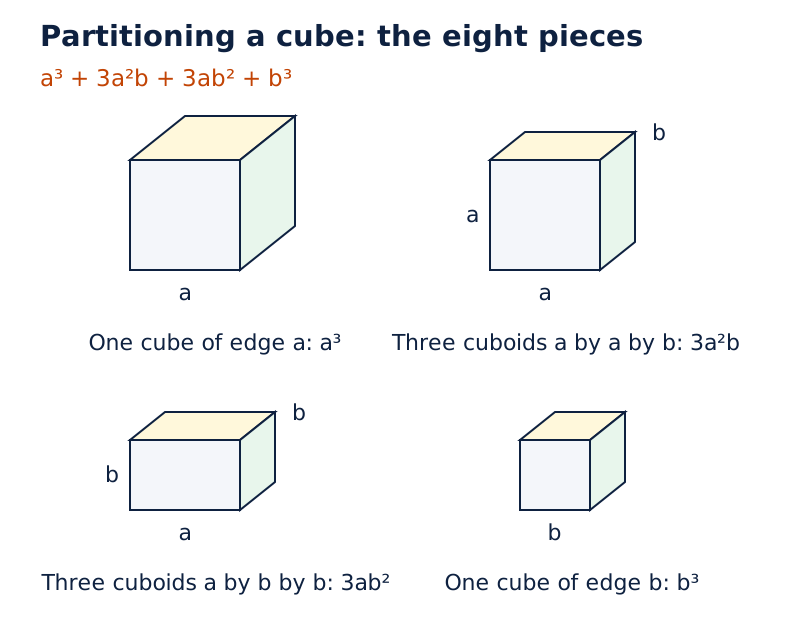
The drawings separate a cube into two cubes labelled a³ and b³, three yellow cuboids grouped as 3a²b, and three green cuboids grouped as 3ab². Edges are labelled a or b.
Drawn by One Young India. See Fig. 4.10 in your NCERT textbook
Three cuboids have dimensions a, a and b; each has volume a²b. The other three have dimensions a, b and b; each has volume ab². Including the two cubes accounts for every part of the larger cube.
Identity: Cube of a difference
(a − b)³ = a³ − 3a²b + 3ab² − b³. Substitute −b for b in the cube-of-a-sum identity. The written signs alternate: plus, minus, plus, minus. In particular, the term involving b² retains a plus sign.
Worked example 11. Find the side of a cube with volume p³ + 6p²q + 12pq² + 8q³ cubic units.
Answer: This equals p³ + 3p²(2q) + 3p(2q)² + (2q)³ = (p + 2q)³. Hence the side is p + 2q units, with a positive value as a length.
Worked example 12. Express 8n³ − 60n²m + 150nm² − 125m³ as a cube, where n and m are variables.
Answer: Rewrite it as (2n)³ − 3(2n)²(5m) + 3(2n)(5m)² − (5m)³. It is therefore (2n − 5m)³.
Matching a cube requires checking all four terms. The first and last cubes identify possible substitutions; the two middle terms confirm whether the expression has the required form.
How do sums and differences of cubes lead to new identities?
The difference of cubes is x³ − y³, which is different from the cube of the difference, (x − y)³. Multiplying carefully shows that x³ − y³ = (x − y)(x² + xy + y²).
Distribute x and then −y through the second factor. This gives x³ + x²y + xy² − x²y − xy² − y³. Both pairs of mixed terms cancel, leaving exactly the difference of the cubes.
Similarly, the sum of cubes factors as x³ + y³ = (x + y)(x² − xy + y²). The negative middle term in the second factor allows the mixed products to cancel. It does not change the final plus sign between the cubes.
Identity: Three cubes and their product
Let z be a third variable. Then x³ + y³ + z³ − 3xyz = (x + y + z)(x² + y² + z² − xy − xz − yz). Here xyz is the product x × y × z.
Expanding the product on the right cancels the terms involving the square of one variable and the first power of another. Three negative copies of xyz remain alongside x³, y³ and z³.
Worked example 13. Three numbers x, y and z have sum 10, product 25 and sum of squares 38. Find their sum of cubes.
Answer: Squaring the sum gives 100 = 38 + 2(xy + xz + yz), so xy + xz + yz = 31. The three-cube identity gives x³ + y³ + z³ = 10(38 − 31) + 3 × 25 = 145.
The sum of pairwise products was not an extra assumption: it was calculated from the given sum and sum of squares. This example combines two identities, using the first result to supply the quantity needed in the second.
When a calculation involves several related expressions, write down the given quantities first. Then choose an identity that connects them to the unknown quantity. This avoids trying to determine each individual number when that is unnecessary.
How does factorisation simplify fractions and solve area problems?
A rational algebraic expression is a fraction whose numerator and denominator are polynomials, expressions formed from variable terms with non-negative integer powers. The numerator is above the fraction bar; the denominator is below it and must not equal zero.
To simplify such a fraction, factor both parts and remove matching non-zero factors. Cancellation is division by a common factor. It applies to factors of the entire numerator and denominator, not to individual terms in a sum.
Worked example 14. Simplify (x² − 7x + 12)/(5x² + 5x − 100), assuming 5x² + 5x − 100 ≠ 0. The sign ≠ means “is not equal to”.
Answer: The numerator is (x − 3)(x − 4). The denominator is 5(x² + x − 20) = 5(x − 4)(x + 5). Cancel the non-zero factor x − 4 to obtain (x − 3)/[5(x + 5)].
Note: The original denominator condition requires x ≠ 4 and x ≠ −5. Both restrictions remain after simplification, even though the factor x − 4 no longer appears in the denominator.
How do factors describe dimensions?
Saira uses a square of side x units, eight rectangular strips of sides x and 1 units, and fifteen squares of side 1 unit. Their total area is x² + 8x + 15 square units.
Since 3 + 5 = 8 and 3 × 5 = 15, the area factors as (x + 3)(x + 5). Possible dimensions of the assembled rectangle are therefore length x + 5 units and breadth x + 3 units.
Worked example 15. A rectangular pool has area 96 square metres and breadth 4 metres less than its length. Find its dimensions.
Answer: Let x be the length in metres. Then x(x − 4) = 96, so x² − 4x − 96 = (x − 12)(x + 8) = 0. Thus x = 12 or x = −8. Reject the negative length. The pool is 12 metres long and 8 metres broad.
A product is zero when at least one factor is zero. This converts the factored pool equation into two possible values of x. The physical meaning then selects the positive length, showing why an algebraic solution must be interpreted in its context.
Glossary
- Variable — A letter representing a number whose value can change within an expression or equation.
- Equation — A statement that two expressions are equal, which need not hold for every variable value.
- Identity — An equation that holds for all values of the variables occurring in it.
- Binomial — An algebraic expression containing two terms joined by addition or subtraction.
- Coefficient — The numerical multiplier attached to a variable term in an algebraic expression.
- Constant term — A term whose value does not depend on the variable being considered.
- Distributive property — The rule that multiplies each term inside brackets by the factor outside them.
- Factorisation — Rewriting an expression as a product of factors that reproduce it when multiplied.
- Common factor — A factor present in every term, or shared by the expressions being compared.
- Perfect-square expression — An expression that can be written as another expression multiplied by itself.
- Algebra tiles — Squares and rectangles whose areas represent terms and help visualise multiplication or factorisation.
- Quadratic expression — An expression in one variable whose highest power after collecting like terms is two.
- Rational algebraic expression — A fraction formed from polynomials, with values restricted so its denominator is not zero.
Common errors and misconceptions
- Misconception: Every equation is an identity. Correct: An identity holds for all variable values; x² − 1 = 24 holds only for x = 5 or x = −5.
- Misconception: Squaring a sum means adding the separate squares. Correct: The expansion includes 2ab, represented by two rectangular areas in the partitioned-square model.
- Misconception: Every term after the first becomes negative in (a − b)². Correct: The expansion is a² − 2ab + b²; squaring −b gives b², which is non-negative.
- Misconception: The square of a difference equals the difference of squares. Correct: (a − b)² includes −2ab, while a² − b² factors as (a + b)(a − b).
- Misconception: Any factor pair of the constant gives a quadratic factorisation. Correct: The pair must also have the required sum matching the coefficient of x.
- Misconception: The cube of a sum is the sum of the cubes. Correct: (a + b)³ also contains 3a²b and 3ab², corresponding to the six cuboids.
- Misconception: A cancelled factor removes the original denominator restriction. Correct: The expression remains restricted to values for which its original denominator is non-zero.
- Misconception: Both algebraic solutions of the pool problem give dimensions. Correct: The negative value cannot represent length, leaving length 12 metres and breadth 8 metres.
Exam-style questions with model answers
Q1. For variables x and y, explain why x² − 1 = 24 is not an identity but (x + y)² = x² + 2xy + y² is an identity. [2 marks]
- The first equation holds only for x = 5 or x = −5, so it does not hold for all values of x.
- The second equation follows by distributing (x + y)(x + y), giving equality for all values of x and y.
Q2. Expand (5x + 2y)² using an identity, where x and y are variables. [3 marks]
- Use the identity (a + b)² = a² + 2ab + b², where a and b are placeholders for the two terms being added.
- Substitute a = 5x and b = 2y to obtain (5x)² + 2(5x)(2y) + (2y)².
- Square both complete terms and calculate the middle product. The required expansion is 25x² + 20xy + 4y².
Q3. Factor 50p² + 60pq + 18q² completely, where p and q are variables. [3 marks]
- Every term has common factor 2. Taking it outside brackets gives 2(25p² + 30pq + 9q²).
- Inside the brackets, recognise (5p)² + 2(5p)(3q) + (3q)². The middle term is exactly twice the product of 5p and 3q.
- Apply the square-of-a-sum identity to obtain 2(5p + 3q)². Retain the outside factor 2 in the complete factorisation.
Q4. Let n be an integer greater than 1. Prove that adding (n − 1)² and (n + 1)², then subtracting twice n², gives 2. [4 marks]
- The three consecutive integers are n − 1, n and n + 1, so their consecutive squares are the three expressions given.
- Expand the first outer square using the difference identity: (n − 1)² = n² − 2n + 1.
- Expand the other outer square: (n + 1)² = n² + 2n + 1. Adding them cancels the opposite linear terms and gives 2n² + 2.
- Subtract twice the middle square: (2n² + 2) − 2n² = 2. The argument holds for every permitted n.
Q5. Three numbers x, y and z satisfy x + y + z = 10, xyz = 25 and x² + y² + z² = 38. Find x³ + y³ + z³ using identities. [5 marks]
- Use the square-of-a-three-term-sum identity: (x + y + z)² = x² + y² + z² + 2(xy + xz + yz).
- Insert the given values to obtain 100 = 38 + 2(xy + xz + yz). Therefore, the sum of the pairwise products is xy + xz + yz = 31.
- Use x³ + y³ + z³ − 3xyz = (x + y + z)(x² + y² + z² − xy − xz − yz).
- Substitute all the known quantities: x³ + y³ + z³ − 3 × 25 = 10(38 − 31) = 70.
- Add 75 to both sides. The sum of the cubes is 145, found without needing the individual numbers.
Q6. Simplify (x² − 7x + 12)/(5x² + 5x − 100), where x is a variable and 5x² + 5x − 100 ≠ 0. State the restrictions retained. [5 marks]
- For the numerator, choose −3 and −4 because their sum is −7 and product is 12. Thus x² − 7x + 12 = (x − 3)(x − 4).
- Remove the common factor 5 from the denominator to obtain 5(x² + x − 20).
- The numbers 5 and −4 have sum 1 and product −20. Hence the complete denominator is 5(x − 4)(x + 5).
- Cancel the common factor x − 4, which is non-zero under the stated denominator condition. The simplified expression is (x − 3)/[5(x + 5)].
- Retain x ≠ 4 and x ≠ −5 from the original denominator. Cancelling a factor does not make the original fraction defined at an excluded value.
Q7. A rectangular pool has area 96 square metres. Its breadth is 4 metres less than its length. Find both dimensions by factorisation. [4 marks]
- Let x be the length in metres. The breadth is x − 4 metres, so the area condition gives x(x − 4) = 96.
- Rearrange and split the middle term: x² − 4x − 96 = x² − 12x + 8x − 96 = (x − 12)(x + 8) = 0.
- A zero product gives x = 12 or x = −8. Reject x = −8 because a pool cannot have negative length.
- The length is 12 metres and the breadth is 12 − 4 = 8 metres. Their product is the given area of 96 square metres.
Q8. A cube has volume p³ + 6p²q + 12pq² + 8q³ cubic units, where p and q represent numbers and p + 2q is positive. Find its side. [3 marks]
- Compare the volume with (a + b)³ = a³ + 3a²b + 3ab² + b³, using a = p and b = 2q as substitutions.
- The given expression becomes p³ + 3p²(2q) + 3p(2q)² + (2q)³, which is exactly (p + 2q)³.
- A cube's volume is its side cubed. Therefore its side is p + 2q units, positive under the given condition.
Key takeaways
- An identity is an equation true for all variable values; numerical checks illustrate a result, while a general argument proves it.
- The square of a sum includes twice the product of its two terms, represented by two rectangles in an area model.
- Squaring a difference gives a² − 2ab + b²; multiplying a sum by its corresponding difference gives a² − b².
- The square of a three-term sum contains three individual squares and twice each product of two different terms.
- To factor x² + (a + b)x + ab, choose numbers satisfying the required sum and product together.
- Cube identities include mixed terms; a geometrical model accounts for them through six cuboids alongside two cubes.
- Factor numerator and denominator before cancelling common non-zero factors, and retain every restriction imposed by the original denominator.
- Area and volume factorisations can suggest dimensions, but each proposed length must have a physically meaningful positive value.
Test yourself
What distinguishes an identity from an equation that is not an identity?
An identity holds for all values of its variables. An equation that is not an identity may hold for some values or for none, but it does not hold for all values.
Which regions explain 2ab in the square-of-a-sum area model?
Two rectangles each have sides a and b, and hence area ab. Adding their areas produces the middle term 2ab.
Why does the final term in (a − b)² have a plus sign?
Replacing b with −b gives a last term of (−b)². Since (−b)(−b) = b², the expansion contains +b². The value of b² is non-negative and equals zero when b = 0.
For x² + 11x + 30, why do 2 and 15 fail as the required factor pair?
Their product is the required 30, but their sum is not 11. The pair must satisfy both conditions; 5 and 6 do.
What is the factorisation of x³ − y³?
It is (x − y)(x² + xy + y²). Expansion cancels the mixed products, leaving exactly the difference of the cubes.
What must be checked before cancelling a common factor in an algebraic fraction?
The common factor must be non-zero. Keep the original denominator restrictions even if the cancelled factor disappears from the simplified fraction.
What are possible dimensions of a rectangle with area x² + 8x + 15 square units, where x is positive?
Factor the area as (x + 3)(x + 5). Possible length and breadth are x + 5 units and x + 3 units.
How many smaller solids occur in the cube-of-a-sum model?
There are two cubes and six cuboids. Three cuboids have volume a²b each and the other three have volume ab² each.
Write about it
Turn a question from this chapter into a paper.
The Writing Studio has a structure guide, a rubric and citation tools for 15 formats, from essays to research papers. Drafting is free with an account. Learnacy Essential adds feedback from an AI writing coach and submission to The OYI Review.
Learnacy Essential is ₹1,499 for the year. Publication depends on review and is not guaranteed.