
I’m Up and Down, and Round and Round | CBSE Class 9 Maths Notes
On this page

This note covers circles and their symmetry, circles through given points, circumcircles, chords and central angles, perpendicular bisectors, chord lengths and distances, angles subtended by arcs, concyclic points, and cyclic quadrilaterals.
What are a circle, a radius, a chord and a diameter?
A plane is a flat, two-dimensional surface. A circle consists of all points in a plane at a fixed distance from a fixed point. That fixed point is its centre; the fixed distance is its radius.
The word equidistant means at equal distances. A locus is the set of points satisfying a given condition. Thus, a circle is the locus of points equidistant from its centre. This description specifies the points on the circular boundary.
Definition: A line segment is the straight part between two endpoints. A chord is a line segment joining two points on a circle. A diameter is a chord passing through the centre. A radius also names a segment joining the centre to a point on the circle.
How do we read the geometric notation?
Letters name points. In the first diagram, A names the centre, while B and C name points on the circle. The notation BC names the segment joining B to C, or its length when used in an equality or calculation.
The symbol ∠ means angle. In ∠BAC, the middle letter A is the vertex, where the two arms AB and AC meet. A single-letter form such as ∠A names the angle at A when it is unambiguous. An angle with its vertex at the centre is a central angle. The chord BC subtends this angle: joining its endpoints to A forms the angle at A.
What the figure shows
Centre, radii and chord
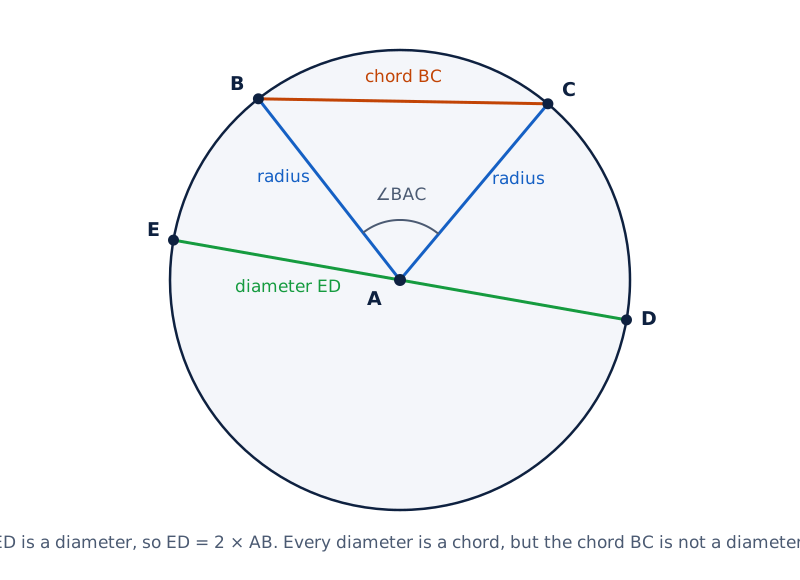
A is marked inside the circle as its centre. B and C lie on the circle, BC joins them, and AB and AC join them to A. E and D mark the endpoints of diameter ED, which passes through A.
Drawn by One Young India. See Fig. 5.3 in your NCERT textbook
In calculations, = means equals, + means addition, − means subtraction, × means multiplication, and / means division.
A diameter contains two radii placed end to end. Its length is therefore twice the radius. Every diameter is a chord, but a chord need not pass through the centre. Distinguishing these terms prevents using the diameter as the radius in calculations.
How do symmetry and two given points determine circles?
Rotational symmetry means that turning a figure about a point makes it coincide with its original position. A circle has complete rotational symmetry about its centre: turning it through any angle leaves its appearance unchanged.
Reflection symmetry means that the two parts on either side of a line match as mirror images. Fold a circular paper so that its boundaries overlap. The crease passes through the centre. Every diameter lies along a line of reflection symmetry.
Where can the centre of a circle through two points lie?
Let A and B be two distinct points. Their midpoint divides segment AB into two equal parts. Its perpendicular bisector is the line through that midpoint meeting AB at a right angle. A right angle measures 90 degrees, written 90°.
Every point on this perpendicular bisector is equidistant from A and B. Conversely, every point equidistant from A and B lies on it. The word converse describes a statement formed by reversing the direction of an implication.
A circle through A and B must have its centre equidistant from them. Any point on the perpendicular bisector can serve as that centre. Consequently, infinitely many circles pass through two distinct points, with their centres on this one line.
The smallest such circle has AB as diameter, so its radius is half the length of AB. As the centre moves farther from AB along the perpendicular bisector, the radius increases. There is no largest circle through the two points.
Worked example 1. What is the longest chord in a circle of radius 5 units?
Answer: The diameter is the longest chord. Its length is 2 × 5 = 10 units, where × means multiplication. A chord through the centre reaches this length.
Why is there one circle through three non-collinear points?
Points are collinear if they lie on one straight line. Three distinct points that do not lie on one straight line are non-collinear. Unlike two points, three non-collinear points determine both the centre and the radius of one circle.
Theorem: Three non-collinear points determine a unique circle
Let A, B and C be three non-collinear points. Suppose O is the centre of a circle through them. The equalities OA = OB and OA = OC require O to lie on the perpendicular bisectors of both AB and AC.
- Construct the perpendicular bisector of AB. Its points have equal distances from A and B.
- Construct the perpendicular bisector of AC. Its points have equal distances from A and C.
- The two bisectors intersect at one point O. Hence OA = OB = OC.
- Draw the circle with centre O and radius OA. It passes through all three points, and no other intersection can provide a different centre.
The circle through a triangle’s three vertices, or corners, is its circumcircle. Its centre is the circumcentre. The triangle is said to be inscribed in the circle, while the circle circumscribes the triangle.
What the figure shows
Constructing a circumcircle
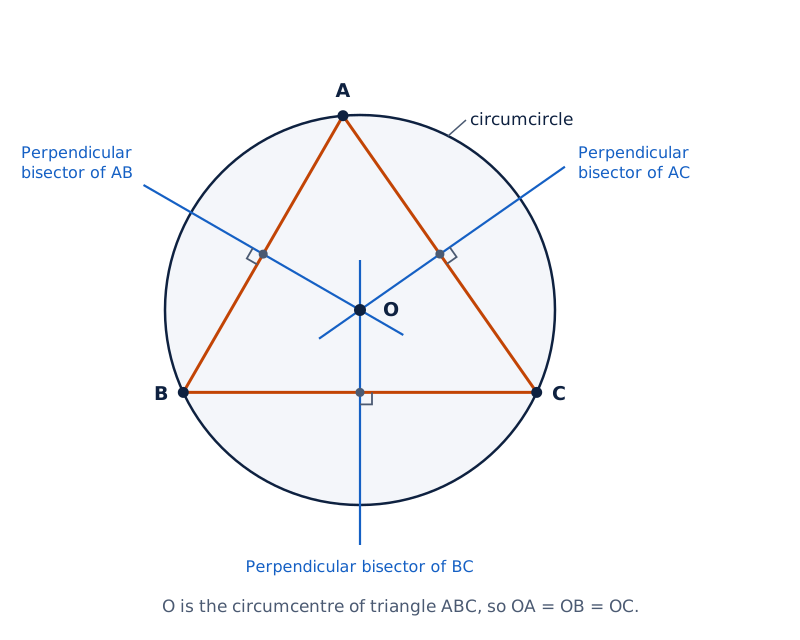
Triangle ABC lies inside a circle with its vertices on the boundary. The perpendicular bisectors of AB, BC and AC meet at O, the circle’s centre.
Drawn by One Young India. See Fig. 5.5 in your NCERT textbook
Where does the circumcentre lie?
| Triangle | Meaning | Circumcentre |
|---|---|---|
| Acute-angled | All angles are less than 90° | Inside the triangle |
| Obtuse-angled | One angle is greater than 90° | Outside the triangle |
| Right-angled | One angle equals 90° | Midpoint of the hypotenuse, the side opposite the right angle |
Worked example 2. Triangle ABC has AB = 5 cm, ∠A = 70° and ∠B = 60°. Here cm means centimetres. Where is its circumcentre?
Answer: The triangle’s angles total 180°, so ∠C = 180° − 70° − 60° = 50°. All three angles are acute. The circumcentre is inside the triangle.
Three distinct collinear points have no circumcircle. The perpendicular bisectors of successive segments on their line are parallel, meaning that they do not meet in the plane, so they cannot meet at a common centre equidistant from all three points.
How are equal chords related to angles at the centre?
Join both endpoints of a chord to the circle’s centre. The resulting triangle has two equal sides because these sides are radii. Such a triangle is isosceles, meaning that two of its sides are equal. The chord forms its base.
Theorem: Equal chords subtend equal central angles
Let C be the centre, and let AB and DE be equal chords. Join C to A, B, D and E. The two triangles have equal radii in corresponding positions, together with the given equal chords.
Congruent triangles have the same size and shape, so corresponding sides and angles are equal. The SSS, or side-side-side, condition establishes congruence when all three corresponding sides are equal.
- CA = CD because both segments are radii of the same circle.
- CB = CE for the same reason.
- AB = DE is the given equality of the chords.
- Triangles CAB and CDE are congruent by SSS, giving ∠ACB = ∠DCE.
Theorem: Equal central angles subtend equal chords
Now suppose ∠ACB = ∠DCE is given instead. Again, CA = CD and CB = CE because all four segments are radii. The given angles lie between the corresponding pairs of equal radii.
The SAS, or side-angle-side, condition uses two equal corresponding sides and their equal included angle. It makes triangles ACB and DCE congruent. Their corresponding third sides are equal, giving AB = DE. This proves the converse.
Keep the direction of the reasoning clear. Given equal chord lengths, prove equal central angles using SSS. Given equal central angles, prove equal chord lengths using SAS. In each argument, the equality of the radii supplies the other needed side equalities.
Note: These results compare chords of the same circle. The central angle and the radii must belong to the circle under discussion; the proof depends on those radii having equal lengths.
Why does a perpendicular from the centre bisect a chord?
Theorem: The centre-to-midpoint line is perpendicular to a chord
Let C be the centre and AB a chord not passing through C. Let M be the midpoint of AB. A line is perpendicular to another when they meet at 90°. The claim is that CM is perpendicular to AB.
Triangle CAB is isosceles because CA = CB. Its base angles, the angles at the endpoints A and B of its base, are equal. Since M lies on AB, these are the angles used when comparing triangles CMA and CMB. Also, AM = BM because M is the midpoint.
By SAS, triangles CMA and CMB are congruent. Therefore ∠CMA = ∠CMB. They are adjacent angles on a straight line and add to 180°. Each is consequently 90°, which proves the required perpendicular relationship.
What the figure shows
A chord and its midpoint
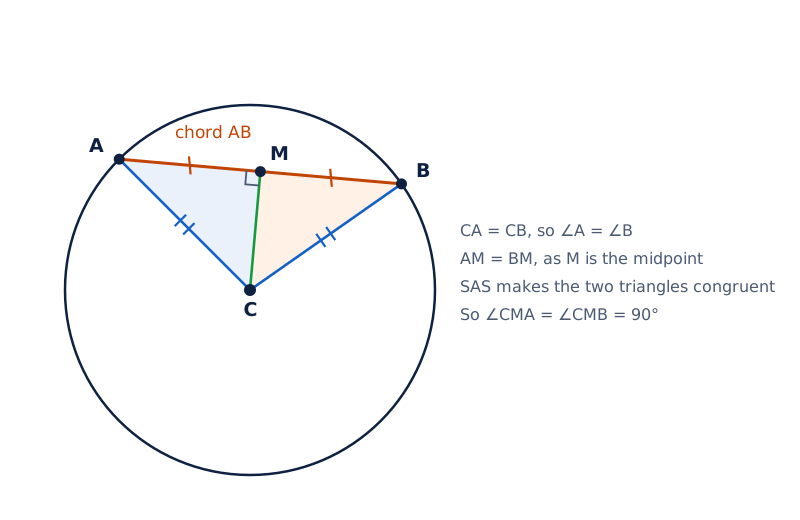
A and B lie on the circle, C is its centre, and M lies on chord AB. Segments CA, CB and CM form two triangles on either side of CM.
Drawn by One Young India. See Fig. 5.12 in your NCERT textbook
Theorem: A perpendicular from the centre bisects the chord
To bisect means to divide into two equal parts. Now start with CM perpendicular to AB. The triangles CMA and CMB are right-angled, have equal hypotenuses CA and CB, and share side CM.
The RHS, or right-angle-hypotenuse-side, condition makes these triangles congruent. It follows that AM = BM. Thus the perpendicular from the centre meets a chord at its midpoint, allowing calculations with half the chord.
A superscript ² means the square of a number, and √ means its square root that is positive or zero. The Baudhāyana-Pythagoras theorem states that a right triangle’s hypotenuse squared equals the sum of the squares of its other two sides.
Worked example 3. Two parallel chords of lengths 6 cm and 8 cm lie on opposite sides of the centre of a circle of radius 5 cm. Find the distance between their midpoints.
Answer: The half-chords measure 3 cm and 4 cm. By the right-triangle relation, their distances from the centre are √(5² − 3²) = 4 cm and √(5² − 4²) = 3 cm. The midpoints are 4 + 3 = 7 cm apart.
The distances are added because the parallel chords lie on opposite sides of the centre. The centre lies between their midpoints on their common perpendicular. This positional information is essential to the calculation.
How do chord lengths compare with their distances from the centre?
The distance from the centre to a chord means its perpendicular distance. The perpendicular meets the chord at its midpoint. An oblique segment, meaning one not perpendicular to the chord, does not represent the distance used in these theorems.
Theorem: Equal chords have equal distances from the centre
Let C be the centre, AB and FG equal chords, and E and H their respective midpoints. The centre-to-midpoint result gives right angles at E and H. Also, AE = FH because these are halves of equal chords.
The right triangles CEA and CHF have equal hypotenuses CA and CF, which are radii, and equal sides AE and FH. RHS congruence gives CE = CH. The perpendicular distances from the centre are therefore equal.
The converse is also true: chords equidistant from the centre have equal lengths. Equal radii and equal perpendicular distances give congruent right triangles. Their half-chords, and therefore their full chords, are equal.
Theorem: The longer chord is nearer the centre
Let AB and DE be unequal chords in a circle with centre C. Drop perpendiculars CF to AB and CG to DE. The symbols > and < mean greater than and less than. Suppose AB > DE.
F and G are the midpoints, so AF > GD. Equal radii give AC² = CD². Applying the Baudhāyana-Pythagoras theorem gives CF² + AF² = CG² + GD². Since AF² is larger, CF² must be smaller than CG², and hence CF < CG.
What the figure shows
Unequal chords and perpendicular distances
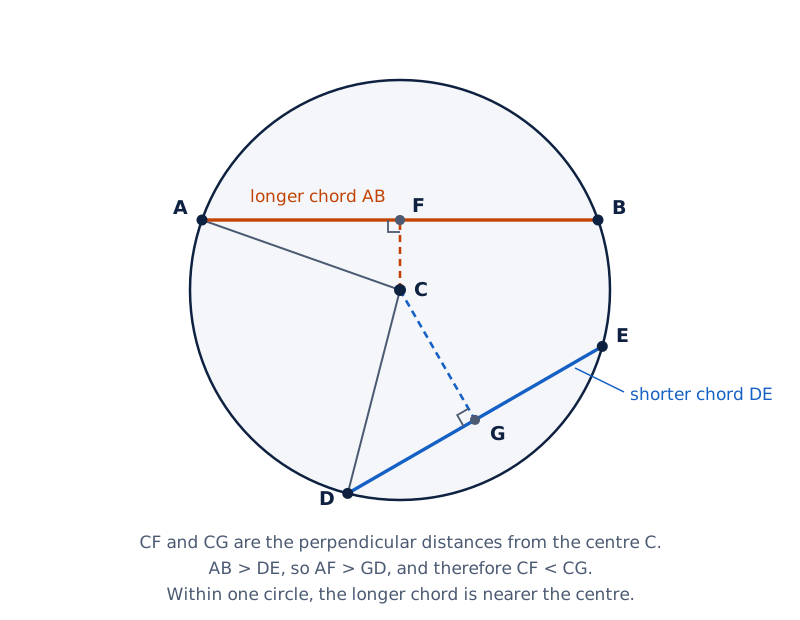
C is the centre. F lies on chord AB and G on chord DE. Segments CF and CG connect the centre to those chords; CA and CD connect it to chord endpoints.
Drawn by One Young India. See Fig. 5.16 in your NCERT textbook
The diameter has zero distance from the centre and is the greatest chord. Moving a chord away from the centre reduces its length. In the limiting position described by a single point on the circle, its length becomes zero and its distance equals the radius.
Paper folding and rotating a tracing can suggest these relationships. However, several successful measurements do not establish a general result. The congruence and right-triangle arguments explain why the relationships hold for every configuration satisfying their conditions.
How can chord lengths and radii be calculated?
Let r denote the radius, d the perpendicular distance of a chord from the centre, and L the full chord length. The perpendicular bisects the chord, so the right triangle uses half its length, written L/2. The slash denotes division.
The right-triangle relation is r² = d² + (L/2)². Subtracting d², taking the non-negative square root and doubling gives L = 2√(r² − d²). The square-root sign covers the entire difference inside the brackets.
What sequence keeps the calculation clear?
- Identify the radius; if the diameter is supplied, divide it by two.
- Draw or identify the perpendicular from the centre to the chord.
- Use the right triangle formed by the radius, perpendicular and half-chord.
- Calculate the missing length, doubling the half-chord when the full chord is required.
Worked example 4. Find the chord length when the radius is 7 cm and its perpendicular distance from the centre is 6 cm.
Answer: The half-chord is √(7² − 6²) = √(49 − 36) = √13 cm. The full chord is 2√13 cm. Doubling takes place after finding the square root.
Worked example 5. A chord is 5 cm from the centre of a circle of radius 13 cm. Find its length.
Answer: Half the chord measures √(13² − 5²) = √(169 − 25) = √144 = 12 cm. Therefore the full chord measures 24 cm.
Worked example 6. A circle has diameter 26 cm and a chord of length 24 cm. Find the chord’s distance from the centre.
Answer: The radius is 13 cm and the half-chord is 12 cm. The perpendicular distance is √(13² − 12²) = √(169 − 144) = 5 cm.
Worked example 7. A chord of length 16 cm is 6 cm from the centre. Find the radius.
Answer: Half the chord is 8 cm. The radius is the hypotenuse, so r² = 6² + 8² = 36 + 64 = 100. Hence r = 10 cm.
These examples use one relationship in different directions. When finding the radius, add the squares of the two shorter sides. When finding a perpendicular distance or half-chord, subtract the square of the known shorter side from the radius squared.
What is an arc, and how are its subtended angles related?
An arc is a connected portion of a circle between two endpoints. Two points A and B split the boundary into two arcs. When their lengths differ, the shorter is the minor arc and the longer is the major arc.
For a circle with centre O, the angle subtended by an arc is the angle swept from OA to OB while following that arc. A minor arc gives an angle less than 180°; a major arc gives one greater than 180°.
A reflex angle is greater than 180° and less than a complete turn of 360°. Thus, specifying the arc matters: using the smaller central angle for the major arc would refer to the wrong sweep.
Theorem: The central angle is twice the angle on the remaining circle
Fix an arc with endpoints A and B. Let D be a point on the circle outside that arc. Joining DA and DB forms the angle subtended at D. The arc’s angle at the centre is twice its angle at D.
For the proof, use C as the centre and name the chosen arc AFB, with F on it. Join DC and extend it to meet the circle at E. Radii CA, CB and CD form two isosceles triangles.
An exterior angle of a triangle is formed by extending one of its sides. It equals the sum of the two interior angles not adjacent to it. Applying this result to the isosceles triangles gives ∠ACE = 2∠ADC and ∠BCE = 2∠BDC.
What the figure shows
Two positions in the central-angle proof
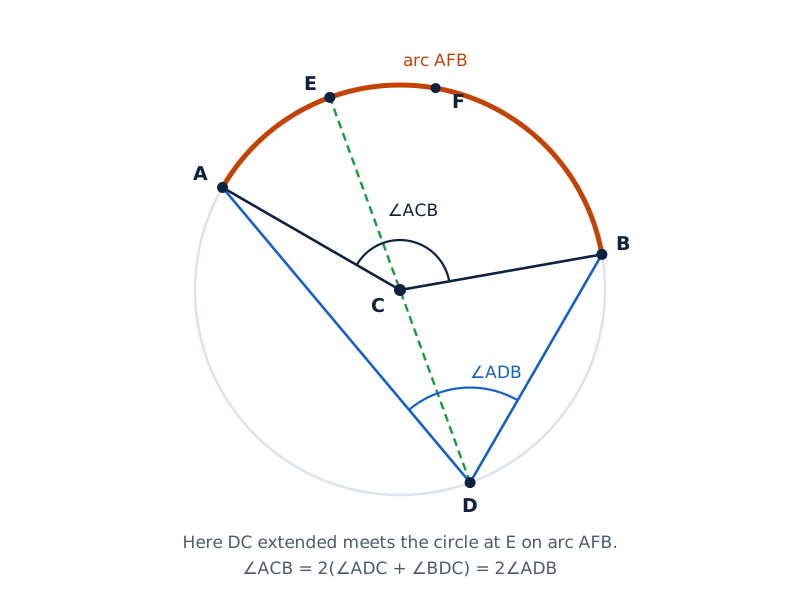
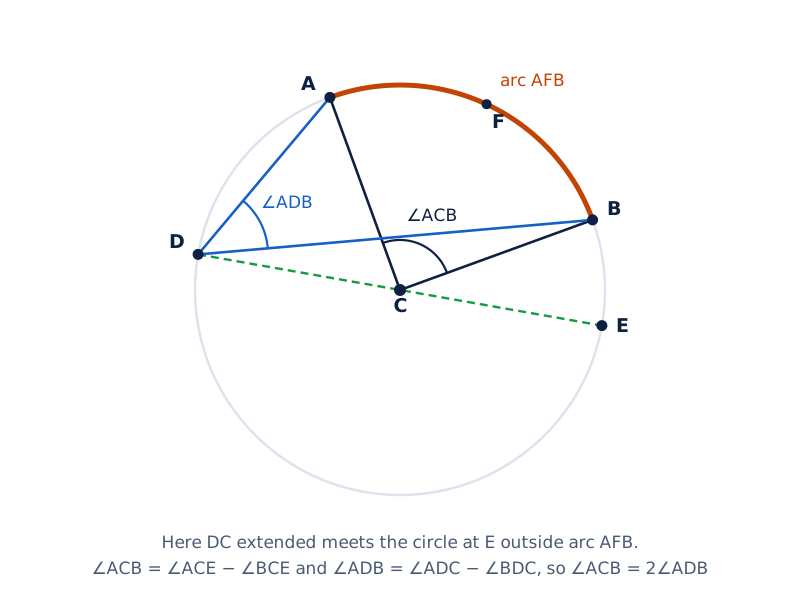
Both drawings show arc AFB, centre C and a point D on the remaining circle. The extension of DC reaches E on arc AFB in Figure 5.21 and outside it in Figure 5.22.
Drawn by One Young India. See Figs. 5.21 and 5.22 in your NCERT textbook
In the first position, add the two central angles and the two angles at D. This gives ∠ACB = 2(∠ADC + ∠BDC) = 2∠ADB. The equality follows by adding the paired angles from the two isosceles triangles.
In the second position, subtract instead: ∠ACB = ∠ACE − ∠BCE, while ∠ADB = ∠ADC − ∠BDC. The same doubled relationship follows. The two arrangements need different operations, although the theorem’s conclusion is unchanged.
Worked example 8. An arc subtends 70° at the centre. Find its angle at a point on the circle outside that arc.
Answer: The angle on the remaining circle is half the central angle. It equals 70°/2 = 35°. The point must lie on the circle outside the specified arc.
All points on the remaining arc give the same subtended angle because each angle is half one fixed central angle. This is the equal-angle property commonly described as angles in the same segment.
How do semicircles and equal angles help identify circles?
A semicircle is half a circle, with a diameter joining its endpoints. The arc along either half subtends a straight angle of 180° at the centre. A point on the other half therefore sees that diameter at half of 180°.
Result: The angle in a semicircle is a right angle
If AB is a diameter and D is another point on the circle, ∠ADB = 90°. This follows directly from the central-angle theorem. A result following immediately from an already proved result is called a corollary.
The equal-angle property requires the observation points to be on the circle and on the same side of the chord. Moving an observation point into the interior or exterior does not preserve the theorem’s hypotheses, meaning its required starting conditions.
Worked example 9. In a circle with centre O, the central angle AOB is 60° and the radius is 12 cm. Find chord AB.
Answer: OA = OB, so the two base angles of triangle AOB are equal. Together they measure 180° − 60° = 120°, giving 60° each. The triangle is equilateral, meaning all three sides are equal. Thus AB = 12 cm.
Theorem: Equal angles on the same side imply concyclicity
Points are concyclic when they lie on one circle. Suppose C and D are on the same side of segment AB, neither lies on the line AB, and ∠ACB = ∠ADB. Then A, B, C and D are concyclic.
First draw the unique circle through the non-collinear points A, B and C. To establish the conclusion, test the two alternatives to D lying on it: D could be outside the circle or inside it.
In the outside position, AD meets the circle again at E. The angle ∠AEB equals ∠ACB because E and C are on the same remaining arc. But ∠AEB is an exterior angle of triangle BED, so it exceeds ∠ADB, contradicting their required equality.
In the inside position, extend AD to E on the circle. Now ∠ADB is the exterior angle and exceeds ∠AEB, again contradicting equality. Both alternatives fail, leaving D on the circle through A, B and C.
What characterises a cyclic quadrilateral?
A quadrilateral, also called a 4-gon, has four sides. It is cyclic when its four vertices lie on one circle. For vertices named A, B, C and D in boundary order, A and C are opposite vertices, as are B and D.
Theorem: Opposite angles of a cyclic quadrilateral total 180°
Let O be the centre of the circle through A, B, C and D. The angle ∠BAD is half the central angle belonging to arc BCD. The opposite angle ∠BCD is half the central angle belonging to arc BAD.
These two arcs together complete the circle, so their central angles total 360°. Consequently, ∠BAD + ∠BCD = 180°. The other opposite pair also totals 180°. Two angles adding to 180° are called supplementary.
What the figure shows
Opposite angles and their arcs
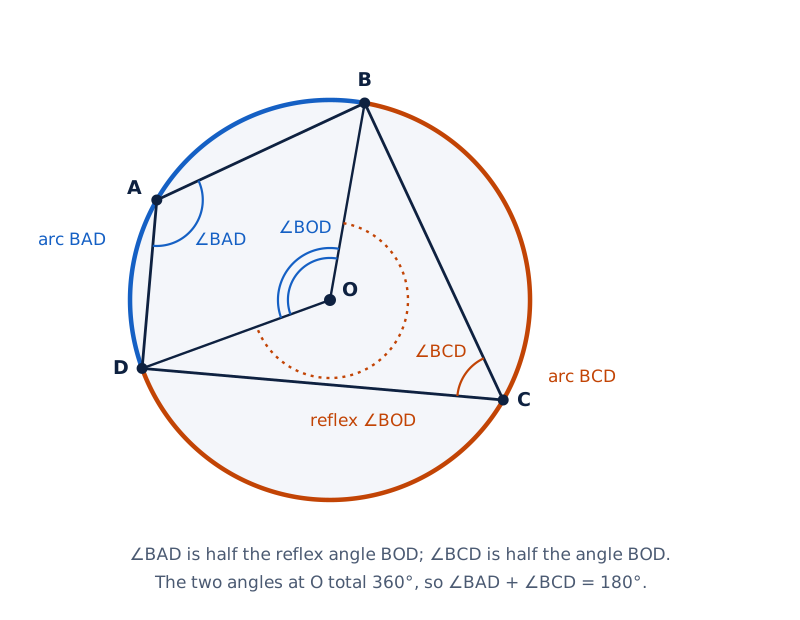
A, B, C and D lie on one circle with centre O. OB and OD are drawn. Angle markings distinguish the smaller and reflex angles at O associated with the two arcs between B and D.
Drawn by One Young India. See Fig. 5.28 in your NCERT textbook
Theorem: Supplementary opposite angles imply cyclicity
The converse supplies a test: if a pair of opposite angles of a quadrilateral adds to 180°, its vertices lie on one circle. This test allows cyclicity to be established from angle information before the circle is drawn.
The two directions serve different purposes. For a known cyclic quadrilateral, subtract a known angle from 180° to find its opposite angle. For a quadrilateral not yet known to be cyclic, check whether opposite angles are supplementary.
Worked example 10. ABCD is cyclic, with ∠A = 75° and ∠B = 110°. Find ∠C and ∠D.
Answer: Opposite angles are supplementary. Therefore ∠C = 180° − 75° = 105°, and ∠D = 180° − 110° = 70°. The pairs used are A with C and B with D.
Worked example 11. PQRS is inscribed in a circle. Its opposite angles are ∠P = (2x + 10)° and ∠R = (3x − 20)°, where x is an unknown number. Find x and the two angles.
Answer: (2x + 10) + (3x − 20) = 180. Thus 5x − 10 = 180, so 5x = 190 and x = 38. Substitution gives ∠P = 86° and ∠R = 94°. Their sum is 180°.
An exterior angle at a vertex of a cyclic quadrilateral equals its interior opposite angle. The exterior angle and the adjacent interior angle total 180°; the opposite interior angle also supplements that same interior angle, so the two are equal.
Glossary
- Circle — The set of points in a plane at a fixed distance from a fixed point.
- Radius — The distance from the centre of a circle to any point on its boundary.
- Chord — A line segment joining two points on the same circle.
- Diameter — A chord passing through the centre, with length twice the radius.
- Locus — The set of all points satisfying a stated geometric condition.
- Perpendicular bisector — A line through a segment’s midpoint, meeting the segment at a right angle.
- Circumcircle — The unique circle passing through all three vertices of a triangle.
- Circumcentre — The centre of a triangle’s circumcircle, where its perpendicular bisectors meet.
- Arc — A connected portion of a circle between two endpoints on the boundary.
- Minor arc — The smaller arc between two endpoints, subtending less than 180° at the centre.
- Major arc — The larger arc between two endpoints, subtending more than 180° at the centre.
- Concyclic points — Points that all lie on the boundary of one circle.
- Cyclic quadrilateral — A quadrilateral whose four vertices all lie on one circle.
- Corollary — A result that follows immediately from another result already proved.
- Supplementary angles — Two angles whose measures add to a total of 180°.
Common errors and misconceptions
- Misconception: Any three distinct points determine a circle. Correct: Three non-collinear points determine a unique circle. Three distinct collinear points do not lie on a circle.
- Misconception: The circumcentre must be inside the triangle. Correct: Its position depends on the triangle: inside for acute triangles, outside for obtuse triangles, and at the hypotenuse’s midpoint for right triangles.
- Misconception: Any segment from the centre measures a chord’s distance. Correct: The required distance is perpendicular to the chord, meeting it at its midpoint.
- Misconception: The full chord is one short side of the right triangle. Correct: Use half the chord with the perpendicular distance and the radius.
- Misconception: The longer chord is farther from the centre. Correct: Within one circle, the longer chord is nearer the centre.
- Misconception: An arc’s angle is half its central angle at any point anywhere. Correct: The point must lie on the circle outside the specified arc.
- Misconception: Adjacent angles of a cyclic quadrilateral must total 180°. Correct: The theorem concerns opposite angles: A with C and B with D when vertices are named in order.
- Misconception: Equal angles alone establish concyclicity. Correct: In the equal-angle test, the angles must stand on the same segment and their vertices must lie on the same side of its line.
Exam-style questions with model answers
Q1. An arc subtends 70° at the centre of a circle. Find its angle at a point on the circle outside that arc, stating the result used. [2 marks]
- An arc’s central angle is twice its angle at any point on the circle outside that arc.
- The required angle is therefore 70°/2 = 35°.
Q2. A circle has radius 7 cm. A chord is at perpendicular distance 6 cm from its centre. Find the chord’s length. [3 marks]
- Draw the perpendicular from the centre to the chord. It bisects the chord and forms a right triangle with a radius and half the chord.
- The half-chord has length √(7² − 6²) = √(49 − 36) = √13 cm, using the Baudhāyana-Pythagoras theorem.
- Double this length to obtain the whole chord: its length is 2√13 cm.
Q3. Triangle ABC has AB = 5 cm, ∠A = 70° and ∠B = 60°. Describe how to construct its circumcircle and state where the centre lies. [4 marks]
- Draw AB of length 5 cm. At A and B, construct angles of 70° and 60° on the same side of AB. The rays, each starting at a vertex and extending in one direction, meet at C.
- Construct the perpendicular bisectors of AB and AC. Name their intersection O.
- Since OA = OB = OC, draw the circle with centre O and radius OA. This is the circumcircle.
- The third angle is 180° − 70° − 60° = 50°. All three angles are acute, so O lies inside the triangle.
Q4. In a circle with centre C, AB and DE are chords of equal length. Prove that ∠ACB = ∠DCE. [5 marks]
- Join C to A, B, D and E. This forms triangles CAB and CDE, with the given chords as their third sides.
- CA and CD are radii of the same circle, so CA = CD. They form one pair of corresponding equal sides.
- CB and CE are also radii of that circle, so CB = CE. They form the second pair of corresponding equal sides.
- The equality AB = DE is given. All three corresponding side pairs are equal, so triangles CAB and CDE are congruent by SSS.
- Corresponding angles in congruent triangles are equal. The angles at C therefore satisfy ∠ACB = ∠DCE, proving the required central-angle relationship.
Q5. Two parallel chords of lengths 6 cm and 8 cm lie on opposite sides of the centre of a circle of radius 5 cm. Find the distance between their midpoints. [4 marks]
- The perpendiculars from the centre bisect the chords. Their half-lengths are therefore 3 cm and 4 cm.
- The distance to the 6 cm chord is √(5² − 3²) = √16 = 4 cm.
- The distance to the 8 cm chord is √(5² − 4²) = √9 = 3 cm.
- The midpoints lie on a common perpendicular with the centre between them, because the parallel chords are on opposite sides. Their separation is 4 + 3 = 7 cm.
Q6. A circle has diameter 26 cm. A chord measures 24 cm. Find its perpendicular distance from the centre. [3 marks]
- The radius is half the diameter, giving 26/2 = 13 cm. This is the hypotenuse of the right triangle formed with the perpendicular to the chord.
- The perpendicular bisects the chord, so the other known side of that triangle is 24/2 = 12 cm.
- The required perpendicular distance is √(13² − 12²) = √(169 − 144) = √25 = 5 cm.
Q7. PQRS is a cyclic quadrilateral, with vertices named in order. Its angles satisfy ∠P = (2x + 10)° and ∠R = (3x − 20)°, where x is an unknown number. Find x and both angles. [4 marks]
- P and R are opposite vertices. Opposite angles of a cyclic quadrilateral are supplementary, so (2x + 10) + (3x − 20) = 180.
- Collecting terms gives 5x − 10 = 180, then 5x = 190, and hence x = 38.
- Substituting gives ∠P = (2 × 38 + 10)° = 86°.
- Similarly, ∠R = (3 × 38 − 20)° = 94°. The check 86° + 94° = 180° confirms the opposite-angle condition.
Q8. AB is a diameter of a circle, and D is a point on the circle distinct from A and B. Prove that ∠ADB is a right angle. [2 marks]
- The semicircular arc from A to B that does not contain D subtends 180° at the centre.
- The same arc subtends half that angle at D, so ∠ADB = 180°/2 = 90°.
Key takeaways
- A circle consists of points at one fixed distance from its centre, and every diameter is a line of reflection symmetry.
- Two distinct points admit infinitely many circles; three non-collinear points determine a unique circumcircle.
- Equal chords subtend equal central angles, and equal central angles correspond to equal chords in the same circle.
- The perpendicular from the centre bisects a chord, creating a right triangle with a radius and half the chord.
- Equal chords have equal perpendicular distances from the centre; among unequal chords, the longer chord is nearer.
- An arc’s central angle is twice its angle at a point on the remaining circle.
- Equal angles standing on the same segment at points on the same side establish that the four points are concyclic.
- A quadrilateral is cyclic when its opposite angles are supplementary; the converse gives the same opposite-angle property.
Test yourself
What condition defines the points of a circle?
They lie in one plane at a fixed distance from the centre.
Where are the centres of circles through two distinct points A and B?
All such centres lie on the perpendicular bisector of segment AB.
Where is the circumcentre of a right-angled triangle?
It is at the midpoint of the hypotenuse, opposite the right angle.
How does the perpendicular from the centre divide a chord?
It bisects the chord, dividing it into two equal lengths.
Of two unequal chords in one circle, which is nearer the centre?
The longer chord has the smaller perpendicular distance from the centre.
What condition must the observation point satisfy in the central-angle theorem?
It must lie on the circle outside the specified arc.
What is the angle subtended by a diameter at another point on the circle?
It is 90°, half the straight angle subtended at the centre.
What angle condition tests whether a quadrilateral is cyclic?
A pair of opposite angles must add up to 180°.
Write about it
Turn a question from this chapter into a paper.
The Writing Studio has a structure guide, a rubric and citation tools for 15 formats, from essays to research papers. Drafting is free with an account. Learnacy Essential adds feedback from an AI writing coach and submission to The OYI Review.
Learnacy Essential is ₹1,499 for the year. Publication depends on review and is not guaranteed.