
Laws of Motion | ICSE Class 9 Physics Notes
On this page
Watch & explore
Start with a few high-quality watches, then dive into the notes below.

This note covers contact and non-contact forces, balanced forces, inertia, Newton’s three laws of motion, momentum, units of force, calculations involving force and motion, universal gravitation, free fall, and the distinction between mass and weight.
What is force, and how do contact and non-contact forces differ?
A force is a push or pull arising from an interaction between objects. It can start motion, stop an object, change its speed or direction, or change its shape. Kicking a stationary ball, striking a cricket ball and squeezing a lemon illustrate these effects.
Force has both magnitude, meaning its size or strength, and direction. A quantity requiring both magnitude and direction is a vector. Changing either the magnitude or the direction of an applied force changes its effect.
Which forces require contact?
A contact force acts through physical contact. Friction opposes relative sliding, or the tendency to slide, between surfaces. The normal reaction is the supporting contact force perpendicular to a surface. Tension is the pulling force transmitted through a stretched string.
| Contact force | Example | Direction to identify |
|---|---|---|
| Friction | A box sliding across a floor | Along the contact surface, opposing sliding |
| Normal reaction | A table supporting a book | Perpendicular to the tabletop, upwards on the book |
| Tension | A string pulling an attached box | Along the stretched string |
Which forces act without contact?
A non-contact force acts without the interacting objects touching. Mass measures the quantity of matter in an object. Gravitational force is the attraction between masses. Electric charge is the property responsible for electric attraction or repulsion. Electrostatic force acts between charges at rest. Magnetic force includes the attraction or repulsion between magnets.
Like electric charges repel and unlike charges attract. Like magnetic poles repel and unlike poles attract; poles are the north and south ends of a magnet. Gravitation is attractive. A bar magnet attracting an iron nail and Earth attracting a falling stone are examples of forces acting at a distance.
What the figure shows
Forces on a box
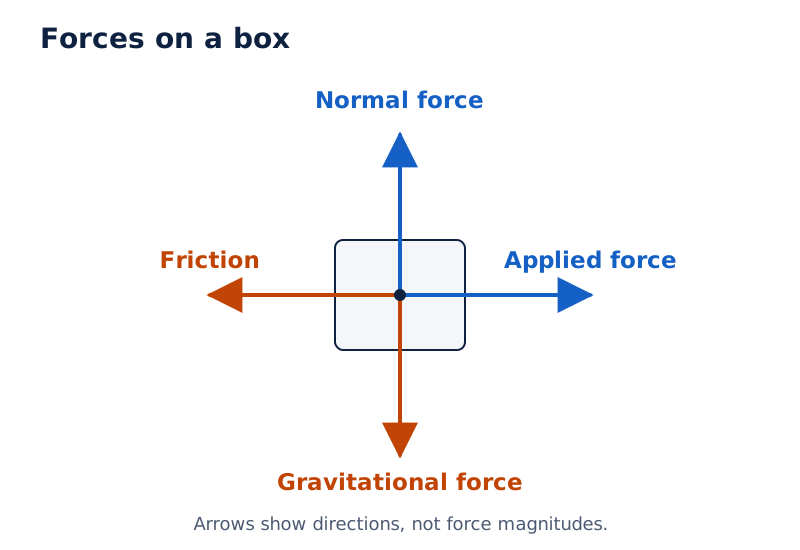
The drawing shows a box with an applied force pointing right and friction pointing left. The normal force points upwards and gravitational force points downwards. Each arrow identifies a force acting on the box.
Drawn by One Young India.
How do balanced and unbalanced forces affect an object?
The net force, also called the resultant force, is the combined effect of the forces acting on one object. For forces along the same straight line, their directions determine whether their magnitudes should be added or subtracted.
Displacement is the directed change from initial to final position. Velocity describes the rate of change of displacement, including direction. Speed is the magnitude of velocity. Acceleration is the rate of change of velocity, so slowing down or changing direction also involves acceleration.
Balanced forces have zero resultant. Two equal forces in opposite directions along the same line balance when they act on the same object. Unbalanced forces have a non-zero resultant and change the object’s velocity.
How are forces along a straight line combined?
- Identify the object whose motion is being considered.
- List the forces on that object and show their directions.
- Add forces pointing in the same direction; subtract opposing totals.
- State the resultant magnitude and its direction, towards the larger opposing total.
Worked example 1. A block experiences horizontal forces of 10 newtons and 6 newtons. The newton, symbol N, is the International System of Units, or SI, unit of force. Find the resultant when both forces act right, and when the 6 N force acts left.
Formula: Resultant = sum of forces in the same direction; resultant magnitude = difference for opposing forces.
Substitute: Same direction: 10 + 6 = 16. Opposite directions: 10 − 6 = 4.
Answer: The resultants are 16 N right and 4 N right, respectively.
In a tug of war, equal opposing pulls balance on the rope; a larger pull produces a resultant towards that side. Balanced forces do not necessarily mean rest. An already moving object can continue with constant velocity while its forces balance.
Note: Zero net force does not mean that no forces act. A book resting on a horizontal table experiences downward gravity and an upward normal reaction of equal magnitude.
What do Newton’s first law and inertia explain?
Definition: Newton’s first law states that an object remains at rest or continues with constant velocity in a straight line unless a net external force acts on it. An external force is exerted by something outside the object being considered.
Inertia is the tendency of an object to resist a change in its state of rest or uniform straight-line motion. Here, uniform motion means motion with constant velocity. Inertia is a property of matter, not an additional force acting on the object.
How do static and dynamic inertia appear?
Static inertia, or inertia of rest, is the tendency to remain at rest. Dynamic inertia, or inertia of motion, is the tendency to continue uniform straight-line motion. A change in speed or direction requires a net force.
When a stationary bus starts, friction between the floor and a passenger’s feet moves the feet forwards. The upper body tends to remain at rest, so the passenger leans backwards relative to the bus. The body subsequently moves with the bus as forces act through it.
When a moving bus stops suddenly, the feet stop with the floor while the upper body tends to continue moving forwards. This illustrates inertia of motion. The forward movement is the continuation of earlier motion, rather than evidence of a new forward force.
Mass also indicates an object’s inertia. An object with greater mass offers greater resistance to a change in motion. The SI unit of mass is the kilogram, symbol kg.
Why do moving objects often stop?
A ball rolling across a floor slows because friction acts against its motion. On an ideal frictionless horizontal surface, with no other unbalanced force, it would continue with constant velocity. A continuing push is needed in ordinary conditions to counter friction, not to sustain velocity by itself.
What the figure shows
Motion with constant velocity
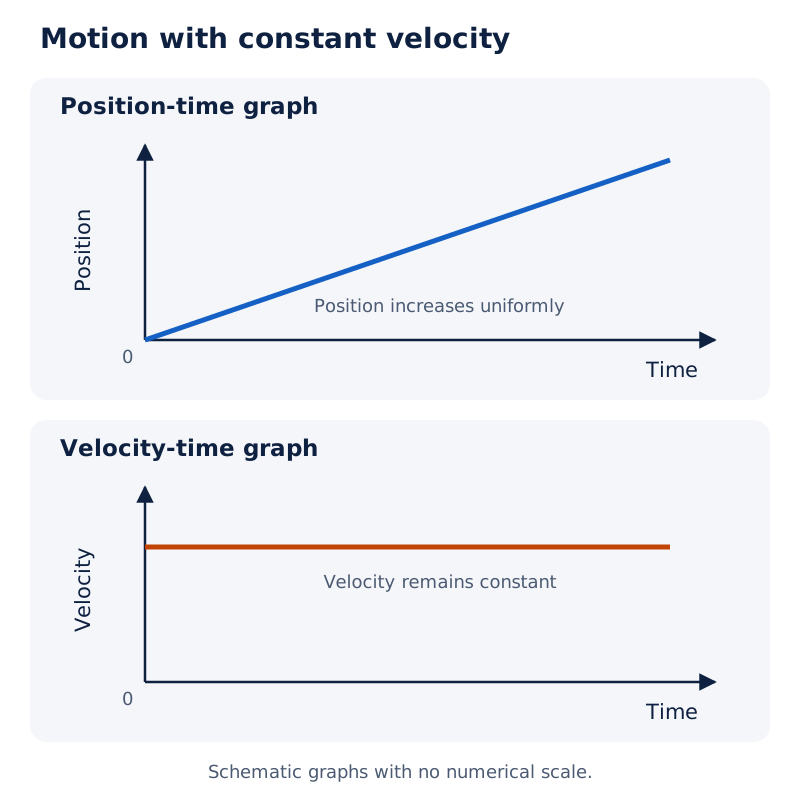
Both drawings have time on the horizontal axis. The position-time graph is a straight line sloping upwards; the velocity-time graph is a horizontal line above zero.
Drawn by One Young India.
What is linear momentum, and how does it change?
Linear momentum is the product of mass and velocity. Let p denote momentum, m denote mass and v denote velocity. The relation is p = mv. Momentum points in the same direction as velocity and is therefore a vector.
The SI unit of velocity is the metre per second, written m/s. In a unit expression, m means metre and s means second; the separate algebraic symbol m represents mass. The SI unit of momentum is kg m/s, read as kilogram metre per second.
Why must both mass and velocity be considered?
A loaded truck and a small car moving with the same velocity do not have the same momentum. The vehicle with greater mass has greater momentum. For a fixed mass, increasing speed increases the magnitude of momentum.
Let u denote initial velocity and v final velocity. The symbol Δ, read as “delta”, means a change, calculated as final value minus initial value. When mass remains constant, Δp = mv − mu = m(v − u).
Choose one direction as positive before subtracting velocities. Motion in the opposite direction then has a negative velocity. A reversal changes momentum even if the speed before and after is the same; subtracting speeds would miss this change of direction.
Worked example 2. A cricket ball of mass 0.15 kg travels towards a batsman at 12 m/s and is hit straight back towards the bowler at the same speed. Find its change in momentum, taking the direction towards the bowler as positive.
Formula: Δp = m(v − u).
Substitute: u = −12 m/s, v = +12 m/s; Δp = 0.15 × [12 − (−12)].
Answer: The change in momentum is 3.6 kg m/s towards the bowler.
Note: Equal initial and final speeds do not ensure equal velocities. Momentum calculations must include direction, especially when an object rebounds.
How does Newton’s second law connect force and acceleration?
Newton’s second law states that the rate of change of momentum is directly proportional to the applied net force and occurs in its direction. A rate tells us how much a quantity changes per unit time.
Let F denote the net force and Δt the time interval over which momentum changes. With SI units, F = Δp/Δt for a constant force; for a varying force over the interval, the quotient gives the average net force.
Derivation: How is F = ma obtained?
Consider an object of constant mass m whose velocity changes uniformly from u to v during time t. Here t is the elapsed time, and a denotes its constant acceleration.
- Initial momentum is mu and final momentum is mv.
- The change in momentum is Δp = mv − mu = m(v − u).
- The rate of change is Δp/t = m(v − u)/t.
- Since a = (v − u)/t, the net force equals mass multiplied by acceleration.
F = ma
The SI unit of acceleration is m/s², meaning metre per second squared. This measures the change in velocity per second. For constant mass, force and acceleration point in the same direction.
What changes when force or mass changes?
Rearranging gives a = F/m. For a fixed mass, doubling the net force doubles acceleration. For the same net force, doubling the mass halves acceleration. These comparisons require the other quantity to remain constant.
When a fielder catches a fast-moving cricket ball, drawing the hands backwards increases the stopping time. For the same change in momentum, a longer stopping time requires a smaller average force. This reduces the force involved in stopping the ball.
An airbag similarly increases the time over which a passenger is brought to rest in a collision. It reduces the force exerted on the person, lowering the risk of serious injuries, particularly when combined with seat belt usage.
Note: In F = ma, F represents the net force on the object. Using a forward push alone gives the wrong acceleration if an opposing frictional force also acts.
How are newtons, dynes and gravitational units related?
Force units can be defined through the acceleration they produce. One newton is the force that produces an acceleration of 1 m/s² in a mass of 1 kg. Thus, 1 N = 1 kg m/s².
The centimetre-gram-second system, abbreviated cgs, uses centimetres for length, grams for mass and seconds for time. The centimetre has symbol cm, the gram has symbol g, and the second has symbol s. Its unit of force is the dyne.
One dyne produces an acceleration of 1 cm/s² in a mass of 1 g. Since 1 kg = 1000 g and 1 m = 100 cm, 1 N = 10⁵ dyne. Conversely, one dyne is 10⁻⁵ N.
What do kilogram-force and gram-force mean?
A gravitational unit of force is defined using weight, the force of gravity on an object. The kilogram-force, symbol kgf, is the weight of a one-kilogram mass under standard gravity. The gram-force, symbol gf, is the corresponding weight of a one-gram mass.
The acceleration due to gravity is denoted by the algebraic symbol g. This g represents acceleration, unlike g written after a mass value, where it means gram. Using the rounded standard value g = 9.8 m/s² gives the following approximate conversions.
| Force unit | Equivalent | Condition |
|---|---|---|
| 1 N | 10⁵ dyne | Exact conversion between SI and cgs |
| 1 kgf | Approximately 9.8 N | Using 9.8 m/s² for standard gravity |
| 1 gf | Approximately 0.0098 N, or 980 dyne | Using 9.8 m/s² for standard gravity |
Keep mass and force units distinct: kg measures mass, while N and kgf measure force. A kilogram does not equal 9.8 N; the weight of a kilogram mass is approximately 9.8 N under the stated gravitational acceleration.
How are force calculations combined with equations of motion?
First find the net force, then obtain acceleration, and finally use the appropriate equation of motion. This sequence keeps force calculations consistent with the motion they produce. Equations for constant acceleration must not be applied as though they describe any changing acceleration.
For motion along a straight line with constant acceleration, v = u + at, s = ut + ½at², and v² = u² + 2as. Here s is displacement; u, v, a and t retain their earlier meanings. In a value such as “2 s”, s is instead the unit second.
How is a stopping force calculated?
Worked example 3. A 50 g bullet moving at 100 m/s enters a heavy stationary wooden block and stops after travelling 50 cm inside it. Estimate the net stopping force, assuming constant acceleration. Take the initial direction as positive.
Formula: a = (v² − u²)/(2s); F = ma.
Substitute: m = 0.050 kg, s = 0.50 m, u = 100 m/s and v = 0 m/s. Therefore a = (0 − 100²)/(2 × 0.50) = −10,000 m/s²; F = 0.050 × (−10,000).
Answer: F = −500 N. The estimated stopping force has magnitude 500 N and acts opposite to the bullet’s initial motion.
How does friction affect displacement?
Worked example 4. A 25 kg block starts from rest on a horizontal floor. A constant 55 N forward push acts against a 50 N opposing frictional force. Find its displacement in 2 s, taking forwards as positive.
Formula: F = applied force − friction; a = F/m; s = ut + ½at².
Substitute: F = 55 − 50 = 5 N; a = 5/25 = 0.2 m/s²; s = 0 × 2 + ½ × 0.2 × 2².
Answer: The displacement is 0.4 m forwards. If the applied force were balanced by friction, the initially stationary block would remain at rest.
How can a change in velocity give force?
Worked example 5. A 1500 kg sports car accelerates uniformly eastwards from rest to 10 m/s in 5 s. Calculate the net force.
Formula: a = (v − u)/t; F = ma.
Substitute: a = (10 − 0)/5 = 2 m/s²; F = 1500 × 2.
Answer: The net force is 3000 N eastwards. During any later interval of constant velocity, its net force is zero.
What does Newton’s third law say about interacting objects?
Newton’s third law states that when one object exerts a force on another, the second simultaneously exerts an equal and opposite force on the first. These two forces are called action and reaction; both terms refer to forces.
Let A and B name two interacting bodies. Let F_AB mean the force on A by B, and F_BA the force on B by A. The relation F_AB = −F_BA expresses equal magnitudes and opposite directions. The minus sign indicates direction, not a smaller magnitude.
Why do action and reaction not cancel on one object?
The two forces act on different objects. When finding the net force on one object, include only the forces acting on that object. Equal and opposite forces balance only when they belong to the same object’s force calculation.
A canoeist pushes water backwards with a paddle, and the water pushes the paddle forwards. The force on the paddle helps move the canoe forwards. The backward force on the water cannot be subtracted as though it also acts on the canoe.
A rocket engine expels gas downwards, while the gas exerts an upward force on the rocket. For lift-off, this upward force must exceed the rocket’s weight. The interaction forces are simultaneous; reaction does not wait for action to finish.
| Action-reaction pair | First receiving object | Second receiving object |
|---|---|---|
| Paddle pushes water backwards; water pushes paddle forwards | Water | Paddle |
| Earth attracts a fruit; the fruit attracts Earth | Fruit | Earth |
| Gun pushes bullet forwards; bullet pushes gun backwards | Bullet | Gun |
Equal forces do not, in general, produce equal accelerations. The masses of the interacting objects may differ. Earth’s acceleration towards a falling fruit is extremely small because Earth’s mass is so large compared with the fruit’s mass.
Figure: Two spring balances connected together are pulled in opposite directions. The photograph shows two horizontal spring balances connected by their hooks, with hands holding the outer ends. Their equal readings demonstrate the equal magnitudes of the forces they exert on each other.
What is the universal law of gravitation?
Gravitation is the mutual attraction between masses. The universal law of gravitation states that two masses attract with a force directly proportional to their mass product and inversely proportional to the square of their separation.
For point masses, F = Gm₁m₂/r². Here F is the magnitude of the gravitational force, m₁ and m₂ are the two masses, r is their separation, and G is the universal gravitational constant.
A point mass is an object treated as concentrated at one point because its size is negligible for the calculation. For spherically symmetric bodies outside one another, the formula uses the distance between their centres. Spherical symmetry means the mass distribution is the same in every direction from the centre.
The value of G is approximately 6.67 × 10⁻¹¹ N m²/kg². The SI unit of G is N m²/kg², meaning newton metre squared per kilogram squared. Unlike the local acceleration g, G is the constant in the universal force law.
What does inverse-square dependence mean?
Inverse-square dependence means the force becomes smaller according to the square of increasing separation, while the masses remain unchanged. Written proportionally, F ∝ 1/r², where ∝ means “is proportional to”. This relation concerns the separation of the interacting masses.
Non-contact forces depend on separation, but the simple point-mass formula must be applied with its conditions. Electrostatic force between fixed point charges in vacuum also follows an inverse-square relation. Point charges have dimensions negligible compared with their separation; a vacuum is a region without matter.
Why is the law important?
The same gravitational interaction explains attraction towards Earth and the motion of the Moon around Earth and planets around the Sun. It connects falling objects with astronomical motion. Gravitational attraction acts without physical contact or an intervening material medium.
The force of Earth on a fruit and the force of the fruit on Earth are an action-reaction pair. Neither force is greater: their magnitudes are equal. Their different effects on motion follow from their very different masses.
How are gravity, acceleration due to gravity and free fall related?
Gravity here means Earth’s gravitational attraction on an object. Its effect on a freely falling object is described by the acceleration due to gravity, g. Near Earth’s surface, g can be taken as nearly constant at approximately 9.8 m/s².
Free fall is motion under gravity alone. In this idealisation, air resistance, the opposing force exerted by air on a moving object, is neglected. The object accelerates downwards towards Earth even if it initially moves upwards.
Derivation: How is surface gravity related to Earth’s mass?
Let M denote Earth’s mass, R its radius, and m the mass of a small object at the surface. Treat Earth as spherically symmetric and neglect other forces.
- The distance from Earth’s centre to the surface object is R.
- The gravitational force on the object is F = GMm/R².
- Newton’s second law gives F = mg for acceleration g.
- Equating the forces and cancelling the object’s mass m gives the surface acceleration.
g = GM/R²
The object’s own mass has cancelled. Thus, under the same gravitational conditions and with air resistance neglected, free-fall acceleration does not depend on the falling object’s mass. Greater gravitational force on a larger mass does not by itself mean greater acceleration.
How are directions handled in free fall?
Choose a positive direction before calculating. If downwards is positive, acceleration is +g. If upwards is positive, acceleration is −g. The physical direction of gravity remains downwards; changing the sign convention changes the algebraic sign.
Worked example 6. An object is dropped from rest and falls freely for 1 s near Earth’s surface. Taking downwards as positive and g = 9.8 m/s², find its velocity after this interval.
Formula: v = u + gt.
Substitute: u = 0 m/s; v = 0 + 9.8 × 1.
Answer: Its velocity is 9.8 m/s downwards. This result assumes gravity alone acts throughout the interval.
How do mass and weight differ?
An object’s weight is the gravitational force acting on it. Let W denote weight. From Newton’s second law, W = mg, where m is the object’s mass and g the acceleration due to gravity at its location.
Mass and weight describe different properties. Mass expresses the quantity of matter and is associated with inertia. Weight describes an interaction with a gravitating body. Near Earth’s surface, its direction is downwards towards Earth’s centre.
Which differences should be kept clear?
| Feature | Mass | Weight |
|---|---|---|
| Meaning | Quantity of matter in an object | Gravitational force on the object |
| Type of quantity | Scalar, meaning it has magnitude without direction | Vector, with magnitude and direction |
| SI unit | Kilogram, kg | Newton, N |
| Dependence on local gravity | Does not change merely because local gravity changes | Depends on local g through W = mg |
| Measurement | Can be compared using a beam balance | Can be measured using a spring balance |
A beam balance compares an object’s mass with standard masses. A spring balance measures force through the extension of a spring. For an object hanging at rest, the upward supporting force balances its downward weight.
Worked example 7. A weightlifter holds a barbell steady. There is a 10 kg mass on each end, and the bar itself has mass 10 kg. Taking g = 9.8 m/s², calculate the upward force required.
Formula: m = sum of the component masses; W = mg.
Substitute: m = 10 + 10 + 10 = 30 kg; W = 30 × 9.8 = 294 N.
Answer: The weightlifter applies 294 N upwards, balancing the 294 N downward weight. The net force on the steady barbell is zero.
The upward support and downward weight both act on the barbell, so they form balanced forces. They are not an action-reaction pair. The reaction to the weight is the barbell’s gravitational pull on Earth, which acts on Earth.
Glossary
- Force — A push or pull arising from an interaction that can change motion or shape.
- Contact force — A force transmitted through physical contact between interacting objects or materials.
- Non-contact force — A force acting between objects without requiring them to touch each other.
- Net force — The resultant obtained by combining all forces acting on one object, accounting for direction.
- Normal reaction — The supporting contact force acting perpendicular to the surface of contact.
- Tension — The pulling force transmitted along a stretched string to an attached object.
- Inertia — The tendency to resist change in rest or uniform straight-line motion.
- Linear momentum — The product of an object’s mass and velocity, directed along its velocity.
- Acceleration — The rate at which velocity changes, including changes in speed or direction.
- Newton — The force that gives a one-kilogram mass an acceleration of one metre per second squared.
- Dyne — The force that gives a one-gram mass an acceleration of one centimetre per second squared.
- Action-reaction pair — Equal and opposite simultaneous interaction forces acting on two different objects.
- Gravitation — The mutual attractive interaction between masses, including Earth and objects near it.
- Free fall — Motion under gravity alone, with air resistance and other forces neglected.
- Weight — The gravitational force on an object, equal to its mass multiplied by local gravitational acceleration.
Common errors and misconceptions
- Misconception: An object needs a net force to keep moving. Correct: Constant straight-line velocity requires zero net force; a non-zero net force changes velocity.
- Misconception: Balanced forces mean that an object must be stationary. Correct: They produce zero acceleration. The object may already be moving with constant velocity.
- Misconception: Inertia is a backward force on a passenger. Correct: Inertia is resistance to changing motion; the passenger’s body tends to retain its previous state.
- Misconception: The applied push is the force to use in F = ma. Correct: Use the resultant of all forces acting on the object, including opposing friction.
- Misconception: Action and reaction cancel on one object. Correct: They act on different objects, so each belongs to a different object’s force calculation.
- Misconception: Unchanged speed means unchanged momentum. Correct: A change in direction changes velocity and therefore momentum, even when mass and speed stay constant.
- Misconception: Mass and weight are interchangeable. Correct: Mass is measured in kilograms; weight is a gravitational force measured in newtons.
- Misconception: A heavier object has a greater free-fall acceleration. Correct: Under the same gravitational conditions, acceleration is independent of mass when air resistance is neglected.
Exam-style questions with model answers
Q1. State Newton’s first law and define inertia. [2 marks]
- An object remains at rest or moves with constant velocity in a straight line unless a net external force acts on it.
- Inertia is its tendency to resist a change in that state of rest or uniform straight-line motion.
Q2. Define friction, normal reaction and tension, giving the direction of each contact force. [3 marks]
- Friction is a contact force that opposes relative sliding, or the tendency to slide, between surfaces. It acts along the contact surface.
- Normal reaction is the supporting contact force between surfaces. It acts perpendicular to the surface of contact, upwards on a book resting on a horizontal table.
- Tension is the pulling force transmitted through a stretched string. It acts along the string on an attached object.
Q3. Derive F = ma for a constant-mass object undergoing uniform acceleration. Define every symbol used. [4 marks]
- Let m be the constant mass, u the initial velocity, v the final velocity and t the elapsed time. Initial momentum is mu and final momentum is mv.
- The change in momentum, denoted Δp, is mv − mu = m(v − u).
- Newton’s second law gives the net force F = Δp/t = m(v − u)/t in SI units.
- Acceleration a = (v − u)/t. Substitution gives F = ma, with acceleration in the direction of the net force.
Q4. A 25 kg block starts from rest on a horizontal floor. A constant 55 N forward push acts against constant friction of 50 N. Calculate its net force, acceleration and displacement after 2 s, and state the direction of motion. [4 marks]
- Taking forwards as positive, the net force F is the applied force minus friction: F = 55 − 50 = 5 N forwards.
- The acceleration a is F/m, where m is mass: a = 5/25 = 0.2 m/s².
- Displacement s = ut + ½at², where u is initial velocity and t is time. Thus s = 0 × 2 + ½ × 0.2 × 2² = 0.4 m.
- The block moves forwards because it starts from rest and has a forward net force and acceleration.
Q5. A canoeist pushes water backwards with a paddle. State the action-reaction pair, explain why it does not cancel on the canoe, and state when the two forces act. [3 marks]
- The paddle exerts a backward force on the water, and the water exerts an equal forward force on the paddle. This is the action-reaction pair.
- The forces act on different objects: one on water and the other on the paddle. The force on water is not part of the net force on the canoe.
- The forces act simultaneously during the interaction; neither force waits for the other to finish.
Q6. State the universal law of gravitation, write its equation with symbols defined, give its force direction, and explain why Earth and a falling fruit have different accelerations despite equal interaction forces. [5 marks]
- Each mass attracts the other with a force directly proportional to the product of their masses and inversely proportional to the square of their separation.
- The force magnitude is F = Gm₁m₂/r², where m₁ and m₂ are the interacting masses and G is the universal gravitational constant.
- The symbol r denotes separation for point masses, or centre-to-centre distance for spherically symmetric bodies outside one another. The force acts attractively along the line joining them.
- Earth and the fruit exert equal and opposite forces on each other, acting on different bodies, in accordance with Newton’s third law.
- Acceleration equals force divided by mass. Earth’s much greater mass makes its acceleration extremely small compared with that of the fruit.
Q7. A 50 g bullet moving at 100 m/s enters a heavy stationary wooden block and stops after penetrating 50 cm. Assuming constant acceleration, calculate its acceleration and net stopping force, stating their directions. [5 marks]
- Convert the mass m to SI units: 50 g = 0.050 kg. The stopping displacement s is 50 cm = 0.50 m.
- Take the bullet’s initial direction as positive. Its initial velocity u = +100 m/s and final velocity v = 0 m/s.
- Use v² = u² + 2as, where a is acceleration. Therefore a = (0 − 100²)/(2 × 0.50) = −10,000 m/s².
- The net force F = ma = 0.050 × (−10,000) = −500 N. Its magnitude is therefore 500 N.
- The negative signs show that acceleration and net force are opposite to the initial motion. This opposing force brings the bullet to rest over the stated penetration distance.
Q8. A barbell has a 10 kg mass on each end and a bar of mass 10 kg. A weightlifter holds it steady. Taking g = 9.8 m/s², calculate its weight and the upward supporting force. [2 marks]
- Total mass m = 10 + 10 + 10 = 30 kg. Weight W = mg = 30 × 9.8 = 294 N downwards.
- The upward supporting force is 294 N because the steady barbell has zero net force.
Key takeaways
- Forces have magnitude and direction; distinguish contact forces such as friction from non-contact forces such as gravity.
- Balanced forces produce zero acceleration, allowing either rest or continued motion with constant velocity.
- Inertia resists changes in rest or uniform straight-line motion; it is a property, not an extra force.
- Momentum equals mass multiplied by velocity, so both speed changes and direction changes can alter it.
- For constant mass, net force equals mass multiplied by acceleration; include all relevant opposing forces before calculating.
- Action and reaction are equal, opposite and simultaneous forces on different objects, so they do not cancel on one object.
- Universal gravitation links mutual attraction between masses with falling objects and the motion of planets.
- Mass is measured in kilograms, weight in newtons; free-fall acceleration is independent of mass when air resistance is neglected.
Test yourself
A box moves with constant velocity while a forward push balances friction. What is its net force?
Its net force is zero because the equal opposing forces balance and its velocity does not change.
Why does a passenger tend to lean backwards when a stationary bus starts?
The feet move forwards with the floor, while the upper body tends to remain at rest because of inertia.
At constant mass, what happens to acceleration when the net force doubles?
The acceleration doubles because acceleration is directly proportional to net force when mass remains constant.
Why does a fielder draw the hands backwards while catching a cricket ball?
This increases the stopping time. For the same momentum change, a longer time reduces the average force required.
Why are a book’s weight and the table’s upward support not an action-reaction pair?
Both act on the book. An action-reaction pair consists of forces acting on two different interacting objects.
What is the difference between G and g?
G is the universal constant in the gravitational force law; g is the local acceleration due to gravity.
What does one newton mean in terms of mass and acceleration?
It is the force that gives a mass of 1 kg an acceleration of 1 m/s².
Under what condition do different masses have the same free-fall acceleration at a given place?
They have the same acceleration when gravity alone acts, with air resistance and other forces neglected.
Write about it
Turn a question from this chapter into a paper.
The Writing Studio has a structure guide, a rubric and citation tools for 15 formats, from essays to research papers. Drafting is free with an account. Learnacy Essential adds feedback from an AI writing coach and submission to The OYI Review.
Learnacy Essential is ₹1,499 for the year. Publication depends on review and is not guaranteed.