
Measuring Space: Perimeter and Area | CBSE Class 9 Maths Notes
On this page
This note covers perimeter, circumference, approximations to π, arc length, areas of rectangles, parallelograms and triangles, medians, Heron’s formula, cyclic quadrilaterals, Brahmagupta’s formula, squaring a rectangle, circle area, sectors, segments and calculations with combined shapes.
What does perimeter measure?
Perimeter is the total length around a shape’s boundary. Imagine travelling once around that boundary and returning to the starting point without turning back. The distance travelled is the perimeter. It measures length, whereas area measures the space occupied by a two-dimensional region in a plane.
A polygon is a closed shape formed from straight line segments. Its sides meet at corners called vertices. Capital letters label points; two point labels together, such as AB, name the segment joining those points or its length, as appropriate. To find its perimeter, add the lengths of all its sides. For a curved boundary, the curved lengths must also be included.
How do the basic perimeter formulas compare?
Let P denote perimeter. In the table, a denotes a side length; for the rectangle, a and b denote its length and width. A right angle is a quarter-turn angle. A rectangle has four right angles, and a square is a rectangle with all sides equal.
| Shape | Side information | Perimeter |
|---|---|---|
| Square | Four sides of length a | P = 4a |
| Equilateral triangle | Three equal sides of length a | P = 3a |
| Rectangle | Opposite sides of lengths a and b | P = 2(a + b) |
An equilateral triangle has three equal sides. Its perimeter-to-side ratio is 3:1, meaning three units of perimeter for each unit of side length. For every square, that ratio is 4:1. The ratio stays fixed as the shape becomes larger or smaller.
A square of side 2 units has perimeter 8 units. Doubling its side to 4 units doubles the perimeter to 16 units. Substituting b = a in the rectangle formula gives 2(a + a) = 4a, showing how the square formula follows from the rectangle formula.
Note: Use length units for perimeter, such as centimetres (cm) or metres (m). Area uses square units: cm² means square centimetres, and m² means square metres.
What is π, and why are its familiar values approximate?
A circle’s perimeter is usually called its circumference. A radius joins its centre to its boundary; a diameter passes through the centre with both endpoints on the circle. Let C denote circumference, D diameter and r radius. Then D = 2r.
Result: The circumference-to-diameter ratio is constant
All circles have the same ratio C/D. This constant is π, pronounced “pi”. Therefore, C = πD = 2πr. Changing the size of the circle changes its circumference and diameter together while preserving their ratio.
To estimate this ratio, measure the diameter D of a cotton reel and wrap thin thread tightly around it 20 times. If L is the unwrapped thread’s measured length, calculate L/(20D). Thin thread helps the measurement approximate the reel’s circumference more closely.
How did approximations develop?
An inscribed polygon has its vertices on a circle. A circumscribed polygon surrounds the circle with its sides touching it. Archimedes used polygons inside and outside circles to place bounds on π, eventually using polygons with 96 sides.
The symbol ≈ means “approximately equal to”; < means “less than”.
| Mathematician | Result | Meaning |
|---|---|---|
| Archimedes | 3 + 10/71 < π < 3 + 1/7 | Lower and upper bounds |
| Zu Chongzhi | π ≈ 355/113 | A close fractional approximation |
| Āryabhaṭa | π ≈ 62832/20000 = 3.1416 | An approximate value, described as asanna |
| Mādhava | π/4 = 1 − 1/3 + 1/5 − 1/7 + … | An exact infinite series |
An infinite series continues adding terms without ending, as indicated by the dots. Mādhava’s full series is exact; stopping after a finite number of terms gives an approximation.
A rational number can be expressed as a ratio of two integers with a non-zero denominator. An irrational number cannot. The number π is irrational, so π ≈ 22/7 but π ≠ 22/7, where ≠ means “not equal to”.
The fraction 22/7 is good enough for most practical uses, but there is no best fraction for π. From their writings, it seems that Āryabhaṭa and Zu Chongzhi regarded π as irrational. Lambert proved its irrationality in 1761.
How are circumference and arc length calculated?
An arc is part of a circle’s boundary. Its central angle is the angle between the radii to its endpoints. To say an arc “subtends” an angle means that its endpoints determine that angle at the centre.
Result: Arc length is the corresponding fraction of circumference
Let l denote arc length, r the circle’s radius and θ the numerical measure of the central angle in degrees. The symbol ° denotes degrees, with 360° representing a full turn. Then l = 2πr × θ/360.
A semicircular arc covers half a circle and subtends 180°, so its length is πr. A quarter-circle arc subtends 90°, so its length is πr/2. Reflection, flipping across a line, and rotation, turning about a point, show why the equal portions of a circle have equal lengths.
What the figure shows
Arc and central angle
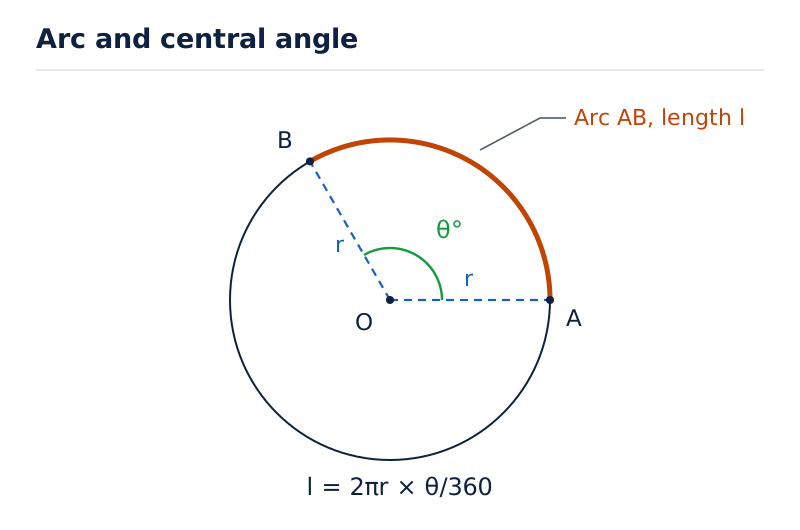
The curved arc joins A and B. Dashed radii join these endpoints to centre O, and the angle between them is labelled θ°.
Drawn by One Young India. See Fig. 6.10 in your NCERT textbook
Worked example 1. A circle has circumference 44 cm. Find its radius using π ≈ 22/7.
Answer: From C = 2πr, the radius r = C/(2π). Substitution gives r = 44 ÷ (2 × 22/7) = 7 cm. The answer is a length, so its unit is cm.
Worked example 2. Find the arc length for a circle of radius 6.3 m and central angle 120°. Use π ≈ 22/7.
Answer: The angle is 120/360 = 1/3 of a full turn. Therefore l = 2 × (22/7) × 6.3 × (120/360) = 13.2 m.
A sector is the region enclosed by an arc and the two radii joining its endpoints to the centre. Its full perimeter includes those two straight lengths. Thus, arc length and sector perimeter answer different questions, even when they refer to the same circle and angle.
Worked example 3. Find the perimeter of a sector of radius 14 cm and angle 75°, using π ≈ 22/7.
Answer: Arc length = 2 × (22/7) × 14 × 75/360 = 55/3 cm. Add both radii: perimeter = 55/3 + 14 + 14 = 139/3 cm.
How do circle lengths explain race tracks and curved paths?
The stagger is the distance between the starting points in adjacent athletics lanes. Runners in outer lanes travel farther around the curved parts because these curves have larger radii. Moving their starting positions compensates for this extra distance.
On the straight portions, adjacent runners cover equal distances. The difference comes from the curved portions. This makes circumference, rather than just the track’s overall appearance, the relevant measurement when comparing lane lengths.
How is the 400 m track measured?
Worked example 4. A track has two straights of 84.39 m each and two semicircular ends of inner radius 36.5 m. Assume an athlete runs 0.3 m from the inner border. Find the circuit length using π ≈ 3.1416.
Answer: Her curved path has radius 36.5 + 0.3 = 36.8 m. The straights total 168.78 m. The semicircles together give 2 × 3.1416 × 36.8 ≈ 231.22 m. Total distance ≈ 168.78 + 231.22 = 400 m.
Each lane is 1.22 m wide. Keep the assumed running line distinct from the inner border: using 36.5 m directly in the circumference calculation would describe a different path. The numerical circuit calculation also depends on rounding the curved distance.
Can differently shaped curved paths have equal lengths?
Yes. Consider one semicircle with diameter PQ, where P and Q are its endpoints. Partition PQ into three consecutive diameters and draw a semicircle on each. The smaller semicircles may curve on different sides of PQ, but their total arc length equals the larger semicircle’s arc length.
Let R denote the large radius and r₁, r₂ and r₃ the smaller radii. Since their diameters together span PQ, 2R = 2r₁ + 2r₂ + 2r₃. Hence R = r₁ + r₂ + r₃ and πR = πr₁ + πr₂ + πr₃.
What the figure shows
Equal semicircular paths
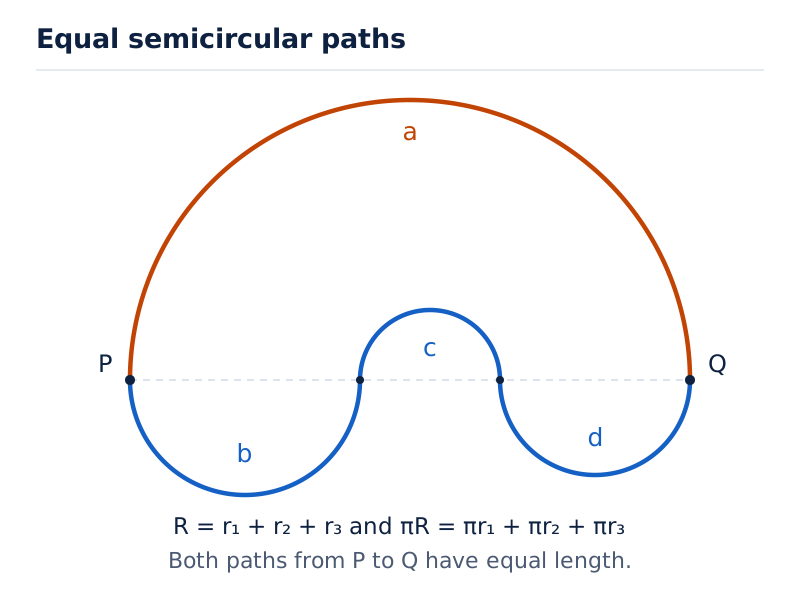
A red semicircle labelled a joins P to Q above the baseline. A second route comprises blue semicircles b and d below it and a smaller semicircle c above it.
Drawn by One Young India. See Fig. 6.13 in your NCERT textbook
Why is a parallelogram’s area base times height?
Area is measured relative to a chosen unit square, a square with side 1 unit and area 1 square unit. Let A denote area. A rectangle with side lengths a and b has A = ab; a square with side a has A = a².
The superscript ² means that a quantity is multiplied by itself. Area in square units records how much of the plane the region occupies. It does not measure the distance around the edge, so an area formula cannot replace a perimeter formula.
Result: A parallelogram and its rearranged rectangle have equal areas
A parallelogram is a quadrilateral whose opposite sides are parallel, meaning their lines remain the same distance apart and do not meet. A quadrilateral, also called a 4-gon, has four sides. Choose one side as the base, of length b. The corresponding height, h, is the perpendicular distance between that side and the opposite parallel side.
Cutting a triangular piece from one end and moving it to the other produces a rectangle with the same base and height. Rearrangement preserves area. Therefore, A = bh for a parallelogram. The height must be perpendicular to the chosen base, rather than measured along a sloping side.
What the figure shows
Rearranging a parallelogram
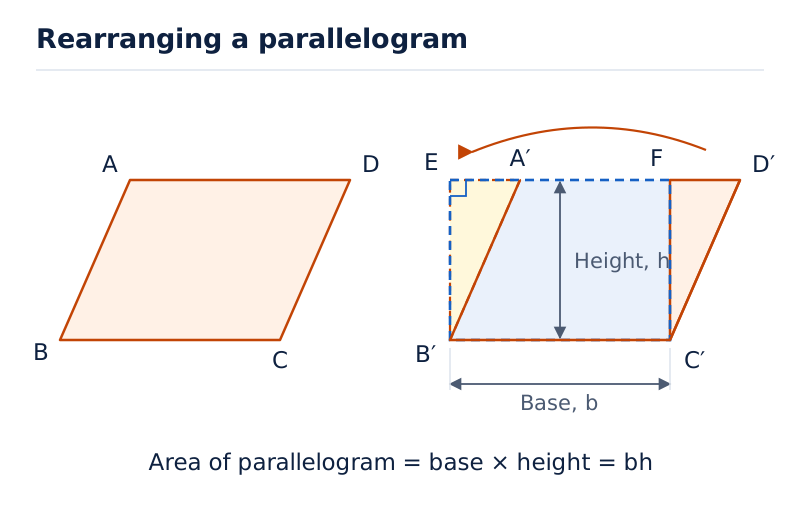
Parallelogram ABCD appears beside its copy A′B′C′D′. Dashed perpendiculars mark a rectangle with base b and height h, and coloured triangular regions show the rearrangement at its ends.
Drawn by One Young India. See Fig. 6.17 in your NCERT textbook
For a thin, strongly slanted parallelogram, the perpendicular may fall outside the side. The rearrangement then needs repeated transfers of matching triangular pieces. This addresses the apparent gap in a single-cut explanation without changing the base-times-height result.
Side lengths alone do not determine a parallelogram’s area. Changing the angle between adjacent sides while keeping their lengths fixed changes the height. Thus a rectangle’s length-times-width calculation cannot be applied to arbitrary adjacent sides of a parallelogram.
How is triangle area derived, and what does a median do?
Two congruent triangles, meaning triangles identical in size and shape, can fit together to make a parallelogram. If the original triangle has base b and perpendicular height h, the resulting parallelogram has the same base and height.
The parallelogram has area bh. Its two congruent triangles have equal areas, giving the triangle formula A = bh/2. This explains the factor 1/2: the triangle occupies half the area of the corresponding parallelogram.
Theorem: A median divides a triangle into two equal-area triangles
A median joins a vertex of a triangle to the midpoint of the opposite side. A midpoint divides a segment into two equal lengths. In triangle ABC, let D be the midpoint of BC; then AD is a median.
- Use BD and DC as the bases of triangles ABD and ACD.
- Since D is the midpoint, the two base lengths are equal.
- Both triangles have the same perpendicular height from A to the line BC.
- Applying half base times height therefore gives equal areas.
What the figure shows
A median and equal bases
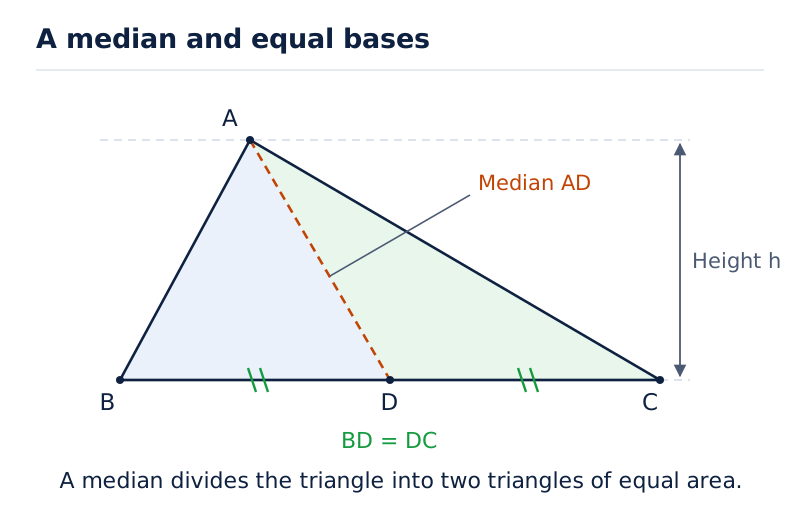
Triangle ABC has D on BC, with matching marks on BD and DC. The dashed median joins A to D. A separate perpendicular marks height h to the line through BC.
Drawn by One Young India. See Fig. 6.22 in your NCERT textbook
The two smaller triangles are, in general, differently shaped. Equal area does not establish congruence. The proof uses equality of bases and heights, rather than equality of all corresponding sides or angles.
How does the same idea help compare triangles?
Triangles sharing a base and lying between the same parallel lines have equal heights and therefore equal areas. In a parallelogram ABCD, points P and Q anywhere on side AB give triangles PCD and QCD with common base CD and equal height. Their area ratio is 1:1.
How does Heron’s formula find area from three sides?
Heron’s formula gives a triangle’s area directly from its three side lengths. Let those lengths be a, b and c. Define the semi-perimeter, s, as half the perimeter: s = (a + b + c)/2.
The symbol √ means the non-negative square root, the non-negative number whose square equals the quantity inside it. Heron’s formula is A = √[s(s − a)(s − b)(s − c)]; everything inside the brackets belongs under that square root. Calculate s before calculating the three differences.
What is a reliable calculation sequence?
- Identify all three sides, finding a missing side from the perimeter if necessary.
- Add the side lengths and divide by two to obtain s.
- Calculate s − a, s − b and s − c separately.
- Multiply these three differences by s, take the square root and state square units.
Worked example 5. Find the area of a triangle with sides 3, 4 and 5 units.
Answer: s = (3 + 4 + 5)/2 = 6 units. Area = √[6 × (6 − 3) × (6 − 4) × (6 − 5)] = √36 = 6 square units. The independent calculation (3 × 4)/2 also gives 6 square units.
The second calculation works because 3² + 4² = 5². The Baudhāyana-Pythagoras theorem relates the squares of the two perpendicular sides of a right-angled triangle to the square of its longest side, the hypotenuse. Its converse identifies this triangle as right-angled.
Worked example 6. A triangle has sides 8 cm and 11 cm and perimeter 32 cm. Find its area.
Answer: The third side is 32 − 8 − 11 = 13 cm. The semi-perimeter is 16 cm. Area = √[16 × 8 × 5 × 3] = √1920 = 8√30 cm².
What do special triangles give?
For an equilateral triangle of side a, s = 3a/2 and area = √3a²/4, meaning (√3 × a²)/4. For an isosceles triangle, which has two equal sides, let those sides be a and its base be 2b. Then s = a + b and area = b√(a² − b²).
The circumcircle passes through a triangle’s three vertices; its radius is R. The incircle touches its three sides from inside; its radius is r. Two further area formulas are A = abc/(4R) and A = r(a + b + c)/2 = rs.
When can Brahmagupta’s formula be used?
A cyclic quadrilateral has all four vertices on one circle. Knowing this property allows its area to be calculated from its sides. Four side lengths alone do not determine the area of a general quadrilateral.
A rhombus has four equal sides. Rhombi with sides 3, 3, 3 and 3 can have different areas as their angles change. The three illustrated examples have areas 9, 8.01 and 5.41. Their common side lengths therefore cannot select one area.
What the figure shows
Equal sides with different areas
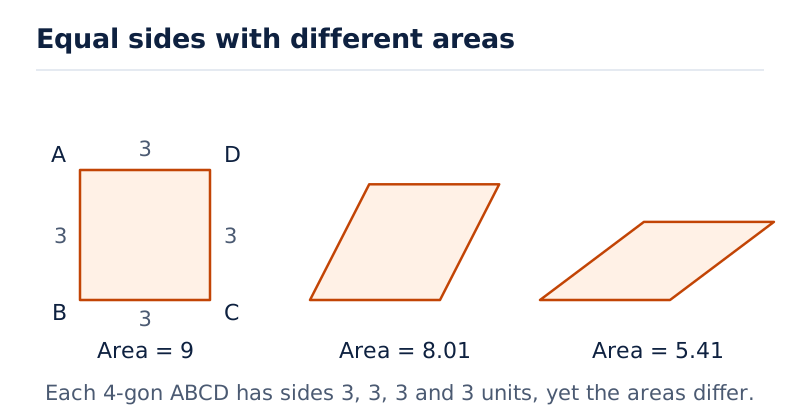
Three pink quadrilaterals labelled ABCD become progressively more slanted. Their displayed areas are 9, 8.01 and 5.41 respectively.
Drawn by One Young India. See Fig. 6.27 in your NCERT textbook
Result: Brahmagupta’s formula applies to a cyclic 4-gon
Let a, b, c and d denote the four side lengths, and let s = (a + b + c + d)/2. Brahmagupta’s formula gives A = √[(s − a)(s − b)(s − c)(s − d)]. The cyclic condition is part of the result.
Worked example 7. Verify Brahmagupta’s formula for a rectangle with adjacent sides a and b.
Answer: All rectangles are cyclic. Its four sides are a, b, a and b, so s = (2a + 2b)/2 = a + b. The formula gives √(b × a × b × a) = ab, agreeing with the rectangle area formula.
All isosceles trapezia, trapezia with equal non-parallel sides, are cyclic too. A trapezium has a pair of parallel sides. Its area equals half the sum of those parallel side lengths multiplied by their perpendicular separation.
How is Heron’s formula a special case?
A special case results from imposing an extra condition on a general result. Regard a triangle as a quadrilateral whose fourth side has length d = 0, so two vertices coincide. Every triangle has a circumcircle, so the cyclic interpretation is available.
Now s = (a + b + c)/2 and s − d = s. Substitution into Brahmagupta’s formula gives √[s(s − a)(s − b)(s − c)], which is Heron’s formula. A generalisation extends a result to a wider setting; Brahmagupta’s formula generalises Heron’s formula in this sense.
What does it mean to square a rectangle?
To square a shape means to construct a square equal in area to it. It does not mean squaring the numerical value of its area. For a rectangle with side lengths a and b, the required square must have area ab.
Baudhāyana’s construction comes from his Śhulbasūtra, dated 800 BCE. The following is a slightly simplified form of that construction. Begin with rectangle ABCD, where AD = a, AB = b and a > b; the symbol > means “greater than”.
What are the construction steps?
- Choose E on AD so that AE = AB.
- Locate F, the midpoint of ED.
- Construct square AFGH on AF, with H on AB extended beyond B.
- With centre H, draw arc AG and mark its intersection with BC as K.
- Through K draw a line parallel to AH, meeting GH at P.
- Construct square HPQS with side HP. This is the required equal-area square.
What the figure shows
Squaring a rectangle
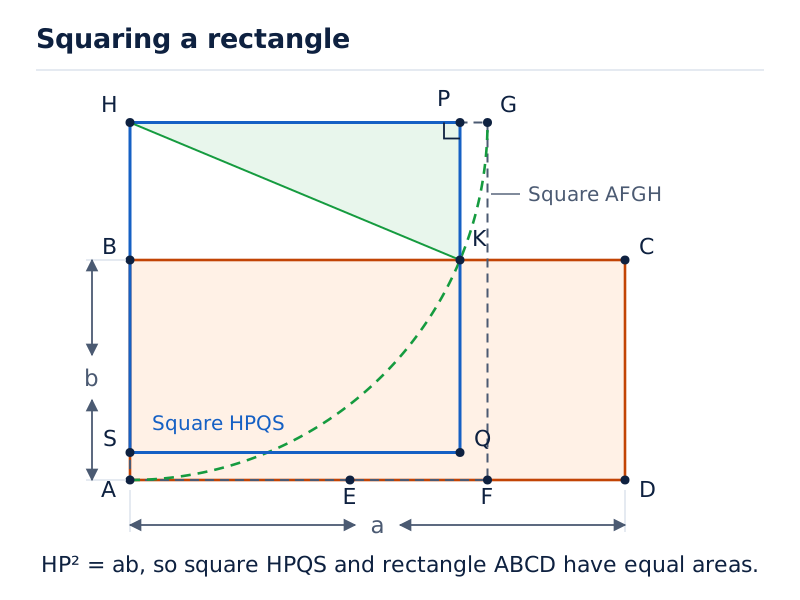
Rectangle ABCD contains E and F on AD. Square AFGH extends above it. A dashed arc from A towards G passes through K on BC, and HPQS marks the constructed square.
Drawn by One Young India. See Fig. 6.30 in your NCERT textbook
Why does the construction preserve the area?
The construction gives AF = (a + b)/2 and HK = (a + b)/2, because HK is a radius of the drawn arc. Also BH = (a − b)/2. The right-angled triangle HKP relates these lengths to HP.
Using the Baudhāyana-Pythagoras theorem gives HP² = [(a + b)/2]² − [(a − b)/2]² = ab. The left side is the area of square HPQS, and the right side is the rectangle’s area. This connects a geometric construction to an algebraic identity, an equation valid for all allowed values of its variables. Here a and b are positive side lengths with a greater than b.
Why is the area of a circle πr²?
For a circle of radius r and area A, the formula is A = πr². The radius is squared because this is an area calculation. This differs from circumference, C = 2πr, where the radius occurs to the first power.
How did earlier area estimates compare?
Early societies related a circle’s area to the square of its circumference. The Babylonian approximation was A ≈ C²/12. Around 1500 BCE, the Egyptian approximation was A ≈ (8d/9)², where d denotes diameter. The latter is also A ≈ (256/81)r².
The same approximate area formula appears through a geometric construction in Baudhāyana’s Śhulbasūtra. Archimedes later showed that the exact coefficient of r² is π. Thus, the constant connecting circumference with diameter also determines the area enclosed by the circle.
How do polygons and rearranged slices explain it?
A regular polygon has equal sides and equal angles. Its area is half its perimeter multiplied by the radius of its incircle. Increasing the number of sides connects this polygon calculation to the circle formula: half circumference times radius equals (2πr × r)/2 = πr².
Another visual argument divides the circular region into small sectors and rearranges them alternately. The resulting shape becomes closer and closer to a parallelogram as the slices become smaller. Its base approaches half the circumference, πr, and its height approaches r.
What the figure shows
Rearranged circle slices
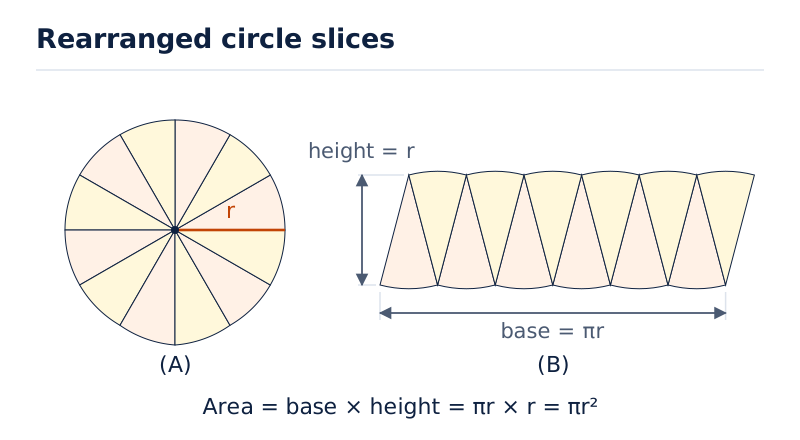
Alternating yellow and orange slices fill a circle in part A. Part B arranges the slices in a long band with alternating pointed ends, giving a parallelogram-like outline.
Drawn by One Young India. See Fig. 6.37 in your NCERT textbook
The argument gives area = base × height = πr × r = πr². A finite set of curved slices does not form an exact straight-sided parallelogram. The increasingly fine rearrangement explains how the circle’s area is connected to that limiting shape.
How are sector and segment areas found?
A sector occupies the same fraction of a circular region as its central angle occupies of 360°. If r is the radius and θ the angle in degrees, its area is A = πr² × θ/360. Here A denotes the sector’s area.
A disc is the region enclosed by a circle. A semicircular disc has area πr²/2. A quadrant is a quarter of a circular region and has area πr²/4. Reflection symmetry explains the halves; quarter-turn symmetry explains the quarters.
Worked example 8. Find the area of a 60° sector of a circle with radius 7 cm, using π ≈ 22/7.
Answer: Area = (22/7) × 7² × 60/360 = 154/6 = 77/3 cm². The angle selects one-sixth of the circle’s area.
Worked example 9. Find the area of a quadrant of a circle whose circumference is 44 cm, using π ≈ 22/7.
Answer: First find the radius: r = 44 ÷ (2 × 22/7) = 7 cm. Quadrant area = (22/7) × 7² ÷ 4 = 38.5 cm².
How does a segment differ from a sector?
A chord is a straight segment joining two points of a circle. A segment of a circle is the region enclosed by a chord and its corresponding arc. Its boundary therefore differs from a sector’s two radii and arc.
For the smaller, or minor, segment in the 60° example below, subtract the triangle between the radii from the minor sector. The remaining larger region is the major segment. Its area is the full circle’s area minus the minor segment’s area.
Worked example 10. A chord in a circle of radius 15 cm subtends 60° at the centre. Find both segment areas using π ≈ 3.14 and √3 ≈ 1.73.
Answer: Minor sector area = 3.14 × 15²/6 = 117.75 cm². The radii and chord form an equilateral triangle, whose area is 1.73 × 15²/4 = 97.3125 cm². Minor segment area ≈ 20.4375 cm². Major segment area ≈ 706.5 − 20.4375 = 686.0625 cm².
How should a multi-step area problem be organised?
Begin by identifying the region or boundary actually requested. A question may give side lengths, a perimeter, a radius, or an angle. These are different kinds of information. Choose the formula whose required quantities can be found from the given data.
How can a missing height be obtained?
Worked example 11. An isosceles trapezium has parallel sides 40 cm and 20 cm, and each non-parallel side is 26 cm. Find its area.
Answer: The difference of the parallel sides is 20 cm, split equally into offsets of 10 cm. The perpendicular height is √(26² − 10²) = √576 = 24 cm. Area = (40 + 20) × 24/2 = 720 cm².
This problem uses two results in sequence. The Baudhāyana-Pythagoras theorem supplies the perpendicular height; the trapezium formula then supplies the area. Multiplying a parallel side by the sloping side would bypass the required height and describe the wrong measurement.
How do boundary and area calculations differ?
- For perimeter, trace the requested boundary and identify every straight segment and arc on it.
- For area, separate the region into shapes with usable formulas or subtract a known region from a larger one.
- Calculate missing radii, heights, angles or sides before substituting into the final formula.
- Keep the chosen approximation for π consistent and give length units or square units as appropriate.
For combined regions, internal dividing lines help calculate area but do not automatically belong to the outer perimeter. For a circular segment, identify its bounding chord and arc separately; together they enclose the region whose area is required.
Check calculations through a second method when the given data permit it. The 3, 4, 5 triangle can be checked using both Heron’s formula and half base times height. Brahmagupta’s formula can be checked against the familiar rectangle result.
Glossary
- Perimeter — The total length of the complete boundary around a shape.
- Circumference — The perimeter of a circle, equal to twice π times its radius.
- Radius — A line segment joining the centre of a circle to its boundary.
- Diameter — A chord through the centre, equal in length to twice the radius.
- Pi (π) — The constant ratio of circumference to diameter for every circle.
- Arc — A portion of a circle’s boundary between two chosen endpoints.
- Sector — A circular region bounded by an arc and radii to its endpoints.
- Segment — A circular region bounded by an arc and the chord joining its endpoints.
- Height — The perpendicular distance associated with the chosen base of a figure.
- Median — A segment joining a triangle’s vertex to the midpoint of its opposite side.
- Semi-perimeter — Half the total perimeter of a polygon, used in Heron’s and Brahmagupta’s area formulas.
- Cyclic quadrilateral — A four-sided polygon whose four vertices lie on one circle.
- Congruent shapes — Shapes identical in size and shape that can cover each other exactly.
- Squaring a shape — Constructing a square whose area equals the area of the given shape.
- Generalisation — A wider result that includes a more restricted result as a special case.
Common errors and misconceptions
- Misconception: π is exactly 22/7. Correct: π is irrational; 22/7 is an approximation good enough for most practical uses, not an exact equality.
- Misconception: Arc length is the full perimeter of a sector. Correct: The sector boundary also contains two radii, so both straight lengths must be added to the arc.
- Misconception: Any adjacent side can serve as a parallelogram’s height. Correct: The height is perpendicular to the chosen base and may differ from a sloping side.
- Misconception: Heron’s s is the whole perimeter. Correct: It is the semi-perimeter. Add all three sides, divide by two, and then calculate the differences inside the square root.
- Misconception: A median creates congruent triangles. Correct: It creates equal-area triangles, which are in general differently shaped. Equality of area alone does not prove congruence.
- Misconception: Brahmagupta’s formula works for every quadrilateral. Correct: The quadrilateral must be cyclic. Four side lengths alone do not determine an arbitrary quadrilateral’s area.
- Misconception: A sector and a segment are the same region. Correct: A sector uses two radii and an arc; a segment uses a chord and an arc.
- Misconception: Rearranged circle slices form an exact parallelogram immediately. Correct: The figure becomes closer to a parallelogram as the slices become smaller and smaller.
Exam-style questions with model answers
Q1. A circle has circumference 44 cm. Find its radius using π ≈ 22/7. [2 marks]
- Let r be the radius. Circumference = 2πr, so 44 = 2 × (22/7) × r.
- Dividing by 44/7 gives r = 7 cm. Radius is a length, so the unit is centimetres.
Q2. Find the full perimeter of a sector with radius 14 cm and central angle 75°. Use π ≈ 22/7. [3 marks]
- The angle covers 75/360 of a full turn. Its curved arc therefore has the same fraction of the circle’s circumference.
- Arc length = 2 × (22/7) × 14 × 75/360 = 55/3 cm. This accounts for the curved boundary alone.
- The full sector boundary also includes two radii. Its perimeter is 55/3 + 14 + 14 = 139/3 cm.
Q3. A triangle has two sides 8 cm and 11 cm and perimeter 32 cm. Find its area using Heron’s formula. [4 marks]
- The third side equals the perimeter minus the two given sides: 32 − 8 − 11 = 13 cm.
- Let s denote the semi-perimeter. Then s = 32/2 = 16 cm, which is half the full boundary length.
- Heron’s formula gives area = √[16 × (16 − 8) × (16 − 11) × (16 − 13)] = √1920.
- Simplifying the square root gives area = 8√30 cm². The result uses square centimetres because it measures a region.
Q4. In triangle ABC, D is the midpoint of BC. Prove that median AD divides the triangle into two equal-area triangles, and explain whether they must be congruent. [3 marks]
- Because D is the midpoint of BC, the bases BD and DC are equal. AD is the segment from vertex A to that midpoint.
- Both smaller triangles have the same perpendicular height from A to line BC. Half base times height therefore gives equal areas for ABD and ACD.
- They need not be congruent: they are in general differently shaped. The argument proves equal areas through equal bases and heights, not identical shapes.
Q5. An isosceles trapezium has parallel sides 40 cm and 20 cm and equal non-parallel sides of 26 cm. Calculate its perpendicular height and area. [5 marks]
- Drop perpendiculars from the endpoints of the shorter parallel side to the longer side. This separates a central rectangle from two equal right-angled triangles at the ends.
- The difference between the parallel sides is 40 − 20 = 20 cm. The equal end triangles therefore each have a horizontal base of 10 cm.
- Let h denote the perpendicular height. Each end triangle has hypotenuse 26 cm, giving h² = 26² − 10² = 576.
- Taking the positive square root gives h = 24 cm. This is the perpendicular separation needed in the trapezium area formula.
- Area is half the sum of the parallel sides multiplied by height: (40 + 20) × 24/2 = 720 cm².
Q6. A chord of a circle of radius 15 cm subtends 60° at the centre. Find the minor and major segment areas using π ≈ 3.14 and √3 ≈ 1.73. [5 marks]
- The minor sector occupies 60/360 of the circle. Its area is 3.14 × 15² × 60/360 = 117.75 cm².
- The radii to the chord endpoints are equal. Their included angle is 60°, making the triangle equilateral with each side 15 cm.
- The triangle’s area is (√3/4) × 15². Using the supplied approximation gives 1.73 × 225/4 = 97.3125 cm².
- Subtract the triangle from the minor sector: minor segment area ≈ 117.75 − 97.3125 = 20.4375 cm². The chord bounds this remaining curved region.
- The full circle has area 3.14 × 225 = 706.5 cm². Subtracting the minor segment gives major segment area ≈ 686.0625 cm².
Q7. For a cyclic quadrilateral with side lengths a, b, c and d, Brahmagupta’s formula is area = √[(s − a)(s − b)(s − c)(s − d)], where s = (a + b + c + d)/2. Explain how setting d = 0 gives Heron’s formula. [3 marks]
- Setting the fourth side length d to zero makes its two endpoints coincide. The resulting shape is a triangle with side lengths a, b and c.
- The semi-perimeter becomes s = (a + b + c)/2. The last factor in Brahmagupta’s expression becomes s − d = s.
- The area expression is therefore √[s(s − a)(s − b)(s − c)], which is Heron’s formula. The triangle is cyclic because a circle passes through its three vertices.
Key takeaways
- Perimeter measures boundary length, while area measures the space occupied by a plane region in square units.
- The circumference-to-diameter ratio is π for every circle; familiar fractions and finite decimals give approximations.
- Arc length and sector area use the central-angle fraction of a complete circumference or complete circle area.
- A sector’s full perimeter includes its two radii as well as its curved arc.
- A triangle’s area is half base times perpendicular height; a median divides it into two equal-area triangles.
- Heron’s formula calculates triangle area from three sides, using their semi-perimeter and three corresponding differences.
- Brahmagupta’s formula needs a cyclic quadrilateral; treating one side as zero produces Heron’s formula.
- Squaring a rectangle constructs an equal-area square, connecting the geometric construction with a difference-of-squares identity.
- For a minor circular segment of the type studied here, subtract the triangle’s area from its sector’s area.
Test yourself
Why is π ≈ 22/7 preferable to π = 22/7?
π is irrational and cannot equal a ratio of integers. The fraction 22/7 is close to π but not equal to it.
What is the length of a semicircular arc of radius r?
It is πr, half the circumference 2πr of the complete circle.
What must be added to a sector’s arc length to find its full perimeter?
Add both bounding radii. If each has length r, the full perimeter is arc length plus 2r.
Why does a median divide a triangle into equal areas?
The smaller triangles have equal bases on the opposite side and the same perpendicular height from the original vertex.
What is the semi-perimeter of a triangle with sides 3, 4 and 5 units?
It is (3 + 4 + 5)/2 = 6 units, half the sum of the three side lengths.
What condition is required before applying Brahmagupta’s quadrilateral formula?
The quadrilateral must be cyclic, with all four vertices lying on a single circle.
What boundary distinguishes a circular segment from a sector?
A segment is bounded by an arc and its chord; a sector is bounded by an arc and two radii.
What does squaring a given rectangle require?
It requires constructing a square with the same area as the rectangle, rather than squaring the numerical area.
Write about it
Turn a question from this chapter into a paper.
The Writing Studio has a structure guide, a rubric and citation tools for 15 formats, from essays to research papers. Drafting is free with an account. Learnacy Essential adds feedback from an AI writing coach and submission to The OYI Review.
Learnacy Essential is ₹1,499 for the year. Publication depends on review and is not guaranteed.