
Nobel Prize in Chemistry 2002: Reading the Mass and Shape of Proteins
On this page

This note covers the Nobel Prize in Chemistry 2002: who won it, how two separate breakthroughs let scientists weigh and image giant protein molecules, how mass spectrometry and nuclear magnetic resonance (NMR) were adapted for biological macromolecules, how the discovery unfolded, why it matters and quick facts for exams.
What was the Nobel Prize in Chemistry 2002 awarded for?
The official citation reads: "for the development of methods for identification and structure analyses of biological macromolecules". This is the overall reason for the prize, which was then split between two groups of laureates working on different techniques.
In plain words, the prize honours scientists who found ways to study very large molecules found in living things, especially proteins, in enough detail to see what they are made of and what shape they take.
Before these methods, chemists could easily study small molecules, but large biological ones were far harder to handle. Half the prize went to John B.
Fenn and Koichi Tanaka for inventing ways to turn proteins into flying ions so a machine called a mass spectrometer could weigh them.
The other half went to Kurt Wüthrich for developing a way to use nuclear magnetic resonance (NMR) to work out the three-dimensional shape of proteins while they are dissolved in water.
The prize's official name is the Nobel Prize in Chemistry, awarded by the Royal Swedish Academy of Sciences.
Who are the laureates?
John B. Fenn
John B. Fenn was born on 15 June 1917 in New York, NY, USA, and died on 10 December 2010 in Richmond, VA, USA. At the time of the award he was affiliated with Virginia Commonwealth University, Richmond, VA, USA. He received one quarter of the prize.
Fenn's contribution was the method called electrospray ionisation (ESI). He showed that spraying a protein solution through a strong electrical field produces tiny charged droplets; as the water in these droplets evaporates, bare, electrically charged protein ions are left hovering freely, ready to be weighed by a mass spectrometer.
Koichi Tanaka
Koichi Tanaka was born on 3 August 1959 in Toyama City, Japan. At the time of the award he worked at Shimadzu Corp., Kyoto, Japan, as an engineer rather than as an academic researcher. He received one quarter of the prize.
Tanaka's contribution was soft laser desorption (SLD). He demonstrated that firing a gentle laser pulse at a protein sample held in a suitable matrix could blast the molecules free from one another without destroying them, releasing them as intact ions that a mass spectrometer could then weigh.
Kurt Wüthrich
Kurt Wüthrich was born on 4 October 1938 in Aarberg, Switzerland. At the time of the award he was affiliated with the Eidgenössische Technische Hochschule (Swiss Federal Institute of Technology), Zurich, Switzerland, and also with The Scripps Research Institute, La Jolla, CA, USA. He received one half of the prize, the largest single share.
Wüthrich's contribution was a systematic method, developed from the early 1980s, for using nuclear magnetic resonance spectroscopy to determine the three-dimensional structure of proteins while they remain dissolved in water, which is closer to their natural environment inside a living cell.
What problem were these scientists trying to solve?
Every living thing, from bacteria to humans, depends on large molecules called macromolecules. The press materials describe nucleic acids such as DNA as the cell's "directors" and proteins as its leading actors: each protein does a specific job, such as the protein haemoglobin carrying oxygen around the body.
To understand how cells work, or how diseases arise, scientists needed to know exactly which proteins were present in a sample and what shape each protein took.
For much of the twentieth century, chemists had two reliable tools for studying small molecules: mass spectrometry, which weighs molecules by turning them into charged particles and timing how fast they travel, and nuclear magnetic resonance (NMR), which uses magnetic fields and radio waves to probe a molecule's structure.
Both methods worked well on small molecules but struggled badly with large, fragile biological ones.
A protein is a long chain of amino acids folded into a complicated three-dimensional shape; if you try to turn it into a flying ion, or expose it to strong magnetic pulses, it can easily break apart or lose the very structure you wanted to study.
As scientists began mapping the genes of various organisms, new questions appeared: how do a limited number of genes produce hundreds of thousands of different proteins, and what goes wrong in diseases such as Alzheimer's disease or mad cow disease? Answering these questions needed methods that could identify and reveal the shapes of large biomolecules without destroying them.
This is the gap that the 2002 laureates filled, one group for identification by weight, the other for structure in solution.
How does mass spectrometry weigh a protein?
A mass spectrometer identifies molecules by turning them into electrically charged particles called ions and then measuring how quickly those ions travel across a known distance inside a vacuum chamber, under the pull of an electrical field.
Light ions with a high charge move fastest; heavy ions move more slowly. From the travel time, called the time of flight, the instrument works out the mass-to-charge ratio of each ion, which is then used to work out the molecule's mass and identity.
The challenge the 2002 laureates solved was the first step: how do you turn a large, fragile protein into a free-floating, undamaged ion in the first place? Earlier techniques that worked for small molecules, such as heating the sample, tended to break large proteins apart.
- A protein solution, or a protein sample fixed in a matrix, is prepared for ionisation.
- Energy is applied gently, either by spraying the solution through an electrical field (Fenn's electrospray method) or by firing a soft laser pulse at it (Tanaka's laser desorption method).
- The protein molecules separate from one another and from the solvent, becoming freely hovering, electrically charged ions in the gas phase, without breaking apart.
- These ions are accelerated through a vacuum chamber by an electrical field.
- The time each ion takes to cross a known distance is measured, giving the mass-to-charge ratio of the ion.
- The pattern of signals is interpreted to give the exact mass, and hence the identity, of the original protein.
In Fenn's electrospray ionisation (ESI) method, published in 1988, a protein solution is sprayed from a fine tip while a strong electrical field is applied. This produces tiny, highly charged droplets.
As the water in each droplet evaporates, the droplet shrinks until only a bare, charged protein ion is left hovering freely.
Tanaka's soft laser desorption (SLD), reported from 1987, instead held the protein sample in a solid or viscous matrix and struck it with a gentle laser pulse; the sample absorbed just enough energy to be "blasted" into small fragments, releasing intact protein ions with a low charge, which were then measured the same way by time of flight.
Diagram
the two routes to a flying protein ion
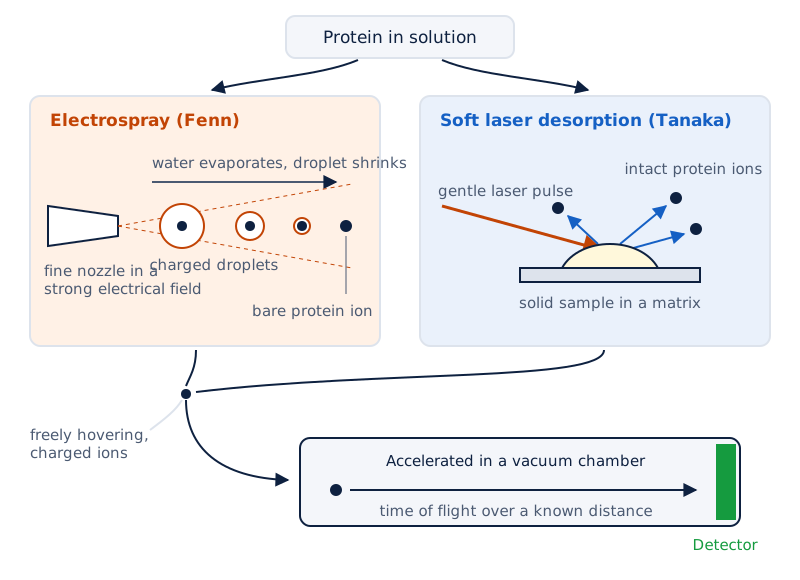
Draw two parallel paths starting from a protein in solution.
On the left, label "Electrospray (Fenn)": a fine nozzle sprays charged droplets into a cone shape, with arrows showing water evaporating and the droplet shrinking down to a single bare ion.
On the right, label "Soft laser desorption (Tanaka)": a laser beam strikes a solid sample spot, with small protein ions flying outward from the impact point.
Both paths should end at a shared vacuum tube labelled "time-of-flight detector", with an arrow showing the ion travelling along it towards a detector.
Drawn by One Young India.
The committee's press release noted that mass spectrometry is "a very important analytical method used in practically all chemistry laboratories the world over", and that only small molecules could be reliably identified before these two methods extended the technique to large biological macromolecules.
How does NMR reveal the shape of a protein?
Where mass spectrometry answers "what?" and "how much is there?", nuclear magnetic resonance (NMR) answers a different question: "what does the molecule look like?" Even the largest proteins are far too small to see with any ordinary microscope, so chemists needed another way to build a three-dimensional picture.
NMR relies on the fact that the nuclei of certain atoms, including hydrogen, behave like tiny spinning magnets.
When a sample is placed in a very strong magnetic field and then exposed to brief pulses of radio waves, these nuclei absorb and re-emit energy at specific frequencies.
The exact frequency for each nucleus depends slightly on its chemical surroundings within the molecule, so the resulting pattern of signals, the NMR spectrum, carries information about the molecule's structure.
The difficulty for large proteins, which can contain thousands of hydrogen nuclei, is that the resulting spectrum has thousands of overlapping peaks.
Wüthrich's key contribution, developed in a series of publications from the early 1980s, was a systematic procedure, called sequential assignment, for working out exactly which peak in the spectrum belongs to which hydrogen nucleus in the protein chain.
- Record two types of two-dimensional NMR spectra for the protein: one that links signals from protons bonded to the same part of an amino acid, and one that links signals from protons that are close together in space.
- Starting from a known or guessed signal, trace a path through the combined spectra, moving from one amino acid residue to the next along the protein's backbone.
- Repeat this tracing to assign the hydrogen signals of every residue along the chain, piece by piece.
- From the remaining signals that link protons close together in space but not adjacent on the chain, work out a large number of short, pairwise distances between hydrogen nuclei.
- Feed all these distance measurements into a mathematical procedure, based on distance geometry, that calculates a single three-dimensional structure consistent with every measured distance.
The popular information page compared this to drawing a three-dimensional picture of a house once you know a large number of the distances between its corners. Wüthrich reported the first complete protein structure solved this way, for a small protein called BUSI IIA, in 1985.
Diagram
assigning NMR signals along a protein chain
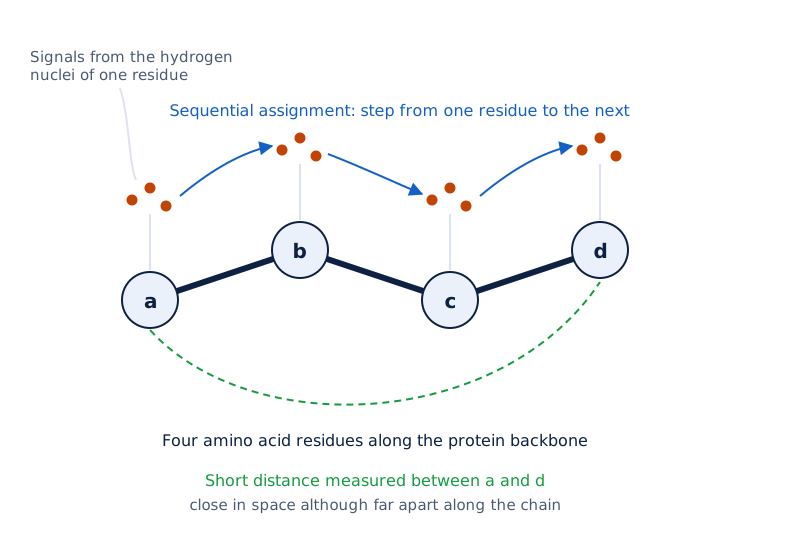
Draw a short zig-zag chain of four linked beads, labelled a, b, c and d, representing four amino acid residues in a row.
Next to each bead draw a small cluster of dots representing its hydrogen signals. Draw curved arrows hopping from the signal cluster of bead a to bead b, then b to c, then c to d, to show the sequential assignment moving step by step along the backbone.
Add a dashed line between beads a and d labelled "short distance measured", to show how NMR can also detect residues that are close together in space even though they are far apart along the chain.
Drawn by One Young India.
A unique advantage of NMR, stressed repeatedly in the committee's materials, is that it studies the protein in solution, an environment much closer to its natural surroundings inside a living cell, unlike X-ray crystallography, which needs the protein to be grown into a solid crystal first.
How did the discovery unfold?
| Year | Event |
|---|---|
| 1945 | Physicists Felix Bloch and Edward Purcell discovered the basic NMR phenomenon, that certain atomic nuclei absorb radio waves of specific frequencies in a strong magnetic field (the Scientific background paper gives 1946 for the same discovery). |
| 1966 | Richard Ernst showed that exposing samples to short, intense radio-frequency pulses, rather than slowly scanning frequencies, could massively increase NMR's sensitivity. |
| 1980s (early) | Kurt Wüthrich developed the sequential assignment method, linking each NMR signal to a specific hydrogen nucleus in a protein, and a distance-geometry method to turn these into a three-dimensional structure. |
| 1985 | Wüthrich and colleagues reported the first complete three-dimensional protein structure determined by his NMR method, for the protein BUSI IIA from bull seminal plasma. |
| 1987 | Koichi Tanaka, working at Shimadzu Corp. in Kyoto, demonstrated at a symposium that soft laser desorption could ionise intact protein molecules, publishing the results the following year. |
| 1988 | John B. Fenn published his breakthrough results showing that electrospray ionisation could analyse proteins and other macromolecules of large mass. |
| 2002 | The Royal Swedish Academy of Sciences announced the Nobel Prize in Chemistry on 9 October, jointly to Fenn, Tanaka and Wüthrich. |
Why does this matter?
The committee's popular information page said these methods turned chemical biology into the "big science" of our time, because chemists could now rapidly identify what proteins a sample contains and also build three-dimensional pictures of those proteins in solution.
Both techniques spread quickly because mass spectrometric methods are relatively cheap, so laboratories worldwide adopted electrospray ionisation and soft laser desorption (in forms such as MALDI) as standard tools for studying peptides, proteins and carbohydrates.
The sources describe several applications that emerged from these methods: speeding up early-stage pharmaceutical development, by allowing hundreds of candidate compounds to be screened per day; new approaches to early diagnosis of malaria, using haemoglobin's ability to absorb laser energy; promising methods for early detection of ovarian, breast and prostate cancer; and checking foodstuffs for harmful substances produced during preparation.
For NMR, the sources note that it remains especially useful for studying proteins that are hard to crystallise, including molecules with disordered or very flexible parts.
One example given is the study of prion proteins, linked to diseases such as mad cow disease, where NMR showed that part of the healthy prion protein chain is well-ordered while another part is highly mobile and unstructured.
NMR is also used in the pharmaceutical industry to screen small candidate drug molecules, since a successful interaction with a target protein changes that protein's NMR spectrum.
The scientific background paper placed both discoveries at the heart of what it called the "omics world", the large-scale study of genomes, proteomes and metabolic products, noting that mass spectrometry and NMR applied to macromolecules remain among the important cornerstones for understanding life processes at a molecular level.
How does this connect to what you study?
If you study biology or chemistry at school, you will meet proteins as long chains of amino acids that fold into specific shapes to carry out jobs in the cell, such as transporting oxygen or speeding up reactions.
This prize is a direct example of how chemistry tools, mass spectrometry and NMR, let scientists actually identify and picture those molecules rather than simply describing them in diagrams.
The idea of ions accelerating in an electrical field, central to mass spectrometry's time-of-flight measurement, connects to basic physics of charged particles in electric fields, while the behaviour of atomic nuclei in a magnetic field, central to NMR, connects to the physics of magnetism and atomic structure.
Seeing how these physical principles were combined to solve a real biological problem shows how science subjects support one another in practice.
Quick facts for exams
The Nobel Prize in Chemistry 2002 was awarded by the Royal Swedish Academy of Sciences, announced on 9 October 2002, "for the development of methods for identification and structure analyses of biological macromolecules".
It was shared three ways: one quarter each to John B. Fenn (USA) and Koichi Tanaka (Japan) for developing soft ionisation methods that let mass spectrometry weigh large proteins, and one half to Kurt Wüthrich (Switzerland) for developing NMR methods that revealed the three-dimensional structure of proteins in solution.
Fenn worked at Virginia Commonwealth University, Tanaka at Shimadzu Corp. in Kyoto, and Wüthrich at ETH Zurich and the Scripps Research Institute. The total prize amount was 10,000,000 Swedish kronor.
| Fact | Detail |
|---|---|
| Prize | Nobel Prize in Chemistry 2002 |
| Date announced | 9 October 2002 |
| Overall citation | "for the development of methods for identification and structure analyses of biological macromolecules" |
| Laureates | John B. Fenn, Koichi Tanaka, Kurt Wüthrich |
| Country of birth | Fenn: USA; Tanaka: Japan; Wüthrich: Switzerland |
| Affiliation at award | Fenn: Virginia Commonwealth University, USA; Tanaka: Shimadzu Corp., Japan; Wüthrich: ETH Zurich, Switzerland, and Scripps Research Institute, USA |
| Shares | Fenn one quarter; Tanaka one quarter; Wüthrich one half |
| Prize amount | 10,000,000 Swedish kronor |
Note: Source. The prize facts in this note are from the Nobel Prize's official site, nobelprize.org.
Glossary
- Macromolecule — a very large molecule, such as a protein, nucleic acid or carbohydrate, built from many repeating smaller units.
- Mass spectrometry — an analytical technique that identifies molecules by turning them into charged ions and measuring their mass.
- Ion — an electrically charged atom or molecule, formed by gaining or losing electrons or protons.
- Electrospray ionisation (ESI) — Fenn's method of spraying a solution through an electrical field to produce charged droplets that shrink into bare protein ions.
- Soft laser desorption (SLD) — Tanaka's method of using a gentle laser pulse to release intact protein ions from a solid sample without breaking them apart.
- Time of flight — the time an ion takes to travel a known distance in a mass spectrometer, used to calculate its mass.
- Nuclear magnetic resonance (NMR) — a technique that uses magnetic fields and radio waves to probe the structure of molecules via their atomic nuclei.
- Sequential assignment — Wüthrich's systematic method for matching each NMR signal to the specific hydrogen nucleus that produced it.
- Distance geometry — a mathematical method that calculates a three-dimensional structure from a set of known distances between points.
- X-ray crystallography — a method of determining molecular structure using X-rays diffracted through a crystallised sample.
- Proteomics — the study of how the full set of proteins in a cell act together.
- Prion protein — a protein linked to diseases such as mad cow disease, which can exist in a harmless or a disease-causing form.
Common errors and misconceptions
- Misconception: Mass spectrometry and NMR were invented in 2002. Correct: Mass spectrometry existed since the early twentieth century and NMR since the mid-twentieth century; the 2002 laureates extended them to work on large biological macromolecules such as proteins.
- Misconception: Fenn and Tanaka used the same method. Correct: Fenn used electrospray ionisation, spraying a solution, while Tanaka used soft laser desorption, firing a laser pulse at a solid sample; both achieve the same goal of releasing intact protein ions.
- Misconception: NMR works only on solid crystals. Correct: A key advantage of NMR, as stressed in the sources, is that it studies proteins in solution, unlike X-ray crystallography, which needs a crystal.
- Misconception: Koichi Tanaka was a university professor like the other laureates. Correct: At the time of the award, Tanaka was an engineer at the Shimadzu Corp. instrument company in Kyoto, not an academic.
- Misconception: The whole prize money was split equally among the three laureates. Correct: Fenn and Tanaka shared one half of the prize equally (one quarter each), while Wüthrich alone received the other half.
- Misconception: NMR replaced X-ray crystallography for protein structures. Correct: The sources describe NMR as complementing X-ray crystallography, with most known protein structures still determined by X-ray methods and NMR used especially for flexible or hard-to-crystallise proteins.
Exam-style questions with model answers
Q1. What was the overall citation for the Nobel Prize in Chemistry 2002? [2 marks]
- The official citation was "for the development of methods for identification and structure analyses of biological macromolecules", honouring new ways to study large biological molecules such as proteins.
Q2. Name the three laureates of the Nobel Prize in Chemistry 2002 and state how the prize money was shared among them. [2 marks]
- The laureates were John B. Fenn, Koichi Tanaka and Kurt Wüthrich; Fenn and Tanaka each received one quarter of the prize, and Wüthrich received the remaining one half.
Q3. Explain, step by step, how John Fenn's electrospray ionisation method turns a protein in solution into an ion ready for mass spectrometry. [4 marks]
- A protein solution is sprayed through a fine nozzle while a strong electrical field is applied, which breaks the liquid into tiny charged droplets.
- As these droplets travel through the instrument, the water inside them steadily evaporates, so each droplet shrinks in size.
- Once the droplet has shrunk enough, only a bare, electrically charged protein molecule remains, hovering freely as an ion in the gas phase.
- This protein ion is then accelerated by an electrical field, and its mass is found by measuring how long it takes to travel a known distance, since lighter and more highly charged ions move faster than heavier, less charged ones.
Q4. Why could large proteins not simply be studied with the mass spectrometry and NMR methods that already existed before 1980? [4 marks]
- Earlier mass spectrometry methods often used heat or harsh bombardment to turn molecules into ions, and large, fragile proteins tended to fragment or break apart under these conditions rather than surviving as whole ions.
- Proteins are far larger and more complex than the small molecules mass spectrometry had traditionally handled, so gentler ways of releasing intact ions were needed, which Fenn's electrospray and Tanaka's laser desorption methods both provided.
- For NMR, a protein contains thousands of hydrogen nuclei, producing an extremely crowded spectrum with thousands of overlapping signals, making it almost impossible to tell which signal belonged to which part of the molecule.
- Wüthrich's sequential assignment method solved this by systematically matching each signal to its specific hydrogen nucleus along the protein chain, which then allowed distances between nuclei to be measured and used to calculate the protein's three-dimensional shape.
Q5. Discuss how the 2002 Nobel Prize in Chemistry methods, mass spectrometry and NMR, have been applied beyond the chemistry laboratory, according to the committee's materials. [5 marks]
- The committee's popular information page described several real-world applications that followed from these two breakthroughs. In pharmaceutical development, electrospray mass spectrometry combined with fluid separation allowed hundreds of candidate drug compounds to be analysed in a single day, speeding up the early stages of designing new medicines.
- In medicine, soft laser desorption enabled early diagnosis approaches for malaria, by detecting how the oxygen-carrying part of haemoglobin absorbed laser energy, and similar surface-based laser desorption techniques were reported as helping chemists detect ovarian, breast and prostate cancer earlier than some conventional methods.
- In food safety, electrospray-based mass spectrometry allowed food to be analysed rapidly at different stages of production, helping identify harmful substances such as acrylamide so that production conditions could be adjusted to reduce them.
- For NMR, beyond determining basic protein shapes, the method proved valuable for studying flexible or disordered proteins that are hard to crystallise, such as prion proteins linked to diseases including mad cow disease, and it is used in the pharmaceutical industry to screen small molecules for their ability to bind to target proteins, since binding changes the target's NMR spectrum.
Q6. What is the difference between what mass spectrometry tells you about a protein and what NMR tells you about it? [3 marks]
- Mass spectrometry identifies a protein and tells you how much of it is present, mainly by measuring its mass through the time it takes charged ions to travel a known distance.
- NMR instead reveals what the protein actually looks like, by using signals from its hydrogen nuclei in a magnetic field to work out its three-dimensional shape while it is dissolved in water.
- The two methods are therefore complementary: one answers "what is it and how much?" and the other answers "what does it look like?"
Key takeaways
- The Nobel Prize in Chemistry 2002 honoured methods for identifying and determining the structure of biological macromolecules such as proteins.
- John B. Fenn and Koichi Tanaka shared one half of the prize for inventing soft ionisation methods for mass spectrometry.
- Fenn's electrospray ionisation sprays a protein solution through an electrical field to produce bare charged ions.
- Tanaka's soft laser desorption uses a gentle laser pulse to release intact protein ions from a solid sample.
- Kurt Wüthrich received the other half of the prize for developing NMR methods to find protein structures in solution.
- Wüthrich's sequential assignment links each NMR signal to a specific hydrogen nucleus, enabling distance measurements and structure calculation.
- NMR's key advantage is studying proteins in their natural, water-dissolved state, unlike X-ray crystallography, which needs a crystal.
- These methods now support pharmaceutical development, cancer diagnosis research, malaria diagnosis research and food safety testing.
Test yourself
Who shared one quarter of the Nobel Prize in Chemistry 2002 each?
John B. Fenn and Koichi Tanaka each received one quarter of the prize for their soft desorption ionisation methods for mass spectrometry.
Where was Kurt Wüthrich affiliated at the time of the award?
Kurt Wüthrich was affiliated with ETH Zurich in Switzerland and also with the Scripps Research Institute in La Jolla, USA.
What does electrospray ionisation do to a protein solution?
Electrospray ionisation sprays the solution through an electrical field, creating charged droplets that shrink as water evaporates, leaving bare protein ions.
How did Koichi Tanaka release intact protein ions?
Tanaka fired a gentle laser pulse at a protein sample held in a matrix, blasting it into fragments that released intact, lightly charged protein ions.
What is sequential assignment, developed by Wüthrich?
Sequential assignment is a systematic method for matching each signal in an NMR spectrum to the specific hydrogen nucleus in the protein that produced it.
Why is studying proteins in solution with NMR useful?
Studying proteins in solution with NMR places them in an environment similar to inside a living cell, unlike X-ray crystallography, which requires a solid crystal.
Name one medical application mentioned for soft laser desorption.
Soft laser desorption was reported as enabling early diagnosis approaches for malaria, using the oxygen-carrying part of haemoglobin to absorb laser energy.
Who announced the Nobel Prize in Chemistry 2002 and when?
The Royal Swedish Academy of Sciences announced the Nobel Prize in Chemistry 2002 on 9 October 2002.