
Nobel Prize in Chemistry 2005: Metathesis Method in Organic Synthesis
On this page
What was the Nobel Prize in Chemistry 2005 awarded for?
The Royal Swedish Academy of Sciences gave the prize jointly to three chemists with the citation: "for the development of the metathesis method in organic synthesis".
In plain words, the three laureates worked out how a chemical trick called metathesis happens, and then built the actual tools (catalysts) that make it work reliably. Metathesis comes from Greek words meaning "change position".
In this reaction, bonds between pairs of carbon atoms break and re-form so that groups of atoms swap partners, producing new molecules.
The Nobel Committee compared it to a dance where two couples meet, briefly join hands, then separate and leave with new partners.
The official name of this award is the Nobel Prize in Chemistry, administered by the Royal Swedish Academy of Sciences and announced on 5 October 2005.
Who are the laureates?
Yves Chauvin
Yves Chauvin was born on 10 October 1930 in Menin, Belgium, and died on 27 January 2015 in Tours, France. At the time of the award he was affiliated with the Institut Français du Pétrole in Rueil-Malmaison, France.
He received one third of the prize. In 1971, working with his student Jean-Louis Hérisson, Chauvin proposed and supported with experiments the detailed mechanism by which metathesis catalysts work, explaining that the active catalyst is a metal compound bonded to carbon by a double bond (a metal carbene, or metal alkylidene).
Robert H. Grubbs
Robert H. Grubbs was born on 27 February 1942 in Possum Trot, KY, USA, and died on 19 December 2021 in Duarte, CA, USA.
At the time of the award he worked at the California Institute of Technology (Caltech), Pasadena, CA, USA, holding the Victor and Elisabeth Atkins Professor of Chemistry chair. He received one third of the prize.
Around 1992 Grubbs discovered a ruthenium-based catalyst that was stable in air and tolerant of many other chemical groups, making metathesis practical for everyday laboratory use.
Richard R. Schrock
Richard R. Schrock was born on 4 January 1945 in Berne, IN, USA. At the time of the award he worked at the Massachusetts Institute of Technology (MIT), Cambridge, MA, USA, as the Frederick G. Keyes Professor of Chemistry.
He received one third of the prize. In 1990 Schrock reported the first family of highly active, well-defined molybdenum-based catalysts for metathesis, after years of testing different metals including tantalum and tungsten.
What problem were the laureates trying to solve?
Organic chemistry is built around the element carbon, which can form chains, branches and rings, and bond to hydrogen, oxygen, nitrogen and other elements.
All life on Earth depends on carbon compounds, and chemists have long tried to build new carbon-based molecules artificially through organic synthesis for use as medicines, plastics and other materials.
A reaction that could efficiently break and remake carbon-carbon double bonds would be an extremely useful tool, since double bonds appear throughout organic molecules.
The Academy's scientific background noted that carbon-carbon bond chemistry had already earned several earlier Nobel Prizes in Chemistry: the 1912 prize to Victor Grignard for reagents that build carbon-carbon bonds and to Paul Sabatier for catalytic hydrogenation of unsaturated compounds, the 1950 prize for the Diels-Alder reaction, which reorganises carbon-carbon double bonds into new rings, the 1979 prize to Herbert C.
Brown and Georg Wittig for reactions that add to or form carbon-carbon double bonds, and the 2001 prize for catalysts that reduce or oxidise such double bonds.
Such a reaction, later called olefin metathesis (olefin is another name for an alkene, a carbon chain with a double bond), was first observed in industry in the 1950s, following earlier work by Karl Ziegler on polymerising ethylene.
A 1957 patent by H. S. Eleuterio at DuPont described unexpected unsaturated polymers forming when the strained molecule norbornene was treated with a molybdenum oxide catalyst, and another patent that year showed that propene could be converted into butene and ethene using a mixture of triisobutylaluminium and molybdenum oxide on alumina.
In 1966 Giulio Natta and co-workers found that tungsten-based mixtures could polymerise other ring-shaped alkenes, and the following year N. Calderon at the Goodyear Tire and Rubber Company extended this work, showed that these were all examples of the same underlying reaction, and named it olefin metathesis.
However, nobody understood what the catalyst looked like at the molecular level or how it actually worked, so finding new catalysts remained, as the Nobel Committee put it, largely "hit-and-miss". This gap, between observing a useful reaction and understanding and controlling it, is what the three laureates closed.
How does the metathesis reaction actually work?
Metathesis, from Greek words meaning change and position, is a general pattern in which two substances AB and CD exchange parts to give AC and BD. Olefin metathesis applies this pattern to molecules containing carbon-carbon double bonds.
In a simple example given by the Academy, two molecules of propene react with the help of a catalyst, and the result is two different molecules, butene and ethene.
One propene molecule swaps its CH2 group for the CH3CH group carried by the other propene molecule, so the double-bonded atom groups effectively change places.
This swapping does not happen on its own. It needs a catalyst, a substance that speeds up and guides the reaction without being consumed by it.
Before and shortly after Chauvin's work, several rival ideas about the catalyst's structure were circulating, including a metal-coordinated cyclobutane model and a metallocyclopentane model, but none could explain all the experimental results.
Chauvin's 1971 mechanism, developed with his student Jean-Louis Hérisson, finally explained the catalytic cycle. He proposed that the active catalyst is a metal carbene (also called a metal alkylidene), a compound in which a metal atom is joined to a carbon atom by a double bond.
The cycle runs in four main steps, often compared to partners in a dance who meet, join hands, then separate with new partners:
- A metal-carbene catalyst (the metal is linked to a carbon atom by a double bond) approaches an alkene molecule.
- The metal and the alkene's carbon atoms form a temporary four-membered ring containing one metal atom and three carbon atoms (called a metallocyclobutane).
- Two of the single bonds in this ring break apart, releasing a new alkene product and leaving behind a new metal-alkylidene species.
- This new metal-alkylidene reacts with another alkene molecule, forming a fresh ring, and the cycle repeats, continuously swapping alkylidene groups between molecules.
Diagram
the metathesis dance
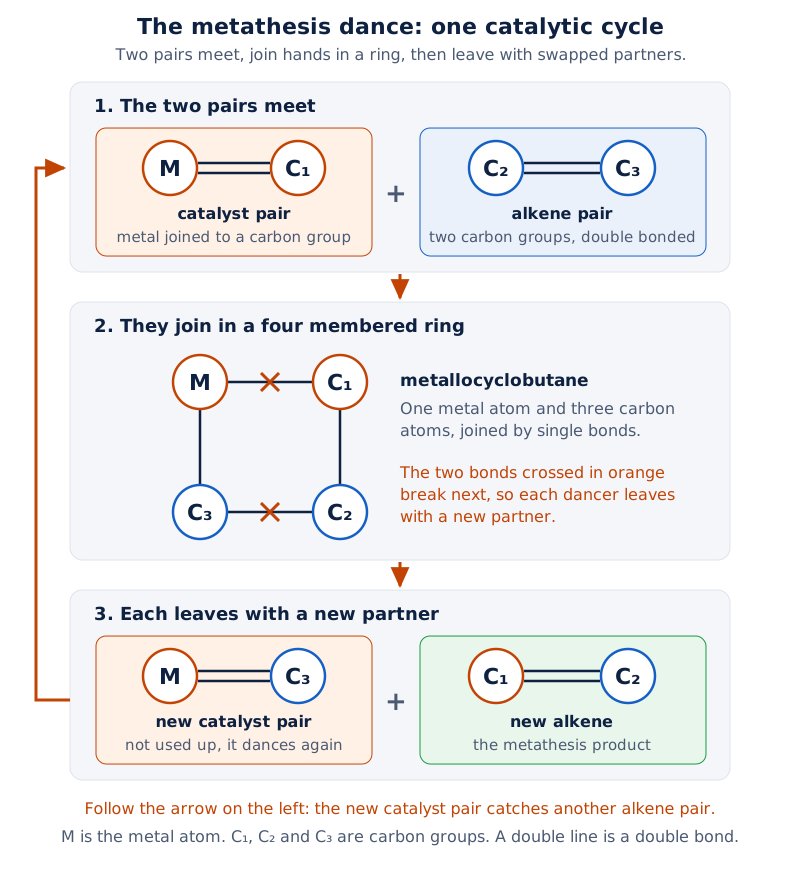
Draw two pairs of circles labelled "catalyst pair" (a metal joined to a carbon group) and "alkene pair" (two carbon groups joined by a double bond).
Show them meeting to form a four-membered ring, then separating with swapped partners, leaving a new catalyst pair ready to repeat the cycle.
Drawn by One Young India.
This mechanism explained results that earlier proposed mechanisms could not account for, and it gained support from later experiments by Grubbs, T. J. Katz and Schrock, among others, becoming the generally accepted picture of how metathesis works.
Chauvin's insight also pointed the way forward: if the catalyst really was a metal alkylidene, chemists could, in principle, design and build such compounds deliberately rather than stumbling on them by chance.
How did Schrock and Grubbs turn the idea into practical catalysts?
Knowing the mechanism was only half the problem. Chemists still needed catalysts that were stable, long-lived, and selective enough to react only with double bonds while leaving the rest of a molecule untouched.
Early catalysts were sensitive to air and moisture and short-lived, which limited their use, and none of the well-defined metal alkylidenes known at the time actually catalysed metathesis.
Richard Schrock began testing different metals for this role in the early 1970s while working at DuPont, including tantalum, tungsten and molybdenum.
His early tantalum-alkylidene compounds were the first stable metal-carbene complexes ever isolated and characterised, but they did not catalyse metathesis themselves.
By 1980, after moving to MIT, Schrock had found that adding certain bulky oxygen-containing groups to a tantalum complex allowed it to catalyse the metathesis of a simple alkene for the first time.
Over nearly two decades of further work, Schrock narrowed in on molybdenum and tungsten as the most active metals for the reaction.
In 1990, Schrock and his co-workers reported a family of highly active, well-defined molybdenum-based catalysts built around carefully chosen bulky groups attached to the metal; these were sensitive to oxygen and moisture but, handled correctly, proved extremely powerful tools for synthesis, and one version was later made commercially available.
Robert Grubbs took a different route, focusing on ruthenium. After exploring less well-defined ruthenium-based catalysts from the mid-1980s, Grubbs and his co-workers published in 1992 a molecularly well-defined ruthenium-carbene catalyst that was stable even in the presence of water and alcohols, unlike the more reactive but more fragile molybdenum catalysts.
Grubbs then refined the catalyst's structure, exchanging certain attached groups to improve its reactivity, and by 1995 reported a version that became known simply as the first-generation Grubbs' catalyst, still prized today for its stability in air and its tolerance of many other chemical groups.
Because some difficult ring-forming reactions needed an even more active catalyst, Grubbs' group later replaced one of the catalyst's attachments with a different type of carbon-based ligand, producing a second-generation Grubbs' catalyst around 1999 that reacted faster while keeping the useful stability of the original design.
Both generations became standard tools against which newer catalysts are still compared.
| Catalyst feature | Schrock's molybdenum catalysts (1990) | Grubbs' ruthenium catalysts (1992 onward) |
|---|---|---|
| Reactivity | Very high | Lower than Schrock's, but still effective |
| Stability in air | Sensitive to oxygen and moisture | Stable in air |
| Tolerance of water, alcohols, acids | Limited | Good, works in their presence |
| Ease of everyday laboratory use | Requires careful handling | Became the standard, widely adopted tool |
How did the discovery unfold?
| Year | Event |
|---|---|
| 1957 | H. S. Eleuterio at DuPont files a patent describing unexpected unsaturated polymers; another patent that year shows propene converting into butene and ethene with an aluminium and molybdenum oxide catalyst mixture. |
| 1967 | N. Calderon at Goodyear links these separate observations and names the reaction olefin metathesis, though the catalyst's mechanism remains unknown. |
| 1971 | Yves Chauvin and his student Jean-Louis Hérisson publish the detailed mechanism showing a metal-carbene catalyst drives metathesis through a four-membered ring intermediate. |
| 1990 | Richard Schrock reports the first family of highly active, well-defined molybdenum-based metathesis catalysts. |
| 1992 | Robert Grubbs reports a ruthenium-based catalyst that is stable in air and tolerant of water, alcohols and acids. |
| 2005 | The Royal Swedish Academy of Sciences awards the Nobel Prize in Chemistry jointly to Chauvin, Grubbs and Schrock, announced on 5 October. |
Why does metathesis matter beyond the laboratory?
Metathesis quickly became, in the words of the Nobel Committee's press release, "one of organic chemistry's most important reactions". It is used daily in the chemical industry, mainly in developing pharmaceuticals and advanced plastics.
The committee said the laureates' contributions made synthesis more efficient (fewer reaction steps, less waste), simpler (catalysts stable in air at normal temperatures and pressures) and more environmentally friendly (safer solvents, less hazardous waste), describing this as a major step for "green chemistry".
The Scientific Background document from the Academy listed real applications made possible by these catalysts, including the synthesis of insect pheromones, herbicides, polymer and fuel additives, and candidate molecules aimed at diseases such as bacterial infections, hepatitis C and cancer, as well as Alzheimer's disease, Down's syndrome, osteoporosis, arthritis, inflammation, fibrosis, HIV/AIDS and migraine.
Metathesis also allowed chemists to build large rings in certain molecules used in cancer research, rings that would be very difficult to form by older synthesis routes, and it supported industries ranging from pharmaceuticals and biotechnology to foodstuffs and polymer manufacturing.
Despite the relatively short time these catalysts had been available by 2005, the breadth of their uses across academic research and industry was already remarkable, and catalyst design kept advancing rapidly, with new variants published almost every month, as more chemists adapted the tools to new problems.
What kinds of reactions can chemists now build with metathesis?
Once stable catalysts existed, chemists found that olefin metathesis could be arranged in several useful patterns, each suited to a different synthetic job. The Academy's scientific background described these types and illustrated them with real published examples.
Ring-closing metathesis joins the two ends of a single long carbon chain that already carries two double bonds, closing it into a ring and releasing a small molecule such as ethene.
The Academy's own popular account gave an example used in cancer research, where a long chain (molecule B) was converted by one of Grubbs' catalysts into a large ring (substance A), and this ring shape was described as necessary for the molecule's anti-cancer activity.
Ring-opening metathesis works the other way, opening a strained ring-shaped alkene and linking many such opened units together into a long polymer chain; this was one of the earliest applications observed industrially, going back to the 1957 patents and the 1960s journal reports by Natta and Calderon.
Cross metathesis joins two separate, smaller alkene molecules into one new alkene. The scientific background gave the example of synthesising the sex pheromone of the omnivorous leafroller, a pest insect that attacks apples, pears, peaches and nectarines; using the second-generation Grubbs' catalyst, chemists produced the pheromone with the particular mixture of two geometric forms that occurs in nature.
More complex syntheses combine several metathesis steps in sequence, sometimes called tandem or domino reactions, and researchers such as K. C.
Nicolaou used ring-closing metathesis on molecules attached to solid supports to build complicated natural-product-like structures, including derivatives of the anti-cancer compound epothilone A.
Other groups used metathesis with carefully controlled catalysts to achieve stereoselective cross metathesis, where the shape and orientation of the product is controlled precisely rather than left to chance.
These different reaction types share the same underlying chemistry explained by Chauvin and made practical by Schrock and Grubbs, but they let chemists choose the right tool, closing a ring, opening a ring, or joining two molecules, depending on what structure they need to build.
Quick facts for exams
The Nobel Prize in Chemistry 2005 was awarded jointly to Yves Chauvin, Robert H. Grubbs and Richard R.
Schrock "for the development of the metathesis method in organic synthesis", announced by the Royal Swedish Academy of Sciences on 5 October 2005. Chauvin, based at the Institut Français du Pétrole in France, explained the reaction's mechanism in 1971.
Schrock, at MIT in the USA, built the first efficient molybdenum catalyst in 1990. Grubbs, at Caltech in the USA, developed a more air-stable ruthenium catalyst in 1992.
Each laureate received one third of the prize, which totalled 10,000,000 Swedish kronor. Metathesis lets chemists break and remake carbon-carbon double bonds to build new molecules used in medicines and plastics.
| Fact | Detail |
|---|---|
| Prize | Nobel Prize in Chemistry 2005 |
| Citation | "for the development of the metathesis method in organic synthesis" |
| Laureates | Yves Chauvin, Robert H. Grubbs, Richard R. Schrock |
| Country of birth | Chauvin: Belgium; Grubbs: USA; Schrock: USA |
| Country of affiliation at award | Chauvin: France (Institut Français du Pétrole); Grubbs: USA (Caltech); Schrock: USA (MIT) |
| Share | One third each |
| Date announced | 5 October 2005 |
| Prize amount | 10,000,000 Swedish kronor |
Note: Source. The prize facts in this note are from the Nobel Prize's official site, nobelprize.org.
Glossary
- Metathesis — a chemical reaction in which the double bonds linking carbon atoms break and re-form so that atomic groups swap places.
- Olefin — another name for an alkene, a carbon chain containing a carbon-carbon double bond.
- Catalyst — a substance that speeds up a chemical reaction without being permanently consumed by it.
- Metal carbene (metal alkylidene) — a compound in which a metal atom is joined to a carbon atom by a double bond, acting as the active part of a metathesis catalyst.
- Metallocyclobutane — a temporary four-membered ring, made of one metal atom and three carbon atoms, formed during the metathesis catalytic cycle.
- Organic synthesis — building new chemical substances by making simpler molecules react together in planned steps.
- Ruthenium catalyst — the metal-based catalyst developed by Grubbs, notable for being stable in air and tolerant of water and acids.
- Molybdenum catalyst — the highly active but more air-sensitive catalyst developed by Schrock.
- Green chemistry — designing chemical processes that reduce hazardous waste and use resources more efficiently.
- Polymer — a large molecule made of many repeating smaller units, some of which can be produced using metathesis.
- Carbon-carbon double bond — a bond where two carbon atoms share two pairs of electrons; metathesis breaks and remakes these bonds.
Common errors and misconceptions
- Misconception: Metathesis was invented by the 2005 laureates. Correct: The reaction was first observed in industry in the 1950s; the laureates explained its mechanism and built practical catalysts for it.
- Misconception: All three laureates worked together in one laboratory. Correct: Chauvin worked in France at the Institut Français du Pétrole, while Grubbs and Schrock worked independently at Caltech and MIT in the USA.
- Misconception: Grubbs' catalyst is simply a better version of Schrock's catalyst in every way. Correct: Grubbs' ruthenium catalyst is more air-stable and tolerant of water and acids but has lower reactivity than Schrock's molybdenum catalysts.
- Misconception: Metathesis only matters in academic laboratories. Correct: The committee stated it is used daily in industry, especially for pharmaceuticals and advanced plastics.
- Misconception: The catalyst is used up during the reaction. Correct: A catalyst speeds up the reaction without being permanently consumed, and is regenerated at the end of each cycle to react again.
- Misconception: "Olefin" and "alkene" refer to different classes of compound. Correct: Olefin is simply another name for alkene, a carbon chain containing a double bond.
Exam-style questions with model answers
Q1. State the official citation for the Nobel Prize in Chemistry 2005. [2 marks]
- The citation was "for the development of the metathesis method in organic synthesis", awarded jointly to Yves Chauvin, Robert H. Grubbs and Richard R. Schrock.
Q2. Name the three laureates and their affiliations at the time of the award. [2 marks]
- Yves Chauvin was at the Institut Français du Pétrole in France, Robert H. Grubbs was at Caltech in the USA, and Richard R. Schrock was at MIT in the USA.
Q3. Explain what metathesis means and give a simple example of the reaction. [4 marks]
- Metathesis means "change places": it is a reaction in which double bonds between carbon atoms are broken and remade so that groups of atoms swap partners.
- A catalyst is needed for this exchange to happen, since it does not occur on its own.
- A documented example is two propene molecules reacting with a catalyst to produce butene and ethene, where one propene exchanges its CH2 group for the CH3CH group of the other.
- This kind of swapping allows chemists to build new carbon-based molecules that would be hard to make with older methods.
Q4. Describe the catalytic cycle Yves Chauvin proposed for metathesis. [4 marks]
- Chauvin proposed that the active catalyst is a metal carbene, where a metal atom is joined to a carbon by a double bond.
- This metal-carbene catalyst reacts with an alkene to form a temporary four-membered ring called a metallocyclobutane, containing the metal and three carbon atoms.
- Two single bonds in this ring break, releasing a new alkene product and leaving a new metal-alkylidene species behind.
- This new species reacts with another alkene molecule, repeating the ring-forming and breaking steps, so the cycle continues and alkylidene groups keep being exchanged between molecules.
Q5. Compare Schrock's and Grubbs' contributions to metathesis catalysts, and discuss why their work mattered for industry. [6 marks]
- Richard Schrock tested several metals, including tantalum, tungsten and molybdenum, before reporting in 1990 a family of highly active, well-defined molybdenum-based catalysts; these were very reactive but sensitive to air and moisture.
- Robert Grubbs developed a different approach using ruthenium, reporting in 1992 a catalyst that was stable in air and could tolerate water, alcohols and acids, though it was less reactive than Schrock's molybdenum catalysts.
- Grubbs went on to refine this design so it became easy to use in ordinary laboratories, and one version became known simply as "Grubbs' catalyst", a standard comparison point for newer catalysts.
- Together these catalysts turned Chauvin's theoretical mechanism into practical tools, allowing chemists to carry out reliable, selective reactions outside specialised settings.
- The Nobel Committee stated that this made synthesis more efficient, simpler to use and more environmentally friendly, describing it as a step forward for green chemistry.
- Industry applications mentioned by the Academy include pharmaceuticals, plastics, insect pheromones, herbicides and candidate drug molecules for diseases such as cancer and hepatitis C.
Q6. Why did the discoverers of metathesis in the 1950s struggle to develop new catalysts for decades afterward? [3 marks]
- Although industrial patents in the 1950s showed that metathesis-type reactions occurred, nobody understood what the catalyst looked like at the molecular level or how it functioned.
- Without knowing the mechanism, searching for better catalysts was largely a matter of trial and error, described by the Nobel Committee as "hit-and-miss".
- This gap was only closed once Chauvin published the detailed mechanism in 1971, after which Schrock and Grubbs could deliberately design catalysts based on that understanding.
Key takeaways
- The Nobel Prize in Chemistry 2005 honoured the development of the metathesis method in organic synthesis.
- Yves Chauvin, Robert H. Grubbs and Richard R. Schrock shared the prize equally, one third each.
- Metathesis breaks and remakes carbon-carbon double bonds so that atomic groups swap partners.
- Chauvin explained the reaction's mechanism in 1971, involving a metal-carbene catalyst and a four-membered ring intermediate.
- Schrock built the first highly active molybdenum catalysts in 1990; Grubbs built an air-stable ruthenium catalyst in 1992.
- The committee linked the discovery to greener, more efficient industrial chemistry with less waste.
- Applications mentioned include pharmaceuticals, plastics, insect pheromones and herbicides.
Test yourself
Who proposed the mechanism of metathesis in 1971?
Yves Chauvin, working with his student Jean-Louis Hérisson, proposed the detailed mechanism of metathesis in 1971.
What metal did Schrock use in his 1990 breakthrough catalyst?
Richard Schrock used molybdenum to build his highly active, well-defined 1990 metathesis catalyst.
What metal did Grubbs use in his air-stable catalyst?
Robert Grubbs used ruthenium to build a metathesis catalyst that was stable in air and tolerant of water and acids.
What does the word metathesis mean?
Metathesis means "change places", describing how double-bonded atom groups swap partners in the reaction.
Where was Yves Chauvin based when he received the prize?
Yves Chauvin was affiliated with the Institut Français du Pétrole in Rueil-Malmaison, France, at the time of the award.
How much prize money was shared among the laureates?
The prize totalled 10,000,000 Swedish kronor, shared equally, with one third going to each laureate.
Give one industrial benefit of metathesis mentioned by the Nobel Committee.
The committee said metathesis made synthesis more efficient, simpler to use and more environmentally friendly, supporting "green chemistry".