
Nobel Prize in Economics 2006: Edmund Phelps and Intertemporal Tradeoffs
On this page
This note covers the Nobel Prize in Economics 2006: who won it, what the official citation means, how Edmund S.
Phelps rewrote the link between inflation and unemployment, how his work on saving and capital formation changed how economists think about fairness between generations, how his ideas developed over four decades, why they still matter for central banks today and a quick-facts summary for exams.
What was the Nobel Prize in Economics 2006 awarded for?
The Royal Swedish Academy of Sciences gave the 2006 prize to Edmund S. Phelps "for his analysis of intertemporal tradeoffs in macroeconomic policy". This is the official citation, and it is worth reading slowly because every word matters.
"Intertemporal" simply means across time. "Tradeoffs" means choosing more of one good thing only by giving up some of another. "Macroeconomic policy" refers to the tools governments and central banks use to manage the whole economy, chiefly interest rates, government spending and taxes.
Put together, the citation says that Phelps showed how a policy choice made today changes what is possible tomorrow.
Two examples run through his work. First, a central bank that tolerates more inflation today to push unemployment down will find, Phelps argued, that it has made future inflation fights harder rather than buying a lasting fall in unemployment.
Second, a society that saves and invests more today can raise the welfare of future generations, but only at some cost to people alive now.
Phelps studied both tradeoffs with careful, from-the-ground-up models of how individual firms, workers and households actually decide.
The prize's official name is the Sveriges Riksbank Prize in Economic Sciences in Memory of Alfred Nobel; it is commonly called the Nobel Prize in Economics, though it was created by Sweden's central bank in 1968 and is not one of the original five Nobel Prizes.
The 2006 prize was announced on 9 October 2006 and carried a prize amount of 10,000,000 Swedish kronor.
Who is the laureate?
The 2006 prize went to a single laureate, who received the whole award. There was no shared citation this year: Phelps received the whole award alone.
Edmund S. Phelps
Edmund S. Phelps was born on 26 July 1933 in Evanston, Illinois, USA. He completed his PhD in economics in 1959 at Yale University in Connecticut, USA.
At the time of the award he held the McVickar Professorship of Political Economy at Columbia University in New York, NY, USA, and received the entire prize share of 1/1.
Phelps grew up in Hastings-on-Hudson, New York, where he played the trumpet avidly, and the Nobel site credits that creative environment as a major influence on his career.
He married Viviana Montdor in 1974. His prize-awarded research began in the late 1960s, when he challenged the then-common assumption that high unemployment always meant low inflation and vice versa.
Phelps worked across two connected fields within macroeconomics: the relationship between inflation, wages and unemployment, and the theory of how much a society should save for future generations.
His contribution built microeconomic foundations under big, economy-wide questions: he explained large-scale patterns by modelling how individual workers, firms and households behave and form expectations.
Phelps died on 15 May 2026, according to the Nobel Prize's official records.
What problem was Phelps trying to solve?
In the years after the Second World War, most economists followed Keynesian thinking, which held that a government could keep the economy near full employment simply by managing total demand through spending, taxes or interest rates, without this causing lasting inflation problems.
Policy seemed almost mechanical: keep demand high enough to avoid idle workers but not so high that it caused shortages and price rises.
This picture was reinforced by an empirical finding published by the economist Phillips in 1958: across historical data, there appeared to be a stable negative relationship between the inflation rate and the unemployment rate. Economists called this the Phillips curve.
Policymakers read it as a menu: accept a bit more inflation and you could buy a permanently lower unemployment rate, or accept more unemployment to keep prices stable.
This comfortable picture had three problems. First, the Phillips curve was a bare statistical pattern with no clear foundation in how individual firms and workers actually set wages and prices.
Second, it implied that purely nominal policy choices (how much money is in the economy) could permanently change real outcomes (how many people have jobs), which clashed with older economic theory.
Third, nobody had a real theory of what determined the lowest unemployment rate an economy could sustain without accelerating inflation, a rate now usually called the natural rate of unemployment or NAIRU. It was this gap that Phelps set out to close from the late 1960s onward.
How did Phelps rewrite the link between inflation and unemployment?
Phelps's central move was to notice that people's expectations about future inflation matter just as much as current unemployment in deciding how fast prices actually rise.
Wages and prices are not changed every instant; firms and workers reset them only occasionally, and when they do, they base the new wage or price on what they expect inflation to be, not just on what it is right now.
The expectations-augmented Phillips curve
From this insight Phelps built what the Nobel sources call the expectations-augmented Phillips curve. In simple words, actual inflation equals expected inflation plus an extra amount that depends on how tight the labour market is (how low unemployment is).
A useful short formula from the scientific background is π = πᵉ + f(u), where π is actual inflation, πᵉ is expected inflation and f(u) is a term that falls as unemployment, u, rises.
- Workers and firms form an expectation of future inflation based on recent experience, because information about the wider economy is costly and incomplete.
- When wages or prices are next renegotiated, they are set using that expected inflation rate plus an adjustment for how scarce or plentiful jobs and workers currently are.
- If policymakers push unemployment below the rate at which expected and actual inflation line up, actual inflation keeps rising above what people expected.
- People then revise their inflation expectations upward, which pushes future wage and price rises higher still for the same unemployment rate.
- The economy settles only when unemployment returns to a level, the equilibrium or "natural" rate, where expected and actual inflation finally match.
Why there is no lasting tradeoff
The consequence is that there is no permanent tradeoff between inflation and unemployment: pushing unemployment below its equilibrium level only buys a one-off, temporary reduction, after which inflation simply keeps climbing.
Equilibrium unemployment itself, Phelps showed in further work, is pinned down by how the labour market functions, including firms deliberately paying wages above the bare minimum to reduce staff turnover and improve morale, an idea now known as efficiency wages.
Diagram
the short-run versus long-run Phillips curve
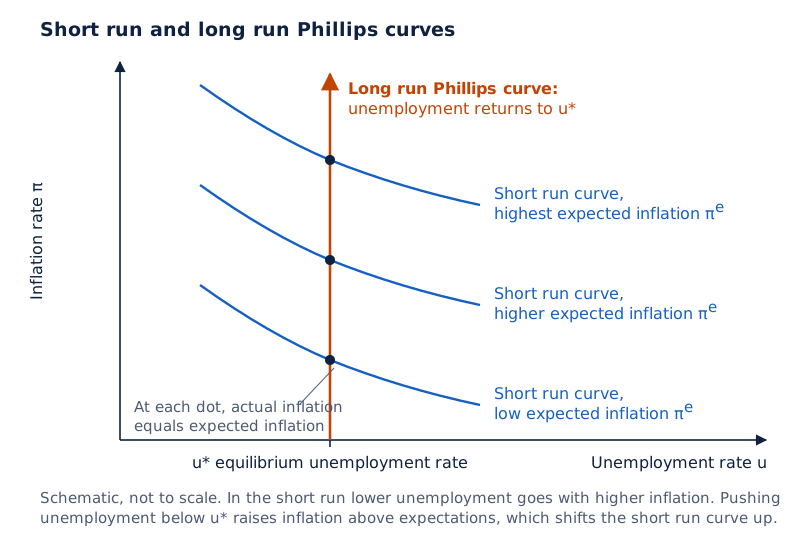
Draw a horizontal axis for the unemployment rate and a vertical axis for the inflation rate, as the scientific background describes.
Sketch several short, downward-sloping curves, one for each level of expected inflation, each showing that lower unemployment goes with higher inflation in the short run.
Then draw a single vertical line crossing all of them at the equilibrium unemployment rate, showing that in the long run inflation can be anything while unemployment always returns to that one level.
Drawn by One Young India.
| Idea | View before Phelps | What Phelps showed |
|---|---|---|
| Inflation and unemployment | A stable Phillips curve offered a permanent menu of choice between the two | Only expected versus unexpected inflation matters; the long-run curve is vertical at an equilibrium rate |
| Role of expectations | Largely ignored in the statistical Phillips curve | Central: current policy shapes future inflation expectations and so future policy choices |
| Equilibrium unemployment | No explicit theory of its determinants | Modelled from firms' wage-setting behaviour under search and matching frictions |
How did Phelps think about saving for future generations?
Alongside his work on inflation, Phelps asked a very different question: how much of today's income should a society save and invest, rather than consume, for the benefit of people not yet born? This is also an intertemporal tradeoff, because resources used for investment in physical capital (factories, machines) or human capital (education, research) are resources current people cannot consume themselves.
The golden rule of capital accumulation
In an early and famous 1961 article, Phelps derived what is called the golden rule of capital accumulation. Taking a long-run, generation-spanning view, he asked what constant savings rate would deliver the highest sustainable level of consumption per person forever.
His answer, which the Nobel committee linked to the ethic of reciprocity, "Do unto others as you would have them do unto you": the ideal long-run savings rate should equal the share of national income that goes to capital, which is the same as saying the return on capital should equal the economy's growth rate.
When saving goes wrong, too much or too little
Phelps then went further than this tidy long-run rule. He showed that if an economy has saved and accumulated capital beyond the golden-rule level, a situation called dynamic inefficiency, then every generation, not just the current one, can be made better off by saving less.
This matters because it shows that "save more for the future" is not automatically good advice; sometimes an economy has already overshot.
Conversely, with Robert Pollak, Phelps analysed the opposite risk, that savings can be too low when each generation cares a little less about its grandchildren's consumption than about its own, a mismatch now studied under the heading of time-inconsistent preferences.
Phelps and Pollak showed that in such cases a policy such as a mandatory pension system, forcing every generation to save more, can leave every generation better off.
- Write down how much of national income is consumed each year and how much is saved and invested, as in the Solow-Swan growth model that Phelps used as his starting point.
- Work out the steady state where capital per worker, and therefore consumption per worker, stays constant over time for a given savings rate.
- Compare steady states across different savings rates to find the one that gives the highest constant consumption level; this identifies the golden-rule savings rate.
- Check whether the economy's actual capital stock sits above or below this golden-rule level, to see whether current saving is too high, too low, or about right.
What did Phelps say about education and economic growth?
Phelps did not treat "capital" as only machines and buildings. In joint work with Richard Nelson, published in 1966, he argued that a more educated workforce finds it easier to adopt new technologies that already exist elsewhere, which helps poorer countries catch up with richer ones.
This is now called the Nelson-Phelps approach to human capital and technology diffusion.
Why the existing stock of education matters
A striking implication, noted in the scientific background material, is that a country's rate of economic growth should depend not only on how fast its education level is rising but also on how high its existing stock of education already is at any point in time, a pattern the committee says matches later empirical research.
The idea also offers an explanation for why the pay gap between highly educated and less educated workers tends to widen during periods of rapid technological change: a well-trained workforce becomes unusually valuable exactly when new technology needs to be understood and applied quickly.
Taken together with the golden rule and the work on dynamic inefficiency, these contributions gave later economists a toolkit for asking not just how fast an economy grows, but whether the mix of saving, physical investment and investment in people's skills and knowledge is actually the one that is fair and efficient across generations.
The Nobel committee described Phelps's overall contribution on this side of his work as opening doors for later research on long-run growth and the debate over economic policy that followed it.
How did Phelps's ideas develop over time?
Move this row so it appears before the "1967 to 1970" row, keeping the table in chronological order.| Year | Event |
|---|---|
| 1933 | Edmund S. Phelps is born in Evanston, Illinois, USA. |
| 1958 | Economist Phillips publishes the statistical relationship between inflation and unemployment later called the Phillips curve. |
| 1959 | Phelps completes his PhD in economics at Yale University. |
| 1961 | Phelps publishes his article deriving the golden rule of capital accumulation. |
| 1965 | Phelps shows that savings rates above the golden-rule level are inefficient for every generation. |
| 1966 | With Richard Nelson, Phelps analyses how human capital speeds up the spread of new technology. |
| 1967 to 1970 | Phelps publishes his core papers introducing the expectations-augmented Phillips curve and modelling equilibrium unemployment; the 1970 paper appeared in the "Phelps volume" anthology. |
| 1972 | Phelps publishes "Inflation Policy and Unemployment Theory", popularising his policy conclusions. |
| 1994 | Phelps publishes "Structural Slumps", examining the real, structural causes of persistent unemployment. |
| 2006 | Phelps is awarded the Sveriges Riksbank Prize in Economic Sciences in Memory of Alfred Nobel, announced on 9 October. |
This timeline shows how Phelps kept returning to the same underlying question across four decades: how does a choice made now limit or enlarge what is possible later, whether that choice is about inflation or about saving? His 1994 return to unemployment, after Europe experienced a stubbornly high jobless rate in the 1980s, is a good example: he went back to the structural, real-economy causes of unemployment rather than the earlier focus on expectations alone.
Why does this work matter today?
The Nobel committee stated that Phelps's theory of inflation and unemployment "radically changed our perception of the interaction between inflation and unemployment" and helped explain why both inflation and unemployment rose together during the 1970s, something the older Phillips curve could not account for.
Modern central banks, the committee noted, now routinely base interest rate decisions on estimates of the equilibrium unemployment rate rather than assuming a permanent tradeoff exists.
Inflation targeting and policy today
His intertemporal framing, that low inflation today is like an investment in low inflation expectations tomorrow, is described in the sources as part of the theoretical basis for inflation targeting, a policy framework many central banks adopted from the early 1990s onward.
The idea that policy choices today shape the menu of choices available in the future is now, the committee said, a standard way economists and central banks discuss monetary policy.
Open questions left for later research
On the saving side, the golden rule and the concept of dynamic inefficiency remain core building blocks of growth theory taught to economics students, while the Nelson-Phelps work on human capital anticipated later findings that a country's existing stock of education, not merely its rate of improvement, helps explain differences in growth across countries.
The sources also note open threads: later researchers, building on Phelps's critique of fully "rational" expectations, continued to explore why past inflation expectations can leave a lasting mark on current inflation, and the quantitative importance of some of his later arguments, such as the effect of real interest rates on unemployment through firms' investment incentives, remained, as the committee noted, without full consensus in later empirical research.
How does this connect to what you study?
Students who study macroeconomics in school or college economics courses will meet the Phillips curve, the ideas of inflation and unemployment, and the concept of saving and investment in growth models.
Phelps's work sits directly behind the modern versions of these topics. When a textbook explains why a central bank cannot permanently trade a little more inflation for a little less unemployment, it is describing, in simplified form, the conclusion Phelps reached through his expectations-augmented Phillips curve.
Similarly, when a course discusses why a country should balance consumption today against investment for the future, whether in factories, infrastructure or education, it is touching the same ground Phelps covered with the golden rule of capital accumulation and his work with Nelson on human capital and growth.
His argument that an economy can sometimes have saved too much, not too little, is a useful corrective to the common classroom assumption that more saving is always better for growth.
For students of general studies or quiz-style exams, Phelps's prize is a good example of how an economics Nobel can recognise a shift in how an entire field thinks, rather than a single invention.
His career also illustrates how an idea published in the late 1960s, when the data of the time seemed to contradict it, was only confirmed by events roughly a decade later, a reminder that economic theories are often tested by history long after they are first proposed.
Quick facts for exams
The Sveriges Riksbank Prize in Economic Sciences in Memory of Alfred Nobel 2006, widely called the Nobel Prize in Economics, was awarded entirely to Edmund S.
Phelps of Columbia University, New York, USA, "for his analysis of intertemporal tradeoffs in macroeconomic policy".
The award was announced on 9 October 2006 by the Royal Swedish Academy of Sciences, which also awards the Physics and Chemistry prizes, and carried a prize amount of 10,000,000 Swedish kronor.
Phelps, born on 26 July 1933 in Evanston, Illinois, USA, is best known for the expectations-augmented Phillips curve, which showed there is no permanent tradeoff between inflation and unemployment, and for the golden rule of capital accumulation, which set out the ideal long-run savings rate for an economy. He held the sole 1/1 share of the prize.
| Fact | Detail |
|---|---|
| Prize | Sveriges Riksbank Prize in Economic Sciences in Memory of Alfred Nobel |
| Year | 2006 |
| Laureate | Edmund S. Phelps |
| Country of birth | USA (Evanston, Illinois) |
| Country of affiliation | USA (Columbia University, New York) |
| Share | 1/1 (whole prize) |
| Citation | "for his analysis of intertemporal tradeoffs in macroeconomic policy" |
| Date announced | 9 October 2006 |
| Prize amount | 10,000,000 Swedish kronor |
Note: Source. The prize facts in this note are from the Nobel Prize's official site, nobelprize.org.
Glossary
- Phillips curve — a statistical pattern, first noted by the economist Phillips in 1958, showing a negative relationship between inflation and unemployment in historical data.
- Expectations-augmented Phillips curve — Phelps's reformulation showing that inflation depends on both unemployment and the inflation rate people expect.
- Equilibrium unemployment rate — the unemployment rate at which actual and expected inflation coincide, determined by how the labour market functions.
- Intertemporal tradeoff — a choice in which gaining something now means giving up something later, or vice versa.
- Golden rule of capital accumulation — Phelps's rule that the long-run savings rate giving the highest sustainable consumption equals capital's share of national income.
- Dynamic inefficiency — a situation where an economy has saved and accumulated so much capital that reducing saving would raise consumption for every generation.
- Human capital — the skills, education and knowledge embodied in a workforce, which Phelps linked to how fast new technology spreads.
- Efficiency wages — wages set above the bare minimum because they improve worker morale, reduce turnover or attract better applicants.
- Adaptive expectations — the assumption, used by Phelps, that people form expectations of future inflation based mainly on recent past inflation.
- Time-inconsistent preferences — a mismatch where a person values near-future and far-future consumption differently depending on when the comparison is made.
- Inflation targeting — a monetary policy framework, adopted by many central banks from the early 1990s, that sets an explicit inflation goal.
- Keynesian economics — the post-war view that managing total demand could keep an economy near full employment without lasting inflation problems.
Common errors and misconceptions
- Misconception: Phelps invented the Phillips curve. Correct: The original Phillips curve came from the economist Phillips in 1958; Phelps challenged and reformulated it.
- Misconception: Phelps said inflation and unemployment are always unrelated. Correct: He said there is a short-run relationship but no permanent long-run tradeoff.
- Misconception: The golden rule says a country should always save more. Correct: Phelps showed saving above the golden-rule level actually makes every generation worse off.
- Misconception: The 2006 prize was shared between several economists. Correct: Edmund S. Phelps received the whole prize alone.
- Misconception: "The Nobel Prize in Economics" is one of Alfred Nobel's original five prizes. Correct: Its official name is the Sveriges Riksbank Prize in Economic Sciences in Memory of Alfred Nobel, created separately by Sweden's central bank.
- Misconception: Phelps's work was only about monetary policy. Correct: He also made major contributions to capital accumulation, saving and human capital's role in growth.
- Misconception: Rising inflation expectations have no real economic effect. Correct: Phelps argued that rising expectations push up future wages and prices and make future policy harder.
Exam-style questions with model answers
Q1. What is the official citation for the Nobel Prize in Economics 2006? [2 marks]
- The Royal Swedish Academy of Sciences awarded the prize "for his analysis of intertemporal tradeoffs in macroeconomic policy".
Q2. Name the sole laureate of the 2006 prize and his affiliation at the time of the award. [2 marks]
- Edmund S. Phelps, who was affiliated with Columbia University in New York, USA, received the entire 1/1 share of the prize.
Q3. Explain what the expectations-augmented Phillips curve says. [4 marks]
- Earlier economists believed a stable Phillips curve offered a permanent choice between inflation and unemployment.
- Phelps showed that actual inflation depends on unemployment and on the inflation rate people expect.
- If policy pushes unemployment below its equilibrium level, actual inflation rises above expectations, which then get revised upward.
- As a result, there is no lasting tradeoff: only the equilibrium unemployment rate persists in the long run, while inflation can settle at different levels.
Q4. What is the golden rule of capital accumulation? [4 marks]
- Phelps asked what constant savings rate gives the highest sustainable level of consumption per person over the long run.
- His answer was that the ideal savings rate should equal the share of national income going to capital.
- This is the same as saying the return on capital should equal the economy's growth rate.
- Phelps named it the golden rule after the ethic of reciprocity, treating every generation the same way.
Q5. Discuss why Phelps's analysis of inflation and unemployment mattered for real-world policy. [6 marks]
- Before Phelps, policymakers treated the Phillips curve as a stable menu allowing a permanent choice between inflation and unemployment.
- Phelps showed that pushing unemployment below its equilibrium level only produces a temporary fall in unemployment, after which inflation keeps rising as expectations adjust.
- This matched events in the 1970s, when both high inflation and high unemployment occurred together, something the old Phillips curve could not explain.
- His intertemporal framing, that today's policy shapes tomorrow's inflation expectations, is now, according to the Nobel committee, part of the theoretical basis for inflation targeting adopted by many central banks from the early 1990s.
- Modern central banks base interest rate decisions on estimates of the equilibrium unemployment rate rather than assuming a lasting tradeoff exists.
- His separate work on equilibrium unemployment, built from how individual firms set wages under labour market frictions, gave later economists a theory of frictional unemployment that had previously been missing.
Q6. What did Phelps and Robert Pollak show about generational saving? [3 marks]
- Phelps and Pollak modelled a situation where each generation values its own consumption more than that of its children and grandchildren.
- They showed that under this mismatch, equilibrium savings rates chosen freely by each generation could be too low.
- They argued that a policy such as a mandatory pension system, forcing all generations to save more, could make every generation better off.
Q7. How did Phelps link human capital to economic growth? [3 marks]
- With Richard Nelson, Phelps argued in 1966 that a better-educated workforce adopts new technology more easily.
- This helps explain why poorer countries can catch up with richer ones once they build sufficient education levels.
- It also implies that growth depends on the existing stock of education, not only on how fast education is rising.
Q8. When was the 2006 Nobel Prize in Economics announced, and what was the prize amount? [2 marks]
- It was announced on 9 October 2006, with a prize amount of 10,000,000 Swedish kronor.
Key takeaways
- Edmund S. Phelps won the entire 2006 Nobel Prize in Economics for analysing intertemporal tradeoffs in macroeconomic policy.
- He rewrote the Phillips curve to include inflation expectations, showing no permanent tradeoff between inflation and unemployment.
- Equilibrium unemployment, in his models, depends on labour market functioning, including firms deliberately paying efficiency wages.
- His 1961 golden rule set out the long-run savings rate that maximises sustainable consumption per person.
- He showed saving above the golden-rule level can be dynamically inefficient, making every generation worse off.
- With Robert Pollak, he showed mismatched generational preferences can make saving rates too low without policy intervention.
- With Richard Nelson, he linked human capital to how fast new technology spreads and to economic growth.
- His framework underlies modern inflation targeting and central banks' use of the equilibrium unemployment rate.
Test yourself
Who received the 2006 Nobel Prize in Economics and what share did he get?
Edmund S. Phelps received the entire prize, a 1/1 share, rather than sharing it with other economists.
What is the main message of the expectations-augmented Phillips curve?
Inflation depends on both unemployment and people's expected inflation rate, so pushing unemployment down permanently only raises inflation without lasting benefit.
What does the golden rule of capital accumulation recommend?
It recommends a long-run savings rate equal to capital's share of national income, which maximises sustainable consumption per person over time.
What is dynamic inefficiency?
It is a situation where an economy has saved too much, so that reducing saving would increase consumption for every single generation.
Where did Phelps work at the time of the award?
Edmund S. Phelps was affiliated with Columbia University in New York, NY, USA, at the time he received the prize.
What did Phelps and Nelson argue about education and technology?
They argued that a better-educated workforce adopts new technology more quickly, helping explain growth differences between countries.
Why did the 1970s help confirm Phelps's theory?
High inflation and high unemployment occurred together in the 1970s, a pattern the older Phillips curve could not explain but Phelps's theory predicted.
When was the 2006 Nobel Prize in Economics announced?
It was announced on 9 October 2006 by the Royal Swedish Academy of Sciences.