
Nobel Prize in Physiology or Medicine 2004: Odorant Receptors and the Olfactory System
On this page

This note covers the Nobel Prize in Physiology or Medicine 2004: who won it, how odorant receptors let the nose detect about 10,000 smells, how the olfactory system organises this information in the brain, how the discovery unfolded, why it matters and quick facts for exams.
What was the Nobel Prize in Physiology or Medicine 2004 awarded for?
The official citation reads: "for their discoveries of odorant receptors and the organization of the olfactory system". In plain words, the two laureates found the actual molecular machinery that lets us smell things, and worked out how the signals from that machinery are wired up inside the brain.
Before their work, scientists knew that smell somehow began in the nose and ended in the brain, but no one had identified the actual receptor proteins that catch odour molecules, or explained how a limited number of receptor types could let us recognise roughly 10,000 different smells.
Axel and Buck discovered a huge family of genes, about 1,000 of them, that make these receptors, and then showed how signals from these receptors are sorted and combined in the brain.
This award is formally called the Nobel Prize in Physiology or Medicine, and it was given jointly, with each laureate receiving an equal half-share.
Who are the laureates?
Both laureates received one half of the prize each, reflecting their joint discovery and their largely independent follow-up work.
Richard Axel
Richard Axel was born on 2 July 1946 in New York, NY, USA. At the time of the award he was affiliated with Columbia University, New York.
Together with Linda Buck, he discovered, in 1991, the large gene family coding for odorant receptors.
Afterwards, working largely independently, he and Buck independently showed that nerve cells carrying the same receptor type send their signals to the same microscopic region, called a glomerulus, inside the brain's olfactory bulb, and his research group also used genetic techniques in mice to confirm the receptor's role in this targeting.
Linda B. Buck
Linda B. Buck was born on 29 January 1947 in Seattle, WA, USA. She completed a bachelor's degree in microbiology in 1975 at the University of Washington, then earned a PhD in immunology in 1980 at the University of Texas Southwestern Medical Center, Dallas, before moving to Columbia University where she worked with Axel.
At the time of the award her affiliation was the Fred Hutchinson Cancer Research Center, Seattle.
Her later work used a pipette technique to empty single olfactory cells and show exactly which receptor gene each cell switched on, linking specific cells to specific odour responses.
Why was the sense of smell poorly understood before 1991?
The Nobel committee's press release described smell as "the most enigmatic of our senses", because the basic principles for recognising and remembering about 10,000 different odours were not understood.
Scientists already knew that olfactory receptor cells sit in a small patch of the nasal epithelium and send thin nerve fibres straight into the brain's olfactory bulb, but the molecular basis of smell detection was a mystery.
At the award ceremony, Professor Sten Grillner noted that although many details of how smell worked had already been mapped, "the basic mode of operation of the sense of smell was not understood" until Axel and Buck's studies. He also called smell "in some way more primitive than other senses – less verbal", because people often lack words to describe a new scent precisely.
The stakes were high because smell is central to survival across species. A newborn mammal relies on smell to find its mother's teats and feed, and cannot survive unaided without this sense.
Adult animals, too, read their environment mainly through odour; the press release notes that dogs have an olfactory epithelium that covers about forty times more area than a human's, and Grillner suggested that the olfactory world of a mouse or a dog is "most likely, infinitely richer" than our own.
Even in people, losing the sense of smell is described as a serious handicap, because warning signals such as smoke from a fire, and the pleasure of food, both depend heavily on it.
How do odorant receptors detect smells?
Axel and Buck showed that about three per cent of our genes, roughly 1,000 genes, code for different odorant receptor proteins. Each of these receptors sits on the surface membrane of an olfactory receptor cell and acts like a tiny docking station for odour molecules drifting into the nose.
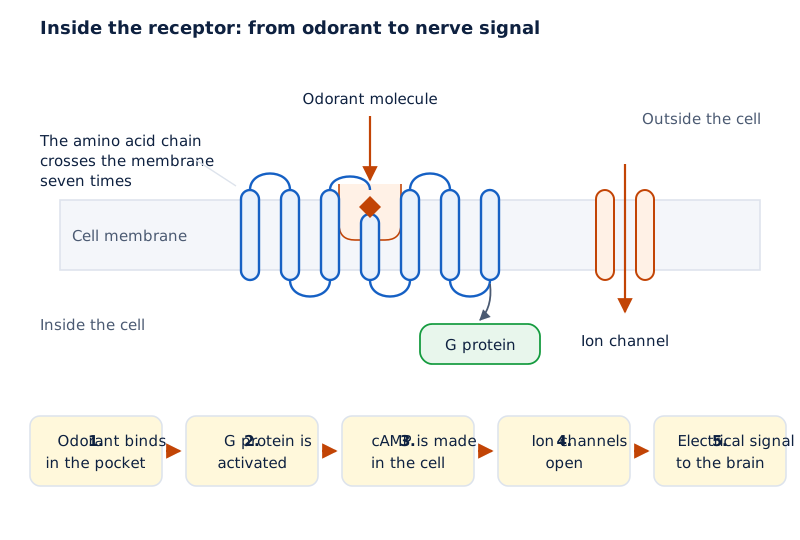
- An odorant molecule, inhaled through the nose, reaches the nasal epithelium and binds to a matching odorant receptor on an olfactory receptor cell.
- This binding changes the shape of the receptor protein, which activates an attached G protein, because the receptor belongs to the G protein-coupled receptor (GPCR) family.
- The activated G protein stimulates the cell to produce more cAMP (cyclic AMP), a chemical messenger inside the cell.
- cAMP opens ion channels in the cell membrane, which triggers an electrical signal in the olfactory receptor cell.
- This electrical signal travels along the cell's thin nerve process into the brain.
Each receptor protein is a chain of amino acids that crosses the cell membrane seven times, creating a pocket where an odorant molecule can attach; small structural differences between receptors explain why different receptors respond to different odorous molecules.
Because each type of receptor has its own distinctive pocket, Grillner described each receptor as a docking station that responds "to only a few odorants" rather than to every molecule that reaches the nose.
The nasal mucosa does not carry just one copy of each receptor type. For every one of the roughly 1,000 receptor types, there are large numbers of cells scattered through the mucosa that all carry the identical receptor, so a single odour can trigger activity across many cells at once rather than in just one isolated location.
The number of receptor types differs sharply between species, as the table below shows.
| Species | Approximate number of odorant receptor types |
|---|---|
| Fish | About 100 |
| Mouse | About 1,000 |
| Human | Somewhat fewer than mice, possibly as few as about 350, because some genes were lost during evolution |
Diagram
One receptor cell, one receptor type
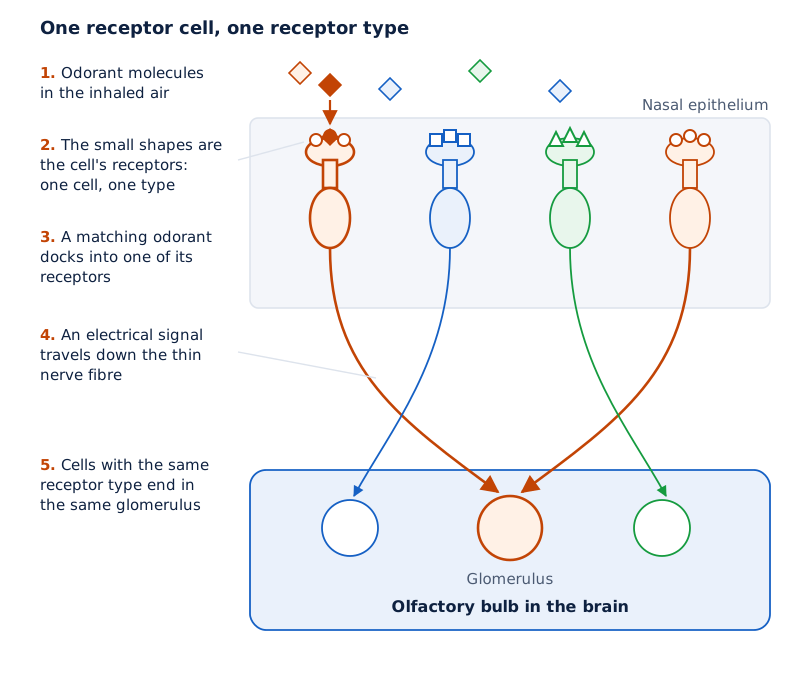
Draw a strip of nasal epithelium with several olfactory receptor cells.
Label one cell with a single receptor type shown as a seven-pass protein on its surface, an odorant molecule docking into it, and an arrow showing the electrical signal travelling down its thin nerve fibre towards the brain.
Drawn by One Young India.
How does the brain organise signals from odorant receptors?
Axel and Buck independently showed that every single olfactory receptor cell switches on only one of the roughly 1,000 odorant receptor genes, so there are as many types of receptor cell as there are receptor types.
Crucially, a given cell does not react to just one odour; it responds, with varying intensity, to several chemically related odorant molecules.
Receptor cells carrying the same receptor type send their nerve fibres to the same glomerulus, one of roughly 2,000 well-defined microregions inside the olfactory bulb, the brain's first smell-processing station, which means there are about twice as many glomeruli as there are types of receptor cell.
Inside each glomerulus, the receptor cell fibres connect with the next nerve cells in the chain, called mitral cells, each of which is activated by only one glomerulus.
Grillner described this arrangement as a "labelled line" running from each receptor subtype all the way to the brain cortex, so that the cortex stays continuously informed about how strongly each of the many receptor subtypes has been activated.
Mitral cells then carry the information onward, through long nerve processes, to regions of the brain cortex, where signals from several different receptor types are combined into a pattern.
Most odours contain many odorant molecules at once, and each molecule activates several receptors, producing what the press release called a combinatorial code, "somewhat like the colours in a patchwork quilt or in a mosaic".
This patterned code is the basis of our ability to recognise and remember around 10,000 different smells, and is what finally let scientists explain, in Grillner's words, "the enigma of our ability to discern so many different scents".
What do these receptors reveal about pheromones and taste?
Axel and Buck found that the general design principle they uncovered for ordinary smell detection also applies, with variations, to other chemical senses.
Pheromones, which are chemical signals that influence social behaviour, especially in animals, are detected by two further families of G protein-coupled receptors located in a different part of the nasal lining from the ordinary odorant receptors.
Separately, the taste buds on the tongue were shown to use yet another distinct family of GPCRs, responsible for the sense of taste.
This means that the nose and tongue between them use at least four different receptor-protein families: one for ordinary smells, two for pheromone signals, and one for taste, all working on the same basic docking-and-signalling plan that the laureates first worked out for odorant receptors.
Both laureates reached this conclusion about pheromones independently of each other, a second, independent discovery made after their joint 1991 paper.
This extended the importance of the 1991 discovery well beyond ordinary smell, into how animals, including humans, sense chemical signals from their environment and from each other in general, and it suggested that the same molecular toolkit, a large family of related GPCRs, underlies several of the body's chemical senses at once.
How did the discovery unfold?
| Year | Event |
|---|---|
| 1946 | Richard Axel is born in New York, NY, USA. |
| 1947 | Linda Buck is born in Seattle, WA, USA. |
| 1975 | Buck receives her bachelor's degree in microbiology from the University of Washington. |
| 1980 | Buck receives a PhD in immunology from the University of Texas Southwestern Medical Center, Dallas, before moving to Columbia University. |
| 1991 | Axel and Buck jointly publish the paper describing the large gene family of odorant receptors, in the journal Cell. |
| 2004 | Axel and Buck are announced as Nobel laureates on 4 October, and receive the prize at the ceremony on 10 December. |
After the joint 1991 paper, Axel and Buck largely worked independently, each running parallel studies that filled in different parts of the picture: how single receptor cells behave, how their signals converge on glomeruli, and how pheromone and taste receptors fit the same pattern.
The presentation speech by Professor Sten Grillner at the award ceremony described their work as having unravelled "the enigma of our ability to discern so many different scents", crediting both laureates equally for solving a puzzle that had resisted explanation for a very long time.
Why does it matter?
The discovery explains something close to everyday experience: why a good wine or a ripe strawberry can activate a whole array of receptors at once, and why a single bad meal involving a particular food, such as a stale clam, can leave a lasting aversion that persists for years and can put someone off an otherwise delicious dish.
The press release notes that smell plays a central role in our enjoyment of food and in triggering vivid memories, both positive and negative, from childhood or later emotional moments; Grillner's speech added that a single remembered scent can bring back memories as specific as the tar of old fishing boats or the scent of a honeysuckle rose.
Beyond daily pleasure, the discovery matters for safety and survival. Losing the sense of smell removes the ability to detect warning signals such as smoke from a fire, and the press release calls this loss a serious handicap, adding that without it we also lose the ability to perceive the different qualities of food.
Across species, the stakes are even higher: without olfaction, a newborn mammal cannot find its mother's teats and cannot survive unaided, and most animals rely on smell far more heavily than humans do to interpret their surroundings.
By showing that this entire sense rests on a huge, well-organised family of receptor genes, and by being the first sensory system worked out mainly through molecular techniques, the discovery also opened the way to understanding other chemical senses, including pheromone detection and taste, using the same basic molecular logic.
How does this connect to what you study?
This discovery connects directly to biology topics on sensory receptors and chemical signalling inside cells. The odorant receptor is a classic example of a G protein-coupled receptor, a type of membrane protein that also appears in many other hormone and drug-signalling pathways studied in cell biology.
The idea that a single gene family can give rise to hundreds of related but slightly different proteins also links to basic genetics, since it shows how one large gene family can produce many specialised cell types, each expressing just one member of the family.
The step-by-step signal chain, from receptor binding, through a G protein and cAMP, to an electrical nerve signal, is a useful worked example of how chemical information outside a cell gets converted into an electrical signal that the nervous system can use, a theme that reappears whenever sensory systems such as vision, hearing or taste are studied.
Quick facts for exams
The Nobel Prize in Physiology or Medicine 2004 was awarded jointly to Richard Axel and Linda B. Buck for discovering odorant receptors and working out how the olfactory system is organised.
The announcement was made on 4 October 2004, and the prize was presented at a ceremony in Stockholm on 10 December 2004. Axel, born in New York, USA, was at Columbia University;
Buck, born in Seattle, USA, was at the Fred Hutchinson Cancer Research Center. Each laureate received one half of the prize.
Their key joint paper, published in 1991, identified roughly 1,000 genes coding for odorant receptors in the nose, explaining how we can recognise about 10,000 different smells.
| Fact | Detail |
|---|---|
| Prize | Nobel Prize in Physiology or Medicine 2004 |
| Laureates | Richard Axel and Linda B. Buck |
| Shares | One half each |
| Country of birth | Both born in the USA (Axel: New York; Buck: Seattle) |
| Affiliation at award | Axel: Columbia University; Buck: Fred Hutchinson Cancer Research Center |
| Citation | "for their discoveries of odorant receptors and the organization of the olfactory system" |
| Date announced | 4 October 2004 |
| Prize amount | 10,000,000 Swedish kronor |
Note: Source. The prize facts in this note are from the Nobel Prize's official site, nobelprize.org.
Glossary
- Odorant receptor — a protein on an olfactory receptor cell that binds a specific group of odour molecules.
- Olfactory receptor cell — a nerve cell in the nasal epithelium that detects inhaled odour molecules.
- Olfactory epithelium — the small tissue area high in the nose that holds the olfactory receptor cells.
- Olfactory bulb — the part of the brain that first receives nerve signals from olfactory receptor cells.
- Glomerulus — a tiny, well-defined region in the olfactory bulb where fibres from one receptor type converge.
- G protein-coupled receptor (GPCR) — a membrane protein family that changes shape on binding a molecule and activates an internal G protein.
- cAMP (cyclic AMP) — a chemical messenger inside a cell that opens ion channels after receptor activation.
- Mitral cell — a nerve cell in the olfactory bulb activated by a single glomerulus, which relays signals to the brain cortex.
- Combinatorial code — the pattern formed when several receptor types respond together to the mixture of molecules in one smell.
- Pheromone — a chemical signal, mainly in animals, that influences social behaviour and is detected by its own GPCR families.
- Gene family — a group of related genes, here about 1,000, that each produce a slightly different odorant receptor.
- Nasal epithelium — the lining tissue inside the nose that contains the olfactory receptor cells.
- Sensory neuron — a nerve cell specialised to detect a stimulus, such as an odour, and convert it into an electrical signal.
- Brain cortex — the outer brain region where signals from many receptor types are combined into a recognisable pattern.
Common errors and misconceptions
- Misconception: Each olfactory receptor cell responds to only one odour. Correct: a cell carries one receptor type but can respond, with varying intensity, to several related odorant molecules.
- Misconception: Humans and mice have the same number of smell receptor genes. Correct: mice have about 1,000 receptor types while humans have fewer, possibly as few as about 350, because some genes were lost in evolution.
- Misconception: Axel and Buck worked as a single team throughout their careers. Correct: they published the key 1991 paper jointly, then carried out their later, often parallel, studies largely independently of each other.
- Misconception: Olfactory receptor cells are only found deep in the brain. Correct: they are sensory neurons located in the nasal epithelium, which also send thin nerve fibres directly into the olfactory bulb.
- Misconception: Pheromones and tastes are detected by the same receptors as ordinary smells. Correct: the press release states that pheromones use two other GPCR families, and taste buds use yet another distinct GPCR family.
- Misconception: Dogs and humans smell the world equally well. Correct: the press release notes that the olfactory epithelium area in dogs is about forty times larger than in humans.
- Misconception: The 2004 prize was awarded only for discovering receptor genes. Correct: the citation also covers the organisation of the olfactory system, meaning how receptor cells and brain regions are wired together.
Exam-style questions with model answers
Q1. Name the two laureates of the Nobel Prize in Physiology or Medicine 2004 and their affiliations at the time of the award. [2 marks]
- Richard Axel was at Columbia University, New York, and Linda B. Buck was at the Fred Hutchinson Cancer Research Center, Seattle, when they received the award.
Q2. What is an odorant receptor? [2 marks]
- An odorant receptor is a protein, located on the surface of an olfactory receptor cell, that binds a specific group of odour molecules and triggers a nerve signal towards the brain.
Q3. Explain how an odorant molecule binding to its receptor leads to an electrical signal in the nerve cell. [4 marks]
- An inhaled odorant molecule binds to its matching receptor on an olfactory receptor cell in the nasal epithelium. This binding changes the receptor's shape, activating an attached G protein, because the receptor belongs to the G protein-coupled receptor family. The activated G protein stimulates the cell to produce more cAMP, a chemical messenger. The cAMP then opens ion channels in the cell membrane, which triggers an electrical signal that travels along the cell's nerve process into the olfactory bulb in the brain.
Q4. Why did the Nobel committee describe smell as the most enigmatic of our senses before 1991? [4 marks]
- Before 1991, scientists knew that olfactory receptor cells sat in the nasal epithelium and sent fibres to the olfactory bulb, but no one had found the receptor proteins themselves or explained how a limited set of receptors could allow recognition of about 10,000 different smells. Unlike vision or hearing, smell lacked an understood molecular basis, which is why the committee called it the most enigmatic sense until Axel and Buck's discoveries clarified the mechanism.
Q5. Describe, step by step, how an odour is detected, converted into a signal, and sent to the brain's olfactory bulb. [6 marks]
- An odorant molecule, inhaled through the nose, reaches the nasal epithelium and binds to a matching odorant receptor on an olfactory receptor cell, out of roughly 1,000 receptor types available. This binding alters the shape of the seven-pass receptor protein, which activates an attached G protein, since the receptor belongs to the GPCR family. The G protein then stimulates production of cAMP inside the cell, a chemical messenger that opens ion channels in the membrane. The opening of these channels triggers an electrical signal in the olfactory receptor cell. This signal travels along the cell's thin nerve process, which runs directly into the brain and ends in one specific glomerulus, a microregion in the olfactory bulb. Because every receptor cell expresses only one receptor type, and all cells with the same receptor type send fibres to the same glomerulus, the pattern of which glomeruli are active carries information about which receptors, and therefore which odorant molecules, have been detected.
Q6. Discuss why the discovery of odorant receptors and the organisation of the olfactory system matters beyond pure science. [6 marks]
- The discovery explains everyday experiences such as how a good wine or a ripe strawberry activates many receptors at once, and why a single bad meal can leave a lasting aversion for years, because smell is closely tied to memory and to the enjoyment of food. It also matters for safety, since losing the sense of smell removes the ability to detect warning signals such as smoke from a fire, which the press release calls a serious handicap. Across species the stakes are higher still: a newborn mammal cannot find its mother's teats and cannot survive unaided without smell, and animals such as dogs, whose olfactory epithelium is about forty times larger than in humans, depend on smell far more heavily to interpret their surroundings. Finally, by showing that pheromone detection and taste rely on related families of G protein-coupled receptors, the work extended its relevance to how animals sense chemical signals generally, well beyond ordinary smell.
Q7. What combinatorial code did Axel and Buck describe, and why is it important? [4 marks]
- Most odours are mixtures of several odorant molecules, and each molecule can activate more than one type of receptor. The resulting pattern of activated receptors, described by the press release as being "somewhat like the colours in a patchwork quilt or in a mosaic", forms a combinatorial code. This code, combined in the brain cortex, is the basis for recognising and remembering around 10,000 different smells using only about 1,000 receptor types.
Key takeaways
- Richard Axel and Linda B. Buck shared the Nobel Prize in Physiology or Medicine 2004 for discoveries about odorant receptors and the olfactory system.
- Their 1991 joint paper identified a gene family of about 1,000 genes, roughly three per cent of our genes, coding for odorant receptors.
- Each olfactory receptor cell expresses only one receptor type, yet can respond to several related odour molecules with varying intensity.
- Odorant receptors are G protein-coupled receptors; binding an odorant triggers a G protein, then cAMP, then an electrical signal.
- Receptor cells with the same receptor type send fibres to the same glomerulus in the olfactory bulb, preserving signal specificity.
- Mitral cells relay glomerulus signals to the brain cortex, where patterns from many receptor types combine into a recognisable smell.
- Related GPCR families, separate from ordinary odorant receptors, detect pheromones and taste, extending the same basic design to other chemical senses.
- The discovery explains why losing smell is a serious handicap for enjoying food, detecting danger, and, for many species, for basic survival.
Test yourself
Who shared the Nobel Prize in Physiology or Medicine 2004, and in what proportion?
Richard Axel and Linda B. Buck shared the prize equally, each receiving one half, for their work on odorant receptors.
What fraction of our genes codes for odorant receptors?
About three per cent of our genes, roughly 1,000 different genes, code for the various odorant receptor types in the nose.
What type of receptor protein family do odorant receptors belong to?
Odorant receptors belong to the G protein-coupled receptor, or GPCR, family, which activates an internal G protein when an odorant binds.
Where does a glomerulus sit, and what is special about it?
A glomerulus is a microregion inside the olfactory bulb where all nerve fibres from receptor cells carrying the same receptor type converge.
How many odorant receptor types does a mouse have, compared with a human?
A mouse has about 1,000 odorant receptor types, while humans have fewer, possibly as few as about 350, since some genes were lost in evolution.
Where was Richard Axel based when he received the Nobel Prize?
Richard Axel was affiliated with Columbia University in New York, NY, USA, at the time of the award.
Where was Linda B. Buck based when she received the Nobel Prize?
Linda B. Buck was affiliated with the Fred Hutchinson Cancer Research Center in Seattle, WA, USA, at the time of the award.
What else, besides smell, uses receptor families related to odorant receptors?
Pheromone detection uses two other GPCR families, and taste buds use yet another separate GPCR family, following the same basic design.