
Nobel Prize in Physiology or Medicine 2005: Helicobacter Pylori and Peptic Ulcer Disease
On this page

What was the Nobel Prize in Physiology or Medicine 2005 awarded for?
The official citation reads: "for their discovery of the bacterium Helicobacter pylori and its role in gastritis and peptic ulcer disease".
In plain words, the two laureates found that a specific bacterium, not stress or spicy food, is the main cause of gastritis (inflammation of the stomach lining) and peptic ulcer disease (sores in the stomach or duodenum, the first part of the small intestine).
Before this discovery, doctors believed ulcers came from lifestyle factors such as stress and diet. The laureates showed instead that an infection was responsible, which meant the disease could be cured with medicines rather than just managed for life.
The prize is formally called the Nobel Prize in Physiology or Medicine, and it was announced on 3 October 2005 by the Nobel Assembly at Karolinska Institutet.
Who are the laureates?
Barry J. Marshall
Barry J. Marshall was born on 30 September 1951 in Kalgoorlie, Australia. At the time of the award he was affiliated with the NHMRC Helicobacter pylori Research Laboratory at QEII Medical Centre, Nedlands, Australia, and with the University of Western Australia, Perth. He received one half of the prize.
Marshall was a young clinical fellow when he became interested in colleague Robin Warren's observations of bacteria in stomach tissue. After many failed attempts, he succeeded in culturing the previously unknown bacterium from biopsy samples, later named Helicobacter pylori.
He went on to help prove that eliminating the bacterium with antibiotics could cure peptic ulcer disease for good.
J. Robin Warren
J. Robin Warren was born on 11 June 1937 in Adelaide, Australia, and died on 23 July 2024 in Perth, Australia. At the time of the award he was resident in Perth, Australia, working as a pathologist. He received the other half of the prize.
Warren, examining tissue samples under a microscope at Royal Perth Hospital, first observed small curved bacteria colonising the lower part of the stomach in about half of the patients whose biopsies he studied.
He made the key observation that inflammation signs were consistently seen near where the bacteria were seen, which led him to suspect the bacteria were causing the gastritis.
What problem were Marshall and Warren trying to solve?
Peptic ulcer disease is one of humanity's most common health complaints. For decades, the medical community believed that ulcers resulted mainly from stress and an improper diet, which caused excess stomach acid to damage the stomach lining.
Treatment therefore focused on reducing acid, but ulcers frequently came back because the underlying cause had never been removed.
Robin Warren worked as a clinical pathologist examining tissue specimens from patients who had undergone gastroscopy (an internal examination of the stomach using a flexible viewing instrument).
He noticed, abundantly present in many samples, spiral-shaped bacteria sitting close to the stomach's lining and protected from the stomach's harsh acid by a thick layer of mucus.
Crucially, wherever these bacteria were seen, the mucous membrane nearby always showed inflammation.
This was a radical idea at the time: that a bacterium could even survive in the highly acidic environment of the stomach, let alone cause a chronic disease there.
The challenge the two researchers faced was proving, against prevailing medical opinion, that this bacterium was not just present by chance but was actually the cause of gastritis and ulcer disease.
How did Marshall and Warren identify and prove the role of the bacterium?
Having observed the bacteria under the microscope, the pair needed to grow them in the laboratory to study them properly, and then show they genuinely caused disease rather than merely accompanying it.
The press release describes this using technologies that were already available: fibre endoscopy, silver staining of tissue sections, and culture techniques for bacteria that need only a little oxygen (microaerophilic bacteria).
- Warren examined stomach biopsy tissue under the microscope and spotted small curved bacteria, noting that inflammation was always present nearby.
- Marshall, a young clinical fellow, became interested in these findings and set out to grow (culture) the bacterium in the laboratory.
- After repeated failed attempts, agar plates were accidentally left in the incubator over the Easter 1982 holiday; when checked afterwards they showed numerous colonies of the same bacterium Warren had observed, revealing it as a whole new bacterial genus, later named Helicobacter pylori.
- Marshall and Warren studied biopsies from 100 patients and found the microbe in nearly every patient who had gastric inflammation, duodenal ulcer or gastric ulcer, leading them to propose it was involved in causing these diseases.
- To fulfil Koch's Fourth Postulate (that an isolated infectious agent must be shown to cause the same disease when introduced into a host), and since no suitable animal model existed, Marshall swallowed a culture of the bacterium himself and developed a severe stomach inflammation.
- Marshall and Warren, along with other researchers, then showed in treatment studies that patients were only cured of peptic ulcer disease for good once the bacteria had been cleared out of the stomach using antibiotics.
Diagram
Where Helicobacter pylori lives in the stomach
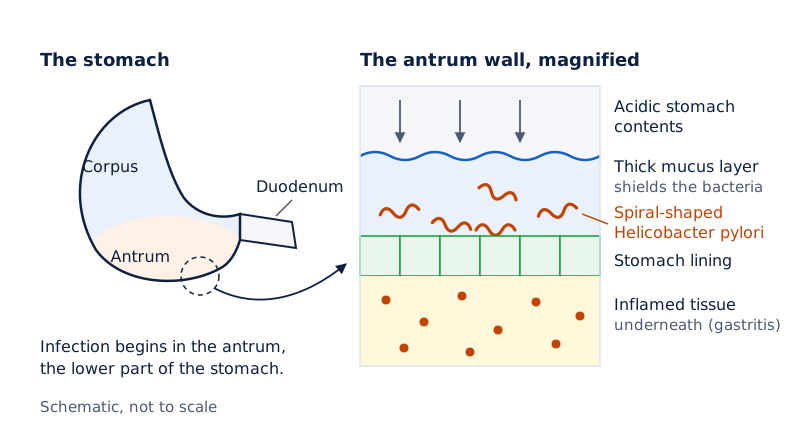
Draw a cross-section of the stomach wall showing the mucus layer on top, the spiral-shaped bacteria sitting within or just beneath this mucus layer close to the stomach lining (shielded from the acidic stomach contents), and inflamed tissue marked in the lower part of the stomach (the antrum), where the infection typically begins.
Drawn by One Young India.
The press release of the Nobel Assembly at Karolinska Institutet stated the discovery was "remarkable and unexpected".
What is Helicobacter pylori and how does infection affect the body?
Helicobacter pylori is a spiral-shaped, Gram-negative bacterium that lives only in the human stomach and colonises it in about 50% of all humans.
Infection is far less common in countries with high socio-economic standards than in developing countries, where nearly everyone may be infected.
People are usually infected in early childhood, often passed from mother to child, and the bacteria can then stay in the stomach for the person's whole life.
The infection begins in the lower part of the stomach, the antrum, and is always associated with inflammation of the stomach lining. In most individuals the infection causes no symptoms at all.
However, about 10 to 15% of infected people will at some time experience peptic ulcer disease, which is more common in the duodenum than in the stomach itself; severe complications include bleeding and perforation.
| Condition linked to H. pylori | What the press release says |
|---|---|
| Duodenal ulcer | Caused by H. pylori in more than 90% of cases |
| Gastric ulcer | Caused by H. pylori in up to 80% of cases |
| Peptic ulcer disease overall | Occurs in about 10-15% of infected individuals |
| Stomach cancer | Risk increases when infection spreads to the corpus region of the stomach |
| MALT lymphoma | A stomach lymphatic tumour that may regress once the bacterium is eradicated |
In some people the bacterium also infects the upper part of the stomach, the corpus, causing more widespread inflammation.
This predisposes not only to ulcers there but also to stomach cancer, which the press release notes still ranked as the second most common cause of cancer deaths worldwide at the time.
Inflammation can also lead to MALT lymphoma, a cancer of the lymphatic tissue lining the stomach.
How did the discovery unfold?
| Year | Event |
|---|---|
| 1961 | Robin Warren received a bachelor's degree from the University of Adelaide. |
| 1968 | Warren became a pathologist at Royal Perth Hospital, where he later began collaborating with Barry Marshall. |
| 1982 | Marshall and Warren isolated and identified the bacterium, later named Helicobacter pylori, and showed that patients recovered for good only once the bacteria had been removed. |
| 1982 (Easter) | Agar plates accidentally left in the incubator over the holiday produced the first successful bacterial colonies. |
| 1999 | Warren retired from medical practice. |
| 2005 | Marshall and Warren were jointly awarded the Nobel Prize in Physiology or Medicine, announced on 3 October. |
| 2005 | The award ceremony speech was delivered on 10 December by Professor Staffan Normark at the Stockholm Concert Hall. |
| 2024 | J. Robin Warren died on 23 July in Perth, Australia. |
The presentation speech recalled that Napoleon Bonaparte died of a stomach ulcer that had turned into cancer, and that the author James Joyce died of a perforated ulcer, illustrating how common and serious the disease has long been in human history.
Why was the discovery initially met with scepticism?
Because stress and diet had been the accepted explanation for ulcers for so long, the idea that a bacterium could survive and thrive in the stomach's acidic environment seemed implausible to many doctors.
The presentation speech describes the finding as "completely revolutionary" and notes it was "initially met by great skepticism."
To overcome this doubt, Marshall took an unusual and risky step: he drank a culture of the bacterium himself in order to satisfy Koch's Fourth Postulate, the scientific requirement that an isolated agent must be shown to cause the same disease when deliberately introduced.
He developed a severe stomach inflammation as a result, providing strong direct evidence that the bacterium alone could cause disease, without needing a laboratory animal.
Over time, further studies of human volunteers, antibiotic treatment trials and large epidemiological studies built up firm evidence for the bacterial cause of peptic ulcer disease, eventually overturning decades of medical belief about stress and lifestyle.
How does this discovery continue to raise open questions?
Although the discovery solved the central mystery of peptic ulcer disease, several questions remained open according to the press release. Only a minority of infected individuals ever develop stomach disease, even though the bacterium is extremely common.
Researchers have found that the bacterium itself is highly variable: strains differ in how strongly they adhere to the stomach lining and how much inflammation they provoke, and even within one infected person the bacteria are not all identical and may adapt over time.
Genetic differences among humans may also affect how susceptible they are to disease from the infection. At the time of the award, an animal model, the Mongolian gerbil, had only recently been established to study peptic ulcer disease and cancerous changes in more detail.
The press release also notes that an indiscriminate use of antibiotics to eradicate the bacterium from healthy, symptom-free carriers would create serious problems with antibiotic resistance. It therefore stated that treatment should be used restrictively, mainly in patients with documented ulcer disease.
Why does this discovery matter?
Before this work, peptic ulcer disease was often a chronic, frequently disabling condition that could be temporarily relieved by reducing stomach acid but which kept relapsing because the underlying bacterial infection remained untreated.
After the discovery, the press release states that the disease could instead be treated and cured with a short course of antibiotics together with drugs that reduce acid secretion, transforming treatment for millions of patients worldwide.
The presentation speech also highlighted a wider scientific impact: the discovery stimulated research around the world into the links between chronic infection, inflammation and cancer.
The press release notes that many other long-term illnesses, such as Crohn's disease, ulcerative colitis, rheumatoid arthritis and atherosclerosis, involve chronic inflammation, and the success in finding a microbial cause for peptic ulcer disease encouraged scientists to search for microbial causes behind other such conditions.
The discovery of the bacterium's link to stomach cancer and MALT lymphoma also deepened the understanding of how chronic infection and inflammation can, in some cases, lead on to cancer.
How does this connect to what you study?
This discovery links directly to school biology topics on microorganisms, the human digestive system and the immune response to infection.
Students studying how bacteria can be helpful or harmful, and how the stomach's acidic environment normally protects the body from most microbes, can see in Helicobacter pylori a striking exception: a bacterium specially adapted to survive this harsh acidic habitat by sheltering in a protective layer of mucus close to the stomach lining.
It also connects to lessons on inflammation and the body's defence mechanisms, since the press release explains how a chronic infection can lead over time to tissue damage, ulcers and, in some cases, cancer, which is a useful real example of how infection, inflammation and disease are linked.
There is also a clear link to lessons on the scientific method and experimental design. Marshall and Warren's work shows how careful observation under a microscope, laboratory culture, large clinical studies of many patients and even a risky self-experiment were combined to test a hypothesis and overturn a long-held but mistaken medical belief.
Finally, the discovery connects to the study of antibiotics and drug resistance, since the press release warns that treating every infected person, rather than only those with diagnosed disease, could make the bacteria resistant to important medicines over time.
Quick facts for exams
The Nobel Prize in Physiology or Medicine 2005 was awarded jointly to Barry J. Marshall and J. Robin Warren, both from Australia, for discovering the bacterium Helicobacter pylori and its role in gastritis and peptic ulcer disease.
The award was announced by the Nobel Assembly at Karolinska Institutet on 3 October 2005. Each laureate received one half of the prize.
Marshall, born in Kalgoorlie in 1951, was affiliated with the NHMRC Helicobacter pylori Research Laboratory and the University of Western Australia, Perth. Warren, born in Adelaide in 1937, was a pathologist resident in Perth.
Their discovery, made in 1982, showed that a common, often painful disease previously blamed on stress could be cured with antibiotics.
| Fact | Detail |
|---|---|
| Prize | Nobel Prize in Physiology or Medicine 2005 |
| Laureates | Barry J. Marshall and J. Robin Warren |
| Countries of birth | Both born in Australia (Marshall in Kalgoorlie, Warren in Adelaide) |
| Affiliation at award | Marshall: NHMRC Helicobacter pylori Research Laboratory and University of Western Australia, Australia; Warren: resident in Perth, Australia |
| Share | One half each |
| Citation | For their discovery of the bacterium Helicobacter pylori and its role in gastritis and peptic ulcer disease |
| Date announced | 3 October 2005 |
| Prize amount | 10,000,000 Swedish kronor |
Note: Source. The prize facts in this note are from the Nobel Prize's official site, nobelprize.org.
Glossary
- Helicobacter pylori — a spiral-shaped bacterium that lives in the human stomach and can cause gastritis and peptic ulcer disease.
- Gastritis — inflammation of the lining of the stomach.
- Peptic ulcer disease — the formation of sores in the lining of the stomach or duodenum.
- Duodenum — the first part of the small intestine, just after the stomach.
- Antrum — the lower part of the stomach, where Helicobacter pylori infection typically begins.
- Corpus (of the stomach) — the upper, main body region of the stomach.
- Gram-negative bacterium — a type of bacterium classified by how its cell wall responds to a particular staining test.
- Microaerophilic — describing an organism that needs only a small amount of oxygen to survive.
- Gastroscopy — an internal examination of the stomach using a flexible viewing instrument (endoscope).
- Koch's Fourth Postulate — the scientific requirement that an isolated infectious agent must be shown to cause the same disease when deliberately introduced into a host.
- MALT lymphoma — a cancer of the mucosa-associated lymphoid tissue in the stomach, linked to chronic Helicobacter pylori infection.
- Epidemiological study — research studying patterns and causes of disease across populations.
- Mongolian gerbil — the animal species used as a research model for studying Helicobacter pylori-related disease.
Common errors and misconceptions
- Misconception: Ulcers are mainly caused by stress and spicy food. Correct: Marshall and Warren showed the main cause is infection by the bacterium Helicobacter pylori, though stress had previously been believed to be the main factor.
- Misconception: No bacteria can survive in the stomach because of its acid. Correct: Helicobacter pylori survives by living within the protective mucus layer, shielded from the full acidity of the stomach contents.
- Misconception: Everyone infected with Helicobacter pylori develops an ulcer. Correct: The infection is usually asymptomatic, and only about 10 to 15% of infected individuals ever develop peptic ulcer disease.
- Misconception: Both laureates discovered the bacterium at the same time independently. Correct: Warren first observed the bacteria in tissue samples, and Marshall then became interested in these findings and succeeded in culturing the organism.
- Misconception: Antibiotics should be given to everyone carrying the bacterium. Correct: The press release states treatment should be used restrictively, mainly in patients with documented ulcer disease, to avoid antibiotic resistance.
- Misconception: Peptic ulcer disease still cannot be permanently cured. Correct: It can now be cured by a short regimen of antibiotics together with acid secretion inhibitors.
Exam-style questions with model answers
Q1. In which year was the Nobel Prize in Physiology or Medicine 2005 announced? [1 mark]
- It was announced on 3 October 2005 by the Nobel Assembly at Karolinska Institutet.
Q2. Name the bacterium discovered by the 2005 laureates and the organ it infects. [2 marks]
- They discovered Helicobacter pylori, a spiral-shaped bacterium that infects and colonises the human stomach, particularly the antrum region.
Q3. Explain how Barry Marshall proved that Helicobacter pylori could cause disease in humans. [4 marks]
- Marshall wanted to satisfy Koch's Fourth Postulate, which requires showing that an isolated infectious agent causes the same disease when deliberately introduced into a host.
- No suitable animal model was available at the time to test this directly.
- Marshall therefore drank a culture of the bacterium himself as a form of self-experimentation.
- He developed a severe inflammation of the stomach as a result, providing strong evidence that the bacterium alone could cause gastric disease in humans.
Q4. Describe the role each laureate played in the discovery of Helicobacter pylori. [4 marks]
- Robin Warren, a pathologist, examined stomach tissue samples under the microscope and observed small curved bacteria colonising the lower stomach in about half the patients studied.
- He noted that inflammation of the stomach lining was always present near the bacteria, leading him to suspect they caused gastritis.
- Barry Marshall, a clinical fellow, became interested in these findings and worked to grow the bacterium in culture, succeeding after many failed attempts.
- Together, they studied biopsies from 100 patients, found the bacterium present in almost all patients with gastric inflammation or ulcer disease, and proposed it as the cause of these conditions.
Q5. Discuss why the discovery of Helicobacter pylori was initially met with scepticism, and explain its wider significance for medical science. [6 marks]
- For decades before the discovery, doctors believed peptic ulcers resulted mainly from stress and poor diet causing excess stomach acid, so treatment focused only on reducing acid.
- The idea that a living bacterium could survive and colonise the highly acidic stomach environment seemed implausible to many in the medical community, and the proposal was initially met with great scepticism.
- Marshall and Warren overcame this through careful observation, successful culturing of the bacterium, large clinical studies of biopsies, and Marshall's own self-experiment drinking the bacterial culture.
- Their work proved that this bacterium is responsible for the great majority of duodenal ulcers and most gastric ulcers.
- This transformed peptic ulcer disease from a chronic, frequently disabling condition into one curable by a short course of antibiotics and acid secretion inhibitors.
- More widely, the discovery stimulated global research into links between chronic infection, inflammation and diseases such as cancer, encouraging scientists to search for microbial causes of other chronic inflammatory conditions like Crohn's disease and rheumatoid arthritis.
Q6. What percentage of humans are estimated to carry Helicobacter pylori infection, and what proportion of these develop peptic ulcer disease? [2 marks]
- About 50% of all humans are colonised by the bacterium, but only about 10 to 15% of infected individuals ever develop peptic ulcer disease.
Q7. Explain the link between Helicobacter pylori infection and stomach cancer. [3 marks]
- In some infected individuals, the bacterium also colonises the upper corpus region of the stomach rather than just the lower antrum.
- This causes more widespread inflammation across the stomach lining, which predisposes the person to ulcers in the corpus region.
- This widespread inflammation also increases the risk of developing stomach cancer, which was noted as the second most common cause of cancer deaths worldwide.
Q8. Why does the press release caution against giving antibiotics to all carriers of Helicobacter pylori? [3 marks]
- Most people infected with Helicobacter pylori show no symptoms at all, since the infection is usually asymptomatic.
- Treating every healthy carrier with antibiotics would involve using these drugs on a huge scale across roughly half of humanity.
- This indiscriminate use would lead to severe problems with bacteria developing resistance to these important antibiotics, so treatment should be used restrictively in patients with documented ulcer disease.
Key takeaways
- Barry J. Marshall and J. Robin Warren won the 2005 Nobel Prize in Physiology or Medicine for discovering Helicobacter pylori and its role in gastritis and ulcer disease.
- Warren first observed curved bacteria in stomach tissue samples; Marshall succeeded in culturing them in the laboratory.
- Marshall drank a bacterial culture himself to prove the organism could cause disease, developing severe stomach inflammation.
- Helicobacter pylori infects about half of all humans, usually acquired in early childhood and lasting a lifetime.
- The bacterium causes more than 90% of duodenal ulcers and up to 80% of gastric ulcers.
- Only about 10 to 15% of infected people ever develop peptic ulcer disease; most carriers show no symptoms.
- Chronic infection is also linked to increased risk of stomach cancer and MALT lymphoma.
- The discovery changed peptic ulcer disease from a chronic relapsing condition into one curable with antibiotics and acid-reducing drugs.
Test yourself
Which two scientists shared the 2005 Nobel Prize in Physiology or Medicine?
Barry J. Marshall and J. Robin Warren shared the prize equally, each receiving one half for their discovery of Helicobacter pylori.
Where was J. Robin Warren born, and where was he based when the prize was awarded?
J. Robin Warren was born in Adelaide, Australia, and was resident in Perth, Australia, at the time of the award.
What accidental event in 1982 helped Marshall successfully culture the bacterium?
Agar plates were mistakenly left in the incubator over the Easter holiday, and when inspected afterwards they showed numerous bacterial colonies.
What unusual step did Marshall take to prove the bacterium caused disease?
Marshall drank a culture containing Helicobacter pylori himself, after which he developed a severe inflammation of his stomach.
What part of the stomach does Helicobacter pylori infection typically begin in?
This infection starts in the lower part of the stomach, called the antrum.
Why can treating all carriers of Helicobacter pylori with antibiotics be harmful?
Indiscriminate antibiotic use in symptom-free carriers could cause the bacteria to develop resistance to these important drugs over time.
Name one historical figure mentioned in the presentation speech who died from an ulcer-related illness.
Napoleon Bonaparte died of a stomach ulcer that had turned into cancer, according to the presentation speech.
What animal model is mentioned as useful for studying Helicobacter pylori-related disease?
The Mongolian gerbil had only recently been established as an animal model for studying peptic ulcer disease and malignant transformation.