
Nobel Prize in Physiology or Medicine 2006: RNA Interference and Gene Silencing
On this page

This note covers the Nobel Prize in Physiology or Medicine 2006: who won it, what RNA interference is and how Andrew Fire and Craig Mello discovered it, how the double-stranded RNA silencing mechanism works inside a cell, how the discovery unfolded from puzzling plant and worm experiments to a named mechanism, why it matters for biology and medicine, and quick facts for exams.
What was the Nobel Prize in Physiology or Medicine 2006 awarded for?
The Nobel Assembly at Karolinska Institutet awarded the prize jointly to Andrew Z. Fire and Craig C. Mello with the citation: "for their discovery of RNA interference - gene silencing by double-stranded RNA".
In plain words, the two scientists found that when a piece of RNA exists as a double strand (two matching strands paired together, rather than the usual single strand), it can switch off a specific gene by destroying the messenger molecule that gene needs to make its protein.
This process is called RNA interference, or RNAi for short. Before 1998 nobody knew that double-stranded RNA could do this; afterwards it became one of the most important tools in biology.
The award is formally called the Nobel Prize in Physiology or Medicine, and in 2006 it recognised a discovery that explained years of confusing laboratory results and opened an entirely new way to study and, potentially, treat disease by turning specific genes off.
Who are the laureates?
Andrew Z. Fire
Andrew Z. Fire was born on 27 April 1959 in Stanford, CA, USA. At the time of the award he was affiliated with Stanford University School of Medicine, Stanford, CA, USA, where he worked as a professor.
He shared one half of the 2006 prize. Fire earned his PhD in Biology in 1983 at the Massachusetts Institute of Technology, and he began working on the roundworm C. elegans while a visiting scientist in the Cambridge, England laboratory of Sydney Brenner (a later Nobel Laureate).
When he and Mello made their key discovery, Fire was based at the Carnegie Institution of Washington.
He was the first-listed author of the landmark 1998 Nature paper, co-written with Mello, describing how double-stranded RNA could silence genes.
Craig C. Mello
Craig C. Mello was born on 18 October 1960 in New Haven, CT, USA. At the time of the award he was affiliated with the University of Massachusetts Medical School, Worcester, MA, USA, where he worked within the Program in Molecular Medicine and was also a Howard Hughes Medical Institute Investigator.
He shared one half of the prize. Mello completed his PhD in Cellular and Developmental Biology at Harvard University in 1990, and worked at the Fred Hutchinson Cancer Research Center before moving to Worcester in 1994.
Mello is credited with coining the term "RNA interference" for the then-unexplained silencing effect, and with Fire he carried out the decisive experiments and conclusions published in 1998.
What problem puzzled scientists before 1998?
By the early 1990s, biologists understood the basic route by which a cell uses its genes: a gene's DNA is copied into messenger RNA (mRNA), and the mRNA is then used to build a protein.
This flow, from DNA to RNA to protein, had been called the Central Dogma of molecular biology by Francis Crick.
Scientists also knew that short, single-stranded "antisense" RNA molecules could sometimes bind to a matching mRNA and stop it from working, and this inspired hope that purpose-built antisense RNA could be used as a treatment to silence faulty genes.
But the results were confusing. Plant scientists trying to deepen the red colour of petunia flowers by inserting an extra copy of the pigment gene sometimes found the opposite: the flowers lost their colour completely, because the mRNA for the pigment had disappeared.
Attempts to use antisense RNA in animals gave inconsistent results, working in some experiments and not in others. The cause of these puzzling effects remained unexplained until Fire and Mello's work in C. elegans.
This unresolved mystery, sometimes called gene silencing or post-transcriptional gene silencing in plants, is the background problem that the 2006 laureates eventually solved.
How did Fire and Mello discover RNA interference?
Fire and Mello were studying how gene activity is controlled in the millimetre-long roundworm Caenorhabditis elegans. They focused on a gene needed for normal movement, injecting different forms of RNA matching that gene into the worm's gonads.
- Injecting single-stranded sense RNA (an exact copy of the mRNA) into the worms caused no visible change in behaviour.
- Injecting single-stranded antisense RNA (a mirror-image strand that can pair with the mRNA) had little or no effect on its own.
- Injecting the two together let them bind and form double-stranded RNA, and this time the worms' offspring showed odd, twitching movements, the same abnormal movement seen in worms that completely lacked a working copy of that muscle gene.
- Repeating the experiment with double-stranded RNA matching several other genes always silenced that specific gene and no other, showing the effect was precise rather than general.
- Only a tiny amount of double-stranded RNA was needed, and the silencing effect could spread between cells and even be passed to offspring, suggesting an amplified, catalyst-like process rather than a simple one-to-one reaction.
Fire and Mello published these findings in the journal Nature on 19 February 1998, under the title "Potent and specific genetic interference by double-stranded RNA in Caenorhabditis elegans".
They proposed the name RNA interference for the mechanism and even guessed that organisms naturally use double-stranded RNA to control their own genes, a guess that later proved correct.
How does the RNA interference machinery work?
Later research, building on Fire and Mello's discovery, revealed the biochemical machinery behind RNA interference. Two protein complexes are central to the process.
| Component | Role in RNA interference |
|---|---|
| Double-stranded RNA (dsRNA) | The trigger molecule; it may enter the cell (for example from a virus) or be made inside the cell |
| Dicer | An enzyme that cuts long double-stranded RNA into short fragments called siRNA, around 21 to 23 nucleotides long |
| siRNA (small interfering RNA) | The short double-stranded fragment produced by Dicer that carries the genetic "address" of the target gene |
| RISC (RNA-induced silencing complex) | A protein complex that takes up one strand of the siRNA and uses it to locate a matching mRNA |
| microRNA (miRNA) | A small RNA made from the cell's own genes that forms a hairpin double-stranded structure and feeds into the same machinery to regulate normal gene expression |
The sequence of events can be set out as a simple process, based on the mechanism described in the Nobel Committee's scientific background document.
- A double-stranded RNA molecule, matching the sequence of a particular gene, is present in the cell.
- The enzyme Dicer cuts this long double strand into short fragments called siRNA.
- One strand of each siRNA fragment is loaded into the RISC complex while the other strand is discarded.
- RISC uses the retained strand to search for a messenger RNA with a matching sequence, binding to it by base-pairing.
- Once bound, RISC cleaves the target mRNA, which is then degraded, so the protein it would have encoded is never made and the gene is effectively silenced.
Draw and label
the RNA interference pathway
Draw a double-stranded RNA molecule being cut by Dicer into short siRNA pieces; show one siRNA strand entering the RISC complex; then show RISC lining up its strand against a matching messenger RNA and cutting it into two broken pieces, with an arrow showing the mRNA being degraded afterwards.
Diagram
where RNA interference acts in the cell
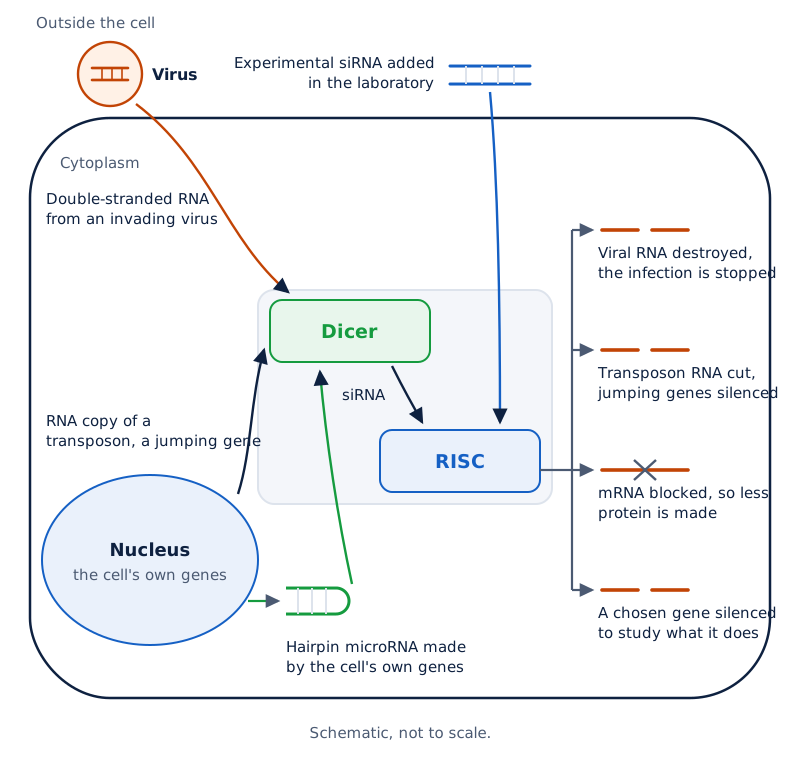
Draw a cell with a nucleus and cytoplasm.
In the cytoplasm, show four separate labelled pathways all feeding into Dicer and RISC: an invading virus's double-stranded RNA, a transposon's RNA copy, a cell's own hairpin-shaped microRNA, and an externally added experimental siRNA, each ending in a broken mRNA or silenced gene.
Drawn by One Young India.
Why does RNA interference matter in nature?
Once the mechanism was understood, scientists realised RNA interference is not just a laboratory curiosity but a natural, widespread part of how cells work, present in plants, animals and humans.
First, RNAi helps control normal gene expression. Hundreds of genes in the human genome make small RNA molecules called microRNAs, which fold into double-stranded hairpin shapes and feed into the Dicer/RISC machinery to block or reduce the production of specific proteins.
This fine-tuning is important for how an organism develops and how its cells carry out their everyday functions.
Second, RNAi acts as a defence against viruses, particularly in plants, worms and insects that lack the antibody-based immune systems of vertebrates.
Many viruses carry or produce double-stranded RNA at some stage; when this RNA is detected and cut up by Dicer and RISC, the viral genetic material is destroyed and the infection can be stopped.
Third, RNAi helps keep the genome stable by silencing transposons, also called jumping genes: DNA sequences that can copy themselves and insert elsewhere in the genome, sometimes causing damage.
Because the process of transposon jumping often produces double-stranded RNA, the RNAi machinery can detect and suppress these mobile elements, protecting the organism's genetic material.
How did the discovery unfold?
| Year | Event |
|---|---|
| 1961 | François Jacob and Jacques Monod proposed a gene control model in which a gene is transcribed into messenger RNA (mRNA), laying the conceptual groundwork later needed to understand RNAi. |
| 1977 | Phillip Sharp and Richard Roberts showed that mRNA sequences can be split across the genome (the split gene concept), deepening understanding of how RNA is processed. |
| 1989 | Sidney Altman and Thomas Cech's earlier discovery that RNA can act as a catalyst was recognised with a Nobel Prize, showing RNA could play active, not just messenger, roles. |
| 1990 | Plant scientists trying to intensify red colour in petunia flowers found that inserting an extra pigment gene sometimes caused the flowers to lose their colour entirely, a puzzling, unexplained result. |
| 1993 | Regulation of a gene by a small antisense-type RNA was first demonstrated in the worm Caenorhabditis elegans, though the effect was seen as an unusual, isolated case at the time. |
| 1998 | Andrew Fire and Craig Mello published their discovery that double-stranded RNA, not single-stranded sense or antisense RNA, efficiently and specifically silences genes in C. elegans, naming the effect RNA interference. |
| 2001 | MicroRNAs were revealed as a large, widespread class of small RNA molecules in worms, flies, mice and humans, showing RNAi-related mechanisms regulate genes naturally throughout the animal kingdom. |
| 2006 | The Nobel Assembly at Karolinska Institutet announced, on 2 October, that Fire and Mello would jointly receive the Nobel Prize in Physiology or Medicine for discovering RNA interference. |
Why does it matter?
RNA interference quickly became an indispensable research tool. By designing a double-stranded RNA molecule matching almost any gene, scientists can silence that gene experimentally and observe what goes wrong, making it possible to study the function of essentially any gene in an organism, something that was previously slow and difficult.
The discovery also raised hopes for new medicine. Because RNAi is a natural mechanism using an easily synthesised molecule, the Nobel Committee's background material noted that several diseases involving over-active genes might be treated by silencing them.
At the time of the award, double-stranded RNA was being tested in animals to silence a gene causing high blood cholesterol, and in clinical trials for conditions including age-related damage to the eye's retina (the fovea) caused by excess blood vessel growth, and for respiratory virus infections in children.
As of the scientific background report, no RNAi-based drug had yet been approved, though the results were described as promising.
Open questions mentioned by the committee included how to deliver double-stranded RNA reliably into the right cells, in the right amount, and for the right length of time, before RNAi-based treatments could become routine medicine.
How does this connect to what you study?
RNA interference connects directly to the biology topics of the cell, DNA, RNA and protein synthesis, and gene regulation that appear in school science. The basic flow from DNA to mRNA to protein, which students learn as transcription and translation, is exactly the pathway that RNA interference interrupts.
Understanding RNAi also helps make sense of why double-stranded RNA behaves differently from the single-stranded RNA usually described in textbooks, and why viruses, which sometimes have double-stranded genetic material, can trigger natural defences in cells.
Students who study genetics, cell biology or biotechnology will meet related ideas such as gene expression, enzymes that cut nucleic acids, and the use of laboratory techniques to switch specific genes off to study their function.
Quick facts for exams
The Nobel Prize in Physiology or Medicine 2006 was awarded jointly to Andrew Z. Fire and Craig C. Mello for discovering RNA interference, the gene-silencing effect of double-stranded RNA.
The announcement was made on 2 October 2006 by the Nobel Assembly at Karolinska Institutet.
Both laureates are American and were working in the United States at the time: Fire at Stanford University School of Medicine and Mello at the University of Massachusetts Medical School. They shared the prize equally, one half each.
Their key discovery, made by injecting RNA into the roundworm Caenorhabditis elegans, was published in the journal Nature on 19 February 1998, and it explained earlier puzzling results in plant and animal gene-silencing experiments.
| Fact | Detail |
|---|---|
| Prize | Nobel Prize in Physiology or Medicine 2006 |
| Laureates | Andrew Z. Fire and Craig C. Mello |
| Countries of birth | Both born in the USA (Fire in Stanford, CA; Mello in New Haven, CT) |
| Affiliation at award | Fire: Stanford University School of Medicine, USA; Mello: University of Massachusetts Medical School, USA |
| Share | One half each |
| Citation | "for their discovery of RNA interference - gene silencing by double-stranded RNA" |
| Date announced | 2 October 2006 |
| Prize amount | 10,000,000 Swedish kronor |
Note: Source. The prize facts in this note are from the Nobel Prize's official site, nobelprize.org.
Glossary
- RNA interference (RNAi) — the process by which double-stranded RNA silences a specific gene by causing destruction of its matching messenger RNA.
- Messenger RNA (mRNA) — the RNA copy of a gene's DNA sequence that carries instructions to the cell's protein-making machinery.
- Double-stranded RNA (dsRNA) — RNA existing as two paired, matching strands rather than the usual single strand; the trigger of RNA interference.
- Gene silencing — stopping a gene from producing its protein, without changing the gene's DNA sequence itself.
- Dicer — an enzyme that cuts long double-stranded RNA into short fragments called siRNA.
- RISC (RNA-induced silencing complex) — a protein complex that uses a short RNA strand to find and cut a matching messenger RNA.
- siRNA (small interfering RNA) — a short double-stranded RNA fragment, about 21 to 23 nucleotides long, produced by Dicer.
- microRNA (miRNA) — a small RNA made by the cell's own genes that regulates other genes through the RNA interference machinery.
- Antisense RNA — a single RNA strand whose sequence is the mirror image of a messenger RNA, able to pair with it.
- Sense RNA — a single RNA strand with the same sequence as a messenger RNA.
- Central Dogma — the principle, described by Francis Crick, that genetic information flows from DNA to RNA to protein.
- Transposon (jumping gene) — a DNA sequence that can move to a new location in the genome, often via an RNA copy of itself.
- Caenorhabditis elegans — a millimetre-long roundworm used as a model organism in which Fire and Mello discovered RNA interference.
- Transcription — the process of copying a gene's DNA sequence into messenger RNA.
- Translation — the process of using messenger RNA to build a protein.
Common errors and misconceptions
- Misconception: RNA interference means cutting or changing the DNA of a gene. Correct: the gene's DNA is untouched; only its messenger RNA is destroyed, so the gene stops being expressed but is not altered.
- Misconception: Antisense RNA alone was what Fire and Mello discovered. Correct: antisense RNA was already known; their discovery was that it is specifically double-stranded RNA (sense plus antisense together) that triggers strong, specific silencing.
- Misconception: RNA interference was found in humans first. Correct: the key discovery was made in the roundworm Caenorhabditis elegans; its presence in humans and other organisms was confirmed afterwards.
- Misconception: Fire and Mello won the prize the same year they published their discovery. Correct: they published their findings in 1998 and received the Nobel Prize eight years later, in 2006.
- Misconception: microRNA and siRNA are the same thing. Correct: siRNA usually comes from an external or experimentally added double-stranded RNA, while microRNA is made from the cell's own genes; both feed into related Dicer/RISC machinery.
- Misconception: RNA interference-based drugs were already approved at the time of the award. Correct: at the time, no RNAi-based drug had been approved, though several were in clinical trials.
- Misconception: The petunia colour-loss experiments were part of Fire and Mello's own research. Correct: the petunia results came from earlier, separate plant experiments; Fire and Mello's discovery later explained why those results had occurred.
Exam-style questions with model answers
Q1. What official citation did the Nobel Assembly give for the 2006 Nobel Prize in Physiology or Medicine? [2 marks]
- The citation was "for their discovery of RNA interference - gene silencing by double-stranded RNA".
- It was awarded jointly to Andrew Z. Fire and Craig C. Mello.
Q2. In which organism did Fire and Mello make their key discovery, and what gene did they study? [2 marks]
- They used the roundworm Caenorhabditis elegans for their key experiments.
- They studied a gene encoding a muscle protein, observing twitching movements when that gene's activity was disrupted.
Q3. Explain why injecting single-stranded sense RNA or single-stranded antisense RNA alone did not silence the target gene in Fire and Mello's experiments, but injecting both together did. [4 marks]
- Single-stranded sense RNA is simply a copy of the messenger RNA and has no mechanism to destroy its own matching mRNA, so it had no effect.
- Single-stranded antisense RNA can pair weakly with mRNA but on its own produced only a weak or absent effect.
- When sense and antisense RNA were injected together, they bound to each other to form double-stranded RNA.
- This double-stranded RNA strongly and specifically triggered the gene-silencing process now called RNA interference, causing the matching mRNA to be degraded and the gene's protein to disappear.
Q4. Describe, in order, how the Dicer and RISC complexes carry out RNA interference once double-stranded RNA is present in a cell. [4 marks]
- The enzyme Dicer recognises the double-stranded RNA and cuts it into short fragments called siRNA, about 21 to 23 nucleotides long.
- One strand of each siRNA fragment is taken up by the RISC complex, while the other strand is discarded.
- RISC uses its retained RNA strand to search the cell for a messenger RNA with a matching sequence, binding to it through base-pairing.
- Once bound, RISC cleaves the target messenger RNA, which is then broken down, so the corresponding gene's protein is never made.
Q5. Discuss why the discovery of RNA interference was considered important both for basic biology and for future medicine, with reference to the roles described by the Nobel Committee. [6 marks]
- In basic biology, RNA interference revealed a previously unknown natural mechanism for regulating gene activity, helping explain confusing earlier results such as colour loss in genetically modified petunias.
- It showed that double-stranded RNA made inside the cell, as microRNA, regulates hundreds of genes and plays a role in how organisms develop and how cells carry out their everyday functions.
- RNA interference was found to act as a natural defence against viruses, particularly in plants and simpler animals, by destroying viral double-stranded RNA before it can cause harm.
- It also protects the stability of the genome by silencing transposons, DNA sequences that could otherwise move around and cause damage if left uncontrolled.
- As an experimental tool, RNAi let scientists silence almost any chosen gene to study its function, transforming research across biology and medicine.
- For medicine, the Nobel Committee's background report noted that double-stranded RNA was being tested to silence disease-causing genes, for example for high cholesterol, eye disease and viral infections, although at the time of the award no RNAi drug had yet been approved and challenges such as delivering the RNA to the right cells remained unsolved.
Q6. Name the two laureates of the 2006 Nobel Prize in Physiology or Medicine, their institutions at the time of the award, and their share of the prize. [3 marks]
- Andrew Z. Fire, affiliated with Stanford University School of Medicine, USA, received one half of the prize.
- Craig C. Mello, affiliated with the University of Massachusetts Medical School, USA, received the other half of the prize.
- They shared the prize equally, one half each.
Q7. What puzzling observation in petunia flowers, made around 1990, was later explained by the discovery of RNA interference? [2 marks]
- Plant scientists adding an extra copy of a red pigment gene to petunias sometimes found the flowers lost all their colour.
- This happened because the pigment gene's mRNA had unexpectedly disappeared.
Key takeaways
- Andrew Z. Fire and Craig C. Mello shared the 2006 Nobel Prize in Physiology or Medicine for discovering RNA interference.
- Their discovery showed that double-stranded RNA, not single-stranded sense or antisense RNA, efficiently and specifically silences a matching gene.
- The key experiments were done in the roundworm Caenorhabditis elegans and published in Nature on 19 February 1998.
- Dicer cuts double-stranded RNA into short siRNA fragments, which guide the RISC complex to cut a matching messenger RNA.
- Natural microRNAs use the same machinery to regulate normal gene activity in plants, animals and humans.
- RNA interference also helps defend cells against viruses and keeps transposons, or jumping genes, under control.
- The discovery became a powerful laboratory tool for studying gene function and raised hopes for future RNAi-based medicines.
- The prize was announced on 2 October 2006, with the laureates sharing the prize equally.
Test yourself
Who discovered RNA interference, and in which year was their key paper published?
Andrew Z. Fire and Craig C. Mello discovered RNA interference and published their findings in Nature in 1998.
What organism did Fire and Mello use for their decisive experiments?
They used the roundworm Caenorhabditis elegans, injecting RNA into it to test effects on gene activity.
What kind of RNA triggers RNA interference?
Double-stranded RNA, formed when sense and antisense RNA strands pair together, triggers the gene-silencing effect.
Which enzyme cuts long double-stranded RNA into short siRNA fragments?
The enzyme Dicer cuts long double-stranded RNA into short siRNA fragments of about 21 to 23 nucleotides.
What does the RISC complex do?
RISC takes up one strand of siRNA and uses it to find and cut a matching messenger RNA, silencing its gene.
Give one natural role of RNA interference besides regulating ordinary gene expression.
RNA interference defends cells against viruses and helps keep transposons, or jumping genes, from disrupting the genome.
On what date was the 2006 Nobel Prize in Physiology or Medicine announced?
It was announced on 2 October 2006 by the Nobel Assembly at Karolinska Institutet.
What puzzling result in petunia flowers did RNA interference later explain?
Adding an extra pigment gene sometimes made petunia flowers lose their colour completely, because the mRNA for the pigment had been destroyed.